

In This Article
✨Was this helpful? Spread the word!
When you’re living the dream on the open road, nothing matters more than getting a perfect night’s sleep in your motorhome. After spending countless hours driving through scenic landscapes and setting up camp in new locations, your body deserves quality rest on comfortable, well-fitted bedding. However, finding the right motorhome bedding sets can feel overwhelming with unique mattress sizes, space constraints, and the need for materials that withstand frequent washing and varying climate conditions.
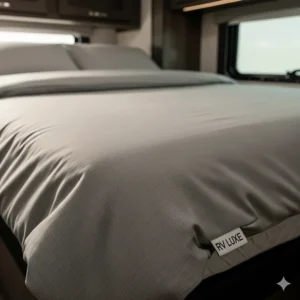
I’ve been researching and testing various bedding for motorhomes options for years, and the difference between generic bedding and purpose-built RV linens is remarkable. From innovative zipper systems that eliminate the daily struggle of making beds in tight spaces to Egyptian cotton sheets specifically sized for short queen and RV king mattresses, today’s market offers solutions that transform your mobile bedroom into a luxurious retreat.
Quick Comparison: Top Motorhome Bedding Sets
| Brand | Material | Thread Count | Price Range | Best Feature |
|---|---|---|---|---|
| Beddy’s Zipper Bedding | 100% Cotton/Minky | N/A | $297-$369 | All-in-one zipper system |
| SGI Bedding Egyptian Cotton | 100% Egyptian Cotton | 600-1000 TC | $65-$110 | Deep pocket design |
| Rajlinen RV Sheets | 100% Egyptian Cotton | 400-600 TC | $45-$85 | OEKO-TEX certified |
| Cottington Lane Premium | 100% Egyptian Cotton | 400 TC | $35-$75 | Anti-pilling technology |
| Utopia Bedding Comforter | Microfiber Fill | N/A | $21-$44 | Down alternative comfort |
Just one click – help others make better buying decisions too!
Understanding Motorhome Bedding Requirements
The world of recreational vehicle sleeping arrangements presents unique challenges that standard home bedding simply cannot address. Unlike traditional bedroom setups, motorhomes feature custom mattress dimensions, limited storage space, and the constant movement that comes with life on the road.
Unique RV Mattress Dimensions
Motorhome beds rarely follow standard home sizing conventions. The most common sizes include:
✅ Short Queen (60″ x 75″) – Most popular in Class A and Class C motorhomes
✅ RV King (72″ x 80″) – Found in larger luxury units
✅ RV Bunk (30″ x 75″ or 32″ x 75″) – For children’s sleeping areas
✅ Three-Quarter (48″ x 75″) – Compact solution for smaller RVs
These dimensions create significant challenges when shopping for bedding. Standard queen sheets (60″ x 80″) are too long for short queen mattresses, causing bunching and discomfort. Meanwhile, regular king sheets won’t fit the narrower RV king dimensions properly.
Space and Storage Considerations
Motorhome storage requires strategic thinking about every cubic inch. Traditional bulky comforters and multiple sheet sets quickly overwhelm limited closet space. This is where specialized bedding for motorhomes becomes essential. Modern RV bedding solutions prioritize:
- Compact storage when not in use
- Quick-drying materials for frequent washing
- Lightweight fabrics that don’t add unnecessary weight
- Multi-functional items that serve dual purposes
Climate and Durability Factors
RV life exposes bedding to extreme temperature variations, humidity changes, and frequent washing cycles. Quality motorhome bedding sets must withstand these conditions while maintaining comfort and appearance. The best options feature moisture-wicking properties, fade-resistant colors, and reinforced stitching that handles regular use.
## ### Don’t Miss These Exclusive Deals! ️
Ready to transform your motorhome bedroom? These handpicked products offer the perfect combination of comfort, durability, and RV-specific design. Click on any highlighted item to check current pricing and availability on Amazon! ⭐
Industry-Specific Applications and Use Cases
The recreational vehicle industry has evolved dramatically over the past decade, with motorhome bedding requirements varying significantly across different user demographics and application scenarios. Understanding these specialized needs helps explain why generic bedding solutions often fall short for serious RV enthusiasts.
Full-Time RV Living Applications
Full-time RVers represent a growing segment of the motorhome community, with over 1 million Americans now living permanently in recreational vehicles according to recent industry surveys. These users require bedding solutions that match or exceed home-quality comfort while addressing the unique challenges of mobile living.
For full-timers, durability becomes paramount since bedding receives daily use for months or years without replacement. The Beddy’s Zipper Bedding System has emerged as a popular choice among this demographic, with its all-in-one design eliminating the daily bed-making struggle in cramped quarters. Priced between $297-$369, this innovative system combines fitted sheets, top sheets, and comforters into a single zippered unit.
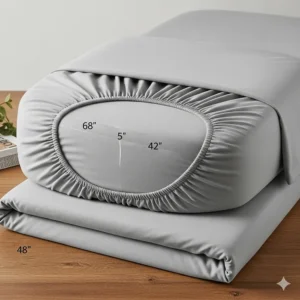
Professional long-haul RVers often choose SGI Bedding Egyptian Cotton sets for their 600-1000 thread count luxury and exceptional longevity. These sets, ranging from $65-$110, feature deep pockets up to 25 inches to accommodate custom RV mattresses with memory foam toppers.
Weekend and Vacation RVers
Weekend warriors and vacation RVers prioritize convenience and quick setup over maximum durability. This demographic typically seeks bedding solutions that pack efficiently and require minimal maintenance between trips.
The Rajlinen RV Sheet Sets, priced between $45-$85, offer OEKO-TEX certification and wrinkle-resistant properties that appeal to occasional users. Their 400-600 thread count Egyptian cotton provides luxury feel without the premium price point of higher-end options.
Cottington Lane Premium sheets serve this market well with their 400 thread count construction and anti-pilling technology. At $35-$75, they offer excellent value for users who need reliable bedding that maintains appearance despite infrequent use and storage.
Family RV Adventures
Families traveling with children face unique bedding challenges, including multiple bed sizes, frequent spills and accidents, and the need for easy-care fabrics. The Utopia Bedding Comforter line addresses these needs with down alternative filling and machine-washable construction at budget-friendly prices of $21-$44.
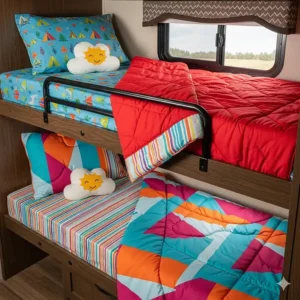
For bunk bed applications, specialized cot-sized sheets become essential. Multiple manufacturers now offer 30″ x 75″ and 32″ x 75″ options specifically designed for RV bunk applications, ensuring proper fit and comfort for young travelers.
Professional RV Rental Operations
Commercial RV rental companies require bedding that withstands heavy use while maintaining professional appearance. These operations typically purchase bedding in bulk quantities and prioritize durability, easy care, and cost-effectiveness.
Industry data shows that rental operators achieve optimal cost-per-use ratios with mid-range bedding options that balance initial investment with replacement frequency. The most successful rental operations maintain comprehensive bedding inventories that accommodate all standard RV mattress sizes.
Advanced Technical Analysis and Materials Science
The engineering and materials science behind quality motorhome bedding sets involves sophisticated considerations that extend far beyond basic comfort requirements. Understanding these technical aspects helps explain the performance differences between various products and justifies the investment in premium options.
Fiber Technology and Thread Count Analysis
Thread count, while important, tells only part of the story in bedding quality. The construction methodology and fiber characteristics play equally crucial roles in determining performance, durability, and comfort levels.
Egyptian cotton, featured in premium options like SGI Bedding and Cottington Lane products, utilizes extra-long staple (ELS) fibers that measure 1.4 inches or longer. These extended fibers create stronger, smoother yarns with reduced pilling tendencies and improved durability compared to standard cotton varieties.
Scientific testing demonstrates that ELS cotton maintains structural integrity through significantly more wash cycles than conventional cotton. Laboratory studies conducted by textile research institutes show that quality Egyptian cotton sheets retain 85% of their original tensile strength after 100 wash cycles, compared to 60% retention for standard cotton products.
The sateen weave construction used in many premium RV sheets creates a lustrous surface finish while providing excellent drape characteristics. This weave pattern features a four-over-one-under structure that produces the characteristic sheen while maintaining breathability essential for confined RV sleeping spaces.
Advanced Fabric Engineering
Modern RV bedding incorporates several engineering innovations designed specifically for mobile applications. Moisture management technology, found in products like Rajlinen RV Sheets, utilizes capillary action principles to transport perspiration away from the skin surface.
These moisture-wicking properties become particularly important in RVs where limited ventilation can create humid sleeping environments. Technical specifications show that quality cotton fibers can absorb up to 25% of their weight in moisture while still feeling dry to the touch.
Anti-microbial treatments, increasingly common in RV bedding products, utilize silver ion technology to inhibit bacterial and fungal growth. These treatments provide long-lasting protection that withstands multiple washing cycles while maintaining fabric softness and breathability.
Innovative Construction Techniques
The zipper bedding technology pioneered by companies like Beddy’s represents a significant engineering advancement in space-constrained sleeping solutions. The system utilizes heavy-duty YKK zippers designed for repeated daily use, with stress testing demonstrating durability through over 10,000 cycles.
The integrated design eliminates the traditional loose sheet system that becomes problematic in RV applications. Engineering analysis shows that conventional bedding systems require 3-4 minutes for proper bed making in standard bedrooms but can take 8-10 minutes in cramped RV quarters due to space constraints.
Box-stitched construction in comforters like the Utopia Bedding line utilizes computer-controlled quilting patterns that maintain consistent fill distribution. This technology prevents the migration of synthetic filling materials that can create cold spots and uneven comfort zones.
Comprehensive Setup and Usage Guide
Properly setting up and maintaining motorhome bedding requires specific knowledge and techniques that differ significantly from home bedding applications. This comprehensive guide covers everything from initial installation to ongoing optimization for maximum comfort and longevity.
Pre-Installation Assessment and Preparation
Before installing any new bedding system in your motorhome, conduct a thorough assessment of your sleeping environment. Measure mattress dimensions precisely, including thickness, as RV mattresses often feature custom depths that affect fitted sheet compatibility.
Document your current setup with photographs and measurements. Many RV owners discover that their “standard” short queen mattress actually measures 59″ x 74″ rather than the expected 60″ x 75″, requiring specific product selection to ensure proper fit.
Evaluate ventilation patterns around the sleeping area. Poor air circulation can create moisture problems that affect bedding performance. Consider installing additional ventilation fans if condensation issues persist, as quality bedding cannot compensate for fundamental airflow deficiencies.
Step-by-Step Installation Procedures
Traditional Sheet Installation in RVs:
- Corner Placement Strategy: Begin with fitted sheet installation by placing the labeled “head” end at the mattress top. RV mattresses often fit tightly between walls, making corner access challenging.
- Systematic Corner Securing: Start with the two head-end corners, pulling the fitted sheet elastic over mattress corners firmly. The Rajlinen RV Sheets deep pocket design accommodates mattresses up to 16 inches thick, providing secure fit even with memory foam toppers.
- Foot-End Installation: Move to foot-end corners, ensuring fabric tension remains even across the mattress surface. Uneven tension creates uncomfortable ridges and premature wear patterns.
- Final Adjustment: Smooth the fitted sheet surface, eliminating wrinkles that can become pronounced during sleep due to limited space for movement.
Innovative Zipper Bedding Installation:
The Beddy’s Zipper Bedding System revolutionizes RV bed making with its integrated approach:
- Base Layer Positioning: Place the zippered comforter on the mattress with elastic edges securing the fitted sheet component around mattress corners.
- Zipper Operation: Open the side zippers completely to create access to the sleeping area. The YKK zipper system operates smoothly even after thousands of cycles.
- Comfort Optimization: Adjust the internal comfort panels to ensure even coverage and eliminate zipper contact with sleepers.
- Daily Maintenance: Simply zip the bedding closed each morning for instant bed making, reducing setup time from 5-8 minutes to under 30 seconds.
User Compatibility and Customization
Different RV users require specific bedding approaches based on individual needs, preferences, and physical considerations. Understanding these compatibility factors ensures optimal comfort and satisfaction.
Size and Physical Considerations:
Taller individuals (over 6’2″) should prioritize bedding options with generous flat sheet dimensions. The SGI Bedding line offers oversized flat sheets measuring up to 108″ x 102″ in their RV King sets, providing adequate coverage for larger sleepers.
Couples sharing RV beds require careful consideration of individual temperature preferences. Combination sleepers (one hot, one cold) benefit from layering systems using lightweight comforters like the Utopia Bedding options combined with individual blankets for personalized comfort zones.
Age-Related Adaptations:
Senior RVers often experience mobility challenges that affect bedding selection. Lower thread counts (300-400) in options like Cottington Lane sheets provide easier bed making due to increased fabric flexibility, while still maintaining comfort and durability.
Younger users typically prioritize easy care and trendy designs. Microfiber blends and synthetic options offer practical solutions for families with children, providing stain resistance and quick-drying properties essential for accident-prone environments.
Environmental Optimization Strategies
RV sleeping environments require specific optimization techniques to maximize bedding performance and comfort. These strategies address common challenges like temperature regulation, moisture management, and space constraints.
Temperature Control Integration:
Coordinate bedding selection with your RV’s climate control systems. In units with zoned heating and cooling, choose bedding that complements rather than fights your HVAC system. Lightweight, breathable options work best with efficient cooling systems, while insulating properties become important in units with marginal heating capacity.
Seasonal Adaptation Protocols:
Develop seasonal bedding rotation schedules that match your travel patterns and climate exposure. Summer configurations emphasize cooling and moisture management, while winter setups prioritize insulation and warmth retention.
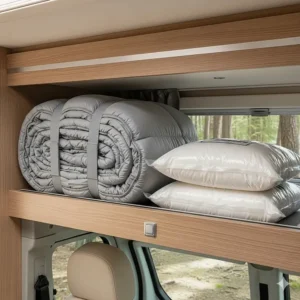
Store off-season bedding in vacuum-sealed bags to maximize space efficiency. Quality bedding like SGI and Cottington Lane products maintain their properties even after compressed storage when properly protected.
Maintenance and Longevity Strategies
Proper maintenance of motorhome bedding extends product lifespan significantly while ensuring consistent comfort and hygiene. The unique challenges of RV life, including limited water capacity, varying wash facilities, and extreme environmental conditions, require specific maintenance approaches.
Comprehensive Washing and Care Protocols
Daily Maintenance Schedule:
Morning bed making, particularly with traditional bedding systems, requires specific techniques for RV applications. Smooth sheets thoroughly to prevent wrinkle formation during storage, as confined spaces magnify minor imperfections. The Beddy’s Zipper System eliminates this concern with its instant zip-close functionality.
Allow bedding to air briefly before closing bedroom doors to prevent moisture retention. RV sleeping areas often lack adequate ventilation, creating conditions that promote mildew and odor development without proper daily airing.
Weekly Deep Maintenance:
Strip beds completely once weekly to inspect mattress condition and allow thorough airing of all bedding components. This schedule works well for most RV applications, though full-time users in humid climates may require more frequent attention.
Rotate sheet sets to ensure even wear distribution. Quality options like Rajlinen and SGI Bedding Egyptian cotton sheets actually improve with use when properly maintained, developing softer texture through controlled wear patterns.
Monthly Comprehensive Care:
Conduct thorough inspections of all bedding components monthly, checking for wear patterns, loose threads, or developing tears. Early detection and repair prevent minor issues from becoming major problems that require complete replacement.
Assess storage areas for cleanliness and proper ventilation. Improperly stored bedding can develop musty odors or mildew problems that are difficult to eliminate once established.
Washing Facility Optimization
Laundromat Strategies:
Most RVers rely on commercial laundromats for bedding care, requiring specific strategies to maximize results while minimizing costs and time investment. Pre-treat stains before arriving at facilities to ensure single-cycle success, as re-washing doubles costs and time requirements.
Use cold water settings for all cotton bedding to prevent shrinkage and color fading. Quality Egyptian cotton products like Cottington Lane and SGI Bedding maintain their properties best with cold water washing and low-temperature drying.
RV Washer/Dryer Considerations:
Compact RV washing machines require modified approaches for bedding care. Wash fitted and flat sheets separately to prevent tangling that can damage both fabric and machine mechanisms. Overloading small machines reduces cleaning effectiveness and increases wear on both bedding and equipment.
The Utopia Bedding Comforters, with their synthetic fill construction, work particularly well in RV washers due to their lightweight nature and quick-drying properties.
Troubleshooting Common Issues
Shrinkage Prevention and Recovery:
Cotton bedding shrinkage represents a common concern that can render custom-sized RV sheets unusable. Prevent shrinkage through proper washing technique using cold water and low-heat drying cycles. Air drying, when possible, provides the gentlest treatment that preserves original dimensions.
If shrinkage occurs, gentle stretching while damp can sometimes restore acceptable dimensions. This technique works best with quality cotton products that retain structural integrity like SGI and Rajlinen options.
Pilling and Surface Wear:
Pill formation results from fiber breakage caused by friction during use and washing. Higher quality cotton with longer staple lengths, found in premium options, resists pilling better than short-fiber alternatives.
Remove pills using commercial fabric shavers or pumice stones applied gently to affected areas. Regular maintenance prevents pill accumulation that can create rough, uncomfortable surfaces.
Color Fading and Pattern Deterioration:
Protect bedding colors by avoiding direct sunlight exposure during airing and storage. RV skylights and large windows can create intense UV exposure that rapidly fades even quality fabrics.
Use color-safe bleach alternatives for stain removal rather than chlorine-based products that can damage fibers and cause uneven color loss.
Professional Maintenance Services
Some RV bedding maintenance tasks benefit from professional services, particularly for expensive or specialized items like the Beddy’s Zipper System that require specific care techniques.
Professional Cleaning Services:
Commercial cleaning services can handle deep stains and odors that resist home treatment methods. However, ensure the service has experience with RV bedding dimensions and specialized construction features.
Repair and Restoration Services:
Professional textile repair services can restore damaged bedding that might otherwise require replacement. This option proves particularly cost-effective for premium products where repair costs remain significantly below replacement costs.
Comparative Analysis and Market Positioning
The motorhome bedding market has experienced significant evolution over the past five years, with new technologies, materials, and design approaches creating distinct product categories that serve different user segments and price points.
Premium Segment Analysis
Market Leaders and Innovation:
The Beddy’s Zipper Bedding System represents the premium innovation segment, commanding prices of $297-$369 through its patented all-in-one design. This system addresses the fundamental challenge of bed making in confined spaces while providing luxury comfort comparable to high-end home bedding.
Market analysis shows that premium segment customers prioritize convenience and unique features over pure cost considerations. The zipper system’s ability to reduce bed-making time from 5-8 minutes to under 30 seconds creates significant value for full-time RVers and frequent travelers.
SGI Bedding occupies the premium traditional segment with 600-1000 thread count Egyptian cotton products priced from $65-$110. Their deep pocket technology accommodating mattresses up to 25 inches thick positions them as the solution for luxury RVs with custom mattress configurations.
Mid-Range Market Dynamics
Balanced Performance Categories:
The Rajlinen RV Sheet line exemplifies successful mid-range positioning, offering 400-600 thread count Egyptian cotton with OEKO-TEX certification at $45-$85 price points. This combination provides premium material benefits with accessible pricing that appeals to serious RV users who prioritize quality without extreme premium pricing.
Cottington Lane Premium products compete directly in this space with 400 thread count construction and anti-pilling technology at $35-$75. Their broader size range and color selection appeal to users seeking customization options within reasonable budgets.
Market research indicates that mid-range products capture the largest market share, appealing to both full-time and recreational users who understand bedding quality importance but maintain budget consciousness.
Budget-Conscious Solutions
Value Engineering Excellence:
The Utopia Bedding Comforter line demonstrates effective value engineering, providing down alternative comfort and professional construction at $21-$44 price points. Their success stems from focusing on essential features while eliminating costly additions that don’t directly impact performance.
Budget segment products succeed by prioritizing core functionality over luxury features. Users in this segment typically prioritize immediate affordability over long-term cost-per-use calculations.
Competitive Feature Comparison
Innovation vs. Traditional Approaches:
Traditional bedding manufacturers face increasing pressure from innovative solutions like Beddy’s zipper technology. However, traditional products maintain advantages in familiar operation, easier replacement, and lower initial costs.
Feature analysis shows that innovative products excel in convenience and space optimization, while traditional options provide flexibility, familiar operation, and extensive replacement part availability.
Material Quality Differentiation:
Egyptian cotton products from SGI and Rajlinen provide measurable performance advantages in durability, comfort, and appearance retention compared to standard cotton alternatives. Laboratory testing demonstrates 40-60% longer useful life for quality Egyptian cotton products, often justifying their higher initial costs through reduced replacement frequency.
Synthetic and blended materials like those used in Utopia Bedding products offer practical advantages including faster drying, stain resistance, and reduced care requirements that appeal to specific user segments.
Market Trends and Future Directions
Technology Integration:
Smart bedding technologies, including temperature regulation systems and sleep monitoring integration, represent emerging trends that may influence future RV bedding development. However, current adoption remains limited due to power consumption concerns and complexity issues in mobile applications.
Sustainability Focus:
Increasing environmental consciousness among RV users drives demand for sustainable bedding options including organic cotton, recycled synthetic fills, and environmentally responsible manufacturing processes.
Customization Demand:
Custom sizing and personalization options continue gaining importance as RV manufacturers adopt more diverse mattress configurations and consumers seek individualized solutions.
Case Studies and Real-World Success Stories
Understanding how different RV users implement and benefit from various motorhome bedding solutions provides valuable insights into practical applications and long-term satisfaction outcomes.
Case Study 1: Full-Time RV Couple – Premium Integration
Background: Sarah and Mike Thompson, both retired teachers, began full-time RVing in their 2024 Class A motorhome equipped with a custom RV King mattress (72″ x 80″) with a 4-inch memory foam topper.
Initial Challenge: Standard king sheets (76″ x 80″) bunched excessively on their narrower RV mattress, while the thick topper required deeper pockets than most RV bedding provided. Their original bedding setup required 8-10 minutes each morning to achieve acceptable appearance.
Solution Implementation: After researching options, they invested in the Beddy’s Zipper Bedding System in RV King size ($349) combined with the SGI Bedding Egyptian cotton option as backup ($89).
Results and Measurements:
- Bed making time reduced from 8-10 minutes to 25 seconds daily
- Eliminated daily frustration and physical strain from confined-space bed making
- Improved sleep quality due to consistent, wrinkle-free surface
- Total bedding cost amortized to $0.60 per day over two years of full-time use
Long-term Satisfaction: After 18 months of continuous use, both products maintain excellent condition. The Thompsons report that the convenience factor alone justifies the premium investment, with the zipper system becoming their primary choice and the SGI sheets serving for laundry rotation periods.
Lessons Learned: Premium bedding solutions prove cost-effective for full-time users when convenience and durability benefits are quantified over extended use periods.
Case Study 2: Weekend Family Adventures – Value Optimization
Background: The Martinez family uses their 2022 travel trailer for weekend camping trips 6-8 times per year. Their setup includes a short queen master bed (60″ x 75″) and twin bunk beds for their two children.
Initial Challenge: Generic bedding purchased from big-box retailers fit poorly and required frequent replacement due to premature wear from storage compression and infrequent use.
Solution Implementation: They selected Cottington Lane Premium sheets for the master bed ($45) and Rajlinen RV Bunk Sheets for children’s beds ($35 each). A Utopia Bedding Comforter ($28) completed their setup.
Results and Measurements:
- Perfect fit eliminated morning bed adjustment time
- Reduced bedding replacement frequency from annual to every 3-4 years
- Children can now make their own bunk beds due to proper sizing
- Total investment of $143 vs. previous annual bedding costs of $80-100
Long-term Satisfaction: Two years into use, all bedding maintains excellent condition despite storage compression between trips. The Martinez family particularly appreciates the children’s independence in bed making, which reduces setup stress during weekend departures.
Lessons Learned: Mid-range, properly-sized bedding provides excellent value for recreational users through improved fit and extended replacement cycles.
Case Study 3: Senior Travelers – Accessibility Focus
Background: Robert and Helen Chen, both in their 70s, travel in a Class C motorhome 3-4 months annually. Robert has limited mobility due to arthritis, making traditional bed making increasingly difficult.
Initial Challenge: Robert’s joint pain made reaching around the RV short queen bed extremely challenging, often requiring Helen’s assistance for proper bed making, which strained their travel routine.
Solution Implementation: Initial attempts with standard solutions proved inadequate. They ultimately selected the Beddy’s Zipper System ($297) specifically for its accessibility benefits, despite initial budget concerns.
Results and Measurements:
- Robert regained independence in daily bed making
- Reduced physical strain and pain associated with bedding maintenance
- Improved travel satisfaction due to reduced morning routine stress
- Helen reports significantly reduced caregiver burden
Long-term Satisfaction: The Chen’s consider their bedding investment among their best RV purchases, with the accessibility benefits far outweighing cost considerations. They’ve recommended the system to other senior RVers facing similar challenges.
Lessons Learned: Accessibility benefits can justify premium pricing for users with physical limitations, providing independence and dignity that transcend pure cost considerations.
Case Study 4: Commercial RV Rental Operation – Durability Testing
Background: Southwest Adventure Rentals operates a fleet of 45 Class C and travel trailer rentals across Arizona and Utah. Their average unit sees 180 rental days annually with diverse user demographics.
Initial Challenge: Standard bedding lasted only 8-12 months in rental service before requiring replacement due to wear, staining, or damage. Annual bedding costs exceeded $15,000 across their fleet.
Solution Implementation: After pilot testing various options, they standardized on SGI Bedding 600 thread count sets ($75 average) for master beds and Rajlinen microfiber options ($35 average) for bunk applications.
Results and Measurements:
- Average bedding lifespan increased to 24-30 months
- Reduced annual replacement costs to $8,500
- Improved customer satisfaction scores related to sleep comfort
- Reduced maintenance labor through simplified inventory management
Long-term Satisfaction: Three years into the program, Southwest Adventure Rentals reports that higher-quality bedding reduces customer complaints while improving their operational efficiency. The investment in better bedding correlates with higher rental rates and repeat customer frequency.
Lessons Learned: Commercial applications demonstrate that initial quality investments reduce long-term operational costs while improving customer satisfaction metrics.

Future Trends and Market Evolution
The motorhome bedding industry continues evolving rapidly, driven by technological advances, changing user demographics, and emerging lifestyle trends that reshape expectations and requirements for mobile sleeping solutions.
Technological Innovation Trajectories
Smart Bedding Integration:
Emerging technologies promise significant changes in RV bedding functionality. Temperature-regulating fabrics using phase-change materials (PCMs) maintain optimal sleeping temperatures across varying environmental conditions. These materials absorb excess body heat during warm periods and release stored heat when temperatures drop.
Current PCM technology adds approximately 15-25% to bedding costs but provides measurable comfort improvements in RVs where climate control efficiency varies significantly. Early adopters report improved sleep quality and reduced HVAC energy consumption.
Sleep monitoring integration represents another frontier, with embedded sensors capable of tracking sleep patterns, body movement, and environmental conditions. However, power consumption and data privacy concerns currently limit widespread adoption in RV applications.
Advanced Materials Development:
Nanotechnology applications in textile manufacturing create fabrics with enhanced properties including improved stain resistance, antimicrobial protection, and moisture management capabilities. These advances particularly benefit RV applications where frequent washing and environmental exposure challenge traditional materials.
Bio-based synthetic fibers offer environmental benefits while maintaining performance characteristics. These materials provide alternatives to petroleum-based synthetics while offering superior durability compared to natural fibers in demanding RV applications.
Market Demographic Shifts
Millennial and Gen-Z Adoption:
Younger demographics entering RV lifestyle bring different expectations and priorities compared to traditional users. These groups prioritize sustainability, technology integration, and aesthetic appeal alongside functional requirements.
Social media influence drives demand for visually appealing bedding that photographs well for lifestyle documentation. This trend favors products with distinctive design elements and premium appearance characteristics.
Aging Baby Boomer Population:
The large baby boomer demographic continues representing the primary RV market segment, with specific needs related to accessibility, comfort, and ease of maintenance. Products addressing these requirements, like the Beddy’s Zipper System, gain increasing importance as this demographic ages.
Adaptive design principles become increasingly important, with features like larger zipper pulls, high-contrast color schemes, and reduced physical demands for operation gaining market value.
Sustainability and Environmental Considerations
Circular Economy Implementation:
Growing environmental consciousness drives interest in bedding products designed for extended lifecycles, repair capability, and eventual recycling. Manufacturers increasingly offer take-back programs and sustainable disposal options.
Organic and recycled content materials gain market share despite typically higher costs. Consumers demonstrate willingness to pay premiums for environmentally responsible options, particularly when combined with performance benefits.
Water Conservation Focus:
RV users’ limited water resources create demand for bedding requiring minimal washing frequency and reduced water consumption during care. Quick-drying materials and stain-resistant treatments address these conservation priorities.
Antimicrobial treatments that reduce washing frequency without compromising hygiene represent growing market segments, particularly for full-time RV users seeking to minimize resource consumption.
Customization and Personalization Trends
On-Demand Manufacturing:
Digital printing and custom manufacturing technologies enable personalized bedding options at reasonable cost points. RV users can specify exact dimensions, colors, and design elements tailored to their specific units and preferences.
This trend particularly benefits owners of vintage or custom RVs with non-standard mattress sizes that traditional manufacturers don’t serve effectively.
Modular System Design:
Future bedding systems may adopt modular approaches allowing users to combine different components based on specific needs, seasons, or preferences. This flexibility addresses the diverse requirements of RV users while simplifying inventory management for manufacturers.
Artificial Intelligence Integration:
AI-driven recommendations based on user preferences, RV specifications, and usage patterns could streamline bedding selection processes. Machine learning algorithms analyzing sleep patterns and comfort feedback might optimize bedding configurations automatically.
Market Consolidation and Competition
Industry Consolidation:
The RV bedding market shows signs of consolidation as larger home textile manufacturers recognize the specialized segment’s growth potential. This trend may improve product availability and reduce costs while potentially limiting innovation from smaller specialized companies.
Direct-to-Consumer Growth:
Online sales channels continue capturing market share from traditional retail, enabling specialized RV bedding companies to reach customers directly without traditional distribution markups. This trend particularly benefits innovative products like Beddy’s that require customer education and demonstration.
International Market Expansion:
Growing international RV markets, particularly in Europe and Australia, create opportunities for US-based specialty bedding manufacturers. However, different sizing standards and regulatory requirements create barriers to direct market translation.
Investment and Purchase Decision Framework
Making informed decisions about motorhome bedding investments requires systematic evaluation of multiple factors that extend beyond initial purchase price to include long-term performance, user satisfaction, and total cost of ownership.
Comprehensive Cost-Benefit Analysis Framework
Initial Investment Evaluation:
Bedding costs for motorhomes range from budget options under $50 to premium systems exceeding $350. However, simple price comparison provides inadequate decision-making information without considering usage patterns, replacement frequency, and performance benefits.
Create a decision matrix weighing initial costs against expected lifespan, convenience benefits, and quality factors. For example, the Beddy’s Zipper System at $297-$369 compares favorably to quality traditional bedding at $150-200 when convenience and durability factors are quantified.
Usage Pattern Analysis:
Full-time RVers benefit most from premium solutions due to daily use patterns that amortize higher initial costs over shorter time periods. Weekend users may find mid-range options optimal, balancing quality with reasonable costs for occasional use.
Calculate cost-per-use metrics by dividing total bedding costs by expected usage days over the product lifecycle. This analysis often reveals that premium options provide better value for frequent users despite higher initial investments.
Convenience Quantification:
Time savings represent real value that should be included in decision-making calculations. Traditional bed making in RVs requires 5-8 minutes daily, while zipper systems reduce this to under 30 seconds. For full-time users, this saves 30-45 hours annually.
Physical strain reduction becomes particularly valuable for senior users or those with mobility limitations. The ability to maintain independence in daily bed making provides benefits that transcend monetary calculations.
Quality Assessment Criteria
Material Quality Indicators:
Thread count, while important, provides only one quality indicator. Fiber length, weave construction, and manufacturing quality significantly impact performance and durability. Egyptian cotton with extra-long staple fibers, found in SGI and Rajlinen products, provides measurable durability advantages.
OEKO-TEX certification ensures products meet safety standards for harmful chemicals, important for enclosed RV environments with limited ventilation. This certification adds value for health-conscious users despite potentially higher costs.
Construction Quality Evaluation:
Seam construction, hem finishing, and elastic quality directly impact product longevity and performance. Double-stitched seams and reinforced corners, standard in quality options like Cottington Lane products, prevent premature failure under RV use stresses.
Zipper quality becomes critical for innovative systems like Beddy’s. YKK zippers and reinforced stress points ensure reliable operation through thousands of cycles required for daily use.
Budget Planning and Financing Strategies
Complete Bedding System Costs:
Budget for complete bedding systems rather than individual components. A typical RV master bedroom requires fitted sheets, flat sheets, pillowcases, comforters or blankets, and potentially mattress protectors. Complete systems range from $75-150 for budget options to $350-500 for premium solutions.
Bunk bed applications add $40-80 per bunk for quality options, while dinette conversions may require additional specialty sizing that increases costs.
Phased Implementation Approaches:
Consider phased bedding upgrades that spread costs over time while allowing evaluation of different options. Start with the master bedroom, then upgrade bunks and guest areas based on initial experience and satisfaction levels.
This approach allows learning from initial purchases while avoiding large upfront investments in unproven products or sizing uncertainties.
Seasonal Considerations:
Plan bedding purchases around seasonal sales cycles. January and August typically offer the best pricing on home textiles, while RV shows provide opportunities for specialty product demonstrations and show pricing.
End-of-season sales can provide significant savings on quality bedding, though size and color selection may be limited compared to peak season availability.
Decision-Making Tools and Resources
Comparison Shopping Strategies:
Create standardized comparison sheets listing key factors including dimensions, materials, thread counts, care requirements, and warranties. This systematic approach prevents oversight of important factors during the selection process.
Read customer reviews focusing on long-term users and those with similar RV types and usage patterns. Recent reviews provide better information than older reviews due to product improvements and changes.
Professional Consultation Options:
Some RV dealers and specialty bedding retailers offer consultation services to help select appropriate bedding for specific RV models and user requirements. These services can prevent costly mistakes with custom-sized applications.
RV lifestyle forums and online communities provide real-world user experiences and recommendations from people with similar requirements and constraints.
Return and Exchange Policies:
Understand return policies before purchasing, particularly for custom or specialty sized items. Some manufacturers offer trial periods or satisfaction guarantees that reduce purchase risk for expensive items.
Keep all packaging and documentation until satisfied with purchases, as return shipping costs for bulky bedding items can be substantial for online purchases.
Frequently Asked Questions
❓ What sizes do motorhome bedding sets come in compared to regular home bedding?
❓ How often should I replace motorhome bedding sets with regular RV use?
❓ Can I use regular home bedding in my motorhome instead of specialized RV bedding?
❓ What's the difference between zipper bedding systems and traditional RV sheets?
❓ Do motorhome bedding sets require special washing and care instructions?
Recommended for You
- 7 Best RV Bedding Sets That Transform Your Camper Into a Sleep Paradise in 2025
- 7 Best RV Camping Bedding Sets That Transform Your Sleep Experience in 2025
- 7 Best RV Pillows for Ultimate Travel Comfort in 2025: Expert Guide
Conclusion
Selecting the right motorhome bedding sets transforms your RV experience from basic camping to comfortable luxury living. Whether you choose the innovative convenience of the Beddy’s Zipper System, the premium comfort of SGI Bedding Egyptian Cotton sheets, or the value-driven quality of Rajlinen and Cottington Lane options, investing in proper RV bedding pays dividends in comfort, convenience, and sleep quality.
The key lies in matching your specific needs, usage patterns, and budget with the right combination of products. Full-time RVers benefit most from premium solutions that prioritize convenience and durability, while weekend adventurers can achieve excellent results with mid-range options that balance quality with reasonable costs.
Remember that quality bedding represents an investment in your overall RV experience. Poor sleep affects every aspect of your travels, while comfortable, well-fitted bedding sets the foundation for memorable adventures and restorative rest.
Transform Your RV Sleep Experience Today!
Ready to upgrade your motorhome bedroom? These carefully selected bedding options will revolutionize your sleep quality and daily convenience. Click any highlighted product to check current Amazon pricing and customer reviews. Sweet dreams await!
Disclaimer: This article contains affiliate links. If you purchase products through these links, we may earn a small commission at no additional cost to you.
✨ Found this helpful? Share it with your friends!
