

In This Article
A self-inflating sleeping pad for backpacking is an insulated ground mattress built around an open-cell foam core. The core springs back after being rolled up and pulls air in through a valve on its own. You open the valve, wait a few minutes, add a breath or two to dial in firmness, and close it. Foam handles the insulation, and air handles the cushion.

Simple idea. Surprisingly easy to get wrong at the store.
Here’s the tension every backpacker feels. Inflatable air pads have hogged the headlines for a decade, with ultralight models that weigh about as much as a water bottle. Yet self-inflating pads keep turning up in packs, and not out of nostalgia. The foam core is forgiving, and it keeps insulating even when your pad is having a bad night. A trailside patch is rarely a crisis. REI’s sleeping pad guide still frames self-inflating models as the comfortable middle ground between bulky foam and fragile air.
The price of that comfort is weight and pack volume, and this guide sorts out who should pay it. We compare seven real pads from Therm-a-Rest, Exped, Sea to Summit, NEMO and REI Co-op. We translate their R-values and weights into actual nights outside, then unpack the three details that separate a great pad from a regrettable one: the open-cell foam core, the valve design and the insulation rating.
Specs and prices reflect research in November 2026. Prices are ranges only, so check current price before you buy. 🎒
Quick Comparison: 7 Self-Inflating Pads at a Glance
Before the deep dive, here’s the whole field on one screen. Weights are manufacturer or retailer figures for regular sizes unless noted.
| Pad | Approx. Weight | R-Value | Thickness | Price Range | Best For |
|---|---|---|---|---|---|
| Therm-a-Rest ProLite Apex | 1 lb 6 oz | 3.8 | 2 in | $130-$190 | Warmth per ounce, 3-season hikers |
| Exped SIM Ultra 3.8 | ~21 oz | 3.1-3.7 (listings vary) | 1.5 in | ~€80-€110 (EU listings) | Gram counters who want foam |
| Sea to Summit Comfort Light SI | 1 lb 5 oz | 3.1 | 2 in | $150-$200 | Packability, summer to early fall |
| Therm-a-Rest Trail Pro | ~1 lb 13 oz | 4.4 | 3 in | $120-$170 | Side sleepers, short carries |
| NEMO Flyer Cloud | 2 lb 9 oz (regular wide) | 5.1 | 3 in | $160-$190 | Cold nights, four-season use |
| REI Co-op AirRail Plus | Check listing | 4.2 | Check listing | $90-$140 | Restless sleepers, mid budget |
| REI Co-op Trailmade | Check listing | 4.6 | 1.5 in | $80-$100 | First-time backpackers |
Looking at the table, the Therm-a-Rest ProLite Apex offers the best balance of ounces and warmth for a classic self-inflating feel. The NEMO Flyer Cloud only justifies its heft if cold nights are your priority. The REI Co-op Trailmade undercuts everything on price, but its 1.5 inches of loft suits fair-weather hikers better than side sleepers. Wide and long sizes add ounces, so treat these weights as the regular-size baseline.
💬 Just one click — help others make better buying decisions too!😊
Top 7 Self-Inflating Sleeping Pads for Backpacking: Expert Analysis
1. Therm-a-Rest ProLite Apex — best warmth-to-weight in a foam pad
The headline is StrataCore, Therm-a-Rest’s layered construction: a continuous sheet of thermal foam between alternating ribs of air and foam. The brand claims the best warmth-to-weight ratio of any self-inflating design, and the numbers make that plausible.
The regular size weighs about 1 lb 6 oz (roughly 620 g) and measures 72 x 20 x 2 inches. It carries an R-value of 3.8 and packs to roughly 11 x 6.8 inches. In practice, that R-value covers most spring-through-autumn nights, and the packed size won’t hog your pack. Retailer descriptions credit the WingLock valve’s larger opening and one-way inflation with roughly three-times-faster filling.
Based on the spec comparison, this is the pad for someone who wants foam’s forgiving, durable feel without hauling a two-pounder. The trade-off is cushion. Two inches suits back and stomach sleepers, while side sleepers with bony hips may want more loft.
Reviewer sentiment is thin but positive. A 2021 ALPIN test scored it 83/100, calling it the warmest mat in its group despite being the thinnest, thanks to dense foam. I couldn’t verify a large pool of customer reviews, so treat that as one expert data point.
Pros:
- ✅ Strong warmth for its weight at R 3.8
- ✅ Compact packed size of about 11 x 6.8 inches
- ✅ Larger WingLock valve speeds setup
Cons:
- ❌ Only 2 inches of cushion for side sleepers
- ❌ Heavier than air pads with similar warmth
Expect roughly $130-$190 depending on size and retailer. That’s fair value if you’d rather not babysit an air pad.
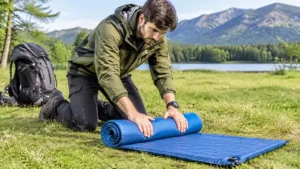
2. Exped SIM Ultra 3.8 — lightest self-inflating pad in this lineup
Exped’s trick is coring. The foam is hollowed out both horizontally and vertically, which trims weight and packed size. A 20D recycled ripstop shell with an anti-slip GripSkin coating wraps it.
The medium measures 183 x 50 x 3.8 cm (about 72 x 20 x 1.5 inches) and weighs 580-610 g, depending on the listing. The foam density is a featherweight 13 kg/m³. R-value shows as 3.7 on several retailer pages and 3.1 on a 2026 European listing. That likely reflects model-year differences, so verify the current spec before buying.
What the spec sheet won’t tell you is how it feels. At 1.5 inches, this is a firmer, flatter sleep than the plush options below. It’s a smart pick for three-season hikers trimming ounces who still want foam’s durability. Flat valves and an included repair kit round it out.
On reviews, I couldn’t find a robust, verifiable customer pool for this exact model, so this verdict rests on specs and Exped’s design details.
Pros:
- ✅ About 21 oz keeps it competitive on weight
- ✅ Fully cored foam packs small
- ✅ Repair kit and anti-slip surface included
Cons:
- ❌ 1.5 inches won’t please side sleepers
- ❌ R-value listings conflict across retailers
European retailers list it around €80-€110. US pricing varies, so check current price. On paper, it’s strong value for weight-focused backpackers.
3. Sea to Summit Comfort Light SI — Delta Core foam trims bulk, not comfort
Sea to Summit cuts triangular cavities, called Delta Core, into the foam. The company says this removes about 40% of bulk and weight. The foam stays thicker on top for insulation directly under your body.
The regular size is 72 x 20 x 2 inches, weighs about 1 lb 5 oz (650 g) and packs near 14 x 28 cm. The R-value is 3.1 on current listings, though some older pages show 2.7. A 30D polyester shell with a TPU laminate keeps weight low. Anti-slip silicone print on top and bottom helps your bag and pad stay put on sloped tent floors, a small feature that matters at 2 a.m.
Retailer descriptions also credit a multifunction valve that lets you roll the pad tightly without fighting re-inflation. At R 3.1, think late spring to early fall rather than shoulder-season frost. One practical tip from retailer care notes: store it flat or folded as little as possible, with the valve open.
I couldn’t verify a meaningful customer review pool for this model, so the analysis rests on specs.
Pros:
- ✅ Roughly 21 oz with 2 inches of loft
- ✅ Anti-slip print on both faces
- ✅ Tight rolling thanks to the multifunction valve
Cons:
- ❌ R 3.1 limits cold-season use
- ❌ Premium pricing versus similar foam pads
Expect around $150-$200. It’s good value only if packed size is a priority.
4. Therm-a-Rest Trail Pro — the plush three-inch classic
This is the pad you buy when comfort beats grams. Its 3-inch StrataCore build gives a mattress-like feel that thinner foam pads can’t match.
The regular weighs about 1 lb 13-14 oz, measures 72 x 20 x 3 inches, and has an R-value of 4.4. It packs to roughly 11 x 8.8 inches. The shell pairs a 50D polyester top with a 75D bottom, which makes it one of the tougher pads in this group. A regular wide (72 x 25) option exists, and it’s the only way to escape the mummy taper.
BetterTrail’s March 2026 review praised the plushness and durability. It also noted the pad behaves more like a car-camping mattress that tolerates occasional backpacking, and that its warmth-to-weight trails lighter pads like the NEMO Tensor All-Season (R 5.4, about 1 lb). Customer reviews on retail sites echo that theme: a few wish for wider sizing, and one notes the foam sits narrower than the cover.
Pros:
- ✅ Three inches of body-cradling cushion
- ✅ Tough 50D top and 75D bottom fabrics
- ✅ R 4.4 handles most three-season trips
Cons:
- ❌ Nearly double the weight of top air pads
- ❌ Bulkier packed size than cored competitors
Prices run roughly $120-$170 depending on sales. It’s great value for short-carry trips and side sleepers.
5. NEMO Flyer Cloud — four-season hybrid at R 5.1
The Flyer Cloud mixes air-core cells with solid foam segments. NEMO says it removes nearly 60% of the foam through horizontal coring, keeping loft while shedding weight.
It’s 3 inches thick with an R-value of 5.1. The regular wide (72 x 25) weighs 2 lb 9 oz per CleverHiker’s spec table. A stretch-knit top adds a soft, quiet feel, and the stuff sack doubles as a pump sack and waterproof dry bag. Regular mummy and rectangular regular wide versions exist.
An R-value above 5 is where winter conversations start, so this is the cold-sleeper’s pick in this lineup. CleverHiker called it comparatively light and packable for a camping mattress. They also noted it isn’t as thick or plush as their top camping picks, though it costs about $100 less. One retail reviewer of the original Flyer felt it didn’t inflate as readily as “self-inflating” suggests, so plan to add breaths.
Pros:
- ✅ R 5.1 for shoulder-season and winter trips
- ✅ Stuff sack doubles as pump and dry bag
- ✅ Soft stretch-knit top reduces noise
Cons:
- ❌ 2 lb 9 oz is a real shoulder burden
- ❌ May need extra breaths to reach full firmness
Roughly $160-$190 puts it mid-pack on price, with strong value if you camp in cold.
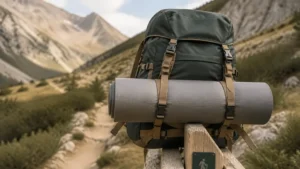
6. REI Co-op AirRail Plus — raised air rails keep you on the pad
Anyone who’s woken up halfway off a pad knows the problem. REI’s AirRail design pairs an insulated open-cell foam core with air rails along the edges to help keep you centered.
The Plus carries an R-value of 4.2 in a mummy shape and packs to about 7.4 x 12.9 inches in regular. That R-value lands in solid three-season territory. The tapered shape trims weight but can feel snug for sprawlers.
I couldn’t verify the weight or thickness from the listings I found, so check the spec table before buying. I also couldn’t find a verified customer review set. That means this recommendation rests on construction logic, not crowd consensus.
Pros:
- ✅ R 4.2 at a mid-range price
- ✅ Raised rails help restless sleepers
- ✅ Compact packed size for the warmth
Cons:
- ❌ Weight and thickness need verification
- ❌ Mummy taper limits sprawling room
Expect roughly $90-$140, depending on size and sales. It’s attractive value for hikers who roll around at night.
7. REI Co-op Trailmade — best budget entry ticket
The Trailmade is the pad you buy when you’re not sure backpacking will stick. It’s simple, warm enough and cheap enough to forgive an impulse purchase.
Current listings show an R-value of 4.6 tested to the ASTM F3340 standard, with 1.5 inches of thickness. An older version was listed at 5.5, so confirm which one you’re buying. Sizes run short through long wide, and the medium packs to about 8 x 11 inches. A repair kit and stuff sack are included, and the pad uses recycled materials.
Its predecessor, the Trailbreak, weighed over 2 lb 5 oz in regular. Expect the Trailmade to be a heavier budget pad, and verify the current weight. Reviewers on REI describe it as a dependable standard pad that gets the job done.
Pros:
- ✅ Lowest price in this lineup
- ✅ R 4.6 is generous at this cost
- ✅ Repair kit included
Cons:
- ❌ Only 1.5 inches of cushion
- ❌ Likely heavier than premium rivals
Around $80-$100 is the range. For beginners, the value is hard to argue with.
How to Choose a Self-Inflating Sleeping Pad for Backpacking
Short answer: match R-value to your coldest night, cap weight at what your shoulders forgive, and prioritize thickness only if you sleep on your side. Then check the valve and repair kit. Here are seven steps:
- Start with your coldest realistic night. Your pad has to beat the ground, not the air, so size the R-value to your worst case.
- Set a weight ceiling. Decide what the pad can weigh before you shop. A 2-pounder is fine for weekends and painful on week-long trips.
- Confirm the rating is ASTM F3340. Tested ratings let you compare brands honestly, while estimated numbers don’t.
- Match thickness to your sleep position. Two inches suits back sleepers. Three inches helps side sleepers keep hips off the ground.
- Inspect the valve. Look for a large opening, a one-way option and easy deflation.
- Pick shape and size deliberately. Mummy shapes save ounces, while wider rectangular pads give room to roll.
- Check the repair kit and warranty. A kit in the box turns a puncture into a ten-minute fix.
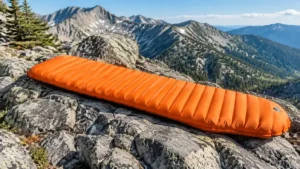
Insulation Rating: How to Read R-Value Without Getting Fooled
Insulation rating is the number that decides whether you sleep or shiver. R-value measures resistance to heat flow, not warmth itself. A higher R-value keeps your body heat from draining into the dirt.
The ASTM F3340-18 standard made those numbers comparable. Labs press a pad between a hot plate and a cold plate and measure the heat transfer. According to SectionHiker’s guide to the standard, Therm-a-Rest, NEMO, REI, Exped, Sea to Summit, Big Agnes, Klymit and ZenBivy have all adopted it. REI requires it for pads sold on its main site. The catch is that some brands still estimate their R-values, which makes comparisons unreliable.
A practical decoder for your insulation rating:
- ❄️ Below R 2: warm summer nights only.
- 🌤️ R 3-4.5: three-season sweet spot.
- ⛄ R 4.5 and up: winter territory, often paired with a foam pad underneath.
R-values are additive, so stacking a pad under another adds ratings. Retesting also changed some old numbers. OutdoorGearLab noted the Therm-a-Rest Trail Lite dropped from 4.9 to 4.5 under the new standard.
Open-Cell Foam Core: What Happens Inside Your Pad
The open-cell foam core is the whole trick. Open-cell foam is spongy and compressible, so when you unroll the pad and open the valve, the foam rebounds and draws air in. Closed-cell foam, by contrast, doesn’t compress that way.
Manufacturers fight a constant battle between foam volume and weight. Sea to Summit’s Delta Core triangles, NEMO’s horizontal coring and Exped’s horizontal-and-vertical coring all remove foam to cut ounces. Therm-a-Rest’s StrataCore uses a layered approach instead. Foam density matters too. Exped lists its SIM Ultra 3.8 foam at 13 kg/m³, while the heavier Exped MegaMat line uses 16 kg/m³ foam. Lower density saves weight, while higher density usually adds support and warmth.
For you, the takeaway is simple. Cored foam is lighter and packs smaller, but it may feel less supportive. Dense, uncored foam is warmer and plusher, but heavier. For storage, retailer care notes recommend laying the pad flat, or folding it as little as possible, with the valve open so the foam doesn’t take a permanent set.
Valve Design: The Small Part That Makes or Breaks the Night
Valve design is easy to ignore until 3 a.m. A good valve opens wide so air enters quickly, then seals without drama. It also deflates fast, so packing doesn’t turn into a wrestling match.
Look at how the field handles it. Therm-a-Rest’s WingLock valve on the ProLite Apex uses a larger opening and one-way inflation. NEMO’s Laylow valve sits flush with the pad and allows micro-adjustment. Sea to Summit’s multifunction valve is designed so a tightly rolled pad doesn’t fight you on re-inflation. Exped uses flat valves for inflation and deflation, and its MegaMat Duo adds large deflation valves for faster packing.
Valves also fail, which is why history matters. OutdoorGearLab noted that older Therm-a-Rest Trail Lite valves drew leak complaints, and the redesign improved durability. Before buying, ask yourself three questions. Is the opening large? Does it close firmly? Does the pad ship with a repair kit?
Self-Inflating Pad vs Air Pad: Which One Belongs in Your Pack?
The self-inflating pad vs air pad debate comes down to ounces versus insurance. Air pads win on weight and packed size. Self-inflating pads win on durability, repairability and a stable sleeping surface.
| Type | Example | Weight | R-Value | Durability | Best For |
|---|---|---|---|---|---|
| Self-inflating | Therm-a-Rest ProLite Apex | 1 lb 6 oz | 3.8 | High | Durable three-season comfort |
| Air pad | Therm-a-Rest NeoAir XLite NXT | ~13 oz | 4.5 | Moderate | Ultralight, long-distance hiking |
| Closed-cell foam | Therm-a-Rest Z Lite Sol | ~14 oz | 2.0 | Very high | Budget backup, stacking |
The table tells the story. The NeoAir XLite NXT saves roughly nine ounces over the ProLite Apex and still posts a higher R-value, but it costs around $200 or more. The Z Lite Sol is indestructible and about $50, yet it only gives R 2. Since foam keeps insulating when partly deflated, a slow leak in a self-inflating pad is an annoyance, not a disaster. REI’s guidance adds that self-inflating pads are more durable and easier to field-repair than air pads, though less compact.
✨ Don’t Miss These Exclusive Deals!
🔍 Take your trail sleep to the next level with these carefully selected pads. Click on any highlighted item to check current pricing and availability. These picks will help you build a sleep system that actually keeps you warm and rested!
Lightweight Self-Inflating Pad for Backpacking: Counting Grams Without Regret
A lightweight self-inflating pad for backpacking is a real category, but it’s a narrow one. The lightest options here, the Exped SIM Ultra 3.8, Sea to Summit Comfort Light SI and Therm-a-Rest ProLite Apex, all land near 21-22 ounces. That’s about eight or nine ounces heavier than a top air pad. Eight ounces is roughly a filled water bottle, which is a real cost but rarely a deal-breaker.
So where does the weight go? Foam you can’t remove without losing insulation. Cored designs like Delta Core and horizontal coring shave the most. Choosing a regular instead of a wide or long size saves more, and a short size saves a little too. Sea to Summit lists its small at about 595 g versus 650 g for the regular.
The honest verdict is this: a lightweight self-inflating pad for backpacking suits hikers who value durability over the last few ounces. If every gram counts, an air pad wins on weight. If you’d rather not worry about punctures on rough ground, the foam core earns its keep.
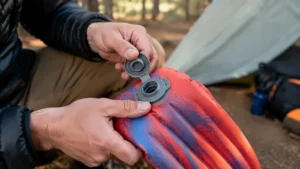
Self-Inflating Pad for Cold Weather Camping: What Works Below Freezing
A self-inflating pad for cold weather camping needs R 4.5 or higher. In this lineup, only the NEMO Flyer Cloud (R 5.1) clears that bar outright. The REI Co-op Trailmade (R 4.6) and Therm-a-Rest Trail Pro (R 4.4) sit right at the edge.
The trick is stacking. Because R-values add up when there’s no air gap, a closed-cell pad underneath boosts your total. On paper, a Z Lite Sol (R 2) under the Trail Pro gets you near R 6.4, and under the Flyer Cloud near R 7.1. REI’s closed-cell versus self-inflating guide recommends exactly this layering for extra cushion and insulation.
Weight is the cost. Cold-weather capability pushes self-inflating pads toward two pounds and beyond. Heavy basecamp options exist, like the Exped MegaMat Duo at R 8.1, but its two-person size weighs nearly ten pounds. That’s a car-camping luxury, not a backpacking pad.
Real-World Scenarios: Matching the Pad to the Hiker
Specs are abstract, so here are three buyer profiles.
The weekend hiker with sore hips. She camps six miles from the trailhead, three seasons a year, and sleeps on her side. The Therm-a-Rest Trail Pro gives three inches of cushion for a modest carry. Weight isn’t her bottleneck, but sleep quality is.
The shoulder-season section hiker. He’s out five days at a time in cool weather, and nights drop near freezing. The NEMO Flyer Cloud gives R 5.1. If weight bothers him, the Therm-a-Rest ProLite Apex plus a Z Lite Sol gets him to a similar total with more flexibility.
The first-timer on a budget. She isn’t sure backpacking will stick. The REI Co-op Trailmade costs roughly $80-$100 and carries a respectable R 4.6. If she falls in love, she can upgrade and keep the Trailmade as a guest pad.
Notice the pattern. None of these hikers needs the “best” pad in the abstract. Each needs the pad that matches their budget, carry distance and sleep style.
Practical Usage Guide: Setup, Inflation and the First 30 Days
Great pads fail when they’re used badly. Here’s a simple routine.
At camp. Unroll the pad as soon as you pitch the tent and open the valve. Let the foam loft while you cook. Then top off with a few breaths. Some pads need up to about ten, depending on the model.
Firmness. Don’t over-inflate. A pad that’s too tight pushes back at your hips. Add air until your hips don’t touch the ground when you lie down, then stop.
Packing. Open the valve, fold the pad lengthwise, and roll from the foot end so air escapes. Close the valve once it’s flat. Storing it flat at home with the valve open helps the foam keep its loft.
First 30 days. Inflate the pad at home and leave it overnight with the valve closed. If it’s noticeably flatter, you’ve found a leak while the return window is still open. Practice a patch with the repair kit, too.
Match the pad to your coldest night. Therm-a-Rest’s R-value explainer is a good reference for pairing your pad with your sleeping bag.
Long-Term Cost and Maintenance: What You Actually Pay Per Night
Sticker shock fades once you divide by nights used. Assume 40 nights over five years, which is an assumption, not a guarantee.
| Tier | Example | Typical Range | Approx. Cost/Night | Best For |
|---|---|---|---|---|
| Budget | REI Co-op Trailmade | $80-$100 | $2.00-$2.50 | First-time backpackers |
| Mid-range | Therm-a-Rest Trail Pro | $120-$170 | $3.00-$4.25 | Comfort-focused hikers |
| Premium | NEMO Flyer Cloud | $160-$190 | $4.00-$4.75 | Cold-weather campers |
Looking at the table, even the premium tier costs under $5 a night. That’s cheap for a decent night’s sleep. The budget pad delivers the best nightly cost, but only if its thin loft doesn’t cost you sleep. The mid-range Trail Pro is the sweet spot for comfort per dollar if weight isn’t critical.
Maintenance is simple. Carry the repair kit, store the pad flat with the valve open, and keep it away from sharp ground. More components mean more things that can fail, so inspect valves before long trips.

Frequently Asked Questions
❓ How long does a self-inflating sleeping pad take to fully inflate?
❓ Do self-inflating sleeping pads need a pump?
❓ Is a thicker pad always better for side sleepers?
❓ How do I fix a leaking self-inflating sleeping pad?
❓ Do self-inflating pads lose their loft over time?
Conclusion: Which Self-Inflating Sleeping Pad for Backpacking Should You Buy?
A self-inflating sleeping pad for backpacking is a trade, and an honest one. You give up a few ounces and some packed volume. In return you get durability, simpler setup and insulation that holds up when things go wrong.
If you want the best all-round balance, the Therm-a-Rest ProLite Apex is hard to beat. If every ounce counts, the Exped SIM Ultra 3.8 is the lightest of the group. The Sea to Summit Comfort Light SI suits warm-season hikers who prize packability, and side sleepers should look hard at the Therm-a-Rest Trail Pro. For cold nights, the NEMO Flyer Cloud leads the way, and the REI Co-op AirRail Plus suits restless sleepers. The REI Co-op Trailmade is the easy first buy.
Read the insulation rating, inspect the valve design, and respect the open-cell foam core. Then pick the pad that fits your nights, not someone else’s.
✨ Ready to sleep better on the trail?
🔍 Click on any highlighted pad above to check current pricing and availability. Your back, hips and future self will thank you! 🎒
Recommended for You
- Budget Foam Sleeping Pad: 7 Proven Picks For 2026
- Foam Sleeping Pad For Winter Camping: 7 Best Picks 2026
- Foam Sleeping Pad For Ultralight Backpacking: 7 Proven Picks 2026
Disclaimer: This article contains affiliate links. As an Amazon Associate, I earn from qualifying purchases. If you purchase products through these links, we may earn a small commission at no additional cost to you.
✨ Found this helpful? Share it with your friends! 💬🤗
