
In This Article
A truck bed is a strange place to sleep. It’s flat, which sounds promising until you meet the ribbed liner, the wheel-well humps and the cold sheet metal underneath. That metal will happily pull the heat out of your body all night. A self-inflating sleeping pad for truck bed camping is the cheapest fix for all of it, because the foam core insulates, cushions and bridges small bumps at once.
Truck camping also sits at the center of modern overlanding, which Wikipedia describes as self-reliant overland travel where the journey matters more than the destination. If your rig is your basecamp, your sleep system is the part you’ll notice every single morning.
Here is what you’ll get in this guide:
- Seven real pads, with specs translated into what they mean at 2 a.m. in a truck bed.
- Honest analysis of fit, warmth, weight and durability.
- A practical walkthrough for building a custom sleeping platform.
- Scenario-based picks for car campers, motorcyclists and overlanders.
Everything below comes from published specs and aggregated reviews. I haven’t slept on any of these pads myself, and I won’t pretend otherwise. Prices are ranges, so check current pricing before you buy.
Quick Comparison: Best Self-Inflating Sleeping Pad for Truck Bed Camping at a Glance
| Pad | R-Value (ASTM) | Thickness | Listed Size / Weight | Best For |
|---|---|---|---|---|
| Exped MegaMat Duo 10 (Medium) | 8.1 | 4 in | 72 x 41 in / ~7.4 lb | Couples in mid-size beds |
| Exped MegaMat 10 (MW) | 8.1 | 4 in | 72 x 25.6 in / 73 oz | Cold-weather solo sleepers |
| Therm-a-Rest MondoKing 3D (Large) | 7.0 | 4.25 in | 77 x 25 in / 4 lb 6 oz | Plush comfort, lower weight |
| Therm-a-Rest LuxuryMap (Large) | 6.0 | 3 in | 77 x 25 in | Side sleepers |
| Therm-a-Rest BaseCamp (Large) | 6.0 | 2 in | 77 x 25 in / 3 lb 6 oz | Budget car and truck camping |
| Sea to Summit Camp Plus (Rect. Wide) | 4.3 | 3 in | 72 x 25 in / 2 lb 11 oz | Tough, affordable all-rounder |
| Therm-a-Rest Trail Pro (Regular) | 4.4 | 3 in | 72 x 20 in / 1 lb 14 oz | Truck bed plus motorcycle duty |
Look at the pattern in the table. The two Exped models own the warmth category, and the MondoKing 3D gives up about one R-value point to save a pound or two. If your trips stay above freezing, the Sea to Summit Camp Plus and Therm-a-Rest Trail Pro deliver most of the comfort for far less money and bulk. The BaseCamp is the sensible middle path, though its 2 inches of foam is the thinnest here.
💬 Just one click — help others make better buying decisions too!😊
What Is a Self-Inflating Sleeping Pad for Truck Bed Camping?
A self-inflating sleeping pad for truck bed camping is an open-cell foam pad sealed inside an airtight fabric shell. When you open the valve, the foam expands and pulls air in on its own. You top it off with a few breaths or a pump sack and close the valve. The foam insulates you from the cold bed floor and smooths out ribs, bolts and cargo-tie recesses.
Unlike a pure air mattress, it keeps working as insulation even if the air pressure drops. Unlike a foam slab, it rolls up small enough to store behind the seats.
Top 7 Self-Inflating Sleeping Pads for Truck Bed Camping: Expert Analysis
1. Exped MegaMat Duo 10 — double-wide warmth that fits between wheel wells
The Exped MegaMat Duo 10 is the closest thing here to a real bed. The Medium size measures 72 x 41 inches and weighs roughly 7.4 pounds. The Long Wide version is 77.6 x 52 inches and just under 10 pounds.
Both carry an ASTM-rated R-value of 8.1 and 4 inches of open-cell foam. The Medium’s 41-inch width matters because many mid-size trucks, the Tacoma among them, are commonly listed at around 41.5 inches between the wheel wells. That’s a snug fit with half an inch to spare, so measure your own bed before committing. The wider version rides up over the wheel wells, so it wants a flat platform beneath it.
Published reviews, including Switchback Travel’s, describe it as extremely comfortable and warm for two. The same reviews flag its weight, its price and its slow inflation. Exped sells a separate Mega Pump (12.3 oz) that speeds things up.
Pros:
- ✅ Bed-like 4-inch foam cushion for two
- ✅ R-value 8.1 handles cold shoulder seasons
- ✅ Medium width can sit between the wheel wells
Cons:
- ❌ Heavy and bulky when rolled up
- ❌ Slow to inflate and deflate without a pump
Expect to pay in the $350-$450 range, depending on size. Check current price, because availability varies. It’s a premium verdict, justified if two people sleep in the bed regularly.
2. Exped MegaMat 10 — the cold-weather solo champion
The single-person Exped MegaMat 10 shares the Duo’s R-value of 8.1 and 4-inch foam, in a pad you can actually carry with one arm. The Medium Wide measures 72 x 25.6 inches and weighs 73 ounces. The Long Extra Wide is 77.6 x 30.3 inches and weighs 91.7 ounces.
Retailer specs list a 50D stretch-tricot polyester top over a TPU laminate. It also has vertical sidewalls, so the sleeping surface runs to the edge instead of tapering. On paper, that means you won’t slide off when you roll over on a narrow bed.
OutdoorGearLab found the pad warm and very comfortable, but among the pricier self-inflating singles. SectionHiker’s review says it feels more like a bed than a sleeping pad. Exped’s -40 temperature figure is a manufacturer claim, so treat it as a ceiling rather than a promise.
Pros:
- ✅ Highest R-value in this roundup, 8.1
- ✅ Wide sidewalls give edge-to-edge sleeping surface
- ✅ Mini pump and repair kit are included
Cons:
- ❌ Pricey for a single-person pad
- ❌ Packs larger than thinner rivals
Pricing starts in the mid-$200s and climbs with size. The verdict is simple: buy it if cold nights are routine.
3. Therm-a-Rest MondoKing 3D — plushest cushion per pound
The Therm-a-Rest MondoKing 3D stacks 4.25 inches of foam. That’s the thickest pad in this lineup, at an R-value of 7.0. The Large is 77 x 25 inches and weighs 4 pounds 6 ounces. The XXL is 80 x 30 inches and weighs 5 pounds 8 ounces.
Its shell uses 50D polyester knit on top and 75D polyester on the bottom. The TwinLock valve system gives separate inflation and deflation ports, which makes packing up faster. The pump sack doubles as the stuff sack.
Better Trail called it the thickest camping mattress they tested and praised the room to move around. They also noted that self-inflation takes about 20 to 30 minutes and that it isn’t the warmest pad in its class. The MondoKing 3D trails the Exped MegaMat 10 by about one R-value point. Winter sleepers should note that gap.
Pros:
- ✅ Thickest foam here for pressure relief
- ✅ Lighter than comparably plush rivals
- ✅ Separate in and out valves speed up packing
Cons:
- ❌ Not the warmest pad at its price
- ❌ Takes up trunk space when rolled
Expect roughly $260-$340. For summer and shoulder-season trucking, it’s the sweet spot of luxury and weight.
4. Therm-a-Rest LuxuryMap — pressure-mapped for side sleepers
The Therm-a-Rest LuxuryMap uses a pressure-mapped foam pattern, soft where your hips and shoulders land and firmer elsewhere. It’s 3 inches thick with an R-value of 6.0 and a TwinLock valve. Large is 77 x 25 inches, and an extra-large size is also offered. Some older retailer listings show R 6.8, so confirm the version on the page you buy from.
Side sleepers care about this because a hard bed floor punishes the hip bone first. REI reviewers describe it as comfortable and quick to expand, usually needing only a couple of breaths to top off. Therm-a-Rest itself recommends leaving it fully inflated for two to four hours before the first night.
Pros:
- ✅ Pressure-mapped foam relieves hips and shoulders
- ✅ Soft knit top feels good against skin
- ✅ Fast two-valve inflate and deflate
Cons:
- ❌ Only 3 inches, so less cushion than the MondoKing
- ❌ Pricier than the BaseCamp for less insulation than Exped
Pricing is roughly $190-$250. Verdict: great value for side sleepers on a flat platform, a step down on a bare ribbed bed.
5. Therm-a-Rest BaseCamp — the budget car-and-truck workhorse
The Therm-a-Rest BaseCamp is the plain, reliable member of this group. It has an R-value of 6.0 on current listings (older listings show 5.8) and 2 inches of foam with a 75D polyester shell. Regular is 72 x 20 inches and weighs 2 pounds 8 ounces. Large is 77 x 25 inches and weighs 3 pounds 6 ounces, and XL is 77 x 30 inches at about 4 pounds.
REI reviewers describe it as great for car camping and note that it stays inflated over repeated use. They also say it’s heavy and doesn’t pack small, and one side sleeper found it less comfortable than thicker pads.
The R-value is genuinely good for the money, but at 2 inches the foam won’t mask a ribbed bed floor. Pair it with a plywood deck and you’ve solved most of that.
Pros:
- ✅ R 6.0 insulation at a low price
- ✅ Reviewers report it stays inflated
- ✅ WingLock valve speeds inflation
Cons:
- ❌ Thin 2-inch profile, hip pain risk for side sleepers
- ❌ Bulky when rolled
Expect roughly $120-$160. Verdict: the best entry point for a first truck bed setup.
6. Sea to Summit Camp Plus — abrasion-ready and easy on the wallet
The Sea to Summit Camp Plus has an ASTM-rated R-value of 4.3 on most listings, 3 inches of foam and a 75D recycled polyester shell. Some retailers show a newer version at R 5.3 and about 2.76 inches thick, so verify the listing. Delta Coring removes over 40% of the foam to cut weight and bulk.
Regular is 72 x 20 inches and weighs about 1 pound 15 ounces, packing to roughly 8 x 10.2 inches. Rectangular Wide is 72 x 25 inches and weighs 2 pounds 11 ounces. Better Trail rated it well among self-inflating mats but called setup and pack-up a bit finicky.
Pros:
- ✅ Tough 75D fabric for abrasive surfaces
- ✅ Packs far smaller than premium pads
- ✅ Self-adhesive repair kit included
Cons:
- ❌ Only R 4.3, so thin on true winter nights
- ❌ Valve routine takes some getting used to
Pricing runs about $100-$110. A strong pick if fabric toughness and packability matter more than thickness.
7. Therm-a-Rest Trail Pro — the pad you can also carry on a bike
The Therm-a-Rest Trail Pro uses StrataCore construction for a strong warmth-to-weight ratio. It has an R-value of 4.4 and 3 inches of foam. Regular is 20 x 72 inches and weighs 1 pound 14 ounces. Wide and Large versions exist.
Many written reviews cover earlier, thinner versions. They praise the warmth for the weight and note a weight penalty over minimalist pads. The current model’s extra thickness should add comfort, though I couldn’t find enough independent data to say by how much.
Pros:
- ✅ Light enough for motorcycle or backpack duty
- ✅ Warm for its weight
- ✅ WingLock valve with one-way inflation
Cons:
- ❌ Narrow in Regular, tight for restless sleepers
- ❌ Less cushion than the plush truck pads
It starts around $155 and rises with size. A fine truck bed pad that doubles as a go-anywhere sleeper.
Top 7 at a Glance: Spec Showdown
| Pad | R-Value | Thickness | Price Range | Best For |
|---|---|---|---|---|
| Exped MegaMat Duo 10 | 8.1 | 4 in | $350-$450 | Couples, winter trucks |
| Exped MegaMat 10 | 8.1 | 4 in | Mid-$200s and up | Cold solo sleepers |
| Therm-a-Rest MondoKing 3D | 7.0 | 4.25 in | $260-$340 | Plush comfort |
| Therm-a-Rest LuxuryMap | 6.0 | 3 in | $190-$250 | Side sleepers |
| Therm-a-Rest BaseCamp | 6.0 | 2 in | $120-$160 | Budget car/truck camping |
| Sea to Summit Camp Plus | 4.3 | 3 in | $100-$110 | Durability on a budget |
| Therm-a-Rest Trail Pro | 4.4 | 3 in | From ~$155 | Dual-use truck and bike |
The Exped MegaMat 10 and Exped MegaMat Duo 10 are the clear winners on warmth, though that comes with weight and price. The MondoKing 3D buys the most cushion per pound, while the BaseCamp and Camp Plus are the value picks. Choose by your coldest realistic night, not your average one.
✨ Don’t Miss These Exclusive Deals!
🔍 Take your truck camping to the next level with these carefully selected pads. Click on any highlighted item to check current pricing and availability. A better pad helps you wake up rested, ready for the trail and happy about your night’s sleep!
How to Choose a Self-Inflating Sleeping Pad for Truck Bed Camping
Follow these seven steps and you’ll narrow the field fast:
- Measure your bed first. Record length and width between the wheel wells. A 72-inch pad overhangs a 5-foot bed unless you drop the tailgate.
- Decide solo or double. A single pad leaves the other half of the bed empty, while a double needs the wheel-well clearance.
- Pick your R-value by coldest night. Under about 4, you’re summer-only. Around 6 handles most three-season trips, and 7 to 8 suits real winter.
- Choose thickness for your sleep style. Side sleepers should lean toward 3 to 4 inches. Back sleepers can get away with 2 to 3.
- Check the shell fabric. Heavier denier on the bottom face resists scuffs from a liner or platform.
- Think about pack size. Premium pads roll large, so check your storage space.
- Look for repair kits and warranties. A punctured pad is a trip-ender without them.
R-value matters because it measures resistance to heat flow. Cascade Designs, which owns Therm-a-Rest, explains how the ASTM F3340-18 standard measures it, so numbers from participating brands can be compared fairly. That’s why I’ve listed ASTM-rated figures where retailers confirm them.
Features That Actually Matter (And Mistakes to Skip)
What matters: R-value, thickness, bottom-fabric toughness, valve speed and repairability. A TwinLock or WingLock valve saves minutes every morning. Vertical sidewalls give you more usable surface.
What doesn’t: inflated “temperature ratings” from manufacturers, pillow add-ons and flashy colors. A temperature number depends on your bag, your clothing and your metabolism, while R-value is the cleaner comparison.
Common mistakes:
- Buying on thickness alone and ignoring R-value, then shivering.
- Skipping the pre-trip inflation. Foam needs hours to fully expand on its first use.
- Ignoring your bed’s real dimensions, which leads to pad overhang.
- Putting a pad directly on a ribbed liner without a layer between.
- Trusting unverified R-values. Some lesser-known brands, such as the Hikenture Double Self Inflating Pad, advertise R 9.5 at 4 inches, but I couldn’t find independent ASTM verification or trustworthy review data, so treat those numbers cautiously.
Self-Inflating Pads vs Air Pads vs Foam: What Wins in a Truck Bed?
| Option | Insulation | Durability | Comfort | Best For |
|---|---|---|---|---|
| Therm-a-Rest MondoKing 3D-style self-inflating pad | High | Good | Very good | Truck beds and car camping |
| Ultralight air pad (e.g., Klymit Static V2, R 1.3) | Very low | Fair | Fair | Summer backpacking |
| Insulated air pad (e.g., Big Agnes Rapide SL, R 4.8) | Medium | Good | Good | Three-season hiking |
| Closed-cell foam | Medium | Excellent | Basic | Backup layer |
A self-inflating pad wins in a truck bed because the foam keeps insulating even if air leaks. A thin air pad can lose its warmth and cushion fast, and a bare metal bed doesn’t forgive that. Foam is nearly indestructible but gives up comfort. For most truck campers, the self-inflating pad is the best balance.
Building a Custom Sleeping Platform for Your Truck Bed
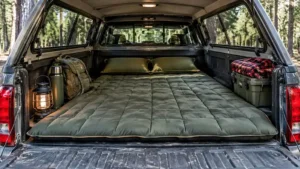
A custom sleeping platform fixes the biggest weakness of any pad: the ribs and humps beneath it. The basic idea is a plywood deck, sometimes folding in half, that spans the wheel wells and gives the pad one flat surface.
- Measure the bed floor, wheel-well height and tailgate clearance.
- Cut the plywood to rest on the wheel wells, or on support legs set to the same height.
- Add storage underneath for recovery gear, stoves and cooking kits.
- Sand and seal the edges to keep splinters off your pad.
- Place the pad and test it before the first trip.
A custom sleeping platform also pairs well with thinner, lighter pads like the BaseCamp, because the platform does the flattening work. A thick pad such as the MondoKing 3D may not need one, but it still sleeps better on a level base. If your bed has a ribbed liner, a platform is the most reliable way to protect any pad’s shell.
Setup and Maintenance: Your First 30 Days With a New Pad
- Day one: Unroll the pad at home and leave it fully inflated for a few hours. Therm-a-Rest recommends two to four hours for the LuxuryMap, and the same logic applies to the others.
- First trip: Open the valve, let the foam expand, then add a few breaths until it feels right. Slightly softer is often more comfortable for side sleepers.
- Every morning: Open the valve fully and roll the pad from the foot end to push air out. Close the valve once rolled.
- Every few weeks: Wipe the pad clean, dry it completely and store it unrolled with the valve open.
- First month mistakes: Over-inflating, storing damp and dragging the pad over sharp bed edges.
Stored compressed for months, foam can lose some loft. Unrolling it between trips is a cheap habit that extends pad life. Always keep the supplied repair kit in the truck.
Real-World Scenarios: Matching Pads to Truck Campers
The weekend couple (mid-size truck, short bed, spring and fall). The Exped MegaMat Duo 10 Medium is the tidy match if your bed measures out. If it doesn’t, two single Therm-a-Rest LuxuryMap pads side by side are a flexible alternative.
The winter solo (full-size truck, cap or shell, nights below freezing). The Exped MegaMat 10 has the R-value to handle it, and the shell blocks wind. Add a closed-cell foam layer if temperatures plunge.
The budget builder (first truck, limited funds, fair weather). The BaseCamp plus a plywood platform gives you a solid base for a modest total. Upgrade the pad later if you outgrow it.
In each case, the right choice depends on your bed, your climate and how often you sleep out. A pad bought for one scenario will frustrate you in another.
Abrasion Resistance: Why Fabric Matters More in a Truck Bed
Abrasion resistance is the quiet differentiator on a truck bed. Ribbed liners, bolt heads, tie-down anchors and gritty dust all grind at the bottom of a pad. Fabric toughness is typically described by denier, where a higher number generally means a heavier, tougher thread.
The MondoKing 3D pairs a 50D top with a 75D bottom, which puts the heavier fabric where the grinding happens. The Sea to Summit Camp Plus and Therm-a-Rest BaseCamp use 75D polyester. The Exped MegaMat 10 uses a 50D tricot with a TPU laminate. Denier is only part of the story, since coatings and seam quality count too. Still, abrasion resistance is a better predictor of long-term durability than a flashy feature list.
Practical advice: put a sacrificial layer, such as a thin bed mat or your platform, between the pad and the bed floor. No fabric survives constant dragging forever.
Self-Inflating Pad for Car Camping: What Translates From the Truck Bed
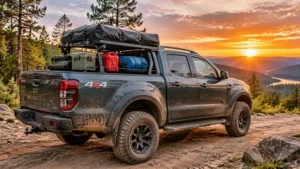
A self-inflating pad for car camping asks the same questions as one for a truck bed, just with different geometry. A hatchback or SUV floor is often flat after you fold the seats, which can suit thinner pads such as the BaseCamp. REI reviewers say it fits easily in the back of an SUV, though it’s heavy and doesn’t pack small.
If you move between car and truck, a mid-size pad like the LuxuryMap works in both. For a dedicated self-inflating pad for car camping where weight doesn’t matter, the MondoKing 3D is the luxury option. Measure your folded-seat floor, because a few inches of difference decides whether the pad lies flat.
Self-Inflating Pad for Motorcycle Camping: When Packability Beats Plush
A self-inflating pad for motorcycle camping lives or dies by pack size and weight. Panniers and tail bags have fixed space, so the 4-inch luxury pads simply won’t fit.
The best candidates from this list are the Sea to Summit Camp Plus Regular (about 1 lb 15 oz, packing to roughly 8 x 10.2 inches) and the Therm-a-Rest Trail Pro Regular (1 lb 14 oz). Both give 3 inches of foam and a decent R-value at a manageable size. The BaseCamp Regular packs to about 21 x 8.5 inches, a bit large for some luggage setups.
If you also camp from a truck, a Trail Pro is a sensible one-pad solution. Bring a patch kit, since a puncture miles from anywhere is a real inconvenience.
Overlanding Gear Systems: Where Your Pad Fits
Overlanding gear is a system, and the pad is one component of it. Your sleeping bag, pad, shelter and ventilation all work together. A great sleeping bag on a thin pad still sleeps cold, because the ground steals heat from beneath you.
When choosing overlanding gear, think about modularity. A pad that fits both the truck bed and a ground tent gives you flexibility if you leave the vehicle. Pads that mate with others, like the MondoKing 3D, let you build a larger sleeping surface. Weight matters less than reliability here, since the truck carries it, so prioritize warmth and repairability. Good overlanding gear earns its place by working when conditions turn.
Long-Term Cost and Maintenance: What You’ll Really Spend
Think in cost per night, not sticker price. A $300 pad used 30 nights a year for five years comes to about $2 per night. A $100 pad used 10 nights a year for three years costs about $3.30 per night. Heavy use favors a better pad.
| Tier | Pads | Price Range | Value Verdict |
|---|---|---|---|
| Budget | Sea to Summit Camp Plus, Therm-a-Rest BaseCamp | $100-$160 | Best entry value |
| Mid-range | Therm-a-Rest LuxuryMap, Therm-a-Rest Trail Pro | $155-$250 | Comfort or versatility |
| Premium | Therm-a-Rest MondoKing 3D, Exped MegaMat 10, Exped MegaMat Duo 10 | $260-$450 | Best for heavy, cold-weather use |
Maintenance costs are small: a patch kit, mild soap and dry storage. Warranty coverage varies, and Exped lists five years on the MegaMat Duo 10. Check each warranty before buying, since terms vary by seller.
Safety, Regulations and Where You Can Park and Sleep
Sleeping in a truck bed is generally low-risk, but a few points apply. Ventilate any enclosed canopy, never run a heater or stove in a sealed space, and tie down your pad when driving so it can’t blow out.
On public land, rules vary. The USDA Forest Service dispersed camping guidance tells visitors to check local alerts for closures and fire restrictions. Individual forests set stay limits, so confirm with the nearest office. If you want to understand how pad insulation relates to cold exposure, SectionHiker’s R-value standard FAQ is a useful read. Pack out everything you bring and follow Leave No Trace principles.
FAQ
❓ How thick should a self-inflating pad be for a truck bed?
❓ Will a self-inflating pad survive a metal or ribbed truck bed?
❓ Do I need a platform under my pad?
❓ What R-value do I need for winter truck camping?
❓ How long does a self-inflating pad take to fully inflate?
Conclusion
The best self-inflating sleeping pad for truck bed camping depends on your bed, your climate and how often you sleep out. For cold-weather comfort, the Exped MegaMat 10 and Exped MegaMat Duo 10 lead on warmth. The Therm-a-Rest MondoKing 3D gives you the plushest cushion for its weight. Side sleepers should look at the Therm-a-Rest LuxuryMap, and budget campers will be well served by the Therm-a-Rest BaseCamp or Sea to Summit Camp Plus. If you also ride, the Therm-a-Rest Trail Pro earns its place in the tank bag.
Whichever you choose, measure your bed first, match the R-value to your coldest night, and protect the shell with a platform or mat. A little planning turns a hard, cold truck bed into the best sleep of your trip. Check current prices before you buy, since they change often.
Recommended for You
- Self-Inflating Sleeping Pad For Backpacking: 7 Best Picks 2026
- Budget Foam Sleeping Pad: 7 Proven Picks For 2026
- Foam Sleeping Pad For Winter Camping: 7 Best Picks 2026
Disclaimer: This article contains affiliate links. As an Amazon Associate, I earn from qualifying purchases. If you purchase products through these links, we may earn a small commission at no additional cost to you.
✨ Found this helpful? Share it with your friends! 💬🤗
