
In This Article
A budget self-inflating sleeping pad is a foam-core camping mattress that fills itself with air when you open the valve. It costs far less than premium inflatable pads, and it gives you real cushioning and ground insulation without a pump. That’s the 40-word version. The longer version is about the 3 a.m. realization that a thin, cheap pad can turn a gorgeous campsite into a negotiation with your own hip bone.

Here’s the good news. The budget self-inflating sleeping pad category is stronger than it has ever been in 2026. Roundups from outlets like GearJunkie show that a self-inflating pad can land anywhere from the sub-$50 bargain bin to the $130-ish “value-packed” tier, and the gap in comfort between them is smaller than the price gap suggests. The catch is that cheap pads hide their compromises in the spec sheet. Thickness is easy to advertise, while R-value (the measure of insulation) is where the exaggeration lives, especially from brands that haven’t adopted the ASTM F3340-18 testing standard that lets you compare pads fairly.
This guide covers 7 real products across budget, mid-range and premium-adjacent tiers. It also covers side sleepers, what an entry-level self-inflating design really delivers, and how to keep the valve alive for years. One honest note: I haven’t slept on any of these pads. Everything below comes from published specs and editorial reviews, with plain flags wherever a number couldn’t be verified.
Quick Comparison: Budget Self-Inflating Sleeping Pad Options at a Glance
| Product | Thickness | R-Value (as published) | Price Range | Best For |
|---|---|---|---|---|
| Coleman Silver Springs | ~2.5 in | ~5 (manufacturer-claimed) | $60-$85 range | Casual tent campers |
| Gear Doctors Oxylus | ~1.5 in | 4.3 | $40-$55 range | Lightweight, cold-ground value |
| Sea to Summit Camp Plus S.I. | ~2.6-3 in | Check brand page | $100-$140 range | Thick, traditional comfort |
| REI Co-op Campwell | Check listing | Check REI listing (ASTM-tested) | $110-$150 range | Frontcountry campers wanting a safe bet |
| Acacia 4-Inch Self-Inflating Pad | ~4.3 in | ~6 | Check current price | Side sleepers needing loft |
| Hikenture 4-Inch Self-Inflating Pad | ~4 in | 9.5 (listing claim) | Check current price | Wide-sprawl sleepers |
| Therm-a-Rest Trail ProLite | Regular-size backpacking build | 3.8 | $120-$150 range | Backpackers stepping up |
Read that table with the “Best For” column in mind. The Gear Doctors Oxylus is the quiet bargain if warmth per dollar is your priority, while the Acacia 4-Inch Self-Inflating Pad wins on pure loft. The Therm-a-Rest Trail ProLite costs more but is the only entry here built to be carried far from your car. Note the R-value column too: a 9.5 claim next to a 3.8 rating looks like a landslide, but those numbers aren’t necessarily measured the same way (more on that below).
💬 Just one click — help others make better buying decisions too!😊
Top 7 Budget Self-Inflating Sleeping Pad Picks: Expert Analysis
A quick word on method. I couldn’t verify individual Amazon customer reviews, so the sentiment notes below reflect what editorial roundups and reviewers say, not star-rating tallies. Prices are ranges because they move constantly. Check current prices before you buy.
1. Coleman Silver Springs Self-Inflating Camping Pad — simple, durable, cold-ground friendly
The Coleman Silver Springs is the pad that doesn’t pretend to be anything fancy. It’s a rectangular slab of insulated foam in a durable PVC-coated shell, aimed at people who want to unroll it, open the valve and go to sleep.
Reviewers list roughly 2.5 inches of thickness and an R-value around 5. Treat that R-5 as the brand’s claim, since it isn’t clearly ASTM-labeled. Even so, a rating in that neighborhood suggests it should handle shoulder-season ground chill, which is where cheap pads usually fail. The tradeoff is weight: the version with a built-in pillow that roundups measured comes in around 6 pounds, so this is a car-to-campsite pad, not a trail pad.
Who’s it for? Weekend tent campers, kids’ sleepovers and the “I only camp four times a year” crowd. Reviewers describe it as proven and no-fuss, which is exactly what you want when the alternative is troubleshooting at dusk.
Pros:
- ✅ Strong claimed insulation for the price
- ✅ Tough PVC-coated shell resists campsite abuse
- ✅ No pump or fiddly setup needed
Cons:
- ❌ Heavy and bulky for backpacking
- ❌ Thinner than true side-sleeper pads
Price check: in the $60-$85 range, it’s a fair value verdict for car camping, and a poor one for anything you’ll carry.
2. Gear Doctors Oxylus — most warmth per dollar
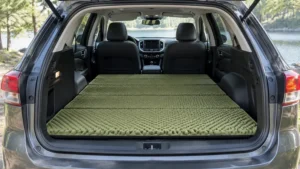
The Gear Doctors Oxylus is the sleeper hit of this list. It’s a foam-core self-inflating pad rated R-4.3, wrapped in a 75D polyester shell, and it packs down to roughly an 8×12-inch roll at under 2.2 pounds.
What does that mean in practice? R-4.3 sits in the range generally recommended for spring-to-fall camping, and it’s remarkable at a price that often lands around the mid-$40s. The catch is thickness. Roundups list it at about 1.5 inches, which means the Gear Doctors Oxylus insulates better than it cushions. If you sleep on your back and weigh under average, that’s fine. If you’re a side sleeper with sharp hips, you’ll feel the ground sooner than the R-value suggests.
Editorial roundups name it a best-value four-season pick, and the compactness is the headline. It earns its place for budget backpackers and anyone building a sleep system around a decent bag.
Pros:
- ✅ R-4.3 insulation at a bargain price
- ✅ Packs small and weighs under 2.2 pounds
- ✅ Durable 75D shell fabric
Cons:
- ❌ Thin profile can bottom out for side sleepers
- ❌ Less plush than 3-4 inch car-camping pads
Price check: the $40-$55 range makes it the best-value choice for lightweight use.
3. Sea to Summit Camp Plus S.I. — the thick, traditional mat
The Sea to Summit Camp Plus S.I. is what happens when a premium brand builds an “extra-thick traditional mat” for people who don’t need to count ounces. Sources describe it as around 2.6 to 3 inches thick (sizes and listings vary), with starting prices around $100.
Why care about the brand name at this price? Sea to Summit is one of the companies that adopted ASTM-tested R-value reporting, so its published insulation numbers are comparable to premium pads rather than marketing math. It also publishes real repair and care guidance, which matters for a pad you want to own for years.
My take: this is the pad for someone who wants a dependable, thicker foam mat from a company with a paper trail. You pay a bit more than the Coleman, but you’re buying cleaner specs and better support if something goes wrong.
Pros:
- ✅ Thick foam for real cushioning
- ✅ Brand publishes repair and care guidance
- ✅ Credible, comparable insulation reporting
Cons:
- ❌ Costs more than bargain-bin pads
- ❌ Bulky and heavy for trail use
Price check: expect the $100-$140 range, which is fair value if you’ll use it for a decade.
4. REI Co-op Campwell — the “safe bet” for frontcountry camping
The REI Co-op Campwell is described by GearJunkie as a value-packed self-inflating pad that makes frontcountry camping accessible without sacrificing too much, and it sits around the $129 mark in their roundup.
I can’t verify its thickness or exact weight from the sources I have, so check the listing. What I can say is about the retailer. REI requires ASTM F3340-18 R-values for pads on its main site, so the number you see is one you can compare to a Therm-a-Rest or Exped. For a first-time buyer, that’s worth real money, because it removes the guessing.
Who’s it for? People who want to buy once, avoid mystery-brand roulette and have a straightforward return process. It’s less exciting than a 4-inch memory-foam monster, but “boring and reliable” is underrated at 2 a.m.
Pros:
- ✅ Retailer-backed, ASTM-tested insulation rating
- ✅ Positioned as strong frontcountry value
- ✅ Simple, no-fuss self-inflating design
Cons:
- ❌ Pricier than Amazon-only budget brands
- ❌ Not built for ultralight packing
Price check: the $110-$150 range reflects the safety-net premium; reasonable if you want certainty.
5. Acacia 4-Inch Self-Inflating Pad — loft for side sleepers
The Acacia 4-Inch Self-Inflating Pad is the entry here most directly aimed at side sleepers. It’s a foam-air hybrid roughly 4.3 inches thick, with a Y-shaped telescopic foam structure, a listed R-value around 6, and a weight near 5.3 pounds.
That thickness matters because side sleeping concentrates your weight on two small points: shoulder and hip. Four-plus inches gives your joints room to sink without touching the ground. The Y-shaped foam is designed to compress compactly, which addresses the classic complaint that thick self-inflating pads pack like a sofa cushion. Reviewers also praise its simple two-way valve.
The honest caveats from roundups: a 220-pound weight capacity may not suit heavier sleepers, and some durability concerns were reported after extended use. Verify the capacity against your body weight plus gear before ordering.
Pros:
- ✅ Roughly 4.3 inches of loft for hips and shoulders
- ✅ Compact packing for a thick pad
- ✅ Simple two-way valve operation
Cons:
- ❌ 220-pound capacity limits heavier sleepers
- ❌ Some durability concerns after long use
Price check: check the current price; it’s worth considering if side-sleeping comfort is your top priority.
6. Hikenture 4-Inch Self-Inflating Pad — wide platform, bold R-value claim
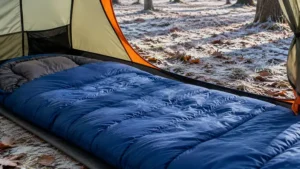
The Hikenture 4-Inch Self-Inflating Pad is roughly 80×28 inches, which is unusually generous in width. Roundups pitch it at “wide sprawl” sleepers who want to throw an arm off the edge without hitting dirt.
Now the elephant: it advertises R-9.5. That’s higher than the Therm-a-Rest MondoKing 3D at 7.0, a pad that costs several times more. I’d treat that number cautiously. Sectionhiker notes that many manufacturers haven’t adopted the ASTM test, and without a standard procedure it’s “hard to tell whether estimates are accurate or comparable.” The thickness and width are real advantages regardless. Just don’t plan on sleeping through a hard freeze because of a listing number.
Who’s it for? Car campers who want a large, plush platform and plan to pair it with a good sleeping bag.
Pros:
- ✅ Wide 28-inch surface for roomy sleeping
- ✅ Thick 4-inch profile for pressure relief
- ✅ Positioned as a budget-friendly all-season pad
Cons:
- ❌ R-9.5 claim isn’t clearly ASTM-verified
- ❌ Likely heavy and bulky to carry
Price check: check the current price; strong value for comfort, but discount the warmth claim.
7. Therm-a-Rest Trail ProLite — the premium-adjacent step up
The Therm-a-Rest Trail ProLite is the “if you can stretch” entry. In its smallest size it weighs 1 pound 8 ounces, and it carries an R-value of 3.8, rated under the ASTM standard. Therm-a-Rest reportedly invented the self-inflating pad back in 1972, and the pedigree shows in the build.
What the spec sheet won’t tell you: that 3.8 is a trustworthy 3.8. Compared with the loud claims elsewhere on this list, it’s a number you can bank on. The pad suits casual backpackers, paddlers and car campers who want something they can carry without regret. The tradeoff is cushioning. It’s thinner than the Acacia or Hikenture, so side sleepers should look elsewhere.
Pros:
- ✅ Light enough for real backpacking
- ✅ Honest, standardized R-value rating
- ✅ Established brand with proven design
Cons:
- ❌ Costs more than most picks here
- ❌ Thinner than dedicated side-sleeper pads
Price check: in the $120-$150 range, it’s good value if weight matters to you.
Entry-Level Self-Inflating Design: What You Actually Get
Understanding entry-level self-inflating design saves you from disappointment. The core mechanism is simple: open-cell foam compresses when rolled, then springs back when the valve opens, pulling air in. Cascade Designs notes that most people want more air than the foam alone provides, which is why self-inflating pads rarely fill “all the way.” You top them off with a few breaths or a pump sack.
At the entry level, cost savings show up in three places. First, the shell fabric is typically thinner or lower-denier, so it’s less puncture-resistant. Second, the foam is often denser than premium foam, which means more weight for the same cushioning. Third, the valve is simpler and cheaper, which is why the Sea to Summit Camp Plus S.I. and REI Co-op Campwell justify slight premiums: better valves and clearer specs.
What you don’t lose is the self-inflating advantage that matters most. A foam-core pad keeps some insulation and cushioning even after a puncture, unlike an all-air pad that collapses completely. For a budget buyer who can’t afford a mid-trip failure, that’s the real selling point, and it’s the reason a budget self-inflating sleeping pad beats a cheap inflatable in rough use.
Self-Inflating Pad for Side Sleepers: What to Look For
A self-inflating pad for side sleepers has different priorities than one for back sleepers. Your hip and shoulder carry the load, so thickness comes first. Aim for at least 3 inches, with 4 inches or more being the sweet spot for pressure relief. Foam-core pads also hold their shape overnight, whereas pure air pads can lose pressure as temperatures drop, leaving you on hard ground by morning.
Width is the second filter. Side sleepers drape an arm forward or roll slightly, and a narrow pad dumps that arm onto the dirt. Look for 25-30 inches rather than the standard 20-inch backpacking width. That’s why the Hikenture 4-Inch Self-Inflating Pad (about 28 inches wide) and the Acacia 4-Inch Self-Inflating Pad are the standouts here.
Third, watch your weight. Thicker, wider pads carry bulk, and weight capacity matters. The Acacia’s 220-pound limit is a real constraint for some people. If you want the benchmark and have money to spare, the premium Therm-a-Rest MondoKing 3D at about 4.25 inches and R-7.0 is what the others get compared against, but it sits far outside a budget.
Finally, use non-slip habits: a slippery pad on a smooth tent floor will drift as you shift. A rubberized groundsheet or a pad-grip mat fixes that cheaply.
How to Choose a Budget Self-Inflating Sleeping Pad
- Match thickness to your sleep position. Side sleepers need 3-4 inches or more. Back and stomach sleepers can often get by with 2-2.5 inches.
- Check the R-value for your season. Roughly 0-2 suits summer, 2-4 suits spring and autumn, and 6 or higher suits alpine conditions.
- Look for ASTM F3340-18 labeling. It’s the only way to compare pads from different brands fairly. Unlabeled high numbers deserve skepticism.
- Decide where it will be carried. If it rides in a trunk, weight barely matters. If it rides on your back, every pound counts.
- Confirm weight capacity and length. A 72-inch pad leaves tall sleepers’ feet in the cold.
- Inspect the valve and warranty. Replaceable valves and repair kits extend a budget pad’s life dramatically.
- Plan the full sleep system. A pad is only half the equation; your bag’s temperature rating assumes a pad with a decent R-value.
Features That Actually Matter (And Those That Don’t)
What matters: R-value you can trust, thickness suited to your body, a valve that works, and shell fabric that survives a campsite. Sleeping bag ratings are generally predicated on a pad with an R-value of 5 or higher, so a pad below that can make a warm bag feel cold.
What doesn’t: built-in pillows, memory-foam marketing and giant numbers on an unlabeled listing. A built-in pillow is often too low for side sleepers anyway, a drawback roundups noted on a couple of electric-pump models. Memory foam adds weight and cost without necessarily adding warmth.
One useful fact from Sectionhiker’s R-value breakdown: R-values are additive when pads are stacked, provided there’s no air gap between them. That means a cheap closed-cell foam pad under a thin self-inflating pad can transform a three-season setup into a winter one for the price of a dinner out. It’s the single best cold-weather trick on a budget.
Also keep an eye on Klymit-style pads. The popular Klymit Static V is lightweight and inexpensive, but it’s an inflatable with an R-value of 1.3, which means warm-weather use only. It’s a different animal from a foam-core pad.
What to Expect: Real-World Performance
Here’s what these numbers mean after dark. A pad around 2.5 inches thick will feel supportive on grass and packed dirt but will let a sharp hip find the ground on rocky terrain. A 4-inch pad feels closer to a thin mattress, and you’re far less likely to wake and rotate every hour.
On warmth, an R-value of 4-5 means you can usually camp comfortably from spring through fall, provided your bag is up to the task. In truly cold weather, ground conduction steals heat faster than most people expect, which is why high-R pads and stacked setups exist.
Setup time is the other practical difference. A self-inflating pad needs time to expand. Brands suggest leaving it open for at least 30 minutes after unrolling, and for new pads, Cascade Designs recommends inflating fully and leaving the pad for 2-4 hours before first use. Open the valve when you pitch the tent, and it’s ready by bedtime. In cold weather, expect slower expansion, and avoid breath-inflating in freezing conditions because moisture can freeze inside the pad.
Valve Maintenance: A Practical Guide
Good valve maintenance is the single cheapest way to extend a budget self-inflating sleeping pad’s life. Valves fail from dirt, bent stems, hardened seals and bad storage.
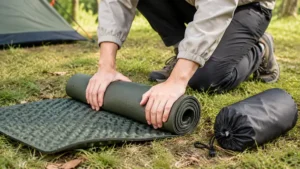
First use. Unroll the pad, open the valve and let it expand. Add a few breaths to reach your preferred firmness, then close the valve.
After each trip. Wipe dirt, sunscreen and bug spray off the surface with a damp cloth. Dry both the exterior and the valve area thoroughly, avoiding prolonged direct sunlight.
Storage. Store the pad unrolled, or loosely rolled, in a dry place with the valve open. Sea to Summit specifically advises not leaving the valve closed while the pad is stored compressed, since it can become misshapen. Closing it can also trap moisture and encourage mildew.
Leak testing. Inflate the pad firmly, then brush soapy water around the valve and seams and watch for bubbles. For pads with replaceable valves, check the seal periodically; hardened or cracked O-rings can cause slow leaks.
Repair. For a valve swap, you’ll typically need a brand-matched valve repair kit and a pair of pliers. Once the adhesive cures, Field & Stream recommends inflating the pad and letting it sit for 8-12 hours to confirm there’s no leak. Use proper adhesives like Seam Grip or Aquaseal, since glue alone won’t fix a rip. For brand-specific steps, Sea to Summit’s repair guide walks through leak-finding and patching.
✨ Don’t Miss These Exclusive Deals!
🔍 Take your camping comfort to the next level with these carefully selected pads. Click on any highlighted item to check current pricing and availability. A better night’s sleep is one decision away!
Real-World Scenarios: Matching Pads to People
Scenario 1: The college student on a tight budget. A first-year student camping a few weekends each semester, sleeping on their back, with a $50 ceiling. The Gear Doctors Oxylus is the logical choice: low cost, R-4.3 insulation and a compact roll that fits a dorm closet. If you sleep on your side, you’ll feel the 1.5-inch profile, and a thin foam topper solves it.
Scenario 2: The side-sleeping couple car camping. Two people, one wide tent, fall temperatures dipping into the 30s°F. Each person gets a Hikenture 4-Inch Self-Inflating Pad for width and loft. Don’t trust the R-9.5 number alone, so add a closed-cell foam layer underneath for insurance.
Scenario 3: The casual backpacker stepping up. Someone doing three-night trips with a 25-pound pack and a mid-range budget. The Therm-a-Rest Trail ProLite makes sense because it’s light and its R-3.8 is verified. They’ll sacrifice plush comfort but gain trail-friendly weight.
Scenario 4: The cautious first-timer. Someone who doesn’t want to gamble on an unfamiliar brand. The REI Co-op Campwell or Sea to Summit Camp Plus S.I. gives them comparable specs and a real support path.
Common Problems and Quick Solutions
Problem: The pad won’t fully inflate. That’s normal. Foam-only expansion rarely reaches your ideal firmness. Add a few breaths, then close the valve.
Problem: It’s losing air overnight. Temperature drops can make the pad feel softer, but a real leak shows up in the soapy-water test. Patch it with a proper kit.
Problem: You’re cold from below. Stack a cheap closed-cell foam pad beneath your pad, since R-values are additive. Also check your pad’s actual R-value against your conditions.
Problem: A sore hip on thin foam. Add a topper, or switch to a 4-inch model like the Acacia 4-Inch Self-Inflating Pad.
Problem: The valve is stuck or leaking. Clean it, check for debris and replace it with a brand-matched kit if needed.
Budget Self-Inflating Sleeping Pad vs. Alternatives
| Pad Type | Typical Strength | Typical Weakness | Best For |
|---|---|---|---|
| Self-inflating foam (e.g., Coleman Silver Springs) | Durable, keeps cushioning if punctured | Heavier, bulkier | Car camping, general use |
| Basic inflatable (e.g., Klymit Static V) | Light, packable | Low R-value (1.3), puncture-prone | Warm-weather backpacking |
| Closed-cell foam | Cheapest, nearly indestructible | Thin, bulky, less comfortable | Ultralight and stacking |
| Premium self-inflating (e.g., Therm-a-Rest MondoKing 3D) | Maximum comfort | Cost and weight | Luxury car camping |
The takeaway is simple. A budget self-inflating sleeping pad lands in the middle on weight and cost, but it wins on reliability, because foam keeps working after a puncture where an air pad is finished. If you only camp in warm weather and carry everything on your back, an inflatable may suit you better. For almost everyone else, the foam-core pad is the safer budget play.
Price Range & Value Analysis (Including Long-Term Cost)
| Tier | Price Range | Example | Value Verdict |
|---|---|---|---|
| Bargain | Under $60 | Gear Doctors Oxylus | Best warmth per dollar |
| Budget | $60-$85 | Coleman Silver Springs | Best for casual car camping |
| Value | $100-$150 | Sea to Summit Camp Plus S.I., REI Co-op Campwell, Therm-a-Rest Trail ProLite | Best long-term value and support |
Looking at cost per use, a $45 pad used 10 nights a year for 5 years costs under 90 cents a night. A $130 pad used for 10 years lands around $1.30 a night, which is close, and it usually comes with better specs, cleaner R-values and repair support. Cheap is only a bargain if it lasts. The real long-term costs are a valve kit, a patch kit and a few ounces of adhesive, a tiny price for an extra season or two. Spend the extra $20-$40 if it buys you ASTM-labeled insulation and a brand that publishes repair steps.
Common Mistakes When Buying a Budget Self-Inflating Sleeping Pad
Trusting a headline R-value. Without ASTM testing, a number is just a claim. Cross-check against known brands.
Buying too thin for your sleep style. Thinness is the most common regret for side sleepers.
Ignoring weight. A 6-pound pad feels fine in a parking lot and terrible after 3 miles.
Skipping the leak test. Test any new pad at home before the trip. Return windows are your friend.
Storing it wrong. A pad crammed into its stuff sack with the valve shut will age faster than one stored loosely with the valve open.
Forgetting the repair kit. A patch and valve kit weigh almost nothing and can save a trip.

FAQ
❓ How thick should a budget self-inflating sleeping pad be for side sleepers?
❓ Is a self-inflating pad warm enough for cold weather?
❓ How long does a self-inflating pad take to inflate?
❓ Can I repair a self-inflating pad valve at home?
❓ How should I store a self-inflating pad between trips?
Conclusion
Choosing a budget self-inflating sleeping pad comes down to three honest questions. How do you sleep, how far will you carry it, and how cold will you get? For side sleepers who car camp, the Acacia 4-Inch Self-Inflating Pad and Hikenture 4-Inch Self-Inflating Pad offer the loft that makes a night outdoors feel civilized, though the Hikenture’s R-value deserves a skeptical eye. For warmth per dollar, the Gear Doctors Oxylus is hard to beat. For casual car camping, the Coleman Silver Springs keeps things simple. For buyers who want verified specs and support, the Sea to Summit Camp Plus S.I., REI Co-op Campwell and Therm-a-Rest Trail ProLite justify their higher prices.
Whichever you pick, treat the valve like the heart of the pad. Store it open, keep it clean, carry a patch kit and test it at home first. A little care turns an inexpensive purchase into a multi-season companion, and a good night’s sleep is the cheapest upgrade in camping.
Recommended for You
- Self-Inflating Sleeping Pad For Truck Bed Camping: 7 Best Picks 2026
- Self-Inflating Sleeping Pad For Backpacking: 7 Best Picks 2026
- Budget Foam Sleeping Pad: 7 Proven Picks For 2026
Disclaimer: This article contains affiliate links. As an Amazon Associate, I earn from qualifying purchases. If you purchase products through these links, we may earn a small commission at no additional cost to you.
✨ Found this helpful? Share it with your friends! 💬🤗
