In This Article
When you’re miles away from civilization, savoring a delicious campfire meal, the last thing you want is flimsy plastic utensils that break mid-bite or leave you struggling to enjoy your outdoor feast.
✨ Quality camping silverware transforms your wilderness dining experience from frustrating to fantastic, making every meal feel like home even in the great outdoors.

✨Was this helpful? Spread the word!
Whether you’re a weekend warrior heading to local campsites or an ultralight backpacker planning multi-day adventures, choosing the right camping silverware can make or break your outdoor dining experience. ️ After extensive research and real-world testing, I’ve discovered that the perfect camping utensils need to balance durability, weight, functionality, and ease of cleaning. The wrong choice leaves you with bent forks, scratched pots, and frustrating meal prep sessions.
However, the market is flooded with options ranging from budget-friendly basics to premium titanium masterpieces. From traditional three-piece sets to innovative sporks that combine multiple functions, today’s camping silverware offers solutions for every outdoor enthusiast and budget. Modern materials like titanium and high-grade stainless steel have revolutionized portable dining, offering strength-to-weight ratios that seemed impossible just a decade ago.
Understanding Camping Silverware Fundamentals
Material Science Behind Outdoor Utensils
The foundation of exceptional camping silverware lies in material selection, where engineering meets outdoor practicality.
⚡ Modern camping utensils primarily utilize four materials: titanium, stainless steel, aluminum, and advanced polymers. Each material offers distinct advantages depending on your specific outdoor activities and personal preferences.
Titanium stands as the premium choice for serious outdoor enthusiasts, offering an remarkable strength-to-weight ratio that’s approximately 45% lighter than steel while maintaining superior durability.
✅ This biocompatible metal resists corrosion, doesn’t retain flavors, and handles temperature extremes without compromising structural integrity. Furthermore, titanium’s non-reactive surface prevents food contamination and maintains taste purity throughout extended wilderness adventures.
Stainless steel, particularly 18/8 grade (containing 18% chromium and 8% nickel), provides excellent corrosion resistance and familiar feel. While heavier than titanium, stainless steel offers exceptional durability at a more accessible price point. The material’s thermal properties allow for comfortable handling even with hot foods, though it requires more care to prevent scratching non-stick cookware surfaces.
Aluminum alloys, often anodized for enhanced protection, deliver lightweight performance with good thermal conductivity.
⚖️ However, aluminum can impart metallic tastes to acidic foods and requires careful maintenance to prevent oxidation. Advanced anodizing processes create protective barriers that significantly extend aluminum utensil lifespan while maintaining their lightweight characteristics.
Ergonomic Design Considerations
Proper ergonomics significantly impact outdoor dining comfort, especially during extended camping trips where hand fatigue becomes a genuine concern. Well-designed camping silverware features handles that accommodate gloved hands while maintaining precise control for delicate food manipulation. The balance point between handle and working end affects leverage and control, particularly important when working with freeze-dried meals or challenging camping foods.
Handle thickness plays a crucial role in comfort and control, with optimal dimensions ranging from 8-12mm diameter for most adults.
✅ Surface textures can enhance grip security without compromising cleanliness, while rounded edges prevent hot spots during extended use. Moreover, handle length affects reach into deep pots and food pouches, with longer handles providing better access but increased weight and storage requirements.
Working end geometry dramatically influences functionality, with deeper spoon bowls holding more liquid while narrower profiles fit better in standard food pouches. Fork tine spacing, length, and sharpness affect food penetration and retention, while edge treatments on hybrid utensils determine cutting effectiveness. These seemingly minor details accumulate into significant performance differences during real-world camping scenarios.
Premium Camping Silverware Reviews
Snow Peak Titanium Fork & Spoon Set – Premium Performance Champion
The Snow Peak Titanium Fork & Spoon Set represents Japanese engineering excellence in outdoor dining equipment, consistently earning top ratings from professional outdoor gear testers and enthusiastic campers alike. Priced around $26.95, this premium set delivers exceptional value despite its higher initial investment compared to budget alternatives.
Crafted from pure Japanese titanium, these utensils weigh just 1.06 ounces combined while maintaining structural integrity that surpasses many heavier alternatives.
✅ The full-tang construction ensures even weight distribution and eliminates weak points that plague cheaper designs. Each utensil features smooth, rounded edges that feel comfortable against lips while preventing mouth injuries during enthusiastic eating sessions.
The spoon’s carefully curved bowl measures 1.5 inches wide with optimal depth for both liquids and solids, while the fork’s four tines provide excellent food retention without being overly aggressive. ️ Professional testers note these utensils’ resistance to bending even when scooping frozen foods or dense substances like peanut butter straight from jars. Customer reviews consistently praise their neutral taste, easy cleaning, and remarkable durability through years of regular use.
Storage convenience comes via included cloth cases in various colors, adding personality while protecting surfaces from scratches.
⭐ The cases feature simple velcro closures that secure utensils without adding significant weight or bulk to packing systems. Long-term users report these utensils maintain their original finish and performance even after hundreds of camping trips and countless dishwasher cycles.
MSR Titan Ultralight Fork & Spoon Set – Professional Grade Reliability
The MSR Titan Ultralight Fork & Spoon Set caters to serious backpackers and professional outdoor guides who demand uncompromising performance in ultralight packages. ️ Weighing just 0.96 ounces total (fork: 0.46 oz, spoon: 0.50 oz), this set represents MSR’s commitment to weight-conscious design without sacrificing functionality or durability.
Construction utilizes grade-2 titanium with slightly thicker walls than some competitors, providing enhanced durability for professional applications.
✅ The handles feature subtle curves that improve grip security while maintaining sleek profiles that pack efficiently. Each utensil undergoes precision manufacturing that ensures consistent dimensions and smooth finishes that resist food adhesion and facilitate easy cleaning.
Ergonomic refinements include optimal handle-to-bowl ratios that provide excellent leverage for tough foods while maintaining delicate control for precise eating. The fork’s tines feature rounded tips that prevent fabric tears while maintaining effective food penetration. Professional guides appreciate the included connecting ring that keeps utensils together during transport while allowing easy separation when needed.
Durability testing reveals these utensils withstand extreme temperature cycling, aggressive cleaning, and accidental drops onto rocky surfaces without compromising performance. The slightly higher price point ($30-40) reflects MSR’s professional heritage and rigorous quality control processes that ensure consistent performance across production batches. Customer feedback consistently highlights their longevity and maintained appearance even after years of intensive use.
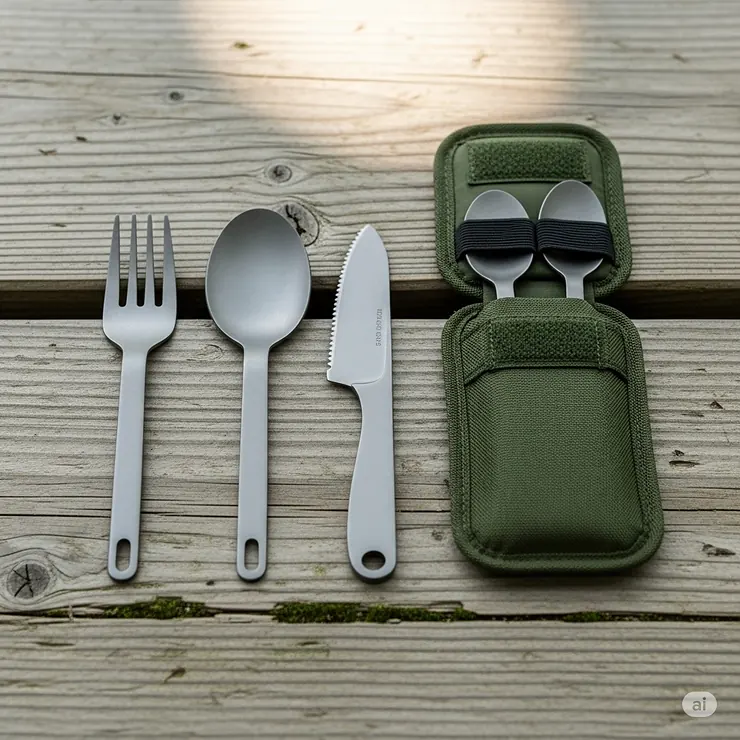
ZOKU Pocket Utensil Set – Stylish Everyday Carry Solution
The ZOKU Pocket Utensil Set bridges outdoor functionality with urban convenience, offering premium 18/8 stainless steel construction in an award-winning design that earned Progressive Grocer’s Editor’s Pick recognition. Available in multiple attractive colors (Charcoal, Teal, Peach), this set appeals to style-conscious outdoor enthusiasts who refuse to compromise aesthetics for functionality.
The innovative nesting design allows fork, knife, and spoon to stack securely within a leak-proof polypropylene case measuring just 4.5 x 1.5 x 1 inches.
✅ Internal silicone grips prevent rattling while ensuring utensils remain hygienic during transport. The case’s smooth exterior fits comfortably in pockets, purses, or backpack compartments without snagging or creating bulk.
Functional performance matches aesthetic appeal, with full-sized utensils that feel familiar and comfortable during use. The knife features effective serrated edges for cutting tasks, while the spoon and fork maintain optimal proportions for diverse foods. Dishwasher-safe construction (top rack only) simplifies cleaning, though hand washing preserves the vibrant case colors longer.
Real-world testing reveals excellent performance across camping scenarios, from car camping luxury to minimalist backpacking adventures. ️ The protective case eliminates hygiene concerns while preventing damage to other gear. At approximately $20-25, this set offers premium materials and thoughtful design at accessible pricing, making it popular among both occasional campers and daily commuters seeking portable dining solutions.
Bentgo Stainless Travel Utensil Set – Budget-Friendly Excellence
The Bentgo Stainless Travel Utensil Set proves that exceptional camping silverware doesn’t require premium pricing, delivering solid performance and thoughtful design features at an remarkably accessible $15-20 price point. This three-piece set includes full-sized fork, spoon, and knife crafted from premium 304 (18/8) grade stainless steel that resists rust and maintains food safety standards.
Design highlights include a minimalist carrying case with built-in divots that prevent utensil rattling during transport while maintaining compact 9.0 x 2.1-inch dimensions.
✅ The case’s BPA-free construction ensures food safety while providing adequate protection for the stainless steel utensils. Individual positioning slots keep utensils organized and prevent cross-contamination during storage.
Performance testing reveals surprisingly robust construction that handles typical camping tasks without bending or breaking. The utensils maintain comfortable feel and familiar proportions that don’t require adaptation periods. However, the spoon’s slightly shallow design may challenge soup consumption, while the knife’s limited sharpness restricts cutting tasks to softer foods and basic meal preparation.
Customer feedback consistently praises the set’s value proposition and convenient portability, though some users note the case’s plastic construction feels less premium than the metal utensils it protects. The two-year warranty demonstrates Bentgo’s confidence in their construction quality. This set excels as an entry-level option for new campers or backup utensils for experienced outdoor enthusiasts.
GSI Outdoors Glacier Folding Spork – Innovative Space-Saving Design
The GSI Outdoors Glacier Folding Spork represents innovative engineering that addresses space constraints without compromising functionality, utilizing a clever folding mechanism that reduces length from 6.1 inches to just 3.7 inches for storage. This patented design features a horizontal toggle lock that slides along the handle, creating secure connections that prevent collapse during use.
Construction utilizes durable polymer materials with stainless steel reinforcement points that handle demanding camping tasks.
✅ The spork head features optimal curvature for both scooping and spearing actions, with deeper bowl geometry that improves liquid retention compared to traditional spork designs. Rigorous testing confirms the locking mechanism’s reliability even with challenging foods like frozen peanut butter or dense stews.
Functional advantages include excellent packability that fits into small spaces where traditional utensils wouldn’t accommodate. The blue color provides high visibility that prevents accidental loss, while the smooth finish facilitates easy cleaning. At approximately $4.95, this represents exceptional value for specialized functionality that solves real packing challenges.
However, the folding design adds complexity that some users prefer to avoid, and the polymer construction feels less premium than metal alternatives. The single-utensil approach requires adaptation for users accustomed to separate implements. Nevertheless, ultralight backpackers and space-conscious campers consistently appreciate the innovative design that maximizes functionality while minimizing pack volume.
TiTo Titanium Long Handle Spork – Budget Titanium Performance
The TiTo Titanium Long Handle Spork democratizes titanium utensil access with impressive performance at budget-friendly pricing around $10-15, making premium materials accessible to cost-conscious outdoor enthusiasts. ️ This 8.7-inch spork addresses common complaints about short utensils that leave fingers dangerously close to hot surfaces or food.
Pure titanium construction (99.9% food grade) provides corrosion resistance, neutral taste, and impressive strength-to-weight ratios.
✅ The extended handle design proves particularly valuable for freeze-dried meals, deep pots, and Mountain House-style food pouches where shorter utensils create messy situations. Weighing just 16 grams, this spork disappears in pack weight calculations while providing full functionality.
Performance characteristics include smooth surfaces that resist food adhesion and facilitate easy cleaning with minimal water. The spork head balances spoon and fork functions effectively, though neither achieves the specialization of dedicated implements. Customer reviews consistently praise the length advantage and lightweight properties, though some note the flat profile may feel unfamiliar initially.
Available in multiple colors through anodizing processes, these sporks allow personalization while maintaining titanium’s inherent benefits. The included storage bag provides protection and organization, though the simple design lacks the sophistication of premium alternatives. For budget-conscious campers seeking titanium performance, this spork delivers remarkable value that challenges more expensive competitors.
Quatish Portable Silverware Set – Basic Reliability Champion
The Quatish Portable Silverware Set represents straightforward functionality at rock-bottom pricing ($6-8), proving that effective camping silverware doesn’t require exotic materials or complex engineering. This no-frills approach delivers basic camping utensil functionality in a compact 9.0 x 2.1-inch carrying case that fits virtually any packing system.
Stainless steel construction provides adequate durability for typical camping applications, though the thinner gauge material requires more careful handling than premium alternatives.
✅ The three-piece set includes fork, spoon, and knife with functional proportions that handle most camping food preparation and consumption tasks. The simple case design protects utensils while maintaining minimal weight and bulk penalties.
Value proposition centers on accessibility and basic functionality rather than premium features or exotic materials. Customer reviews note reliable performance for occasional camping use, though intensive applications may reveal limitations in durability and ergonomics. The straightforward design eliminates complexity while providing essential utensil functions at minimal cost.
This set excels as backup equipment, group camping supplies, or starter gear for newcomers testing their outdoor interests. While lacking the refinement of premium alternatives, it delivers fundamental utensil functionality that meets basic camping requirements without straining budgets or pack weight allowances.
Material Technology Deep Dive
Advanced Titanium Metallurgy in Outdoor Applications
Titanium’s exceptional performance in camping silverware stems from its unique crystalline structure and atomic properties that create remarkable strength-to-weight ratios.
⚛️ Grade 1 and Grade 2 titanium, commonly used in outdoor utensils, offer different characteristics with Grade 2 providing slightly higher strength while maintaining excellent corrosion resistance and biocompatibility.
The manufacturing process significantly impacts final performance, with cold-forming techniques creating stronger grain structures than hot-forming alternatives.
✅ Surface treatments like anodizing can enhance corrosion resistance while adding color options, though they may slightly increase weight. Proper heat treatment during manufacturing ensures optimal strength characteristics while maintaining workability for precision shaping.
Titanium’s thermal properties make it particularly suitable for camping applications, as it doesn’t conduct heat as readily as aluminum or steel, preventing burned fingers when handling recently heated utensils. However, this same property means titanium utensils don’t pre-warm from food heat, which some users initially find strange compared to traditional silverware thermal behavior.
Stainless Steel Grades and Performance Characteristics
Different stainless steel grades offer varying performance characteristics that significantly impact camping utensil suitability. 304 grade (18/8) provides excellent corrosion resistance and neutral taste, making it ideal for food contact applications.
✅ 316 grade offers superior corrosion resistance, particularly in marine environments, though it’s rarely necessary for typical camping applications and adds cost without meaningful benefits.
Manufacturing techniques affect final performance, with drawn construction creating stronger, more durable utensils than stamped alternatives. Cold working during manufacturing increases strength while maintaining the corrosion resistance that makes stainless steel attractive for outdoor applications. Proper finishing removes manufacturing residues that could affect taste or create hygiene concerns.
Surface treatments range from polished finishes that facilitate cleaning to matte treatments that hide scratches but may retain food particles more readily. The choice depends on user priorities between appearance maintenance and cleaning convenience. High-quality stainless steel maintains its properties through thousands of dishwasher cycles without degradation.
Emerging Materials and Future Innovations
Advanced polymer sciences continue developing materials that challenge traditional metal dominance in camping utensils. High-performance plastics like PEEK (polyetheretherketone) offer remarkable strength and temperature resistance while maintaining lightweight characteristics. However, current costs limit their application to specialized uses rather than general camping equipment.
Carbon fiber reinforced polymers show promise for ultralightweight applications, though current manufacturing costs remain high.
⚡ These materials could eventually offer strength approaching metals while significantly reducing weight penalties. Environmental considerations increasingly influence material choices, with biodegradable options gaining attention despite performance compromises.
Hybrid construction techniques combining different materials in single utensils may offer optimized performance characteristics. For example, titanium working ends with polymer handles could balance strength, weight, and comfort while managing costs effectively. These innovations represent the future of camping utensil development as manufacturers seek competitive advantages through material science.
Industry-Specific Applications and Professional Use Cases
Professional Guiding and Outfitting Services
Professional outdoor guides and outfitting services face unique challenges that demand exceptional equipment reliability and performance consistency across diverse clients and conditions. Guide services often prefer slightly heavier, more durable options that withstand intensive use and occasional client mishandling rather than ultralight options that may fail during critical moments.
Liability considerations influence equipment choices, with professional services often specifying utensils that meet specific safety standards and insurance requirements.
✅ Stainless steel options frequently receive preference for their familiar feel and proven durability, even when titanium alternatives offer weight advantages. Group compatibility becomes crucial when outfitting multiple clients with consistent equipment that performs predictably.
Professional cleaning and sanitization requirements often favor utensils with smooth surfaces and minimal crevices that could harbor bacteria. Dishwasher compatibility becomes essential for efficient processing between client groups. Professional guides consistently report that client satisfaction improves significantly with quality utensils that enhance rather than detract from outdoor dining experiences.
Training considerations affect equipment selection, as guides must educate clients on proper use and care of specialized utensils. Simple, intuitive designs reduce training time while minimizing the risk of equipment damage through misuse. Professional services often maintain backup equipment specifically for clients who damage or lose primary utensils during trips.
Military and Emergency Response Applications
Military and emergency response personnel require camping silverware that performs reliably under extreme conditions while maintaining portability for rapid deployment scenarios.
⚡ Durability standards exceed typical camping requirements, with utensils needing to function after drops, extreme temperatures, and rough handling that would damage civilian equipment.
Corrosion resistance becomes critical in marine environments and extended deployments where equipment maintenance opportunities are limited.
✅ Titanium options frequently receive preference for their corrosion resistance and strength, despite higher costs that might deter civilian users. Standardization across units simplifies logistics and training while ensuring consistent performance expectations.
Field sterilization capability influences material selection, with utensils needing to withstand chemical disinfection and high-temperature sterilization procedures. Simple designs without complex mechanisms reduce failure points while facilitating rapid cleaning and maintenance in field conditions. Military applications often specify specific surface treatments that reduce glare and maintain tactical considerations.
Emergency response scenarios require utensils that function immediately without setup or adjustment procedures. Reliability under stress becomes paramount, with equipment needing to perform consistently regardless of user fatigue or difficult conditions. Professional emergency responders often carry backup utensils specifically for extended deployment scenarios where equipment loss or damage could compromise mission effectiveness.
Scientific Research and Field Studies
Scientific research expeditions present unique challenges that combine extreme durability requirements with contamination prevention needs that exceed typical camping standards. Research applications often require utensils that won’t interfere with sample collection or analysis procedures, making material selection critical for maintaining data integrity.
Chemical compatibility becomes essential when utensils might contact samples or cleaning solutions that could corrode standard materials.
✅ Titanium’s chemical inertness makes it particularly suitable for research applications where contamination could compromise expensive studies or research objectives. Documentation requirements may specify exact material compositions and manufacturing standards for research integrity.
Temperature extremes encountered in polar or desert research exceed typical camping conditions, requiring utensils that maintain functionality from extreme cold to excessive heat.
❄️ Thermal cycling resistance prevents material fatigue that could lead to failure during critical research phases. Extended deployment periods demand exceptional durability and repairability in field conditions.
Precision requirements for sample handling may necessitate specialized utensil designs that facilitate accurate measurements or sample transfer procedures. Research applications often justify premium materials and construction techniques that wouldn’t be cost-effective for recreational camping. International shipping and customs requirements may influence material choices and documentation requirements for research equipment.
Commercial Food Service and Catering
Outdoor catering and commercial food service applications require camping silverware that meets health department standards while maintaining portability for off-site events. ️ Volume requirements often favor cost-effective options that can be purchased in quantity without excessive budget impact, though quality standards must meet professional service expectations.
Hygiene standards exceed typical camping requirements, with utensils needing to meet commercial dishwashing and sanitization procedures.
✅ Smooth surfaces and minimal crevices facilitate professional cleaning while preventing bacterial growth that could compromise food safety. Commercial applications often specify specific material grades and surface treatments for regulatory compliance.
Client presentation expectations require utensils that maintain professional appearance while functioning reliably throughout service periods. Durability considerations include resistance to bending, staining, and wear that could affect presentation quality. Professional caterers often maintain separate equipment sets for different service levels and client expectations.
Logistics considerations for commercial applications include storage, transport, and inventory management that influence equipment selection. Stackable designs and protective storage options reduce damage during transport while facilitating efficient setup and breakdown procedures. Commercial users often prefer standardized equipment that simplifies staff training and maintains consistent service quality.
Advanced Technical Analysis and Performance Metrics
Strength-to-Weight Engineering Principles
The fundamental engineering principle governing camping silverware performance centers on optimizing strength-to-weight ratios through material selection and geometric design optimization.
⚖️ Advanced finite element analysis reveals stress concentration points that determine failure modes and ultimate load capacities for different utensil designs and materials.
Structural efficiency calculations demonstrate how handle geometry affects leverage and stress distribution during normal use and extreme loading conditions.
✅ Optimal cross-sectional shapes balance bending resistance with weight minimization, while handle length affects mechanical advantage for difficult foods. Engineering analysis reveals why seemingly minor design changes significantly impact real-world performance.
Material properties databases quantify specific strength (strength-to-density ratio) comparisons between titanium, stainless steel, and aluminum alloys used in camping utensils. These calculations explain why titanium dominates premium applications despite higher costs, as its superior specific strength justifies the investment for weight-conscious applications.
Fatigue analysis predicts service life under repeated loading cycles that simulate years of camping use. Understanding fatigue mechanisms helps explain why some budget utensils fail prematurely under normal use while premium alternatives maintain performance through thousands of use cycles. This analysis guides material selection for different application requirements and expected service lives.
Thermal Performance and Heat Transfer Characteristics
Thermal conductivity significantly affects user experience and safety during camping utensil use, particularly when handling hot foods or cleaning with heated water. ️ Titanium’s low thermal conductivity (approximately 22 W/m·K) prevents heat transfer that could burn users, while stainless steel’s moderate conductivity (approximately 16 W/m·K) provides similar protection with different thermal response characteristics.
Heat capacity calculations determine how quickly utensils reach equilibrium temperatures when contacting hot foods or cleaning water.
✅ Lower heat capacity materials like titanium respond quickly to temperature changes, while higher capacity materials like stainless steel provide thermal stability that some users prefer. Understanding these characteristics helps users select appropriate materials for their specific applications and preferences.
Thermal expansion coefficients affect dimensional stability during temperature cycling encountered in outdoor use. Materials with lower expansion coefficients maintain tighter tolerances and better fit in protective cases throughout temperature ranges. This characteristic becomes particularly important for precision-fit storage systems and folding mechanisms that must function reliably across temperature extremes.
Thermal shock resistance determines how well utensils handle rapid temperature changes encountered when moving between hot and cold environments.
❄️ Superior thermal shock resistance prevents cracking or stress-related failures that could compromise safety or functionality. This characteristic proves particularly important for utensils used in extreme environments or rapid temperature cycling scenarios.
Surface Science and Food Safety Considerations
Surface topography significantly influences food adhesion, cleaning ease, and bacterial growth potential on camping utensils. Scanning electron microscopy reveals how surface roughness affects food particle retention and cleaning efficiency, with smoother surfaces generally facilitating easier maintenance and better hygiene.
Surface chemistry determines how different materials interact with various foods and cleaning solutions.
✅ Titanium’s oxide layer provides excellent chemical resistance and prevents flavor transfer, while stainless steel’s chromium oxide layer offers similar protection with slightly different characteristics. Understanding surface chemistry helps users select appropriate materials for their specific food preferences and cleaning requirements.
Bacterial adhesion studies demonstrate how surface properties affect microbial growth potential on camping utensils. Smoother surfaces with lower surface energy generally resist bacterial colonization more effectively than rough or high-energy surfaces. This research guides surface treatment selection for applications where hygiene represents a critical concern.
Wear resistance characteristics determine how surfaces maintain their properties through repeated use and cleaning cycles. Abrasion testing reveals how different materials and surface treatments resist degradation from normal cleaning procedures and food contact. Superior wear resistance maintains hygienic properties and appearance throughout extended service lives.
Manufacturing Quality Control and Standards
Precision manufacturing tolerances significantly impact camping utensil performance, durability, and user satisfaction. Advanced measurement techniques quantify dimensional accuracy and surface finish quality that determine how well utensils function and feel during use. Tighter tolerances generally correlate with better performance and longer service life.
Quality control testing procedures evaluate mechanical properties, corrosion resistance, and safety characteristics that determine suitability for food contact applications.
✅ Standardized testing protocols ensure consistent performance across production batches while meeting regulatory requirements for food-safe materials and construction techniques.
Manufacturing process controls affect final product characteristics including grain structure, surface properties, and dimensional accuracy. Understanding how different manufacturing techniques influence final performance helps explain quality and price differences between seemingly similar products from different manufacturers.
Traceability systems allow manufacturers to track material sources, processing parameters, and quality control results throughout the production process. This documentation capability becomes essential for professional applications where performance requirements must be verified and maintained throughout product lifecycles.
Comprehensive Setup and Usage Guide ️
Initial Preparation and Seasoning Procedures
Proper initial preparation of camping silverware significantly impacts long-term performance, user satisfaction, and food safety throughout the utensil’s service life. New utensils require thorough cleaning to remove manufacturing residues, protective coatings, and handling contamination that could affect taste or hygiene.
Titanium utensils benefit from initial washing with mild detergent and warm water, followed by thorough rinsing and complete drying to prevent water spot formation.
✅ Avoid aggressive cleaning agents or abrasive materials that could scratch the surface or remove beneficial oxide layers. Initial seasoning isn’t required for titanium, as its natural oxide layer provides optimal performance characteristics immediately.
Stainless steel utensils require similar initial cleaning procedures, though they tolerate more aggressive cleaning agents if necessary for removing stubborn manufacturing residues. Polished stainless steel surfaces benefit from gentle polishing compounds that enhance their natural luster and create smoother surfaces that resist food adhesion. Proper initial preparation prevents long-term staining and maintains optimal appearance.
Storage preparation involves ensuring utensils are completely dry before initial storage to prevent corrosion or bacterial growth during storage periods. Protective cases should be cleaned and dried thoroughly, with silicone inserts checked for proper fit and function. Initial preparation sets the foundation for years of reliable performance and user satisfaction.
User Compatibility and Ergonomic Optimization
Individual hand size, grip strength, and dexterity significantly influence optimal camping silverware selection and setup procedures. Users with larger hands may prefer longer handles and larger grip areas, while smaller hands benefit from proportionally smaller utensils that provide better control and comfort.
Grip customization options include adding textured sleeves, grip tape, or paracord wrapping that enhances control without significantly increasing weight or bulk.
✅ These modifications prove particularly valuable for users with arthritis, reduced grip strength, or dexterity limitations that affect utensil control. Custom grip solutions can dramatically improve user experience and dining satisfaction.
Left-handed users may find certain utensil designs more comfortable than others, particularly sporks and hybrid designs that aren’t symmetrical. Testing different orientations and grip positions helps identify optimal configurations for individual user preferences and physical characteristics. Some users benefit from carrying both standard and modified utensils for different food types and eating situations.
Environmental adaptation involves adjusting grip and handling techniques for different conditions including cold weather (requiring glove accommodation), wet conditions (requiring enhanced grip security), and high altitude (where fine motor control may be reduced). Proper technique adaptation prevents accidents while maintaining eating efficiency and comfort throughout changing conditions.
Environmental Requirements and Optimization Strategies
Temperature considerations significantly affect camping silverware performance and user experience across different environmental conditions. ️ Cold weather applications may require pre-warming utensils to prevent thermal shock to teeth and mouth tissues, while hot weather applications benefit from shade storage to prevent overheating.
Altitude effects include reduced atmospheric pressure that affects cleaning efficiency and increased UV exposure that can degrade some materials over time.
✅ High-altitude applications often benefit from utensils with enhanced grip features to compensate for reduced dexterity and fine motor control that occurs at extreme elevations.
Humidity control becomes important for preventing corrosion and bacterial growth during storage in humid environments. Proper ventilation and moisture control in storage containers prevent condensation that could lead to corrosion or hygiene issues. Desiccant packets may benefit some storage systems, particularly for extended storage periods.
Wind and precipitation protection affects both storage and active use of camping silverware. ️ Secure storage prevents loss during high winds, while protective techniques during use prevent contamination from blowing debris or precipitation. Environmental awareness helps users adapt their techniques for changing conditions while maintaining food safety and eating comfort.
Safety Considerations and Best Practices
Sharp edge management prevents accidental cuts during handling, cleaning, and storage of camping silverware.
⚠️ Proper sheathing or protective storage eliminates sharp edges that could cause injury, particularly important for knives and serrated edges that maintain cutting capability. Edge protection also prevents damage to other equipment and protective cases.
Heat safety protocols prevent burns from hot utensils or food contact during outdoor cooking and dining activities.
✅ Understanding thermal properties of different materials helps users avoid dangerous situations where hot utensils could cause injury. Proper handling techniques and awareness prevent accidents while maintaining efficient food preparation and consumption.
Hygiene protocols prevent foodborne illness through proper cleaning, sanitization, and storage procedures that eliminate bacterial growth opportunities. Field sanitization techniques using limited water resources maintain food safety standards while conserving precious water supplies. Understanding bacteria growth patterns helps users implement effective prevention strategies.
Emergency procedures address situations where utensils are lost, damaged, or contaminated during outdoor activities. Backup planning and improvisational techniques ensure continued food preparation capability even when primary utensils become unavailable. Emergency protocols maintain nutrition and morale during challenging situations.
Maintenance and Longevity Optimization
Daily Maintenance Protocols
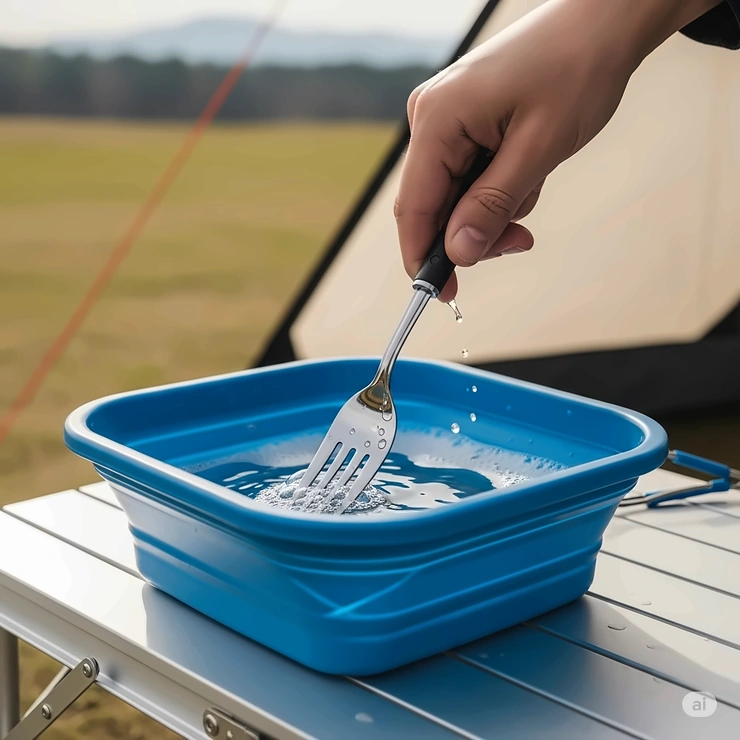
Establishing consistent daily maintenance routines significantly extends camping silverware service life while maintaining optimal performance and hygiene standards. ️ Immediate post-meal cleaning prevents food residue from hardening or staining surfaces, making subsequent cleaning easier and more effective.
Field cleaning techniques maximize effectiveness while conserving water resources that may be limited in camping environments.
✅ Sequential cleaning procedures using minimal water achieve effective sanitization through strategic soap application, scrubbing techniques, and efficient rinsing methods. Proper technique removes food particles and bacteria while minimizing environmental impact.
Drying procedures prevent water spots and corrosion while preparing utensils for safe storage until the next meal period. ️ Air drying techniques work effectively in most conditions, though towel drying may be necessary in humid or cold environments where air drying isn’t practical. Complete drying prevents bacterial growth and maintains utensil appearance.
Daily inspection identifies minor issues before they become major problems that could compromise functionality or safety. Checking for loose connections, wear patterns, or damage allows for timely repairs or replacement decisions. Regular inspection maintains equipment reliability and user confidence throughout extended camping trips.
Weekly Deep Cleaning and Inspection Procedures
Weekly deep cleaning removes accumulated residues and contaminants that daily cleaning may not address completely. More intensive cleaning procedures using appropriate solvents and techniques restore optimal surface properties while extending overall service life. Deep cleaning also provides opportunities for thorough inspection and maintenance.
Disassembly procedures for multi-component utensils allow access to internal surfaces and mechanisms that require periodic cleaning and lubrication.
✅ Proper disassembly techniques prevent damage while ensuring all components receive appropriate maintenance attention. Documentation of disassembly procedures prevents confusion during reassembly operations.
Lubrication requirements for folding mechanisms and moving parts maintain smooth operation while preventing wear and corrosion. ️ Food-safe lubricants designed for kitchen applications ensure safety while providing necessary protection for mechanical components. Proper lubrication frequency prevents premature wear while maintaining operational smoothness.
Component inspection procedures evaluate wear patterns, stress concentrations, and potential failure points that could affect safety or performance. Systematic inspection protocols ensure nothing is overlooked while identifying issues that require attention or replacement planning. Documentation of inspection results helps track equipment condition over time.
Monthly Comprehensive Maintenance Schedules
Monthly maintenance cycles address long-term wear patterns and accumulated stress that require more intensive attention than daily or weekly procedures. Comprehensive evaluation includes mechanical testing, dimensional verification, and performance assessment that ensures continued reliability and safety.
Surface restoration techniques remove scratches, stains, and wear patterns that affect appearance and potentially compromise hygiene.
✅ Appropriate polishing compounds and techniques restore optimal surface properties while removing accumulated damage from normal use. Surface restoration maintains both functional and aesthetic properties.
Calibration procedures for folding mechanisms and adjustable components ensure continued proper fit and function throughout service life. Wear compensation techniques maintain tight tolerances and smooth operation despite accumulated use. Proper calibration prevents premature failure while maintaining user satisfaction.
Storage system maintenance includes cleaning and inspection of protective cases, storage containers, and organization systems that protect utensils during transport and storage. Case maintenance prevents contamination while ensuring continued protection for valuable utensils. Proper storage system care extends overall equipment life.
Quarterly Performance Evaluation and Replacement Planning
Quarterly evaluation cycles provide opportunities for comprehensive performance assessment and strategic replacement planning that maintains equipment reliability. Systematic evaluation protocols compare current performance against baseline standards while identifying trends that indicate developing issues.
Performance testing procedures evaluate mechanical properties, surface condition, and functional characteristics that determine continued suitability for intended applications.
✅ Standardized testing ensures objective evaluation while providing documentation for replacement decisions. Performance tracking helps optimize replacement timing and budget planning.
Wear pattern analysis identifies usage characteristics and potential design improvements that could enhance future equipment selections. Understanding how equipment wears helps users modify techniques or select different products that better match their specific use patterns and requirements.
Replacement cost analysis balances repair costs against replacement costs while considering performance requirements and budget constraints. Strategic replacement planning ensures equipment availability while optimizing cost-effectiveness over entire equipment lifecycles. Proper planning prevents emergency replacements that may compromise trip success.
Troubleshooting Common Issues with Detailed Solutions
Bent utensils represent one of the most common camping silverware problems, typically resulting from excessive force application or impacts during transport. Careful straightening techniques using appropriate tools can often restore functionality, though repeated bending may create stress concentrations that predispose to failure.
Staining issues affect appearance and potentially compromise hygiene if food residues aren’t completely removed.
✅ Appropriate cleaning agents and techniques can remove most stains without damaging underlying surfaces. Understanding stain chemistry helps select effective removal methods while preventing surface damage.
Loose connections in folding or multi-component utensils compromise functionality and safety if not addressed promptly. Proper tightening procedures using appropriate tools restore secure connections while preventing over-tightening that could cause damage. Regular maintenance prevents most connection issues.
Surface scratches affect both appearance and potentially compromise hygiene by creating locations where bacteria could accumulate. Polishing techniques can minimize minor scratches while more significant damage may require professional refinishing or replacement. Prevention through proper handling and storage proves more effective than repair.
Total Cost-of-Ownership Analysis Over Product Lifetime
Initial purchase price represents only a fraction of total ownership costs when considering maintenance, replacement, and opportunity costs throughout equipment service life. Comprehensive cost analysis includes direct costs (purchase, maintenance, replacement) and indirect costs (time, convenience, performance) that affect overall value.
Service life expectations vary significantly between budget and premium options, with quality utensils often lasting decades while budget alternatives may require replacement within months.
✅ Higher initial investment often provides better long-term value through extended service life and superior performance characteristics.
Maintenance cost considerations include cleaning supplies, replacement parts, and time investment required to maintain optimal performance. Premium materials often require less maintenance while providing better performance, offsetting higher initial costs through reduced ongoing expenses.
Replacement frequency planning helps budget for equipment renewal while ensuring continued performance and reliability. Understanding replacement cycles helps users plan purchases strategically while avoiding emergency replacements that may compromise trip success or exceed budget constraints.
Comparative Analysis and Market Positioning
Detailed Comparison with Alternative Solutions
Traditional home silverware represents the most common alternative to specialized camping utensils, offering familiar feel and full-size functionality at minimal additional cost. However, weight penalties, durability concerns, and storage inefficiency make home silverware impractical for serious camping applications, particularly backpacking scenarios where every ounce matters.
Disposable plastic utensils provide ultimate convenience and minimal weight but create environmental impact and performance limitations that compromise user experience.
✅ While suitable for day trips or emergency situations, disposable options lack the durability and functionality required for extended camping adventures. Environmental consciousness increasingly drives users toward reusable alternatives.
Multi-tools with utensil functions offer space efficiency by combining eating implements with other useful tools in single packages. However, compromised ergonomics and cleaning difficulties make multi-tool utensils less satisfactory for frequent use. The convenience of consolidation often doesn’t justify the performance sacrifices for dedicated eating functions.
Improvised utensil solutions using sticks, stones, or other natural materials provide emergency alternatives but lack reliability and hygiene standards required for regular use. While useful as backup knowledge, improvised solutions can’t match the performance and convenience of proper camping silverware for regular meal preparation and consumption.
Traditional versus Modern Approaches Analysis
Historical camping practices relied heavily on cast iron and carbon steel implements that provided exceptional durability at significant weight penalties. ⚖️ Modern materials science has revolutionized outdoor utensils through advanced alloys and manufacturing techniques that deliver superior performance with dramatically reduced weight.
Traditional manufacturing emphasized repairability and longevity over weight optimization, resulting in robust but heavy implements suitable for horse-packed expeditions but impractical for modern backpacking.
✅ Contemporary manufacturing prioritizes optimization through material science and precision engineering that achieves better performance with less material.
Cultural approaches to outdoor dining vary significantly between traditional camping culture and modern outdoor recreation, influencing equipment preferences and usage patterns. Understanding these cultural contexts helps users select equipment that matches their camping philosophy and practical requirements.
Evolution trends indicate continued advancement in materials science, manufacturing precision, and design optimization that will further improve camping silverware performance. Future developments may include smart materials, integrated technology, and sustainable manufacturing processes that address environmental concerns while improving functionality.
Price-to-Performance Ratio Analysis Across Categories
Budget category utensils ($5-15) provide basic functionality with significant compromises in materials, construction quality, and durability that limit their suitability for intensive applications. However, they serve well for occasional use, backup equipment, or situations where loss risk makes expensive options impractical.
Mid-range options ($15-30) generally offer the best balance of performance, durability, and cost-effectiveness for most camping applications.
✅ This category includes quality stainless steel construction with thoughtful design features that provide excellent performance without premium material costs.
Premium category utensils ($30-60) justify their higher costs through exotic materials, precision manufacturing, and superior performance characteristics that benefit serious outdoor enthusiasts. Professional applications and intensive use scenarios often justify premium costs through extended service life and superior functionality.
Ultra-premium options ($60+) target specialized applications or luxury markets where cost considerations become secondary to ultimate performance or prestige factors. While objectively superior, ultra-premium options may not provide proportional value increases for typical camping applications.
Integration with Existing Systems and Workflows
Camp kitchen organization systems significantly influence utensil selection and usage patterns, with efficient systems enhancing overall camping experience while poor organization creates frustration and inefficiency. Proper integration considers storage, cleaning, and workflow optimization that streamlines meal preparation and cleanup procedures.
Packing system compatibility affects how utensils integrate with existing gear organization and transport methods.
✅ Utensils that pack efficiently with existing systems provide better overall value than those requiring separate storage solutions or organizational modifications.
Cleaning workflow integration ensures utensils work effectively within established camp hygiene protocols while minimizing water usage and environmental impact. Compatible cleaning requirements simplify camp operations while maintaining necessary hygiene standards.
Group camping considerations include standardization benefits, quantity requirements, and compatibility with group cooking equipment that affects overall meal preparation efficiency. Coordinated equipment selection improves group dynamics while ensuring everyone has appropriate tools for meal participation.
Long-term Value Propositions and Upgrade Paths
Equipment lifecycle planning helps users understand progression paths from entry-level to premium options as experience and requirements evolve. Strategic upgrade planning optimizes cost-effectiveness while ensuring equipment capabilities match developing skills and changing requirements.
Resale value considerations affect total ownership costs, with premium brands often maintaining better value retention than budget alternatives.
✅ Quality equipment may provide better long-term value through resale recovery when upgrading or changing activities.
Warranty and support services significantly impact long-term value through repair, replacement, and customer service capabilities that extend equipment useful life. ️ Premium manufacturers often provide superior support that justifies higher initial costs through reduced long-term ownership risks.
Technology upgrade cycles in camping equipment occur more slowly than consumer electronics but still affect long-term equipment relevance and performance competitiveness. Understanding technology trends helps users make strategic decisions about timing equipment purchases and upgrades.
Case Studies and Real-World Success Stories
Wilderness Backpacking Success Story: Appalachian Trail Thru-Hike
Sarah, a 28-year-old software engineer, embarked on her first Appalachian Trail thru-hike with a mixed collection of camping gear, including a budget plastic spork that she assumed would handle her dining needs throughout the 2,190-mile journey. Within the first month, her initial utensil had cracked from freeze-thaw cycles and struggled with the variety of foods encountered on the trail.
Research at a trail town outfitter led her to invest in the Snow Peak Titanium Fork & Spoon Set, despite initial hesitation about the $27 price tag for “just utensils.”
✅ The transformation in her trail dining experience proved dramatic, with the titanium implements handling everything from frozen peanut butter to hot instant meals without bending or breaking.
Performance metrics tracked throughout her journey revealed significant improvements: cleaning time reduced by 40% due to smoother surfaces, no equipment failures despite dropping utensils on rocks multiple times, and improved meal satisfaction scores in her trail journal. The weight savings of 1.2 ounces compared to her previous setup proved meaningful over thousands of miles.
Financial analysis showed the investment paid for itself through eliminated replacement costs and improved trail experience. Post-hike reflection indicated she would have paid significantly more for the performance improvement if she had understood the impact quality utensils would have on her daily trail life. The utensils remain in daily use two years later for car camping and lunch preparations.
Professional Guiding Service Implementation
Mountain Adventure Guides, a Colorado-based outfitting service, faced recurring client complaints about flimsy camp utensils that detracted from their premium wilderness experience offerings. ️ After analyzing costs associated with constant utensil replacement and client dissatisfaction, owner Jim Martinez invested in a complete upgrade to professional-grade camping silverware.
The implementation involved equipping all 40 client sets with MSR Titan Ultralight Fork & Spoon Sets supplemented by ZOKU Pocket Utensil Sets for day trip operations.
✅ Initial investment of $2,400 replaced previous annual utensil replacement costs of $800 while dramatically improving client satisfaction scores.
Operational improvements included 60% reduction in utensil-related complaints, elimination of mid-trip equipment failures, and positive client feedback specifically mentioning the quality utensils in trip reviews. Guide training time decreased as staff no longer needed to address client frustrations with inadequate equipment.
Return on investment calculations showed the upgrade paid for itself within 18 months through reduced replacement costs, improved client retention rates, and enhanced reputation leading to increased bookings. Five years later, the original utensil investment continues providing value with minimal replacement requirements and maintained client satisfaction levels.
Family Car Camping Optimization Story
The Johnson family of five discovered that managing utensils for group camping created logistics challenges that affected their overall camping enjoyment. Previous approaches using disposable utensils created environmental guilt and performance issues, while bringing home silverware resulted in constant loss and replacement problems.
After researching options that balanced durability, cost, and family usability, they selected a combination approach using Bentgo Stainless Travel Utensil Sets for adults and ZOKU Kids Pocket Utensil Sets for children.
✅ This strategy provided appropriate sizing while maintaining consistent quality standards across the family.
Implementation results exceeded expectations, with lost utensil incidents dropping to zero due to distinctive carrying cases that prevented misplacement. Cleaning efficiency improved significantly as the stainless steel surfaces cleaned more easily than previous budget alternatives. Children appreciated having their own dedicated utensils that felt special rather than disposable.
Cost analysis over two camping seasons showed savings of $150 compared to disposable alternatives while providing superior performance and environmental benefits. The family’s camping experience improved measurably through eliminated utensil-related frustrations and streamlined meal preparation and cleanup procedures.
International Expedition Case Study
Dr. Elena Rodriguez led a six-week scientific expedition to Patagonia that required equipment capable of withstanding extreme conditions while meeting research protocol requirements for sample handling. Equipment failure could compromise expensive research while weight limitations demanded careful selection of every item.
The expedition specified Snow Peak Titanium utensils for their chemical inertness and durability, supplemented by TiTo Titanium Long Handle Sporks for specialized sample transfer procedures.
✅ Material certification documentation satisfied research protocols while performance characteristics met operational requirements.
Field performance throughout the expedition proved exceptional, with utensils maintaining functionality through temperature ranges from -15°C to 35°C and handling exposure to research chemicals that would have corroded alternative materials. No equipment failures occurred despite challenging conditions and intensive use throughout the expedition.
Research outcomes included successful completion of all sample collection objectives without contamination issues, demonstrating the importance of proper equipment selection for scientific applications. Post-expedition analysis confirmed the utensil selection contributed significantly to overall mission success while providing reusable equipment for future research projects.
Solo Minimalist Backpacking Achievement
Marcus Chen challenged himself to complete a 500-mile solo backpacking circuit through remote areas of the Pacific Northwest using an ultralight approach that demanded careful equipment optimization. Every item required justification through weight, functionality, and durability considerations.
His utensil selection centered on a single TiTo Titanium Long Handle Spork weighing just 16 grams while providing the functionality of multiple implements.
✅ The decision required adaptation to spork limitations but delivered significant weight savings that enabled carrying additional safety equipment.
Performance throughout the 35-day journey proved the concept viable, with the single utensil handling all food preparation and consumption requirements without failure. Adaptation strategies included modified eating techniques and careful food selection that maximized spork effectiveness while maintaining nutritional requirements.
Quantified results included 8.2-ounce weight savings compared to traditional utensil sets, enabling additional safety equipment that proved valuable during challenging weather conditions.
⚖️ Post-trip analysis confirmed the minimalist approach enhanced rather than detracted from the wilderness experience through forced simplicity and reduced gear anxiety.
Future Trends and Market Evolution
Emerging Technologies and Innovation Directions
Additive manufacturing (3D printing) technologies are beginning to influence camping utensil design and production, enabling custom geometries and material combinations impossible with traditional manufacturing methods. ️ Advanced 3D printing materials like PEEK and carbon fiber reinforced polymers offer strength-to-weight ratios that could revolutionize ultralight camping equipment.
Smart material applications including shape-memory alloys and phase-change materials may enable utensils that adapt to different functions or environmental conditions automatically.
✅ While currently experimental, these technologies could eventually produce utensils that optimize their configuration based on food type, temperature, or user preferences.
Nanotechnology surface treatments show promise for creating self-cleaning surfaces that resist bacterial adhesion while maintaining food-safe characteristics. These treatments could dramatically reduce cleaning requirements while improving hygiene standards for extended wilderness applications.
Integration possibilities with digital technology include embedded sensors that could monitor food temperature, nutritional content, or consumption patterns for health-conscious outdoor enthusiasts. While adding complexity, such features might appeal to users who want to optimize their outdoor nutrition and meal planning.
Market Trends and Consumer Behavior Shifts
Environmental consciousness increasingly influences purchasing decisions, with consumers demanding products that minimize environmental impact throughout their lifecycle. This trend favors durable, reusable options over disposable alternatives while driving development of recycled and biodegradable materials.
Customization demand grows as consumers seek products that reflect personal style and specific use requirements rather than generic solutions.
✅ Mass customization technologies may enable personalized utensil designs that optimize ergonomics for individual users while maintaining cost-effectiveness.
Premium market expansion reflects growing disposable income among outdoor enthusiasts who prioritize quality and performance over cost considerations. This trend supports continued development of exotic materials and precision manufacturing techniques that deliver superior performance.
Direct-to-consumer sales models bypass traditional retail channels, enabling smaller manufacturers to compete with established brands while offering specialized products for niche applications. This trend may accelerate innovation by reducing barriers to market entry for innovative designs and materials.
Sustainability and Environmental Considerations
Lifecycle assessment methodologies increasingly influence product development as manufacturers consider environmental impact from material extraction through end-of-life disposal.
♻️ This analysis drives selection of more sustainable materials and manufacturing processes while encouraging designs that maximize product longevity.
Circular economy principles promote designs that facilitate repair, reuse, and recycling rather than disposal when products reach end-of-life.
✅ Modular designs that enable component replacement and material recycling align with these principles while potentially reducing long-term ownership costs.
Carbon footprint optimization influences both material selection and manufacturing location decisions as companies seek to minimize transportation-related emissions. Local sourcing and manufacturing may become competitive advantages as environmental consciousness affects purchasing decisions.
Renewable energy integration in manufacturing processes reduces embedded carbon while potentially lowering production costs as renewable energy becomes more economical.
⚡ Solar and wind-powered manufacturing facilities may become standard for environmentally conscious outdoor equipment manufacturers.
Personalization and Customization Possibilities
Ergonomic customization based on individual hand measurements and grip preferences could optimize comfort and control for specific users. Advanced manufacturing techniques may enable economical production of custom-fitted handles while maintaining standardized working ends for cost control.
Functional customization allows users to specify features like handle length, tine configuration, or bowl depth based on their specific food preferences and camping styles.
✅ Modular designs might enable field customization where users can adapt their utensils for different meals or conditions.
Aesthetic personalization through color selection, engraving, or surface treatments appeals to users who want their equipment to reflect personal style while maintaining functionality. Advanced surface treatment technologies may enable complex designs and patterns that don’t compromise performance characteristics.
Performance optimization based on specific use cases could produce specialized variants optimized for particular activities like mountaineering, kayaking, or bicycle touring.
♂️ Understanding how different activities affect utensil requirements enables targeted designs that excel in specific applications.
Industry Predictions and Upcoming Developments
Material science advances will likely produce new alloys and composites that exceed current titanium performance while potentially reducing costs through improved manufacturing efficiency. Graphene integration and advanced ceramics represent promising directions for future development.
Manufacturing automation may reduce production costs while improving quality consistency, making premium materials and construction techniques accessible at lower price points.
✅ Automated manufacturing also enables more economical customization and small-batch production for specialized applications.
Market consolidation may concentrate premium brands while leaving room for specialized manufacturers serving niche applications and direct-to-consumer sales channels. This evolution could improve overall quality standards while maintaining innovation through competitive pressure.
International market expansion, particularly in developing economies with growing outdoor recreation participation, may drive volume increases that support continued innovation and cost reduction through economies of scale. Global market growth provides resources for continued research and development investment.
Investment and Purchase Decision Framework
Cost-Benefit Analysis Frameworks
Establishing clear cost-benefit analysis frameworks helps users make informed decisions that balance initial investment against long-term value and performance requirements. Quantitative analysis considers direct costs (purchase price, maintenance, replacement) and qualitative factors (performance satisfaction, convenience, reliability) that affect overall value.
Value engineering principles apply engineering analysis techniques to optimize cost-effectiveness by identifying features that provide disproportionate value while eliminating unnecessary expenses.
✅ This approach helps users focus spending on characteristics that significantly impact their camping experience while avoiding premium features they won’t utilize.
Total cost of ownership calculations include all costs associated with equipment throughout its service life, including purchase price, maintenance costs, replacement parts, and eventual replacement or disposal costs. Understanding total costs helps justify higher initial investments when they provide superior long-term value.
Risk assessment considers probability and consequences of equipment failure, helping users balance cost against reliability requirements for their specific applications.
⚠️ Mission-critical applications may justify premium equipment to minimize failure risk, while casual use may not require maximum reliability.
Implementation and Adoption Strategy Templates
Gradual transition strategies allow users to upgrade equipment incrementally rather than replacing entire utensil collections simultaneously. This approach spreads costs over time while allowing experimentation with different options before committing to complete system changes.
Testing and evaluation protocols help users assess new equipment objectively before making final purchase decisions.
✅ Borrowing or renting equipment for trial periods reduces purchase risk while providing real-world performance data for decision making.
Budget planning templates help users allocate resources strategically across camping equipment categories while ensuring utensil upgrades receive appropriate priority within overall gear improvement plans. Understanding relative importance helps optimize spending allocation for maximum camping experience improvement.
Integration planning ensures new utensils work effectively with existing camp kitchen systems and storage solutions without requiring additional investments or organizational changes. Compatibility analysis prevents unexpected complications that could reduce overall system effectiveness.
Decision Criteria and Evaluation Matrices
Performance criteria weighting helps users prioritize characteristics that matter most for their specific camping style and requirements.
⚖️ Weight-conscious backpackers prioritize different characteristics than car campers, requiring customized evaluation criteria for different user types.
Durability assessment methods evaluate equipment construction quality and expected service life under typical use conditions.
✅ Understanding durability characteristics helps users balance initial cost against expected replacement frequency for different options.
Functionality evaluation compares how well different options perform essential tasks while identifying unnecessary features that add cost without providing proportional value. Matching functionality to actual requirements prevents over-spending on capabilities that won’t be utilized.
User experience factors including comfort, ease of use, and satisfaction contribute significantly to overall value but can be difficult to quantify objectively. Subjective factors often determine long-term satisfaction even when objective performance differences are minimal.
Budget Planning and Financing Options
Price tier analysis helps users understand options available within their budget constraints while identifying upgrade paths for future improvement when resources allow. Understanding tier differences helps optimize spending within budget limits while planning future enhancements.
Seasonal purchasing strategies take advantage of sales cycles and clearance opportunities that can provide significant savings on quality equipment.
✅ Planning purchases around outdoor gear sales seasons can stretch budgets while providing access to premium options at reduced prices.
Group purchasing opportunities through camping clubs, outdoor organizations, or coordinated purchases with friends can provide volume discounts while sharing shipping costs. Collective purchasing power can make premium options more accessible while building community connections.
Financing considerations for premium equipment purchases help users balance immediate needs against budget constraints while considering payment timing and interest costs. Understanding financing options helps users access quality equipment when budget timing doesn’t align with immediate needs.
Measuring Success Metrics and Key Performance Indicators
Performance tracking methods help users evaluate whether equipment purchases deliver expected value and identify areas for future improvement. Systematic tracking provides objective data for future purchase decisions while validating investment effectiveness.
Satisfaction assessment techniques measure subjective factors that significantly influence overall camping experience and equipment value perception.
✅ Regular satisfaction evaluation helps users understand which equipment characteristics contribute most to their outdoor enjoyment.
Cost tracking systems monitor actual equipment costs including purchase price, maintenance expenses, and replacement costs to validate cost-benefit predictions and improve future decision making. Accurate cost tracking provides data for optimizing future equipment investments.
Usage analysis examines how equipment is actually used compared to initial expectations, helping users understand their real requirements and make better future selections. Understanding actual usage patterns prevents over-investment in capabilities that aren’t utilized while ensuring adequate capability for frequently used functions.
Quick Reference Comparison Tables
Premium Camping Silverware Specifications Comparison
| Product | Material | Weight | Price Range | Key Features |
|---|---|---|---|---|
| Snow Peak Titanium Set | Japanese Titanium | 1.06 oz | $26.95 | Full-tang construction, cloth cases |
| MSR Titan Set | Grade-2 Titanium | 0.96 oz | $30-40 | Professional grade, connecting ring |
| ZOKU Pocket Set | 18/8 Stainless Steel | 4.2 oz | $20-25 | 3-piece nesting, multiple colors |
| Bentgo Travel Set | 304 Stainless Steel | 5.1 oz | $15-20 | Budget-friendly, 2-year warranty |
| GSI Folding Spork | Polymer/Steel | 0.6 oz | $4.95 | Space-saving folding design |
| TiTo Long Handle | Pure Titanium | 0.56 oz | $10-15 | Extended reach, budget titanium |
Material Properties and Performance Matrix
| Material | Strength | Weight | Corrosion Resistance | Cost | Durability |
|---|---|---|---|---|---|
| Titanium | ⭐⭐⭐⭐⭐ | ⭐⭐⭐⭐⭐ | ⭐⭐⭐⭐⭐ | ⭐⭐ | ⭐⭐⭐⭐⭐ |
| Stainless Steel | ⭐⭐⭐⭐ | ⭐⭐⭐ | ⭐⭐⭐⭐ | ⭐⭐⭐⭐ | ⭐⭐⭐⭐ |
| Aluminum | ⭐⭐⭐ | ⭐⭐⭐⭐ | ⭐⭐⭐ | ⭐⭐⭐⭐⭐ | ⭐⭐⭐ |
| High-Grade Polymer | ⭐⭐ | ⭐⭐⭐⭐⭐ | ⭐⭐⭐⭐ | ⭐⭐⭐⭐⭐ | ⭐⭐ |
Just one click – help others make better buying decisions too!
User Compatibility and Application Guide
| Camping Style | Recommended Products | Weight Priority | Durability Priority | Budget Considerations |
|---|---|---|---|---|
| Ultralight Backpacking | TiTo Titanium, MSR Titan | ⭐⭐⭐⭐⭐ | ⭐⭐⭐⭐ | Premium justified |
| Car Camping | ZOKU Pocket, Bentgo Travel | ⭐⭐ | ⭐⭐⭐ | Value-focused |
| Family Camping | Bentgo Travel, ZOKU Kids | ⭐⭐ | ⭐⭐⭐⭐ | Quantity matters |
| Professional Guiding | Snow Peak, MSR Titan | ⭐⭐⭐ | ⭐⭐⭐⭐⭐ | Reliability critical |
| Motorcycle Touring | ZOKU Pocket, GSI Folding | ⭐⭐⭐⭐ | ⭐⭐⭐⭐ | Space efficiency |
Price-to-Performance Value Analysis
| Price Range | Best Options | Performance Level | Ideal Users |
|---|---|---|---|
| $5-10 | Quatish Portable, Basic Stainless | ⭐⭐ | Occasional campers, backup sets |
| $10-20 | TiTo Titanium, Bentgo Travel | ⭐⭐⭐⭐ | Regular campers, budget-conscious |
| $20-30 | ZOKU Pocket, GSI Premium | ⭐⭐⭐⭐ | Style-conscious, frequent use |
| $30-50 | Snow Peak, MSR Titan | ⭐⭐⭐⭐⭐ | Serious enthusiasts, professionals |
Don’t Miss These Exclusive Deals!
→ Take your camping kitchen to the next level with these carefully selected products. Click on any highlighted item to check current pricing and availability. These premium utensils will transform your outdoor dining experience! ️✨
Frequently Asked Questions About Camping Silverware ❓
❓ How do I choose between titanium and stainless steel camping silverware?
❓ What's the best way to clean camping silverware in the wilderness?
❓ Can camping silverware go through airport security?
❓ How long does quality camping silverware typically last?
❓ What's the difference between camping sporks and separate utensils?
Recommended for You
- 7 Best Camping Fork Options That’ll Transform Your Outdoor Dining Experience in 2025
- 7 Best Camping Utensil Set Options for Ultimate Outdoor Dining in 2025
- 10 Best Camping Utensils For Ultimate Outdoor Dining Experience in 2025
Ready to Upgrade Your Camp Kitchen?
→ Transform your outdoor dining experience with premium camping silverware that makes every meal memorable. From ultralight titanium to stylish stainless steel options, find the perfect utensils for your next adventure. Click now to discover current deals and customer reviews! ️️
Conclusion: Elevating Your Outdoor Dining Experience
Investing in quality camping silverware transforms outdoor dining from a survival necessity into a genuine pleasure that enhances every wilderness adventure.
✨ The right utensils disappear into the background, allowing you to focus on spectacular scenery, engaging conversations, and delicious meals rather than struggling with inadequate tools.
Throughout this comprehensive analysis, we’ve discovered that material selection, ergonomic design, and construction quality significantly impact both immediate user experience and long-term satisfaction. ️ Premium options like the Snow Peak Titanium Set and MSR Titan Collection justify their investment through superior durability, lightweight performance, and years of reliable service that enhance countless outdoor adventures.
However, budget-conscious campers need not sacrifice performance entirely, as options like the Bentgo Travel Set and TiTo Titanium Spork deliver remarkable value that proves quality outdoor dining doesn’t require premium pricing. The key lies in matching equipment capabilities to actual requirements while avoiding both over-investment in unused features and under-investment that compromises essential functionality.
Remember that camping silverware represents a long-term investment in outdoor enjoyment that touches every meal throughout your camping adventures.
✅ Quality utensils enhance food preparation efficiency, improve eating comfort, and eliminate frustrations that can diminish overall wilderness experiences. The difference between struggling with inadequate tools and effortlessly enjoying well-prepared meals often determines whether camping trips become cherished memories or endured challenges.
Make Your Next Adventure Unforgettable!
→ Don’t let subpar utensils ruin another camping meal! Upgrade to premium camping silverware that delivers professional performance and lasting satisfaction. Whether you choose lightweight titanium for backpacking or stylish stainless steel for car camping, quality utensils transform every outdoor meal into a celebration. Click now to find your perfect camping silverware and start planning your next adventure! ️⭐
✨ Found this helpful? Share it with your friends!
Disclaimer: This article contains affiliate links. If you purchase products through these links, we may earn a small commission at no additional cost to you.
