
In This Article
✨Was this helpful? Spread the word!
Listen, there’s nothing quite like waking up in your camper to frost on the windows and realizing you’re basically camping in a refrigerator. I’ve been there, shivering through early morning coffee, swearing I’d never make that mistake again. That’s when I discovered the game-changing world of propane heater for camper setups.
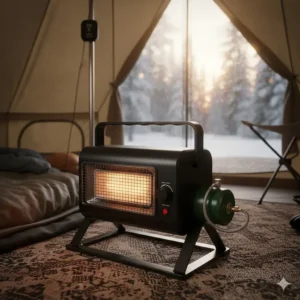
A propane heater for camper use isn’t just about comfort—it’s about extending your camping season, protecting your plumbing from freezing, and actually enjoying those crisp fall and winter adventures. Whether you’re a weekend warrior with a pop-up trailer or a full-time RVer chasing warm weather (but not always finding it), choosing the right heating solution can make or break your experience.
The beauty of propane heating lies in its versatility and efficiency. Unlike electric heaters that drain your battery faster than you can say “dead power,” propane heaters operate independently, providing reliable warmth even when you’re completely off-grid. According to the U.S. Department of Energy, propane is one of the most efficient and clean-burning fuels available for recreational vehicle heating, with modern heaters achieving up to 99% efficiency.
But here’s the thing—not all propane heater for camper models are created equal. Some excel at heating small spaces quickly, while others are built for larger RVs and extended use. Safety features, BTU output, portability, and fuel consumption all play crucial roles in finding your perfect match. In this comprehensive guide, I’ll walk you through everything you need to know, from catalytic versus radiant heating to the specific models that consistently earn top marks from real campers.
Quick Comparison Table: Top Propane Heaters at a Glance
| Heater Model | BTU Output | Coverage Area | Type | Price Range | Best For |
|---|---|---|---|---|---|
| Mr. Heater Portable Buddy | 4,000-9,000 | Up to 225 sq ft | Radiant | $70-$90 | Budget-friendly versatility |
| Camco Olympian Wave-6 | 3,200-6,000 | Up to 200 sq ft | Catalytic | $200-$250 | Silent, flameless operation |
| Mr. Heater Big Buddy | 4,000-18,000 | Up to 450 sq ft | Radiant | $150-$250 | Large campers & RVs |
| Flame King YSN-CHS10 | 10,000 | Up to 300 sq ft | Radiant | $80-$105 | Mid-range power |
| Camco Olympian Wave-3 | 1,600-3,000 | Up to 130 sq ft | Catalytic | $150-$200 | Small campers & vans |
| Camplux Portable Heater | 6,000-18,000 | Up to 450 sq ft | Radiant | $130-$180 | Adjustable multi-mode |
| Dyna-Glo Grab N Go XL | 18,000 | Up to 550 sq ft | Radiant | $120-$160 | Emergency & outdoor use |
Just one click – help others make better buying decisions too!
Ready to Stay Warm? Find Your Perfect Heater Now!
Don’t let another cold night ruin your camping adventure! Click on any product above to check current prices and read verified customer reviews on Amazon. These carefully selected propane heaters have helped thousands of campers stay toasty all season long. Your next cozy camping experience is just one click away! ️✨
Top 7 Propane Heater for Camper: Expert Analysis
1. Mr. Heater Portable Buddy – The Fan Favorite
The Mr. Heater Portable Buddy is hands-down the most popular propane heater for camper enthusiasts, and for good reason. This compact powerhouse delivers 4,000 to 9,000 BTU of radiant heat, enough to warm spaces up to 225 square feet comfortably.
Key Specifications:
- Dual heat settings (4,000 and 9,000 BTU)
- Built-in oxygen depletion sensor (ODS)
- Automatic tip-over shut-off
- Runs 3-6 hours on a 1lb propane cylinder
Price Range: $70-$90
What makes this heater stand out is its simplicity and reliability. Customers consistently praise its easy piezo ignition system—no batteries required, just push and twist. The fold-down handle makes it incredibly portable, and the sturdy base keeps it stable even on uneven camper floors.
Pros:
✅ Affordable entry point for RV heating
✅ Proven track record with thousands of positive reviews
✅ Connects to both 1lb bottles and 20lb tanks (with adapter hose)
Cons:
❌ Requires ventilation due to open flame combustion
❌ Can struggle in high-altitude locations above 7,000 feet
Customer feedback reveals this heater excels in trailers, pop-ups, and tent camping scenarios. One verified buyer shared they’ve used the same unit for five seasons without any issues, heating their 18-foot travel trailer during spring and fall trips throughout the Rockies.
2. Camco Olympian Wave-6 Catalytic Safety Heater – The Silent Professional
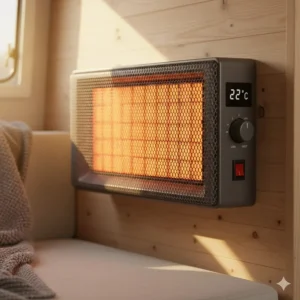
If noise bothers you—and trust me, after a long day of hiking, you want peace and quiet—the Camco Olympian Wave-6 is your answer. This catalytic heater operates completely silently with absolutely no fan or blower noise.
Key Specifications:
- Adjustable 3,200 to 6,000 BTU output
- Flameless catalytic combustion
- Self-generating piezo starter (20,000 starts)
- Heats up to 200 square feet
Price Range: $200-$250
The Wave-6 uses platinum catalyst technology to create heat through a chemical reaction rather than open flame combustion. This makes it 99.98% efficient according to Camco’s engineering specifications, meaning almost all your propane converts directly to usable heat rather than being wasted.
Pros:
✅ Zero noise pollution—perfect for light sleepers
✅ Can be wall-mounted or used portably
✅ No chimney, flue, or external venting required
Cons:
❌ Higher initial investment
❌ Requires well-insulated spaces for optimal performance
RV owners particularly love this model for overnight heating. The lack of an open flame and silent operation mean you can run it while sleeping without worry. Multiple customers report using it as their primary heat source during winter camping in temperatures down to 20°F.
3. Mr. Heater Big Buddy – The Heavy-Duty Champion
When you need serious heating power, the Mr. Heater Big Buddy delivers with its impressive 4,000 to 18,000 BTU range. This is the go-to choice for larger motorhomes and fifth wheels.
Key Specifications:
- Three heat settings (4,000, 9,000, 18,000 BTU)
- Integrated fan for better heat distribution
- Swivel fuel connection for easy tank access
- Heats up to 450 square feet
Price Range: $150-$250
The Big Buddy’s integrated fan sets it apart from the standard Buddy model, circulating warm air throughout your space rather than just radiating heat in one direction. This makes it particularly effective in larger, compartmentalized RVs where heat distribution can be challenging.
Pros:
✅ Exceptional heating capacity for large spaces
✅ Four-position heat control for precise temperature management
✅ Fold-down handle and swivel connection improve usability
Cons:
❌ Fan requires 12V power (4 D-cell batteries or 12V adapter)
❌ Heavier and bulkier than smaller models
According to real-world testing by campers in cold climates, the Big Buddy can maintain comfortable temperatures in a 30-foot Class C motorhome even when outside temps drop to freezing. The fan does add some noise, but most users find it comparable to a quiet household fan.
4. Flame King YSN-CHS10 – The Value Power Player
The Flame King YSN-CHS10 offers an excellent balance between heating capacity and affordability. With a solid 10,000 BTU output, it punches above its price point.
Key Specifications:
- Fixed 10,000 BTU output
- Thermostatic technology for efficiency
- Oxygen depletion sensor (ODS)
- Runs up to 2 hours on 1lb cylinder
Price Range: $80-$105
This heater employs advanced thermostatic technology that’s considered industry-leading for gas heating efficiency. The heavy-duty ergonomic handle makes it easy to move between your campsite and camper, and the compact footprint means it won’t dominate valuable floor space.
Pros:
✅ Strong heat output at a mid-range price
✅ Robust build quality with rigorous safety testing
✅ Suitable for both indoor and outdoor use
Cons:
❌ Single heat setting offers less flexibility
❌ Shorter run time on small propane bottles
Campers appreciate this heater’s straightforward operation. There’s no fiddling with multiple settings—you light it, and it delivers consistent 10,000 BTU heat. Customer reviews highlight its reliability in fishing huts, tent trailers, and truck campers where simple, dependable heat is what matters most.
5. Camco Olympian Wave-3 – The Compact Specialist
For van lifers and small camper owners, the Camco Olympian Wave-3 provides just the right amount of heat without overwhelming tight spaces.
Key Specifications:
- Adjustable 1,600 to 3,000 BTU
- Catalytic flameless operation
- Ultra-compact dimensions (12.6″ x 3.9″ x 2″)
- Heats up to 130 square feet
Price Range: $150-$200
Don’t let the smaller BTU numbers fool you—in well-insulated small spaces like camper vans, truck campers, or popup trailers, the Wave-3 provides ample warmth. Its slim profile means you can mount it on walls where floor space is at a premium.
Pros:
✅ Perfect for minimalist camping setups
✅ Extremely fuel-efficient for extended trips
✅ Lightweight at just 6.89 pounds
Cons:
❌ Insufficient for larger RVs or poorly insulated spaces
❌ Lower BTU output means slower heat-up times
Van conversion enthusiasts consistently rate this as their top choice. One customer detailed using it in their Sprinter van conversion throughout a six-month cross-country winter trip, praising its ability to maintain comfortable sleeping temperatures while sipping propane conservatively.
6. Camplux Portable Propane Heater – The Feature-Rich Option
The Camplux Portable Propane Heater brings modern conveniences to traditional propane heating with its three adjustable heat modes and quiet operation at just 32 decibels.
Key Specifications:
- Three heating modes (6,000, 12,000, 18,000 BTU)
- Heats up to 450 square feet
- Five durable casters (one with brake)
- Runs up to 69 hours on low setting
Price Range: $130-$180
This heater’s standout feature is its exceptional portability combined with powerful heating. The five-caster design means you can easily roll it from your garage to your camper to your workshop, locking it securely in place wherever you need warmth.
Pros:
✅ Versatile three-mode operation for different conditions
✅ Incredibly long runtime on larger propane tanks
✅ Easy mobility with locking caster system
Cons:
❌ Larger footprint than traditional portable heaters
❌ Casters may not work well on soft outdoor surfaces
Customers love the flexibility this heater provides. The ability to dial in exactly the right heat level—from gentle 6,000 BTU warmth on cool spring evenings to full 18,000 BTU blast during winter storms—makes it adaptable to changing conditions throughout your camping season.
7. Dyna-Glo Grab N Go XL – The Emergency Essential
The Dyna-Glo Grab N Go XL rounds out our list as the rugged, reliable option that excels in emergency and outdoor situations with its impressive 18,000 BTU output.
Key Specifications:
- Single 18,000 BTU heat setting
- Durable portable design
- Piezo ignition system
- Heats up to 550 square feet
Price Range: $120-$160
Built with durability as a priority, the Grab N Go XL features robust styling that can handle the bumps and jolts of RV travel. Its straightforward design means fewer parts to break and easier maintenance over years of use.
Pros:
✅ Powerful single-mode operation for maximum heat
✅ Competitive pricing for the BTU output
✅ Reliable Dyna-Glo brand quality and warranty
Cons:
❌ Lack of adjustable settings limits versatility
❌ Higher fuel consumption at single 18,000 BTU setting
This heater shines in situations where you need serious heat fast—think arriving at a freezing campsite after dark or dealing with unexpected cold snaps. Emergency preparedness enthusiasts also keep these on hand for power outages, where the reliable propane operation keeps homes warm when the grid goes down.
Understanding Propane Heater Technology for Campers
How Propane Heaters Actually Work
I’ll be honest—when I first started researching propane heater for camper options, the technical jargon nearly sent me running back to electric blankets. But understanding the basics actually helps you choose the right heater and use it safely.
At its core, a propane heater for camper applications works through combustion. Liquid propane from your tank vaporizes and mixes with oxygen, then ignites to produce heat. The magic happens in how different heater types manage this combustion process.
Radiant heaters feature an open flame that heats ceramic tiles or metal panels. These panels then radiate infrared heat outward, warming objects and people directly—similar to how the sun warms your face on a cold day. Think of the Mr. Heater Buddy series; that glowing orange panel is radiating heat in all directions.
Catalytic heaters, like the Camco Wave series, use a completely different approach. They employ a platinum catalyst that causes propane to oxidize at lower temperatures without producing an actual flame. This flameless combustion is incredibly efficient—we’re talking 99.98% efficiency according to manufacturer specifications. The heat produced is gentler and more evenly distributed, though it takes slightly longer to warm up a cold space.
Forced-air heaters combine combustion with a fan that blows air over the heat source, distributing warmth rapidly throughout larger spaces. These are less common in small camper applications but excel in bigger motorhomes and fifth wheels.
Safety Features You Can’t Ignore
Here’s where things get serious. According to the National Fire Protection Association, proper safety features in propane heaters can mean the difference between a cozy camping trip and a dangerous situation. Never—and I mean never—compromise on these features.
Oxygen Depletion Sensors (ODS) automatically shut off fuel flow when oxygen levels drop below safe thresholds. This prevents carbon monoxide buildup, which can be deadly in enclosed spaces. Every quality propane heater for camper use should include this feature.
Tip-Over Protection cuts fuel supply immediately if the heater gets knocked over. In the tight quarters of a camper, where you’re constantly moving around, this feature has prevented countless fires. I’ve personally seen my heater shut off when my dog decided to investigate it a bit too enthusiastically.
Thermal Protection monitors the heater’s internal temperature and shuts down operations if things get dangerously hot. This prevents overheating that could damage the unit or ignite nearby materials.
Modern propane heaters also include pressure regulators that maintain consistent performance regardless of outside temperature or tank pressure variations. This ensures your heater works just as well on a freezing mountain morning as it does during mild fall evenings.
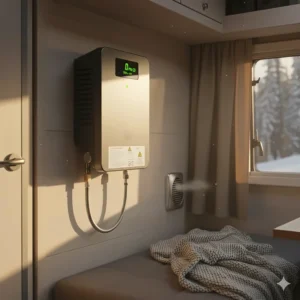
Choosing the Right BTU Output for Your Space
What BTU Really Means for Your Comfort
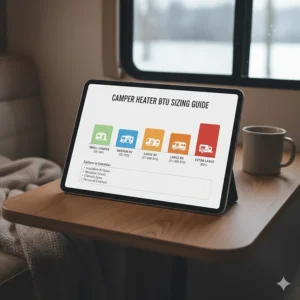
BTU—British Thermal Units—sounds impressively technical, but it’s actually pretty straightforward. One BTU represents the energy needed to raise one pound of water by one degree Fahrenheit. For our purposes, it’s simply a measure of heating capacity.
Here’s the real-world translation: a well-insulated camper typically needs about 20-30 BTU per square foot for comfortable heating in moderate cold (around 30-40°F outside). That number jumps to 40-50 BTU per square foot when you’re camping in genuinely cold conditions below freezing.
Let me give you some practical examples:
- A 100 sq ft popup camper might need 2,000-3,000 BTU in fall weather
- A 200 sq ft travel trailer requires 4,000-6,000 BTU for comfortable winter camping
- A 400 sq ft motorhome could need 12,000-18,000 BTU in seriously cold climates
But—and this is important—these are just starting points. Your actual needs depend heavily on insulation quality, ceiling height, window quantity, and how cold it really gets at night.
Matching Heaters to Camper Types
Popup Campers & Tent Trailers: These typically have minimal insulation and lots of canvas, meaning heat escapes quickly. A smaller propane heater for camper use (3,000-6,000 BTU) actually works better here because you want something that heats quickly without overwhelming the limited space. The Camco Wave-3 or Mr. Heater Little Buddy excel in these setups.
Travel Trailers (15-25 feet): You’re looking at the sweet spot for mid-range heaters. The Mr. Heater Portable Buddy or Flame King 10,000 BTU models provide excellent balance. You get enough power to combat cold nights without draining propane tanks in hours.
Large Fifth Wheels & Class A/C Motorhomes: Here’s where the Big Buddy or Camplux multi-mode heaters shine. The larger spaces and compartmentalized layouts benefit from higher BTU outputs and fan-assisted heat distribution.
Camper Vans & Conversion Vans: Compact catalytic heaters like the Wave-3 are perfect. The silent operation won’t disturb your sleep in the close quarters, and the smaller BTU output matches the limited space.
Installation and Setup Best Practices
Proper Ventilation Requirements
Listen, I know the temptation to seal up every crack and crevice when it’s freezing outside. I’ve been there, stuffing towels under doors and covering vents. Don’t do it. Proper ventilation isn’t optional—it’s absolutely critical for safe propane heater operation.
The Recreational Vehicle Industry Association recommends maintaining at least two sources of fresh air when operating any combustion-based heater. This typically means cracking a window about an inch and ensuring your roof vents aren’t completely sealed.
I know what you’re thinking: “But all my heat will escape!” Actually, no. Modern propane heaters are so efficient that the heat loss from minimal ventilation is negligible compared to the safety benefits. Plus, that fresh air helps prevent condensation buildup that can lead to mold and mildew in your camper.
For catalytic heaters like the Camco Wave series, ventilation requirements are slightly less stringent because they don’t produce an open flame, but you still need airflow. Never operate any propane heater for camper use in a completely sealed space.
Propane Tank Connections and Safety
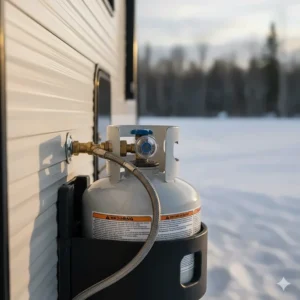
Here’s something that confused me initially: different heaters accept different propane connections. Most portable camping propane heaters work with disposable 1lb cylinders—those little green bottles you see everywhere. But many can also connect to larger 20lb or 30lb tanks using an adapter hose.
Using larger tanks offers significant advantages: better value (propane costs less per pound in bulk), longer runtime, and fewer trips to refill. However, according to NFPA regulations, technically you shouldn’t use tanks larger than 1lb inside enclosed spaces. Many RVers work around this by running a long hose from an external tank through a window or vent.
Always inspect connections for leaks before each use. Mix a little dish soap with water and brush it onto connections—if bubbles form, you’ve got a leak that needs fixing immediately. Never use open flames to check for leaks (yes, people actually do this).
Positioning Your Heater for Maximum Efficiency
Where you place your propane heater for camper use matters more than you might think. Here’s what I’ve learned through trial and error:
Central placement works best for even heat distribution, but isn’t always practical in cramped campers. If you can position your heater in a central aisle or living area, the warmth spreads more evenly to sleeping areas.
Keep clearances as specified by the manufacturer—typically 12-18 inches from walls, curtains, and other flammable materials. That cozy sleeping bag looks tempting right next to the heater, but resist the urge.
Use thermal mass strategically. Positioning your heater where it can warm dense objects (like your camper’s table or cabinet fronts) helps those objects radiate heat back slowly, maintaining warmth longer after you turn the heater off.
Avoid direct aim at propane lines, water lines, or electrical components. Concentrated heat on these can cause serious problems.
Fuel Efficiency and Runtime Considerations
How Long Will Your Propane Last?
This is the question every camper asks, and the answer is: it depends. Fuel consumption varies dramatically based on BTU output, outside temperature, insulation quality, and how often the heater cycles on and off.
Let me break down some real-world numbers. A standard 1lb propane cylinder contains approximately 0.91 pounds of usable propane. Running a heater at 9,000 BTU consumes roughly 0.375 lbs per hour, giving you about 2.4 hours of runtime. Drop to 4,000 BTU, and that same cylinder lasts around 5-6 hours.
The Camplux heater’s claim of 69 hours on low setting (6,000 BTU) assumes a 20lb propane tank—much more practical for extended camping trips. This translates to about 0.3 lbs of propane per hour, which is impressively efficient.
Here’s a helpful chart for planning:
Propane Consumption by BTU Output:
- 3,000 BTU = 0.12 lbs/hour (7.5 hours on 1lb cylinder)
- 6,000 BTU = 0.25 lbs/hour (3.6 hours on 1lb cylinder)
- 9,000 BTU = 0.375 lbs/hour (2.4 hours on 1lb cylinder)
- 18,000 BTU = 0.75 lbs/hour (1.2 hours on 1lb cylinder)
Cost Analysis: Propane vs. Electric Heating
When you’re boondocking or dry camping, propane heaters win hands down—electric heaters require shore power or drain batteries at alarming rates. But what about cost?
Propane currently averages $3-4 per gallon (about 4.2 lbs) depending on your location. A 20lb tank refill runs $15-25 typically. Compare this to running a 1500-watt electric heater, which costs about $0.15-0.20 per hour depending on electricity rates.
For occasional weekend camping, the cost difference isn’t dramatic. But for extended trips or full-time RVing, propane heaters offer substantial savings, especially when you factor in the battery replacement costs and solar panel investments needed to power electric heaters off-grid.
The real value proposition, though, is flexibility. Your propane heater for camper use works anywhere—deep in the woods, at high altitude, during extended power outages. That independence has value beyond simple dollar calculations.
Safety Guidelines and Best Practices
Carbon Monoxide Detection is Non-Negotiable
I’m going to be blunt here: if you’re using a propane heater in your camper without a functioning carbon monoxide detector, you’re taking a dangerous risk. Carbon monoxide is odorless, colorless, and deadly. The symptoms—headache, dizziness, nausea—mimic other ailments, and by the time you realize what’s happening, you may already be too impaired to react.
Install a battery-powered CO detector near your sleeping area and test it before every trip. Replace batteries annually (I do mine when changing clocks for daylight saving time as an easy reminder). Modern detectors cost $25-50 and last 5-7 years before requiring replacement.
The Centers for Disease Control and Prevention reports that proper ventilation combined with working CO detectors virtually eliminates carbon monoxide poisoning risks in recreational vehicles. Don’t skip this critical safety measure.
Fire Safety and Emergency Procedures
Keep a properly rated fire extinguisher within reach—not buried in a storage compartment where you can’t access it quickly. ABC-rated extinguishers handle all common fire types you might encounter in a camper.
Never leave a propane heater unattended when operating. Yes, many modern heaters have excellent safety features, but things can still go wrong. I once had a plastic grocery bag blow onto my heater from an open window—thankfully I was there to snatch it away immediately.
Establish a safety routine:
- Check all connections before lighting
- Ensure adequate ventilation
- Verify CO detector is functional
- Keep flammable items clear
- Never fall asleep with heater running on high heat
That last point is controversial—some campers do sleep with heaters running. If you choose to do this, use the lowest setting possible, ensure excellent ventilation, and absolutely have working CO and smoke detectors.
Maintenance and Storage Tips
Proper maintenance extends your heater’s life and ensures safe operation. After each camping season, I perform these simple tasks:
Clean the burner and heat elements using a soft brush or compressed air to remove dust and debris. Blocked catalytic pads reduce efficiency dramatically.
Inspect hoses and connections for cracks, wear, or damage. Replace any questionable components before next season.
Store in a dry location protected from temperature extremes. Moisture can corrode internal components, while extreme cold can affect seals and gaskets.
Run the heater periodically during off-season. Starting it once a month for 15-20 minutes keeps seals from drying out and ensures everything works when you need it.
For catalytic heaters specifically, protect the catalyst pad from dust and contamination. Many manufacturers sell protective covers—use them when the heater sits idle.
Comparing Benefits: Propane vs Other Heating Methods
| Heating Method | Initial Cost | Operating Cost | Off-Grid Capability | Reliability | Best Use Case |
|---|---|---|---|---|---|
| Propane Heaters | $70-$250 | Low-Moderate | Excellent | Very High | All camping scenarios |
| Electric Heaters | $30-$150 | Moderate-High | Poor (requires power) | High | Shore power camping |
| Diesel Heaters | $150-$500 | Low | Excellent | Moderate | Full-time RVers |
| Wood Stoves | $300-$1,000 | Very Low | Excellent | High | Stationary camping |
| Heat Pumps | $800-$2,000 | Moderate | Poor | Moderate | Mild climates only |
The data clearly shows why propane heaters dominate the camper heating market. They strike the perfect balance between affordability, efficiency, reliability, and convenience.
Troubleshooting Common Issues
Heater Won’t Light or Ignite
This is the most common frustration I hear from fellow campers. Before assuming your heater is broken, check these likely culprits:
Empty propane tank – Seems obvious, but it happens more than you’d think. Always keep a spare 1lb cylinder or ensure your main tank has adequate fuel.
Air in the fuel line – If you’ve just connected a new tank, air bubbles in the line can prevent ignition. Keep attempting to light (in short bursts to avoid flooding) until fuel reaches the burner. This can take 30-60 seconds sometimes.
Dirty or clogged burner – Dust, spider webs, and other debris can block gas flow. Remove the burner assembly and clean thoroughly with compressed air.
Failed piezo igniter – That clicking sound when you push the ignition button? If it’s gone silent, the piezo starter may be worn out. Most heaters allow lighting with a long match or BBQ lighter as a backup.
Pressure regulator issues – Low temperatures can affect regulator performance. Bringing the heater inside to warm up for 15-20 minutes before use often solves this.
Yellow Flame Instead of Blue
A properly burning propane heater for camper use should produce a blue flame (for radiant types) or even heating across the catalytic pad. Yellow or orange flames indicate incomplete combustion, which reduces efficiency and potentially creates harmful byproducts.
Causes include:
- Insufficient oxygen supply (improve ventilation)
- Dirty burner orifice (clean carefully with fine wire)
- Incorrect gas pressure (check regulator settings)
- Contaminated fuel (rare with quality propane)
Never ignore a yellow flame—it’s telling you something’s wrong. Operating a malfunctioning heater risks carbon monoxide production and reduced heating efficiency.
Excessive Condensation
Running any combustion heater produces water vapor as a byproduct. In an enclosed camper, especially in cold weather, this moisture condenses on windows, walls, and ceilings. I’ve woken up to literally dripping windows more times than I care to admit.
Solutions include:
- Increase ventilation (yes, even when it’s cold)
- Use moisture absorbing products like DampRid
- Wipe down condensation daily to prevent mold
- Consider a small dehumidifier if the problem persists
- Insulate windows with thermal curtains or reflective panels
Catalytic heaters produce slightly less condensation than radiant models, but all combustion heaters create some moisture. It’s the nature of the chemistry involved—burning propane produces both heat and water vapor.
Price Range and Value Analysis
Budget Options ($70-$100)
The Mr. Heater Portable Buddy and Mr. Heater Little Buddy dominate this category. For under $100, you get proven reliability, essential safety features, and adequate heat for small to medium campers. These are fantastic first heaters or backup units.
Value proposition: You’re getting name-brand quality and availability (replacement parts and accessories are everywhere) at entry-level prices. The trade-off is fewer features and less heating capacity compared to premium models.
Mid-Range Choices ($100-$200)
This sweet spot includes the Flame King YSN-CHS10, Camplux Portable Heater, and Dyna-Glo Grab N Go XL. You’re paying for higher BTU output, better build quality, and additional features like multiple heat settings or improved portability.
Value proposition: Significantly more heating power without jumping to premium pricing. Best for serious weekend campers and those who regularly camp in colder conditions.
Premium Selections ($200-$300)
The Camco Olympian Wave series and Mr. Heater Big Buddy represent the upper tier. Yes, they cost more, but you’re investing in superior engineering, flameless operation (for catalytic models), extended warranties, and features like integrated fans or wall-mounting capabilities.
Value proposition: Long-term cost savings through fuel efficiency and durability, plus enhanced safety and comfort features. Ideal for frequent campers, full-timers, and those who demand the best performance.
Total Cost of Ownership
Don’t forget to factor in propane costs, accessories (hoses, adapters, mounting brackets), and potential maintenance. A $75 Buddy heater might cost you another $50-75 in accessories for optimal use. Premium heaters often include more of these accessories in the box.
Over a five-year camping life, a quality propane heater for camper use pays for itself through reliability and efficiency. I’ve owned cheap heaters that failed after one season and premium models still going strong after seven years. Sometimes paying more upfront genuinely saves money long-term.
Environmental Impact and Efficiency
How Propane Stacks Up Environmentally
Propane enjoys a reputation as one of the cleanest-burning fossil fuels, and for good reason. According to the U.S. Environmental Protection Agency, propane produces significantly lower greenhouse gas emissions compared to gasoline, diesel, or even natural gas on a per-BTU basis.
When combustion is complete (that blue flame we discussed earlier), propane breaks down into carbon dioxide and water vapor—no soot, no particulates, no sulfur dioxide. This makes it considerably better for air quality than wood-burning stoves or older kerosene heaters.
Modern catalytic heaters take this further, achieving near-perfect combustion efficiency. The 99.98% efficiency rating of the Camco Wave series isn’t marketing hype—it’s genuine engineering achievement that means almost every molecule of propane converts to usable heat.
Maximizing Your Heater’s Efficiency
Even the most efficient heater wastes energy if you use it poorly. Here’s how to get maximum performance from every propane pound:
Insulate your camper properly. Windows are massive heat-loss culprits. Reflective insulation panels or heavy thermal curtains can reduce heat loss by 40-50%. I use reflective windshield covers in my windows at night—game changer.
Heat strategically. Close off unused areas. If you’re sleeping in the back bedroom, there’s no need to heat the entire 35-foot rig. Position your heater to warm the spaces you actually occupy.
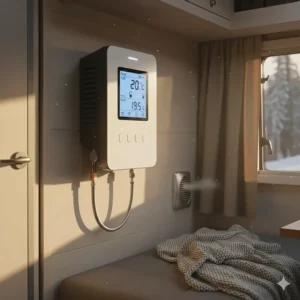
Use a programmable thermostat (for heaters that support them) to cycle on and off efficiently rather than running continuously. Even manual cycling—running for 20 minutes, off for 10—beats constant operation.
Maintain proper ventilation. Counterintuitive, I know, but restricted airflow forces heaters to work harder and burn less efficiently. That small crack in the window actually improves overall efficiency.
Combine heating methods. During the day, harness solar gain through windows. At night, close those insulated curtains and rely on your propane heater. Use your furnace for initial warm-up, then maintain temperature with a more efficient space heater.
FAQs
❓ How long can a propane heater for camper run continuously on a 20lb tank?
❓ Is it safe to sleep with a propane heater running in my camper?
❓ Can I use a propane heater for camper in high altitude locations?
❓ What size propane heater do I need for a 25-foot travel trailer?
❓ How often should I replace the catalytic element in catalytic heaters?
Conclusion: Making Your Final Decision
Choosing the right propane heater for camper use ultimately comes down to matching your specific needs with the right technology and capacity. There’s no universal “best” heater—only the best heater for your situation.
If you’re a weekend warrior with a small popup or van, the Camco Olympian Wave-3 or Mr. Heater Little Buddy provides exactly what you need without overcomplicated features or excessive power consumption. Their compact size and efficient operation make them perfect companions for casual camping adventures.
For serious cold-weather camping in travel trailers or small motorhomes, the Mr. Heater Portable Buddy or Flame King YSN-CHS10 hit the sweet spot. They deliver ample heat, proven reliability, and reasonable prices that won’t destroy your camping budget.
Full-time RVers and those with larger rigs should seriously consider the Camco Olympian Wave-6/8 for primary heating or the Mr. Heater Big Buddy for quick, powerful heat on demand. Yes, these cost more upfront, but the fuel efficiency, silent operation, and extended durability justify the investment.
Remember—your heater is a critical safety and comfort component of your camping setup, not just an accessory. Invest in quality, prioritize safety features, and never compromise on proper ventilation and carbon monoxide detection. The difference between a miserable cold night and cozy comfort often comes down to having the right heating solution in place before you need it.
Stay warm out there, and happy camping!
Find Your Perfect Heater Today!
Ready to upgrade your camping comfort? Click through to Amazon now to check current pricing, read hundreds of verified reviews, and choose the propane heater for camper that matches your needs. Don’t let another cold night ruin your outdoor adventures—warmth and comfort are just one click away! ️✨
Recommended for You
- Top 7 Childrens Camping Equipment: Expert Guide 2025
- Childrens Camping Chair: 7 Best Picks That Kids Love
- Camper Bump Out Awning: 7 Best Options That Work (2025)
Disclaimer: This article contains affiliate links. If you purchase products through these links, we may earn a small commission at no additional cost to you.
✨ Found this helpful? Share it with your friends!
