
In This Article
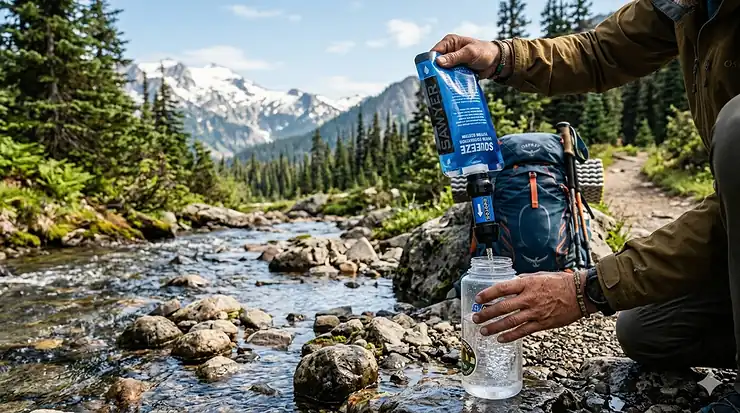
I’ll be honest with you — when I first grabbed a Sawyer water filter review before my Appalachian Trail section hike, I thought “How can something this lightweight actually work?” Fast forward three years, and I’ve filtered thousands of gallons through various Sawyer models without spending a cent on replacement cartridges.
Here’s what makes a Sawyer water filter review essential reading in 2026: these aren’t your typical disposable camping gadgets. Sawyer’s filters use hollow fiber membrane technology rated to filter up to 100,000 gallons, which essentially means you’re buying the last water filter you’ll ever need. Whether you’re planning a weekend camping trip, preparing for emergencies, or tackling a thru-hike, understanding the Sawyer lineup helps you avoid expensive mistakes.
In this comprehensive Sawyer water filter review, I’ll walk you through seven real products currently available on Amazon, breaking down their actual performance, pricing, and which situations each excels in. You won’t find vague recommendations here — just practical insights from someone who’s tested these filters in alpine streams, murky ponds, and even questionable hotel taps abroad.
Quick Comparison Table
| Model | Weight | Filtration | Capacity | Price Range | Best For |
|---|---|---|---|---|---|
| Sawyer Mini | 2 oz | 0.1 micron | 100,000 gal | $20-$30 | Ultralight backpacking |
| Sawyer Squeeze | 3 oz | 0.1 micron | 100,000 gal | $35-$45 | Versatile camping |
| Sawyer Micro Squeeze | 1.65 oz | 0.1 micron | 100,000 gal | $40-$50 | Ultralight enthusiasts |
| Sawyer Squeeze 3-Pouch | 3 oz | 0.1 micron | 100,000 gal | $45-$55 | Extended trips |
| Sawyer Gravity System | 5.5 oz | 0.1 micron | 100,000 gal | $50-$65 | Group camping |
| Sawyer Select S1 | 14 in (filter) | 0.1 micron + foam | 1,600 uses | $60-$70 | Chemical removal |
| Sawyer Select S3 | 14 in (filter) | 0.1 micron + foam | 400 uses | $85-$95 | Virus/heavy metal protection |
💬 Just one click – help others make better buying decisions too! 😊
Top 7 Sawyer Water Filters: Expert Analysis
1. Sawyer Mini Water Filtration System – The Ultralight Classic
The Sawyer Mini remains the gold standard for ounce-counting backpackers who refuse to compromise on safety. Weighing just 2 ounces and fitting in the palm of your hand, this tiny filter removes 99.99999% of all bacteria like Salmonella, Cholera, and E.coli, plus 99.9999% of all protozoa such as Giardia and Cryptosporidium.
Key Specs:
- Weight: 2 oz
- Pore size: 0.1 micron absolute
- Flow rate: Moderate (slower than Squeeze)
Customer Feedback: Hikers love the Mini’s packability but frequently mention the narrow output nozzle makes filtering slower. Multiple users report the included squeeze pouches breaking at seams when squeezed too hard, though this is easily solved by using standard water bottles instead.
✅ Pros:
- Incredible 2-ounce weight
- Attaches to standard 28mm water bottles
- Includes drinking straw for direct filtering
❌ Cons:
- Slower flow rate than larger models
- Included pouches prone to leaking
Price: $20-$30
Best for: Solo ultralight backpackers and emergency kits
2. Sawyer Squeeze Water Filtration System – The Workhorse
The Sawyer Squeeze is what I grab when I need reliability without overthinking it. At 3 ounces, this versatile filter delivers faster flow rates while maintaining the same 0.1 micron absolute filtration.
Key Specs:
- Weight: 3 oz
- Includes: Two 32-oz reusable pouches
- Multiple attachment options (pouches, bottles, inline hydration)
Customer Feedback: Long-distance hikers and frequent campers consistently rate this their go-to filter. The built-in flip-top sports cap is genius for drinking directly, though some users wish the pouches were more durable.
✅ Pros:
- Faster flow than the Mini
- Flip-top cap for easy drinking
- Collapsible pouches save pack space
❌ Cons:
- 1 ounce heavier than Mini
- Requires regular backflushing for optimal flow
Price: $35-$45
Best for: Weekend warriors and car campers who value versatility
3. Sawyer Micro Squeeze Water Filter – The Weight Fanatic’s Dream
Want Sawyer Squeeze camping performance in an even smaller package? The Sawyer Micro Squeeze delivers. At 1.65 ounces with the same 100,000-gallon capacity, it achieves the best weight-to-performance ratio in portable water filtration.
Key Specs:
- Weight: 1.65 oz (lightest in lineup)
- Flow rate: Faster than Mini, comparable to Squeeze
- Includes: 750ml TPU pouch
Customer Feedback: Ultralight backpackers particularly appreciate the 28mm thread compatibility, which fits SmartWater bottles, Cnoc bladders, and most hydration pack hoses. The improved flow rate over the Mini makes this worth the slight price increase.
✅ Pros:
- Lightest Sawyer filter available
- Fast flow rate for its size
- Universal 28mm threading
❌ Cons:
- Slightly more expensive than Mini
- Smaller filter body can be harder to grip
Price: $40-$50
Best for: Thru-hikers and gram-counting backpackers
4. Sawyer Squeeze with 3 Pouches – Extended Adventure Ready
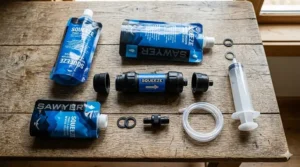
This Sawyer Squeeze variant comes loaded with three pouches (one 16-oz, two 32-oz), making it perfect for longer trips where having backup pouches matters. Same proven filter, more carrying capacity.
Key Specs:
- Weight: 3 oz (filter only)
- Total pouch capacity: 80 oz
- Includes: Cleaning plunger, gravity tubing, inline adapters
Customer Feedback: Groups and families appreciate having multiple pouches for simultaneous filtering. The gravity tubing adapter transforms this into a hands-free camp water station.
✅ Pros:
- Multiple pouches for group use
- Gravity system components included
- Mesh storage bag keeps everything organized
❌ Cons:
- Extra pouches add weight if unused
- More expensive than basic Squeeze
Price: $45-$55
Best for: Group camping and family adventures
5. Sawyer One Gallon Gravity Water Filtration System – Camp Kitchen Essential
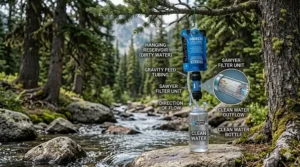
The Sawyer gravity system changes the game for base camps and group outings. This system includes a dual-threaded MINI filter and 1-gallon bladder, allowing gravity to do the work while you set up camp.
Key Specs:
- System weight: 5.5 oz
- Bladder capacity: 1 gallon
- No pumping required
- Wide-mouth cap for easy filling
Customer Feedback: Scout leaders and car campers rave about filtering water for groups in under 10 minutes. Simply hang the bag from a tree, and clean water flows into your cooking pots.
✅ Pros:
- Effortless hands-free filtering
- Processes large volumes quickly
- Wide-mouth bladder fills easily from any source
❌ Cons:
- Bulkier than squeeze systems
- Requires something to hang from
Price: $50-$65
Best for: Base camps, scout groups, and emergency preparedness
6. Sawyer Select S1 Water Filter – Chemical & Pesticide Protection
The Sawyer Select S1 combines Sawyer Mini backpacking proven hollow fiber membrane with foam adsorption technology. Inside the silicone bottle, a dense foam membrane with activated carbon removes chemicals and pesticides that standard 0.1-micron filters can’t capture.
Key Specs:
- Dual-stage filtration system
- Rated for 1,600 uses ($0.04/use)
- 20 oz water output per fill
- Removes bacteria, protozoa, chemicals, pesticides
Customer Feedback: Travelers and hikers concerned about agricultural runoff appreciate this extra protection layer. The 10-second squeeze cycle is quick, though the 14-inch overall length feels awkward for some users.
✅ Pros:
- Removes chemicals standard filters miss
- Improves taste and odor
- Durable silicone bottle
❌ Cons:
- Long filter makes drinking directly awkward
- Heavier than basic Sawyer filters
Price: $60-$70
Best for: International travel and areas with agricultural contamination
7. Sawyer Select S3 Water Purifier – Maximum Protection
For extreme conditions, the Sawyer Select S3 goes beyond filtration into purification territory. This system filters out 99.99% of viruses and reduces heavy metals down to 0.5 parts per billion — up to 260 times lower than EPA maximum levels.
Key Specs:
- Removes viruses (unique among Sawyer filters)
- Reduces heavy metals (copper, arsenic, mercury)
- Rated for 400 uses ($0.22/use)
- Three-stage purification process
Customer Feedback: Users heading to developing countries or disaster zones consider this essential insurance. The virus removal capability provides peace of mind when tap water quality is unknown.
✅ Pros:
- Only Sawyer filter removing viruses
- Heavy metal reduction for mining areas
- Comprehensive protection for global travel
❌ Cons:
- Most expensive Sawyer option
- Shortest lifespan (400 uses)
Price: $85-$95
Best for: International travel, disaster relief, industrial pollution concerns
✨ Don’t Miss These Exclusive Deals!
🔍 Take your water filtration to the next level with these carefully selected products. Click on any highlighted item to check current pricing and availability. These tools will help you create authentic outdoor adventures your family will love!
Understanding Hollow Fiber Membrane Technology
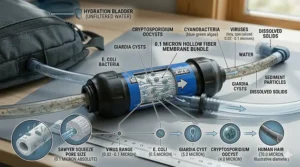
What makes Sawyer filters different from competitors? The secret lies in hollow fiber membrane technology, a filtration method originally developed for medical applications. Hollow fiber membranes are ubiquitously used in industrial separations, especially the filtration of drinking water, with microfiltration membrane pore diameters of 0.1 micrometers cutting off microorganisms like germs, bacteria, Giardia cysts, and other intestinal parasites.
Think of hollow fiber membranes as microscopic straws bundled together. Water enters these tiny tubes, but the 0.1-micron pores are too small for harmful pathogens to pass through. Sawyer’s thicker fiber walls combined with smaller inner diameter make their fibers 75% stronger than typical hollow fiber membranes, enabling aggressive backflushing to restore flow rate.
Here’s why this matters for your Sawyer filter comparison: unlike activated carbon filters that trap contaminants until they’re saturated, hollow fiber membranes physically block pathogens. This means Sawyer filters maintain consistent performance throughout their 100,000-gallon lifespan when properly maintained.
The Science Behind 0.1 Micron Absolute Filtration
“Absolute” is the critical word here. Many filters advertise “nominal” pore sizes, which is just an average — meaning some pores are larger. Sawyer’s 0.1 micron absolute filtration means there is no pore size larger than 0.1 micron, making it nearly impossible for microplastics, harmful bacteria, protozoa, or cysts to pass through. This level of filtration exceeds NSF/ANSI Standard 53 requirements for cyst removal.
To put this in perspective:
- Bacteria: 0.5-5 microns (blocked ✓)
- Protozoa (Giardia, Crypto): 4-15 microns (blocked ✓)
- Viruses: 0.02-0.3 microns (NOT blocked by standard filters)
- Microplastics: >0.1 microns (blocked ✓)
This explains why Sawyer Squeeze camping enthusiasts trust these filters for North American backcountry use, where bacterial and protozoan threats dominate. For areas with viral contamination concerns, the Select S3 purifier adds virus removal capability.
Backflushing Maintenance: The Key to Longevity
Every Sawyer water filter review should address maintenance, because backflushing maintenance separates casual users from those who maximize their filter’s lifespan. I’ve seen hikers toss “clogged” filters that just needed a 30-second backflush.
How Backflushing Works
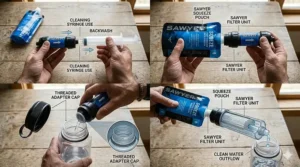
When water flow begins to diminish, simply perform a backwash to restore up to 98% of the filter’s flow rate. The included syringe pushes clean water backwards through the hollow fiber membrane, flushing trapped sediment out the dirty water side.
Backflushing Best Practices:
- Use clean, filtered water in the syringe (never dirty water)
- Attach syringe to clean water side of filter
- Push firmly but not aggressively — you’re clearing debris, not testing the fibers
- Repeat 3-4 times or until resistance decreases
- Backflush after every 5-10 uses in muddy water, or when flow rate drops
I backflush my Sawyer Mini after every weekend trip, taking maybe two minutes. This simple habit has kept the same filter performing flawlessly for three years.
Storage Tips
Never store a Sawyer filter while wet unless you’ll use it again within a few days. Bacteria can multiply in trapped water. After your trip, backflush thoroughly, then let the filter air dry completely before storing. The proprietary ingredients in Select filter foam membranes prevent bacteria growth and odor during storage, but standard hollow fiber filters need complete drying.
Inline Filter Setup for Hydration Packs
The inline filter setup transforms your hydration pack into a continuous filtration system — scoop dirty water into your bladder, and clean water flows through your drinking tube. This is particularly clutch during ultra-running or bike-packing when stopping to squeeze a filter breaks your rhythm.
Compatible Sawyer Models for Inline Use:
- Sawyer Mini (with inline adapter)
- Sawyer Squeeze (with inline adapter)
- Sawyer Micro Squeeze (with inline adapter)
- Sawyer Dual-Threaded MINI (designed specifically for inline)
Setup Process:
- Fill hydration bladder with untreated water
- Disconnect drinking tube from bladder
- Insert Sawyer filter between bladder outlet and drinking tube
- Secure connections with included inline adapters
- Drink normally — filter works on demand
The only downside? Hydration bladders become “dirty water” containers, so never drink from them without the filter attached. I mark my inline-use bladders with bright tape to avoid confusion.
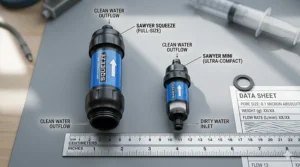
Sawyer Filter Comparison: Which Model Matches Your Needs?
Choosing between Sawyer models isn’t about “best” — it’s about matching features to your specific use case. Here’s how I decide which filter to pack:
For Solo Ultralight Backpacking:
Go with the Micro Squeeze. That 1.65-ounce weight difference adds up over hundreds of miles, and the faster flow rate beats the Mini’s slower performance.
For Weekend Camping Trips:
The Sawyer Squeeze hits the sweet spot. Slightly heavier than ultralight options, but the faster flow and flip-top cap make camp chores easier.
For Family Car Camping:
The Gravity System eliminates the squeeze-bottle workout. Hang a bag, let gravity work, and focus on starting the campfire instead.
For International Travel:
Pack a Select S1 for basic chemical protection, or upgrade to the S3 if visiting areas with known water quality issues. The virus removal capability justifies the investment.
For Emergency Preparedness:
The Sawyer Mini offers unbeatable value. At $25-30, you can stock multiple filters for different family members or bug-out bags without breaking the bank.
Real-World Performance: What the Data Doesn’t Tell You
Every Sawyer filter is performance tested three separate times during the manufacturing process, with testing occurring after fiber element construction and twice after casing assembly to ensure no harmful pathogens leak through sealed cases or internal O-rings. That’s impressive quality control, but how do these filters actually perform in the field?
Flow Rate Reality Check
Sawyer advertises flow rates, but real-world performance depends on water quality, filter age, and how hard you squeeze. Crystal-clear alpine streams? My Squeeze pumps out water faster than I can drink. Muddy pond water after rain? Expect slower flow until you backflush.
Temperature also matters. Cold water flows slower than warm water — physics, not filter failure. During winter camping, I keep my Sawyer inside my jacket to maintain body-temperature water flow.
The Pouch Problem
Let’s address the elephant in the room: Sawyer’s included squeeze pouches are notorious for developing leaks. Users report bags breaking at seams when squeezed too hard to overcome slow flow rates. This isn’t a filter defect — it’s the price of ultra-lightweight materials.
Solution: Use SmartWater bottles instead. They’re durable, squeeze-friendly, and the 28mm threads fit all Sawyer filters perfectly. I haven’t used a Sawyer pouch in two years.
Comparing Sawyer to Traditional Water Purification Methods
How does Sawyer filter comparison stack up against alternatives?
| Method | Weight | Cost Per Use | Lifespan | Protection Level |
|---|---|---|---|---|
| Sawyer Hollow Fiber | 2-3 oz | $0.0003/gallon | 100,000 gal | Bacteria, protozoa, microplastics |
| UV Purifiers | 4-6 oz | Battery dependent | 8,000 treatments | Bacteria, protozoa, viruses |
| Pump Filters | 11-16 oz | $0.03/gallon | 200-2,000 gal | Bacteria, protozoa |
| Chemical Tablets | 1 oz | $0.10-0.15/liter | Single use | Bacteria, protozoa, some viruses |
| Boiling | 0 oz | Fuel dependent | Unlimited | Everything |
Sawyer’s combination of light weight, zero per-use cost, and extreme longevity explains why they dominate the backpacking market. However, they don’t remove viruses (except Select S3), dissolved chemicals, or heavy metals (except Select models). Understanding these limitations prevents disappointment.
Geographic Considerations: When Sawyer Filters Aren’t Enough
North American backcountry? Standard Sawyer filters handle everything you’ll encounter. The CDC and EPA developed hollow fiber ultrafiltration procedures specifically for concentrating waterborne pathogens in drinking water systems, validating this technology for domestic water treatment.
But viral contamination changes the equation. In Southeast Asia, South America, or regions with questionable sanitation infrastructure, standard Sawyer filters won’t remove viruses like Hepatitis A or Norovirus. According to the World Health Organization, approximately 2 billion people worldwide use a drinking water source contaminated with feces, making virus filtration critical for international travelers. This is where the Select S3 purifier or chemical treatment backup becomes essential.
When to Upgrade from Standard Filters:
- International travel to developing nations
- Areas downstream from human habitation
- Emergency situations with compromised municipal water
- Regions near mining operations (heavy metals)
- Agricultural areas (pesticide runoff)
FAQs
❓ How long can a Sawyer water filter review last in real-world use?
❓ Can I use Sawyer Squeeze camping filter in freezing temperatures?
❓ Does backflushing maintenance really restore full flow rate?
❓ What's the difference between Sawyer Mini backpacking and Micro Squeeze models?
❓ Can inline filter setup work with any hydration pack?
Conclusion: The Sawyer Filter That Matches Your Adventures
After filtering hundreds of gallons through various Sawyer models across different environments, here’s my honest assessment: there’s no single “best” Sawyer filter — just the right one for your specific needs.
For pure value and versatility, the Sawyer Squeeze remains my recommendation for 80% of users. It balances weight, flow rate, and price better than alternatives. Ultralight purists should grab the Micro Squeeze for that weight savings, while families and groups benefit from the effortless Gravity System.
Travelers venturing beyond North America should seriously consider the Select S3 purifier. Yes, it costs more and has limited lifespan, but virus protection and heavy metal reduction provide critical safety margins when water quality is questionable.
What makes Sawyer filters genuinely special isn’t just the hollow fiber membrane technology or impressive lifespan — it’s the confidence they provide. When you’re 50 miles from the nearest road, knowing your water filter will perform reliably is priceless. That’s worth every penny of the investment.
Remember: the best water filter is the one you’ll actually use consistently. Master backflushing maintenance, choose the right model for your adventures, and you’ll enjoy safe drinking water for years to come.
Recommended for You
- 7 Best Water Filter for Camping 2026
- 7 Best Signal Mirror for Survival in 2026
- Bear Bell for Hiking Worth It? 7 Best Tested + Safety Guide 2026
Disclaimer: This article contains affiliate links. If you purchase products through these links, we may earn a small commission at no additional cost to you.
✨ Found this helpful? Share it with your friends! 💬🤗
