In This Article
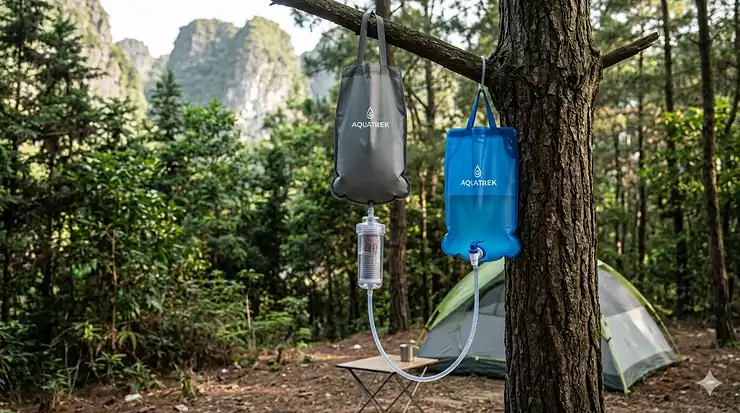
Picture this: you’ve just finished setting up camp after a long hike, and everyone’s thirsty. Instead of spending the next 30 minutes pumping water by hand until your arm feels like it’s going to fall off, you simply fill a bag, hang it from a tree, and let physics do the heavy lifting. That’s the beauty of a gravity water filter for camping—it transforms water purification from a tedious chore into a set-it-and-forget-it convenience.
According to the CDC, portable water filters can remove parasites and bacteria from backcountry water sources, making them essential gear for anyone venturing into the wilderness. A gravity filter system camping setup offers hands-free filtering that’s perfect when you’re managing camp duties, cooking dinner, or simply want to relax after a long day on the trail.
Unlike squeeze filters that require constant manual pressure or pump filters that demand physical effort, gravity water filters work with nature’s most reliable force. Fill the reservoir, hang it above your clean water container, and gravity pulls water through the filtration membrane at a steady pace. For group camping filtration, this means you can produce several liters of clean water while simultaneously preparing meals or setting up tents—true multitasking at its finest.
The reservoir capacity liters you choose depends on your group size and camping style. Solo backpackers might opt for a compact 3L system, while base camps and larger groups benefit from 6L to 10L systems that can hydrate everyone without constant refills. With options ranging from budget-friendly models to premium systems packed with advanced features, there’s a gravity water filter for camping that matches every adventure style and budget.
Quick Comparison Table
| Product | Capacity | Flow Rate | Pore Size | Weight | Price Range |
|---|---|---|---|---|---|
| Platypus GravityWorks 4L | 4L (8L total) | 1.75 L/min | 0.2 micron | 10.75 oz | $90-$120 |
| MSR AutoFlow XL | 10L | 1.75 L/min | 0.2 micron | 12 oz | $130-$150 |
| Katadyn Gravity BeFree 3L | 3L | 2 L/min | 0.1 micron | 4.6 oz | $90-$110 |
| LifeStraw Peak Series 8L | 8L (16L total) | 1 L/30 sec | 0.2 micron | 14 oz | $110-$130 |
| Sawyer Gravity System | 1-2 gallon | 1+ L/min | 0.1 micron | 2-4.5 oz | $40-$70 |
| Waterdrop Gravity Filter | 1.5 gallon | 700 ml/min | 0.1 micron | 3 oz | $35-$50 |
| LifeStraw Peak Series 3L | 3L | 1 L/30 sec | 0.2 micron | 8.1 oz | $70-$90 |
💬 Just one click – help others make better buying decisions too! 😊
Top 7 Gravity Water Filter for Camping: Expert Analysis
1. Platypus GravityWorks 4L – Best Complete System
The Platypus GravityWorks stands as the gold standard for backcountry gravity filtration, delivering a complete dual-reservoir system that eliminates cross-contamination worries. This system filters 4 liters of water in approximately 2 minutes and 15 seconds with its 0.2-micron hollow fiber membrane that removes bacteria and protozoa exceeding EPA requirements.
Key Specifications:
- Dual 4L reservoirs (8L total capacity)
- 1.75 liters per minute flow rate
- Filter lifetime: 1,500 liters
- Hollow fiber 0.2-micron filtration
Customer Feedback: Users consistently praise the Platypus GravityWorks for its reliability on multi-day backpacking trips. The color-coded dirty (blue) and clean (clear) bags prevent mix-ups, while the system’s versatility shines when used as a camp shower or handwashing station.
✅ Pros:
- Complete system with dedicated clean/dirty bags
- Fast filtration speed
- Can filter on slopes without hanging
❌ Cons:
- Zip closure can be finicky
- Higher price point
- Bulkier than minimalist options
Price: $90-$120
Best For: Small groups, multi-day backpacking, versatile camp use
2. MSR AutoFlow XL 10L – Best for Large Groups
When you need serious water volume for base camps or large groups, the MSR AutoFlow XL delivers an impressive 10-liter capacity in a rugged, expedition-ready package. The 0.2-micron hollow filter cartridge removes 99.9999% of bacteria and 99.9% of protozoa, and the system’s 1000-denier flat base resists wear and tear on rocky surfaces.
Key Specifications:
- 10L single reservoir capacity
- 1.75 L/min flow rate
- RF-welded seams for durability
- NSF protocol P231 certified
Customer Feedback: Groups using the MSR AutoFlow XL on extended camping trips report that while backflushing is needed more frequently in turbid water, the high-volume capacity makes it worth the minimal maintenance. One reviewer used it for a group of 20 students with excellent results.
✅ Pros:
- Massive 10L capacity
- Exceptionally durable construction
- Separate hang strap and bag clip
❌ Cons:
- Requires frequent backflushing
- No dedicated clean water bag
- Heavier than smaller systems
Price: $130-$150
Best For: Large groups, base camps, extended expeditions
3. Katadyn Gravity BeFree 3L – Best Flow Rate
The Katadyn Gravity BeFree 3L impresses with its exceptional 2 liter per minute flow rate, making it one of the fastest gravity systems available. Built with a durable HydraPak reservoir and featuring the easy-clean EZ-Clean Membrane, this system balances speed with simplicity.
Key Specifications:
- 3L HydraPak reservoir
- 0.1 micron hollow fiber filter
- 2 L/min flow rate (fastest in class)
- 1,000 liter filter lifetime
Customer Feedback: While users love the Katadyn Gravity BeFree speed in clear water, some report performance degradation in silty or murky conditions. The shake-to-clean feature eliminates backflushing tools, though filter longevity varies with water quality.
✅ Pros:
- Exceptionally fast flow rate
- No backflush syringe needed
- Lightweight and packable
❌ Cons:
- Filter clogs faster in murky water
- No dedicated clean water storage
- Performance decreases over time
Price: $90-$110
Best For: Clear water sources, speed-focused users, couples/small groups
4. LifeStraw Peak Series 8L – Best Premium Option
The LifeStraw Peak Series 8L represents the pinnacle of gravity filter design, featuring both an 8L gravity bag and a matching 8L storage bag for seamless safe water storage. The premium materials resist punctures and tears while the custom twist spout provides fast flow and versatile pouring options.
Key Specifications:
- Dual 8L bags (16L total system)
- 0.2 micron membrane microfilter
- 2,000 liter filter lifetime
- Multiple carrying configurations
Customer Feedback: Campers appreciate the LifeStraw Peak Series dual-bag system that allows one person to carry all water needs for the group. The leak-proof design enables mobility, and the filter’s compatibility with standard water bottles adds versatility. For every purchase, a child receives a year of safe water through LifeStraw’s Give Back program.
✅ Pros:
- Complete dual-bag system
- Exceptional build quality
- Versatile configuration options
❌ Cons:
- Premium price point
- Larger packed size
- Overkill for solo trips
Price: $110-$130
Best For: Base camps, group RV camping, families
5. Sawyer Gravity System – Best Budget Option
Don’t let the affordable price fool you—the Sawyer Products Gravity System delivers reliable 0.1 micron absolute filtration in an ultralight package. Available in both 1-gallon and 2-gallon configurations, it uses the proven Sawyer MINI or Squeeze filter that’s individually tested three times during manufacturing.
Key Specifications:
- 1-2 gallon capacity options
- 0.1 micron absolute filtration
- 99.99999% bacteria removal
- Lifetime filter (with backflushing)
Customer Feedback: Budget-conscious backpackers praise the Sawyer Gravity System for its incredible value and virtually unlimited filter life. The cleaning plunger makes maintenance simple, and the system’s compatibility with standard water bottles adds functionality beyond gravity filtering.
✅ Pros:
- Extremely affordable
- Lifetime filter with backflushing
- Ultra-lightweight (2-4.5 oz)
❌ Cons:
- Slower flow rate than premium options
- Single bag (no clean water reservoir on SP160)
- Requires more frequent backflushing
Price: $40-$70
Best For: Budget backpackers, solo hikers, emergency kits
6. Waterdrop Gravity Filter 1.5 Gallon – Best Value System
The Waterdrop Gravity Water Filter punches above its weight class with 5-stage filtration and a generous 1,400-gallon filter lifespan, all at an entry-level price point. The 0.1 micron ultrafiltration membrane combined with coconut shell activated carbon delivers both safety and improved taste.
Key Specifications:
- 1.5 gallon (5.7L) TPU bag
- 5-stage filtration system
- 700 ml/min flow rate
- Up to 100,000 gallons with backwashing
Customer Feedback: Users find the Waterdrop Gravity Filter surprisingly robust for its price, with the nylon strap earning praise for comfortable carrying when full. The filter doubles as a straw for direct drinking, and reviewers note the water tastes noticeably clean compared to competitors.
✅ Pros:
- Exceptional value for money
- Multi-stage filtration improves taste
- Versatile usage modes
❌ Cons:
- No clean water reservoir included
- Must hold during filtering in some setups
- Less durable than premium brands
Price: $35-$50
Best For: First-time buyers, car camping, emergency preparedness
7. LifeStraw Peak Series 3L – Best for Backpacking
The compact LifeStraw Peak Series 3L strikes an ideal balance between capacity and packability for backpackers who count every ounce. The modular design allows the filter to work as a gravity system, squeeze bottle, straw, or bottle attachment—four filtering methods in one lightweight package.
Key Specifications:
- 3L leak-proof reservoir
- 0.2 micron membrane
- 2,000 liter filter life
- 8.1 oz total weight
Customer Feedback: Thru-hikers love the LifeStraw Peak for its thoughtful design details like the thick bag material that withstands rough handling and the backwash syringe that easily maintains flow rate. The ability to remove the filter and screw it onto standard water bottles provides backup options.
✅ Pros:
- Four-in-one filtering modes
- Extremely durable construction
- Leak-proof for safe storage
❌ Cons:
- Small opening makes filling tricky in shallow water
- Slower flow than larger systems
- Premium pricing for 3L capacity
Price: $70-$90
Best For: Solo backpackers, minimalist campers, multi-day treks
Understanding Gravity Water Filtration Technology
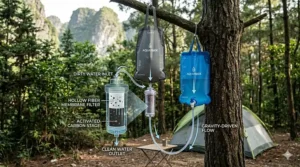
Gravity water filter for camping systems operate on a brilliantly simple principle: hydrostatic pressure. When you elevate a reservoir filled with untreated water above a clean water container, gravity creates pressure that forces water through a filtration membrane. The greater the height difference, the faster the flow rate—basic physics working in your favor.
Modern gravity filter system camping products use hollow fiber membrane technology, which consists of thousands of tiny tubes with microscopic pores. These pores are measured in microns (one millionth of a meter), with most camping filters ranging from 0.1 to 0.2 microns. Filters meeting EPA standards with pore sizes of 0.2 micron or smaller can effectively remove 99.9999% of bacteria like E. coli and 99.9% of protozoa such as Giardia and Cryptosporidium, the primary waterborne threats in North American backcountry.
The hollow fiber design creates an incredibly high surface area within a compact filter cartridge. Water flows through the outer walls of these microscopic tubes while bacteria and protozoa are physically blocked. Unlike chemical treatment that requires waiting periods, physical filtration works instantly—if water passes through, it’s been filtered. This immediate action makes hands-free filtering not just convenient but reliably safe.
Some advanced systems incorporate activated carbon stages that improve taste and reduce chlorine, while others use sediment traps to prevent clogging in silty water. Understanding these technologies helps you match a filter to your specific water sources and camping conditions.
Choosing the Right Reservoir Capacity Liters
Selecting the appropriate reservoir capacity liters depends on multiple factors beyond just group size. A solo backpacker doing 15-mile days needs different capacity than a family car camping for a weekend. Consider your consumption rate for drinking, cooking, cleaning, and hygiene—it adds up faster than you’d think.
Solo Hikers (1 person): A 1-3 liter system typically suffices. You’ll filter more frequently, but the weight savings and pack space matter more than convenience. Models like the Sawyer 1-Gallon or LifeStraw Peak 3L hit the sweet spot.
Couples & Small Groups (2-4 people): The 3-4 liter range provides enough capacity for meals and drinking without constant refilling. The Platypus GravityWorks 4L excels here, offering 8 liters total capacity when you count both reservoirs. This means one filtering session can handle dinner prep, dishwashing, and tomorrow’s water bottles.
Large Groups & Base Camps (5+ people): Jump to 6-10 liter systems like the MSR AutoFlow XL or LifeStraw Peak 8L. These workhorses can produce enough water for a dozen campers in one session. For group camping filtration, calculate roughly 2-3 liters per person per day in moderate conditions, more in hot weather or high altitude.
Trip Duration Considerations: Multi-day treks through arid regions might require carrying extra capacity during long dry stretches. Having a larger bag doesn’t mean you must fill it completely—it provides options when water sources are sparse or of questionable quality.
Flow Rate Performance and Real-World Expectations
Manufacturers advertise impressive flow rates—1.75 liters per minute! 2 liters per minute!—but real-world performance depends on several variables that aren’t mentioned in marketing materials. Understanding these factors prevents disappointment at the campsite.
Height Differential: The physics are simple—more height equals faster flow. Hanging your dirty bag 6 feet above the clean container produces significantly faster filtration than 2 feet. When possible, maximize this vertical distance. Some systems like the Platypus GravityWorks can work on slopes with minimal height, but flow rate suffers accordingly.
Water Clarity: Crystal-clear alpine streams filter faster than silty rivers. Sediment and organic matter gradually clog the filter membrane, slowing flow over time. The Katadyn BeFree demonstrates this dramatically—blazing fast in clean water but requiring frequent cleaning in murky sources. Pre-filtering cloudy water through a coffee filter or bandana extends filter life and maintains flow.
Filter Age and Maintenance: Even the best filters slow down with use. Regular backflushing reverses flow to dislodge trapped particles, restoring up to 98% of original flow rate according to manufacturers like Sawyer Products. Filters that arrive at 1.75 L/min might drop to 1 L/min after filtering 500 liters without maintenance. Budget 30 seconds every few uses for backflushing—a small price for sustained performance.
Temperature Effects: Cold water flows slower than warm water. Winter camping or glacier-fed streams mean longer wait times. Some users warm their filter in a pocket before use to improve flow in freezing conditions.
Maintenance and Filter Longevity
Proper maintenance transforms a gravity water filter for camping from a temporary gear purchase into a decade-long investment. Most hollow fiber filters can last effectively indefinitely if properly cared for—the membrane doesn’t wear out, it just gets clogged. Here’s how to maximize that lifespan.
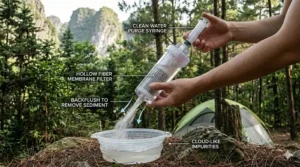
Backflushing Frequency: Don’t wait until flow becomes a trickle. Backflush after every 3-5 uses in clear water, or immediately after filtering turbid water. Most systems include a syringe or plunger—fill it with clean filtered water and force it backward through the filter. You’ll see dirty water emerge from the inlet side as trapped particles dislodge. The Sawyer and Platypus systems make this especially easy with their included cleaning couplers.
Field Cleaning Protocol: Beyond backflushing, some filters benefit from swishing in clean water. The Katadyn BeFree pioneered this shake-to-clean approach—simply fill the filter housing with water, cap it, and shake vigorously. This mechanical action dislodges particles without requiring separate tools. However, this method works best in the field as a temporary measure; thorough backflushing at home remains essential.
Storage Considerations: Never store filters wet unless using a saline solution. Bacteria and mold can grow in damp hollow fibers, ruining the filter. After your trip, backflush thoroughly, then blow excess water out by mouth or syringe. Some users like the LifeStraw recommendation of storing filters in a weak saline solution (1 teaspoon salt per cup water) to prevent microbial growth while keeping fibers hydrated.
Freeze Protection: Freezing destroys hollow fiber filters permanently. Ice crystals expand and tear the delicate membrane, creating pathways for pathogens to pass through. In winter camping, sleep with your filter in your sleeping bag. If you suspect freezing occurred, replace the filter—it’s not worth the health risk. Most manufacturers like MSR void warranties on frozen filters for this reason.
Hands-Free Filtering Setup Techniques
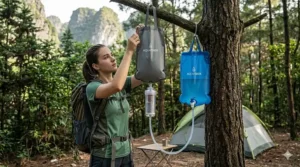
Setting up a gravity filter system camping arrangement seems straightforward—fill bag, hang bag, attach filter, wait. Yet small technique adjustments dramatically improve efficiency and convenience. Here’s what veteran backcountry users have learned through trial and error.
The Perfect Hang: Not all hang points are created equal. Look for sturdy branches at least 5-6 feet off the ground when possible. The Platypus GravityWorks includes a webbing strap that makes securing to various diameters easier. In treeless terrain like deserts or above treeline, get creative—trekking poles lashed together in an A-frame, the tailgate of your vehicle, or even having someone hold the bag for a few minutes works in a pinch.
Clean Water Collection: Dual-reservoir systems like the Platypus eliminate this concern with dedicated clean bags. Single-reservoir systems require you to hold a bottle or pot under the output hose—convenient if you’re nearby, frustrating if you wanted true hands-free operation. Pro tip: pack a lightweight stuff sack or dry bag as an impromptu clean water reservoir. It won’t be food-grade perfect, but works for washing or cooking water.
Dealing with Shallow Sources: Wide-mouth reservoirs are easier to fill from streams, but shallow puddles or seeps challenge even the best designs. The Katadyn BeFree narrow opening becomes a liability here. Solution: carry a small collapsible cup or scoop for transferring water, or use your cook pot to dip and pour. Some users cut the top off a plastic water bottle to create a permanent scoop that nests inside their reservoir.
Cross-Contamination Prevention: The number one rookie mistake is touching the clean output hose with dirty hands or letting it contact contaminated surfaces. Always keep the output side elevated and separate from the dirty reservoir. The MSR AutoFlow XL separate clip system helps here, but ultimately cleanliness requires conscious attention. Designate one person as the “clean hands” water manager if filtering for a group.
Group Camping Filtration Strategies
Managing water for multiple people changes the filtration game entirely. A solo hiker might tolerate squeezing a filter for their 2-liter daily needs, but try that for 10 people and you’ll understand why gravity systems dominate group camping scenarios. Here are proven strategies for keeping everyone hydrated efficiently.
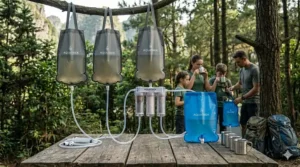
The Base Camp Water Station: Set up your MSR AutoFlow XL or LifeStraw Peak 8L as a semi-permanent water source. Hang it from a sturdy branch near camp, keep it topped off throughout the day, and designate a rotation for refilling duties. This eliminates bottlenecks where everyone wants to filter simultaneously before dinner. Bonus: it doubles as a handwashing station—just squeeze the output hose to create a stream of clean water over soapy hands.
The Two-System Approach: For groups of 6+, consider running two smaller systems simultaneously rather than one large system. Two Platypus GravityWorks 4L filters produce 8 liters of clean water in the same time as one MSR AutoFlow XL 10L, but with the flexibility of positioning them at different locations. This prevents the “everyone needs water right now” traffic jam.
Batch Processing: Calculate your group’s total daily consumption and filter it all at once rather than on-demand. Morning or evening works best when you’re already at camp. A group of 8 might need 20-24 liters total for drinking, cooking three meals, and cleanup. Run three full cycles through your 8L system, store clean water in everyone’s bottles and bladders, and you’re set for the day. This frontloading prevents the frustration of waiting for filtered water when you’re already thirsty.
Designate a Water Manager: On longer trips, rotate this responsibility daily. The water manager’s job includes monitoring filter flow rate, performing backflushing as needed, scouting water sources on the route, and ensuring everyone has adequate hydration. This system prevents the tragedy of the commons where everyone assumes someone else will handle it.
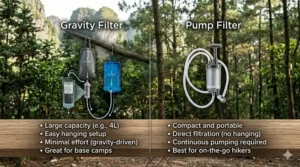
Comparing Gravity vs. Pump vs. Squeeze Filters
Each filtration method has earned its place in the backcountry toolkit. Understanding when gravity systems outshine alternatives—and vice versa—helps you make informed decisions for different trips.
Gravity Advantages: The obvious winner for hands-free operation and group efficiency. While your water filters, you cook, set up camp, or relax. No physical effort required beyond the initial fill and hang. For group camping filtration scenarios, nothing matches gravity’s ability to produce several liters unattended. The Platypus GravityWorks filtering 4 liters while you prep dinner represents peak backcountry multitasking.
Gravity Limitations: Requires sufficient vertical space for setup—problematic in deserts, plains, or anywhere trees are scarce. Bulkier than squeeze filters and heavier than straws. Flow rate depends on nearly-full bags; as the reservoir empties, gravity pressure decreases and flow slows. Less practical for filtering on-the-move during day hikes; primarily a camp-based solution.
When Pumps Excel: Shallow puddles or tiny seeps that barely wet the ground—scenarios where you can’t scoop water into a bag. Pumps also work in below-freezing temperatures when wet gravity bags would freeze. The mechanical pressure maintains consistent flow rate regardless of water level. However, pumps require continuous physical effort, and that repetitive motion gets tedious fast when producing 20 liters for a large group.
Squeeze Filter Niche: Solo ultralight backpackers prize squeeze systems like the Sawyer for minimal weight and pack volume. Fill a soft bottle, squeeze through the filter into your mouth or container, done. No setup required. The trade-off? Manual effort for every liter and typically smaller bag capacity. Great for 1-2 people on the move, frustrating for camp-based groups.
Hybrid Approaches: Smart campers often carry multiple systems. A lightweight squeeze filter for on-trail filtering during the day, plus a gravity system for camp. The LifeStraw Peak Series modular design embraces this versatility—function as a gravity filter at camp, then detach the filter element for squeeze-bottle or straw use during daytime.
Water Source Selection and Safety
Even the best gravity water filter for camping can’t overcome poor source selection. Knowing how to evaluate water sources and apply appropriate treatment ensures your group stays healthy. The CDC recommends treating any surface water before ingestion as a precaution, but some sources require extra caution.
Ideal Sources: Fast-flowing streams and rivers from mountainous areas typically offer the cleanest water. Current prevents bacterial growth, and the upstream wilderness environment minimizes contamination. Still, always filter—even pristine-looking alpine streams can harbor Giardia from wildlife. Cold, clear water flows faster through your filter and extends cartridge life compared to warm, murky alternatives.
Questionable Sources: Stagnant ponds, cattle-accessed streams, and water downstream from human activity demand extra vigilance. These situations might warrant double treatment—filter first, then add chemical disinfection for viruses that hollow fiber filters miss. Remember, 0.1-0.2 micron filters like those in the Katadyn and Sawyer systems excel at removing bacteria and protozoa but cannot filter out viruses, which are smaller.
Pre-Filtering Turbid Water: Muddy or silty water quickly clogs any filter, dramatically reducing flow rate and shortening cartridge life. When faced with cloudy sources, let water settle in a cook pot for 30 minutes before filtering, or pre-filter through a coffee filter or bandana. This simple step can quadruple your filter’s effective lifespan in sediment-heavy environments.
Coastal and Brackish Water: Gravity filters remove biological contaminants, not salt. The LifeStraw and Platypus systems work great in freshwater but cannot make saltwater or brackish water drinkable. For coastal camping, locate freshwater streams or springs rather than attempting to filter from the ocean.
Chemical Contamination: Agricultural runoff, mining operations, or industrial pollution introduce chemicals that physical filtration cannot remove. If you suspect chemical contamination, find an alternate source. Your hollow fiber filter excels at biological threats but offers zero protection against pesticides, heavy metals, or industrial chemicals.
Temperature Performance and Winter Considerations
Water doesn’t freeze at the same rate everywhere in your filtration system, and understanding these nuances prevents expensive filter damage and ensures reliable winter performance. The physics of freezing creates specific vulnerabilities in gravity systems.
The Filter Element Risk: Hollow fiber membranes are most vulnerable to freeze damage. When residual water inside the thousands of tiny tubes freezes, ice crystals expand and rupture the delicate membranes. This damage is permanent and undetectable without laboratory testing. Many users have unknowingly ruined their Sawyer or Platypus filter by assuming “just a little frost” wouldn’t matter. If there’s any possibility of freezing, drain and purge the filter element completely.
Purging Technique: After your final filtering session of the day, disconnect the filter and blow forcefully through it in reverse to expel all water. Some users also swing the filter in wide arcs (holding the outlet end) to centrifugally force water out. The MSR filter element’s integrity check feature helps verify your filter hasn’t been compromised by freezing—a valuable safety feature worth the premium price.
Overnight Storage: Sleeping with your filter in your sleeping bag guarantees it stays above freezing. Place it in a waterproof bag or stuff sack first to contain any moisture. The same applies to your dirty and clean water reservoirs if they contain water—either drain them completely or bring them inside your shelter and sleeping bag.
Cold Water Flow Rate: Even without freezing, cold water (near 32°F/0°C) flows significantly slower than 60°F/15°C water due to increased viscosity. Expect roughly 30-40% slower flow rates in winter conditions. Build this into your timeline—what takes 3 minutes in summer might take 5 minutes in winter. Some experienced winter campers warm their filter element in an interior jacket pocket for 10 minutes before use to improve initial flow.
Winter-Specific Alternatives: For serious winter camping, some users prefer chemical treatment or boiling over filtration entirely to eliminate freeze-damage risk. However, if you must filter, the Sawyer system’s small filter element is easiest to keep warm in a pocket, and its affordable replacement cost ($20-30) means a frozen filter isn’t a financial disaster.
❓ FAQ
❓ How long does it take to filter water with a gravity system?
❓ Can gravity filters remove viruses from water?
❓ How often should I backflush my gravity filter?
❓ What's the difference between 0.1 and 0.2 micron filters?
❓ Can I use a gravity filter for dirty reservoir water at base camp?
Final Thoughts: Finding Your Perfect Match
Choosing the right gravity water filter for camping ultimately comes down to matching system capabilities to your specific adventure style. Solo ultralight backpackers will appreciate the Sawyer Gravity System or LifeStraw Peak 3L for their minimal weight and versatile configurations. Weekend car campers with families should look at the LifeStraw Peak 8L dual-bag system that provides abundant capacity and leak-proof storage. And for serious backcountry groups or base camp operations, the Platypus GravityWorks 4L or MSR AutoFlow XL deliver the perfect blend of capacity, speed, and reliability.
The beauty of gravity filtration lies in its simplicity—no batteries to charge, no complex moving parts to fail, just basic physics delivering clean water while you handle other camp tasks. Whether you’re filtering glacier-fed streams in the Rockies, murky rivers in the Southeast, or desert springs in the Southwest, there’s a gravity filter system camping solution designed for your specific water sources and group size.
Remember, the best gravity water filter for camping is the one you’ll actually use consistently. A $150 premium system sitting at home because it’s too bulky for your minimalist style provides zero protection. Start by honestly evaluating your typical group size, camping style, and the water sources you encounter most often. Then match those needs to the reservoir capacity liters, flow rate, and features that align with your priorities.
One final piece of advice: practice setting up your new gravity system at home before your trip. Understanding how the quick-disconnects work, where the filter attaches, and how to achieve optimal hang height in your backyard means smoother operation when you’re tired at camp. Clean water is fundamental to any outdoor adventure—invest in quality filtration, maintain it properly, and it will serve you reliably for years of wilderness experiences.
Recommended for You
- 7 Best LifeStraw Review Camping Filters 2026
- 7 Best Sawyer Water Filter Review 2026
- 7 Best Water Filter for Camping 2026
Disclaimer: This article contains affiliate links. If you purchase products through these links, we may earn a small commission at no additional cost to you.
✨ Found this helpful? Share it with your friends! 💬🤗
