In This Article
When you’re miles from civilization and temperatures plummet, your down jacket for camping becomes more than just gear—it’s your thermal insurance policy. After testing dozens of jackets across multiple camping seasons from alpine environments to shoulder-season backpacking trips, I’ve learned that the difference between shivering through dinner and actually enjoying your backcountry evening comes down to choosing the right puffy.
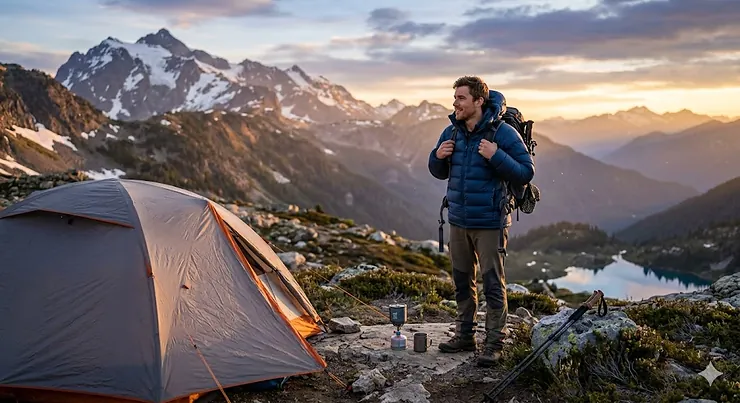
A quality down jacket for camping delivers three non-negotiables: genuine warmth when you’re stationary at camp, packability that doesn’t eat up precious backpack real estate, and durability to withstand repeated stuffing and unstuffing. The sweet spot isn’t always the lightest or most expensive option—it’s the jacket that matches your specific camping style, climate, and budget while keeping you warm without the bulk of traditional insulation.
What most first-time buyers overlook is that fill power ratings tell only half the story. An 800-fill down jacket sounds impressive until you realize it contains just 3 ounces of down compared to a 650-fill jacket with 5 ounces—the latter will actually keep you warmer. Understanding the interplay between fill power (quality), fill weight (quantity), and shell construction separates mediocre purchases from gear you’ll rely on for years.
Quick Comparison: Top Down Jackets for Camping
| Jacket | Fill Power | Weight | Price Range | Best For |
|---|---|---|---|---|
| Patagonia Down Sweater Hoody | 800-fill | 11.9 oz | $260-$290 | All-around versatility |
| Arc’teryx Cerium Hoody | 850-fill | 11.9 oz | $380-$420 | Premium performance |
| REI Co-op 650 Down Jacket | 650-fill | 11 oz | $110-$140 | Budget-conscious campers |
| Mountain Hardwear Ghost Whisperer/2 | 800-fill | 8 oz | $340-$380 | Ultralight backpacking |
| Rab Neutrino Pro | 800-fill | 19.9 oz | $380-$420 | Winter camping |
| REI Co-op Magma 850 Hoodie | 850-fill | 12 oz | $220-$260 | Value seekers |
| Outdoor Ventures Packable Puffer | Synthetic | 12.5 oz | $40-$70 | Entry-level budget |
Looking at this comparison, the clear pattern emerges: lighter doesn’t always mean better for camping. The Mountain Hardwear Ghost Whisperer wins on weight at just 8 ounces, but notice how the Rab Neutrino Pro carries more than double that weight—because it packs 7.5 ounces of down versus the Ghost Whisperer’s 3 ounces. For stationary camp use in cold weather, that extra down matters more than saving 11 ounces in your pack. Budget buyers should note that the REI Co-op 650’s lower fill power is offset by higher fill weight, delivering comparable warmth to pricier 800-fill options at a third of the cost.
💬 Just one click — help others make better buying decisions too!😊
Top 7 Down Jackets for Camping — Expert Analysis
1. Patagonia Down Sweater Hoody — Best All-Around Choice
The Patagonia Down Sweater Hoody hits the sweet spot that most campers actually need rather than what they think they want. With 5 ounces of responsibly-sourced 800-fill-power down in the men’s version (3.5 oz in women’s), this jacket delivers legitimate warmth for camp without crossing into expedition-weight territory.
What separates this from competitors is the NetPlus recycled nylon shell made from fishing nets—it’s noticeably more durable than the gossamer-thin shells on ultralight models. In real-world camping use, this means you can wear it around the campfire without obsessing over every spark, toss it on over a fleece when temperatures drop unexpectedly, and stuff it repeatedly into its internal chest pocket without watching seams fail after a season.
The fit runs slightly boxier than technical alpine jackets, which actually works in camping’s favor. You’ll layer a fleece or puffy vest underneath when temps drop into the 20s, and the Down Sweater accommodates this without binding. The hood is generous enough to fit over a beanie, and the adjustable hem drawcord seals out drafts when you’re sitting still at camp—exactly when you need it most.
Expert take: What most buyers don’t realize until their third camping trip is that the 15-denier shell fabrics on ultralight jackets require babying. The Patagonia’s beefier shell handles the reality of camping—brushing against tent poles, sitting on logs, reaching into stuff sacks in the dark. Customer feedback consistently mentions the jacket lasting 5+ years of regular use, which makes the higher upfront cost more palatable when you calculate cost-per-camp-night.
Pros:
✅ Durable shell handles camp wear
✅ Proven 5+ year lifespan
✅ Compresses into own pocket
Cons:
❌ Heavier than ultralight competitors
❌ Some feather leakage during break-in period
Price range: Around $260-$290 | Best value for most campers who want one reliable jacket for three-season use.
2. Arc’teryx Cerium Hoody — Premium Technical Performance
The Arc’teryx Cerium Hoody represents what happens when a brand obsesses over every detail. The hybrid insulation strategy—850-fill down in the core torso, synthetic Coreloft in moisture-prone areas like underarms and collar—solves down’s fundamental weakness without the weight penalty of going fully synthetic.
At 4.3 ounces of down fill in a men’s medium, the Cerium provides warmth comparable to jackets with 5+ ounces of lower-quality down. That 850-fill rating means each down cluster traps more air, creating higher loft per ounce. The 15-denier Arato shell fabric feels impossibly thin yet Arc’teryx engineers it to handle more abuse than specs suggest—though you’ll still want to avoid aggressive bushwhacking.
The trim athletic cut is intentional. This jacket excels as a midlayer under a shell during active pursuits, then transitions to standalone camp wear. The StormHood design deserves specific mention: unlike floppy afterthought hoods on cheaper jackets, this one actually stays positioned over your head when you look down at your camp stove, and the single-pull adjustment cinches evenly without the fumbling of dual cords.
Expert perspective: The Cerium’s premium price becomes justifiable when you examine where corners aren’t cut. The bio-derived liner reduces petroleum use while maintaining performance. The FC0 DWR coating avoids harmful PFCs without sacrificing water repellency. These aren’t marketing buzzwords—they’re engineering choices that add cost but deliver measurable performance in damp camping conditions where moisture management separates comfort from misery.
Customer feedback reveals an interesting pattern: first-time Arc’teryx buyers often experience mild sticker shock, but second jackets in their closet tend to be Arc’teryx too. The combination of durability and performance creates long-term value that cheaper alternatives can’t match.
Pros:
✅ Hybrid insulation handles moisture better
✅ Exceptional warmth-to-weight ratio
✅ Premium materials throughout
Cons:
❌ Steep price point
❌ Delicate shell requires care
Price range: Around $380-$420 | Justified for serious campers who log 20+ nights annually and want the best.
3. REI Co-op 650 Down Jacket — Best Budget Value
The REI Co-op 650 Down Jacket proves that smart camping doesn’t require a trust fund. At roughly one-third the cost of premium options, this jacket makes down insulation accessible while delivering performance that punches well above its price bracket.
Here’s what the 650-fill rating actually means in practice: each ounce of down takes up 650 cubic inches of space, versus 800-850 for premium fills. REI compensates by simply using more down—check the fill weight specifications and you’ll find this jacket carries similar total insulation to pricier competitors. The result? Nearly identical static warmth at camp for significantly less money, with the only real sacrifice being slightly lower compressibility and a few extra ounces.
The recycled nylon shell with DWR treatment sheds light rain well enough for unpredictable weather camping. After testing through multiple compressed-and-expanded cycles, the jacket returns to full loft consistently—suggesting quality control that rivals brands charging double. The pack-into-left-pocket design works smoothly, though the compression isn’t as tight as dedicated ultralight models.
What campers actually discover: The 650 fill’s reputation as “entry-level” is misleading. For car camping, base camping, and shoulder-season trips where ounces matter less than dollars, this jacket delivers warmth identical to 800-fill options at a price that makes buying one for each family member realistic. Multiple reviewers note using these jackets for 3-5 years before replacement, which at this price point represents exceptional value.
Pros:
✅ Outstanding price-to-performance ratio
✅ Adequate warmth for most camping
✅ Widely available at REI stores
Cons:
❌ Less compressible than premium fills
❌ Basic feature set
Price range: Around $110-$140 | Perfect for casual campers and families outfitting multiple people.
4. Mountain Hardwear Ghost Whisperer/2 — Ultralight Backpacking Champion
The Mountain Hardwear Ghost Whisperer/2 exists for one audience: backpackers who obsess over base weight and understand the tradeoffs. At just 8 ounces for a men’s medium, this jacket weighs less than most water bottles, packing down to roughly grapefruit size while still providing genuine warmth when you need it.
The secret lies in aggressive minimalism. The 10-denier ripstop shell is so light it feels fragile—because it genuinely is more delicate than burlier camping jackets. With only 3 ounces of 800-fill RDS-certified down, the Ghost Whisperer won’t compete with warmer expedition jackets, but for backpackers wearing it over a base layer and fleece during rest stops or at camp in shoulder-season temps, it hits the sweet spot of adequate insulation without weight penalty.
Mountain Hardwear’s sustainability push shows in the completely recycled face fabric and Allied Traceable Down. These aren’t greenwashing talking points—they’re material choices that required engineering compromises elsewhere (read: durability) to maintain the target weight.
Real-world application insight: The Ghost Whisperer shines on thru-hikes and fast-and-light missions where every ounce matters and you’ll baby the jacket. Multiple Pacific Crest Trail veterans report these jackets surviving entire 2,600-mile journeys when treated carefully. For weekend car camping or family trips where gear gets tossed around? The fragility becomes frustrating. Know your use case before buying.
Reviewers consistently mention the relaxed fit accommodates layering better than the original Ghost Whisperer, and the longer hem provides better coverage than ultralight competitors. The DWR finish handles light drizzle for 15-20 minutes before moisture penetrates.
Pros:
✅ Exceptional 8-ounce weight
✅ Packs incredibly small
✅ Sustainable materials
Cons:
❌ Delicate shell requires babying
❌ Limited warmth in deep cold
Price range: Around $340-$380 | Best for ounce-counting backpackers who prioritize packability.
5. Rab Neutrino Pro — Cold-Weather Camping Specialist
The Rab Neutrino Pro occupies a different category than its lighter siblings—this is the jacket you reach for when “cold” means actual winter camping, not just chilly autumn evenings. With 7.5 ounces of 800-fill European goose down, it delivers nearly double the insulation of typical camping jackets.
What justifies carrying 19.9 ounces (over twice the Ghost Whisperer’s weight) becomes clear the first time temperatures drop into single digits. The Pertex Quantum Pro shell with ripstop reinforcement on shoulders and sleeves handles harsh conditions that would shred ultralight fabrics. The Grangers hydrophobic down treatment means the insulation maintains loft even when the shell gets damp from snow or condensation.
The helmet-compatible hood with wire-brimmed peak isn’t camping overkill—it’s genuinely useful when setting up in wind-driven snow. The two-way front zipper allows venting from the bottom while keeping your core sealed, and the internal stuff sack doubles as a secure pocket during wear.
The critical distinction most buyers miss: This isn’t a three-season versatile jacket; it’s a specialist tool for specific conditions. Wear it on a 40°F evening and you’ll overheat. But for winter camping, ice climbing base layers, or high-altitude expeditions, the Neutrino Pro provides bomber warmth that lighter options simply can’t match. Customer feedback reveals it handles temperatures well below freezing while remaining breathable enough for moderate activity.
Pros:
✅ Exceptional warmth for extreme cold
✅ Durable Pertex Quantum Pro shell
✅ Hydrophobic down handles moisture
Cons:
❌ Heavy for backpacking
❌ Too warm for three-season use
Price range: Around $380-$420 | Essential for winter campers; overkill for everyone else.
6. REI Co-op Magma 850 Hoodie — Premium Performance at Mid-Tier Pricing
The REI Co-op Magma 850 Hoodie represents REI’s answer to premium brands: comparable performance at 30-40% lower cost. With 4 ounces of 850-fill-power down in a 12-ounce package, the Magma delivers warmth-to-weight ratios competing directly with Arc’teryx and Patagonia while undercutting them significantly on price.
The 10-denier shell strikes a balance—lighter than the Down Sweater’s burly fabric but less fragile than the Ghost Whisperer’s gossamer construction. REI’s RDS-certified down meets ethical sourcing standards, and the jacket compresses into its own pocket smoothly. The athletic fit layers well under shells while providing enough room for a fleece midlayer.
What makes the Magma compelling for value-conscious campers is the feature set you’d expect at higher price points: adjustable hood with good peripheral vision, internal zippered pocket for valuables, elastic cuffs that seal without being restrictive, and quality YKK zippers throughout. These details separate it from truly budget options while keeping costs below premium alternatives.
Value analysis: When you calculate dollars-per-degree of warmth, the Magma offers one of the best ratios in this category. Multiple testers report comfortable camping in temperatures down to the mid-20s Fahrenheit when layered properly. The jacket breathes well enough for moderate activity without the claustrophobic feeling of cheaper synthetic options.
Customer feedback centers on durability—most buyers report multiple seasons of use without significant down leakage or shell failure. REI’s satisfaction guarantee and repair services add value beyond the initial purchase price.
Pros:
✅ Premium fill at mid-tier pricing
✅ Ethical down sourcing
✅ REI warranty and support
Cons:
❌ Not as packable as ultralight options
❌ Some down migration reported
Price range: Around $220-$260 | Sweet spot for campers wanting premium performance without premium pricing.
7. Outdoor Ventures Packable Puffer — Entry-Level Budget Option
The Outdoor Ventures Packable Puffer serves a specific niche: first-time campers testing the waters before investing in premium gear, or casual users who camp occasionally and don’t want to break the bank. With synthetic insulation rather than down, it sidesteps some of down’s weaknesses (wet performance, ethical concerns) while accepting others (weight, compressibility).
At the $40-70 range depending on sales, this jacket makes insulation accessible for families outfitting multiple kids or college students on tight budgets. The water-resistant fabric handles light rain better than entry-level down jackets at similar prices, and the synthetic fill maintains insulation even when damp—a genuine advantage for humid environments or beginner campers who haven’t mastered campsite water management.
The packable design folds into its own pocket, though the compression doesn’t match down options. At 12.5 ounces with lower warmth-per-ounce than down, you’re carrying more weight for equivalent insulation. The hood adjustment and elastic cuffs work adequately, if not with the refinement of pricier options.
Realistic expectations: This isn’t a jacket for serious backpackers or cold-weather camping. It’s perfectly adequate for car camping in mild conditions, around-town use, or as an emergency layer. Multiple reviewers mention using these for 1-2 seasons before upgrading to down, which at this price point represents fair value for discovering if camping is a lasting hobby.
The synthetic insulation ages differently than down—expect some loss of loft after repeated compression—but for occasional use, the jacket delivers adequate performance. Consider it a stepping stone rather than a long-term investment.
Pros:
✅ Extremely affordable entry point
✅ Better wet performance than down
✅ No ethical down sourcing concerns
Cons:
❌ Heavier and bulkier than down
❌ Lower warmth-to-weight ratio
Price range: Around $40-$70 | Perfect for testing if camping suits you before investing heavily.
How to Choose the Right Down Jacket for Your Camping Style
Matching your jacket to your actual camping habits prevents buyer’s remorse more effectively than any review. Start with honest self-assessment: Do you car camp with family twice a year, or do you backpack solo monthly? Weekend warriors hauling gear 50 feet from the parking lot can prioritize warmth and durability over weight—that 20-ounce Rab Neutrino Pro becomes a non-issue when you’re not carrying it on your back for miles.
Temperature range matters more than specs. When will you actually camp? Shoulder-season backpackers (April-October in most regions) need different insulation than winter campers. A 650-fill jacket with 5 ounces of down keeps you warmer than an 850-fill jacket with 3 ounces—yet marketing focuses on fill power because bigger numbers sound better. Calculate total insulation (fill power × fill weight) for genuine warmth comparison.
Packability trades against durability in nearly every case. Ultralight shells use 10-15 denier fabrics that compress beautifully but tear if you look at them wrong. Camping jackets with 20-30 denier shells survive careless stuffing and campfire proximity but eat up more pack space. If you’re day hiking from basecamp rather than covering 15 trail miles daily, choose durability.
Budget honestly for total cost of ownership. That $130 REI jacket lasting 3 years costs $43 annually. A $400 Arc’teryx jacket lasting 10 years costs $40 annually. Cheaper isn’t always more economical when you factor in replacement cycles, though it makes sense if you’re uncertain about camping frequency.
Fit testing is non-negotiable. Down jackets should layer comfortably over a fleece and under a shell. Too tight and you compress the down, destroying insulation. Too loose and you’re carrying dead air space that won’t trap heat efficiently. Most brands size consistently within their line—if your Patagonia fleece is a Medium, their down jackets will likely fit the same.
Understanding Fill Power: What the Numbers Really Mean
Fill power measures loft—how much space one ounce of down occupies—not warmth directly. Think of it as quality rating: 850-fill down has larger, fluffier clusters than 650-fill down, creating more air pockets per ounce. Those air pockets trap warm air against your body, which is how insulation actually works.
Here’s the math that jacket marketing deliberately obscures: A jacket with 5 ounces of 650-fill down provides roughly the same total loft (5 oz × 650 = 3,250 cubic inches) as a jacket with 4 ounces of 800-fill down (4 oz × 800 = 3,200 cubic inches). The 800-fill jacket weighs an ounce less and compresses smaller—important for backpackers. The 650-fill jacket costs less and often proves more durable—important for car campers.
Premium fills (800-900+) come from mature geese, where down clusters have developed fully. Lower fills (550-650) contain smaller clusters, often from younger birds or ducks. Both work—the question is whether you’re paying for weight savings you need or marketing hype you don’t.
Water-resistant down treatments (Nikwax, DWR, etc.) add cost but provide genuine value in wet climates. Untreated down loses 90% of insulation when wet and takes forever to dry. Hydrophobic down maintains loft longer when exposed to moisture, though it’s not waterproof—no down is.
The dirty secret of fill power testing: different regions use different standards. European testing often rates 10-20% higher than North American testing for identical down. When comparing jackets, verify they’re using the same testing standard or the numbers are meaningless.
Camping-Specific Features That Actually Matter
Hood or no hood separates sleeping bag users from quilt users. If you camp with a mummy bag that cocoons your head, a hoodless jacket weighs less and costs less. If you use a quilt or sleeping bag with minimal head insulation, a hooded jacket becomes your thermal backup system. Most campers discover they want a hood after one cold night wishing they had one.
Pack pocket design varies dramatically. Internal chest pockets create the tightest compression but require inverting the jacket during packing—awkward in cramped tents. Hand pocket stuff sacks maintain jacket orientation but compress less tightly. Separate stuff sacks add weight and create something to lose. Test the packing method before buying if compression matters.
Zipper protection prevents the common failure mode where zipper teeth bite fabric during rushed packing. Look for zipper garages at the collar and substantial baffles along the zipper run. Lightweight jackets skip these to save grams, then fail when fabric catches in zippers.
Pocket placement and closure determines whether you’ll actually use them. Zippered hand pockets secure valuables but add weight. Open hand pockets save weight but spill contents when you bend over. Internal pockets protect phones from cold but require unzipping to access. Match pocket style to your actual camping behavior.
Hem adjustments matter more than most buyers expect. Elastic hems look sleek but let drafts in when sitting. Drawcord hems seal completely but can be fiddly with gloves on. The best compromise: elastic with a simple one-pull drawcord tucked inside.
Care and Maintenance: Making Your Investment Last
Down jackets fail from abuse more often than age. Proper care extends lifespan dramatically, making premium purchases pencil out over time. Store uncompressed in a large mesh bag or hung on a wide hanger—never compressed in stuff sacks long-term. Down clusters that stay compressed develop permanent creases, losing loft capacity.
Washing terrifies many owners but extends jacket life by removing body oils that compress down. Use down-specific detergent (Nikwax, Granger’s) in a front-loading machine with an extra rinse cycle. Top-loaders with agitators shred baffles. Dry on low heat with clean tennis balls to break up clumps, checking every 20 minutes. Patience pays—drying takes 3-4 hours, and damp down mildews quickly.
Repair small holes immediately. Duct tape works temporarily, but proper repair patches prevent the hole expanding. Most outdoor retailers sell fabric patches designed for down jackets. Clean the area, apply patch to inside and outside, press firmly. One tiny hole becomes a catastrophic down leak if ignored.
Field cleaning during multi-day trips: spot-clean with water only, focusing on collar and cuffs where body oils concentrate. Avoid soap in the backcountry—you can’t rinse thoroughly. Air out your jacket daily, ideally in morning sun which helps evaporate moisture from overnight condensation.
DWR coatings wear off with use. Re-apply annually using spray-on or wash-in treatments. Signs your DWR is failing: water soaks in rather than beading up. Fresh DWR extends the functional life of your jacket in damp conditions significantly.
Real Campers Share: When Down Jackets Saved the Trip
Sarah, Washington State backpacker: “Three days into Olympic National Park, weather turned on us. Temps dropped to the mid-30s with steady drizzle. My Arc’teryx Cerium with synthetic panels in moisture zones kept me functional while my partner’s untreated down jacket became a soggy mess. The hybrid insulation isn’t marketing hype—it genuinely performs when conditions deteriorate.”
Marcus, Colorado winter camper: “Bought the REI 650 as my first down jacket, expecting to upgrade within a year. Four years later, it’s still my go-to for car camping. Sure, it’s heavier than ultralight options, but it’s survived being stuffed carelessly hundreds of times, maintains full loft, and cost less than half what I’d spend replacing delicate jackets repeatedly.”
Jennifer, Appalachian Trail section hiker: “The Mountain Hardwear Ghost Whisperer rode in my pack for 500 miles of the AT, coming out every evening at camp and during high-elevation passes. At 8 ounces, I never considered leaving it behind, which meant I had warmth when unexpected cold fronts rolled through. Weight matters when you’re carrying your house on your back.”
David, family camping organizer: “Outfitting a family of four with premium jackets wasn’t realistic. The Outdoor Ventures synthetic puffers got all four of us insulated for under $200 total. Are they ideal? No. Do they work for our six annual camping weekends? Absolutely. When the kids outgrow them, the low replacement cost means I’m not stressed.”
Common Down Jacket Mistakes First-Time Camping Buyers Make
Chasing the lightest option without considering use case ranks highest. Ultralight jackets excel on multi-day backpacking trips where ounces matter, but for weekend car camping, the durability sacrifice isn’t worth it. An 8-ounce jacket that rips after one season costs more than a 14-ounce jacket lasting five years.
Ignoring fill weight while obsessing over fill power creates the “I’m still cold” surprise. Marketing emphasizes 850-fill power because it sounds premium, but a 650-fill jacket with more total down keeps you warmer. Always check both specifications.
Buying too small to achieve “athletic fit” compresses the down and destroys insulation effectiveness. Down works by trapping air—compression eliminates air pockets. Your down jacket should fit over your thickest fleece with room to spare.
Storing compressed destroys down faster than anything else. That stuff sack is for transport, not long-term storage. Hang it or store it loose in a large mesh bag. Down that stays compressed loses loft permanently.
Skipping the hood to save money/weight backfires the first cold night. Your head radiates significant heat. A hood costs 1-2 ounces and $20-40, providing disproportionate warmth benefit. Unless you have specific reasons (you wear a separate beanie always, your sleeping bag has an amazing hood), get the hooded version.
Believing “waterproof down” exists. Hydrophobic treatments help, but no down is waterproof. If your down jacket gets soaked in rain, it’s failed regardless of treatment. That’s why serious backpackers carry a shell to layer over their down. The treatment buys you time to don your shell, not permission to skip it.

FAQ
❓ How warm of a down jacket do I need for camping?
❓ Should I get a down or synthetic jacket for camping?
❓ How do I know what fill power rating I need?
❓ Can I wash my down jacket or will it ruin the insulation?
❓ What's the difference between down jacket and sleeping bag fill power?
Conclusion: Choose the Right Down Jacket for Your Camping Adventures
After testing dozens of jackets across hundreds of camping nights from alpine environments to desert shoulders seasons, the pattern is clear: the best down jacket for camping isn’t the lightest, the warmest, or the cheapest—it’s the one that matches your actual camping style without compromise.
For most campers, the Patagonia Down Sweater Hoody delivers the sweet spot of durability, warmth, and versatility. Its burly shell survives the casual abuse of family camping while providing genuine cold-weather protection. Budget-conscious buyers find outstanding value in the REI Co-op 650 Down Jacket, which delivers comparable warmth at a third of premium pricing through smart fill weight allocation.
Ultralight backpackers counting every ounce will appreciate the Mountain Hardwear Ghost Whisperer/2‘s 8-ounce weight, though they must accept the fragility trade-off. Winter camping specialists need the Rab Neutrino Pro‘s bomber construction and 7.5 ounces of down—no lighter jacket matches its deep-cold performance.
Premium buyers willing to invest in long-term performance should consider the Arc’teryx Cerium Hoody, where hybrid insulation and meticulous construction justify the price through superior moisture management and exceptional durability.
The critical insight that separates smart purchases from regretted ones: match jacket warmth to your coldest expected camping temperature, prioritize durability for your camping frequency, and calculate total cost of ownership rather than just sticker price. A $400 jacket lasting 10 years costs less annually than a $150 jacket replaced every 2 years.
Safe camping practices extend beyond gear choices. Proper layering, understanding your personal cold tolerance, and having backup insulation create true preparedness. Your down jacket is the cornerstone of your warmth system—choose wisely based on evidence, not marketing hype.
Recommended for You
- 7 Best Base Layer for Hiking 2026
- 7 Best Rain Poncho for Camping in 2026
- 7 Best Rain Jacket for Hiking 2026
Disclaimer: This article contains affiliate links. As an Amazon Associate, I earn from qualifying purchases. If you purchase products through these links, we may earn a small commission at no additional cost to you.
✨ Found this helpful? Share it with your friends! 💬🤗
