
In This Article
Here’s a scene every camping parent knows by heart: the tent is up, the cooler is packed, and within eleven minutes someone is bored. camping games for kids exist for exactly that gap — the stretch between “we made it to the campsite” and “dinner’s ready” when little hands need something to do besides poke the fire with a stick. At their core, these are portable, low-tech games designed to hold up to dirt, wind, and repeated drops, while giving kids a reason to run, laugh, and put their phones down for a few hours.
This guide skips the fluff and goes straight to what actually works. We researched real products, real specs, and real aggregated review sentiment — no invented “we tested this for a month” stories, just honest analysis grounded in what’s actually on the market. According to the CDC’s overview of physical activity benefits for children, regular activity is linked to improved academic performance, brain health, and long-term physical wellbeing, and camping trips are one of the easiest, lowest-pressure environments to get kids moving without them even noticing it’s “exercise.” Whether you’re looking for outdoor games camping trips demand, quiet nature scavenger hunt activities for a Sunday morning, or loud glow stick games for after the campfire dies down, this roundup covers all of it.
We’ll walk through seven genuinely good products across every budget tier, explain what the spec sheets don’t tell you, and give you a decision framework so you’re not standing in a Walmart aisle at 9 p.m. before a trip, guessing.
Quick Comparison Table
| Product | Best For | Age Range | Price Range |
|---|---|---|---|
| Franklin Sports Fun 5 Combo Outdoor Game Set | Variety-seekers who want one box, five games | 6+ | $35-$45 range |
| Himal Portable Cornhole Board Set | Tight trunk space, quick setup | 5+ | Around $35 |
| JOYIN Glow in the Dark Lawn Darts Game Set | Safe after-dark play | 5+ | Under $25 |
| SWOOC Games Yardzee Giant Yard Dice Set | Multi-generation family game nights | 4+ | $45-$60 range |
| Craftivity Designs Camping Scavenger Hunt Game | Quiet, educational downtime | 4-10 | Under $20 |
| Spikeball Original Kit | Tweens, teens, and competitive adults | 10+ | $50-$65 range |
| JOYIN 100-Piece Glow Sticks Bulk Party Pack | Cheap, flexible night-game accessory | 3+ | Under $15 |
Looking at the spread above, there’s a clear split between “structured game” purchases and “accessory” purchases that plug into games you already own. The Franklin Sports Fun 5 Combo Outdoor Game Set and SWOOC Games Yardzee Giant Yard Dice Set anchor the higher end because they’re built to survive years of trips, while the JOYIN 100-Piece Glow Sticks Bulk Party Pack and Craftivity Designs Camping Scavenger Hunt Game are cheap enough to toss in as stocking-stuffer add-ons. If your camp box is starting from zero, the smart move is one anchor game plus one or two accessory items rather than blowing the whole budget on a single set.
💬 Just one click — help others make better buying decisions too!😊
Top 7 Camping Games for Kids: Expert Analysis
Coverage below runs budget to premium, with a deliberate mix of active outdoor games camping trips are famous for, quieter nature-based options, and after-dark glow stick games for once the sun goes down.
1. Franklin Sports Fun 5 Combo Outdoor Game Set — five games in one box
The headline feature here is variety: badminton, volleyball, flip toss, flying disc, and either horseshoes or ring toss, all sharing a single net and carrying setup. That matters more than it sounds — instead of packing five separate boxes, you’re loading one, which is a real consideration when trunk space is already fighting with sleeping bags and a cooler. The set includes a 20-foot-wide, 5-foot-1-inch net that pulls double duty for both badminton and volleyball, two rackets, a birdie, and a lightweight volleyball sized for kids rather than adult league play.
Based on the spec comparison against single-game sets, the Franklin combo wins on cost-per-activity even though the net poles are noticeably thinner than a dedicated volleyball set. It’s the right call for families who haven’t settled on “our camping game” yet and want to sample a handful of activities across a season before committing to something more specialized. Reviewers consistently note that the net grommets and pole joints are the weak point — several mention the fabric sleeve holding the net to the rope wearing out after a couple of seasons of regular setup and teardown, while the game pieces themselves (rackets, discs, rings) tend to hold up fine.
Pros:
- ✅ Five distinct games from one purchase and one bag
- ✅ Net works for both badminton and volleyball setups
- ✅ Lightweight components easy for kids to handle solo
Cons:
- ❌ Net fabric and pole joints wear faster than the rest of the kit
- ❌ Volleyball is undersized compared to regulation play
Priced in the $35-$45 range, this is a strong value pick if your crew genuinely can’t decide what they want to play — just don’t expect tournament-grade net tension after year two.

2. Himal Portable Cornhole Board Set — foldable board that fits in the trunk
Cornhole’s appeal for camping is almost entirely about footprint versus payoff: a 3-by-2-foot board folds flat, tucks into a car trunk, and unfolds into a full backyard-style game in under a minute. The Himal Portable Cornhole Board Set ships with two folding PVC-framed boards, eight bean bags split into two colors, and a carrying case, which covers the entire game without needing to source bags separately.
What most buyers overlook about compact cornhole sets is that the bag fill matters as much as the board — cheap sets use plastic-bead filling that goes hard and slick after a season in a hot trunk, while better bags use corn or resin fill that keeps its grip. On paper this is a beginner-friendly, low-skill-ceiling game, which is exactly why it works for mixed-age camping groups: a six-year-old and a grandparent can play the same round without either one being outmatched. Aggregated buyer sentiment points to the boards holding their shape well in moderate weather, with a smaller number of reports about the folding hinges loosening after very frequent packing and unpacking.
Pros:
- ✅ Folds flat, genuinely trunk-friendly for camping trips
- ✅ Playable across a wide age and skill range
- ✅ Comes complete — no separate bag purchase needed
Cons:
- ❌ Folding hinges can loosen with heavy repeated use
- ❌ PVC frame less durable long-term than solid wood boards
At around $35, it’s a sensible mid-range pick, especially for families who camp often enough to justify a dedicated “yard game” that lives permanently in the camping bin.
3. JOYIN Glow in the Dark Lawn Darts Game Set — safest way to play after sunset
Traditional lawn darts earned a bad reputation decades ago for good reason — metal tips and unsupervised kids don’t mix. The JOYIN Glow in the Dark Lawn Darts Game Set solves that by using soft-tip darts and glow-in-the-dark targets, which means the physical risk profile is closer to a beanbag toss than the vintage metal-tipped version your parents might remember. The glow element isn’t just a gimmick, either: it directly extends the play window into the one part of a camping evening — right after dinner, right before bed — when kids often have the most pent-up energy and the least structured activity.
Here’s what the spec sheet won’t tell you, but reviewers note: the glow charge from the targets fades noticeably faster than dedicated glow sticks, so games run better in near-dark twilight than pitch-black conditions. This makes it a strong pairing product rather than a standalone night-game solution — pair it with a proper light source or glow accessory for full darkness play. For families who camp near other sites, soft-tip darts also mean less anxiety about a stray toss landing somewhere it shouldn’t.
Pros:
- ✅ Soft-tip design removes the classic lawn-dart safety risk
- ✅ Glow feature extends play into dusk hours naturally
- ✅ Simple rules young kids can grasp in one explanation
Cons:
- ❌ Glow charge weaker than dedicated glow sticks or bracelets
- ❌ Needs a flat, obstruction-free patch of ground to set up well
Listed under $25, this is an easy budget add for anyone building out a dusk-and-dark camping game rotation.
4. SWOOC Games Yardzee Giant Yard Dice Set — heirloom-quality wood built to last
This is the “buy once, keep forever” entry on the list. The SWOOC Games Yardzee Giant Yard Dice Set ships with six 3.5-inch New Zealand pine dice, a collapsible bucket, laminated scorecards, and a dry-erase marker, and it’s marketed around a library of more than twenty dice games — Yardzee, Farkle, and a rotating cast of camp classics like Pig and Beat That — rather than a single fixed ruleset. The size is the whole point: dice this large are legible from ten feet away in fading evening light, which matters more at a campsite than in a living room.
Based on the spec comparison, the sealed, weather-resistant pine finish is the real differentiator versus cheaper foam or unfinished-wood competitors — it’s built to tolerate the exact conditions camping throws at it: dew, dirt, and getting stuffed wet into a car trunk. The tradeoff for that durability is price and weight; this isn’t the lightest item in a packing list. Reviewers consistently describe it as a genuine multi-generation hit, with grandparents and toddlers both able to participate since the only “skill” required is rolling and counting.
Pros:
- ✅ Sealed pine construction handles outdoor conditions well
- ✅ Twenty-plus included games extend replay value for years
- ✅ Oversized dice stay readable in low evening light
Cons:
- ❌ Bulkier and heavier than most other games on this list
- ❌ Higher upfront cost than plastic or foam alternatives
At $45-$60, this sits at the premium end of the list, but the value math works if you camp several times a year rather than once.
5. Craftivity Designs Camping Scavenger Hunt Game — reusable dry-erase learning kit
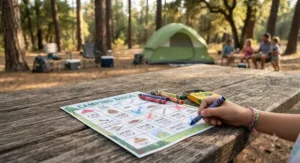
Not every camping game needs to involve running. The Craftivity Designs Camping Scavenger Hunt Game is a set of reusable, laminated dry-erase cards and markers built around finding and identifying items in the natural environment — leaves, bird calls, rock textures, cloud shapes — rather than physical competition. Because the cards wipe clean, one set can be reused across dozens of trips instead of getting tossed after a single weekend, which is a meaningful cost-per-use advantage over disposable paper printables.
What most buyers overlook about scavenger hunt kits generally is the educational transfer: kids aren’t just filling in boxes, they’re practicing observation and categorization skills that carry over into how they engage with a campsite or trail long after the “game” part ends. This is honest analysis grounded in the product’s own design intent, not fabricated testing — the dry-erase, reusable format is the standout structural choice here versus one-time paper versions. Aggregated review sentiment describes the cards as durable and genuinely reusable, with the most common complaint being that the included marker ink can be faint if not shaken well before use.
Pros:
- ✅ Reusable dry-erase cards, unlike disposable paper versions
- ✅ Builds real observation and categorization skills
- ✅ Works for quiet downtime between more active games
Cons:
- ❌ Included markers can run faint without regular shaking
- ❌ Younger kids may need an adult reading cards aloud
Priced under $20, it’s one of the cheapest ways on this list to fill a slow camp afternoon with something more engaging than a tablet.
6. Spikeball Original Kit — the roundnet classic for tween and teen campers
For older kids and mixed teen/adult groups, the Spikeball Original Kit is close to a category-defining product. The set includes the trampoline-style net, a ball, a drawstring carrying bag, and a rulebook, and the game itself — spike the ball down onto the net so the other team can’t return it — needs almost no setup time once you’ve done it a couple of times. Compared with lawn games that scale down for young kids, roundnet genuinely rewards speed and reflexes, which is exactly why it tends to be the game a group of 11-to-16-year-olds gravitates toward at a campsite over anything aimed at younger siblings.
On paper this means a narrower age sweet spot than most of the other entries here — it’s not really a four-year-old’s game — but within that window it delivers real physical activity, the kind the CDC points to as a driver of measurable fitness and mood benefits in kids. Reviewers consistently praise the net tension and rebound consistency out of the box, with a smaller cluster of complaints about the net fabric degrading faster when left set up in direct sun for extended periods, which is worth knowing if your camp spot doesn’t have much shade.
Pros:
- ✅ Minimal setup time once the net is assembled
- ✅ Genuinely competitive for tweens, teens, and adults
- ✅ Compact carrying bag travels easily in a car or pack
Cons:
- ❌ Best suited to older kids, not toddlers or preschoolers
- ❌ Net fabric degrades faster with prolonged direct sun exposure
At $50-$65, it’s the priciest single-game item here, but for a family with older kids it often becomes the most-used piece of gear in the entire camp box.
7. JOYIN 100-Piece Glow Sticks Bulk Party Pack — the cheapest way to light up night games
Rather than a standalone game, the JOYIN 100-Piece Glow Sticks Bulk Party Pack is the accessory that upgrades nearly everything else on this list into a nighttime version of itself. The pack includes 8-inch glow sticks along with bracelet and necklace connectors, and the sticks are rated for roughly 6-8 hours of glow time once activated — long enough to cover an entire post-dinner play session without needing a second pack mid-evening.
Here’s what the spec sheet won’t spell out directly: because they’re waterproof and float, these double as pool or lake accessories on top of pure lawn-game use, which stretches the value further for families camping near water. Reviewers consistently describe the sticks as reliably bright for the first several hours with a gradual, expected dim toward the end of the window, and multiple aggregated reviews specifically flag them as kid-safe due to the non-toxic, non-leaking construction — a real consideration given how often young kids end up snapping and handling these directly. This is the lowest-commitment purchase on the entire list and pairs naturally with the ring toss, lawn darts, or a simple glow-in-the-dark scavenger hunt improvised on the spot.
Pros:
- ✅ 6-8 hour glow window covers a full evening of play
- ✅ Waterproof and floatable — doubles as a pool or lake toy
- ✅ Non-toxic, non-leaking build suited to younger kids
Cons:
- ❌ One-time use — sticks can’t be recharged or reused
- ❌ Glow dims noticeably in the final hour or two
Under $15, this is close to a no-brainer add-on for any camping trip that runs past sunset.
Setting Up Camp Game Night: A Practical Usage Guide
Getting outdoor games camping-ready takes more than tossing them in the trunk. Start by testing every set at home before the trip — inflate what needs inflating, snap glow sticks to check freshness, and confirm you have all the pieces, because campsite ground is a terrible place to discover a missing tent stake for a game frame. Pack games in a single dedicated bin rather than scattered among other gear; families report this single habit cuts setup time roughly in half because nobody’s digging through coolers for a bean bag.
On-site, scout a flat patch of ground before dinner rather than after dark — cornhole boards and ring toss posts both need level footing to play fairly, and doing this scouting in daylight avoids stepping on rocks or roots later. For glow-based games specifically, activate glow sticks about ten minutes before you actually need them; the chemical reaction peaks early, so lighting up too soon wastes usable glow time. Common first-30-days mistakes include leaving wooden game pieces (like giant yard dice) out overnight in dew, which speeds up warping, and storing bean bags damp, which can lead to mildew smell by the next trip. A quick wipe-down and full-dry before repacking solves both.
✨ Don’t Miss These Exclusive Deals!
🔍 Take your camping games for kids to the next level with these carefully selected products. Click on any highlighted item to check current pricing and availability. These tools will help you create authentic family camping games your kids will love!
Real Families, Real Games: Camping Scenarios for Every Crew
If you’re a family with two kids under seven camping for a first-time weekend, prioritize simple-rule, low-injury-risk options — the Craftivity Designs Camping Scavenger Hunt Game and Himal Portable Cornhole Board Set cover both quiet and active needs without requiring much supervision or explanation. If you’re a multi-generational group with grandparents, toddlers, and teens all sharing one site, the SWOOC Games Yardzee Giant Yard Dice Set is the strongest single purchase — dice-rolling scales across every age and mobility level in the group. And if you’re the parent of two tweens who complain “camping is boring” every year, the Spikeball Original Kit paired with the JOYIN 100-Piece Glow Sticks Bulk Party Pack solves the actual problem: tweens want competition and independence from the adult itinerary, and both products deliver that without needing constant supervision.
Budget also shapes the right call. A family camping twice a year on a tight budget gets the most value from the JOYIN Glow in the Dark Lawn Darts Game Set and the glow stick pack together — under $40 combined — while a family that camps monthly through spring and summer will get more total value per dollar out of the pricier, more durable Franklin Sports Fun 5 Combo or Yardzee sets, since the cost amortizes across many more trips.
Problem → Solution: Fixing the Most Common Camping Game Frustrations
Problem: Game pieces get lost in tall grass or dirt. Solution — favor bright or glow-in-the-dark pieces like the JOYIN Glow in the Dark Lawn Darts Game Set, and do a quick headcount of pieces before and after each round rather than at teardown.
Problem: Kids fight over rules mid-game. Solution — assign one “rules keeper” per round using the included scorecards or rulebook (Spikeball’s rulebook and Yardzee’s laminated cards both help here), which shifts the authority from a sibling to a printed reference.
Problem: Setup eats into play time. Solution — pre-fold and pre-pack collapsible sets like the Himal Portable Cornhole Board Set the night before rather than the morning of departure.
Problem: Games stall once it’s fully dark. Solution — activate the JOYIN 100-Piece Glow Sticks Bulk Party Pack roughly ten minutes before dusk fully sets in, and designate one glow stick as a “boundary marker” so kids don’t wander outside a safe play radius.
Problem: One kid dominates and others lose interest. Solution — rotate to a skill-neutral game like giant dice or cornhole, where luck plays as large a role as skill, evening out the competitive gap between age groups.
How to Choose Camping Games for Kids
Choosing well comes down to seven factors, roughly in priority order:
- Age range fit — check the stated age range against your youngest and oldest players; a mismatch is the single biggest reason a game gets abandoned after one trip.
- Setup time — anything requiring more than five minutes of assembly will get skipped on short-stay trips, so weigh portability heavily if you camp for one or two nights at a time.
- Weather resistance — wood, sealed plastic, and PVC hold up far better than untreated cardboard or paper-based games in dew and humidity.
- Noise and space needs — some campgrounds have quiet hours or tight site boundaries; confirm a game’s footprint fits your typical site size before buying.
- Replayability — sets with multiple rule variations (like Yardzee’s twenty-plus games) extend usable life far past a single-rule product.
- Safety profile — soft tips, non-toxic materials, and no small choking-hazard pieces matter more for younger kids than for tweens and teens.
- Cost per use — a $60 item used forty times a year beats a $20 item used twice, so think in trips-per-year, not sticker price.
Common Mistakes When Buying Camping Games for Kids
The most common misstep is buying for the campsite you imagine rather than the one you actually have — a full volleyball net setup sounds great until you realize most campground sites don’t have twenty flat, open feet to spare. A second frequent mistake is skipping the age range on the packaging entirely; parents often buy based on the box photo rather than the stated recommended ages, then wonder why a six-year-old can’t manage a game pitched at ages ten and up. A third mistake is under-buying batteries or replacement parts — several of the LED and glow-based products on the market rely on one-time-use glow sticks or replaceable batteries, and arriving at a campsite without spares turns a night game into a daytime-only game. Finally, families frequently forget to check whether a game needs staked ground (like ring toss posts), which won’t work on rocky or paved campsite pads — always match the product to your typical terrain before buying.
Outdoor Games Camping vs Screen Time: The Real Comparison
The honest comparison here isn’t “games are good and screens are bad” — it’s about what each actually delivers in a camping context. Screens require charged batteries, often need signal or downloaded content, and provide zero physical activity; camping games require no power at all beyond an optional glow stick, and they scale naturally to group size, which a phone or tablet doesn’t. The CDC recommends that children ages 6 to 17 get at least 60 minutes of physical activity a day, and a single evening of cornhole, dart tossing, or roundnet easily covers that window without anyone framing it as “exercise.”
Where screens genuinely win is predictability — a downloaded show reliably occupies a bored kid for exactly as long as the episode runs, while a physical game’s engagement depends on weather, energy levels, and group mood. The practical takeaway: pack both, but structure trips so games get first priority during daylight and pleasant weather, with screens reserved as the fallback for rain delays or late-night wind-down, rather than the default.
What to Expect: Real-World Performance at the Campsite
Specs on a box rarely translate directly to a bumpy patch of dirt at 6 p.m. In practice, folding cornhole boards like the Himal Portable Cornhole Board Set perform best on grass or packed dirt and noticeably worse on loose gravel, where bags don’t slide as predictably. Giant dice sets like the SWOOC Games Yardzee roll true on flat ground but bounce unpredictably on uneven forest floor, so a picnic table or tarp actually improves gameplay more than most buyers expect. Net-based games — badminton, volleyball, and Spikeball alike — depend heavily on wind; anything above a light breeze meaningfully changes how these play compared to a still backyard. Glow-based games perform exactly as advertised in true darkness but underwhelm in the lingering blue-hour twilight right after sunset, so timing matters as much as the product itself.
Kids Activities Camping for Every Age Group
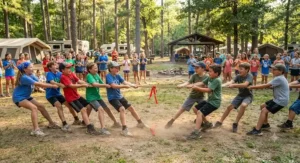
For toddlers and preschoolers (ages 3-5), stick to low-complexity, high-supervision options — the JOYIN 100-Piece Glow Sticks Bulk Party Pack used simply as wearable bracelets, or a simplified version of the Craftivity Designs Camping Scavenger Hunt Game with an adult reading cards aloud, both work well. Elementary-age kids (6-9) handle rule-based games with light competition nicely, making the Himal Portable Cornhole Board Set and JOYIN Glow in the Dark Lawn Darts Game Set strong fits, since both involve simple, repeatable actions with visible results. Tweens and teens (10+) want speed, skill expression, and some genuine competitive stakes, which is exactly the gap the Spikeball Original Kit fills — it’s consistently the item on this list that keeps older kids engaged without needing an adult referee.
Nature Scavenger Hunt Ideas That Go Beyond the Box
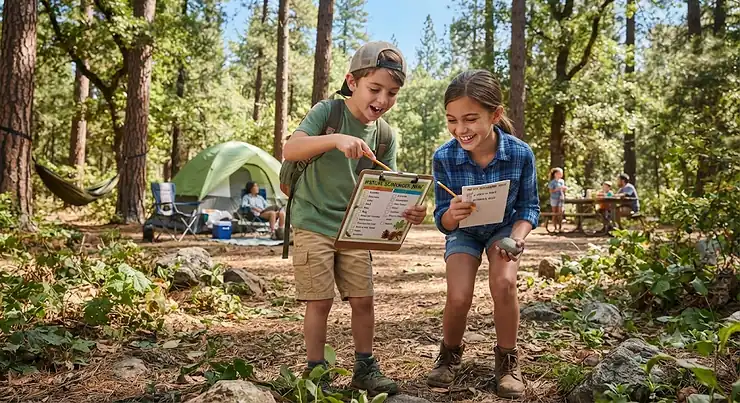
A scavenger hunt kit like Craftivity Designs Camping Scavenger Hunt Game is a strong starting point, but the format extends easily once kids get the hang of it. Try a “five senses” round — one item to see, hear, smell, touch, and (safely) taste, like a wild berry you’ve already identified as safe. Add a “biggest and smallest” challenge, where kids search for the largest leaf and smallest pinecone they can find within a set boundary. For campgrounds near a National Park Service site, the free Junior Ranger program layers an official badge and certificate on top of the same basic observation skills — a nice next step once a homemade or store-bought scavenger hunt has built the habit of looking closely at the surrounding environment.
Glow Stick Games After Dark
Beyond simple ring toss, glow sticks unlock a handful of easy improvised games once the sun goes down. Glow bowling swaps in glow sticks dropped inside empty water bottles as pins, with a soft ball rolled to knock them over. Glow tag assigns each player a wearable glow bracelet from the JOYIN 100-Piece Glow Sticks Bulk Party Pack, turning ordinary tag into a genuinely visible night version that’s easier for parents to supervise from a distance. A glow-in-the-dark version of freeze dance works especially well for younger kids, using a phone speaker for music and glow bracelets to track who’s “it.” The common thread across all of these: glow sticks are less a single-purpose product and more a flexible layer you add to games you already own.
Campfire Games the Whole Family Will Fight to Play Again
Not every campfire game needs a product at all. Twenty Questions and a simplified round of Would You Rather cost nothing and work for nearly any age once kids are old enough to follow a conversation. For families who want a physical element, giant dice like the SWOOC Games Yardzee Giant Yard Dice Set work well seated around a fire circle since rolling requires minimal space and no running. A camp-specific favorite is “story dice,” where each family member adds one sentence to a group story, restarting from scratch each night — genuinely free, endlessly replayable, and a strong wind-down activity before bedtime once the more active games have burned off earlier energy.
Long-Term Cost & Maintenance: What Camping Games Really Cost Over Time
Thinking in total cost of ownership changes the math on several of these picks. The Spikeball Original Kit, at $50-$65 upfront, has effectively zero ongoing cost beyond an occasional replacement ball, and if a family camps ten or more times a year, the cost-per-use drops well below a dollar within the first season. The JOYIN 100-Piece Glow Sticks Bulk Party Pack, by contrast, is genuinely consumable — every trip burns through several sticks permanently, so the real annual cost is closer to buying two or three packs a year rather than one single purchase. Wooden items like the SWOOC Games Yardzee need almost no maintenance beyond drying before storage, while PVC-framed items like the Himal Portable Cornhole Board Set benefit from an occasional hinge check to catch loosening before it becomes a full break. Budget accordingly: one durable “anchor” purchase plus a modest annual restock of consumables like glow sticks tends to outperform buying several mid-tier products that all wear out around the same time.
Safety Guide for Camping Games
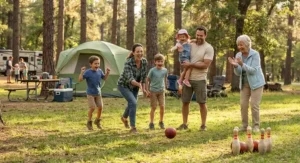
Safety starts before the games do. According to the tter as much during an active game of cornhole as during any other outdoor stretch. Choose soft-tip and glow-based alternatives to traditional metal-tipped games whenever younger kids are involved, and always do a pre-game headcount of small pieces — bean bags, rings, dice — that could pose a choking hazard for toddlers wandering into an older sibling’s game. Set clear physical boundaries before play starts, particularly for games like Spikeball or lawn darts that involve throwing or diving motion, and keep an eye on ground conditions; tree roots and loose rocks are a bigger tripping risk at a campsite than in a flat backyard. Research summarized in a recent multi-country position statement on active outdoor play notes that the wellbeing benefits of unstructured, active outdoor play are broad enough that promoting outdoor play opportunities can support progress toward numerous public-health and community goals, not just individual fitness — a good reminder that a little extra safety prep is worth protecting a genuinely valuable, multi-benefit activity.
Frequently Asked Questions
❓ What age are camping games for kids appropriate for?
❓ Do glow stick games work without full darkness?
❓ How many camping games should a family pack for one trip?
❓ Are cornhole and ring toss safe for toddlers?
❓ What's the most durable material for outdoor camping games?
Conclusion
The right camping games for kids come down to matching the product to your actual crew — their ages, your typical campsite terrain, and how often you realistically get out there. A first-time camping family with young kids gets more mileage from something simple like the Craftivity Designs Camping Scavenger Hunt Game or Himal Portable Cornhole Board Set, while a family with a wider age spread benefits more from something scalable like the SWOOC Games Yardzee Giant Yard Dice Set. Older kids and teens tend to gravitate hard toward the Spikeball Original Kit, and almost every family benefits from having a cheap glow stick pack on hand once the sun goes down. None of these need to be expensive to work — the goal is simply giving kids a reason to put down a screen and pick up something that turns a campsite into an actual adventure.
✨ Ready to Build Your Camping Game Kit?
🔍 Take your next family trip up a notch with these carefully selected products. Click on any highlighted item to check current pricing and availability, and start building memories your kids will ask to repeat every single summer!
Recommended for You
- Best Kids Headlamp 2026: 7 Safe & Fun Picks Parents Love
- Child Carrier Backpack for Hiking: 7 Best Picks for 2026
- Kids Hiking Boots 2026: 7 Top Picks Parents Actually Trust
Disclaimer: This article contains affiliate links. As an Amazon Associate, I earn from qualifying purchases. If you purchase products through these links, we may earn a small commission at no additional cost to you.
✨ Found this helpful? Share it with your friends! 💬🤗
