
In This Article
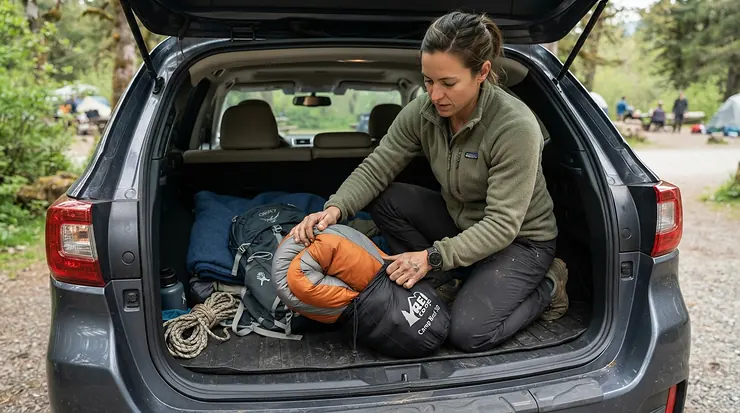
Picture the moment you slide into a sleeping bag after a long day of campfire smoke and trail dust. Now picture that bag squeezing your shoulders like a boa constrictor with a grudge. That’s the mummy experience for plenty of people, and it’s exactly why a rectangular sleeping bag for car camping keeps winning the argument at campgrounds.
Here’s the thing. When your trunk, truck bed or rig does the hauling, ounces stop mattering. Space starts mattering. You roll over, sprawl like a starfish, tuck a pillow wherever you like, and kick one foot out into the night air. A boxy cut gives you all of that, and it usually brings softer fabrics, longer zippers and the option to unzip the whole thing into a blanket. 🏕️
This guide ranks seven real bags built around that idea, from a budget-friendly pick to a deep-cold flannel heavyweight. Along the way we’ll dig into what a flannel lining actually does for comfort, why bag zippers deserve more of your attention than the temperature rating, how a rectangular sleeping bag for RV camping changes the math, and how to keep a bulky bag from devouring your RV storage space.
One honesty note up front. This is a research-driven comparison. I synthesized published specs, retailer listings and aggregated feedback from third-party testing sites and buyers, rather than pretending I slept in every bag. Where the data is thin, I’ll say so. Prices appear as ranges because they move constantly, so check the current price before you buy.
Let’s get you a better night’s sleep.
Quick Comparison: 7 Rectangular Sleeping Bags at a Glance
Think of this table as the menu before the meal. Ratings are the numbers brands and retailers list, not guarantees, and we’ll unpack how to read them later.
| Product | Listed Rating | Standout Trait | Best For |
|---|---|---|---|
| TETON Sports Celsius XXL | 0°F | 90 x 39 in, poly-flannel lining | Big sleepers, cold-natured campers |
| Coleman Heritage Big & Tall 10°F | 10°F | 84 in length, cotton flannel | Tall campers, truck camps |
| Browning Camping Klondike -30°F Flannel | -30°F | Extreme-cold flannel build | Winter hunting camps |
| REI Co-op Siesta Hooded 20 | 20°F | Two-way and off-side zippers | Comfort-first shoulder seasons |
| Coleman Brazos | 30°F | Lowest-cost warm rectangle | Budget families |
| Wenzel Lakeside 40-50°F | 40-50°F | Unzips into a full blanket | Summer nights, van life |
| Kelty Galactic 30 | 30°F | Tougher 50-denier fabrics | Three-season regulars |
Looking at the table, the TETON Sports Celsius XXL and Coleman Heritage Big & Tall 10°F are the obvious picks if you need length and cold-weather margin. The Wenzel Lakeside 40-50°F and Coleman Brazos answer a different question: how little can I spend and still sleep well? The REI Co-op Siesta Hooded 20 sits in the middle with the most thoughtful comfort features, while the Browning Camping Klondike -30°F Flannel is a specialist you only buy if winter is your actual plan.
💬 Just one click — help others make better buying decisions too!😊
What Is a Rectangular Sleeping Bag for Car Camping?
A rectangular sleeping bag for car camping is a roomy, boxy-shaped bag with a straight cut from shoulders to feet, designed to be driven to the campsite rather than carried. It trades packability for space, softer linings, full-length zippers and the ability to unzip into a blanket.
That trade is the whole point. Rectangular bags give you room to stretch and roll around, mummy bags taper from shoulders to feet and hug the body, and hybrids borrow a mummy-style hood and upper body with a roomier footbox. Wikipedia’s overview of the sleeping bag walks through these main shapes if you want the background.
The catch? Roomy means bulky and heavy. Roundups of rectangular bags consistently point out that most belong in the car rather than on the trail. That’s fine here. You’re parking within sight of the tent, so weight becomes a rounding error and comfort becomes the product you’re actually buying.
Top 7 Rectangular Sleeping Bags for Car Camping: Expert Analysis
Each pick below gets the same treatment: what the specs mean in real life, who the bag suits, what reviewers keep saying, and whether the price range earns its keep.
1. TETON Sports Celsius XXL — roomiest warmth for big sleepers
The headline is sheer acreage. The XXL listing runs 90 inches long and 39 inches wide, which is less “sleeping bag” and more “zippered duvet.” It lists a 0°F rating, SuperLoft Elite hollow-fiber fill, a soft poly-flannel lining, draft tubes and double-layer construction, all at roughly 7 pounds. In practice, that means a plush, bed-like surface and room to curl up. One independent review site, however, cautions against leaning on it much below 10°F and calls 20°F to 60°F its sweet spot. Treat 0°F as a stretch limit, not a comfort promise.
Based on the spec comparison, this bag suits tall or broad campers, restless sleepers and anyone who runs cold. It’s a tougher sell if your trunk is already stuffed: the shipping package alone is listed near 17.5 x 13.5 x 12.9 inches.
Reviewers consistently describe it as thick, soft and warm, and one buyer reports nights dipping into the low teens while staying comfortable. The recurring complaint is bulk. Buyers stress it’s a car-camping bag, not a hiking bag, and one found its zipper less impressive than a Coleman’s.
Pros:
- ✅ Huge 90 x 39 inch footprint
- ✅ Soft poly-flannel lining feels bed-like
- ✅ Strong warmth for its price tier
Cons:
- ❌ Heavy and bulky at about 7 pounds
- ❌ Zipper draws mixed reviewer opinions
Price tier: mid-range (I couldn’t verify a stable current figure, so check current price). Value verdict: excellent warmth-per-dollar if you have the trunk space.

2. Coleman Heritage Big & Tall 10°F — flannel comfort for six-foot-plus sleepers
The standout is length: 84 inches, listed to fit adults up to 6’7″, so tall sleepers aren’t forced into a knees-bent compromise. Key specs include a 10°F rating, a cotton flannel lining, about 5 pounds of Holofill 808 insulation, machine-washable fabric and a Wrap ‘N’ Roll packing system. That fill weight is why the bag feels quilt-like, and it’s also why total weight lands around 8 to 9 pounds depending on the source. Cotton flannel feels cozy against skin, though it generally dries slower than polyester after a damp night.
Here’s what to weigh: this is a bag for tall campers, truck-bed sleepers and anyone who also wants a guest-room backup. It is not a backpacking bag, and reviewers say so bluntly.
Reviewers consistently call the lining soft and the bag thick and generously sized, and one even noted it fits a long twin air mattress neatly. A common caution comes from a living-room test where the sleeper’s feet still felt cold, a reminder that ratings describe lab conditions, not every body.
Pros:
- ✅ 84-inch length suits very tall sleepers
- ✅ Soft cotton flannel lining
- ✅ Machine washable with easy roll-up system
Cons:
- ❌ Heavy at roughly 8 to 9 pounds
- ❌ Some sleepers report cold feet
Price tier: mid-range; check current price. Value verdict: strong for tall campers, overkill for summer-only trips.
3. Browning Camping Klondike -30°F Flannel — deep-cold armor for hunting camps
Let’s be upfront: this is the specialist. The Klondike is listed at -30°F, built as a rectangular flannel bag, and roundups place it squarely in the extreme-conditions category. I found less independent hands-on data for it than for the other six, so this analysis rests on the listed rating, the category it competes in and reviewer-roundup positioning rather than a deep review pool.
What does a -30°F rating mean for you? Mostly margin. Even if real-world comfort lands far warmer than the label, you’re starting from a much bigger buffer than a 20°F or 30°F bag gives you. The trade-off is physics: bags built for that kind of cold are inherently bulky, so budget serious vehicle space.
Who should buy it? Winter hunters, ice-fishing campers and people who sleep in unheated cabins. Who shouldn’t? Anyone camping from May through September, because you’ll spend the night with the zipper wide open and a bag the size of a beanbag in your trunk.
Reviewer sentiment across the roundups I found treats it as a warm, flannel-lined, extreme-weather pick, but I can’t point to a large verified review pool, so read that with appropriate caution.
Pros:
- ✅ Enormous cold-weather safety margin
- ✅ Flannel interior for comfort
- ✅ Rectangular room for layering
Cons:
- ❌ Overkill and bulky for three-season use
- ❌ Limited independent test data available
Price tier: premium (check current price). Value verdict: worth it only if deep cold is your real use case.
4. REI Co-op Siesta Hooded 20 — best zipper tricks for 20°F car camping
This is the comfort-engineered pick. It’s a synthetic, rectangular bag filled with recycled polyester, rated to about 20°F, with offset quilt construction to prevent cold spots. Its party trick is the zipper system: a two-way main zipper, a short off-side zipper that lets you fold the top down like a comforter, a draft collar, a zipper draft tube and an anti-snag strip. Translation: you can vent your feet, flip the top back and stay warm without waking up cold.
Based on the spec comparison, it suits couples who share a tent but not a bag, side sleepers and shoulder-season campers. It’s hefty, though. One tester measured about 5 pounds 7 ounces and called it one of the heaviest camping bags they’ve handled, with a standard packed size near 20.5 x 11.75 inches.
Reviewers consistently praise the plush insulation, roomy cut and accurate 20°F rating, with one tester calling it their top camping pick of the year. The most-repeated complaint is zipper snagging, since the fabric around the zipper can catch even though the zipper itself is high quality.
Pros:
- ✅ Off-side zipper folds down like bedding
- ✅ Roomy, plush, accurate 20°F performance
- ✅ Draft tube and collar block cold air
Cons:
- ❌ Zipper snags frequently in reviews
- ❌ Heavy for its warmth class
Price: around $150 range. Value verdict: excellent if comfort features matter more than ounces.
5. Coleman Brazos — cheapest way into a warm rectangle
The standout is price. One review site names the Coleman Brazos its best budget camping bag, listed in the $50 to $60 range, with a 30°F rating that suits spring and fall weekends. At that price you’re buying a straightforward rectangular shell, simple insulation and a familiar brand rather than premium touches.
Here’s what to weigh: a 30°F rating means this is a three-season bag at best. Pair it with a decent sleeping pad and you can stretch comfort lower, but don’t expect it to shrug off a hard frost.
One reviewer who compared several rectangular bags found the Brazos ran small for them and felt like it used cheaper materials. That’s a useful flag for taller campers, who should double-check dimensions before buying. Even so, budget roundups keep returning to it because the price-to-warmth ratio is hard to beat.
For families outfitting four people, or for a first-time camper who isn’t sure the hobby will stick, the Coleman Brazos is a low-risk starter. It’s also a sensible guest bag that lives in a closet most of the year.
Pros:
- ✅ Very low price for 30°F rating
- ✅ Simple, familiar Coleman design
- ✅ Good starter or spare guest bag
Cons:
- ❌ Runs snug for taller sleepers
- ❌ Build feels less robust than pricier bags
Price: around $50 to $60 range. Value verdict: great entry point, modest long-term durability.

6. Wenzel Lakeside 40-50°F — full-unzip blanket for summer nights
The hook is versatility: this 78 x 33 inch bag unzips completely into a blanket, which is a gift on warm campsites where even a light bag feels like a sauna. A 40-50°F rating tells you plainly where it belongs: summer, early fall and anywhere the thermometer stays friendly.
Based on the spec comparison, it’s ideal for casual car campers, van lifers, kids’ sleepovers and anyone wanting a bag that doubles as a throw on the couch. Reviewers describe it as fluffy and comfortable, cheaper than a standard Coleman, with zippers that don’t snag, plus elastic bands that keep it rolled and a carry bag it actually fits back into.
A caution on sample size: the retail page I found showed a 4.8-star average from only six reviews, so treat the praise as encouraging, not conclusive. The thin warmth range also means a cold front will find you quickly. Layer a liner or a wool blanket if forecasts get iffy.
Pros:
- ✅ Unzips into a full blanket
- ✅ Zippers reportedly glide without snagging
- ✅ Comfortable, fluffy feel for summer
Cons:
- ❌ Narrow 33-inch width for broad sleepers
- ❌ Too light for shoulder-season nights
Price tier: budget (check current price). Value verdict: terrific for warm weather, wrong for cold.
7. Kelty Galactic 30 — tougher fabrics for three-season regulars
The standout here is fabric. One testing comparison notes that Kelty Galactic 30 uses 50-denier shells and liners, heavier than the thin fabrics many camping bags rely on. Heavier fabric usually means better resistance to snags, abrasion and the general abuse of being thrown into a trunk week after week. It carries a 30°F rating and appears in roundups of rectangular and roomy car-camping bags.
Who is it for? Regular weekend campers who want something sturdier than a bargain bag but don’t need a deep-winter monster. It also fits campers who value a recognized outdoor brand and a design that tolerates repeated use.
One review site lists it around $190, which positions it near the top of this list for a 30°F bag. I couldn’t verify a deep pool of independent reviews during this research, so I can’t summarize buyer sentiment with confidence. Read recent buyer feedback before you commit, especially on sizing and zipper action.
Compared with the Coleman Brazos, you’re paying a premium for durability rather than warmth. That makes sense if you camp twenty nights a year and not if you camp twice.
Pros:
- ✅ Sturdy 50-denier shell and liner
- ✅ Recognized brand for repeat use
- ✅ Good three-season temperature range
Cons:
- ❌ Higher price for a 30°F rating
- ❌ Limited independent review data
Price: around $150 to $200 range. Value verdict: justified for frequent campers, pricey for occasional use.
Top 7 Compared: Fit, Price and Reviewer Sentiment
| Product | Fit & Size | Price Range | Reviewer Sentiment | Best For |
|---|---|---|---|---|
| TETON Sports Celsius XXL | 90 x 39 in | Mid-range | Thick, soft, warm; bulky | Big sleepers |
| Coleman Heritage Big & Tall 10°F | 84 in length | Mid-range | Soft lining; heavy | Tall campers |
| Browning Camping Klondike -30°F Flannel | Large, extreme-cold build | Premium | Limited verified data | Winter camps |
| REI Co-op Siesta Hooded 20 | Roomy rectangular | Around $150 | Plush; zipper snags | Comfort seekers |
| Coleman Brazos | Runs snug | Around $50-$60 | Great value; cheaper build | Budget families |
| Wenzel Lakeside 40-50°F | 78 x 33 in | Budget | Fluffy; small sample | Summer nights |
| Kelty Galactic 30 | Roomy rectangular | Around $150-$200 | Limited verified data | Frequent campers |
Read the table and the pattern appears: price rises as either warmth or durability rises, and the best value depends on how many nights you really camp. For most casual campers, the Coleman Brazos or Wenzel Lakeside 40-50°F covers warm-weather needs for the least money. Step up to the REI Co-op Siesta Hooded 20 when comfort features matter, and reserve the Browning Camping Klondike -30°F Flannel for true winter use.
✨ Ready to Find Your Bag?
🔍 Take your next trip from “survivable” to “slept like a log” with these carefully selected bags. Click any highlighted product to check current pricing and availability. Your back, your shoulders and your campsite neighbors will thank you!
Rectangular Flannel Sleeping Bag: Is Flannel Lining Worth It?
If you’ve ever dived into flannel sheets on a cold night, you already know the appeal. A rectangular flannel sleeping bag feels warm the moment you climb in, because flannel’s brushed surface isn’t cold and slick against bare skin the way thin nylon is. That first-minute comfort is a real feature, not marketing fluff.
But what is a flannel lining actually doing? Mostly three things. It adds a soft, bed-like feel, it reduces that clammy cling you get from synthetic liners, and it adds a little loft-adjacent warmth against your body. The TETON Sports Celsius XXL uses a poly-flannel lining, while the Coleman Heritage Big & Tall 10°F uses cotton flannel, and one listing for the HiZYNICE XXL Cold Weather advertises a 100% cotton flannel lining.
Here’s the trade-off. Cotton flannel feels wonderful but holds moisture longer and dries slowly. Poly-flannel dries faster and resists mildew better, though some people find it a touch less cozy. A flannel lining also adds weight, which is irrelevant for car camping and annoying for anything else.
One more tip: read listings carefully. One buyer of a replacement Coleman Dunnock 20°F Big ‘n Tall was disappointed that the new version lacked flannel on one side, so confirm the lining before you click buy.
How to Choose a Rectangular Sleeping Bag for Car Camping
Choosing well takes seven decisions, none of them complicated:
- Start with your coldest realistic night. Lab ratings use a thermal mannequin on a standard foam mat, and bag brands typically list comfort, limit and extreme figures. Switchback Travel’s temperature rating guide explains how EN and ISO standards work, and its advice to build in a buffer is smart for any bag.
- Match the length to your height. Add several inches beyond your height, or you’ll curl your knees all night. Tall sleepers should look at 84 to 90 inch bags like the Coleman Heritage Big & Tall 10°F or TETON Sports Celsius XXL.
- Pick the lining. A flannel lining is cozy but slower to dry, while smooth polyester dries fast and slides over clothing.
- Inspect the bag zippers. Look for a draft tube, an anti-snag strip and a two-way zipper if you want ventilation.
- Check packed size against your vehicle. Bulk is the real cost of a rectangular bag.
- Plan for your pad. Insulation under you matters as much as the rating.
- Confirm washability. A bag you can clean is a bag you’ll keep for years.
Rectangular Sleeping Bag vs Mummy Sleeping Bag
The rectangular sleeping bag vs mummy sleeping bag debate boils down to a single question: do you value space or heat retention more? A mummy bag tapers to hold less dead air around your body, so it keeps you warmer per pound. A rectangular bag wins on freedom, ventilation and the ability to open fully into a quilt.
Hybrids split the difference. One testing site calls the Nemo Tempo a warmer-than-average camping bag with an ISO lower limit of 19°F and a packed volume around 10 liters, yet its zipper stops before the foot, so it can’t open into a full blanket. That’s the hybrid compromise in one sentence: warmer, but less versatile.
| Factor | Rectangular | Mummy |
|---|---|---|
| Room to move | High | Low |
| Warmth per pound | Lower | Higher |
| Packed size | Bulky | Compact |
| Ventilation | Excellent, opens fully | Limited |
| Quilt use | Easy | Rare |
| Best For | Car camping, RV trips (REI Co-op Siesta Hooded 20) | Backpacking, cold sleepers |
In short, a rectangular sleeping bag vs mummy sleeping bag comparison favors rectangular shapes anywhere weight is irrelevant. If you run very cold, a hybrid like the Nemo Tempo could still be worth a look. For everyone else, rolling over without a wrestling match wins.
Bag Zippers: The Small Part That Decides Your Whole Night
Nobody shops for bag zippers. Everyone suffers from them. A zipper that snags at 2 a.m. while you’re half-asleep and cold is an unforgettable character flaw, and it’s the complaint that appears most in reviews of otherwise well-liked bags.
Good bag zippers do more than close. The REI Co-op Siesta Hooded 20 pairs a two-way main zipper with a short off-side zipper, so you can vent your feet or fold the top down like a comforter. Its zipper draft tube and anti-snag strip target the exact failure points: air leaking through the teeth and fabric catching in the slider. Even so, reviewers still flagged snagging, which tells you fabric near the zipper matters as much as the zipper itself.
Here’s a practical checklist:
- Choose a two-way zipper if you want foot ventilation.
- Look for a draft tube so cold air doesn’t whistle through the teeth.
- Match left-zip and right-zip bags if you hope to join two into a double, as one TETON Sports Celsius XXL buyer did.
- Hold the fabric flat with one hand while you zip, every time.
Zippers are cheap to engineer and expensive to ignore.
Rectangular Sleeping Bag for RV Camping: What Changes Inside a Rig
A rectangular sleeping bag for RV camping lives in a different world than one headed for a tent. You have a mattress, a furnace, maybe a heat pump, and a bedroom measured in inches instead of acres. The bag’s job shifts from survival gear to cozy bedding.
Here’s what that means for your pick. Warmth ratings matter less, since you can heat the space, but ventilation matters more, so unzip-to-blanket designs like the Wenzel Lakeside 40-50°F and the REI Co-op Siesta Hooded 20 shine. Fit matters too: one buyer reported that the Coleman Heritage Big & Tall 10°F fit their long twin air mattress neatly, which is a good hint for bunks and guest sleepers.
Couples might consider a double bag. The REI Co-op Siesta Hooded 20 Double is listed around the $250 range, though two single bags with opposite zippers can combine at lower cost.
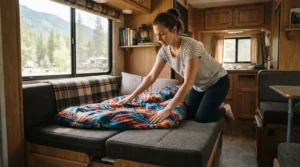
A rectangular sleeping bag for RV camping also doubles as guest bedding, fall-weekend insurance and a cozy couch throw. Just remember that flannel linings hold smells and moisture, so air the bag out regularly instead of letting it sit in a closed cabinet.
RV Storage Space: How to Keep a Bulky Bag From Eating Your Rig
RV storage space is the hidden tax on a rectangular bag. Every cubic inch of cabinet you give to bedding is a cubic inch you can’t give to food, tools or shoes, so a little planning pays off.
Start with real dimensions. The standard REI Co-op Siesta Hooded 20 packs to about 20.5 x 11.75 inches, while the long version measures roughly 22.75 x 12.5 inches. The Coleman Heritage Big & Tall 10°F listing shows a packed size near 20.5 x 11.4 inches. The TETON Sports Celsius XXL ships in a package near 17.5 x 13.5 x 12.9 inches, so assume similar bulk.
Now the tips:
- Store loosely, not tightly compressed. Manufacturers like Snugpak and Scandinavian Outdoor advise against long-term compression, because it reduces loft over time.
- Use under-bed or overhead-bunk space for bags you only use seasonally.
- Air each bag out after a trip and make sure it’s completely dry before storing, since trapped moisture breeds odor.
- Stagger your bags. Keep your daily-use bag handy and rotate the spares into deep storage.
With a little discipline, RV storage space stops being a fight and starts being a system.
Practical Usage Guide: First Night, Maintenance and Care
A great bag can still disappoint if you treat it badly. Here’s a simple routine:
Before the trip: Unroll the bag at home 24 hours ahead so the insulation can recover its loft. Check zipper action and tags, and confirm the care label.
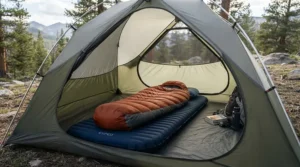
On the first night: Always use a sleeping pad. The ground steals heat from underneath, and even a 0°F bag can’t fix that. Wear dry base layers, and unzip the bottom if you run warm.
Every morning: Air the bag out. Scandinavian Outdoor notes that airing after each night reduces built-up moisture and helps preserve insulation.
Washing: Most sources recommend washing about once a year, or more if the bag gets visibly dirty. For synthetic bags, use a cool, gentle machine cycle, no bleach, and skip liquid detergent and fabric softeners, which can leave residue. Never wring the bag out. Air-dry it, or tumble on low only if the care label allows.
Mistakes in the first 30 days: compressing the bag for weeks, leaving it damp, skipping the pad, and ignoring the care label.
Real-World Scenarios: Which Rectangular Bag for Which Camper
Three campers, three very different answers.
The September family of four. Hatchback, two kids, a $250 total bedding budget, five or six weekends a year. Lows hover around 45°F. The Wenzel Lakeside 40-50°F or Coleman Brazos covers the group, with the Brazos adults and Wenzel kids if length allows. Why: low spend, simple care, easy to wash.
The tall November hunter. Six-foot-three, truck bed with a cap, camping fifteen nights a year, lows near 15°F. The Coleman Heritage Big & Tall 10°F or TETON Sports Celsius XXL fits his length and gives him margin. If nights dip into single digits, the Browning Camping Klondike -30°F Flannel becomes sensible insurance.
The RV couple in shoulder season. Medium-sized rig, a furnace and a queen mattress, twenty-plus nights per year. A rectangular sleeping bag for RV camping like the REI Co-op Siesta Hooded 20 gives them ventilation and quilt-style flexibility. A frequent camper might step up to the Kelty Galactic 30 for its tougher fabrics.
Three profiles, three budgets, one rule: buy for your coldest regular night, not your coldest imaginable one.
Features That Actually Matter (And Those That Don’t)
Marketing loves to shout. Here’s what’s worth hearing.
Matters: length, a draft tube along the zipper, a two-way zipper if you vent often, an honest temperature rating, a soft lining and a washable fabric. Understanding ratings helps most. ISO 23537 is the international standard behind many modern bag ratings, and it exists specifically to make bags comparable across brands.
Doesn’t matter much: a flashy compression sack for a bag that will live in a trunk, extreme-cold labels you’ll never test, and a hood on a bag you’ll use in a heated RV.
Here’s the catch. Not every bag has an ISO or EN rating, and many budget bags use a simple manufacturer label. That doesn’t make them bad, but it does mean you should give yourself a buffer and rely on the warmer side of what you expect to face.
One more filter: judge zippers and lining before logos. A well-built bag with simple styling will always beat a pretty one with a stubborn zipper.
Long-Term Cost & Value: What You’re Really Paying For
Price per night is the honest metric. A $50 bag used four nights a year costs about $12 a night in year one, but may need replacing sooner. A $150 bag used twenty nights a year over five years costs around $1.50 a night.
| Tier | Example | Typical Range | Value Verdict | Best For |
|---|---|---|---|---|
| Budget | Coleman Brazos | Around $50-$60 | Excellent starter | Occasional campers |
| Mid | REI Co-op Siesta Hooded 20 | Around $150 | Best comfort per dollar | Frequent weekenders |
| Upper-mid | Kelty Galactic 30 | Around $150-$200 | Durability premium | Regular campers |
| Heavy-duty flannel | TETON Sports Celsius XXL, Coleman Heritage Big & Tall 10°F, Browning Camping Klondike -30°F Flannel | Check current price | Strong for cold use | Cold-weather camps |
Looking at the numbers, the Coleman Brazos wins if you camp rarely, while the REI Co-op Siesta Hooded 20 wins if you camp often and care about comfort. Heavy-duty flannel bags only pay off if you truly use the extra warmth. Add a washable fabric and a good care routine, and any of these will outlast a cheaper bag treated carelessly.
Cold Nights and Carbon Monoxide: A Safety Guide
Warm sleepers sometimes cheat with heaters, and that’s where camping gets dangerous. Carbon monoxide is a colorless, odorless gas, and the U.S. Consumer Product Safety Commission’s carbon monoxide guidance for camping equipment is worth reading before any cold-weather trip.
The CPSC’s broader carbon monoxide guidance is blunt: never run portable generators inside enclosed spaces, keep them well away from sleeping areas, and use battery-powered CO alarms outside sleeping spaces. Symptoms include headache, dizziness, weakness, nausea and confusion, and if you suspect poisoning you should get to fresh air immediately and call 911.
For RV campers, that means keeping CO alarms working and never improvising a heater setup near your bunk. For tent and truck campers, it means leaning on insulation instead of fire.
The safest warmth is the boring kind: a properly rated bag, a good pad, dry layers and a hat. If a night feels too cold for your bag, add a liner or a blanket, or drive to a warmer spot. No sleeping bag is worth a gamble with your lungs.

FAQ
❓ Can I use a rectangular sleeping bag for backpacking?
❓ Is a flannel-lined sleeping bag warmer than a nylon-lined one?
❓ What length rectangular sleeping bag does a 6'2' camper need?
❓ Can you zip two rectangular sleeping bags together?
❓ How do I wash a rectangular flannel sleeping bag?
Conclusion
A rectangular sleeping bag for car camping isn’t the lightest or sleekest choice, and it was never trying to be. It’s the choice for people who’d rather sleep well than pack small, and with your car doing the heavy lifting, that’s a very good deal.
Here’s the short version. Pick the TETON Sports Celsius XXL or Coleman Heritage Big & Tall 10°F if you’re tall, cold-natured or camping in shoulder season. Choose the REI Co-op Siesta Hooded 20 when comfort features and bag zippers matter most. Go with the Coleman Brazos or Wenzel Lakeside 40-50°F when budget and warm weather lead the decision. Pick the Kelty Galactic 30 for tougher fabrics, and reserve the Browning Camping Klondike -30°F Flannel for real winter.
Don’t forget the practical layer: a good pad, a flannel lining that suits your climate, a plan for RV storage space and a gentle care routine. Buy for your coldest regular night, check the current price, and spend the savings on better coffee.
Recommended for You
- Winter Sleeping Bag For Women: 7 Warmest Picks For 2026
- Warmest Winter Sleeping Bag For Car Camping: 7 Proven Picks (2026)
- Winter Sleeping Bag For Backpacking: 7 Best Picks For 2026
Disclaimer: This article contains affiliate links. As an Amazon Associate, I earn from qualifying purchases. If you purchase products through these links, we may earn a small commission at no additional cost to you.
✨ Found this helpful? Share it with your friends! 💬🤗
