In This Article
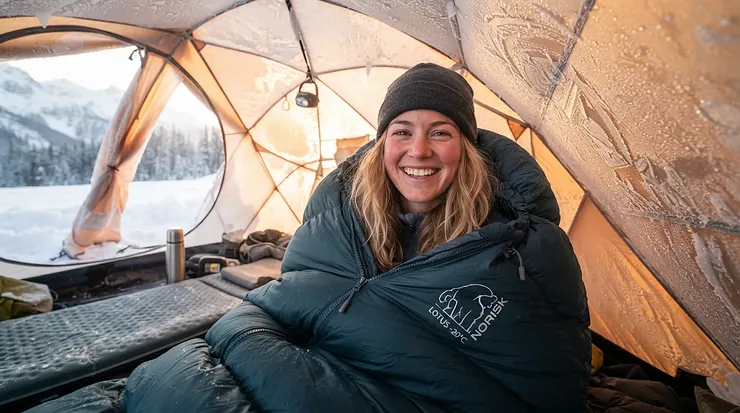
The warmest winter sleeping bag for car camping is a cold-rated bag, typically 0°F or lower, that trades packability for sheer insulation, roomy cut, and durable fabrics, since weight barely matters when your trunk does the hauling. It pairs with a high R-value pad and layered sleepwear to keep you warm through freezing nights.
Here’s the beautiful thing about winter car camping: your vehicle is a pack mule. You can bring the 13-pound canvas fortress, the thick pad, the extra blanket, the thermos the size of a fire hydrant. Nobody’s counting ounces. So the real question isn’t “how light can I go?” It’s “how warm can I get without turning the night into a shivering negotiation with a zipper?”
Be careful with the number on the tag, though. Premium brands test to the lab-based EN 13537 standard, now succeeded by ISO 23537, which produces separate comfort and lower-limit figures. Budget bags often skip the lab and print one marketing number. A “0°F” bag might be a true comfort-to-zero bag, or it might be a survive-the-night-in-everything-you-own bag. That gap is the whole game.
This guide covers seven real bags, from budget synthetics to a buy-once down heirloom, plus the pad and layering strategy that decides whether any of them works. Everything here comes from manufacturer specs and published reviews, not personal testing, and I’ll flag where the numbers don’t add up. Prices are ranges at the time of research, so check current price before you buy.
Quick Comparison: Warmest Winter Sleeping Bag for Car Camping at a Glance
Seven bags, one table. Read the “Headline Rating” column with a raised eyebrow, because not all ratings are created equal (more on that below).
| Bag | Headline Rating | Insulation | Weight (approx.) | Price Range | Best For |
|---|---|---|---|---|---|
| Coleman North Rim 0°F | 0°F (maker’s claim) | Synthetic hollow fiber | ~5-6.5 lb (listings vary) | ~$60-$100 | Tight budgets, occasional winter trips |
| TETON Sports Celsius XXL 0°F | 0°F (maker lists 25-30°F comfort) | Hollow-fiber synthetic | ~7 lb | $100-$130 | Big sleepers who want room |
| ALPS OutdoorZ Redwood -25 | -25°F (maker’s claim) | TechLoft synthetic, canvas shell | ~13 lb | $160-$200 | Truck and base-camp cold sleepers |
| Kelty Cosmic Down 0 | 5°F (per Kelty) | 550-fill down | ~4.3 lb | $200-$250 | Down warmth on a mid budget |
| Marmot Mad River 0 | 0°F (ISO limit -1°F, comfort 13°F) | 650-fill down | ~4 lb 1 oz | mid-$300s | Verified ratings, value down |
| Marmot CWM -40 | -40°F | 800-fill goose down | ~4.5-5 lb | $900-$950 range | Wind, snow, and deep cold |
| Western Mountaineering Bristlecone MF -10 | -10°F | 850+ goose down | 3 lb 15 oz | $1,150-$1,200 range | Buy-once heirloom |
Looking at the table, the ALPS OutdoorZ Redwood -25 posts the lowest number per dollar, but it’s also the heaviest by a mile, which only works because a car is doing the carrying. The Marmot Mad River 0 is the only bag here with a published lab comfort rating, and that 13°F figure is a useful reality check on what “0” really means. Budget buyers should note that the Coleman North Rim 0°F and TETON Sports Celsius XXL 0°F deliver the lowest entry price, with the trade-off that their headline ratings are the least independently verified.
💬 Just one click — help others make better buying decisions too!😊
Top 7 Warmest Winter Sleeping Bags for Car Camping: Expert Analysis
I’ve ordered these from budget to premium. Each entry interprets the specs rather than repeating them, and each review summary reflects what published testers and reviewers report, not my own nights in the bag.
1. Coleman North Rim 0°F — cheapest entry into zero-degree territory
The North Rim’s pitch is price. For roughly what two restaurant dinners cost, you get a mummy-cut synthetic bag with a draft tube along the zipper, an insulated footbox, and a drawstring hood. Those three features separate “bag for a cold night” from “glorified blanket.”
The Thermolock draft tube matters more than it sounds, because the zipper line is where cold sneaks in when you roll over. Listings describe it as 82 x 32 inches, fitting campers up to about 6’2″, and the weight varies by listing from roughly 4.7 to 6.5 pounds, so verify before buying. The synthetic hollow fiber keeps its loft when damp, a real advantage in a frosty tent where breath condensation is constant.
Here’s the honest analysis. The “0°F” is a manufacturer label, not a lab-tested comfort figure, and one retailer’s spec field even lists 10°F next to a 0°F title. On paper, that suggests treating it as an “okay with a good pad and layers” bag, not a “sleep in a T-shirt” bag. Reviewers describe it as a durable value for occasional winter camping and consistently flag bulk and weight. Independent testing coverage is thinner than for pricier bags, so I can’t point to a verified rating.
Pros:
- ✅ Mummy hood and draft tube at a budget price
- ✅ Synthetic fill tolerates damp tents
- ✅ Machine-washable, easy to maintain
Cons:
- ❌ Headline rating isn’t independently verified
- ❌ Bulky, with inconsistent listed weights
Price: around $60-$100 at the time of research, so check current price. Value verdict: a smart backup bag or first winter bag, as long as you plan your pad and layers around it.
2. TETON Sports Celsius XXL 0°F — roomiest budget bag for big sleepers
Roomy is the headline. At 90 x 39 inches, it’s cut more like a sleeping bag crossed with a duvet than a true mummy, and the half-circle hood plus shoulder draft tubes add heat-trapping where it counts.
The specs: SuperLoft Elite hollow-fiber insulation in double-layer construction, a polyester taffeta shell, a flannel lining, and a two-way zipper. Packed, it measures about 17.5 x 12.5 inches in a compression sack, and it weighs roughly 7 pounds. Double-layer construction means the insulation layers are offset, so the stitching lines don’t become cold seams. The flannel feels warmer against skin than slick nylon. And 7 pounds is nothing in a trunk, though it’s a lot on a trail.
My favorite detail is TETON’s own spec sheet, which lists a comfort range of 25-30°F for this “0°F” bag. That’s refreshingly transparent. It’s effectively a three-season-plus bag: fine for nights in the 20s with a good pad and layers, and in anything colder you’ll want to stack warmth.
Reviewers at CleverHiker call it a stellar budget buy for car campers and compare the feel to a weighted comforter, while noting it’s among the heaviest and bulkiest bags in their guide. Retail ratings vary, so sentiment is mixed-to-positive for car-camping use.
Pros:
- ✅ Generous 90 x 39 inch interior
- ✅ Flannel lining feels cozy on contact
- ✅ Honest comfort range published by the brand
Cons:
- ❌ True comfort sits far above the 0°F label
- ❌ Heavy and bulky to store
Price: $100-$130 range at the time of research. Value verdict: great for milder winter nights and tall or broad sleepers, but don’t buy it expecting zero-degree comfort.
3. ALPS OutdoorZ Redwood -25 — rugged canvas fortress for truck camps
If the TETON Sports Celsius XXL 0°F is a comforter, the Redwood is a weighted blanket with a shell like a work jacket. It uses a cotton canvas exterior, a 100% cotton flannel liner, and TechLoft synthetic insulation in two offset layers, in an oversized 80 x 38 inch rectangle.
At 13 pounds, it’s built for the trunk, not the trail. The manufacturer’s own marketing points at truck camping, base camps, and hunting trips. The canvas shrugs off snags and abrasion, and the cotton liner feels temperate against skin instead of clammy. The trade-off is that it comes with roll-up straps rather than a stuff sack, so storage is a bulky roll.
Analysis time. Reviewers of the Redwood line (OutdoorGearLab’s testing of the -10° version) praised the warm, weighty feel, while one user noted you’d still want extra layers at the cold end. Another reviewer suggests adding roughly 10°F to the stated rating. Based on that reasoning, treat -25 as a “survivable with layers” number and plan for realistic comfort well above it. One buyer also noted that the -10 and -25 versions use different zipper sizes, so they can’t be zipped together.
Pros:
- ✅ Tough canvas shell built for rugged use
- ✅ Spacious cut fits big frames and extra layers
- ✅ Cotton flannel liner feels soft
Cons:
- ❌ 13 pounds, with no stuff sack included
- ❌ Reviewers suggest the rating runs optimistic
Price: roughly $160-$200 range at the time of research. Value verdict: one of the best cost-per-degree deals for a vehicle-supported winter camper.
4. Kelty Cosmic Down 0 — down warmth without the boutique price
Here’s where we cross into down territory. Kelty lists the Cosmic Down 0 as a semi-rectangular bag with 550-fill down, a 5°F rating, and a Regular weight around 4.34 pounds with 39.5 ounces of fill.
That fill weight is the key spec. Lower fill-power down (550) is heavier and bulkier per unit of warmth than premium 800+ down, so Kelty compensates with a lot of it. Specs have shifted across model years: OutdoorGearLab’s older review covered a 600-fill version near 3.8 pounds, so always confirm which version you’re buying. Their tester judged the warmth comparable to a far pricier ultralight bag, at the cost of weight, with a roughly 1:1 fill-to-fabric ratio that makes it inefficient for backpacking but fine for a car.
My analytical take is that this is the sweet spot for a car camper who wants down’s soft, lofty feel and good compressibility versus synthetics, without paying for expedition-grade materials. Down also tends to feel lighter on top of you than a hollow-fiber blanket.
Pros:
- ✅ Real down loft at a mid-range price
- ✅ Packs far smaller than comparable synthetics
- ✅ Semi-rectangular cut gives leg room
Cons:
- ❌ Heavy for the warmth, a lower-grade down tradeoff
- ❌ Specs vary across model years
Price: around $200-$250 range at the time of research. Value verdict: a smart upgrade over budget synthetics if you camp dry and cold.
5. Marmot Mad River 0 — the one with lab-verified numbers
The standout here is transparency. Marmot’s listing publishes an ISO-tested lower limit of -1°F and a tested comfort rating of 13°F. In other words, “0” is the lower limit, and warm-sleeping comfort sits near the teens.
The specs: 650-fill down with ExpeDry treatment, recycled nylon shell and lining, a draft collar, a wraparound footbox, and a regular weight of about 4 pounds 1.3 ounces with roughly 12.8 liters compressed volume. ExpeDry is a permanent water-repellent down treatment. In a frosty tent or a damp car, that helps down keep loft when condensation sneaks in.
Backpacker magazine named it their best budget winter bag in a testing roundup that logged 76 nights outside, which is a notable endorsement at this price tier. My take: if you’re a cold sleeper, shop by the comfort figure (13°F), not the headline. If you sleep warm and plan on layers, the lower limit is your friend.
It’s technically a backpacking-style mummy, so it’s snugger than the canvas and rectangle bags above. Roomy-bag lovers should look elsewhere.
Pros:
- ✅ ISO-tested comfort and limit published
- ✅ Treated down resists humidity and condensation
- ✅ Packs small for a zero-degree bag
Cons:
- ❌ Mummy cut feels snug for restless sleepers
- ❌ Comfort is 13°F, not 0°F
Price: roughly mid-$300s at the time of research. Value verdict: the best “I want honest numbers” pick in this lineup.
6. Marmot CWM -40 — expedition-grade armor for brutal cold
The headline is the shell. The CWM uses a Pertex Shield waterproof/windproof/breathable membrane over 30-denier ripstop nylon, filled with 800-fill goose down and built with cross-baffle construction, a down-filled draft tube, and a six-baffle hood.
That 30D fabric was the thickest in Backpacker’s test group, and testers reported even down distribution with no hot or cold spots. They also noted it weighs at least half a pound more than comparable -40°F bags, which they said was worth its weight in gold for the warmth. Listed weights run about 4.5 to 5 pounds depending on size and retailer.
Honest analysis: this is overkill unless you truly camp in deep cold, high winds, or snow-camp setups where frost and wind attack the shell. The membrane protects the down from tent frost, but breathability is never limitless, so on multi-night trips you’d manage moisture. For a car camper in the northern plains or alpine trailheads, though, it’s the most cold insurance money can buy at this price.
Reviewers consistently describe it as dependable in extreme conditions. Retail review pages show strong averages, though the volume is modest.
Pros:
- ✅ Waterproof, windproof membrane shell
- ✅ Draft tube and baffled hood seal heat in
- ✅ Real -40°F design for extreme cold
Cons:
- ❌ Premium price for most car campers
- ❌ Heavier than comparable -40°F bags
Price: roughly $900-$950 range at the time of research. Value verdict: justified only if your forecast regularly dips into deep sub-zero territory.
7. Western Mountaineering Bristlecone MF -10 — the buy-once heirloom
This one wins on craftsmanship. It’s a semi-rectangular bag with 850+ goose down, 42 ounces of fill, 8.5 inches of loft, a full down collar, a full-length draft tube, and a 20D MicroLite XP shell, all at just 3 pounds 15 ounces. It’s also made in the USA.
The girth numbers (69 inches shoulder, 61 hip, 48 foot) mean you can wear a puffy inside without compressing the insulation, which matters because compressed down is cold down. Side-block baffles keep the down from migrating. And the MicroLite XP shell is dense and breathable, so it stays warm in both dry and humid conditions per Backpacker’s testers.
Backpacker named it best winter bag overall, with a candid caveat: on paper, it isn’t the lightest or warmest bag in the test, but long-term testing revealed it as the most dependable. That’s the honest tradeoff. You pay for refinement, not records.
For a car camper, the lightness is a bonus rather than a necessity, so the real value is comfort, durability, and decades of use.
Pros:
- ✅ Roomy cut with full collar and draft tube
- ✅ Dense shell stays warm in humid conditions
- ✅ Built to last for many winters
Cons:
- ❌ Highest price in this lineup
- ❌ -10°F rating is milder than the CWM’s
Price: around $1,150-$1,200 range at the time of research. Value verdict: the best long-term bag, if you can stomach the sticker.
How to Choose the Warmest Winter Sleeping Bag for Car Camping
Start with your coldest expected night, then work backward. Here are seven steps.
- Know your coldest night. Pick a bag whose comfort rating, not just the lower limit, sits at or below the coldest forecast low.
- Check the rating type. An ISO or EN comfort figure beats a single unverified number, and a published comfort range like TETON’s is better than silence.
- Match the insulation to your conditions. Down wins on loft and compressibility, while synthetic wins when moisture is a constant.
- Pick a cut that fits your sleep style. Rectangular bags give room; mummies hold heat more efficiently.
- Demand the cold-stoppers. Look for a draft collar, a zipper draft tube, and a cinchable hood.
- Budget for the pad. A great bag on a thin pad is a cold night waiting to happen.
- Think about storage. Bulky bags need closet or trunk space, and down bags need to be stored uncompressed.
Each step matters because the biggest winter mistakes happen in the gaps between the label and the night.
Winter Sleeping Bag for Extreme Cold Weather: What Actually Changes
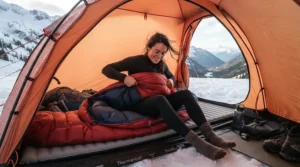
A winter sleeping bag for extreme cold weather isn’t just a thicker version of a three-season bag. Reviewers testing cold-weather bags consistently point to a short list of features: high-fill-power down or high-loft synthetic, draft collars, insulated hoods, and offset or box-wall construction.
Why? Because cold doesn’t just conduct, it leaks. In deep cold, every gap matters: the zipper, the neck opening, the hood. The Marmot CWM -40 attacks all three with a draft tube, a collar, and a six-baffle hood, and the Western Mountaineering Bristlecone MF -10 does the same with a full down collar.
Shell fabric matters more at the extreme end too. The Marmot CWM -40‘s 30D membrane shell protects from wind and frost. On the other hand, a canvas shell like the ALPS OutdoorZ Redwood -25 is bulky but tolerates abuse, and the two-layer synthetic construction prevents cold seams.
Honest reasoning: for car campers, a winter sleeping bag for extreme cold weather works best as part of a system. A -40 bag on a bad pad underperforms a -10 bag on a great one. If you’re serious about cold, spend on the bag, then spend almost as much attention on the ground beneath you and the clothes inside.
Winter Sleeping Bag for Sub-Zero Temperatures: Reading the Ratings Honestly
When shopping for a winter sleeping bag for sub-zero temperatures, the number on the tag is only half the story. Lab standards define a comfort rating (for a relaxed sleeper), a lower limit (for a curled-up sleeper), and an extreme rating (a survival number). Many budget bags print just one figure.
| Bag | Headline Rating | Evidence Behind It | What to Plan For |
|---|---|---|---|
| Coleman North Rim 0°F | 0°F | Maker’s claim; no lab comfort figure found | Treat as warmer-than-label; add layers |
| TETON Sports Celsius XXL 0°F | 0°F | Maker lists 25-30°F comfort | Comfortable in the 20s; stack for colder |
| ALPS OutdoorZ Redwood -25 | -25°F | Maker’s claim; reviewers suggest adding ~10°F | Layers required near the limit |
| Kelty Cosmic Down 0 | 5°F | Per Kelty; current ISO figures unconfirmed | Fine for teens with a good pad |
| Marmot Mad River 0 | 0°F | ISO limit -1°F, comfort 13°F | Plan on the teens for comfort |
| Marmot CWM -40 | -40°F | Expedition design, tested by reviewers | Genuine deep-cold bag |
| Western Mountaineering Bristlecone MF -10 | -10°F | Reviewers trust it to its rating | Dependable to about -10°F |
Looking at this table, the pattern is clear: bags with transparent testing (the Marmot Mad River 0 and Western Mountaineering Bristlecone MF -10) let you plan with confidence, while bags with a bare headline number demand a safety margin. For a winter sleeping bag for sub-zero temperatures, I’d suggest at least a 15-20°F cushion between your expected low and the bag’s comfort figure. If your forecast hits single digits or below, the Marmot CWM -40 is the only bag here that’s clearly in its element.
Sleeping Pad R-Value: The Half of Your Sleep System Most People Ignore
Here’s the cold truth: your bag’s insulation gets crushed flat under your body, which means the ground steals your heat through the pad, not the bag. That’s where sleeping pad R-value comes in. It measures how well a pad resists heat flow, tested under the ASTM F3340-18 standard, which brands including Therm-a-Rest, NEMO, and Sea to Summit now use, so numbers are comparable across brands.
The general guidance across retailers and gear guides is simple: R-2 or so for summer, R-3 to R-5 for three-season use, and R-5 or higher for winter, often R-5 to R-7 on snow or frozen ground. The best news for car campers is that R-values are additive. Stack a foam pad under an air pad and you add the numbers together, though the stacked total is an engineering estimate, not a certified rating.
| Pad Setup | Approx. R-Value | Best For |
|---|---|---|
| Closed-cell foam (Therm-a-Rest Z Lite Sol) | 2.0 | Backup layer, puncture protection |
| Insulated air pad (NeoAir XLite NXT) | 4.5 | Three-season, or half of a stack |
| Foam + XLite NXT stacked | ~6.5 (estimated) | Winter on frozen ground |
| Winter air pad (NeoAir XTherm NXT) | 7.3 | Deep cold, snow |
| Thick self-inflating (MondoKing 3D) | 7.0 | Winter car camping comfort |
The table shows why stacking is the cheapest winter trick: a $40-ish foam pad on top of what you already own can add two full R-value points. Budget buyers should note that a cheap bag on a high R-value pad beats an expensive bag on a thin one. If you’re in a car or on a cot, remember that cold air circulates underneath you too.
Down vs Synthetic vs Canvas-Shell Synthetic: Which Insulation Wins for Winter Car Camping?
Insulation type shapes everything: feel, bulk, moisture behavior, and cost. For car campers, the usual backpacker obsession with weight takes a back seat, which opens up options.
| Type | Warmth for Size | Wet Performance | Bulk | Cost | Best For |
|---|---|---|---|---|---|
| Down (Western Mountaineering Bristlecone MF -10, Marmot CWM -40) | Excellent | Weak unless treated | Small | High | Dry, deep cold; buy-once buyers |
| Treated down (Marmot Mad River 0, Kelty Cosmic Down 0) | Very good | Better with ExpeDry or DriDown | Moderate | Mid | Cold sleepers, humid nights |
| Hollow-fiber synthetic (TETON Sports Celsius XXL 0°F, Coleman North Rim 0°F) | Moderate | Strong | Large | Low | Budget, damp camps |
| Canvas + synthetic (ALPS OutdoorZ Redwood -25) | Moderate | Strong | Very large | Low-mid | Rugged truck camps |
The takeaway: down gives you the most warmth per pound and the best compressibility, but it demands dry storage and care. Synthetics shrug off moisture and forgive neglect, but they’re bulkier for the same warmth. For most car campers, the real decision isn’t down versus synthetic, but how much you value loft and longevity versus low-maintenance toughness. If winter nights are dry and bitter, down wins. If they’re frosty, foggy, or shared with a muddy dog, synthetic earns its keep.
Cold-Weather Camping Tips: A First-30-Nights Playbook
Great gear still needs good habits. These cold-weather camping tips are the practical stuff that product pages skip.
Before bed
- Set up the bag early and fluff it, since down needs time to loft.
- Eat a snack with fat or protein and drink warm fluids, but skip alcohol.
- Warm a hard-sided bottle with hot water (sealed tightly) and tuck it near your core or feet inside the bag.
Inside the bag
- Cinch the hood so only your nose is exposed, and avoid breathing into the bag, since moisture will dampen the insulation.
- Keep tomorrow’s clothes in the bag foot area so they’re warm in the morning.
Ventilation and condensation
- Crack a vent or window slightly. A sealed tent or car fills with breath moisture that freezes and drips.
Common first-month mistakes
- Wearing sweaty day clothes to bed.
- Compressing the bag into its stuff sack all week instead of storing it loose.
- Skipping the pad stack because “the bag is rated for it.”
The thread running through all of this is moisture and compression. Dry insulation that’s allowed to loft is warm insulation, and everything else is a detail.
Layering for Sleep: What to Wear Inside Your Winter Bag
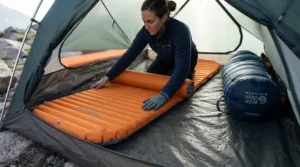
Layering for sleep is a smaller version of layering for the trail: a moisture-managing base, a modest insulating mid-layer if needed, and dry extremities. The goal isn’t to wear everything you own, because overstuffing a bag compresses the loft and can leave you colder.
Start with a clean, dry synthetic or wool base layer, since cotton holds moisture. Add dry socks and a lightweight hat. If you need more, add a thin fleece or lightweight puffy. Hold off on the bulky stuff, because tight clothing squeezes insulation and restricts circulation.
Sweat matters more than most people realize. The CDC notes that hypothermia can occur even above 40°F if a person becomes chilled from rain, sweat, or cold water. In practical terms, that means changing out of damp clothing before bed, and not sprinting around camp until you’re sweating right before you crawl in.
Pair this with roomy bags like the TETON Sports Celsius XXL 0°F, the ALPS OutdoorZ Redwood -25, or the Western Mountaineering Bristlecone MF -10 and you have headroom for a light mid-layer without compressing anything. In a snug mummy like the Marmot Mad River 0, stick to a single thin base layer so the insulation can do its job.
Real-World Scenarios: Which Bag for Which Camper?
Case studies beat spec sheets. Here are three profiles with reasoning.
The weekend hunter, truck-supported, nights near 0°F, 10 trips a year. The ALPS OutdoorZ Redwood -25 fits: rugged canvas, plenty of room for layers, and the weight is irrelevant in a truck bed. Stack a foam pad under an insulated pad to reach R-6 or higher, and expect real comfort in the teens.
The budget-conscious couple, state-park cabins and campsites, nights in the 20s, 4 trips a year. Two TETON Sports Celsius XXL 0°F bags or two Coleman North Rim 0°F bags offer low cost, with the TETON’s own comfort range of 25-30°F as the honest guide. Add a thick pad each and use hot water bottles.
The cold sleeper at a mountain trailhead, nights near 0°F, 6 trips a year. The Marmot Mad River 0 is the pick: its 13°F comfort rating tells the truth, and treated down handles frosty mornings. If forecasts drop well below zero, step up to the Marmot CWM -40.
The long-haul owner who hates replacing gear. The Western Mountaineering Bristlecone MF -10 earns its price over decades. A Kelty Cosmic Down 0 is the middle path if you’d rather test down before committing.
Common Mistakes When Buying a Winter Sleeping Bag
After comparing specs and review themes, the same mistakes keep surfacing.
Trusting the headline number. As we’ve seen, “0°F” can mean very different things. Look for comfort ratings, or at least a transparent comfort range.
Ignoring the pad. The ground drains heat faster than air does. If your pad is R-2 and the forecast says teens, no bag can fully save you.
Buying too snug. A cramped bag compresses insulation when you wear layers. If you sleep with extra clothes, size for them.
Forgetting storage. Down bags kept compressed lose loft over time. TETON even includes hang loops on its bags for long-term storage, a small detail that signals how much storage matters.
Overbuying for the climate. A -40 bag is wasted if your coldest night is 15°F, and you’ll overheat and sweat, which makes you colder later. Match the bag to your actual forecast and add a modest margin.
Skipping the zipper details. A snagging zipper at 2 a.m. in the dark is a bigger problem than it sounds. Anti-snag designs and draft tubes are worth paying for.
Safety Guide: Staying Warm Without Taking Dangerous Shortcuts
Cold-weather camping is safe when you respect the physics. Two risks deserve a callout: hypothermia and carbon monoxide.
For hypothermia, watch for shivering, exhaustion, confusion, fumbling hands, slurred speech, and drowsiness. If you or a companion shows these, get warm, dry, and fed, and seek medical help if symptoms are serious.
Carbon monoxide is the silent one. The CDC explains that CO is an odorless, colorless gas that kills without warning and is produced any time you burn fuel, including in stoves, lanterns, grills, and vehicles. The U.S. Consumer Product Safety Commission warns against using portable heaters or lanterns while sleeping in enclosed areas such as tents, campers, and other vehicles. Never warm your tent or car with a grill or charcoal, and never sleep in a vehicle with the engine running.
The smart strategy is to rely on the bag, the pad, and the layers rather than a fuel-burning shortcut. If you use a battery-powered CO detector, keep it near where you sleep. And if you wake up with a headache, dizziness, or nausea, treat it as a warning and get fresh air immediately.
Long-Term Cost & Maintenance: What Your Bag Really Costs Per Night
Sticker price is only part of the story. Here’s an illustrative cost-per-night comparison, using the price ranges above and assumed use.
A Western Mountaineering Bristlecone MF -10 at roughly $1,175, used 20 nights a year for 15 years, works out to about $4 per night. A ALPS OutdoorZ Redwood -25 at around $180, used 12 nights a year for 10 years, lands near $1.50 per night. So the budget bag isn’t necessarily the more expensive choice per night, but premium down tends to hold performance longer.
Maintenance extends all of it:
- Store loose. Hang or keep the bag in a large breathable sack, never compressed for weeks.
- Wash sparingly. Use a down-specific cleaner for down bags and follow the care label for synthetics. Canvas bags like the ALPS OutdoorZ Redwood -25 are best spot-cleaned.
- Dry thoroughly. Moisture is the enemy of loft and the friend of mildew.
- Check zippers and seams before each season.
A modest annual routine can add years to even a budget bag, and with premium down it protects an investment that can last decades.
FAQ
❓ How cold of a sleeping bag do I need for winter car camping?
❓ Is a canvas bag like the ALPS OutdoorZ Redwood -25 warmer than a down bag?
❓ Can I double up two sleeping bags for extra warmth?
❓ Are cheap 0°F bags really rated for zero degrees?
❓ Is sleeping in my vehicle warmer than a tent?
Conclusion
The warmest winter sleeping bag for car camping isn’t a single product, it’s the right bag for your coldest night, set on the right pad and worn with the right layers. If you want rugged, roomy, and affordable, the ALPS OutdoorZ Redwood -25 is the best cost-per-degree pick. If you want honest numbers and compact down, the Marmot Mad River 0 is the standout, and the Kelty Cosmic Down 0 is a friendlier-priced down alternative. For true deep cold, the Marmot CWM -40 is expedition insurance, while the Western Mountaineering Bristlecone MF -10 is the long-haul heirloom. And if the budget is tight, the TETON Sports Celsius XXL 0°F and Coleman North Rim 0°F are workable starting points, as long as you respect their real comfort ranges.
Remember the three rules that outweigh any model choice: shop by comfort rating, stack your pad to R-5 or more, and keep your layers dry. Do that, and even a modest bag becomes a much warmer one.
✨ Ready to Sleep Warm This Winter?
🔍 Compare the bags above, check current pricing and availability, and build a sleep system that fits your coldest night. Click any bold bag name to see where it stands today. Your warmest, most restful winter camp is one smart choice away!
Recommended for You
- Winter Sleeping Bag For Backpacking: 7 Best Picks For 2026
- 3-Season Sleeping Bag For Side Sleepers: 7 Best Picks (2026)
- Budget 3-Season Sleeping Bag: 7 Proven Warm Picks For 2026
Disclaimer: This article contains affiliate links. As an Amazon Associate, I earn from qualifying purchases. If you purchase products through these links, we may earn a small commission at no additional cost to you.
✨ Found this helpful? Share it with your friends! 💬🤗
