In This Article
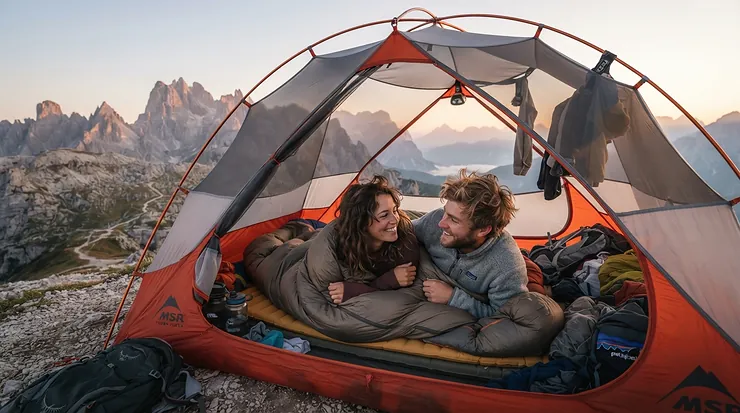
A double sleeping bag for backpacking couples is a single two-person insulated shell, or a two-person quilt, that lets partners share one warm space instead of hauling two separate bags. You give up a little personal territory. In return you get shared body heat, fewer zippers to fight at 2 a.m., and, in the best designs, less total weight and bulk than two singles.
Here’s the catch most product pages skip: plenty of “doubles” are car-camping couches wearing trail-runner marketing. Several well-known models weigh 7 to 9-plus pounds, which is fine for a truck bed and miserable on mile nine. Only a short list earns the ounces.
This guide is built from published specs, manufacturer data, and aggregated tester feedback, not hands-on testing. You’ll see where the evidence is thick and where it’s thin.
One calibrating note before the picks. Temperature ratings come from a lab protocol, and the ISO 23537 method explained by Rab separates a “comfort” figure for relaxed sleepers from a “limit” figure for curled-up, fighting-the-cold sleepers. Quilts and expedition bags fall outside that standard, so their numbers are estimates.
Along the way we’ll dig into the three questions couples ask most: what makes a lightweight double sleeping bag for backpacking, whether a double sleeping bag that converts to two singles is worth the compromise, and how two-person tent compatibility really works.
Quick Comparison: 7 Double Sleeping Bags and Quilts for Backpacking Couples
Think of this table as the cheat sheet. Weights are manufacturer or tester figures and vary by size and version, so check the current spec before buying.
| Product | Type | Rated Temp | Approx. Weight | Best For |
|---|---|---|---|---|
| Big Agnes King Solomon 20 | Down double bag | 20°F | ~3 lb 15 oz | Couples wanting a “real bag” feel |
| Therm-a-Rest Vela Double 20 | Down quilt | 20°F (estimate) | ~2 lb 15 oz | Tall couples, pad-attached comfort |
| ZPacks 20F Twin Quilt | Down quilt | 20°F | ~1 lb 12 oz | Ultralight, high-mileage hikers |
| Enlightened Equipment Accomplice | Down quilt | 30°F | ~1 lb per person | Customizers who want exact fit |
| Big Agnes Dream Island 20 | Synthetic double bag | 20°F | ~7 lb | Damp climates, short approaches |
| Kelty Tru.Comfort Doublewide 20 | Synthetic 3-in-1 | 20°F | ~9 lb | Car-camp trips, splitting into two singles |
| Coleman 45F Double Sleeping Bag | Synthetic zip-apart | 45°F | ~9 lb (reported) | Summer trips on a tight budget |
The table reveals a clean split. The three down quilts sit between roughly one and three pounds, while the synthetic doubles climb to 7-9 pounds. If your pack weight matters, that gap decides the whole question. If you’re driving to a trailhead and walking a mile, it barely matters.
💬 Just one click — help others make better buying decisions too!😊
Top 7 Picks: Expert Analysis of Each Double Sleeping Bag for Backpacking Couples
1. Big Agnes King Solomon 20 — the down double that actually packs
Big Agnes built the Big Agnes King Solomon 20 on a simple promise: a doublewide bag should weigh less and pack smaller than two comparable singles. The spec sheet largely backs that up.
Trail weight is listed at 3 lb 15 oz, with 30 oz of 650-fill hydrophobic DownTek and an ISO limit of 20°F. That works out to roughly two pounds per person, and it compresses to about 11 x 14 inches. The Pad Cinch system straps the bag to a doublewide pad or two singles, which fixes the classic midnight slide off the pad. The top layer also zips off to become a quilt on mild nights.
Based on the specs, this suits couples who want draft control and a closed shell without surrendering their pack. Two caveats: it fits people up to 6 feet, and the 108-inch hip girth is generous at night but awkward in a snug tent.
Field Mag’s tester named it best overall among doubles, and one retail shopper reports it compresses well enough for backpacking. Several retail pages still show few or no reviews, so the evidence base is modest.
Pros:
- ✅ Down fill keeps weight near two pounds per person
- ✅ Pad Cinch stops sliding on single or double pads
- ✅ Zip-off top doubles as a quilt
Cons:
- ❌ Max user height is only 6 feet
- ❌ Wide cut crowds smaller tents
Expect the mid-$400s range; check current price. Verdict: expensive, but the most bag-like option that still earns its pack space.
2. Therm-a-Rest Vela Double 20 — roomiest quilt for tall couples
The Therm-a-Rest Vela Double 20 is a two-person quilt that feels like your bed at home, just with a stuff sack. It’s the comfort-first answer to a lightweight double sleeping bag for backpacking.
It carries 890 g of 650-fill Nikwax hydrophobic down, weighs about 1,342 g (roughly 2 lb 15 oz), and packs to around 9 x 16 inches. Snaps and a loop kit attach it to compatible pads, and a closed, elasticized footbox holds the foot end in place. It fits people up to 6’6″, which is rare in this category. The 20°F rating is an estimate, since EN/ISO testing doesn’t cover quilts.
Here’s the analysis: the quilt rewards couples who sleep hot and cold at different rates, because each person can adjust their side without waking the other. It rewards a good pad even more. Without enough R-value underneath, a quilt can’t make up the difference.
A published two-person test reported warmth well into low temperatures and a snug, home-like feel. The same testers wished for a way to keep the quilt off their faces and noted there’s no real weight advantage over two one-person quilts.
Pros:
- ✅ Fits tall sleepers up to 6’6″
- ✅ Hydrophobic down handles damp air better
- ✅ Independent temperature control per sleeper
Cons:
- ❌ Saves little weight versus two solo quilts
- ❌ Needs a high R-value pad pair
Priced in the premium tier; check current price. Verdict: worth it for tall, comfort-minded couples.
3. ZPacks 20F Twin Quilt — lightest warmth for two, period
The ZPacks 20F Twin Quilt is the weight-shaving specialist. If grams keep you up at night, this one lets you sleep.
Total weight is listed at 27.9 oz (792 g), including 20.3 oz of down and a 7.6 oz shell, and the quilt is reversible with no sewn-through seams. That’s about 14 oz per person for 20°F-class warmth. ZPacks says it beats the weight, cost, and warmth of two separate bags, and a free dry bag is included in the package.
Here’s the trade-off: a quilt this stripped down has few features. There are no pad attachments, so you’ll want sleeping pad straps to lash pads together and block drafts. Pack volume also matters, so couples may need to rearrange other gear to balance the load.
CleverHiker’s reviewers named it the top choice among the doubles they tested, and a CleverHiker review of the ZPacks twin quilt calls it an excellent value for couples cutting base weight. The same review notes how few features it has.
Pros:
- ✅ About 14 oz per person
- ✅ Reversible, no sewn-through seams
- ✅ Dry bag included
Cons:
- ❌ No built-in pad attachment
- ❌ Few frills; needs separate pad straps
Pricing sits in the upper-$500s range; check current price. Verdict: the clear pick for ultralight couples who already own good pads.
4. Enlightened Equipment Accomplice — most customizable two-person quilt
Enlightened Equipment Accomplice is the quilt for people who enjoy picking their own specs. Wider, longer, warmer, lighter: the maker offers a long menu of sizes and options.
It’s a zipperless, hoodless down quilt with a closed footbox, separate neck draft collars with snap-and-cinch closure, and individual side vents. Elastic pad straps ship in two sets, one for two separate pads and one for a double-wide pad. Reviewers describe a true 30°F rating at roughly one pound per person, and a 900-fill option shaves weight at a higher price.
My read of the spec sheet: individual draft control is the sleeper feature. One partner can seal the collar while the other vents, which is the main complaint with any shared quilt. The catch is that you order by the taller person’s height, and that a quilt demands a decent pad.
Rokslide’s reviewer called it the best couples solution found for the backcountry, and Adventure Alan described it as plenty roomy and warm for its weight. Availability seems to vary, so confirm stock before you plan a trip around it.
Pros:
- ✅ Individual draft collars and vents
- ✅ Both pad strap sets included
- ✅ Roughly one pound per person
Cons:
- ❌ Stock and lead times can vary
- ❌ 30°F rating limits shoulder-season use
Premium pricing; check current price. Verdict: superb for couples who want a tailored fit.
5. Big Agnes Dream Island 20 — synthetic comfort for damp, short trips
The Big Agnes Dream Island 20 is the plush, wet-weather-friendly option. It’s built for sleeping well rather than moving fast.
It uses recycled FireLine Max synthetic, weighs about 7 lb (3.18 kg), and carries 60 oz of fill in a 50-inch-wide doublewide shell. Hand-tuck pockets and the Pad Cinch system add comfort and stability. Synthetic insulation keeps warming when damp, which down can’t promise, though the price is weight and bulk.
Do the arithmetic: 7 lb is 3.5 lb per person, roughly double the per-person weight of the down options. That’s fine for a short, rainy-forecast overnight or bike-and-boat trips, but heavy for multi-day mileage.
OutdoorsMagic named it best overall double bag for campsites and wild camping, and Field & Stream’s tester picked it as best synthetic while noting it runs slightly heavier than most tested. One retailer lists an older version as discontinued, so verify the current model before buying.
Pros:
- ✅ Synthetic fill tolerates damp conditions
- ✅ Roomy 50-inch shell with hand pockets
- ✅ Pad Cinch keeps you on the pad
Cons:
- ❌ About 3.5 lb per person
- ❌ Bulky for long carries
The regular price is around the $300 mark, with sale listings in the $225-$300 range; check current price. Verdict: great for short, soggy trips, not for big miles.
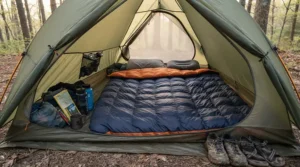
6. Kelty Tru.Comfort Doublewide 20 — splits into two singles when you need it
The Kelty Tru.Comfort Doublewide 20 is the clearest example of a double sleeping bag that converts to two singles, with a lightweight sheet for a third configuration.
OutdoorGearLab measured it at 8.8 lb and 60 inches across, queen-bed width, while a Field & Stream roundup lists 9 lb 8 oz. It has a large U-shaped zipper, built-in blankets for each sleeper, and PFC-free DWR fabric, plus a 20°F rating.
The honest assessment: the splitting feature solves a real problem, since you’re not stuck with a giant empty bag on solo nights. But that flexibility is mostly a car-camping virtue. At roughly 4.4 lb per person, and 60 inches wide, this is no ultralight tent companion.
Testers gave it decent warmth scores and strong comfort marks, and OutdoorGearLab recommended it for people who want one bag instead of two. A REI reviewer found it big and not very packable, and another round-up flagged it as unsuitable for backpacking.
Pros:
- ✅ Converts to two single bags
- ✅ Large U-zipper and built-in blankets
- ✅ Queen-width roominess
Cons:
- ❌ Roughly 9 lb and bulky
- ❌ Too wide for most two-person tents
Around the $200-$250 range; check current price. Verdict: a car-camping star that moonlights as a short-haul option.
7. Coleman 45F Double Sleeping Bag — budget zip-apart for warm nights
The Coleman 45F Double Sleeping Bag is the entry ticket. It’s the cheapest way to find out whether you actually enjoy sharing a bag.
It’s a polyester-fill, 45°F-rated XL tandem that zips apart into two singles and is machine washable. A 45°F rating means this is a summer number: below that, you’d be layering or shivering. One roundup lists a weight around 9 lb 5 oz, which I’d treat as approximate.
Here’s how I’d frame it. The low rating and weight make it a poor trail bag. But for warm-weather car camps, backyard tests, or trying the shared-bag idea before spending serious money, it’s a low-risk experiment.
I could only verify roundup-level commentary on this model, not deep independent lab testing, so treat its rating cautiously. Roundups consistently describe it as a budget-friendly, versatile zips-apart design.
Pros:
- ✅ Zips apart into two single bags
- ✅ Machine washable for easy care
- ✅ Lowest cost of the group
Cons:
- ❌ 45°F rating limits it to summer
- ❌ Heavy and bulky for backpacking
At the budget end of the category; check current price. Verdict: a fair first experiment, not a backpacking solution.
Top 7 Side by Side: Specs, Weight, and Price Ranges
Same seven picks, now with the details that drive the buying decision. Prices are ranges, since retailers move them constantly.
| Product | Insulation | Approx. Weight | Pad/Zip System | Price Range | Best For |
|---|---|---|---|---|---|
| Big Agnes King Solomon 20 | 650-fill down | ~3 lb 15 oz | Pad Cinch, zip-off top | Mid-$400s | Down comfort for two |
| Therm-a-Rest Vela Double 20 | 650-fill hydrophobic down | ~2 lb 15 oz | Snap loops | Premium tier | Tall couples |
| ZPacks 20F Twin Quilt | Down | ~1 lb 12 oz | None (straps sold separately) | Upper-$500s | Ultralight hikers |
| Enlightened Equipment Accomplice | Down | ~1 lb per person | Both pad strap sets | Premium tier | Custom fit |
| Big Agnes Dream Island 20 | FireLine synthetic | ~7 lb | Pad Cinch | $225-$300 | Damp, short trips |
| Kelty Tru.Comfort Doublewide 20 | Synthetic | ~9 lb | Splits into two bags | $200-$250 | Car camps, solo splits |
| Coleman 45F Double Sleeping Bag | Polyester | ~9 lb (reported) | Zips apart | Budget | Summer tryouts |
Notice how the price follows the weight in reverse. The lightest options cost the most, while the cheapest bags weigh the most. A middle path exists: the Big Agnes King Solomon 20 gives up a pound or two against the quilts but gets a more bag-like, draft-resistant experience.
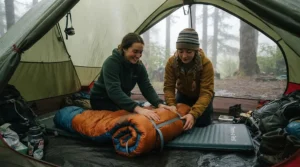
How to Choose a Double Sleeping Bag for Backpacking Couples
The short answer: match the lower-limit temperature to your coldest expected night, then pick a weight and shape you can carry and fit in your tent. Here are the steps, in order.
- Set your coldest realistic night. Commonly cited outfitter advice is to pick a rating 10-20°F below your expected low. Two bodies help, but gaps and drafts steal heat.
- Choose insulation for your climate. Down wins on warmth per ounce and compressibility. Synthetic wins when it’s wet and costs less.
- Decide bag versus quilt. Quilts save weight and give each sleeper control but lean on the pad. Bags block drafts better.
- Check the taller partner’s height. Some doubles top out at 6 feet. Size to the taller person.
- Match the pad plan. Confirm whether the bag supports two single pads, one doublewide, or both.
- Measure your tent floor. Compare the bag or pad width to your floor, as the tent section below explains.
- Weigh the split option. If you’ll ever hike alone, a design that separates into two singles may justify its extra weight.
Lightweight Double Sleeping Bag for Backpacking: Where the Ounces Go
A lightweight double sleeping bag for backpacking comes down to one decision: quilt or bag. Per person, the numbers are stark. The ZPacks 20F Twin Quilt lands near 14 oz each. The Enlightened Equipment Accomplice is roughly a pound each. The Therm-a-Rest Vela Double 20 is about 1.5 lb each, and the Big Agnes King Solomon 20 is about two pounds each. Then the synthetic doubles jump to 3.5 lb or more per person.
Two forces explain the gap. Down is simply lighter per unit of warmth, and quilts drop the zippers, hoods, and bottom insulation you’d crush anyway. The trade is that a lightweight double sleeping bag for backpacking built as a quilt leans harder on your pads and your technique, because drafts creep in where the quilt meets the pad.
A fair caution from reviewers: a quilt isn’t automatically lighter than two singles. One review of the Therm-a-Rest Vela Double 20 found no weight advantage over two one-person quilts. The real wins are pack bulk and shared warmth, so run the numbers on your own current gear before assuming a double saves weight.
Double Sleeping Bag That Converts to Two Singles: Does It Actually Work?
A double sleeping bag that converts to two singles sounds like the best of both worlds. Sometimes it is. The Kelty Tru.Comfort Doublewide 20 and the Coleman 45F Double Sleeping Bag both unzip into separate bags, and the Big Agnes King Solomon 20 lets you zip off the top layer for quilt-style use.
The catch is design compromise. A double sleeping bag that converts to two singles needs long wrap-around zippers, which add weight, create potential draft paths, and make the bag bulkier than a purpose-built double. Each half also becomes a rectangular single with no hood or taper, so it’s heavier and less efficient than a mummy bag.
When does conversion earn its keep? If one of you hikes solo sometimes, or you want the flexibility to sleep apart on a hot night, the feature has real value. If you’ll always sleep together on trips, skip it and favor a lighter, purpose-built quilt.
One practical tip: test the zipper before the trip. Zip, unzip, and re-zip in your living room, because a snag at a dark trailhead is a bad time to learn how the system behaves.
Two-Person Tent Compatibility: Will Your Double Bag Fit?
Two-person tent compatibility is where many couples get surprised. A true two-person floor is commonly cited as at least 50 inches wide and about 84 inches long. NEMO’s own pad-fitting guide notes that a 52-inch floor can fit two regular pads, a regular and a wide pad, or two wide pads.
| Setup | Approx. Width Needed | Fit in a 52-inch Floor? |
|---|---|---|
| Two regular pads (20 in each) | ~40 in | Yes, with room to spare |
| Two wide pads (25 in each) | ~50 in | Yes, but tight |
| Big Agnes King Solomon 20 on pads | Pad widths ~40-50 in per one listing | Yes at 50 in or less |
| Kelty Tru.Comfort Doublewide 20 | ~60 in wide | No; it climbs the walls |
| Two-person quilts on two pads | Pad width | Yes; quilts drape and tuck |
Mind the tent shape too. A tapered floor like the Big Agnes Copper Spur UL2 (88 x 52 inches at the head, 42 at the foot) squeezes the foot end, where bulky bag footboxes hang out.
My arithmetic, not a manufacturer claim: a bag’s flat width is roughly half its girth. The Big Agnes King Solomon 20‘s 108-inch hip girth implies a width in the low 50s, right at a 52-inch limit. Some buyers choose a three-person tent for livability, so measure your pads before you trust any label.
✨ Don’t Miss These Exclusive Deals!
🔍 Take your backcountry sleep system to the next level with these carefully selected products. Click on any highlighted item to check current pricing and availability. These picks will help you create restful, warm nights your partner will love!
Double Sleeping Bag vs Two Singles vs Two-Person Quilt
Which format wins? It depends on what you value most.
| Factor | Two Single Bags | Double Sleeping Bag | Two-Person Quilt |
|---|---|---|---|
| Weight | Moderate | Lower than two singles (maker claim) | Lowest |
| Packability | Two stuff sacks | One bigger sack | One compact sack |
| Draft control | Good | Very good | Needs pad straps |
| Temperature control | Individual | Shared, some ports | Per-side adjustment |
| Solo use | Easy | Only if it splits | Awkward |
| Best For | Independent sleepers | Couples wanting a “real bag” | Weight-focused couples |
Singles stay the most flexible. You each control your own warmth, and you can walk away from each other’s snoring. A double sleeping bag cuts one layer of insulation, which is why makers claim lower weight and bulk than two singles. A quilt goes further by removing zippers and hoods, but the price is more reliance on pad quality and pad straps.
So who should choose what? Light sleepers and very different temperature tolerances favor singles. Couples who want closeness and a familiar bed feel favor a double bag. Couples counting every ounce favor a quilt.
Features That Actually Matter (And Those That Don’t)
Features worth paying for:
- Pad attachment. Systems like Pad Cinch or snap loops keep you on the pad when you roll over. This feature prevents more bad nights than almost any other.
- Independent zippers or vents. Two zippers let each of you get in and out without waking the other.
- Draft collars and a closed footbox. Cold air sneaks in at the neck and feet, and these two features block it.
- Hydrophobic down. Treated down resists dampness better, a real advantage in condensation-prone tents.
- Honest girth and length numbers. They tell you whether it fits your tent and your tallest sleeper.
Features that sound better than they are:
- Included pillows or pillow-tops. Nice, but they add bulk you’ll replace with an inflatable pillow anyway.
- Flannel linings. Cozy at camp, heavy on trail.
- “Waterproof” shell claims. Water-resistant is useful. Waterproof marketing often means weight without extra warmth.
- Extreme ratings. That number is a survival figure, not a comfort figure.

Common Mistakes When Buying a Double Sleeping Bag for Backpacking Couples
Buying a car-camping bag for a trail trip. Reviewers consistently flag the Kelty Tru.Comfort Doublewide 20 and similar doubles as bulky. Great for a truck bed, painful in a pack.
Trusting the “two-person” label. Tents, pads, and bags all use the term loosely. Measure widths, don’t assume.
Ignoring the taller partner. A bag that fits to 6 feet leaves a 6’3″ sleeper with cold feet.
Skipping the pad. A double bag over thin pads is like a down jacket over a T-shirt on wet ground. Pair the bag’s rating with a pad of matching R-value.
Reading the extreme number. Sleeping at the extreme limit is survival, not sleep.
Storing it compressed. Long-term compression flattens insulation in any bag. Use the large storage sack that most brands include.
Temperature Ratings and Safety Guide for Two Sleepers
Safety starts with understanding what the number means. Under ISO 23537-1:2022, the comfort rating is the temperature at which a standard woman can sleep comfortably in a relaxed position, and the lower limit is for a standard man sleeping curled up. The extreme rating is a survival number only.
For couples, that has two practical consequences. First, if you’re a cold sleeper, use the comfort number rather than the limit. Second, a shared bag doesn’t double the warmth. Heat gets shared, but gaps at the neck and sides leak it away, so draft collars and tight pad attachment matter.
Remember that quilts sit outside the standard. The 20°F rating on a quilt like the Therm-a-Rest Vela Double 20 is a manufacturer estimate, so build in a buffer. A common outfitter rule is to choose a rating at least 10°F below your expected low, and carry a down jacket and insulated layers as backup.
Finally, dampness is a hidden hazard. Down loses insulation when soaked, so vent your tent and keep the bag dry. In consistently wet conditions, a synthetic like the Big Agnes Dream Island 20 is the safer choice.
Practical Usage Guide: Setup, Pad Pairing, and Your First 30 Days
Buying the bag is the easy half. Using it well is where comfort lives.
Pair pads first. Lay both pads side by side, strap them together, and check the combined width against your tent floor. A single doublewide pad is simpler but harder to pack. Two pads let you split for solo nights.
Dial in the attachment. For the Big Agnes King Solomon 20, adjust the Pad Cinch drawstring and middle strap until the bag stays put when you roll. For the ZPacks 20F Twin Quilt or Enlightened Equipment Accomplice, use the pad straps and tuck the quilt edges under your sides.
Pre-warm and vent. Change into dry layers, eat something, and shut the footbox against drafts. If you wake sweaty, open a vent before you cool.
Common first-month mistakes:
- Sizing to the shorter partner
- Cinching the neck collar so tight it traps moisture
- Skipping a test night at home
- Packing the bag wet, then leaving it compressed all week
Maintenance schedule: air the bag after every trip, spot-clean as needed, store it loose, and check zippers and snaps before each season.
Real-World Scenarios: Three Couples, Three Best Picks
These are hypothetical profiles, built to show how the trade-offs play out.
The high-mileage couple. Picture two section hikers covering 15 miles a day in three-season conditions, with money to spend and a strict weight budget. The ZPacks 20F Twin Quilt or Enlightened Equipment Accomplice fits. At roughly 14 oz to a pound per person, the savings add up, and these hikers already own good pads and know quilt technique.
The comfort-first weekend couple. Imagine a pair hiking four miles to a lake twice a month, who care more about sleep than speed. The Big Agnes King Solomon 20 or, in a rainy climate, the Big Agnes Dream Island 20 suits them. Short carries make the extra pound or two tolerable.
The curious beginner couple. Imagine two people unsure whether shared bags will work for them, camping near the car in summer. The Coleman 45F Double Sleeping Bag or Kelty Tru.Comfort Doublewide 20 lets them experiment cheaply, and both split into two singles if the idea flops.
The pattern: the more miles, the more the quilt wins. The more comfort and the shorter the trip, the more the doublewide bag wins. Beginners should start cheap and upgrade with evidence.
Long-Term Cost and Care: What Your Double Sleeping Bag Really Costs
Sticker price misleads. A down bag typically costs about twice what a synthetic bag with similar ratings costs, but the British Mountaineering Council’s guidance on choosing a sleeping bag notes that down keeps its loft for at least twice as long, so costs tend to even out over a bag’s life.
Try a rough illustration. A mid-$400s bag used 100 nights costs about $4.50 per night, and that figure keeps shrinking with every extra trip. A budget synthetic may cost less up front but lose loft sooner.
Care affects the math more than the brand does. Store the bag uncompressed in the large sack, wash it only when needed and per the maker’s instructions, and dry it thoroughly. Hydrophobic down like the type in the Therm-a-Rest Vela Double 20 and Big Agnes King Solomon 20 shrugs off damp better, but it isn’t waterproof.
Don’t forget the pad. A quilt without a proper pad is a bad deal, so budget for pads, straps, and a repair kit alongside the bag.
Frequently Asked Questions
❓ What temperature rating should a double sleeping bag for backpacking couples have?
❓ Is a two-person quilt warmer than a double sleeping bag?
❓ Do I need a double sleeping pad with a double bag?
❓ Can one person use a double sleeping bag alone?
❓ How heavy is a lightweight double sleeping bag for backpacking?
Conclusion
Choosing a double sleeping bag for backpacking couples is mostly a matter of honest priorities. If weight rules, the ZPacks 20F Twin Quilt and Enlightened Equipment Accomplice are the lightest tickets to shared warmth. If you want a familiar bag feel without wrecking your pack, the Big Agnes King Solomon 20 is the balanced down choice, while the Therm-a-Rest Vela Double 20 suits tall couples who value roominess.
For wet weather and short carries, the Big Agnes Dream Island 20 is comfortable but heavy. If a double sleeping bag that converts to two singles appeals, the Kelty Tru.Comfort Doublewide 20 and Coleman 45F Double Sleeping Bag deliver flexibility at car-camping weights, not backpacking ones.
Before you buy, measure your tent floor, because two-person tent compatibility catches more couples than temperature ratings do. Match pad width to the bag, buy for the taller partner, and give yourself a 10°F safety buffer. Every verified spec here is from published manufacturer or tester data, and details can change, so double-check the current listing.
✨ Ready to sleep better under the stars?
🔍 Compare the picks above, click through to check current pricing and availability, and give your next trip the cozy, shared warmth it deserves!
Recommended for You
- Double Sleeping Bag For Couples Camping: 7 Best Picks 2026
- Budget Mummy Sleeping Bag: 7 Warm Picks Under $150 (2026)
- Mummy Sleeping Bag For Side Sleepers: 7 Best Picks In 2026
Disclaimer: This article contains affiliate links. As an Amazon Associate, I earn from qualifying purchases. If you purchase products through these links, we may earn a small commission at no additional cost to you.
✨ Found this helpful? Share it with your friends! 💬🤗
