In This Article
A budget mummy sleeping bag is a body-hugging, hooded sleeping bag that tapers from shoulders to feet to trap heat efficiently, usually filled with synthetic insulation and priced well under the premium down bags that dominate gear-shop walls. It trades a little weight and packed size for serious warmth per dollar.

That’s the dictionary version. Here’s the real-world version: it’s the difference between shivering through a 3 a.m. cold snap and actually sleeping. Your sleeping bag is typically the largest item in your pack, and per the field testers at Outdoor Life’s backpacking sleeping bag guide, a well-chosen budget synthetic bag can be a sensible first purchase for newcomers who don’t yet know what they’ll want long-term.
Why mummy and not rectangular? Because heat doesn’t care about your comfort preferences. Every extra cubic inch of air inside the bag is air your body has to warm up, and the tapered cut keeps that volume low. The trade-off is less wiggle room, a fair complaint for restless sleepers and side sleepers.
This guide covers seven real bags that make sense if you’re shopping for a mummy sleeping bag under $150, and several of them sit comfortably below $100. We’ll also dig into what a mummy sleeping bag for cold weather really needs, why synthetic insulation is the smart default on a tight budget, and how to treat a sleeping bag as one piece of entry-level backpacking gear rather than a standalone purchase. Along the way we’ll use a simple lens, the warmth-to-cost ratio, to separate bags that earn their price from bags that just look cheap.
One honesty note up front: the specs and review themes below come from published gear roundups and manufacturer-style listings gathered during research. This article doesn’t claim hands-on testing of any bag. Where a detail varies by model year or temperature variant, you’ll be told to confirm it on the current listing.
Quick Comparison: 7 Budget Mummy Sleeping Bags at a Glance
| Product | Listed Rating | Insulation | Approx. Price Range* | Best For |
|---|---|---|---|---|
| Marmot Trestles 30 | 30°F | Synthetic | ~$90-$130 | Beginner backpackers, 3-season trips |
| TETON Sports Celsius | 0°F | Synthetic, double-layer | Under ~$100 | Real winter cold, car camping |
| Kelty Mistral 20 | 20°F | Synthetic (CloudLoft) | ~$100-$150 | Cold shoulder-season nights |
| Coleman North Rim 0 | 0°F | Synthetic | Under ~$100 | Cheapest route to deep cold |
| ALPS Mountaineering Blaze | Varies by variant | Synthetic, two layers | Around $80 | Value-first all-season campers |
| TETON Sports ALTOS | 3-season | Synthetic | ~$70-$120 | Cold sleepers who want a lighter bag |
| Marmot NanoWave 45 | 45°F | Synthetic | Under ~$100 | Summer and warm-weather backpacking |
*Prices change constantly; these are ranges at the time of research. Check current price on each listing.
Look at the table and one pattern jumps out: warmth and weight pull in opposite directions. The TETON Sports Celsius and Coleman North Rim 0 buy you deep-cold ratings cheaply, but you pay in pounds and bulk, while the Marmot Trestles 30 and Marmot NanoWave 45 lean lighter and warmer-season. If your trips are mostly cold-weather car camping, the first group wins. If you’re carrying everything on your back, the second group deserves a hard look.
The Kelty Mistral 20 sits in the middle, which is exactly why it keeps showing up in budget roundups: it doesn’t dominate any single category, but it avoids the big compromises.
💬 Just one click — help others make better buying decisions too!😊
Top 7 Budget Mummy Sleeping Bags: Expert Analysis
Each entry below turns the spec sheet into something useful: what the numbers mean at 2 a.m., who the bag suits, and where it lets you down.
1. Marmot Trestles 30 — best entry point for first-time backpackers
The Marmot Trestles 30 earns its reputation by being unglamorous in the best way. It’s a synthetic mummy rated to 30°F, which maps neatly onto spring, summer, and early-fall trips in most of the country. One gear writer at Outdoor Life notes buying it on sale for roughly $90 for a first foray into backpacking, and that tracks with the typical street range.
What does 30°F mean in practice? It’s a lower-end rating, so treat it as a bag for nights in the 40s with a margin of safety, not a bag to bet on at freezing. Synthetic insulation also means it keeps working if a damp tent wall or a drizzle gets at it, which down can’t promise.
Reviewers in roundup coverage consistently describe it as light enough for a synthetic and easy to live with, though it isn’t an ultralight bag, and its packed size is noticeably larger than a down equivalent.
Who should buy it? Anyone building entry-level backpacking gear on a tight budget who wants one bag for most of the season.
Pros:
- ✅ Reliable three-season warmth at a modest price
- ✅ Synthetic fill tolerates damp conditions
- ✅ Weight friendly enough for beginner backpacking
Cons:
- ❌ Bulkier packed than comparable down bags
- ❌ Not enough for true winter nights
Price range: roughly $90-$130 depending on sales. Value verdict: a standout warmth-to-cost ratio for three-season use.
2. TETON Sports Celsius — deepest cold per dollar
If your main concern is a mummy sleeping bag for cold weather without spending big, the TETON Sports Celsius is the blunt-instrument answer. It’s a 0°F-rated synthetic bag with double-layer construction and draft tubes, features you’d expect on far pricier winter bags.
Draft tubes are the unsung hero here. They block cold air from creeping in through the zipper, the classic weak spot in cheap bags. Double-layer insulation also means seams don’t line up into cold stripes, which is a common failing of single-layer budget construction.
The catch is weight. Roundup coverage flags it as the area where it falls short, and the packed size makes it a car-camping or short-haul bag, not a thru-hiker’s bag. Reviewers repeatedly praise the warmth for the price, though remember the 0°F figure is a survival-leaning ceiling for most sleepers, so judge comfort a good 15-20 degrees warmer.
Who it suits: winter car campers, hunters sitting in a blind, and anyone who values staying warm over shaving ounces.
Pros:
- ✅ Very warm for a synthetic at this price
- ✅ Draft tube along the zipper
- ✅ Double-layer insulation limits cold spots
Cons:
- ❌ Heavy and bulky for long backpacking trips
- ❌ Rating overstates real-world comfort
Price range: generally under $100 at the time of research. Value verdict: unbeatable for cold-weather warmth-to-cost ratio, if weight doesn’t matter.
3. Kelty Mistral 20 — best balance of warmth and quality
Kelty has built a name on dependable mid-priced synthetic bags, and the Kelty Mistral 20 is the budget-friendly entry that carries that DNA. Its 20°F rating and CloudLoft synthetic insulation target cold shoulder-season nights without pushing into expedition territory.
Here’s what most buyers overlook: the fill type matters less than how well the bag manages cold spots. Reviewers and roundup writers note the shaped hood and quality-feeling zipper, while one guide candidly flags it as a tad pricier than the very cheapest options, which is fair since you’re paying for refinement.
On paper, 20°F means a comfortable range into the 30s for most people, particularly with a decent pad underneath. That makes it one of the stronger candidates if you want a single bag covering fall hikes through mild winter car camps.
It isn’t the lightest option, and the packed size reflects the synthetic fill, but for the price, the trade-off is reasonable.
Pros:
- ✅ Quality zipper and hood for the price
- ✅ 20°F rating suits fall and early winter
- ✅ Respected brand with accessible support
Cons:
- ❌ Pricier than the cheapest synthetic bags
- ❌ Bulkier than down alternatives
Price range: roughly $100-$150. Value verdict: the best all-round pick when you can stretch the budget slightly.
4. Coleman North Rim 0 — cheapest ticket to zero-degree territory
Coleman isn’t chasing gram counts, and the Coleman North Rim 0 doesn’t pretend otherwise. It’s a mummy-style bag with a 0°F rating that one editor’s pick lists as a budget winter option that keeps you warm without breaking the bank.
That “0 degrees” label deserves interpretation. ISO-style ratings are guidelines, not guarantees, a point Rab’s explanation of EN ISO 23537 testing makes clear by separating comfort, limit, and extreme figures. The extreme number describes an emergency scenario, not a cozy night. Plan on this bag being genuinely comfortable somewhere around 15-25°F, which is still impressive for the money.
The real-world tradeoff is size and weight: it’s designed for drive-up campsites, scout trips, and cold-weather gear closets, not for hiking miles in.
Aggregated user feedback in budget roundups praises the warmth but notes that cold-rated budget bags rarely offer the polish of pricier options. A warm bag plus an insulated pad makes up for most of it.
Pros:
- ✅ Extremely low price for a cold-rated bag
- ✅ Warm enough for real winter camping
- ✅ Mummy hood seals out drafts
Cons:
- ❌ Too heavy for most backpacking
- ❌ Basic zipper and fabric feel
Price range: usually under $100. Value verdict: elite warmth-to-cost ratio if you won’t carry it far.
5. ALPS Mountaineering Blaze — dependable all-season value
The ALPS Mountaineering Blaze is a mummy bag with a durable polyester shell and two layers of insulating material, according to editorial coverage that lists it at around $80. That layering approach is the quiet strength here: offset insulation layers reduce the cold seams that plague cheap single-layer designs.
Since ALPS sells the bag in several temperature variants, the single most important step is checking which version you’re buying. A “3-season” version and a colder version look nearly identical in photos but behave very differently overnight.
What does the construction mean for you? It’s a bag aimed at campers who want one dependable option rather than a specialist. Comfort sleepers will appreciate the structured fit, though it’s less forgiving for side sleepers than a roomier cut.
Review themes in roundups point to strong value for the cost and sturdy build, while cautioning that you shouldn’t expect ultralight packing or premium softness.
Pros:
- ✅ Two insulation layers reduce cold seams
- ✅ Durable polyester shell
- ✅ Strong value at a low price
Cons:
- ❌ Variants differ; confirm the rating
- ❌ Not built for ultralight packing
Price range: around $80 at the time of research. Value verdict: excellent warmth-to-cost ratio for casual campers.
6. TETON Sports ALTOS — lighter option for cold sleepers
The TETON Sports ALTOS is a classic budget synthetic mummy that, per one roundup, delivers impressive warmth for its weight class at about 2.8 pounds with Dupont Sonora synthetic fill. That’s a lighter figure than many cold-leaning budget bags, which is why it keeps getting recommended to backpackers who run cold.
Why does 2.8 pounds matter? Because under three pounds is where a synthetic bag starts feeling realistic for multi-day hikes. Reviewers note excellent compression for a synthetic bag, though it still won’t squeeze as small as down.
Think of it as the bridge between the heavy car-camping bags (TETON Sports Celsius, Coleman North Rim 0) and the lighter three-season options. It suits cold-sleeping backpackers who prioritize warmth and durability over absolute minimum weight.
As always with budget gear, check the specific temperature variant on the listing, and pair it with a properly insulated sleeping pad.
Pros:
- ✅ Good warmth for a roughly 2.8-pound synthetic
- ✅ Compresses well for its class
- ✅ Solid durability for the price
Cons:
- ❌ Still bulkier than down equivalents
- ❌ Variants vary; verify the rating
Price range: roughly $70-$120. Value verdict: a strong middle path for backpackers on a budget.
7. Marmot NanoWave 45 — best under-$100 warm-weather pick
Not every trip needs a cold-weather monster. The Marmot NanoWave 45 is a lightweight summer-oriented mummy that one buyer’s guide names the best backpacking sleeping bag under $100, with the honest caveat that it isn’t a fair fight because most others on that list carry roughly 20-degree ratings.
At 45°F, this bag is for summer nights, low-elevation trips, and warm-weather hikes. Treat it as a fast, light, cheap solution, not an all-season workhorse. Its job is to keep your pack light and your budget intact.
The smart play: pair it with a warm layer of clothing for shoulder-season surprises, but don’t ask it to be a winter bag. That mismatch is the single most common way budget buyers end up cold and cranky.
It’s a fine second bag for a gear closet, or a first bag for someone who only camps June through August.
Pros:
- ✅ Very low price for a name-brand bag
- ✅ Light and easy to pack
- ✅ Perfect for summer backpacking
Cons:
- ❌ Only suited to warm nights
- ❌ Little margin for cold snaps
Price range: generally under $100. Value verdict: great for warm-season use, a poor fit for cold.
How to Choose a Budget Mummy Sleeping Bag
Choosing well comes down to a few honest questions. Work through them in order.
- Decide your coldest realistic night. Pick a bag rated 10-15°F colder than your expected low, because rating figures are guidelines, not promises.
- Know the rating type. Comfort, limit, and extreme mean different things, and sellers love quoting the flattering one. Section Hiker’s explainer on EN13537 ratings is a useful reference for sorting this out.
- Pick synthetic insulation for the budget. It costs less than down at the same warmth and keeps insulating when damp.
- Weigh weight against bulk. Car camping tolerates five pounds; backpacking really doesn’t.
- Check the fit. Mummy bags run snug. Shoulder and hip room matter if you sleep on your side.
- Look for draft tubes and a hood drawstring. They separate genuinely warm bags from merely warm-looking ones.
- Budget for a pad. A bag alone won’t keep you warm if the ground is stealing your heat.

Common Mistakes When Buying a Budget Mummy Sleeping Bag
The most frequent error is trusting the number on the label too much. A bag labeled 0°F isn’t a bag you’ll be comfortable in at 0°F; reading the label as a survival rating rather than a comfort rating is the root of most cold-night regret.
The second mistake is ignoring the pad. Cold ground quietly drains heat faster than cold air, and as one outdoors advice column puts it, a good insulated pad matters as much as the bag. An air mattress without insulation can make a warm bag feel mediocre.
Third, buying for the trip you imagine rather than the trip you’ll take. Most beginners do one or two cold weekend camps and then mostly warm-season trips. Matching the bag to your typical trip beats matching it to your most ambitious fantasy.
Finally, there’s the “cheapest wins” trap. Saving $20 sounds smart until a weak zipper snags nightly or thin shell fabric tears on the first trip. The best budget bags save money in the right places, not everywhere.
Mummy Sleeping Bag for Cold Weather: Reading Temperature Ratings Honestly
A real mummy sleeping bag for cold weather isn’t defined by the lowest number on the tag. It’s defined by whether the bag keeps you warm at the temperature you’ll actually face, with the clothing and pad you’ll actually use.
Most reputable ratings follow EN ISO 23537, which produces a comfort rating, a limit-of-comfort rating, and an extreme rating, as Rab’s guide describes. The comfort figure tells you where a relaxed sleeper stays warm. The limit figure describes a curled sleeper fighting the cold. The extreme figure is emergency territory, not a goal.
For budget bags, a sensible rule is to shop on the limit rating and treat the lower number as a safety margin. A bag with a 20°F limit rating is a good bag for nights in the 30s. That’s still a lot of capability for a mummy sleeping bag under $150.
Pair the bag with a warm base layer, a hat, and a closed-cell or insulated inflatable pad. Together these usually add more effective warmth than buying a bag rated 10 degrees colder.
One more reality check on synthetic insulation in cold conditions: it won’t beat high-fill down for pure warmth-to-weight, but it will hold up when damp air or condensation creeps in, which matters most in humid winters.
Synthetic Insulation vs Down: Which Makes Sense on a Budget?
For tight budgets, synthetic insulation is usually the smarter default. As the British Mountaineering Council’s guide to choosing a sleeping bag notes, a good down bag costs at least twice as much as a synthetic bag with an equivalent rating, and synthetic holds more of its insulating value when wet.
| Feature | Synthetic Insulation | Down |
|---|---|---|
| Typical cost at same rating | Lower | Roughly double or more |
| Performance when damp | Keeps much of its warmth | Loses loft when wet |
| Weight and packed size | Heavier, bulkier | Lighter, packs smaller |
| Lifespan | Loses loft over years | Lasts decades with care |
| Care | Easy machine wash | Needs gentler handling |
| Best For | Budget buyers, wet climates | Weight-focused backpackers |
Reading that table plainly: if every ounce in your pack matters and money isn’t tight, down wins on weight. If your budget is the limiting factor, or your trips involve rain and condensation, synthetic insulation wins on value and forgiveness.
That’s why nearly every bag in this guide uses it. The real cost is bulk, which is the price of staying under $150.
Warmth-to-Cost Ratio: What Your Money Actually Buys
Here’s a framework that cuts through marketing: the warmth-to-cost ratio. It’s not an official metric; it’s simply how many degrees of useful warmth you get per dollar, adjusted for the weight you’re willing to carry.
| Bag Type | Typical Spend | Warmth Gained | Weight Penalty | Best For |
|---|---|---|---|---|
| Marmot NanoWave 45 | Lowest | Summer only | Low | Warm-season hikes |
| ALPS Mountaineering Blaze | Low | All-season-ish | Moderate | Casual campers |
| TETON Sports ALTOS | Low-mid | Good for its weight | Moderate | Cold-sleeping backpackers |
| Kelty Mistral 20 | Mid | Strong 3-season+ | Moderate | Shoulder-season trips |
| TETON Sports Celsius | Low | Deep cold | High | Winter car camping |
The table reveals something counterintuitive: the very cheapest bags often deliver the best raw warmth-to-cost ratio, but they hit a wall on weight. Meanwhile the mid-priced Kelty Mistral 20 and Marmot Trestles 30 buy you refinement, lower weight, and better build quality.
Where’s the sweet spot? For most beginners, it’s the middle: a bag in the $80-$130 range with a realistic rating for your coldest typical night.
Over the long term, synthetic bags do lose loft with repeated compression and use. Store yours loose in a large sack rather than stuffed, wash it gently a few times a year, and the cost-per-night drops considerably.
Features That Actually Matter (And Those That Don’t)
Marketing loves features. Most of them don’t change how you sleep.
Features that matter: a draft tube behind the zipper, a hood with an adjustable drawstring, a snag-resistant zipper, and offset or double-layer construction. These directly stop heat loss.
Features that matter less: glossy colors, fancy stuff-sack branding, and tiny weight differences measured in ounces when the pad and pack weigh pounds more.
Water-resistant shell fabric is the in-between feature. It helps with tent condensation and light damp, but it won’t turn a sleeping bag into a rain jacket.
If a bag you’re considering has the first group and skips the second, you’re probably looking at a bag that was designed by people who understand sleep, not just shelves.
Entry-Level Backpacking Gear: Building a Sleep System Around Your Bag
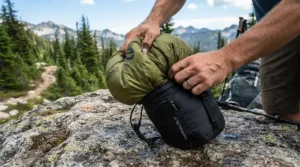
Treat the sleeping bag as one part of a three-piece system: bag, pad, and shelter. When you’re buying entry-level backpacking gear, the smartest money often goes to the pad, not the bag.
Why? Because insulation compresses under your body weight, and the bag does almost nothing underneath you. The pad is doing that job. An insulated pad with a decent R-value can add several degrees of effective warmth, which is cheaper than buying a colder-rated bag.
A practical budget breakdown for beginners: a mummy sleeping bag under $150, a mid-priced insulated pad, a basic tent, and a pack that fits. Spreading the budget evenly beats overspending on one item.
If you’re stuck choosing between a slightly warmer bag and a slightly better pad, pick the pad. It improves every night, in every season, with every bag you’ll ever own.
Practical Usage Guide: Setting Up and Caring for Your Bag
A budget bag lasts years if you treat it right, and the care routine is simple.
First-use tips. Pitch your shelter on flat, dry ground. Fluff the bag for a few minutes before you get in, since insulation needs air to loft. Wear a clean base layer and a hat, and cinch the hood so only your nose and mouth are exposed.
Optimization tricks. Eat something before bed, since your body generates heat while digesting. Fill a hard-sided bottle with warm water and place it near your core. Keep tomorrow’s clothes inside the bag so they’re warm in the morning.
Maintenance schedule. Never store the bag compressed. Hang it or keep it loose in a large cotton sack. Wash it in a large front-loader on a gentle cycle only when needed, per the care label.
Common mistakes in the first 30 days. Stuffing a damp bag into its sack, letting zippers rust, and sleeping in sweaty clothes. Each one shortens the bag’s life.
Do those few things and a bag in this price range easily lasts many seasons.
Problem → Solution Guide for Budget Mummy Bag Owners
Even a good bag has quirks. Here are the usual complaints and fixes.
Problem: “I’m cold even in the bag.” Check the pad first. Then add a liner, a hat, and warm socks. If you’re still cold, the bag’s rating is probably a limit rating you’ve misread as comfort.
Problem: “I feel claustrophobic.” Try a roomier size or relax the hood. Some people never love mummy cuts, and a rectangular bag may suit you better for car camping.
Problem: “The zipper keeps snagging.” Slow down, hold the fabric clear, and keep the track clean. A bit of zipper lubricant helps.
Problem: “My bag is bulky in my pack.” Use a compression sack, but don’t leave it compressed. Pack the bag at the bottom of your pack and fill the gaps around it.
Problem: “I’m a side sleeper.” Mummy bags are snug. Look for a wider cut, or sleep with your knees slightly drawn in. Reviewers often note that a good pillow and pad make side sleeping workable.
Real-World Scenarios: Which Bag for Which Person?
Let’s put real people in these bags.
The college student, spring hiking, tight budget. Weekend trips in the 40s and 50s, carrying everything. The Marmot Trestles 30 fits: light enough, warm enough, and affordable. If summer-only, the Marmot NanoWave 45 saves even more.
The family car camper in the Northeast, late fall. Weight is irrelevant, cold is real. The TETON Sports Celsius or Coleman North Rim 0 gives deep-cold warmth at a very low price, and nobody needs to carry it far.
The new backpacker who sleeps cold, hiking at elevation. The TETON Sports ALTOS or Kelty Mistral 20 hits the sweet spot: warmer ratings without the heaviest bulk.
The casual camper who wants one bag. The ALPS Mountaineering Blaze is built around value and durability, covering most weekend trips without a second thought.
Notice the logic: it starts with your coldest likely night and how far you carry the bag, not with brand names.
✨ Don’t Miss These Exclusive Deals!
🔍 Take your next camping trip to the next level with these carefully selected bags. Click on any highlighted item to check current pricing and availability. These picks will help you stay warm, sleep better, and keep your gear budget under control!
FAQ
❓ What is the best mummy sleeping bag for cold weather on a budget?
❓ Is a synthetic mummy sleeping bag warm enough for winter?
❓ How much should I spend on a mummy sleeping bag under $150?
❓ Can side sleepers use a mummy bag comfortably?
❓ Do I need a sleeping pad with a budget mummy sleeping bag?
Conclusion
Finding the right budget mummy sleeping bag isn’t about chasing the lowest price or the lowest temperature rating. It’s about matching a realistic rating, a sensible weight, and honest construction to the trips you’ll actually take.
For most beginners, the Marmot Trestles 30 and Kelty Mistral 20 offer the best blend of warmth, weight, and reliability. If cold car camping is your thing, the TETON Sports Celsius and Coleman North Rim 0 deliver remarkable warmth for very little money. The ALPS Mountaineering Blaze and TETON Sports ALTOS fill the middle ground well, while the Marmot NanoWave 45 keeps summer trips light and cheap.
Whatever you choose, remember the big three: a rating colder than your coldest night, synthetic insulation for value, and an insulated pad beneath you. Get those right and even a modest bag turns cold nights into good sleep. If you’re assembling entry-level backpacking gear on a budget, a smart bag is one of the best places to start.
✨ Ready to sleep warmer?
Compare the picks above and check current pricing before your next trip! 🏕️
Recommended for You
- Mummy Sleeping Bag For Side Sleepers: 7 Best Picks In 2026
- Ultralight Mummy Sleeping Bag: 7 Best Picks For 2026 (Ranked)
- Wide Rectangular Sleeping Bag For Big And Tall: 7 Best Picks 2026
Disclaimer: This article contains affiliate links. As an Amazon Associate, I earn from qualifying purchases. If you purchase products through these links, we may earn a small commission at no additional cost to you.
✨ Found this helpful? Share it with your friends! 💬🤗
