In This Article
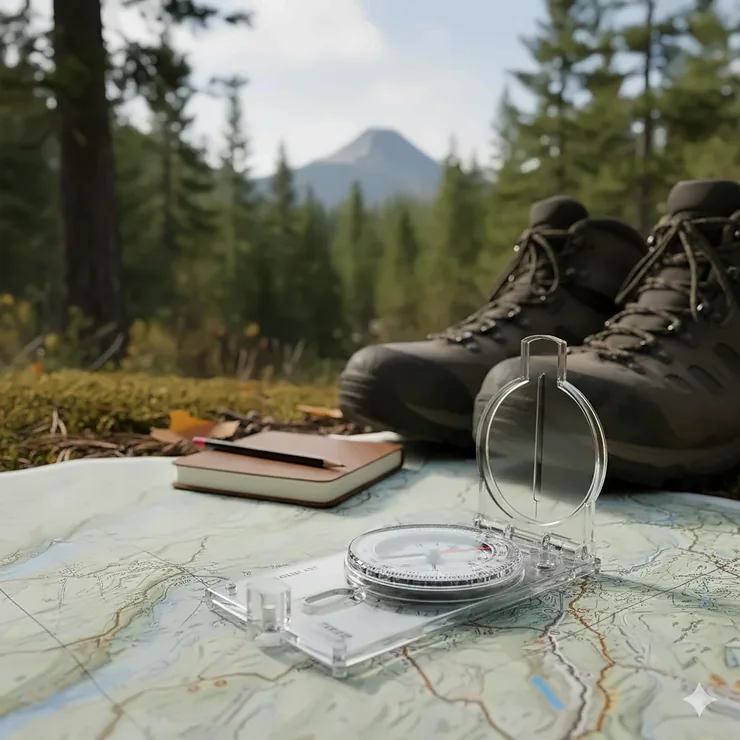
You’re standing at a trail junction in the Pacific Northwest, fog rolling in, and your phone battery just died. This isn’t the time to wish you’d brought a proper navigation tool. A quality compass for hiking transforms from optional gear to essential survival equipment in moments like these.
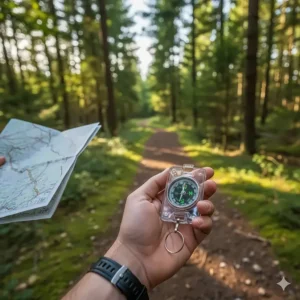
I’ve spent over a decade guiding wilderness expeditions, and the one constant across changing technology is this: magnetic compasses never need charging, never lose signal, and never fail when you need them most. Whether you’re a weekend warrior tackling local trails or a serious backcountry explorer planning multi-day expeditions, understanding how to choose and use a hiking compass review can literally save your life.
The landscape of navigation tools has evolved dramatically. Today’s orienteering compass models blend traditional reliability with modern innovations like global needles, tool-free declination adjustment, and phosphorescent markings. From budget-friendly options under $15 to professional-grade instruments exceeding $100, there’s a compass designed for every skill level and adventure type. This guide cuts through the marketing hype to reveal which models actually perform when conditions turn challenging.
Quick Comparison Table
| Compass Model | Type | Price Range | Best For | Key Features |
|---|---|---|---|---|
| Silva Ranger 2.0 | Mirror Sighting | $52-$70 | Advanced users | Declination adjustment, slope card, distance lanyard |
| Suunto MC-2 | Mirror Sighting | $50-$70 | Serious hikers | Global needle, clinometer, high accuracy |
| Brunton TruArc 3 | Baseplate | $10-$15 | Budget buyers | Tool-free declination, global needle, lightweight |
| Cammenga 3H Tritium | Lensatic | $120-$150 | Military/tactical | Self-illuminating tritium, waterproof, battle-tested |
| Suunto A-10 | Baseplate | $20-$24 | Beginners | Simple design, fixed declination scale, durable |
| TurnOnSport | Baseplate | $10-$12 | Kids/learning | Acrylic baseplate, magnifying glass, affordable |
| Brunton TruArc 15 | Mirror Sighting | $70 | Professionals | Dual clinometer, glow-in-dark, made in USA |
💬 Just one click – help others make better buying decisions too!😊
Top 7 Compass for Hiking: Expert Analysis
1. Silva Ranger 2.0 – Premium Choice for Advanced Navigation
The Silva Ranger 2.0 represents Swedish engineering excellence in compass design. This mirror sighting compass delivers professional-grade accuracy with innovations that separate it from competitors.
Key Specifications:
- Accuracy: ±2.5 degrees
- Weight: 3 oz (86g)
- Temperature range: -4°F to +140°F
Price: $52.94-$69.99
What sets the Silva Ranger 2.0 apart is its innovative slope card and distance lanyard system. The bendable lanyard features multiple map scales (1:24k, 1:25k, 1:50k, 1:62.5k), allowing you to measure route distances directly on topographic maps without calculations. The included slope card helps assess avalanche risk and determines extra hiking distance caused by steep terrain.
Customer feedback consistently praises its DryFlex rubber grip, which maintains control even with wet hands. The built-in declination adjustment accepts a small screwdriver (cleverly hidden in the lanyard breakaway clasp) for precise magnetic north calibration. Luminous markings glow for up to 4 hours after light exposure, though some users report this isn’t bright enough for complete darkness navigation.
✅ Pros: Exceptional accuracy, comprehensive map scales, durable construction
❌ Cons: Slightly heavier than baseplate models, requires tool for declination adjustment
Target User: Experienced navigators, mountaineers, search-and-rescue personnel who demand precision in challenging terrain.
2. Suunto MC-2 – Global Performance Meets Finnish Craftsmanship
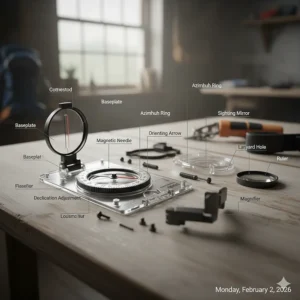
The Suunto MC-2 earns its reputation as a workhorse compass that performs flawlessly across hemispheres. Finnish manufacturing standards ensure this mirror compass survives decades of hard use.
Key Specifications:
- Global needle capability
- Integrated clinometer (±2° accuracy)
- Multiple scale options (USGS or metric)
Price: $50-$70
This Suunto MC-2 features a globally balanced needle system—a breakthrough construction allowing independent tilting of needle and magnet. Unlike hemisphere-specific models that struggle near the equator, the global needle maintains accuracy whether you’re hiking Alaska or exploring Patagonia. The sighting mirror doubles as an emergency signal device, and reviewers consistently mention its value during actual search situations.
The clinometer measures slope gradients essential for backcountry skiers assessing avalanche danger and mountaineers gauging ascent angles. The liquid-filled capsule uses Suunto’s special formulation that prevents needle sticking across extreme temperature ranges. Multiple customers report their MC-2 compasses functioning perfectly after 20+ years of regular use.
Some users note the markings on the bezel can wear with heavy use, and the cover may crack if dropped repeatedly on rocks. However, the precision and reliability outweigh these durability concerns for most serious navigators.
✅ Pros: Global operation, built-in clinometer, excellent mirror sighting
❌ Cons: Bezel markings may fade over time, slightly higher cost
Target User: Globe-trotting hikers, mountaineers, professionals requiring worldwide functionality.
3. Brunton TruArc 3 – Unbeatable Value for Budget-Conscious Explorers
The Brunton TruArc 3 proves you don’t need to spend big for reliable navigation. Made in Wyoming, this baseplate compass delivers features typically found on models costing three times more.
Key Specifications:
- 2° resolution accuracy
- Waterproof to 300 feet
- Weight: 1.1 oz (31g)
Price: $10-$15
At under $15, the Brunton TruArc 3 includes a global needle and tool-free declination adjustment—features that would cost $50+ on competing models. Simply squeeze the compass center while rotating the bezel to adjust magnetic declination without fumbling for tiny screwdrivers in the field. The TruArc Global Needle tilts up to 20 degrees, maintaining functionality across both hemispheres.
Customer reviews highlight its exceptional value, with many purchasing multiple units as backups or for teaching navigation skills. The imperial and metric scales (inch/millimeter) work with standard USGS topographic maps. Some users mention the degree markings could be more prominent, and the lack of a sighting mirror limits precision over long distances.
The compass housing isn’t liquid-filled, which means the needle responds slightly slower than premium models. However, for general trail navigation and learning purposes, this difference is negligible. Scout groups frequently choose the TruArc 3 for its affordable reliability.
✅ Pros: Incredible value, tool-free declination, global needle, lightweight
❌ Cons: No sighting mirror, degree markings could be clearer
Target User: Budget hikers, students learning navigation, scout groups, backup compass for experienced users.
4. Cammenga 3H Tritium – Military-Grade Precision for Tactical Applications
The Cammenga 3H Tritium compass isn’t just military-issue—it’s the official U.S. Armed Forces compass, built to MIL-PRF-10436N specifications. This lensatic compass camping enthusiasts trust when failure isn’t an option.
Key Specifications:
- Seven tritium micro-lights (12+ year lifespan)
- Accuracy: ±40 mils
- Cast aluminum frame, waterproof housing
Price: $120-$150
What justifies the Cammenga 3H Tritium premium price? Self-powered illumination that requires zero external light source. Seven tritium micro-lights embedded throughout the compass glow continuously for over 12 years without batteries or recharging. Night navigation becomes effortless when you can read bearings in complete darkness.
The copper induction damping system (rather than liquid) means this compass functions flawlessly from -50°F to +150°F without bubble formation or fluid leakage. It’s shock-proof, sand-proof, and waterproof to depths that would destroy lesser instruments. The magnifying lens and dual graduation system (degrees and mils) provide military-standard precision.
Customers who’ve used this compass in extreme conditions—from Arctic expeditions to desert warfare—report unshakeable reliability. The sapphire jewel bearing ensures the needle moves friction-free for decades. However, learning to use a lensatic compass requires more training than baseplate models, and the higher cost puts it beyond casual hikers’ budgets.
✅ Pros: Self-illuminating tritium, extreme durability, military precision
❌ Cons: Expensive, steeper learning curve, heavier than baseplate models
Target User: Military personnel, serious survivalists, professional guides, adventurers demanding absolute reliability in extreme environments.
5. Suunto A-10 – Simple Excellence for Beginners
The Suunto A-10 strips navigation down to essentials, creating the perfect learning platform for newcomers to map-and-compass navigation.
Key Specifications:
- High-grade steel needle with jewel bearing
- Fixed declination correction scale
- Liquid-filled capsule for stable operation
Price: $20-$24
The Suunto A-10 represents minimalistic brilliance. Without adjustable declination or advanced features that confuse beginners, this compass focuses on core functionality: pointing north accurately and working with topographic maps. The rounded baseplate fits comfortably in your palm, and the liquid-filled capsule stabilizes the needle quickly.
REI’s navigation courses use the A-10 because it teaches fundamental skills without overwhelming students with excessive features. The fixed declination correction scale printed inside the bezel allows manual calculations as you learn how magnetic variation affects navigation. Scales printed in red stand out clearly against standard USGS maps.
Customer reviews from parents teaching kids navigation praise its durability and ease of use. Several users report their A-10 compasses lasting 20-30 years with regular use. The snap-lock lanyard detaches easily for map work. Some experienced users find it lacks features they want, but that simplicity makes it ideal for learning before graduating to advanced models.
A few reviewers mention the baseplate can crack if dropped from significant heights onto hard surfaces, though most consider it reasonably durable for recreational use.
✅ Pros: Simple to learn, affordable, durable Finnish construction, perfect for teaching
❌ Cons: No adjustable declination, fixed correction scale only, fragile if dropped hard
Target User: Beginning navigators, children learning compass skills, recreational hikers on marked trails.

6. TurnOnSport Orienteering Compass – Best Entry-Level Option for Young Explorers
The TurnOnSport Orienteering Compass makes learning navigation accessible with its transparent design and comprehensive basic features at an incredibly low price point.
Key Specifications:
- Acrylic baseplate with 360° rotating bezel
- Magnifying glass for map reading
- Compass ruler scale 1:24,000
Price: $10-$12
This TurnOnSport compass includes everything needed for basic orienteering: magnetic needle in a bubble-free liquid-filled capsule, azimuth bearing markings, orienting lines, and a built-in magnifying glass. The transparent acrylic baseplate allows you to see map features underneath while plotting routes.
Boy Scout troops and adventure education programs frequently choose this model because multiple units can be purchased for group training without breaking budgets. The included lanyard keeps it accessible during activities. Customer feedback emphasizes that while it’s not competition-grade equipment, it performs admirably for learning navigation fundamentals and casual hiking.
The 1:24,000 scale marking matches standard USGS topographic maps commonly used in North America. Parents report their kids successfully learn map reading with this compass before potential upgrading to more advanced models. Some users note the magnetic needle occasionally sticks or moves slowly, and the construction feels less robust than premium brands.
✅ Pros: Extremely affordable, includes magnifying glass, good for group purchases, lightweight
❌ Cons: Basic construction quality, needle response can be sluggish, not suitable for precision work
Target User: Scouts, students, families introducing children to navigation, budget-conscious beginners.
7. Brunton TruArc 15 – Professional-Grade Features for Serious Navigators
The Brunton TruArc 15 combines advanced navigation capabilities with American manufacturing quality, creating a mirror compass that rivals any international competitor.
Key Specifications:
- Dual clinometer system (vial and lid)
- 1° resolution azimuth ring
- Phosphorescent markings (8-hour glow)
Price: $70
The Brunton TruArc 15 stands out with its triple clinometer system—internal vial clinometer, lid clinometer, and engineer’s ruler—providing comprehensive slope and height measurement capabilities. The glow-in-the-dark azimuth ring, needle, and sighting line illuminate for up to 8 hours after light exposure, far exceeding competitors’ phosphorescent performance.
Made in Brunton’s Riverton, Wyoming facility, this compass features the proprietary EverNorth magnet that resists demagnetization over time better than standard magnets. The bubble level ensures absolute precision when taking bearings—a critical feature professional land surveyors appreciate. The magnified readout balances precision with readability, a challenge many high-resolution compasses fail.
Geologists and field researchers praise the TruArc 15 for scientific measurements. The removable high-visibility cling enhances low-light performance while detaching easily for detailed map work. The full-coverage mirror cover protects the compass face during transport.
Some customers mention the price sits at the upper end of recreational budgets, and all the features can overwhelm casual users. However, professionals requiring precise measurements for avalanche safety, search-and-rescue, or field science find the investment worthwhile.
✅ Pros: American-made quality, dual clinometers, long-lasting luminescence, comprehensive features
❌ Cons: Higher cost, complex for basic navigation, heavier than simple baseplate models
Target User: Professional guides, field scientists, serious backcountry skiers, anyone requiring precision measurements in remote locations.
Understanding Declination Adjustment: Essential Knowledge
Magnetic declination represents the angular difference between magnetic north (where your compass needle points) and true north (geographic North Pole). According to the U.S. Geological Survey, declination varies significantly across the United States—from nearly 20 degrees east on the West Coast to 20 degrees west on the East Coast.
Why does this matter? A 15-degree declination error on a one-mile hike puts you a quarter-mile off course. Over longer distances, that error compounds dangerously. Modern compasses address this through adjustable or fixed declination scales.
Adjustable declination allows you to mechanically set your compass to account for local variation. Once set, your compass automatically compensates—you simply orient the needle to north without mental math. The NOAA Magnetic Declination Calculator provides current declination values for any location worldwide.
Fixed declination scales require manual calculations each time you take a bearing. REI’s expert guidance explains the mnemonic: “West is best and East is least”—add west declination values and subtract east declination values when converting between magnetic and true bearings.
Baseplate vs. Lensatic vs. Mirror Compasses
Baseplate Compasses
Baseplate compass survival tools dominate recreational hiking because they integrate seamlessly with topographic maps. The transparent rectangular base allows you to see map features while plotting routes. Most include ruler scales matching common map scales (1:24,000, 1:50,000), eliminating distance calculation errors.
Advantages: Lightweight, affordable, intuitive with maps, excellent for learning
Limitations: Less precise for long-distance sighting, no elevation measurement
Lensatic Compass Camping Models
Military forces worldwide rely on lensatic compasses because they’re nearly indestructible and provide precise bearing measurements. The hinged cover protects the dial, while the rear sight wire and front sight allow accurate targeting of distant landmarks.
Advantages: Extreme durability, highly accurate sighting, works without maps
Limitations: Steeper learning curve, heavier, more expensive, requires different technique
Mirror Sighting Compasses
Mirror compasses represent the sweet spot for serious navigators. The hinged mirror allows simultaneous viewing of the compass dial and distant terrain, dramatically improving bearing accuracy. Many include clinometers for measuring slope angles—essential for avalanche assessment and route planning.
Advantages: Superior accuracy, dual functionality (baseplate + sighting), often include clinometers
Limitations: Higher cost, additional weight, more complex mechanisms that could fail
How to Choose the Right Compass for Your Adventures
1. Assess Your Skill Level Honestly
Beginners benefit from simple baseplate models that teach fundamentals without confusion. The Suunto A-10 or TurnOnSport options provide everything needed to learn map-and-compass navigation. Intermediate users ready for precision should consider mirror compasses like the Silva Ranger 2.0. Advanced navigators and professionals require specialized features found in the Brunton TruArc 15 or Suunto MC-2.
2. Consider Your Typical Environment
Desert hiking demands durability and temperature resilience. Mountain environments require clinometers for slope assessment. Dense forests benefit from quick needle response. Global travelers need hemisphere-independent designs. Match features to conditions you’ll actually encounter.
3. Evaluate Weight vs. Features Trade-offs
Ultralight backpackers obsess over every ounce. A 1-ounce Brunton TruArc 3 performs admirably for weight-conscious hikers. Guide services and search-rescue teams justify carrying 3+ ounce precision instruments. Consider whether advanced features warrant the additional weight for your typical trips.
4. Budget Realistically
Quality compasses range from $10 to $150, but more expensive doesn’t always mean better for your needs. A $12 TurnOnSport teaches navigation as effectively as a $70 Brunton for beginners. However, professionals working in extreme conditions find the Cammenga tritium compass’s reliability worth every dollar.
5. Plan for Your Next-Level Needs
If you’re serious about developing navigation skills, consider purchasing a quality compass that supports growth. The Silva Ranger 2.0 or Suunto MC-2 serve beginners through advanced use, eliminating the need for upgrades as skills improve.
Essential Compass Features Explained
Global Needle vs. Hemisphere-Specific
Traditional compasses balance for either northern or southern hemispheres. When traveling across the equator, hemisphere-specific needles drag or stick. Global needles use innovative construction allowing worldwide operation—critical for international travelers or expedition leaders working across multiple regions.
Luminous vs. Tritium Illumination
Phosphorescent markings absorb light and glow temporarily (1-8 hours depending on quality). They require “charging” with flashlight or sunlight before night navigation. Budget-friendly but need periodic reactivation.
Tritium illumination uses radioactive isotope-powered micro-lights that glow continuously for 12+ years without any external power source. No charging, no batteries, no maintenance—just constant illumination. The Cammenga 3H demonstrates this technology’s value for professional use.
Clinometer Integration
Clinometers measure vertical angles—essential for determining slope gradients, assessing avalanche danger, and estimating heights of geographic features. The Suunto MC-2 and Brunton TruArc 15 include clinometers calibrated for ±2° accuracy, valuable for mountaineers and backcountry skiers.
Bearing Accuracy and Resolution
Resolution describes the smallest measurement increment marked on the compass. A 2° resolution (like the Brunton TruArc 3) provides adequate accuracy for general hiking. Professional instruments offer 1° resolution for precision work. Military-grade lensatic compasses often include mil graduations (6400 mils = 360°) for artillery and tactical applications.
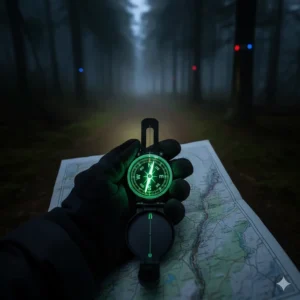
Magnetic North Navigation: Real-World Techniques
Understanding theory differs from executing navigation under pressure. Here’s how experienced guides use these tools effectively.
Pre-Trip Planning
Before leaving civilization, determine your area’s current magnetic declination using NOAA’s calculator. Set adjustable compasses correctly—this one-time adjustment saves constant mental calculations. Download and print backup maps; digital devices fail, paper doesn’t.
Taking Field Bearings
Distance yourself from metal objects (belt buckles, keys, vehicles, fences) that create local magnetic interference. Hold the compass level—tipping affects accuracy. When using mirror models, tilt the mirror to 45 degrees so you can simultaneously view the compass dial and your target landmark. Identify distinctive terrain features to use as intermediate waypoints.
Working with Topographic Maps
Orient your map to the terrain using compass and recognizable features. The Silva Ranger 2.0’s distance lanyard simplifies measuring route length—bend the scaled lanyard along your planned path directly on the map. Cross-reference multiple terrain features to confirm your position before making route decisions.
Triangulation for Position Finding
When you’re uncertain of your location, identify three distant landmarks you can see and find on your map. Take compass bearings to each, then draw lines backward from those map points at the appropriate angles. Where all three lines intersect approximates your position—the smaller the triangle formed, the more precise your location estimate.
Maintenance and Longevity Tips
Quality compasses last decades with minimal care. Here’s how to ensure yours remains reliable.
Storage Practices
Store compasses away from magnets, speakers, and electronic devices that could demagnetize needles. Keep them in provided cases or pouches to prevent scratches on transparent baseplates. Avoid extreme temperature storage—liquid-filled models can develop bubbles if frozen then thawed repeatedly.
Cleaning and Care
Clean baseplates with mild soap and water, avoiding harsh chemicals that cloud acrylic. Dry thoroughly before storage. Check that mirror hinges and moving parts operate smoothly. Lubricate metal hinges sparingly with appropriate lubricant if they become stiff.
Accuracy Verification
Periodically verify accuracy by comparing your compass to a known accurate reference or digital compass app. Check that declination adjustments haven’t shifted. Ensure the needle moves freely without sticking or dragging.
When to Replace
Replace compasses showing cracks in the capsule, loose needles that don’t settle quickly, or bubbles that don’t dissipate (small bubbles from temperature changes usually resolve). If declination adjustment mechanisms break or strip, professional repair is rarely cost-effective—replacement makes more sense.
FAQ
❓ How do I know if I need declination adjustment on my compass for hiking?
❓ Can a lensatic compass camping model be used with topographic maps?
❓ What's the difference between an orienteering compass and a hiking compass review?
❓ How long do tritium compasses like the Cammenga maintain their glow?
❓ Should beginners start with a basic baseplate compass or invest in a mirror compass?
Conclusion: Finding Your Perfect Navigation Companion
Selecting the ideal compass for hiking depends on balancing your current skill level, typical environments, and budget constraints against features that genuinely improve safety and confidence. For most recreational hikers, the Brunton TruArc 3 ($10-15) or Suunto A-10 ($20-24) provide exceptional value while teaching proper navigation fundamentals. These models handle typical trail conditions reliably without unnecessary complexity.
Serious backcountry adventurers investing in long-term capability should consider the Silva Ranger 2.0 or Suunto MC-2 in the $50-70 range. Their mirror sighting capabilities, global needles, and additional features like clinometers justify the higher investment for remote wilderness travel. Professional guides and expedition leaders operating in extreme conditions find the Cammenga 3H Tritium’s ($120-150) military-grade construction and self-illuminating tritium worth every dollar.
Remember that even the most advanced compass for hiking becomes useless without practiced navigation skills. Purchase a quality compass matched to your needs, then commit to regular practice sessions. Navigate parks and familiar trails until map reading and bearing following become second nature. When technology fails in the backcountry—and it will—your compass and skills become literally lifesaving tools.
The magnetic north navigation techniques covered here, combined with proper declination adjustment understanding and consistent practice, transform what seems like complex equipment into an intuitive extension of your outdoor awareness. Whether you’re exploring established trails or venturing into trackless wilderness, a reliable compass provides confidence and security that GPS devices simply cannot match.
Recommended for You
- 7 Best Backpacking First Aid Kits 2026
- 7 Best Wilderness First Aid Kits for Backcountry Adventures (2026)
- 7 Best First Aid Kits for Camping 2026
Disclaimer: This article contains affiliate links. If you purchase products through these links, we may earn a small commission at no additional cost to you.
✨ Found this helpful? Share it with your friends! 💬🤗
