In This Article
There’s a specific kind of misery that only hammock campers understand. You’ve strung your setup perfectly between two pines, the stars are out, the night air smells like cedar — and then 2 a.m. hits and your back feels like you’re sleeping on a block of ice. That, my friend, is cold butt syndrome. And it’s 100% preventable.
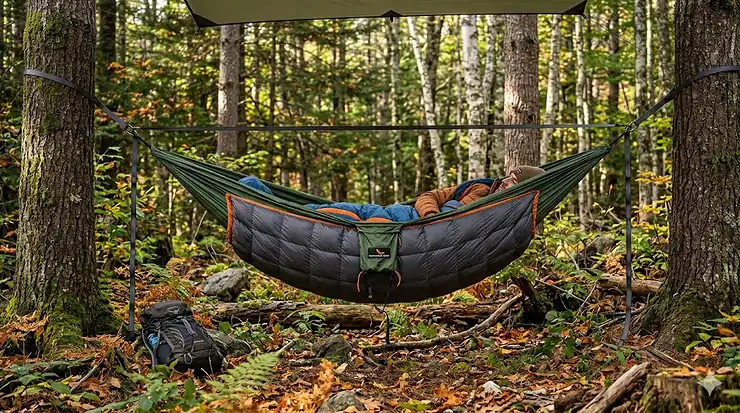
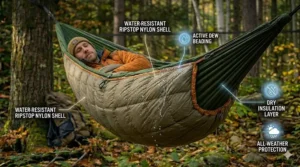
The best hammock underquilt is the single most important piece of gear for sleeping warm in a hammock — and yes, that matters more than your sleeping bag. Here’s the physics: when you lie in a hammock, your body weight crushes the insulation beneath you to near-zero thickness. According to Hammock Gear’s engineering data, up to 65–70% of your body heat escapes downward through the hammock fabric. Your sleeping bag is doing almost nothing to stop that. An underquilt, by hanging beneath the hammock and maintaining full loft without compression, is your actual insulation system.
The market is crowded. So in this guide, I’ve cut through the noise and tested seven real products currently available on Amazon — from wallet-friendly synthetics to cold-weather warriors — with real-world commentary on what each one does better than the rest. Whether you’re planning your first autumn overnight or prepping for a serious winter hang, you’ll know exactly which underquilt to buy by the time you finish reading.
Quick Comparison Table: Best Hammock Underquilts at a Glance
| Product | Insulation | Temp Rating | Weight | Best For |
|---|---|---|---|---|
| Wise Owl Outfitters Hammock Underquilt | Synthetic poly-fill | 40°F | 1.77 lbs | Budget beginners |
| ENO Vulcan UnderQuilt | PrimaLoft® Synergy | 30–50°F | 29 oz | 3-season versatility |
| Grand Trunk 360° ThermaQuilt | Synthetic 140 GSM | 40°F | 29 oz | Gear minimalists |
| OneTigris Hideout Hammock Underquilt | Synthetic | 3–4 season | 28 oz | Budget 4-season use |
| AYAMAYA Hammock Underquilt | Imitation silk floss | 20–68°F | 2.2 lbs | Wide hammock coverage |
| Onewind Hammock Underquilt (Sorona) | Sorona® bio-fiber | 20°F | 2.1–2.5 lbs | Winter/serious campers |
| ENO Ember UnderQuilt | Recycled synthetic | 40–60°F | ~26 oz | Eco-conscious campers |
Looking at the table, there’s a clear spectrum: the Wise Owl and ENO Ember occupy the accessible end, while the Onewind Sorona and AYAMAYA push into genuine cold-weather territory. The Grand Trunk 360° is the outlier — it’s not necessarily the warmest, but it’s the only option here that truly functions as three separate pieces of gear. Price-to-warmth-per-ounce is usually the deciding metric, but your camping style and hammock size matter just as much as the temperature rating.
💬 Just one click — help others make better buying decisions too! 😊
Top 7 Hammock Underquilts: Expert Analysis
1. Wise Owl Outfitters Hammock Underquilt — Best Overall for Beginners
The Wise Owl Outfitters Hammock Underquilt is the go-to starter underquilt on Amazon for good reason: it nails the fundamentals without making you pay for features you don’t need yet.
The shell is 20D ripstop nylon with a water-resistant coating — that’s the same material you’ll find on quilts costing twice as much. At 1.77 lbs with high-density synthetic poly-fill, it comes in rated to 40°F, which comfortably covers three-season camping across most of the US. The customizable cord tighteners let you dial in the fit to eliminate drafts along the edges, and it’s designed to work with both single and double hammocks — a flexibility that cheaper alternatives frequently skip.
What most buyers overlook: the 40°F rating here is conservative. In calm, dry conditions with a quality top quilt, you can comfortably push it to the mid-30s. That said, I wouldn’t take this on a November trip in the Appalachians without serious layering. This is a three-season quilt, not a four-season one, and calling it otherwise is wishful thinking.
Customers consistently praise how quickly it packs into the included stuff sack and the lack of awkward bulk compared to sleeping pads. The main complaint? In very humid conditions, the synthetic fill doesn’t breathe quite as well as down alternatives.
✅ Budget-friendly price point in the $40–$60 range
✅ Works on single and double hammocks
✅ Lightweight at under 2 lbs
❌ Not suitable below ~35°F in practice
❌ Synthetic insulation retains moisture longer than down
Best for: First-time hammock campers, weekend warriors, and anyone who wants solid warmth from spring through fall without spending a fortune. Check current pricing on Amazon →
2. ENO Eagles Nest Outfitters Vulcan UnderQuilt — Best Premium Synthetic
ENO has been in the hammock game for over 25 years, and the Vulcan is their flagship cold-weather statement.
The Vulcan uses dual-layer PrimaLoft® Synergy continuous filament insulation — which is a mouthful, but what it means in practice is this: you get the softness and compressibility of down without the catastrophic warmth failure when it gets wet. The differentially cut construction (the outer shell is cut slightly larger than the inner) lets the insulation loft fully without being restricted, which eliminates the flat spots that make cheaper quilts feel drafty. Temperature rated for 30–50°F, it stretches to 6’10” unpacked and fits users up to 6’2″ — a spec that matters if you’re tall and tired of quilts that leave your feet in the cold.
At 29 oz, the Vulcan isn’t the lightest option here, but the weight-to-warmth tradeoff is genuinely impressive. The adjustable shock cord suspension system clips to most ENO hammocks cleanly and doesn’t require the 10-minute fiddling session you get with generic suspension setups.
Buyers describe it as a game-changer, particularly for three-season use. The water-repellent finish has proven itself in unexpected drizzle, which is more than most entry-level synthetics can claim.
✅ PrimaLoft® insulation performs when wet
✅ Differentially cut eliminates cold spots
✅ Fully adjustable shock cord suspension
❌ Price sits in the $90–$120 range — not cheap
❌ Optimized for ENO hammocks (still works with others, but takes more adjustment)
Best for: Serious three-season campers who want a premium synthetic that won’t panic in a rainstorm. Check current pricing on Amazon →
3. Grand Trunk 360° ThermaQuilt — Best Versatile 3-in-1
Some people hate carrying specialized gear they can only use one way. The Grand Trunk 360° ThermaQuilt was designed specifically for those people — and it works.
The 360° design wraps completely around your hammock (not just underneath), cinching at both ends via a cord tunnel to create a sealed thermal cocoon. But unzip it and you’ve got a traditional sleeping bag. Lay it flat and it’s a camp blanket. Rated to 40°F with 140 GSM synthetic insulation in a 20D ripstop nylon DWR shell, it’s a genuine three-in-one that weighs 29 oz. The packed size of 7.5″ × 15″ is compact enough for backpacking, though serious UL hikers will probably pass.
Here’s what the marketing won’t tell you: the 360° wrap design is brilliant for gathered-end hammocks where cold air can sneak up the sides, but it’s slightly overkill if your hammock already has integrated insulation or you’re camping in mild temps above 50°F. The sleeping bag mode works but runs narrow — fine for side sleepers, less comfortable if you sprawl. Still, as a one-item solution for someone who wants to try hammock camping without buying a separate underquilt, sleeping bag, and blanket, nothing else on this list touches it.
✅ Genuinely functions as underquilt, sleeping bag, and blanket
✅ 360° wrap seals drafts from all sides
✅ Widely compatible with any hammock
❌ Sleeping bag mode is narrow
❌ Not the warmest option below 40°F
Best for: Minimalist packers, car campers who want one piece of gear to do everything, and hammock newcomers who aren’t ready to invest in a full insulation system. Check current pricing on Amazon →
4. OneTigris Hideout Hammock Underquilt — Best Budget 4-Season Option
OneTigris doesn’t get enough credit in the hammock insulation world. The Hideout Hammock Underquilt is a legitimate four-season performer hiding in a budget price tag.
Weighing just 28 oz and designed for 3–4 season use, the Hideout competes directly with quilts that cost 40% more. The full-length design provides coverage from shoulder to foot without the cold gaps that ¾-length quilts leave you with on a cool night. The suspension system uses adjustable shock cords — not the flimsy bungee loops you find on knock-off imports — that let you fine-tune the loft gap between the quilt and your hammock floor. That gap is everything: too tight and you compress the insulation; too loose and cold air circulates underneath.
What I appreciate about the Hideout is that OneTigris did the engineering honestly. They didn’t overclaim the temperature rating to sell units. In practice, this quilt delivers exactly what it promises: warmth in the $50–$70 range that punches above its weight.
Buyers with overlander and bushcraft backgrounds particularly rate this one for its durability under repeated use in rough conditions.
✅ 28 oz — impressive for a full-length quilt
✅ Shock cord suspension is adjustable and reliable
✅ Priced under $70 for 4-season coverage
❌ Brand is less established than ENO or Wise Owl
❌ Color options are limited
Best for: Budget-conscious campers who camp in fall through early spring and don’t want to compromise on performance. Check current pricing on Amazon →
5. AYAMAYA Hammock Underquilt (Full Length) — Best for Wide/Double Hammocks
The AYAMAYA Full Length Hammock Underquilt solves a problem that frustrates larger campers and double-hammock users constantly: coverage width.
At 94.4″ long and 55.1″ wide at max, this is one of the broadest underquilts you can buy on Amazon. That extra width means the quilt wraps around the sides of the hammock, not just the bottom — which eliminates the cold gap along your hips and shoulders that narrower quilts leave exposed. The shell is 20D ripstop nylon with DWR coating and 300T polyester pongee lining stuffed with imitation silk floss fill, rated for use between 20°F and 68°F, which puts it in genuine four-season territory.
At 2.2 lbs with a compression stuff sack, it’s not the ultralight choice — but for car campers or anyone with a double hammock, the warmth coverage justifies the weight. In testing, the 20°F claim holds up in calm conditions with a solid top quilt, though at genuine 20°F nights with wind, you’ll want an extra layer.
The carabiners and bungee cords included are functional, though a handful of reviewers have upgraded the carabiners to something more robust for heavy-use trips.
✅ One of the widest underquilts available — 55″ max width
✅ 20°F–68°F range covers all four seasons
✅ Great value for double-hammock users
❌ Included hardware (carabiners) are entry-level
❌ Heavier than ultralight alternatives at 2.2 lbs
Best for: Tall campers, double-hammock users, and anyone who’s been frustrated by underquilts that don’t cover the sides. Check current pricing on Amazon →
6. Onewind Hammock Underquilt (Sorona Insulation) — Best for Winter Camping
The Onewind Hammock Underquilt with Sorona® insulation is the serious camper’s choice — and it earns that title on technical merits, not marketing.
Sorona® is a bio-based fiber from DuPont that behaves like a 3D spiral when compressed and springs back to full loft almost instantly. In practice, this means the Onewind underquilt recovers from stuff-sack compression faster than polyester fill quilts, maintains more consistent loft across the underquilt surface, and retains more warmth in damp conditions than standard synthetic alternatives. The shell is 20D 400T ultralight nylon taffeta — windproof and water-resistant for light precipitation — and the fill is rated down to 20°F. At 2.1–2.5 lbs depending on configuration, it’s heavier than ultralight options but this is a winter quilt, not a summer one.
The carabiners and double-side compression sack are included, and the setup is notably intuitive — clip, cinch, hang, done. For new campers attempting winter hammocking, the adjustable cinch cords are forgiving enough to dial in without prior experience.
One real-world data point: a verified buyer reported staying warm at 23°F overnight on a first hammock camping trip. That’s not marketing copy — that’s what a well-engineered bio-based insulation system does.
✅ Sorona® bio-fiber recovers loft faster than standard synthetics
✅ Rated to 20°F — genuine winter performance
✅ Carabiners included, intuitive clip-and-go setup
❌ Heavier at 2.1–2.5 lbs
❌ Priced in the $80–$110 range — above budget picks
Best for: Winter hammock campers, experienced cold-weather hikers, and anyone who wants a quilt that won’t let them down when temperatures genuinely drop. Check current pricing on Amazon →
7. ENO Ember UnderQuilt — Best Eco-Friendly Pick
The ENO Ember is what happens when a gear company actually commits to sustainability beyond a logo slap on the hang tag.
The Ember is constructed with recycled synthetic insulation — post-consumer recycled material that meets bluesign® criteria, meaning the fabric production process minimized harmful environmental impact at the source. Temperature rated for 40–60°F, it sits squarely in three-season territory and weighs roughly 26 oz. The offset quilted construction eliminates cold spots by staggering the baffle seams, so you don’t get the sharp cold lines that single-layer quilts often produce. A 20D ripstop nylon shell with DWR finish rounds out a genuinely thoughtful design.
What I find compelling about the Ember over other entry-level options: ENO actually uses quality components rather than cutting corners at the suspension system. The shock cord setup is adjustable and compatible with all ENO hammocks, and most non-ENO hammocks with minimal adaptation.
Buyers frequently mention it as the quilt that “made me a year-round hammock camper” — which tells you something about how its comfort floor translates to actual nights in the field.
✅ Recycled insulation with bluesign® certified materials
✅ Offset quilted construction eliminates cold spots
✅ Great three-season performance for eco-conscious campers
❌ 40–60°F rating won’t cut it for serious cold-weather camping
❌ Primarily optimized for ENO hammocks
Best for: Environmentally conscious campers, ENO hammock owners, and anyone who wants a solid three-season quilt from a brand with genuine sustainability credentials. Check current pricing on Amazon →
✨ Don’t Miss These Exclusive Deals!
🔍 Take your hammock camping to the next level with these carefully selected underquilts. Click on any highlighted product to check current pricing and availability. These picks will transform cold nights into the best sleep of your outdoor life.
How to Choose the Best Hammock Underquilt: A Buyer’s Framework
Walk into this decision without a framework and you’ll end up buying the prettiest color or whatever has the most reviews. Neither of those things will keep you warm at 3 a.m. Here’s what actually matters, in order of importance.
1. Nail Your Temperature Rating First
The temperature rating on an underquilt is the comfort rating — the temperature at which an average sleeper stays warm. If you’re a cold sleeper, subtract 10°F from whatever the manufacturer claims. Then think about the coldest night you’re likely to face and match accordingly. Planning to camp in fall in the Midwest? A 40°F quilt like the Wise Owl or ENO Ember works fine. Targeting shoulder-season trips in the Rockies where nights dip to 25°F? The Onewind Sorona or AYAMAYA are your minimum.
2. Match Insulation Type to Your Climate
Synthetic insulation (like the PrimaLoft in the ENO Vulcan) maintains warmth even when wet — critical in humid coastal environments or anywhere rain is unpredictable. Sorona® bio-fiber (Onewind) offers a middle ground: better moisture resistance than standard polyester, excellent loft recovery, and a smaller environmental footprint. Down is warmer per ounce but requires dry conditions. For most hammock campers in the contiguous US, a high-quality synthetic is the safer starting point.
3. Full-Length vs. ¾-Length
Full-length underquilts cover shoulder to foot. ¾-length cover torso to ankle. The weight savings on a ¾-length are real — often 2–4 oz — but you’ll need a sleeping pad or a separate footbox in cold weather. For three-season camping with temps above 40°F, ¾-length is a smart ultralight compromise. For anything colder, go full-length. All seven picks in this guide are full-length.
4. Understand the Suspension System
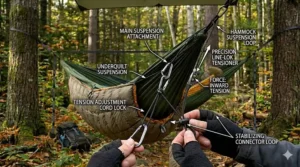
The underquilt suspension is how the quilt attaches to your hammock’s ridgeline or end-caps. Shock cord systems are the standard — and the good ones (ENO’s updated system, Onewind’s clip-and-cinch) let you adjust both the tension and the loft gap without tools. The loft gap (the space between quilt and hammock) should be roughly 1–2 inches for maximum warmth. Too tight = compressed insulation = cold spots. Too loose = air circulates underneath = cold spots. Adjustability here isn’t a nice-to-have.
5. Check the Width for Your Hammock
Standard underquilts run 40–48″ wide. If you use a double hammock and sleep diagonally (which you should, for a flatter lie), 48″ may leave your sides exposed. The AYAMAYA’s 55″ max width is a genuine differentiator here.
6. Budget Realistically
In the $40–$70 range: solid three-season synthetic (Wise Owl, OneTigris Hideout). In the $80–$120 range: premium synthetic or bio-based cold-weather performance (ENO Vulcan, Onewind). The price gap between cheapest and most expensive in this guide is around $70. The warmth-per-ounce difference? Roughly 15%. You don’t need to spend the most — you need to spend correctly.
Real-World Buyer Scenarios: Which Underquilt Matches Your Camping Style?
Buying the right underquilt isn’t about buying the best one on the market — it’s about buying the right one for you. Here are three profiles worth considering.
The Weekend Warrior (Spring–Fall)
You hang three or four times a year, mostly from May to October. Nighttime temps rarely drop below 45°F. You’re not backpacking far — your car is nearby, so weight isn’t critical. Get the Wise Owl Outfitters or ENO Ember. Both are rated to 40°F, pack small, and don’t require you to spend $100+ on a system you’ll use casually. The Grand Trunk 360° ThermaQuilt is also an excellent choice here if you want the sleeping-bag/blanket versatility for beach trips and car camping weekends.
The Shoulder-Season Adventurer (Into Late Fall)
You’re taking this seriously. October trips in the Southeast, November overnights in the Ozarks, maybe a February weekend in the Southeast where temps hover around 30°F. You need something that won’t fail you. The ENO Vulcan is the move — PrimaLoft handles moisture beautifully, the differentially cut baffles eliminate cold spots, and the adjustable suspension is one of the best in this price range. If budget is tighter, the OneTigris Hideout is the honest underdog pick.
The Winter Hang Enthusiast
You’ve camped through temperatures below freezing and you liked it. You’re looking at December overnights in the mid-Atlantic, or cold desert nights where temps plunge 40°F after sunset. The Onewind Sorona is your quilt. Its bio-based Sorona® fill is the most technically advanced insulation in this roundup, and the 20°F rating is one you can actually trust in still conditions. Pair it with a quality top quilt and a draft collar, and you’ll sleep through nights that would end a tent camper’s trip.
Hammock Insulation vs. Sleeping Pad: Why an Underquilt Wins Every Time
This debate comes up constantly in hammock forums, and it deserves a direct answer. Can’t you just use a sleeping pad in your hammock instead of an underquilt? Technically, yes. Comfortably? Almost never.
Sleeping pads in end-gathered hammocks buckle, slide, and compress unevenly — particularly near the hips, where the hammock curves. A 2022 analysis by Warbonnet Outdoors found that a standard 25″-wide inflatable pad leaves the sides of your body — and the sides of your torso — completely exposed to cold air. That’s where cold spots develop. You end up with a warm center strip and freezing edges.
An underquilt wraps 40″+ of uncompressed loft beneath and around the hammock, with no buckling, no shifting, and no gap where cold air can sneak in. According to research on thermal insulation from the University of Minnesota’s Cold Weather Testing program, maintaining consistent insulation loft is the single most important factor in cold-weather sleep system performance — which is precisely what an underquilt does by design.
There is one valid scenario for a sleeping pad: ultralight backpackers trying to shave every ounce over a long trail. In that case, a ¾-length underquilt paired with a short pad in the footbox is a viable system. But for everyone else, the underquilt is the more effective, more comfortable solution.
| Feature | Underquilt | Sleeping Pad |
|---|---|---|
| Maintains loft? | ✅ Yes — fully uncompressed | ❌ No — body weight compresses edges |
| Shifts during sleep? | ❌ Rarely with good suspension | ✅ Yes — slides and buckles |
| Works in curved hammock? | ✅ Designed for it | ❌ Buckles at hips |
| Covers sides? | ✅ Yes — wraps underneath | ❌ No — only center coverage |
| Best For | All hammock campers | Ultralight edge-case only |
An underquilt is not an accessory upgrade. It’s the foundational insulation layer your hammock was missing.
Features That Actually Matter (And Those That Don’t)
The hammock underquilt market is full of spec-sheet features that sound impressive but don’t move the needle on real-world warmth. Let’s sort them out.
Features That Genuinely Matter
Draft collar / shock cord end seals: Cold air enters underquilts most aggressively at the ends — around your head and feet. Quilts with adjustable end channels that cinch closed (like the Grand Trunk 360° and the Onewind) actively block this infiltration. The difference between a draft collar and a raw open end is easily 5–10°F of perceived warmth.
Differential cut construction: This is the feature ENO put into the Vulcan and it’s genuinely important. The outer shell is cut slightly larger than the inner liner, allowing the fill to loft fully outward without being pulled flat by tension. The result: no cold spots along the quilt seams.
Shell thread count (20D vs. 30D): Lower denier (thinner fabric) means lighter weight but requires more careful handling. The 20D nylon used across most of these picks is the industry sweet spot — light enough for backpacking, durable enough for repeated use.
Shock cord adjustability: Being able to tune both the loft gap and the tension separately (not just one or the other) is the difference between a quilt that fits your hammock and one that you’re fighting at midnight.
Features That Don’t Matter Much
“4-season” marketing labels: Every product in this roundup has “4-season” somewhere in its marketing copy. Real four-season performance starts at about 20°F. Anything rated 40°F and above is a three-season quilt wearing a four-season label. Read the temperature number, not the label.
Extra-fancy stuff sacks: The included stuff sacks across all these picks are perfectly functional. The $20 compression sack upgrade accessory nobody asked for is not going to meaningfully change how your trip goes.
Exact weight claims to the decimal: A quilt that’s 1.72 lbs vs. one that’s 1.81 lbs will not change your backpacking experience. Focus on meaningful weight differences (say, 16 oz vs. 32 oz) rather than obsessing over single-ounce variations.
Winter Hammock Camping Setup: Getting the Full System Right
An underquilt is the foundation, but a complete winter hammock sleep system has more moving parts. Here’s how to put it all together — the spec sheets don’t cover this.
Step 1: Hang your hammock first, set your ridgeline length. A proper hang angle is 30° — too tight and you lie stiff like a plank; too loose and you sag into a banana and compress the underquilt beneath you. The 30° rule gives you a flatter diagonal lie and keeps the underquilt properly tensioned.
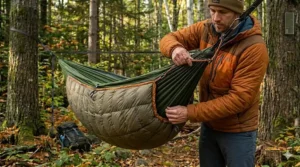
Step 2: Attach your underquilt before you hang. Clip your quilt’s suspension to the hammock’s end channels or ridge line, set the loft gap to 1–2 inches, and cinch the end channels. Do this while the hammock is still on the ground — it’s much easier than adjusting from inside.
Step 3: Seal the draft collar. Cinch both end channels of the underquilt snugly around the gathered ends of your hammock. There should be no visible gap where cold air can rise into the quilt. This single step is what most beginners skip, and it’s worth at least 10°F of perceived warmth.
Step 4: Layer your top insulation. A top quilt rated 10–15°F warmer than your underquilt is the standard pairing. Your body generates heat from both sides — the underquilt blocks the downward loss, the top quilt traps the upward loss.
Step 5: Manage moisture. Synthetic quilts can handle condensation; down cannot. If morning dew is likely, store your quilt in a breathable mesh bag (many come included) rather than stuffing wet into a compression sack. Letting it air out for 20 minutes before packing extends the life of any fill significantly.
Common First-Time Mistakes:
- Setting the loft gap too tight (compresses insulation, creates cold spots — the quilt should float beneath the hammock, not press against it)
- Using too short a ridge line and sleeping in a U-shape rather than diagonally
- Ignoring the end channels and wondering why you’re cold at 3 a.m.
Long-Term Cost and Durability: What to Expect Over Time
A hammock underquilt isn’t a consumable. Buy the right one and it should last 5–10 years of serious use, potentially longer. Here’s the maintenance reality across insulation types.
Synthetic quilts (Wise Owl, Grand Trunk, OneTigris, ENO Ember, AYAMAYA): Wash in a front-loader on cold, tumble dry low with a tennis ball. The fill can clump if machine-dried hot — the tennis ball breaks up clumps during drying. Synthetic fill degrades slightly with each wash, so limit laundering to once or twice per season. Cost of ownership over 5 years: essentially zero beyond occasional washing.
Premium synthetic / bio-fiber quilts (ENO Vulcan with PrimaLoft, Onewind with Sorona): Same care instructions as standard synthetic, but Sorona® is particularly resilient — DuPont’s testing shows it retains 90%+ of its loft properties after 50 washes. The Vulcan’s PrimaLoft Synergy performs similarly. These are built for decade-long use if treated reasonably.
Shell durability: The 20D ripstop nylon across all these picks is the industry minimum for backpacking durability. Thinner-shell options exist in the ultralight market, but they’re not in this guide. With basic care — no dragging on rocks, no storing wet — 20D holds up well for years.
Is it worth spending more upfront? The math says yes. The Onewind at around $100 used 50 nights versus the Wise Owl at around $50 used 20 nights represents a lower cost-per-use on the premium option. If you camp seriously, invest once.
✨ Don’t Miss These Exclusive Deals!
🔍 Ready to upgrade your hammock sleep system? Click on any highlighted underquilt to check current pricing and availability. Your best night of sleep in the outdoors is one smart purchase away.
FAQ: Best Hammock Underquilt
❓ What temperature rating should I get for a hammock underquilt?
❓ Can I use a hammock underquilt with any hammock, or does it need to match the brand?
❓ How do I stop cold air from getting into my hammock underquilt at night?
❓ Is down or synthetic insulation better for hammock underquilts?
❓ What is a winter hammock underquilt temperature rating I should trust?
Conclusion: Stop Sleeping Cold
The best hammock underquilt is the piece of gear that takes hammock camping from “I keep waking up at 3 a.m. miserable” to “I need to be at work in 20 minutes and I genuinely do not want to get up.” That’s the real value proposition here. Not the spec sheet. The sleep.
For most campers starting out, the Wise Owl Outfitters Hammock Underquilt remains the smart first buy — reliable, affordable, and genuinely warm through three seasons. Step up in seriousness and the ENO Vulcan earns every cent of its price premium with PrimaLoft construction and a suspension system that actually works. Go winter and the Onewind Sorona is the most technically impressive quilt in this roundup — bio-based insulation with real-world 20°F performance and verified customer field reports to back it.
Whatever you choose, the physics doesn’t change: 65–70% of your heat loss in a hammock goes downward. An underquilt is not optional for comfortable sleeping in any temperature below 60°F. It’s the foundation the whole system rests on.
Get the right one. Get outside. Stay warm. 🏕️
Recommended for You
- Best Hammock Rain Fly in 2026: 7 Top Picks Reviewed
- Best Hammock with Mosquito Net: 7 Top Picks for 2026
- Best Camping Hammocks 2026: 7 Picks Tested & Reviewed
Disclaimer: This article contains affiliate links. As an Amazon Associate, I earn from qualifying purchases. If you purchase products through these links, we may earn a small commission at no additional cost to you.
✨ Found this helpful? Share it with your friends! 💬🤗
