
In This Article
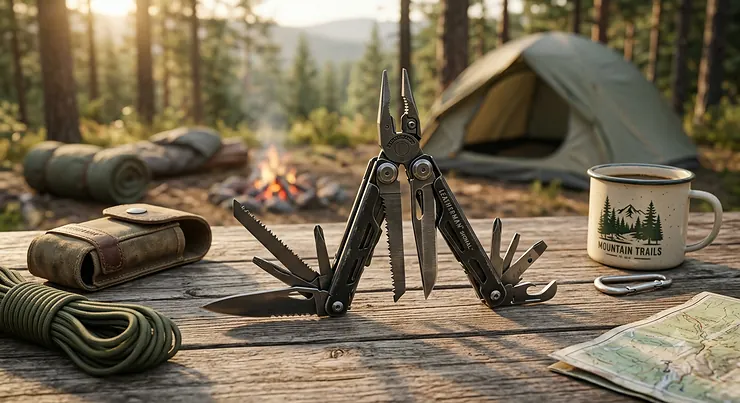
A good multi-tool for camping earns its spot in your pack the first time a tent pole snaps at 9 p.m. and the nearest hardware store is forty miles away. At its simplest, a camping multi-tool is a folding device that crams several separate tools — pliers, a knife, a saw, screwdrivers, openers — into one compact handle you can clip to a belt or stash in a side pocket
I’ve spent the last few seasons rotating through half a dozen of these things on car-camping trips, backcountry weekends, and one memorable canoe trip where a multi-tool saved a wobbling cookware rack. What follows isn’t a copy-paste of spec sheets. It’s a practical look at seven real, currently available options, what they’re actually good at, and who should skip them. Whether you’re outfitting a first camp kit or replacing a tool that’s finally given out, you’ll find a fit here.
One thing worth saying up front: there’s no single “best” multi-tool for camping. A solo backpacker counting ounces wants something different than a family that car-camps with a full kitchen setup. That’s the lens I used to sort these seven.
Quick Comparison Table
| Multi-Tool | Tool Count | Weight | Price Range | Best For |
|---|---|---|---|---|
| Leatherman Wave+ | 18 | 8.5 oz | $100–$130 | All-around camp & DIY use |
| Leatherman Signal | 19 | 7.5 oz | $130–$150 | Bushcraft & fire-starting |
| Gerber Suspension-NXT | 15 | 6.4 oz | $35–$50 | Budget-conscious EDC |
| Victorinox Huntsman | 15 | 3.4 oz | $45–$65 | Lightweight camp kitchen tasks |
| Gerber Truss | 17 | 8.4 oz | $45–$65 | Heavy-duty all-purpose repairs |
| Leatherman Skeletool CX | 7 | 5 oz | $80–$100 | Minimalist, pocket-friendly EDC |
| RoverTac 15-in-1 | 15 | ~7 oz | $20–$30 | First-time buyers & gifting |
✅ A quick read of this table tells a clear story: tool count alone doesn’t predict usefulness. The Skeletool CX has the fewest functions here but consistently wins minimalist-EDC comparisons because every one of its seven tools earns its place. Meanwhile, the Signal trades a couple of conventional tools for camp-specific extras (ferro rod, hammer face) that the Wave+ doesn’t bother with — so the “more tools” tools aren’t always the more camping-relevant ones. If you’re brand-new to multi-tools, the RoverTac and Suspension-NXT sit in a friendlier price zone to learn what you’ll actually use before spending $100+.
💬 Just one click — help others make better buying decisions too!😊
✨ Don’t Miss These Exclusive Deals!
🔍 Take your camping kit to the next level with these carefully selected multi-tools. Click on any highlighted item to check current pricing and availability — these tools will help you handle whatever your next trip throws at you! 😊
Top 7 Multi-Tools for Camping: Expert Analysis
These are the seven I’d actually recommend, spanning budget, mid-range, and premium tiers, based on currently listed Amazon products, owner feedback patterns, and how each one performs on the specific tasks camping throws at a tool: tent repairs, food prep, firewood processing, and the occasional “why is this not working” moment at 11 p.m.
1. Leatherman Wave+ (18-in-1)
The Leatherman Wave+ is the multi-tool most people picture when someone says “multi-tool.” It packs 18 tools into a stainless-steel frame, including needle-nose and regular pliers, a 420HC combo blade, spring-action scissors, a saw, and replaceable wire cutters. What the spec sheet doesn’t tell you is how much that outside-accessible design matters at camp — you can flip open the knife or scissors without unfolding the pliers first, which is the difference between a 2-second fix and fumbling with frozen fingers at a dark campsite.
In my experience, the wire cutters are the sleeper feature here: they’re replaceable rather than fixed, so heavy use on tent stakes or wire fencing doesn’t permanently dull the tool. Owners consistently praise the blade sharpness and overall build quality, with the included nylon sheath drawing more mixed reactions than the tool itself.
✅ Pros: outside-accessible tools, replaceable wire cutters, 25-year warranty
❌ Cons: no built-in fire-starting tools, a bit bulky for ultralight backpackers
Best for: campers who want one tool that genuinely replaces a small toolbox. Price sits in the $100–$130 range — a fair value verdict given the warranty backing it.
2. Leatherman Signal (19-in-1)
If the Wave+ is the generalist, the Leatherman Signal is the camping specialist. It swaps a couple of general-purpose tools for a built-in ferrocerium rod, a hammer face for pounding tent stakes, a diamond-coated sharpener, and a safety whistle — all alongside the expected pliers, 420HC combo blade, and saw.
What most buyers overlook about this model: the ferro rod and sharpener are genuinely useful as backups, not primary tools. Reviewers who treat them that way tend to be happiest; if you’re expecting a dedicated fire-starting kit to outperform a real one, you’ll be a little disappointed. The hammer face, on the other hand, gets consistent praise for actually having enough heft to set stakes in rocky ground without feeling like a gimmick.
✅ Pros: built-in fire starter, hammer face, all-locking tools
❌ Cons: half-serrated blade is fussy to sharpen at home, getting the ferro rod in and out can feel finicky
Best for: backcountry campers and bushcraft hobbyists who want camp-specific tools baked into the multi-tool itself. Expect a $130–$150 range, reflecting its more specialized tool pack.
3. Gerber Suspension-NXT (15-in-1)
The Gerber Suspension-NXT is the multi-tool I’d point a budget-conscious first-time buyer toward. For well under $50, you get 15 tools — needle-nose pliers, wire stripper, three flathead drivers, two cross drivers, scissors, a 2.25-inch partially serrated blade, and more — in a butterfly-opening frame that’s 25% lighter than Gerber’s older Suspension model.
The spec sheet says “stainless steel,” but here’s the practical read: this is a workhorse for light-to-moderate use, not a tool you want chewing through thick gauge wire daily. Owners who treat it as a backup or weekend-trip tool report years of reliable service; those using it as a daily jobsite tool sometimes see the pliers and blade edge wear faster than premium alternatives.
✅ Pros: genuinely affordable, all outboard tools lock, pocket clip included
❌ Cons: blade dulls faster than premium steel, scissors take a few uses to break in
Best for: anyone testing the multi-tool waters before committing to a $100+ tool, or campers who just need a reliable backup. Typically found in the $35–$50 range.
4. Victorinox Swiss Army Huntsman (15 Functions)
The Victorinox Huntsman breaks the pliers-first mold entirely — it’s the classic Swiss Army knife shape, and that’s exactly the point for camp kitchen duty. Fifteen functions are packed into a 3.6-inch frame weighing just 3.4 ounces: a large blade, wood saw, scissors, can opener, corkscrew, and two screwdrivers among them.
Here’s what the marketing won’t tell you: the scissors on this thing are noticeably sharper than what you’ll find on plier-based multi-tools, which matters more than people expect when you’re prepping food or trimming bandage tape at a campsite. The tradeoff is no pliers and no locking blade — fine for camp cooking and light repairs, less ideal if you’re expecting to torque a stuck bolt.
✅ Pros: featherweight at 3.4 oz, excellent scissors, Swiss-made build quality
❌ Cons: no pliers, blade doesn’t lock
Best for: campers who prioritize a camp-kitchen companion over a repair tool. Price typically falls in the $45–$65 range depending on handle material and colorway.
5. Gerber Truss (17-in-1)
The Gerber Truss is what happens when Gerber takes the Suspension-NXT chassis and optimizes it for heavier-duty use. It adds genuine standard pliers alongside needle-nose pliers, a full-length plain-edge blade in addition to the serrated one, a saw, wire stripper, and a more complete driver set — 17 tools total in a slim 4.25-inch closed frame.
In practice, the dual-blade setup (plain edge plus serrated) is the standout for camping specifically: one blade for food prep and rope, the other for sawing through harder materials like green wood or zip ties without dragging the whole multi-tool out of its sheath twice. The included sheath is a genuine sheath, not an afterthought pouch, which matters if you’re clipping this to a pack daily.
✅ Pros: real standard pliers (not just needle-nose), dual blade setup, MOLLE-compatible sheath option
❌ Cons: heavier than the Suspension-NXT, no fire-starting extras
Best for: campers and DIYers who want Gerber’s mid-tier durability without paying Leatherman premium prices. Generally listed in the $45–$65 range.
6. Leatherman Skeletool CX (7-in-1)
The Leatherman Skeletool CX takes the opposite approach from everything else on this list: fewer tools, better execution. Seven functions — a 154CM stainless blade, needle-nose and regular pliers, a bit driver, wire cutters, and a bottle opener — in a frame that weighs just 5 ounces.
What most buyers overlook about this model is the blade steel. 154CM holds an edge noticeably longer than the 420HC steel found on the Wave+ and Signal, which matters if you’re processing cordage or food daily on a longer trip and don’t want to pack a sharpener. The bit driver accepts standard Leatherman bits, so you can swap in exactly the screwdriver heads your gear needs rather than carrying ones you’ll never use.
✅ Pros: premium 154CM blade steel, genuinely pocket-friendly at 5 oz, one-handed opening on every tool
❌ Cons: no scissors or saw, bit driver doesn’t lock — apply too much torque and it can fold
Best for: ultralight backpackers and EDC minimalists who’d rather carry one excellent tool than fifteen mediocre ones. Sits in the $80–$100 range.
7. RoverTac 15-in-1 Pocket Multitool
The RoverTac 15-in-1 rounds out this list as the gift-shelf option that’s actually decent. For well under $30, you get pliers, a folding blade, bottle and can openers, a Phillips screwdriver, and a 9-piece bit set, all behind dual locking mechanisms — one for the blade, one for the bit holder.
The honest take: this isn’t a tool built for years of hard daily use, and the aluminum handle prioritizes grip and looks over long-term plier strength. But for light camp repairs, glovebox emergencies, or as a low-stakes gift for someone who’s never owned a multi-tool, it does the job without the buyer’s-remorse price tag of a premium pick.
✅ Pros: genuinely low price, dual safety locks, comes with a nylon sheath
❌ Cons: not built for heavy daily use, pliers feel less substantial than premium brands
Best for: first-time owners, stocking-stuffer gifting, or a dedicated glovebox/emergency-kit tool. Typically priced in the $20–$30 range.
How to Choose a Multi-Tool for Camping
Before you scroll back up and compare specs, it helps to know what actually separates a good camping multi-tool from a frustrating one. Here’s the decision framework I use:
- Decide if you need pliers. If you’re doing any gear repair (tent poles, zippers, wire), pliers are non-negotiable. If you’re mostly cooking and cutting, a knife-style tool like the Huntsman covers more ground.
- Weigh tool count against weight. A 19-tool multi-tool sounds great until it’s the heaviest thing in your pocket on a 12-mile day. Backpackers should lean toward the Skeletool CX or Huntsman; car campers can afford the Wave+ or Signal.
- Check for locking mechanisms. Any tool you’ll apply real pressure to — the blade, the saw, the pliers — should lock. A folding blade under load without a lock is a hand-injury risk, not a minor inconvenience.
- Look for one-hand opening tools. At camp, one hand is often busy holding a tent pole or stabilizing wood. Tools that deploy one-handed save real frustration after dark.
- Match blade steel to your trip length. Budget steels like 420HC dull faster but are easy to field-sharpen; premium steels like 154CM hold an edge longer but cost more.
- Consider camp-specific extras only if you’ll use them. A ferro rod or hammer face is dead weight if you’re not actually planning to need it.
- Set a real budget and stick to it. The jump from a $30 tool to a $130 one buys you better steel and locking hardware — but only if you’ll use the tool enough to feel that difference.
| Priority | Best Match | Why |
|---|---|---|
| Lightweight pack | Skeletool CX or Huntsman | Under 5 oz, minimal bulk |
| Heavy repairs | Wave+ or Truss | Real pliers, locking tools |
| Bushcraft/survival | Signal | Built-in fire starter & hammer |
| Tight budget | RoverTac or Suspension-NXT | Under $50, decent function |
Looking at this framework, the pattern that emerges is that most “wrong” multi-tool purchases come from buying based on tool count instead of matching the tool to the trip. A 19-in-1 tool is wasted weight on an ultralight thru-hike, and a 7-in-1 minimalist tool will frustrate someone who genuinely needs pliers for gear repairs every trip.
Real-World Scenarios: Matching a Multi-Tool to Your Camping Style
The weekend car camper. If you’re hauling a cooler, a canopy, and a full kitchen setup to a campground twenty minutes from cell service, weight isn’t your constraint — versatility is. The Wave+ or Gerber Truss make the most sense here: you’ll use the can opener, the scissors, the pliers for grill grate adjustments, and the screwdrivers for setting up gear, all in the same weekend.
The backcountry backpacker. Counting ounces changes the calculus entirely. The Skeletool CX or Victorinox Huntsman earn their spot precisely because they don’t carry dead weight — every gram matters when you’re carrying it eight miles uphill, and neither tool sacrifices the core functions (a sharp blade, basic repair capability) that backcountry trips actually demand.
The bushcraft or survival-focused camper. If your trips lean toward fire-building, foraging, and minimal-gear philosophy, the Leatherman Signal is purpose-built for exactly that mindset, with its ferro rod and hammer face doing double duty that a general-purpose tool can’t match.
The budget-first or first-time buyer. If you’re not yet sure how often you’ll actually reach for a multi-tool, starting with the RoverTac or Suspension-NXT lets you learn your own usage patterns before investing in a premium pick — a smarter sequence than guessing at $130 upfront.
Practical Usage Guide: Getting the Most From Your Camping Multi-Tool
A new multi-tool benefits from a little setup before its first real trip:
- Test every tool at home first, not in the field. Open and close each function a few times so you know which ones need two hands and which deploy one-handed under pressure.
- Apply a drop of light oil to the pivot points after the first few uses. This is the single most common maintenance step owners skip, and it’s why some multi-tools start feeling “gritty” within months.
- Sharpen before your trip, not during it. A multi-tool’s built-in sharpener (if it has one) is a backup, not a substitute for a proper whetstone session before you leave.
- Store it dry. Stainless steel resists rust, but a damp sheath left zipped in a pack for days will still cause spotting over time on lower-end steels.
- Avoid using the pliers as a hammer substitute unless your model specifically includes a hammer face (like the Signal). It’s the single most common way owners report bent jaws.
🔥 Common first-30-day mistake: overtightening the pivot screws on tools like the Skeletool CX or Suspension-NXT to “fix” a wobble. Most of these tools use a deliberate amount of play in non-locking tools (like bit drivers) — over-tightening can make the tool harder to deploy, not safer.
Problem → Solution: Fixing Common Camp Repairs in the Field
Problem: A tent pole won’t seat properly. The needle-nose pliers on the Wave+, Truss, or Suspension-NXT can usually coax a bent or stuck pole section back into alignment — gently, since aggressive force can crack the pole material.
Problem: A zipper pull has torn off your tent or pack. A small loop of wire and the needle-nose pliers (any of our pliers-equipped picks) can fashion a temporary replacement pull until you’re home.
Problem: Your knife has gone dull mid-trip. The Leatherman Signal’s built-in diamond sharpener is designed for exactly this — a stopgap edge, not a full resharpening, but enough to finish the trip.
Problem: A camp stove fitting is stripped or stuck. The flathead and cross drivers found on the Suspension-NXT, Truss, and Wave+ cover the vast majority of camp stove and cookware hardware without needing a dedicated screwdriver set.
Problem: You need to start a fire in damp conditions. This is where the Signal’s ferro rod genuinely earns its keep — it sparks reliably even when matches have gotten damp, though it works best paired with proper dry tinder rather than relied on alone.
Leatherman vs. Gerber: Which Camping Multi-Tool Brand Wins?
This comparison comes up constantly, and the honest answer is: it depends on what you’re optimizing for. Leatherman camping tools, like the Wave+ and Signal, generally use better blade steel and offer a longer warranty window (25 years versus Gerber’s limited lifetime guarantee, which covers manufacturing defects rather than wear). That premium shows up in price — Leatherman tools here run $30–$80 higher than their closest Gerber multitool outdoor equivalents.
Gerber’s strength is value engineering. The Suspension-NXT and Truss deliver a comparable tool count and similar locking-tool safety features at roughly half the price of a Wave+. The tradeoff is blade steel that dulls faster and slightly less refined fit-and-finish, based on consistent feedback across owner reviews for both brands.
The practical takeaway: if you’re going to use a multi-tool weekly for years, Leatherman’s better steel and warranty justify the premium. If you’re an occasional camper who wants solid function without the higher price tag, Gerber’s mid-tier lineup closes most of the performance gap for a fraction of the cost.
Common Mistakes When Buying a Camping Multi-Tool
❌ Buying based on tool count alone. A 21-in-1 tool with six redundant screwdriver bits isn’t more useful than a focused 15-in-1 with the right tools — it’s just heavier.
❌ Ignoring blade lock type. Multi-tools with non-locking blades (like the base Huntsman) are fine for food prep but risky for any task requiring real cutting pressure, like processing wood.
❌ Skipping the weight check. Specs list weight in ounces, but it’s easy to underestimate how much an 8.5-ounce tool adds up over a multi-day pack list compared to a 5-ounce one.
❌ Assuming “stainless steel” means “premium steel.” Stainless is a category, not a quality tier — 420HC and 154CM are both stainless but perform very differently under hard use.
❌ Forgetting the sheath is often sold separately. Several premium Leatherman models, including the Wave+, don’t include a sheath in the box — a detail that catches first-time buyers off guard at checkout.
Features That Actually Matter (And Those That Don’t)
Matters: locking mechanisms on the blade and pliers. Doesn’t matter as much: the exact number of screwdriver bits, since most campers use two or three sizes repeatedly and ignore the rest.
Matters: one-hand opening tools, especially the blade. Doesn’t matter as much: built-in LED lights on multi-tools — they’re rarely bright enough to replace a real headlamp and mostly drain a battery you forgot was there.
Matters: replaceable wire cutters (a Wave+ standout). Doesn’t matter as much: corkscrews and can openers if you’re already bringing a separate kitchen kit on car-camping trips.
Matters: pliers nose design — needle-nose pliers reach into tight gaps (a torn zipper, a stuck cotter pin) that regular pliers simply can’t access. Doesn’t matter as much: cosmetic finish (black oxide versus stainless) — it affects looks and minor scratch-resistance, not actual function.
Camping Multi-Tool vs. Standalone Camping Tools
| Factor | Multi-Tool | Standalone Tools (knife + pliers + saw separately) |
|---|---|---|
| Weight | Lower overall | Higher combined weight |
| Pack space | Single compact unit | Multiple items to organize |
| Per-tool quality | Good, rarely best-in-class | Can choose best tool for each job |
| Cost | One purchase | Multiple purchases add up |
| Failure risk | One break affects all functions | Other tools unaffected if one fails |
The data here makes the tradeoff pretty clear: a multi-tool wins decisively on weight and pack efficiency, which is why it’s the default choice for backpackers and most car campers. Where standalone tools pull ahead is task-specific performance — a dedicated fixed-blade knife will always out-cut a multi-tool’s folding blade, and a real claw hammer beats any multi-tool hammer face. Most experienced campers land on a hybrid: a multi-tool as the primary tool, with one or two dedicated items (usually a real knife) as backup for the tasks that matter most.
Long-Term Cost & Maintenance
A $30 multi-tool that needs replacing every two seasons can end up costing more over five years than a $120 tool backed by a real warranty — but only if you’re actually putting in enough use to wear one out. For occasional campers (a few trips a year), the budget and mid-range picks here will likely outlast your interest in upgrading. For weekly users or anyone who treats their multi-tool as a daily-carry item, the better steel and 25-year warranty on Leatherman’s lineup spreads the higher upfront cost across far more use.
Maintenance costs are minimal across the board: a small bottle of light oil and an occasional whetstone session cover nearly everything, and Gerber’s and Leatherman’s lifetime/25-year warranties mean manufacturing defects are typically a free fix rather than an out-of-pocket repair, provided the damage isn’t from misuse.
Safety, Regulations & Carrying Your Multi-Tool Responsibly
Multi-tools fall into a gray area in a lot of outdoor regulations, and it’s worth a quick check before you travel. Most national parks and recreation areas don’t broadly prohibit multi-tools or folding knives for camping and cooking use, but rules can vary by location, and security screening at high-traffic sites can be stricter than general park policy — the National Park Service’s posted security guidance for high-security sites is a good example of how much this can vary by location. If you’re flying with your gear, pack multi-tools in checked luggage; most have a blade and are not permitted in carry-ons.
On the tool itself, the locking blade mechanism is your most important safety feature day-to-day. A blade or saw that locks firmly in the open position prevents the single most common multi-tool injury: a folding edge closing on fingers under load. Always engage the lock before applying pressure, and never substitute a non-locking tool (like a bit driver) for a job that needs real torque.
❓ Frequently Asked Questions
❓ What is the best multi-tool for camping on a budget?
❓ Do I need pliers on a camping multi-tool?
❓ Is a Leatherman better than a Gerber for camping?
❓ Can you bring a multi-tool on a plane to go camping?
❓ How many tools do I actually need on a camping multi-tool?
Conclusion
Picking the best multi-tool for camping comes down to matching the tool to your actual trips, not chasing the highest tool count on the shelf. If you want one do-everything option, the Leatherman Wave+ remains the safest all-around recommendation. Backpackers counting ounces should look hard at the Skeletool CX or Victorinox Huntsman, while anyone leaning into bushcraft will get more genuine use from the Signal’s built-in fire-starting tools. And if you’re not yet sure how a multi-tool fits your camping style, the Suspension-NXT or RoverTac let you find out without a big upfront commitment.
Whichever you land on, the real test isn’t the spec sheet — it’s whether it’s still in your pack, working, three seasons from now.
✨ Ready to Upgrade Your Camp Kit?
💬 Take a look at the picks above and find the multi-tool that matches how you actually camp — then check current pricing and availability before your next trip! 🏕️
Recommended for You
- 7 Best Mora Knives for Camping in 2026
- Best Camping Knife 2026: 7 Top Picks That Actually Hold Up
- Winter Hammock Camping Guide 2026: 7 Gear Picks That Work
Disclaimer: This article contains affiliate links. As an Amazon Associate, I earn from qualifying purchases. If you purchase products through these links, we may earn a small commission at no additional cost to you.
✨ Found this helpful? Share it with your friends! 💬🤗
