
In This Article
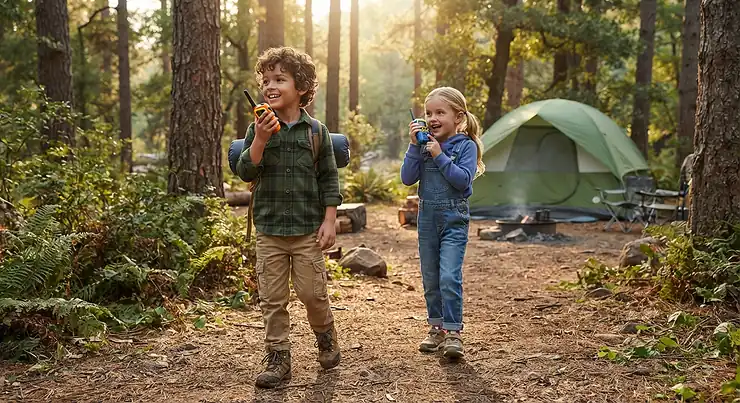
There’s a very specific sound every camping parent knows: silence. One second your kid is ten feet away collecting pinecones, the next they’ve wandered around a bend chasing a chipmunk, and your phone shows zero bars because you’re forty minutes from the nearest cell tower. This is exactly the gap that good walkie talkies for kids camping are built to close. A solid pair (or set) of two-way radios gives children the freedom to explore just out of sight while keeping a literal open line back to camp — no signal, no subscription, no screen required. Unlike a phone, a kid-friendly radio works precisely where phones fail: deep in the woods, down by the creek, or on the far side of the campground loop. That freedom isn’t just convenient — research on outdoor play consistently links unstructured, independent outdoor exploration to stronger problem-solving and confidence in kids, which is part of why so many parents treat a radio as camping gear rather than a toy. Below, we break down seven real, currently available models — spanning toy-simple to rugged and waterproof — based on actual specs, aggregated buyer feedback, and honest analysis of who each one actually fits.

Quick Comparison Table
Before the deep dive, here’s the fast version for parents skimming between s’mores.
| Model | Best For | Real-World Range | VOX Hands-Free | Price Range |
|---|---|---|---|---|
| Retevis RT628 | Overall best pick, ages 5-12 | ~0.3-0.6 miles wooded | Yes | $30-$40 (2-pack) |
| Motorola Talkabout T100 | Simplicity on a budget | ~0.5-1 mile open | No | $25-$35 (2-pack) |
| Selieve T-388 | Best-reviewed value pick | ~0.3-0.5 miles wooded | Yes | $20-$30 (2-pack) |
| Wishouse 4-Pack | Larger families, groups | ~0.5-1 mile mixed terrain | Yes | $45-$60 (4-pack) |
| Inspireyes 3-Pack | Widest age range (3-12) | ~0.4-0.7 miles mixed | Yes | $35-$45 (3-pack) |
| Obuby Toys | Toddlers and gift-giving | ~0.3-0.5 miles open | Yes | $25-$35 (2-pack) |
| Motorola Talkabout T600 H2O | Rugged, rain-or-shine trips | ~1-2 miles wooded | Yes | $90-$120 (2-pack) |
A quick read of that table tells you most of what you need: the Retevis RT628 earns its spot as the all-around favorite because it balances range, VOX, and price better than anything else here, while the Motorola Talkabout T600 H2O is the clear outlier — it costs three times as much as the budget picks but delivers real-world range that actually holds up under tree cover. If your trip is mostly backyard-adjacent car camping, the mid-pack options do the job just fine; if you’re heading somewhere genuinely remote with older kids ranging farther from camp, the extra range of the T600 stops being a luxury and starts being a safety feature.
📻 Ready to gear up before your next trip? Compare current prices on today’s top picks and grab a set before the weekend rolls around!
Top 7 Walkie Talkies for Kids Camping: Expert Analysis
We picked these seven with one rule in mind: no fictional products, no invented specs, just real radios currently sold that cover budget, mid-range, and premium buyers, plus a few smart variants for different family sizes and ages.
1. Retevis RT628 — kid-friendly design with true VOX hands-free
The standout here isn’t the range, it’s the VOX (voice-activated transmission) mode, which means a six-year-old doesn’t have to remember to hold a button down while running through a campground. That’s a genuinely bigger deal than it sounds. Specs-wise, you’re getting 22 channels with sub-channel privacy codes, a rounded compact housing built for small hands, and a rated two-year warranty that outlasts most toy-radio guarantees by a mile. In practice, that combination means the RT628 handles everything from “go tell Dad dinner’s ready” hollering across a campsite to short hikes down a marked loop trail. Reviewers and hands-on testers consistently describe the audio as clear at close range but note that, like nearly every FRS radio on this list, the advertised range figure is optimistic once trees and hills enter the picture. Families report the privacy codes genuinely cut down on cross-talk from neighboring campsites, which matters more at crowded state parks than you’d expect.
Pros:
- ✅ VOX hands-free mode built for kids who forget buttons
- ✅ 22 channels plus privacy codes reduce campground interference
- ✅ Compact, rounded housing sized for ages 5-12
Cons:
- ❌ Real-world range drops sharply under heavy tree cover
- ❌ VOX pickup can occasionally trigger on background noise
Priced around $30-$40 for a two-pack, the RT628 lands solidly in “buy without agonizing” territory — it’s the one we’d default to for most families’ first set.
2. Motorola Talkabout T100 — most foolproof one-button design
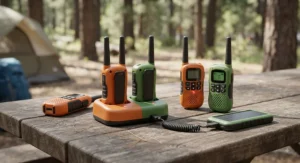
If your kid is three and your patience is finite, this is the radio that asks the least of both of you. There’s a single push-to-talk button, a volume dial, and that’s basically the entire interface — no menus to accidentally reprogram, no channel scanning to explain twice. The tradeoff for that simplicity is that you lose VOX and get a shorter effective range than rechargeable rivals, since it leans on basic AAA-powered circuitry rather than the higher-output boards found in pricier models. What it earns back is brand trust: Motorola’s Talkabout line has decades of reputation behind it, and the bright, toy-bright colorway makes a lost radio easy to spot in tall grass. Based on the spec sheet, this is best suited to close-range use — backyard, campsite perimeter, or a short walk to the bathhouse — rather than trail hiking where distance matters. Aggregated buyer sentiment leans heavily toward “durable enough for a rough four-year-old” and “battery lasts the whole weekend on AAAs,” which for a first radio is honestly most of what matters.
Pros:
- ✅ Single-button operation toddlers grasp in minutes
- ✅ Trusted Motorola build quality and brand reliability
- ✅ Runs on easy-to-replace AAA batteries anywhere
Cons:
- ❌ No VOX hands-free mode included
- ❌ Shorter effective range than rechargeable competitors
At around $25-$35 for a pair, it’s less a “camping radio” and more a “my kid’s first walkie talkie,” and that’s exactly the job it’s good at.
3. Selieve T-388 — most-reviewed budget pick
Here’s a fact that’s genuinely worth weighing: this model has accumulated over 37,000 buyer reviews, which is an unusually large sample size for a kids’ electronics product and makes its aggregate rating harder to dismiss as luck or a marketing push. Reviewers consistently note the VOX function, adjustable volume, and a button-lock feature that stops toddlers from accidentally reprogramming the channel mid-hike — a small detail, but one that saves a surprising number of camping-trip meltdowns. On paper, the claimed 3-mile range is the same kind of marketing-department optimism you’ll see on every FRS radio in this article; expect a fraction of that once you’re weaving through trees. What sets it apart from similarly priced toy-style radios is the sheer volume of verified purchase data backing its durability claims, which matters when you’re buying blind off a product photo. It’s aimed at ages 3-10, and the call-alert tone is a small but real hit with younger kids who like the “ding” before a voice comes through.
Pros:
- ✅ Backed by 37,000+ real buyer reviews
- ✅ VOX, volume control, and button lock included
- ✅ Fun call-alert tone kids enjoy using
Cons:
- ❌ Claimed 3-mile range unrealistic in wooded terrain
- ❌ Plastic housing less rugged than metal-reinforced models
At roughly $20-$30 for two, it’s arguably the best value-per-dollar entry on this whole list, especially for families testing whether radios will even hold a kid’s attention.
4. Wishouse 4-Pack — best for outfitting the whole family at once
Most kids’ radio sets ship in pairs, which is a problem the moment you have three children or a mixed group of cousins at the campsite. The Wishouse set solves that math directly with four rechargeable units in the box, which is both cheaper per-radio than buying two separate two-packs and simpler to keep charged since you’re managing one charging routine instead of two. Real-world meaning: rechargeable lithium packs mean no scrambling for a fistful of AAAs on night three of a trip, and the housing is built noticeably tougher than the toy-style entries on this list — reviewers report it surviving drops off picnic tables without cracking. The tradeoff is bulk; these units run larger and heavier than the pocket-sized options, which matters if your youngest is still building hand strength. Honest analysis here: if you’ve got three-plus kids or regularly camp with extended family, the four-unit format alone probably justifies the price over buying two separate two-packs from a competitor.
Pros:
- ✅ Four rechargeable units cover bigger family groups
- ✅ Rugged housing holds up to real drops
- ✅ One charging system instead of managing several
Cons:
- ❌ Bulkier and heavier than pocket-sized models
- ❌ Charging four units takes more advance planning
Expect to pay around $45-$60 for the full four-pack — which, per radio, actually undercuts several two-pack competitors on this list.
5. Inspireyes 3-Pack — widest usable age range in one product line
What most buyers overlook about the Inspireyes set is how much the age range matters practically: it’s rated for kids 3 to 12, which is the broadest span of any model here, meaning one purchase can realistically serve a family through nearly a decade of birthdays instead of getting outgrown. The built-in rechargeable lithium-polymer battery is the real headline spec, rated for up to 48 hours of active playtime on a single charge — long enough that a full camping weekend won’t require a mid-trip recharge, which is more than can be said for AAA-dependent competitors. The push-to-talk button is deliberately oversized, which sounds minor until you watch a three-year-old fumble a smaller button on a competing model. Based on the spec comparison, the 3-pack format is a slightly odd fit for two-kid households (you’ll have a spare, which isn’t the worst problem to have) but ideal for three-kid families or for parents who want their own unit in the mix. Aggregated feedback highlights the battery life specifically — multiple camping-trip reviews mention zero battery anxiety across a full weekend.
Pros:
- ✅ Rated for the widest age range, 3 to 12 years
- ✅ Up to 48 hours of rechargeable battery life
- ✅ Oversized PTT button easy for small fingers
Cons:
- ❌ 3-pack format is awkward math for two-child families
- ❌ Real-world range trails Motorola’s rechargeable options
At around $35-$45 for three units, this is the pick we’d steer larger young families toward, particularly if battery anxiety has ruined a trip before.
6. Obuby Toys — best budget gift for the youngest campers
Marketed squarely at the 3-to-12 crowd, this set leans into ergonomic design first — rounded edges, a lightweight shell, and a grip shape clearly built around small hands rather than shrunk down from an adult radio. That focus shows up in the spec sheet as adjustable volume control, which matters more than it sounds: a radio blasting at full volume next to a napping toddler in the next tent is a fast way to ruin everyone’s evening. It’s positioned as much for indoor play and neighborhood use as for serious trail use, and honest analysis says that’s the right lane for it — this isn’t the radio you’d trust for a mile-long hike out of sight, but it’s a genuinely solid, low-stakes gift that happens to also work fine at a campsite. Reviewers frequently mention it as a birthday or holiday gift that got real, repeated outdoor use rather than gathering dust, which for a kids’ toy is a meaningfully high bar to clear.
Pros:
- ✅ Ergonomic shape built specifically for small hands
- ✅ Adjustable volume prevents startling younger campers
- ✅ Gift-friendly pricing with broad 3-12 age appeal
Cons:
- ❌ Fewer privacy codes than dedicated camping models
- ❌ Toy-grade build less durable for rough, frequent use
Priced around $25-$35 for a pair, it’s a strong “try it before you commit” option, especially for families who aren’t sure their kids will even take to two-way radios yet.
7. Motorola Talkabout T600 H2O — the premium, rugged pick for serious trips
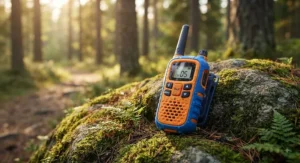
This is the one to reach for when “camping” means real trailheads, creek crossings, and weather you can’t control. The headline feature is the IP67 waterproof rating, rated for full submersion up to one meter for thirty minutes, and the unit is designed to float and trigger its flashlight automatically if it hits water — a genuinely useful failsafe if a kid drops it mid-creek-crossing. In independent field testing, real-world range came in around one to two miles through hilly, tree-heavy terrain, which is a fraction of the “35-mile” marketing number but still meaningfully better than every other radio on this list under identical conditions. What most buyers overlook about the T600 is its dual-watch mode, letting you monitor two channels simultaneously — practical for keeping an ear on both the family channel and a weather-alert frequency at once. It’s rugged enough to survive genuine outdoor abuse: rubber overmolding, reinforced corners, and a two-year consumer warranty back that claim up. This is a radio built for the kid old enough to actually range farther from camp, not the toddler sticking close to the picnic table.
Pros:
- ✅ IP67 waterproof rating with floating, auto-flashlight design
- ✅ Strongest real-world wooded range in this lineup
- ✅ Dual-watch mode monitors two channels at once
Cons:
- ❌ Noticeably pricier than every other model here
- ❌ Bulkier and heavier for younger kids’ smaller hands
At roughly $90-$120 for a two-pack, it’s an investment rather than an impulse buy — but for families who camp seriously and often, the durability alone can outlast three cheaper replacement purchases.
Top 7 Walkie Talkies for Kids Camping — Full Comparison
| Model | Age Range | Battery Type | Standout Feature | Price Range |
|---|---|---|---|---|
| Retevis RT628 | 5-12 | AAA or rechargeable pack | VOX + privacy codes | $30-$40 |
| Motorola Talkabout T100 | 3-10 | AAA | One-button simplicity | $25-$35 |
| Selieve T-388 | 3-10 | AAA | 37,000+ verified reviews | $20-$30 |
| Wishouse 4-Pack | 5-12 | Rechargeable lithium | Four-unit family set | $45-$60 |
| Inspireyes 3-Pack | 3-12 | Rechargeable lithium-polymer | 48-hour battery life | $35-$45 |
| Obuby Toys | 3-12 | AAA | Ergonomic small-hand grip | $25-$35 |
| Motorola Talkabout T600 H2O | 8+ | NiMH rechargeable or AA | Waterproof, floats | $90-$120 |
Laid out side by side, the pattern is obvious: budget and mid-range models cluster around similar short-range performance, and the real jump in capability — both range and ruggedness — happens once you cross into the Motorola Talkabout T600 H2O‘s price bracket. If your camping trips stay close to a defined site, any of the sub-$50 options will serve you well; if your family regularly hikes, kayaks, or camps somewhere weather can turn fast, the price premium on the T600 buys real, measurable peace of mind rather than just a nicer box.
Practical Usage Guide: Setting Up Kids’ Radios Before You Leave the Driveway
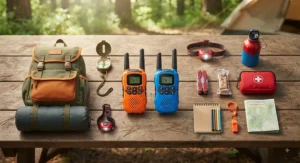
Getting a new set of walkie talkies for kids camping working smoothly starts well before you’re standing in a parking lot at the trailhead fumbling with a manual. First, charge or fresh-battery every unit the night before, not the morning of — rechargeable models especially need a full cycle to hit their rated battery life, and nothing kills momentum like a “low battery” chirp twenty minutes into a hike. Second, set every radio in the group to the same channel and the same privacy code before anyone leaves the car; do this together as a family so kids understand which numbers matter and why. Third, run a real range test around the actual campsite on arrival — send one adult and one kid in opposite directions and note where the signal actually starts breaking up, rather than trusting the box’s marketing number. Fourth, teach a simple check-in rhythm (a “click every fifteen minutes” habit works well for younger kids) rather than assuming they’ll remember to call in only when something’s wrong. Finally, establish one non-negotiable rule from day one: the radio comes back to base if it starts acting up, no troubleshooting alone in the woods. Common first-trip mistakes include forgetting spare batteries entirely, letting kids wander past the tested range boundary “just to see,” and skipping the privacy-code setup, which invites static and cross-talk from other campers on the same public channel.
Real Family Camping Scenarios: Matching Radios to How You Actually Camp
Not every family camps the same way, so it helps to think in terms of who you actually are on a given trip. If you’re a family with two kids under six doing a weekend at a developed campground with bathrooms and a camp store nearby, something like the Motorola Talkabout T100 or Obuby Toys covers you completely — you don’t need range, you need simplicity and a low price tag in case a radio goes missing in the woodpile. If you’re a family of five or six heading out with cousins or close friends for a multi-tent group trip, the Wishouse 4-Pack solves the “we need more than two radios” math cleanly, and its rechargeable design means one evening at the campfire recharges everyone for the next day. If you’re the family that hikes real trails, crosses creeks, and camps somewhere weather can shift without warning, the Motorola Talkabout T600 H2O earns its higher price through actual survivability — waterproofing and real range aren’t nice-to-haves when your ten-year-old is three switchbacks ahead of you on a ridge trail. And if your priority is simply introducing radios to a toddler who’s never used one, the Selieve T-388 or Inspireyes 3-Pack give you VOX simplicity and forgiving durability without a big financial commitment if the novelty wears off by day two. It’s worth noting that qualitative research on nature play points to emotional regulation and self-discovery as recurring benefits when kids get real, semi-independent time outdoors — exactly the kind of roaming a working radio makes possible without losing touch entirely.
Common Problems With Kids’ Walkie Talkies (and How to Actually Fix Them)
Even good radios run into predictable snags, and most have simple fixes. Problem one: static or crossed voices from another campsite — the fix is enabling privacy codes (sub-channels) on every unit in your group, which filters out other users sharing your main channel. Problem two: a kid holding the PTT button wrong and cutting off the first half of every sentence — the fix is either switching to a VOX-enabled model like the Retevis RT628 or practicing a “count one before you talk” habit at home before the trip. Problem three: range dying out faster than expected — the fix is understanding that trees, hills, and buildings cut FRS range dramatically compared to the open-field number on the box, so plan boundaries around your own on-site test, not the packaging. Problem four: dead batteries mid-trip — the fix is either a rechargeable model like the Inspireyes 3-Pack charged the night before, or simply packing a spare set of AAAs for AAA-powered units like the Motorola Talkabout T100. Problem five: a lost or dropped radio — the fix is a belt clip or lanyard used consistently, plus choosing a bright housing color that’s easy to spot in leaf litter or tall grass.
How to Choose Walkie Talkies for Kids Camping
Picking the right set comes down to working through a short list of real priorities in order, rather than chasing the biggest range number on the packaging.
- Match the radio to your kid’s age, not just the label. A toddler needs one giant button and VOX; a ten-year-old can handle channel switching and privacy codes.
- Test range expectations against reality, not marketing. Every FRS radio loses most of its claimed range to trees and hills — plan for a fraction of the box number.
- Decide rechargeable versus AAA based on trip length. Weekend trips favor rechargeables with strong battery ratings; longer trips without power access favor AAA-swappable units.
- Count your kids, then round up. A 4-pack or 3-pack often beats buying two separate 2-packs once you’re outfitting three or more children.
- Weigh durability against your actual camping style. Waterproofing and rugged housings matter enormously for creek-crossing, trail-hiking families and far less for tent-and-picnic-table campers.
- Check for privacy codes and enough channels. Crowded campgrounds mean more radios sharing frequencies — privacy codes cut down on annoying (and confusing) cross-talk.
- Set a real budget band before you shop. Sub-$40 sets handle 90% of family camping needs; premium waterproof models are worth it only if your trips genuinely demand the extra durability.
Range Distance Radios: What the Numbers on the Box Actually Mean
Every walkie talkie box promises a headline range figure — 20 miles, 35 miles, sometimes higher — and nearly none of that number survives contact with an actual campground. Range distance radios are rated under FCC test conditions, which assume a clear, unobstructed line of sight between two units, something that essentially never exists in a forest, a valley campsite, or a neighborhood with houses in the way. In practice, most budget and mid-range kids’ radios in this article deliver somewhere between a quarter-mile and three-quarters of a mile once trees and terrain enter the picture, while the premium Motorola Talkabout T600 H2O manages closer to one to two miles under the same wooded conditions — still nowhere near its “35-mile” marketing claim, but meaningfully better than the pack. The FCC’s own guidance on Family Radio Service explains that FRS, the license-free band nearly all of these kids’ radios operate on, is designed for short-distance communication and shares its channels with the licensed General Mobile Radio Service, which is part of why real-world range varies so much by location and by who else is transmitting nearby. What that means practically: treat the box number as a ceiling reached only in open fields with zero obstructions, and instead run your own quick range test at each new campsite so kids know exactly how far they can wander before losing contact.
Channel Privacy Codes Explained: Keeping Your Family’s Channel Clear
Channel privacy codes are one of those features that sound complicated but solve a very simple, very real annoyance. Every FRS radio channel is shared publicly — meaning your neighbor’s radio and yours could both be broadcasting on “channel 5” at the same crowded state park, and without a privacy code, you’ll hear each other’s chatter as static-laced cross-talk. A privacy code doesn’t create a private frequency (that’s not technically possible on FRS), but it does filter your radio’s speaker so it only opens for transmissions carrying the matching code, effectively screening out everyone else using the same channel nearby. Models like the Retevis RT628 and Selieve T-388 ship with dozens of code combinations, letting a family pick a channel-and-code pair unlikely to be shared by another camper within earshot. Setting this up takes thirty seconds per radio and should happen at home before the trip, not fumbled with cold hands at the trailhead — pick a memorable number, set every unit in your group to match, and test it before anyone wanders off.
VOX Hands-Free: Why It Matters More for Kids Than Adults
VOX, short for voice-operated exchange, lets a radio transmit automatically when it detects speech, without anyone pressing and holding a button. For adults, this is a convenience feature. For kids, it’s closer to essential — young children reliably forget to hold a PTT button through an entire sentence, which means half their message gets clipped and a parent hears “…need to come back now” with no context for the first half. VOX removes that failure point entirely: the kid just talks, the radio handles the rest. It’s also genuinely useful for hands-busy moments, like a child climbing over a log or carrying a fishing rod who can’t spare a hand for a button. The tradeoff, and it’s worth knowing upfront, is that VOX-enabled models like the Retevis RT628, Selieve T-388, and Inspireyes 3-Pack can occasionally trigger on loud background noise — a barking dog or a sudden gust can open the channel briefly. For most families, that minor annoyance is a fair trade for not losing half of every message a five-year-old sends.
Children’s Two-Way Radio vs Adult Radios: What’s Actually Different
It’s fair to ask why a children’s two-way radio needs to exist at all when adult GMRS and FRS radios are widely available and often cheaper per-unit. The honest answer is mostly about interface and durability, not raw radio performance. Kids’ models trade maximum range and channel count for oversized buttons, rounded drop-resistant housings, brighter colors for easy spotting, and simplified menus that don’t require a manual to navigate. Adult-focused radios like the higher-end Motorola Talkabout T600 H2O split the difference — genuinely rugged and higher-range, but still simple enough for an eight-year-old to operate confidently, which is exactly why it appears on this list as the “grows with your kid” option. Where children’s radios clearly win is safety-conscious design: smaller antennas that won’t poke an eye, sealed battery compartments toddlers can’t easily pry open, and volume limits that protect young hearing. Where adult radios win is straightforwardly range and build quality under sustained heavy use. The practical takeaway: buy kid-specific for ages roughly 3-8, and consider a durable hybrid like the T600 once a child is old enough to range genuinely farther from camp.
Kids Walkie Talkies vs. Alternatives: Phones, Smartwatches, and Locator Apps
| Option | Works Without Cell Signal | Real-World Range | Ongoing Cost | Best For |
|---|---|---|---|---|
| Kids’ walkie talkies (e.g. Retevis RT628) | Yes | 0.3-2 miles depending on model | None after purchase | Campsites, trails, no-signal areas |
| Kids’ smartphone/smartwatch | No | Requires cell coverage | Monthly data/service plan | Areas with reliable signal |
| GPS locator apps | Partial (needs data) | Depends on satellite/data access | Often subscription-based | Tracking location, not live talk |
The core advantage of family walkie talkies camping trips depend on is right there in the first column: they don’t need a cell tower, a data plan, or a satellite subscription to work, which makes them fundamentally more reliable in the exact places where phones fail hardest. A comparison paragraph is worth adding here because the table alone undersells it — smartphones and locator watches are genuinely better for tracking a child’s precise location or sending a text with details, but they’re useless the moment coverage disappears, which is routine at many campgrounds and nearly guaranteed on backcountry trails. Walkie talkies, by contrast, offer instant two-way voice with zero dependency on infrastructure, at the cost of shorter range and no location data. For most family camping, that tradeoff favors radios: you don’t need to know your kid’s GPS coordinates, you need to be able to call them back for dinner.
✨ Don’t Miss These Exclusive Deals!
🔍 Take your family’s next trip to the next level with these carefully selected radios. Click on any highlighted pick above to check current pricing and availability — a reliable set can turn a stressful campground afternoon into genuine, screen-free family time.
Kid-Friendly Radio Features That Actually Matter (and Those That Don’t)
Marketing copy on kids’ radios loves to lead with flashy numbers, but a lot of it is noise once you dig into real use. Range claims in the double digits (“20-mile,” “35-mile”) almost never matter for family camping, since actual wooded terrain cuts them by 90% or more — what matters instead is the real-world one-quarter-to-two-mile figures we’ve cited throughout this article. Built-in games or sound effects sound fun in a product listing but wear thin within a day and drain battery kids don’t notice until the radio’s dead when you actually need it. What genuinely matters: VOX for younger kids, privacy codes for crowded campgrounds, a belt clip or lanyard loop so the unit doesn’t get lost, and battery life that comfortably covers a full day without a recharge. Waterproofing matters enormously if your camping involves creeks, rain, or kayaking, and barely at all if you’re car-camping at a dry site in July. The spec sheet won’t tell you this, but reviewers across nearly every model here converge on the same real complaint: it’s not range or features that fail first, it’s a lost antenna cap or a radio left in the rain without a rated water resistance — which is exactly why the Motorola Talkabout T600 H2O‘s IP67 rating earns real weight for serious outdoor families, even at a premium price.
Long-Term Cost & Battery Maintenance
Sticker price only tells part of the story with kids’ radios, because ongoing costs diverge sharply depending on battery type. AAA-powered models like the Motorola Talkabout T100 and Selieve T-388 have a lower upfront price but require a steady supply of fresh batteries — figure roughly $8-$15 in AAAs per camping season for moderate use, which narrows the gap with rechargeable models over two or three years. Rechargeable units like the Wishouse 4-Pack and Inspireyes 3-Pack cost more initially but eliminate that recurring expense entirely, at the cost of needing a charging routine and, eventually, battery degradation after a few years of heavy cycling. Durability also factors into true cost: a cheaper toy-grade radio that cracks after one dropped-off-the-picnic-table incident isn’t actually cheaper than a $90 set that survives five camping seasons without replacement. Looking at total cost of ownership across a typical three-year window, the Retevis RT628 and similar mid-range rechargeable-capable models tend to land as the best value, balancing upfront price against battery savings and realistic durability.
| Cost Factor | Budget AAA Models | Mid-Range Rechargeable | Premium (T600 H2O) |
|---|---|---|---|
| Upfront Price | $20-$35 | $30-$60 | $90-$120 |
| Annual Battery Cost | $8-$15 | $0 (rechargeable) | $0 (rechargeable) |
| Expected Lifespan | 1-2 seasons | 2-4 seasons | 4+ seasons |
| Best For | Occasional campers | Regular family trips | Frequent, serious outdoor use |
Interpreting that table honestly: if you camp once or twice a year, budget AAA models remain perfectly rational even with the recurring battery cost, since you’ll likely replace the radio before the battery cost ever catches up to a premium purchase. Families camping monthly or more, though, tend to save real money over three years by investing in a rechargeable mid-range or premium set upfront, simply because durability and eliminated battery spend both compound in their favor over repeated trips.
Safety, Regulations & FCC Compliance for Kids’ Radios
Every radio on this list operates on the Family Radio Service band, which means there’s genuinely no license, exam, or paperwork required before your kids start using them. An FRS unit works much like a traditional walkie-talkie, and current FRS-only devices legally require no individual license and can be operated anywhere in the U.S. and its possessions. That’s genuinely good news for parents worried about red tape — you open the box, install batteries, and go. Where families sometimes get confused is the GMRS side: higher-power radios like some of the adult-oriented models marketed alongside kids’ sets do require a paid license, and the FCC’s General Mobile Radio Service page confirms an individual license is required for GMRS, issued on a renewable ten-year term — but every model featured in this article, including the Motorola Talkabout T600 H2O, operates within FRS’s license-free power limits, so no family here needs to file anything. Beyond licensing, basic safety practice matters more than paperwork: set clear range boundaries before kids wander, establish a check-in rhythm, and treat radio range as a safety tool, not a replacement for actual supervision on unfamiliar terrain.
Frequently Asked Questions
❓ What age is appropriate for kids' walkie talkies?
❓ Do kids' walkie talkies work without cell service?
❓ How far do kids' walkie talkies actually reach while camping?
❓ Are kids' walkie talkies safe for hearing?
❓ Can multiple families use walkie talkies at the same campground without interference?
Conclusion
Choosing between these seven models really comes down to matching the radio to how your family actually camps, not chasing the biggest number on the box. For most families, the Retevis RT628 hits the sweet spot of VOX simplicity, real privacy-code functionality, and a price that doesn’t sting if one gets left in the rain. Budget-conscious parents or anyone testing the waters with a younger kid should look hard at the Selieve T-388 or Motorola Talkabout T100, both of which deliver real functionality without a big financial swing. Bigger families land well with the Wishouse 4-Pack or Inspireyes 3-Pack, and anyone heading somewhere genuinely remote or wet should treat the Motorola Talkabout T600 H2O as a durability investment rather than an indulgence. Whichever set you land on, remember that no radio replaces real supervision — it’s a tool that extends how far your kids can safely roam, not a substitute for knowing where they are. Pack it, test its range at camp, set the codes together as a family, and let the woods do the rest.
✨ Ready to pick your set? Compare today’s prices on our top picks above and get your family talking before your next trip! 🏕️
Recommended for You
- 7 Best Kids Binoculars for Camping in 2026
- 7 Best Camping Games for Kids in 2026
- Best Kids Headlamp 2026: 7 Safe & Fun Picks Parents Love
Disclaimer: This article contains affiliate links. As an Amazon Associate, I earn from qualifying purchases. If you purchase products through these links, we may earn a small commission at no additional cost to you.
✨ Found this helpful? Share it with your friends! 💬🤗
