
In This Article
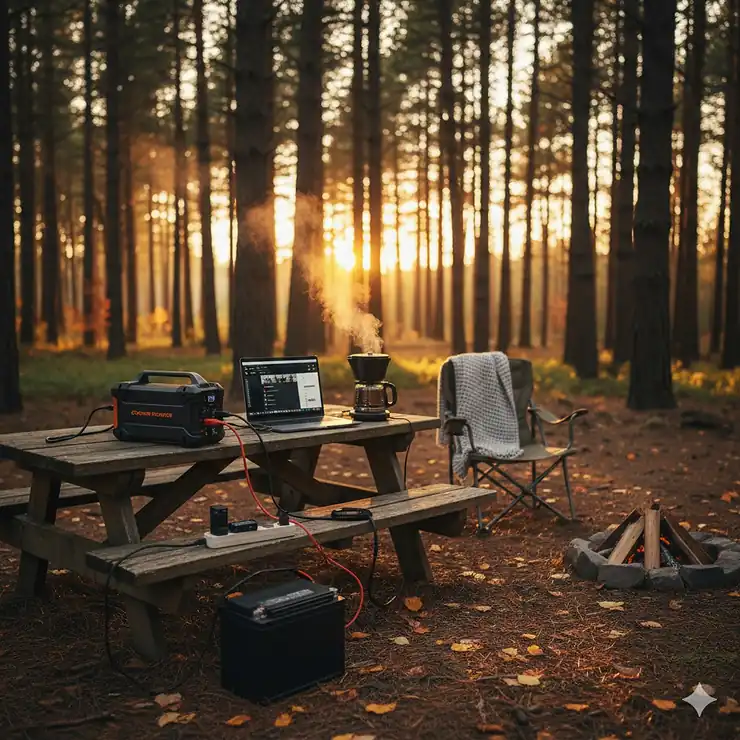
Picture this: you’re miles deep into the wilderness, the sun’s setting over pine trees, and your phone battery is at 5%. Or maybe you want to brew that morning coffee without building a fire. This is where a camping power inverter guide becomes your best friend.
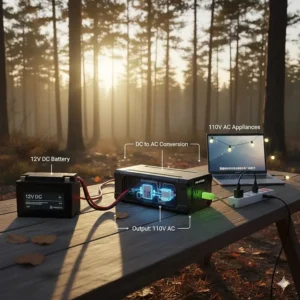
A camping power inverter transforms your vehicle’s 12-volt DC power into standard 110-volt AC electricity, letting you run laptops, charge cameras, power small appliances, and keep essential medical devices like CPAP machines running during outdoor adventures. These compact powerhouses have evolved dramatically since 2020, with improved efficiency, quieter operation, and smarter protection systems that prevent damage to both your devices and your vehicle’s electrical system.
Whether you’re a weekend warrior hitting state parks or a full-time RVer exploring cross-country routes, choosing the right 12v to 110v inverter camping setup can mean the difference between digital convenience and complete disconnection. Modern pure sine wave inverters deliver clean power comparable to your home outlets, while modified sine wave alternatives offer budget-friendly options for basic needs. Understanding wattage capacity inverter requirements, overload protection features, and the pure sine wave versus modified sine wave debate will help you make an informed decision that matches your specific camping style and power needs.
Quick Comparison Table 📊
| Product | Wattage | Wave Type | Price Range | Best For |
|---|---|---|---|---|
| BESTEK 300W Pure Sine Wave | 300W / 700W Peak | Pure Sine Wave | $50-$70 | Phones, laptops, small devices |
| Energizer 500W Modified Sine | 500W / 1000W Peak | Modified Sine Wave | $40-$60 | Budget-conscious campers |
| GIANDEL 600W Pure Sine | 600W / 1200W Peak | Pure Sine Wave | $85-$100 | Small appliances, electronics |
| Renogy 1000W Pure Sine | 1000W / 2000W Peak | Pure Sine Wave | $180-$220 | Mid-range camping needs |
| EDECOA 1500W Pure Sine | 1500W / 3000W Peak | Pure Sine Wave | $150-$200 | Coffee makers, power tools |
| Ampeak 2000W Modified Sine | 2000W / 4000W Peak | Modified Sine Wave | $140-$170 | Heavy-duty applications |
| GoWISE Power 3000W Pure Sine | 3000W / 6000W Peak | Pure Sine Wave | $250-$290 | RVs, extended camping |
💬 Just one click – help others make better buying decisions too!😊
Top 7 Camping Power Inverters: Expert Analysis 🏕️
1. BESTEK 300W Pure Sine Wave Inverter – Best Compact Option
The BESTEK 300W stands out as America’s leading compact car inverter camping solution, perfect for travelers who need reliable power without bulk. This ultra-portable unit delivers 300 watts of continuous pure sine wave power with 700-watt peak capacity.
Key Specifications:
- Input: 12V DC (11-17V compatible, including Tesla Model Y)
- Output: 110V AC pure sine wave
- Ports: 2 AC outlets + 2 USB ports (4.8A total)
- Dimensions: 4.5″ x 3.1″ x 1.9″ (iPhone-sized)
Customers praise its aluminum housing that withstands drops and bumps while maintaining efficient heat dissipation through smart cooling fans. The ETL certification under UL 458 standard ensures safety with built-in 40-amp fuses protecting against overheating, voltage fluctuations, and short circuits.
Pros:
✅ Extremely portable and lightweight (1.1 lbs)
✅ Tesla-compatible voltage range (11-17V)
✅ 5-year manufacturer warranty
Cons:
❌ Limited to 300W (not suitable for high-power devices)
❌ Cigarette lighter limited to 150W max
Price: $50-$70 | Ideal for: Solo campers, smartphone/laptop charging
2. Energizer 500W Power Inverter – Best Budget Choice
The Energizer 500W offers exceptional value for campers seeking reliable modified sine wave performance without premium pricing. This UL-certified unit provides 500 watts continuous with 1000-watt peak surge capability.
Key Specifications:
- Continuous Power: 500W / 1000W peak
- Wave Type: Modified Sine Wave
- USB Ports: 4 x 2.4A (48W/9.6A total)
- AC Outlets: 2 standard 120V
This modified sine wave inverter works excellently for resistive loads like lights, fans, phone chargers, and small TVs. The ultra-silent thermal fan activates only when needed, keeping noise levels minimal during operation. MET approved under UL STD 458 and CSA C22.2 standards.
Pros:
✅ Affordable price point
✅ Six total charging ports (4 USB + 2 AC)
✅ Ultra-quiet operation
Cons:
❌ Modified sine wave (not ideal for sensitive electronics)
❌ Some durability concerns after extended use
Price: $40-$60 | Ideal for: Budget campers, basic power needs
3. GIANDEL 600W Pure Sine Wave Inverter – Best Mid-Range Value
The GIANDEL 600W delivers professional-grade pure sine wave camping power with excellent build quality and comprehensive protection systems. ETL listed under UL458 standard, this inverter has served campers reliably for over 20 years.
Key Specifications:
- Continuous: 600W / Peak: 1200W
- Wave: Pure Sine Wave (<3% THD)
- Efficiency: 90% maximum
- Remote: 15-foot wired remote control
GIANDEL’s pure sine wave technology produces clean power identical to grid electricity, protecting sensitive electronics like laptops, CPAP machines, and audio equipment. The aluminum alloy housing provides rugged durability while integrated cooling fans maintain optimal temperature. Features isolated input/output design with low interference technology.
Pros:
✅ Clean pure sine wave output
✅ 15-foot remote control included
✅ 18-month warranty
Cons:
❌ Cannot power refrigerators (high startup draw)
❌ Remote control LED lights are overly bright
Price: $85-$100 | Ideal for: Weekend campers, sensitive electronics
4. Renogy 1000W Pure Sine Wave Inverter – Best Overall Performance
The Renogy 1000W represents the sweet spot for serious campers who demand both power and reliability. This inverter provides 1000 watts continuous with 2000-watt peak surge and over 90% conversion efficiency.
Key Specifications:
- Power: 1000W continuous / 2000W surge
- Voltage: 12V DC to 120V AC
- Ports: 2 AC outlets + 1 USB (5V/2.1A) + AC terminal block
- Certifications: UL 458 & CSA C22.2 No. 107.1
Renogy’s advanced pure sine wave technology delivers grid-quality power with minimal harmonic distortion, running appliances smoother, cooler, and quieter. The ECO Mode automatically enters standby when output drops below 50W, conserving battery power. Dual high-speed cooling fans provide almost silent heat dissipation.
Pros:
✅ Excellent conversion efficiency (>90%)
✅ ECO power-saving mode
✅ Compatible with Renogy BT-2 for app monitoring
Cons:
❌ No expandable battery option
❌ Requires proper 80% discharge depth battery
Price: $180-$220 | Ideal for: Extended camping, RV enthusiasts
5. EDECOA 1500W Pure Sine Wave Inverter – Best for Power Tools
The EDECOA 1500W tackles demanding applications with 1500 watts continuous and 3000-watt peak capacity, making it ideal for campers who need to run power tools, coffee makers, or multiple devices simultaneously.
Key Specifications:
- Power: 1500W / 3000W peak
- Waveform: Pure Sine Wave (90% efficiency)
- Display: LCD with voltage/power/current monitoring
- Protection: 5-layer safety system
This inverter features SPWM (Sinusoidal Pulse Width Modulation) chips and MOSFET technology reducing interruption and maintaining stable 90% inversion efficiency. The LCD display shows real-time operating data including voltage, power, and current draw. Galvanized isolation between input and output ensures safety.
Pros:
✅ High wattage for demanding applications
✅ LCD display for monitoring
✅ Remote control with 15ft cable
Cons:
❌ Mixed reliability reviews
❌ Some units fail within 2 years
Price: $150-$200 | Ideal for: Work camping, power tool users
6. Ampeak 2000W Power Inverter – Best Heavy-Duty Option
The Ampeak 2000W dominates when you need serious power for extended off-grid adventures. With 2000 watts continuous and 4000-watt peak surge, this modified sine wave powerhouse handles refrigerators, microwaves, and multiple devices concurrently.
Key Specifications:
- Power: 2000W continuous / 4000W peak
- Efficiency: 89% (industry-leading for modified sine)
- Outlets: 3 AC + 2 USB (3.1A each)
- Protection: 17 safety protections
Ampeak’s 89% conversion efficiency outperforms competitors offering only 70-75%, saving energy and prolonging device life. The LCD display shows voltage, power, and current, while the smart cooling fan uses noise-reduction technology operating at just 52 decibels. Seventeen protection systems including reverse polarity, overload, over/under voltage, and temperature safeguards.
Pros:
✅ Industry-leading 89% efficiency
✅ 17 comprehensive protections
✅ Quiet operation (52dB)
Cons:
❌ Modified sine wave (not for all electronics)
❌ Requires 200AH battery for optimal performance
Price: $140-$170 | Ideal for: Full-time RVers, heavy power users
7. GoWISE Power 3000W Pure Sine Wave Inverter – Best for Extended RV Living
The GoWISE Power 3000W delivers maximum capability for serious campers and RV enthusiasts requiring consistent high-wattage power. This pure sine wave beast provides 3000 watts continuous with 6000-watt surge capacity.
Key Specifications:
- Power: 3000W / 6000W peak
- Wave: Pure Sine Wave (<3% THD)
- Display: Dual-color LCD with AC/DC gauges
- Remote: 15-foot ON/OFF switch cable
GoWISE inverters employ advanced soft-start technology with low interference and temperature-controlled cooling. The dual-color LCD message center displays both AC power output and battery DC input with color-coded alerts. Six protection systems guard against over/under voltage, reverse polarity, short-circuit, overload, and over-temperature.
Pros:
✅ Massive 3000W capacity
✅ Dual-color LCD display
✅ Hardwire terminal option
Cons:
❌ Heavy and bulky
❌ Requires professional installation for hardwire
Price: $250-$290 | Ideal for: Full-time RVers, permanent installations
What is Camping Power Inverter Guide? 🔌
A camping power inverter guide is your comprehensive resource for understanding and selecting DC to AC power converters designed specifically for outdoor adventures and mobile living. At its core, a power inverter is an electronic device that transforms the 12-volt direct current (DC) electricity from your vehicle’s battery or solar panels into standard 110-volt alternating current (AC) power that runs household appliances and electronics.
According to Penn State’s Utility Solar Electric course, inverters work through electromagnetic induction, rapidly switching DC input to create an alternating magnetic field that generates AC output. Modern camping inverters use sophisticated electronic components like MOSFETs and IGBTs controlled by microprocessors to produce either pure sine wave or modified sine wave electricity.
The camping power inverter guide helps you navigate critical decisions: understanding pure sine wave versus modified sine wave differences, calculating your wattage capacity inverter requirements, identifying necessary overload protection features, and matching inverter capabilities to your specific camping scenarios—whether that’s weekend tent camping, van life adventures, or full-time RV living.
How to Choose the Right Camping Power Inverter 📋
Step 1: Calculate Your Total Wattage Needs
Start by listing every device you’ll power and add their wattage ratings (found on labels or manuals). Remember that motors, compressors, and tools require 2-3x their running wattage for startup surge. For example, a 700W microwave might need 1400W peak power. Your inverter’s continuous rating should exceed total running watts, while peak rating must handle the highest startup surge.
Step 2: Decide Between Pure Sine Wave and Modified Sine Wave
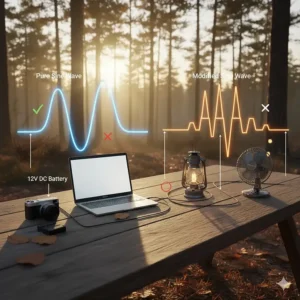
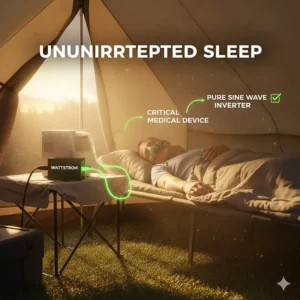
Pure sine wave inverters produce electricity identical to your home outlets, making them essential for sensitive electronics like laptops, CPAP machines, medical equipment, variable-speed tools, and audio systems. Modified sine wave inverters cost less but produce choppy waveforms acceptable only for simple resistive loads like lights, fans, and basic chargers. As The Engineering Mindset explains, pure sine wave ensures appliances run cooler, quieter, and last longer.
Step 3: Match Inverter Size to Battery Capacity
Your battery must supply enough amp-hours to run your inverter. Use this formula: Battery Ah needed = (Inverter Watts × Hours of Use) ÷ (Battery Voltage × 0.85). For a 1000W inverter running 5 hours on a 12V battery: (1000 × 5) ÷ (12 × 0.85) = 490 Ah minimum. Most campers use deep-cycle batteries rated for 80% discharge depth.
Step 4: Verify Protection Features
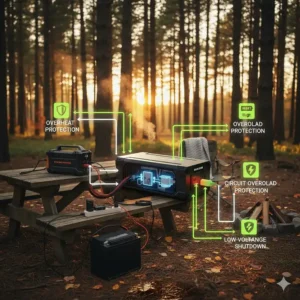
Quality car inverter camping units include multiple safety systems. Look for overload protection (automatic shutdown when exceeding wattage), over/under voltage protection (guards against battery damage), short-circuit protection (prevents fires), over-temperature protection (thermal sensors trigger cooling or shutdown), and reverse polarity protection (saves the inverter if cables connect incorrectly).
Step 5: Consider Installation and Portability
Smaller inverters (under 400W) plug directly into cigarette lighter sockets. Mid-range units (400-1500W) require battery cable connections with appropriate gauge wire. Large inverters (1500W+) often need professional hardwire installation. Consider where you’ll mount the inverter—good ventilation is critical, and proximity to batteries reduces voltage drop.
Step 6: Evaluate Additional Features
Modern camping inverters offer remote controls (convenient for hard-to-reach installations), LCD displays (show voltage, wattage, errors), USB charging ports (eliminate adapter need), ECO modes (automatic standby conserving battery), and cooling fans (temperature-controlled for quiet operation). Prioritize features matching your actual usage patterns.
Step 7: Check Certifications and Warranty
Always choose UL 458 or ETL certified inverters meeting North American safety standards. Quality brands offer 1-3 year warranties minimum. Read customer reviews focusing on real-world camping experiences, long-term reliability, and manufacturer support responsiveness.
Pure Sine Wave vs Modified Sine Wave: Making the Right Choice ⚡
The battle between pure sine wave inverter and modified sine wave technology represents one of the most critical decisions in your camping power inverter guide journey.
Understanding the Waveform Difference
Pure sine wave inverters produce smooth, curved AC waveforms identical to utility grid power, with total harmonic distortion (THD) under 3%. This clean electricity flows smoothly like waves on a calm ocean. Modified sine wave inverters generate stepped, blocky waveforms that approximate AC power through rapid on-off switching, creating a stair-step pattern rather than smooth curves.
Device Compatibility Breakdown
Requires Pure Sine Wave:
- Laptop computers and tablets
- CPAP and medical equipment
- Variable-speed power tools
- Laser printers
- Audio equipment and speakers
- Microwave ovens
- Refrigerators with digital controls
Works with Modified Sine Wave:
- LED/incandescent lights
- Phone chargers
- Coffee makers (basic models)
- Electric kettles
- Fans and heaters
- Power tools (fixed-speed)
Performance and Efficiency Impacts
Pure sine wave camping inverters operate appliances 15-20% more efficiently, reducing heat generation and noise while extending equipment lifespan. Motors run cooler and quieter, digital clocks keep accurate time, and sensitive electronics experience zero interference. Modified sine wave units cause some devices to buzz, may shorten motor life by 20%, and reduce overall conversion efficiency by 10-15%.
Price Considerations
Modified sine wave inverters cost 30-50% less than pure sine wave equivalents at the same wattage. A 1000W modified unit runs $80-$120, while pure sine wave versions cost $150-$220. However, the price gap has narrowed considerably since 2020 as manufacturing improves, making pure sine wave increasingly accessible for serious campers.
Key Features to Look for in Camping Inverters 🔍
Wattage Capacity Inverter Ratings
Understanding continuous versus peak wattage proves crucial. Continuous wattage represents steady power output—this number must exceed your typical combined load. Peak or surge wattage handles brief power spikes when motors, compressors, or tools start up, typically lasting 1-3 seconds. Quality inverters offer peak ratings 2-3x continuous capacity.
Overload Protection Systems
Modern 12v to 110v inverter camping units employ intelligent overload protection that automatically shuts down when demand exceeds capacity, preventing damage to both the inverter and connected devices. Better models provide audible alerts and visual indicators (flashing lights or LCD warnings) before shutdown, giving you time to reduce load. After overload events, simple power cycling usually resets the system.
Cooling and Heat Management
Inverters generate substantial heat during operation—efficient thermal management determines reliability and lifespan. Temperature-controlled smart fans activate only when internal sensors detect rising heat (typically above 113°F/45°C), reducing noise during light loads while ensuring cooling during heavy use. Premium units feature aluminum alloy housings with strategic ventilation and heat sinks maximizing passive cooling.
Battery Protection Features
Low voltage disconnect prevents deep discharge damage to batteries, automatically shutting down when voltage drops to dangerous levels (typically 9.5-10V for 12V systems). High voltage protection guards against alternator surges or charging errors exceeding safe limits (usually 15.5-16V). These safeguards prove essential for battery longevity.
Display and Monitoring Options
LCD or LED displays show real-time data: input voltage (battery health indicator), output wattage (current load), fault codes (diagnostic information), and sometimes temperature readings. This monitoring helps prevent problems before they occur and aids troubleshooting when issues arise.
USB Charging Integration
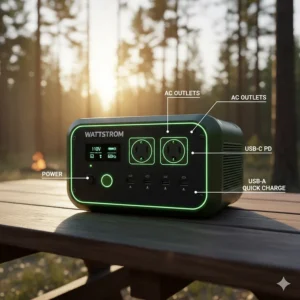
Built-in USB ports eliminate adapter clutter, typically offering 2.1-2.4A per port supporting fast-charging protocols. Higher-end models include USB-C Power Delivery (PD) ports delivering 18-65W for laptops and tablets, plus Quick Charge 3.0 for compatible smartphones. This integration simplifies camping setups significantly.
Wattage Requirements for Common Camping Devices 📱
Understanding your power needs prevents buying an oversized (expensive) or undersized (frustrating) inverter.
Low Power Devices (Under 100W)
- Smartphone charging: 5-20W
- LED camping lights: 10-30W
- Laptop computers: 45-90W
- Tablet charging: 10-30W
- Small fans: 20-75W
- Electric toothbrush: 2-5W
Medium Power Devices (100-500W)
- CPAP machines: 30-60W (plus 100W for heated humidifier)
- 32″ LED TV: 50-100W
- DVD player: 15-25W
- Small coffee maker: 400-800W (startup)
- Electric kettle: 1000-1500W
- Hair dryer (travel): 300-1000W
High Power Devices (500W+)
- Full-size coffee maker: 800-1200W
- Microwave (compact): 600-1000W
- Portable refrigerator: 50-100W running (300-500W startup)
- Power drill: 300-900W
- Circular saw: 1200-1800W
- Electric griddle: 1000-1500W
- Air compressor: 1500-2000W (startup)
Pro Tip: Always check the nameplate on your specific devices. Inductive loads (motors, compressors) require 2-3× running wattage for startup surge. Calculate total load by adding all devices you might run simultaneously, then multiply by 1.25 for safety margin.
Installation and Safety Tips for Camping Inverters ⚠️
Proper Battery Connection
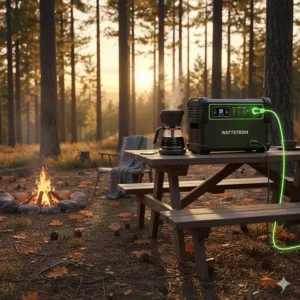
Never connect inverters exceeding 400W through cigarette lighter sockets—they’re rated only 120-180W maximum. Use heavy-duty battery cables with appropriate gauge: 4 AWG for 1000-1500W, 2 AWG for 1500-2500W, 1/0 AWG for 2500W+. Keep cable runs under 3 feet when possible to minimize voltage drop.
Mounting Location Considerations
Install inverters in well-ventilated spaces away from moisture, heat sources, and flammable materials. Maintain 4 inches clearance on all ventilated sides. Avoid mounting upside-down or sideways unless manufacturer specifies otherwise. Never operate inverters in sealed compartments or near batteries emitting hydrogen gas.
Grounding and Circuit Protection
Always connect the inverter ground terminal to vehicle chassis or proper earth ground. Install inline fuses or circuit breakers on the positive cable—fuse rating should match inverter specifications (typically 150-400A depending on wattage). Place fuses within 7 inches of the battery to protect the entire cable run.
Ventilation Requirements
Operating temperatures typically range 32°F to 104°F (0°C to 40°C), but inverters perform best below 85°F. Ensure adequate airflow—inverters running at high loads generate significant heat. Never cover ventilation openings with blankets, clothing, or camping gear.
Common Installation Mistakes to Avoid
Don’t reverse polarity (red to negative, black to positive)—while most inverters have reverse polarity protection, you’ll blow fuses. Don’t operate inverters with vehicle engines off for extended periods without monitoring battery voltage—you risk being unable to start your vehicle. Don’t connect AC and DC power simultaneously on inverter/charger combo units—this can damage the device.
Regular Maintenance Checks
Inspect battery cable connections monthly for corrosion, looseness, or damage. Clean terminals with baking soda solution if corrosion appears. Check fuses periodically. Listen for unusual fan noises indicating bearing wear. Store inverters in cool, dry locations when not in use.
Best Camping Inverter Applications: Real-World Scenarios 🏕️
Weekend Tent Camping
A 300-600W pure sine wave inverter handles phone/laptop charging, LED lights, small portable fans, and electric air pump for inflatable mattresses. Mount compact units like the BESTEK 300W near your vehicle’s rear cargo area for easy access. Budget-conscious campers can choose modified sine wave for basic charging needs.
Van Life and Road Tripping
Mid-range 1000-1500W inverters support extended travel needs including laptops for remote work, CPAP machines, electric coolers, instant pots, and USB device charging for multiple occupants. The Renogy 1000W or EDECOA 1500W offer excellent balance of power and portability for van installations.
Full-Time RV Living
Serious RVers require 2000-3000W inverters managing refrigerators, microwaves, TVs, and simultaneous device charging. The GoWISE Power 3000W handles residential-style power demands. Consider professional hardwire installation integrating with RV electrical systems and automatic transfer switches.
Off-Grid Solar Camping
Pair inverters with solar panel systems and deep-cycle battery banks for truly independent power. Pure sine wave inverters prove essential for efficient solar system integration. Calculate daily watt-hours needed, then size batteries and solar panels accordingly—inverter efficiency matters more in solar applications.
Emergency Preparedness
Keep a reliable car inverter camping unit in your vehicle year-round for roadside emergencies, power outages, or disaster situations. The 500-1000W range balances portability with capability, running essentials like phone chargers, radios, medical devices, and small appliances during crises.
Work Camping and Job Sites
Power tools demand pure sine wave inverters with sufficient surge capacity. Circular saws, drills, and compressors create massive startup loads—the Ampeak 2000W or EDECOA 1500W handle demanding work applications while the LCD display monitors power draw preventing overloads.
Troubleshooting Common Inverter Problems 🔧
Inverter Won’t Turn On
Possible Causes:
- Low battery voltage (below 10.5V)
- Blown fuses or tripped breakers
- Loose cable connections
- Faulty on/off switch
Solutions: Charge battery fully, inspect and replace fuses, tighten all connections with proper torque, test switch continuity with multimeter.
Frequent Overload Shutdowns
Possible Causes:
- Combined device wattage exceeds inverter capacity
- Inductive loads creating excessive startup surge
- Worn cables increasing resistance
- Inverter operating above temperature limits
Solutions: Reduce simultaneous loads, sequence device startups (don’t start multiple motors together), upgrade to heavier gauge cables, improve ventilation around inverter.
Poor AC Voltage Output
Possible Causes:
- Battery voltage drop under load
- Excessive cable length creating voltage loss
- Weak battery unable to supply required current
- Inverter component degradation
Solutions: Use shorter, heavier cables (reduce voltage drop), test battery capacity and replace if below 80%, ensure battery connections are clean and tight.
Audible Buzzing or Humming
Possible Causes:
- Modified sine wave incompatibility (especially with audio equipment)
- Loose internal components
- Fan bearing wear
- Transformer saturation
Solutions: Switch to pure sine wave inverter for sensitive equipment, have unit professionally serviced if under warranty, replace worn fans.
Inverter Runs Hot
Possible Causes:
- Operating at or near maximum capacity
- Insufficient ventilation/airflow
- High ambient temperatures
- Cooling fan malfunction
Solutions: Reduce load to 80% of rated capacity, ensure 4+ inches clearance all sides, relocate to cooler area, verify fan operation and replace if necessary.
Battery Draining Quickly
Possible Causes:
- Inverter inefficiency (especially modified sine wave under heavy load)
- Parasitic draw when inverter “off”
- Weak battery unable to hold charge
- Excessive continuous load
Solutions: Upgrade to higher-efficiency pure sine wave model, disconnect inverter when not in use, test battery health and replace if needed, reduce usage duration or add battery capacity.
Maximizing Battery Life with Your Camping Inverter 🔋
Understanding Battery Types
Deep-cycle batteries designed for discharge/recharge cycles work best with inverters, unlike starting batteries optimized for brief high-current engine cranking. AGM (Absorbed Glass Mat) batteries require zero maintenance and tolerate rough handling, perfect for camping. Lithium batteries offer superior energy density and lifespan but cost significantly more—compatible inverters must accommodate different voltage profiles.
Calculating Runtime
Battery amp-hours (Ah) determine runtime. Formula: Runtime Hours = (Battery Ah × 12V × 0.85) ÷ Inverter Load Watts. For example, a 100Ah battery powering a 500W load: (100 × 12 × 0.85) ÷ 500 = 2.04 hours. The 0.85 factor accounts for inverter efficiency and avoiding complete discharge.
Preventing Deep Discharge
Never drain lead-acid batteries below 50% capacity—doing so dramatically reduces lifespan. A 100Ah battery provides only 50Ah usable power. Quality inverters include low-voltage disconnect protection automatically shutting down around 10.5V, preventing damaging deep discharge. Lithium batteries tolerate 80% discharge safely.
Charging Best Practices
Recharge batteries promptly after use—leaving batteries partially discharged accelerates sulfation in lead-acid types. Use quality multi-stage chargers matching battery chemistry. Solar panel charging works excellently for extended trips, maintaining battery health through daily charging cycles. Never charge frozen batteries.
Temperature Considerations
Battery capacity decreases dramatically in cold weather—a battery delivering 100Ah at 77°F provides only 50Ah at 0°F. Store batteries in heated spaces when possible during winter camping. Conversely, high temperatures above 100°F accelerate battery degradation and water loss in flooded types.
Dual Battery Systems
Serious campers install dedicated auxiliary batteries isolating camping power from starting batteries, eliminating the risk of being stranded with a dead engine battery. Battery isolators or automatic charging relays (ACR) connect batteries when the engine runs while isolating during camping use.
Frequently Asked Questions ❓
❓ How long will a 12v to 110v inverter camping setup run on a car battery?
❓ Can I run a camping fridge off a pure sine wave inverter all night?
❓ What size wattage capacity inverter do I need for a CPAP machine while camping?
❓ Is modified sine wave safe for charging laptop computers during camping trips?
❓ How do I prevent overload protection shutdown when starting my camping coffee maker?
Conclusion: Finding Your Perfect Camping Power Solution 🎯
Choosing the right camping power inverter guide ultimately comes down to matching capability with your specific outdoor lifestyle. Weekend warriors making quick trips to nearby campgrounds thrive with compact 300-600W pure sine wave units like the BESTEK 300W or GIANDEL 600W—offering sufficient power for phones, laptops, and basic comforts without breaking budgets or taking valuable cargo space.
Van lifers and extended adventurers require the middle ground that 1000-1500W inverters provide. The Renogy 1000W stands out with its exceptional efficiency and ECO mode, while the EDECOA 1500W tackles more demanding loads including power tools and kitchen appliances. These mid-range options balance portability with serious capability, supporting work-from-road lifestyles and creature comforts that make extended trips enjoyable.
Full-time RVers and serious off-grid enthusiasts need robust 2000-3000W solutions managing residential-style power demands. The Ampeak 2000W delivers industry-leading efficiency in a modified sine wave package, while the GoWISE Power 3000W provides maximum pure sine wave capacity for those unwilling to compromise on power quality.
Remember that your inverter works only as well as the system supporting it. Pair quality inverters with appropriately-sized deep-cycle batteries, use proper gauge cables minimizing voltage drop, ensure adequate ventilation preventing thermal shutdowns, and leverage solar charging for sustainable long-term power. Understanding the pure sine wave versus modified sine wave debate, calculating wattage capacity inverter requirements accurately, and utilizing overload protection features properly transforms camping from roughing it into comfortable adventure.
The 2026 camping season awaits—equipped with the right 12v to 110v inverter camping setup, you’ll enjoy modern conveniences anywhere your wheels take you, whether that’s remote national forests, beachside state parks, or cross-country highway adventures exploring this incredible country.
Recommended for You 📚
- 7 Best Coleman LED Lantern Review 2026
- 7 Brightest Headlamps for Camping 2026 | Expert Tested
- Jackery vs Goal Zero Camping: 7 Best Solar Generators 2026
Disclaimer: This article contains affiliate links. If you purchase products through these links, we may earn a small commission at no additional cost to you.
✨ Found this helpful? Share it with your friends! 💬🤗
