In This Article
A dutch oven for camping is basically a thick-walled, heavy-lidded pot built to sit directly in coals or on a grate and turn a campfire into something closer to a real kitchen. In practice, that means bread that actually rises, chili that doesn’t scorch on one side, and a cobbler that comes out with a crisp top instead of a soggy mess. If you’ve ever eaten a sad foil-packet dinner while your neighbor’s campsite smelled like a Sunday roast, you already know why this piece of cookware has a cult following.

Choosing the right one, though, is where things get messy. Walk into any outdoor store — or scroll Amazon for ten minutes — and you’ll find a pile of cast iron pots that all look basically the same, priced anywhere from $35 to $150, with vague marketing copy that tells you nothing about how they actually cook. Some are genuinely built for campfire abuse. Others are kitchen dutch ovens wearing a costume, and they’ll warp, crack, or wobble the first time you set them on uneven coals.
This guide walks through seven real, currently available options — cast iron and cast aluminum, budget and premium — with honest analysis based on their actual specs and the aggregated sentiment from real buyer reviews. According to Wikipedia’s overview of dutch oven history and design, the “camp” style with three legs and a flanged, coal-holding lid has roots stretching back centuries, which is a good reminder that this isn’t a gimmick category — it’s a genuinely proven cooking method. We’ll also cover coal placement, leg height, seasoning, and the buying mistakes that trip up first-timers, so you walk away with a dutch oven for camping that actually earns its spot in your gear box.
Quick Comparison Table
| Product | Type | Capacity | Best For |
|---|---|---|---|
| Lodge Cast Iron Camp Dutch Oven | Cast iron | 6 qt | Best all-around pick |
| Camp Chef Classic 12″ Dutch Oven | Cast iron | 6 qt | Thermometer notch & coal control |
| Lodge Deep Camp Dutch Oven | Cast iron | 8 qt | Big groups & families |
| Overmont Cast Iron Camp Dutch Oven | Cast iron | 6 qt | Budget starter kit |
| GSI Outdoors Hard Anodized Dutch Oven | Cast aluminum | ~5 qt (12″) | Lightweight & rust-proof |
| Lodge Cast Iron Double Dutch Oven | Cast iron | 5 qt | 2-in-1 pot and skillet |
| Camp Chef Deluxe 12″ Dutch Oven (DO-12) | Cast iron | 9.33 qt | Premium versatility |
Looking at this lineup, the split between cast iron and cast aluminum matters more than the price tags suggest — the GSI Outdoors Hard Anodized Dutch Oven trades some heat retention for roughly a third of the weight, which is a real trade-off, not just a marketing line. Among the cast iron options, capacity is the biggest differentiator: the Overmont Cast Iron Camp Dutch Oven and Lodge Cast Iron Camp Dutch Oven suit two-to-four people, while the Lodge Deep Camp Dutch Oven and Camp Chef Deluxe 12″ Dutch Oven are built for six-plus. If you’re torn between similar-looking pots, the deciding factor usually comes down to how many mouths you’re feeding and how far you have to carry it.
Found a favorite already? Tap its name above to check the current price before it’s gone.
Top 7 Dutch Ovens for Camping: Expert Analysis
Every camp oven review on the internet seems to recycle the same five sentences about “even heat distribution,” so let’s skip that and get into what actually separates these seven pots when they’re sitting in real coals.
1. Lodge Cast Iron Camp Dutch Oven — best all-around 6-quart pick
The Lodge Cast Iron Camp Dutch Oven is the pot most camp oven review roundups default to, and for good reason — it nails the basics without asking you to compromise on anything major. Made in the USA and pre-seasoned at the factory, it arrives ready to cook, with three short legs that hold it steady over uneven coal beds and a flanged lid rim that keeps briquettes from rolling off. Based on the spec comparison across this list, the 6-quart size hits a sweet spot: big enough for a family-sized chili or a loaf of no-knead bread, small enough that one adult can still carry it from truck to fire pit without a second trip.
Reviewers consistently report that the factory seasoning holds up well after the first few cooks, though several note that a home reseasoning in the first month noticeably improves the non-stick surface. This is the dutch oven for camping most beginners should start with — it’s forgiving, widely available, and the accessory ecosystem (lid lifters, carry bags, trivets) is enormous because so many campers already own one.
Pros:
- ✅ Pre-seasoned and ready to cook out of the box
- ✅ Three-leg design stays stable on uneven coals
- ✅ Massive accessory and replacement-part ecosystem
Cons:
- ❌ Heavier than aluminum alternatives at a similar size
- ❌ Factory seasoning benefits from an early home touch-up
At a price typically in the $50-$70 range, the Lodge Cast Iron Camp Dutch Oven delivers strong value for a first cast iron dutch oven camping purchase, and check current price before buying since cast iron cookware pricing shifts with material costs.

2. Camp Chef Classic 12″ Dutch Oven — built-in thermometer notch
The Camp Chef Classic 12″ Dutch Oven stands out the moment you notice the small notch carved into the lid — a built-in thermometer channel that lets you check internal temperature without breaking the coal seal. That’s a small design choice with a real practical payoff: peeking under the lid every ten minutes to check on a loaf of bread drops the temperature and adds cooking time, so a notch that avoids that is genuinely useful. At 6 quarts and a 12-inch diameter, the Camp Chef Classic 12″ Dutch Oven matches the Lodge on capacity but adds a flanged lid rated to hold a specific coal count, plus a wire bail handle designed for lifting the whole pot with a single hook rather than two hot handles.
What most buyers overlook about this model is that the flanged lid also flips to work as a rough griddle surface, which extends its usefulness for breakfast cooking beyond what the spec sheet advertises. Aggregated reviewer sentiment points to strong satisfaction with build quality, with the most common complaint being that the pre-seasoning layer is thinner than Lodge’s and needs a couple of extra seasoning cycles before food stops sticking.
Pros:
- ✅ Built-in thermometer notch for lid-on temperature checks
- ✅ Flanged lid holds a measured coal count evenly
- ✅ Wire bail handle simplifies single-hand lifting
Cons:
- ❌ Thinner factory seasoning than some competitors
- ❌ No skillet-lid versatility like the Camp Chef Deluxe
Expect a price in the $60-$85 range for the Camp Chef Classic 12″ Dutch Oven, and given the thermometer notch alone, it’s a strong value for anyone who bakes bread or biscuits over coals regularly.
3. Lodge Deep Camp Dutch Oven — best for big groups, 8 quarts
When four people turns into eight, the Lodge Deep Camp Dutch Oven is the one that keeps up. At 8 quarts, it holds nearly 50% more volume than the standard 6-quart Lodge, which in real terms means a full pot roast with vegetables instead of a roast that barely fits with no room for sides. Here’s what the spec sheet won’t tell you, but reviewers note: that extra depth also means more thermal mass, so it takes noticeably longer to come up to baking temperature — plan on an extra 5-10 minutes of coal time compared to the 6-quart version.
The dual handles plus a reinforced steel bail make it manageable for two people to move when it’s full, which matters because an 8-quart dutch oven loaded with stew is genuinely heavy. This is squarely a Lodge dutch oven camping pick for family reunions, scout troops, and multi-night group trips rather than solo or couple’s camping, where its size becomes dead weight to haul.
Pros:
- ✅ Nearly 50% more capacity than standard 6-quart models
- ✅ Dual handles plus steel bail ease two-person lifting
- ✅ Flanged lid design matches Lodge’s proven coal-holding shape
Cons:
- ❌ Longer preheat time due to added thermal mass
- ❌ Overkill weight and size for solo or couples’ trips
The Lodge Deep Camp Dutch Oven typically runs in the $85-$110 range — pricier than the standard size, but reasonable given the capacity jump for group cooking.
4. Overmont Cast Iron Camp Dutch Oven — budget kit with lid lifter included
The Overmont Cast Iron Camp Dutch Oven takes a different approach to value: instead of just being cheaper, it bundles a lid lifter and legs into a kit that Lodge and Camp Chef often sell separately. At roughly 6-quart capacity, it’s sized for two to four campers and comes pre-seasoned with vegetable oil, ready for a campfire, charcoal grill, or gas stovetop. Based on the spec comparison, the core casting is comparable to the bigger legacy brands — Overmont has been producing cast iron cookware since 2013 — but it hasn’t built the multi-decade review history that Lodge has, so buyers are trading brand pedigree for a lower price point.
A common theme in aggregated reviews is that the included cookbook and starter accessories make it a popular gift pick, with a smaller number of reviewers noting the seasoning arrives thinner than expected and benefits from an immediate home reseasoning pass before first use. If your budget is the main constraint and you don’t mind doing a bit of extra seasoning work upfront, this is a genuinely capable dutch oven for camping.
Pros:
- ✅ Lid lifter and legs bundled in at a lower price
- ✅ Multi-surface use: campfire, grill, and stovetop
- ✅ Includes a cookbook aimed at camp-cooking beginners
Cons:
- ❌ Thinner factory seasoning than more established brands
- ❌ Shorter track record of long-term durability reviews
Priced generally in the $45-$65 range, the Overmont Cast Iron Camp Dutch Oven is one of the better value plays if you’re outfitting a camp kitchen from scratch on a budget.
5. GSI Outdoors Hard Anodized Dutch Oven — lightest option, about a third the weight
Every list needs the outlier, and the GSI Outdoors Hard Anodized Dutch Oven is it. Built from hard-anodized cast aluminum rather than iron, the 12-inch model weighs roughly 6 pounds versus the 10+ pounds a comparable cast iron pot carries — GSI advertises it at about a third of the weight of a traditional cast iron camp oven. Here’s the honest trade-off: aluminum conducts heat faster but holds it for a shorter window once you pull the pot off the coals, so dishes that rely on long, slow residual heat (think all-day braises) perform a bit differently than they would in cast iron.
On the upside, it never needs seasoning, won’t rust if you forget to dry it after a rainy trip, and the anodized surface is genuinely food-release-friendly according to aggregated user feedback. Reviewers who backpack or canoe camp — where every pound matters — consistently rate this as the pot that finally made dutch oven cooking feasible for their trip style, while car campers who prioritize maximum heat retention for slow cooking tend to stick with cast iron instead.
Pros:
- ✅ About one-third the weight of comparable cast iron pots
- ✅ Rust-proof and never requires seasoning
- ✅ Nests with other GSI sizes for compact storage
Cons:
- ❌ Loses heat faster once removed from direct coals
- ❌ Less ideal for very long, slow-braised recipes
The GSI Outdoors Hard Anodized Dutch Oven generally sits in the $90-$130 range depending on size, which reflects the anodizing process rather than any pricing gimmick.
6. Lodge Cast Iron Double Dutch Oven — lid doubles as a 10.25-inch skillet
The Lodge Cast Iron Double Dutch Oven solves a real packing problem: instead of hauling a separate skillet for breakfast and a pot for dinner, the lid flips over and functions as a genuine 10.25-inch skillet on its own. At 5 quarts, it’s on the smaller side of this list, which lines up with its intended use — solo campers, couples, or anyone trying to cut their cookware count in half rather than feed a crowd. Based on the spec comparison, Lodge markets this cookware as PFAS-free and built with the same even heat retention as its other camp lines, so you’re not sacrificing cooking performance for the 2-in-1 design.
What most buyers overlook is that using the lid as a skillet means you can fry eggs or bacon while the main pot simmers something else on a separate heat source, effectively doubling your cooking capacity without doubling your gear. Aggregated review sentiment is strongly positive on the pre-seasoning quality straight out of the box, with the main critique being that 5 quarts is genuinely too small for groups of five or more.
Pros:
- ✅ Lid doubles as a full 10.25-inch skillet
- ✅ Cuts overall cookware load roughly in half
- ✅ Strong out-of-box seasoning per aggregated reviews
Cons:
- ❌ 5-quart capacity is tight for larger groups
- ❌ Two-piece design is heavier than a single comparable pot
Expect a price in the $70-$95 range for the Lodge Cast Iron Double Dutch Oven — a fair premium for genuinely losing a piece of cookware from your pack list.
7. Camp Chef Deluxe 12″ Dutch Oven (DO-12) — premium 9.33-quart flagship
At the top of this lineup sits the Camp Chef Deluxe 12″ Dutch Oven, model DO-12, which combines the largest usable capacity here — 9.33 quarts — with a deep-dish lid that also works as a full-size skillet or serving trivet. That’s a meaningful upgrade over the standard flanged lid: instead of just holding coals, it flips to actually cook a second dish, similar in concept to the Lodge Double Dutch Oven but scaled up for bigger groups. The built-in thermometer channel carries over from Camp Chef’s design language, letting you monitor internal temperature without lifting the lid and losing heat.
Here’s what the spec sheet won’t tell you, but reviewers note: a 9.33-quart cast iron pot with its lid is genuinely heavy — figure well over 20 pounds fully assembled — so this is a car-camping and base-camp tool, not something you’re packing into the backcountry. Reviewers consistently point to it as the pick for cabin trips, extended base camps, and cooking for eight or more, where the added capacity and skillet-lid versatility pay off every single meal.
Pros:
- ✅ Largest capacity on this list at 9.33 quarts
- ✅ Deep-dish lid doubles as a skillet or serving trivet
- ✅ Built-in thermometer channel for lid-on monitoring
Cons:
- ❌ Heavy enough that it’s car-camping only
- ❌ Premium price compared to standard-size cast iron
The Camp Chef Deluxe 12″ Dutch Oven generally lands in the $110-$150 range, positioning it as the splurge pick for anyone who cooks for a crowd on a regular basis.
Practical Usage Guide: Seasoning, Lid Coal Placement, and Your First 30 Days
Buying any cast iron dutch oven camping setup is the easy part — the first month of actually using it is where most people either fall in love with the process or give up and let it rust in the garage. Start with seasoning cast iron properly before the first cook, even on pre-seasoned models: rub a thin layer of high-smoke-point oil (avocado or refined vegetable oil work well) across every surface, wipe off the excess until the pot looks almost dry, then bake it upside down at around 450°F for an hour. Thin, repeated layers build a better non-stick surface than one thick coat, which tends to go gummy.
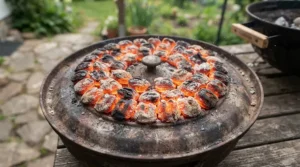
Once you’re at the fire, lid coal placement is the single skill that determines whether your food bakes evenly or burns on one side. As a rough starting formula that several experienced camp cooks converge on: for a 12-inch dutch oven baking at roughly 350°F, place about 16-17 coals on top of the flanged lid and 7-8 underneath, adjusting the ratio up or down depending on whether you’re baking (more heat on top) or simmering (more heat underneath). Wind and altitude both shift these numbers, so treat it as a starting point rather than gospel — the National Park Service’s guide to cooking in camp is a solid resource for broader campsite food-prep and cleanup practices worth pairing with your coal routine. Common first-month mistakes include using too few coals and assuming the pot is broken, cleaning with soap that strips the seasoning, and storing the lid tightly sealed while damp, which invites rust.
Real Campsite Scenarios: Which Dutch Oven Fits Your Trip
Picture three different campers standing in front of this list. The first is a couple doing weekend car camping trips a few times a season, cooking for two with the occasional guest — they’re best served by the Lodge Cast Iron Double Dutch Oven, since the skillet-lid combo means less gear for exactly the meal sizes they cook. The second is a family of five doing a week-long summer trip with grandparents joining on weekends — that’s the Lodge Deep Camp Dutch Oven or Camp Chef Deluxe 12″ Dutch Oven territory, where the extra capacity absorbs unpredictable headcounts without anyone going hungry. The third is a backpacker or canoe camper counting every ounce, planning one hearty one-pot meal a night after miles of paddling — for them, the GSI Outdoors Hard Anodized Dutch Oven is the only realistic choice on this list, since cast iron’s weight simply doesn’t belong in a canoe pack or backpacking loadout. Matching the pot to the trip, not just the price tag, is what actually determines whether it gets used or left behind.
Common Problems and Fixes for Camp Dutch Oven Cooking
Even a great dutch oven for camping runs into predictable snags. Food sticking despite “pre-seasoned” claims is the most common complaint across camp oven review sites, and the fix is almost always more use plus a couple of deliberate reseasoning cycles in the first month rather than a defective pot. Uneven baking, where one side is done and the other is raw, usually traces back to wind pushing heat to one side of the coals — rotating the lid a quarter turn and the pot itself a quarter turn (in opposite directions) every 15-20 minutes solves this in most cases. Rust spots after a rainy trip mean the pot was packed away before it was fully dry; scrub the spot with a stiff brush, re-oil, and re-bake it before its next use. Finally, a wobbly pot on uneven ground is often a leg-height mismatch rather than a bad casting — digging a slightly recessed spot for the shorter leg, or shifting to a bed of leveled coals, usually fixes it without needing a new pot.
How to Choose a Dutch Oven for Camping: 7 Criteria
- Material — cast iron holds heat longer for slow cooks; cast aluminum saves significant pack weight but loses heat faster once off the coals.
- Capacity — match quarts to headcount: 4-6 quarts for one to four people, 8-plus quarts for groups of six or more.
- Leg height — legs typically run 1.5-2.5 inches tall; taller legs give more airflow under the pot for coal-heavy baking, shorter legs sit lower for a more compact grill setup.
- Lid design — a flanged (raised-rim) lid is what actually holds coals on top; a flat lid without a rim can’t do this safely.
- Handle style — a wire bail handle allows one-hook lifting with a lid lifter tool, which matters more than it sounds once the pot is scorching hot.
- Pre-seasoning quality — thicker factory seasoning means less prep work before your first meal, based on aggregated reviewer feedback across brands.
- Portability — weight and whether it nests with other cookware matters enormously for backpackers and canoe campers, and far less for car campers.
A common mistake buyers make here is choosing based on price alone and ending up with a dutch oven for camping that’s either too heavy for how they actually camp or too small for how they actually cook — reading a few real camp oven review breakdowns before buying, rather than just the star rating, tends to catch this early.
Cast Iron Dutch Oven Camping vs Aluminum Camp Ovens
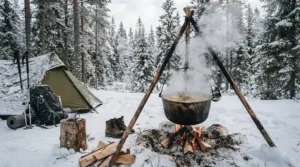
The cast iron versus aluminum debate isn’t really about which material is “better” — it’s about which trade-off matches your camping style. A cast iron dutch oven camping setup wins decisively on thermal mass: once it’s hot, it stays hot, which is exactly what long braises, all-day chilis, and slow-baked bread need. It also survives genuine campfire abuse — direct coal contact, being dropped on rocks, decades of use — better than almost any other cookware category. Aluminum’s case is built entirely around weight and maintenance: at roughly a third of the mass, it turns “should I bring the dutch oven” into an easy yes for trips where every pound is calculated, and it never needs seasoning or worries about rust. Based on the spec comparison across this list, if your trips involve a vehicle within a hundred feet of your campsite, cast iron’s downsides basically disappear and its upsides dominate; if you’re carrying everything on your back, aluminum’s weight savings usually outweigh the heat-retention trade-off.
What to Expect: Real-World Performance at the Campsite
On paper, most of these dutch ovens look similar — cast iron, flanged lid, three legs. In practice, the differences show up the moment wind picks up or the coal bed isn’t perfectly even. A pot with a well-fitted, heavier lid (like the standard Lodge and Camp Chef models) holds heat and moisture noticeably better in breezy conditions than lighter aluminum lids, which is why bread bakers tend to gravitate toward cast iron specifically. Expect your first two or three cooks with any new pot — regardless of brand — to run 10-15% hotter or cooler than a recipe’s stated coal count suggests, since altitude, wind, and coal quality (briquettes vs. hardwood coals) all shift the math. By the fourth or fifth cook, most campers report dialing in their own personal coal formula that accounts for their typical camping conditions, at which point the pot stops feeling unpredictable and starts feeling like a reliable tool.
Leg Height, Lid Coal Placement, and Other Features That Actually Matter
Marketing copy loves to highlight flashy extras, but a few unglamorous specs matter far more day-to-day. Leg height is one of them: most camp dutch ovens use legs between 1.5 and 2.5 inches, and that gap is what lets airflow feed coals underneath the pot without smothering them — a pot with stubby or missing legs (common on kitchen-style dutch ovens mistakenly used for camping) will choke its own coal bed and cook unevenly. Lid coal placement design is the second unglamorous winner: a proper flanged lid with at least a half-inch rim keeps briquettes from sliding off when the pot gets bumped, which flat-lidded pots simply can’t do safely. On the “doesn’t matter as much as you’d think” side: enamel coatings look nice but add weight and can chip from direct coal contact, and oversized dual handles are convenient for kitchen use but mostly get in the way once you’re using a long-handled lid lifter at the campfire anyway.
Long-Term Cost & Maintenance: Seasoning Cast Iron the Right Way
A well-maintained cast iron dutch oven for camping can genuinely last multiple decades — Lodge pots from the 1950s still show up in working condition at estate sales — which makes the long-term cost math look very different from disposable cookware. The ongoing investment is mostly time, not money: seasoning cast iron every few months (more often if you notice food starting to stick) using a thin layer of oil baked in at high heat, hand-washing without soap when possible, and drying thoroughly before storage. According to Wikipedia’s explanation of cookware seasoning, the process works by polymerizing a thin oil layer into a semi-permanent, food-safe coating, which is why re-seasoning rebuilds a damaged surface rather than requiring a whole new pot. Compare that to aluminum options like the GSI pick, which need zero seasoning maintenance but also can’t be “restored” the same way if the anodized surface gets scratched. Over a ten-year ownership window, a $60 cast iron dutch oven that gets reseasoned twice a year works out to pennies per use — genuinely one of the best cost-per-meal ratios in any camp kitchen category.
Campfire Cooking Safety and Regulations
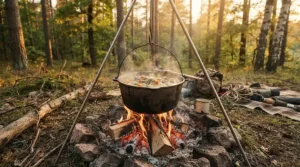
Cooking with cast iron over an open flame comes with a few non-negotiable safety basics that camp oven review sites often skip. Always use a dedicated lid lifter or heavy welding-style gloves — cast iron handles and lids routinely exceed 400°F, and a quick grab with a kitchen towel isn’t sufficient protection. Keep the pot on stable, cleared ground away from dry grass or debris that coals could ignite if they roll off the lid. Before you even build the fire, it’s worth checking local rules: many public lands restrict or ban open campfires and even charcoal grills during high fire-danger periods, and the National Park Service’s campfire safety guidance is a good baseline for the kind of precautions — clearing a 15-foot radius, never leaving coals unattended, fully extinguishing until cold to the touch — that apply whether you’re in a national park or a state campground. When fire restrictions are in effect, a camp stove with a flat cast iron or aluminum dutch oven set on top is a legitimate backup that keeps your cooking plans intact without breaking any rules.
FAQ
❓ What size dutch oven do I need for camping?
❓ Do I need to season a pre-seasoned camp dutch oven?
❓ How many coals do I need for a 12-inch dutch oven?
❓ Is cast iron or aluminum better for camping?
❓ Can I use a regular kitchen dutch oven for camping?
Conclusion
A good dutch oven for camping earns its weight in the pack almost immediately — one decent chili or loaf of campfire bread tends to convert skeptics fast. Across this list, the Lodge Cast Iron Camp Dutch Oven remains the safest all-around pick for most campers, the GSI Outdoors Hard Anodized Dutch Oven is the clear call for anyone counting ounces, and the Camp Chef Deluxe 12″ Dutch Oven makes sense once you’re regularly cooking for a crowd. What matters most isn’t chasing the “best” pot on paper — it’s matching leg height, capacity, and material to how you actually camp, then putting in the small, repeatable maintenance habits (proper seasoning cast iron, correct lid coal placement, thorough drying) that make any of these seven options last for decades rather than one season.
Recommended for You
- 7 Best Campfire Cooking Grates in 2026: Honest Buyer’s Guide
- 7 Portable Fire Pit for Camping Picks Worth Packing in 2026
- Portable Weather Station Camping: 7 Best Picks for 2026
Disclaimer: This article contains affiliate links. As an Amazon Associate, I earn from qualifying purchases. If you purchase products through these links, we may earn a small commission at no additional cost to you.
✨ Found this helpful? Share it with a fellow camper before your next trip! 💬🏕️
