

In This Article
Somewhere around mile eight, your phone bars disappear, the trail forks in a way the map didn’t quite prepare you for, and the only thing standing between “mildly lost” and “actual emergency” is whatever’s in your pack. That’s the exact gap a satellite messenger for hiking is built to close. In plain terms: a satellite messenger is a small handheld device that bounces text messages and SOS alerts off orbiting satellites instead of cell towers, so it keeps working in canyons, dense forest, and alpine terrain where your phone becomes a very expensive paperweight. You pair it with a subscription plan, and it gives you two-way texting, location sharing, and an emergency button that reaches real search-and-rescue coordinators, not a voicemail box.

This isn’t a gadget for extreme mountaineers only. Day hikers on popular trails, solo backpackers, trail runners chasing new routes, and even car campers exploring dirt roads all benefit from having a device that doesn’t care whether Verizon built a tower nearby. The National Park Service is blunt about this in its own trail safety guidance, warning hikers outright not to count on cell coverage and to carry a way to communicate regardless of how popular or “easy” a trail looks.
The market has matured a lot since the early days of one-way SOS beacons. Today you’re choosing between standalone GPS communicators with full keyboards, ultralight phone-paired hotspots, and hybrid devices that lean on your smartphone for the heavy lifting. Below, I’ve broken down seven real, currently available devices — covering Garmin inReach hiking gear, SPOT messenger review picks, and a couple of lesser-known alternatives — with honest analysis of specs, aggregated review sentiment, subscription costs, and exactly who each one is built for.
Quick Comparison: Satellite Messenger for Hiking at a Glance
Before diving into the deep dives, here’s a fast reference for how these seven stack up on the things that matter most: standalone capability, weight, and starting subscription cost.
| Device | Network | Standalone Use | Weight (approx.) | Starting Plan | Best For |
|---|---|---|---|---|---|
| Garmin inReach Mini 3 Plus | Iridium | Yes | ~4.4 oz | ~$15/mo | Photo/voice messaging power users |
| Garmin inReach Mini 2 | Iridium | Yes | ~3.5 oz | ~$15/mo | All-around standalone reliability |
| Garmin inReach Messenger | Iridium | Limited | ~4 oz | ~$15/mo | Longest battery, phone-first users |
| ZOLEO Satellite Communicator | Iridium | No (SOS only) | ~5.3 oz | ~$20/mo | Budget seamless messaging |
| SPOT X | Globalstar | Yes | ~7 oz | ~$12/mo | Full keyboard, no-phone typing |
| SPOT Gen4 | Globalstar | Yes | ~5 oz | ~$12/mo | Budget one-way tracking + SOS |
| Somewear Global Hotspot | Iridium | No | ~4 oz | ~$8/mo | Ultralight, cheapest subscription |
Looking at this table, the pattern that jumps out is the trade-off between standalone independence and price. The Garmin inReach Mini 2 and Garmin inReach Mini 3 Plus justify their higher entry cost by working fully on their own, no phone required, which matters most when your phone is dead, wet, or shattered. The Somewear Global Hotspot wins on subscription price precisely because it leans on your phone for everything but the SOS button, so you’re trading a lower monthly bill for a real dependency. If raw upfront cost is your main filter, SPOT Gen4 and ZOLEO sit in the middle, offering solid core functionality without Garmin’s premium.
💬 Just one click — help others make better buying decisions too!😊
Top 7 Satellite Messengers for Hiking: Expert Analysis
1. Garmin inReach Mini 3 Plus — most advanced messaging with photo and voice
The Garmin inReach Mini 3 Plus is the newest flagship in Garmin’s lineup, and the standout feature is its Iridium Messaging Transport module, which lets it send messages roughly 300 times larger than older inReach devices — including actual photos and 30-second voice clips over satellite.
What that spec means in practice: instead of typing “I’m okay, minor ankle sprain, continuing slowly,” you can send a photo of the trail marker you’re at and a short voice note explaining the situation, which cuts down on the back-and-forth that used to eat battery and time during an actual incident. It pairs the new color touchscreen with up to roughly 330-350 hours of battery life in 10-minute tracking mode, according to Garmin’s published specs, a real jump from earlier Mini generations.
Based on the spec comparison against the standard Mini 3, the Plus model is the one worth the extra cost if you actually plan to use the device as a standalone communicator rather than just a backup. Reviewers who’ve tested the Mini 3 family note the touchscreen and IMT module make texting far less tedious than earlier inReach interfaces, though the device is close to an ounce heavier than the older Mini 2. Aggregated review sentiment from outdoor gear testers frames this as “the biggest step forward the Mini family has taken,” while also cautioning that the added screen and audio hardware are new enough that long-term field durability is still being proven.
Pros:
- ✅ Sends photos and voice messages over satellite, a first for this device class
- ✅ Color touchscreen makes on-device typing dramatically easier
- ✅ Long tracking battery life for multi-day trips
Cons:
- ❌ Heaviest Mini in the lineup, working against ultralight setups
- ❌ Premium price puts it well above budget-conscious alternatives
The Garmin inReach Mini 3 Plus sits in the premium tier, generally landing in the $450-$550 range at the time of research. For hikers who genuinely want richer communication — not just “I’m safe” pings — the added cost buys real functionality rather than marketing gloss.
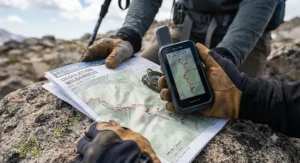
2. Garmin inReach Mini 2 — best all-around standalone reliability
The Garmin inReach Mini 2 earns its reputation as the category benchmark, and its standout feature is doing everything a satellite messenger needs to do, in a genuinely pocket-sized unit, without requiring a paired phone.
Under the hood, it runs on the Iridium network with global pole-to-pole coverage, offers roughly 14 days of battery life in 10-minute tracking mode, and includes TracBack routing that guides you back along your recorded path if you get turned around. What that means for a hiker: even if your phone dies on day two of a three-day trip, the Mini 2 keeps working exactly as it did on day one — full two-way texting, SOS, and location sharing, no smartphone dependency required.
Here’s what most buyers overlook about this model: it’s the device most likely to still be fully functional in a genuine worst-case scenario, because it doesn’t rely on a second piece of electronics with its own battery to fail. Reviewers on retail platforms consistently describe it as reliable across multi-day trips, with recurring praise for its size-to-capability ratio and complaints centered mainly on the small screen making longer message composition slow. One recent independent review summarized it as “not the cheapest option, but the combination of size, safety, and functionality is hard to beat” for serious outdoor users.
Pros:
- ✅ Fully standalone — no phone required for any core function
- ✅ Genuinely compact at roughly 3.5 ounces
- ✅ USB-C charging and a widely praised, mature interface
Cons:
- ❌ Small screen makes composing longer custom messages tedious
- ❌ Higher device cost than several phone-paired competitors
Price for the Garmin inReach Mini 2 has actually softened as newer Mini 3 models launched, with street prices frequently landing in the $250-$400 range depending on retailer promotions. For most hikers, this is still the safest default recommendation in the Garmin inReach hiking lineup.
3. Garmin inReach Messenger — best battery life for phone-first hikers
The Garmin inReach Messenger trims Garmin’s feature set down to the essentials, and its standout feature is class-leading battery life, reported at up to 28 days in low-power messaging mode by multiple independent testers.
The spec sheet shows it uses the same Iridium network as its siblings, supports GPS, Galileo, BeiDou, and QZSS for faster satellite lock, and can even reverse-charge a phone in a pinch. In practical terms, that reverse-charging feature solves one of the quieter but real risks in the backcountry: a dead phone mid-rescue, which independent reviewers have flagged as an actual factor in delayed responses. The trade-off is that it drops the standalone navigation screen depth found on the Mini 2, leaning instead on the companion smartphone app for most interactions.
What the spec sheet won’t tell you, but reviewers note, is that the tiny onboard screen is workable for viewing messages in a pinch but genuinely tedious for anything beyond that — you’re meant to use your phone as the primary interface. That makes this a strong pick specifically for hikers with good phone-battery discipline who prioritize weight and endurance over standalone navigation features. One trail-tested reviewer summed it up as “a solid inReach if battery life and price are your priorities and you’re comfortable relying on your phone for everything else.”
Pros:
- ✅ Best-in-class battery life among tested Garmin devices
- ✅ Reverse-charging capability for topping off a phone
- ✅ Multi-GNSS support improves satellite lock speed in tough terrain
Cons:
- ❌ No dedicated phone number, making it harder for others to reach you directly
- ❌ Onboard typing is slow, pushing most use onto the paired app
Pricing for the Garmin inReach Messenger typically falls in the $200-$350 range, occasionally dipping lower during retailer promotions, making it one of the more accessible entries into the Garmin ecosystem.
4. ZOLEO Satellite Communicator — best seamless messaging on a budget
The ZOLEO Satellite Communicator carved out its niche by solving a specific annoyance: switching between satellite, cellular, and Wi-Fi without losing your conversation thread, and that seamless handoff remains its standout feature.
Specs-wise, it runs on the Iridium network, weighs around 5.3 ounces, and supports messages up to 900 characters — notably longer than some competing devices. In real-world terms, this means you can start a text to a family member while on trail with no signal, and the moment you reach a trailhead parking lot with Wi-Fi, the conversation just continues in the same app thread rather than fragmenting into separate messages.
Based on the spec comparison against Garmin’s lineup, ZOLEO’s biggest strength is cost: the hardware itself runs meaningfully cheaper than a comparable inReach, and it comes with a real, dedicated phone number, something the inReach Messenger notably lacks. The honest trade-off is that ZOLEO offers essentially no standalone navigation and, unlike the Mini 2, cannot function as a true no-phone backup — reviewers note it operates SOS independently, but full messaging always depends on the paired smartphone. Aggregated customer sentiment across outdoor gear review sites consistently praises the “seamless” cross-network messaging experience while flagging the device itself as “a bit heavy and bulky” relative to Garmin’s smallest offerings.
Pros:
- ✅ Seamless messaging handoff between satellite, cell, and Wi-Fi
- ✅ Dedicated phone number makes you easy to reach directly
- ✅ Lower device price than comparable Garmin models
Cons:
- ❌ No standalone navigation or on-device custom message composition
- ❌ Bulkier and heavier than the smallest competing devices
The ZOLEO Satellite Communicator typically runs in the $100-$200 range for the hardware, positioning it as one of the most approachable entry points for hikers testing out satellite messaging for the first time.
5. SPOT X — best full keyboard for no-phone typing
The SPOT X takes a different design philosophy entirely, and its standout feature is a physical QWERTY keyboard that lets you compose custom messages entirely on the device, without ever touching a phone.
The specs include a 2.7-inch backlit screen, Globalstar network connectivity, a built-in digital compass, and Bluetooth for optional phone pairing. Practically, this means the SPOT X is the pick for hikers who specifically dislike relying on a smartphone in the backcountry, or who want redundancy in case their phone is damaged or dies — the keyboard makes typing full sentences dramatically less painful than the tiny button interfaces on Garmin’s Mini series.
What’s worth weighing here is the network difference: SPOT X runs on Globalstar rather than Iridium, and independent gear reviewers have consistently noted “near global” coverage with documented gaps in parts of the Pacific and at extreme northern and southern latitudes. For most U.S. hiking — the Appalachian Trail, Rockies, Sierra, Cascades — that’s a non-issue, but it’s a real consideration for anyone planning expedition-style trips toward the poles. Reviewer sentiment has been consistent for years: the physical keyboard is a genuine differentiator, but build quality and interface responsiveness lag behind Garmin’s more polished software.
Pros:
- ✅ Physical keyboard makes full standalone typing genuinely usable
- ✅ Doesn’t require a paired phone for core messaging functions
- ✅ Built-in compass and basic navigation features
Cons:
- ❌ Globalstar network has documented coverage gaps at extreme latitudes
- ❌ Heavier and bulkier than most direct competitors
Expect the SPOT X to run in the $150-$250 range depending on current retailer pricing, making it a reasonably priced standalone option for anyone who wants Garmin-style independence with a real keyboard.
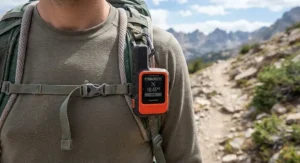
6. SPOT Gen4 — best budget tracker with one-way SOS
The SPOT Gen4 strips things down further, and its standout feature is rugged simplicity: a no-screen, button-and-LED device built primarily for tracking and emergency SOS rather than back-and-forth conversation.
Specs show an IP68 dust and water resistance rating, four AAA battery power, and tracking intervals as frequent as every 2.5 minutes on the extreme plan. In practice, this makes the Gen4 ideal for hikers whose primary need is “let my family watch my dot move on a map and hit SOS if something goes wrong,” rather than sending detailed custom texts. It lacks a two-way messaging screen entirely — all feedback comes through flashing LED patterns, which reviewers agree has a real learning curve before it becomes intuitive.
Here’s the honest analysis: for pure tracking-and-SOS use cases, the Gen4’s simplicity is a genuine strength, not a limitation — fewer components mean fewer failure points, and the AAA battery format means you can restock power at literally any gas station on a long thru-hike. The trade-off is stark, though: no custom outgoing messages beyond pre-set check-ins, and no way to receive incoming replies at all. Aggregated reviewer sentiment ranks it lower specifically on messaging and SOS category scores relative to two-way devices, while consistently praising its battery life and portability.
Pros:
- ✅ Rugged IP68 build using easily replaceable AAA batteries
- ✅ Frequent tracking intervals for real-time location sharing
- ✅ One of the lowest device prices in this roundup
Cons:
- ❌ No true two-way messaging — you cannot receive replies
- ❌ LED-only feedback has a real learning curve
Pricing on the SPOT Gen4 generally sits in the $100-$150 range, with the device frequently discounted below its list price, making it one of the most accessible entry points into satellite safety gear for budget-conscious hikers.
7. Somewear Global Hotspot — lightest device, cheapest subscription
The Somewear Global Hotspot takes the phone-dependent approach to its logical extreme, and its standout feature is weight: at roughly 4 ounces in a rounded, buttonless “hockey puck” housing, it’s among the lightest satellite communicators tested.
Specs include Iridium network connectivity, IPX7 water resistance, and claimed battery life supporting 1,000+ messages per charge or roughly 11 days of 10-minute location tracking. The device pairs over Bluetooth with a smartphone app that handles all custom messaging, weather checks, and mapping, while a single external SOS button provides emergency capability independent of the phone connection.
Here’s what most buyers overlook about the subscription side: Somewear’s plans are consistently reported by reviewers as the least expensive in the two-way messaging category, occasionally as low as single digits per month on annual plans, which can offset the device’s mid-range hardware price over the course of a season. Reviewers who tested it side-by-side with the Mini and SPOT X described its messaging speed as noticeably “zippy” thanks to clear signal-strength feedback in the app. The honest trade-off, as with ZOLEO, is total dependency on your phone for anything beyond the SOS button — if your phone is dead or broken, custom messaging goes with it.
Pros:
- ✅ Among the lightest two-way satellite communicators available
- ✅ Consistently the cheapest subscription plans in independent comparisons
- ✅ Smart routing switches to Wi-Fi or cellular automatically when available
Cons:
- ❌ No custom messaging without a paired, functioning smartphone
- ❌ No onboard screen for viewing messages independently
The Somewear Global Hotspot generally runs in the $250-$350 range for the hardware, with its real value showing up over time through some of the lowest subscription costs in this entire comparison.
Top 7 Products: Specs, Price Range, and Best-For Comparison
| Device | Network | Battery Life | Price Range | Best For |
|---|---|---|---|---|
| Garmin inReach Mini 3 Plus | Iridium | ~330-350 hrs tracking | $450-$550 | Photo & voice power users |
| Garmin inReach Mini 2 | Iridium | ~14 days tracking | $250-$400 | Standalone all-rounder |
| Garmin inReach Messenger | Iridium | ~28 days low power | $200-$350 | Battery-first, phone-paired hikers |
| ZOLEO Satellite Communicator | Iridium | Multi-day, device-dependent | $100-$200 | Budget seamless messaging |
| SPOT X | Globalstar | ~240 hrs tracking | $150-$250 | No-phone typing via keyboard |
| SPOT Gen4 | Globalstar | Multi-day, AAA-powered | $100-$150 | Budget one-way tracking |
| Somewear Global Hotspot | Iridium | ~11 days tracking | $250-$350 | Lightest device, cheapest plans |
The clearest signal from this table is that price and standalone independence move together almost linearly: the two devices that work with zero phone dependency, Garmin inReach Mini 2 and Garmin inReach Mini 3 Plus, sit at the top of the price range, while phone-dependent options like Somewear Global Hotspot and ZOLEO undercut them substantially. If you’re weighing subscription cost satellite plans as your deciding factor rather than upfront hardware price, Somewear and SPOT devices tend to post the lowest recurring bills over a full season of use.
✨ Don’t Miss These Exclusive Deals!
🔍 Take your backcountry safety setup to the next level with these carefully selected satellite messengers. Click on any highlighted item to check current pricing and availability. These tools will help you build authentic peace of mind your family will actually feel!
Practical Setup Guide: Getting a New Satellite Messenger Trail-Ready
Buying the device is step one; setting it up correctly is what actually makes it useful when you need it. Before your first hike, fully charge the unit, then register it with your chosen subscription plan online — this typically takes 10-15 minutes and requires your emergency contacts’ phone numbers and email addresses ahead of time.
Next, send a test message from a known location with clear sky view, ideally your backyard or a nearby park, and confirm your emergency contact actually receives it — plenty of first-time users skip this step and discover setup errors mid-trip instead. Program at least two or three preset check-in messages (“On schedule, all good,” “Delayed but safe, no need to worry”) so you can communicate quickly without draining battery on custom typing. A common mistake in the first 30 days is leaving tracking intervals set to the most frequent (and most battery-draining) setting for casual day hikes; dial tracking back to 30- or 60-minute intervals unless you’re doing something genuinely remote. Finally, clip the device somewhere with unobstructed sky access — inside a pack pocket facing up works, buried at the bottom does not — since every device in this roundup depends on a clear satellite line of sight to function.
Real-World Scenarios: Matching the Right Device to Your Hiking Style
Not every hiker needs the same device, so here are three common profiles and the honest reasoning behind each recommendation.
The weekend day hiker on popular trails (moderate budget, mostly short trips, occasional solo hikes): the SPOT Gen4 or ZOLEO Satellite Communicator make the most sense here. You mostly need “family can see I’m okay” reassurance and an emergency button, not elaborate two-way conversations, so there’s little reason to pay for Garmin’s premium standalone navigation features.
The solo backpacker on multi-day remote trips (higher budget tolerance, values redundancy, phone battery is a real concern by day three): the Garmin inReach Mini 2 is the strongest fit. Its fully standalone operation means your safety net doesn’t disappear the moment your phone dies, which matters most exactly when things go wrong.
The ultralight thru-hiker counting every ounce (weight-obsessed, phone is already the primary navigation tool, disciplined about battery management): the Somewear Global Hotspot or Garmin inReach Messenger fit best. Both shave weight and cost by leaning on a phone you’re already carrying and already relying on for maps, so the trade-off costs you little in practice.
Common Problems Hikers Face — and the Right Satellite Messenger Fix
Problem: “I keep losing signal in dense tree canopy.” Devices on the Iridium network — Garmin inReach Mini 2, Garmin inReach Messenger, ZOLEO, and Somewear Global Hotspot — generally perform better under canopy than Globalstar-based devices, according to multiple independent field tests, thanks to Iridium’s polar low-earth-orbit design.
Problem: “My family panics every time I go quiet for a few hours.” Set up scheduled tracking pings rather than relying only on manual check-ins; every device in this roundup supports automated location sharing at set intervals, which removes the pressure of remembering to message manually.
Problem: “I don’t want to pay for a subscription I barely use.” Look specifically at devices with pause or suspend options; ZOLEO offers a low-cost monthly suspend that preserves your phone number, and Garmin’s plans include seasonal freeze options — both let you avoid paying full price during off-season months.
Problem: “I’m worried about accidentally triggering the SOS button.” Check for a recessed or covered SOS button design before buying; this has been a specific point of criticism for some budget devices in independent testing, where an exposed button design was flagged as a real risk of accidental activation in a packed bag.
Problem: “I need this to work internationally, not just in the U.S.” Confirm the satellite network’s global reach before you travel — Iridium-based devices offer genuinely pole-to-pole coverage, while Globalstar-based devices like the SPOT line have documented gaps at extreme latitudes and in some ocean regions.

How to Choose a Satellite Messenger for Hiking
- Decide if standalone capability matters to you. If you want a device that works with your phone dead or broken, prioritize the Garmin inReach Mini series or SPOT X over phone-dependent options.
- Estimate your realistic messaging volume. Occasional check-ins favor cheaper plans on ZOLEO or Somewear; frequent two-way conversations may justify Garmin’s higher-tier plans.
- Weigh weight against features honestly. Every extra gram matters on a thru-hike, but don’t cut a genuinely useful safety feature just to save an ounce on a weekend trip.
- Check network coverage for your specific destinations. Iridium offers stronger polar and canopy performance; Globalstar can be perfectly adequate for most U.S. trails at a lower device cost.
- Compare full-season subscription costs, not just device price. A cheaper device with an expensive plan can cost more over a year than a pricier device with a lean subscription.
- Read the SOS button design carefully. A recessed or guarded button reduces accidental activation risk, a real factor flagged in independent testing of some budget devices.
- Match battery life to your actual trip length. A weekend hiker doesn’t need 28-day battery life, but a thru-hiker absolutely benefits from Garmin inReach Messenger-level endurance.
Satellite Messenger vs. Personal Locator Beacon: What’s the Real Difference?
This is one of the most common points of confusion for first-time buyers, and it’s worth untangling clearly. A satellite messenger (like everything in this roundup) requires an ongoing subscription and offers two-way messaging alongside SOS — you can text your progress, get replies, and check weather, in addition to summoning help. A Personal Locator Beacon (PLB), by contrast, is a one-way emergency-only device: press the button, and it sends your GPS coordinates directly to search-and-rescue authorities via the Cospas-Sarsat satellite system, with no subscription fee and no non-emergency messaging capability at all.
The practical trade-off comes down to use case. If you only want an emergency safety net and never plan to send routine texts, a PLB is genuinely cheaper long-term since there’s no monthly bill — but you lose the reassurance value of routine check-ins, and you can’t tell rescuers any details about your situation beyond your location. Satellite messengers cost more over time through subscription fees, but the two-way messaging means you can clarify “twisted ankle, need evacuation” versus “lost, need direction,” which materially changes how a rescue response is staged. Note also that PLBs sold in the U.S. must be registered with NOAA under federal regulation, a step that’s easy to forget but genuinely required by law.
For most day hikers and backpackers, the two-way messaging capability of a satellite messenger for hiking is worth the recurring cost, precisely because most real backcountry incidents involve ambiguity that a single SOS button can’t communicate.
What to Expect: Real-World Performance in the Backcountry
Specs on a box rarely translate directly into trail experience, so here’s the honest gap between marketing numbers and actual use. Message send times advertised as “seconds” typically hold true only under clear open sky; under moderate tree cover, expect anywhere from one to several minutes per message across most devices, with Iridium-based units generally performing better in canopy than Globalstar-based ones based on aggregated field reviews. Battery life figures are almost always measured in low-power tracking mode with infrequent pings — active two-way texting drains batteries meaningfully faster than the headline numbers suggest, so budget for real-world battery life to run shorter than the marketing claim, especially in cold temperatures.
SOS response isn’t instantaneous either; once triggered, your alert routes through a monitoring center (commonly International Emergency Response Coordination Center or FocusPoint International, depending on the brand) before local search-and-rescue authorities are contacted, a process that typically takes minutes rather than seconds. None of this makes these devices less valuable — it just means setting realistic expectations rather than assuming instant, flawless connectivity in every condition.
Long-Term Cost and Subscription Analysis
Device price is only half the financial picture; the ongoing subscription cost satellite plans require is where budgets diverge most over a full year of use. Entry-level plans across this roundup generally start somewhere between $8 and $20 per month, with unlimited messaging and more frequent tracking pushing costs toward $30-$50 monthly on premium tiers. Annual, upfront-paid plans are typically cheaper per month than pay-as-you-go flexible plans, but they lock you in for a full year even if you only hike seasonally.
Here’s the ROI math that matters: if you hike primarily in spring through fall and want to avoid paying for winter months you’re not using the device, look specifically at brands offering suspend or freeze options — ZOLEO’s low-cost monthly suspend and Garmin’s seasonal freeze plans both let you preserve your account and device registration without paying full price during off-months. Over a three-year ownership window, a cheaper device paired with an expensive unlimited plan can easily cost more in total than a pricier device paired with a modest, seasonally-paused plan — so calculate total cost of ownership across your actual usage pattern, not just sticker price on day one.
Safety, Regulations, and Compliance for Backcountry Communication
Emergency satellite devices operate within a regulated framework that’s worth understanding before you rely on one. In the United States, devices that transmit emergency distress signals through the Cospas-Sarsat system, including many personal locator beacons, must be registered with NOAA, and failure to register can delay a rescue response according to federal guidance. While most consumer satellite messengers in this roundup route SOS through commercial monitoring centers rather than directly through Cospas-Sarsat, the underlying principle holds: accurate, current contact information tied to your device is what allows a rescue coordinator to act quickly rather than working from an outdated or incomplete profile.
It’s also worth noting that some jurisdictions internationally regulate or restrict satellite communication devices, so if you’re traveling abroad with any device from this list, checking local regulations ahead of time avoids an unpleasant surprise at customs or on trail. Domestically, land management agencies consistently recommend carrying a communication backup rather than relying on cell service alone, reinforcing that these devices aren’t a luxury add-on so much as a baseline safety practice for anyone spending real time in the backcountry.

Frequently Asked Questions
❓ What is the best satellite messenger for hiking beginners?
❓ Do satellite messengers work without cell service?
❓ How much does a satellite messenger subscription cost per month?
❓ Can I use a satellite messenger internationally?
❓ Is a satellite messenger better than a personal locator beacon?
Conclusion: Choosing Your Backcountry Safety Net
There’s no single “best” satellite messenger for hiking — there’s only the right match for your trip length, budget, and how much you value standalone independence from your phone. If you want the safest, most proven all-around pick, the Garmin inReach Mini 2 remains the benchmark most reviewers keep coming back to. If subscription cost matters more than anything else, Somewear or ZOLEO undercut Garmin meaningfully. And if you specifically want to type real sentences without touching a phone, SPOT X’s keyboard is still a genuinely useful differentiator.
Whatever you choose, the honest takeaway from every review cited throughout this piece is consistent: none of these devices are perfect, all of them beat having nothing, and the difference between carrying one and not carrying one has, by NOAA’s own accounting, factored into thousands of real rescues. That’s not marketing language — it’s the actual track record of a category of gear built specifically for the moments when everything else stops working.
✨ Ready to Hit the Trail Prepared?
🔍 Check current pricing on the satellite messenger that fits your hiking style best, and build a backcountry safety setup you can actually trust when it counts.
Recommended for You
- Two-Way Radio for Camping: 7 Best Picks for 2026
- Dry Shampoo for Camping: 7 Best Waterless Picks for 2026
- Camping Toilet Paper: 7 Best Septic-Safe Picks for 2026
Disclaimer: This article contains affiliate links. As an Amazon Associate, I earn from qualifying purchases. If you purchase products through these links, we may earn a small commission at no additional cost to you.
✨ Found this helpful? Share it with your friends! 💬🤗
