In This Article
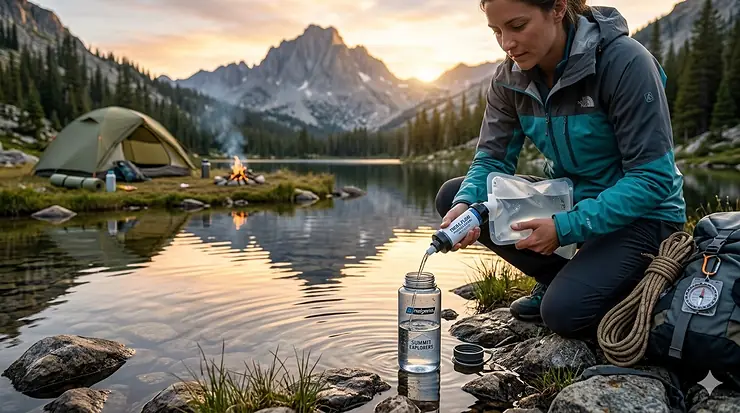
Picture this: you’re three miles deep into a backcountry trail, your water bottle’s bone dry, and there’s a crystal-clear stream gurgling beside the path. Tempting, right? But that pristine-looking water could be harboring microscopic hitchhikers like Giardia, Cryptosporidium, or E. coli – ready to turn your adventure into a nightmare.
That’s where a reliable water filter for camping becomes your backcountry best friend. I’ve tested dozens of portable water filtration systems over the years, from budget squeeze bags to premium purifiers, and I can tell you this: the right filter doesn’t just prevent illness – it gives you the freedom to explore without lugging gallons of water on your back.
According to the Centers for Disease Control and Prevention, waterborne illnesses from bacteria, parasites, and viruses remain a significant risk for outdoor enthusiasts. Even water that looks clean can make you seriously sick. The good news? Modern camping water filter technology has evolved dramatically, offering lightweight, efficient solutions that fit every budget and adventure style.
In this guide, I’ll walk you through the top 7 camping water filter systems available in 2026, breaking down everything from micron filter ratings to flow rate performance. Whether you’re a weekend warrior or a thru-hiker planning a six-month expedition, you’ll find the perfect portable water filter outdoor solution here.
Quick Comparison Table
| Product | Type | Weight | Micron Rating | Filter Lifespan | Flow Rate | Price Range |
|---|---|---|---|---|---|---|
| Sawyer Squeeze | Squeeze | 3 oz | 0.1 micron | 100,000 gallons | ~1 L/min | $25-$40 |
| Katadyn BeFree | Squeeze | 2.3 oz | 0.1 micron | 1,000 liters | 2+ L/min | $40-$50 |
| LifeStraw Peak Squeeze | Squeeze | 2.2 oz | 0.2 micron | 500 gallons | 1.5 L/min | $45-$55 |
| Platypus QuickDraw | Squeeze | 3.3 oz | 0.2 micron | 1,500 liters | 3 L/min | $55-$80 |
| GRAYL GeoPress | Press Purifier | 15.9 oz | Purifier | 65 gallons | 5 L/min | $90-$110 |
| MSR Guardian | Pump Purifier | 17.3 oz | 0.02 micron | 10,000 liters | 2.5 L/min | $350-$400 |
| Survivor Filter PRO | Pump | 12.8 oz | 0.01 micron | 100,000 liters | 0.5 L/min | $60-$75 |
💬 Just one click – help others make better buying decisions too!😊
✨ Don’t Miss These Exclusive Deals!
🔍 Take your camping hydration to the next level with these carefully selected products. Click on any highlighted item to check current pricing and availability. These tools will help you create authentic adventure experiences your family will love!
Top 7 Water Filter for Camping: Expert Analysis
1. Sawyer Squeeze – The Ultralight Champion
The Sawyer Squeeze has earned legendary status among thru-hikers and weekend campers alike, and after using mine for over two years across everything from Colorado mountain streams to murky desert water holes, I completely understand why.
Key Specifications:
- Micron filter rating: 0.1 absolute
- Filter lifespan: 100,000 gallons
- Flow rate: approximately 1 liter per minute
- Weight: 3 ounces
- Price: $25-$40
What makes the Sawyer Squeeze special is its absurd value proposition. At a fraction of a cent per liter over its lifetime, this filter will outlast every other piece of gear in your pack. The 0.1 micron hollow fiber membrane removes 99.99999% of bacteria (including E. coli and salmonella) and 99.9999% of protozoa (Giardia and Cryptosporidium).
Customer feedback consistently praises the versatility. You can squeeze it into bottles, use it inline with hydration bladders, attach it to standard water bottles, or even drink directly through it as a straw. One hiker on the Pacific Crest Trail told me she filtered over 800 liters on her thru-hike without noticeable flow degradation.
✅ Pros:
- Unbeatable cost-per-liter value
- Incredibly versatile usage options
- Compact and featherweight
❌ Cons:
- Included pouches are notoriously fragile (get a Cnoc or Evernew bag instead)
- Flow rate slower than competitors like BeFree
Target User: Budget-conscious backpackers, thru-hikers, and ultralight enthusiasts who prioritize longevity over speed.
2. Katadyn BeFree – Speed Demon for Fast-Packers
If speed is your priority, the Katadyn BeFree delivers the fastest flow rate in the squeeze filter category – over 2 liters per minute when new. I’ve used this on trail runs where stopping to filter feels like an eternity, and the Katadyn BeFree gets you moving again in seconds.
Key Specifications:
- Micron filter rating: 0.1 absolute
- Filter lifespan: 1,000 liters (264 gallons)
- Flow rate: 2+ liters per minute initially
- Weight: 2.3 ounces
- Price: $40-$50
The EZ-Clean membrane technology is genuinely innovative – just shake and swish to clean rather than backflushing with a syringe. The soft flask design collapses to the size of a granola bar when empty, making it incredibly packable.
However, here’s the reality check: that blistering flow rate degrades notably over time. Multiple users report dropping to around 1 L/min by 500 liters, even with regular cleaning. The 1,000-liter capacity is significantly shorter than the Sawyer Squeeze alternative.
✅ Pros:
- Lightning-fast initial flow rate
- Ultra-compact when empty
- No backflushing syringe needed
❌ Cons:
- Flow rate degrades faster than competitors
- Shorter overall lifespan
- Soft flask can develop leaks
Target User: Trail runners, fastpackers, and day hikers who need quick hydration stops more than long-term durability.
3. LifeStraw Peak Squeeze – The Durable Alternative
The LifeStraw Peak Squeeze represents LifeStraw’s evolution into the competitive squeeze filter market, and it addresses many durability concerns that plagued earlier collapsible designs.
Key Specifications:
- Micron filter rating: 0.2 micron
- Filter lifespan: 500 gallons (1,893 liters)
- Flow rate: approximately 1.5 liters per minute
- Weight: 2.2 ounces (650ml version)
- Price: $45-$55
What I appreciate most about the LifeStraw Peak Squeeze is the build quality. The soft flask feels noticeably more robust than the fragile pouches included with other systems, and after six months of regular use, mine shows zero signs of pinhole leaks or cap degradation. The included backflushing syringe makes maintenance straightforward.
Customer reviews highlight the reliable performance across varied water conditions. One reviewer filtered heavily silted water from Nevada desert springs for three weeks straight without significant flow reduction. The 0.2 micron rating (slightly larger than 0.1 micron competitors) doesn’t meaningfully impact pathogen removal – both filter sizes eliminate bacteria and protozoa effectively.
✅ Pros:
- More durable flask than competitors
- Good balance of flow rate and reliability
- Effective backflushing system included
❌ Cons:
- Shorter lifespan than Sawyer options
- Bulkier than ultra-minimalist alternatives
- Requires syringe for proper cleaning
Target User: Weekend campers and section hikers who want squeeze filter convenience with better longevity than basic options.
4. Platypus QuickDraw – The Premium Squeeze Experience
After extensive field testing, the Platypus QuickDraw has become my personal go-to for multi-day backpacking trips. It refines the squeeze filter concept with thoughtful engineering touches that elevate the user experience.
Key Specifications:
- Micron filter rating: 0.2 micron hollow fiber
- Filter lifespan: 1,500 liters
- Flow rate: 3 liters per minute
- Weight: 3.3 ounces
- Price: $55-$80 (depending on reservoir size)
The Platypus QuickDraw features a unique “shake-to-clean” mechanism that requires no backflushing syringe – just vigorous shaking with clean water. The proprietary HydraPak reservoir feels indestructible compared to cheap squeeze pouches, and the dual-thread cap fits both standard bottles and hydration bladders seamlessly.
What impressed me most during a week-long Sierra Nevada trek was the consistent flow rate. Unlike filters that slow to a trickle after heavy use, the QuickDraw maintained near-original performance through 40+ liters of filtering. The activated carbon option (sold separately) improves taste by removing chlorine and organic compounds.
✅ Pros:
- Outstanding flow rate consistency
- Tool-free maintenance system
- Extremely versatile attachment options
❌ Cons:
- Higher price point than budget alternatives
- Slightly heavier than minimalist options
- Carbon element requires periodic replacement
Target User: Serious backpackers who value premium features and long-term reliability over rock-bottom pricing.
5. GRAYL GeoPress – International Travel Powerhouse
The GRAYL GeoPress transcends typical camping water filtration by offering true purification – removing viruses, bacteria, protozoa, heavy metals, and chemicals in a single press.
Key Specifications:
- Filter type: Electroadsorption + activated carbon purifier
- Filter lifespan: 65 gallons (250 liters) per cartridge
- Flow rate: 24 oz in 8-10 seconds (approximately 5 L/min)
- Weight: 15.9 ounces
- Price: $90-$110
I’ve tested the GRAYL GeoPress everywhere from questionable hostel taps in Southeast Asia to contaminated streams in Colorado mining country. The press mechanism is brilliantly simple: fill the outer cup, insert the inner filter press, push down firmly, and drink immediately. The water filtration camping device removes 99.99% of viruses – critical protection that standard 0.1 micron filters cannot provide.
The activated carbon element tackles chemical contaminants and heavy metals (removing 99.5% mercury, 93% lead), making it ideal for water sources near agriculture or industrial areas. One user reported drinking from a visibly yellow, acidic stream polluted with mining runoff – the GeoPress produced clear, neutral-pH water with no metallic taste.
The tradeoff? At nearly 16 ounces and with only 65-gallon cartridge life, this isn’t the lightest or most economical option for pristine wilderness water. But for international travel, urban camping, or anywhere virus contamination is a concern, it’s unparalleled.
✅ Pros:
- True virus removal (99.99%)
- Removes heavy metals and chemicals
- Simple, foolproof operation
❌ Cons:
- Heavy for backpacking
- Short cartridge lifespan
- More expensive per-liter cost
Target User: International travelers, urban adventurers, and anyone camping near agricultural or industrial areas where virus contamination is a risk.
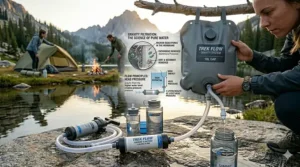
6. MSR Guardian – The Ultimate Backcountry Purifier
The MSR Guardian represents the absolute pinnacle of pump purification technology. It’s expensive, heavy, and completely worth it if you need virus protection in the backcountry.
Key Specifications:
- Micron filter rating: 0.02 micron (removes viruses)
- Filter lifespan: 10,000 liters
- Flow rate: 2.5 liters per minute
- Weight: 17.3 ounces
- Price: $350-$400
What makes the MSR Guardian extraordinary is the self-cleaning mechanism. Every stroke of the pump simultaneously filters clean water AND backflushes the filter element, meaning it actually gets faster over time instead of slower. After pumping 200 liters through heavily silted desert water, my flow rate improved rather than degraded.
The 0.02 micron pore size removes 99.99% of viruses (including norovirus and rotavirus) that pass straight through standard 0.1-0.2 micron filters. For international expeditions, developing countries, or anywhere human contamination is likely, this virus protection is essential. The Guardian also works from incredibly shallow water sources – just an inch deep.
Yes, $400 is serious money. But consider this: humanitarian organizations, military units, and professional expedition teams worldwide trust the MSR Guardian in the most challenging conditions on Earth.
✅ Pros:
- True virus removal capability
- Self-cleaning improves performance over time
- Works from extremely shallow sources
❌ Cons:
- Very expensive initial investment
- Heavier than squeeze filters
- Overkill for pristine North American wilderness
Target User: International adventurers, expedition leaders, group camping coordinators, and anyone traveling where water quality is seriously questionable.
7. Survivor Filter PRO – Budget-Friendly Triple Filtration
The Survivor Filter PRO offers impressive triple-stage filtration at a price point that won’t break the bank, making it an excellent entry into serious water filtration camping systems.
Key Specifications:
- Micron filter rating: 0.01 micron internal ultra filter
- Filter lifespan: 100,000 liters
- Flow rate: 500ml (17 oz) per minute
- Weight: 12.8 ounces
- Price: $60-$75
The Survivor Filter PRO uses a three-stage approach: a pre-filter for sediment, a 0.1 micron carbon filter for taste/chemicals, and a 0.01 micron ultra filter for virus-level filtration. This configuration removes 99.999% of tested viruses, bacteria, and protozoa while reducing heavy metals according to NSF/ANSI standards.
Customer feedback emphasizes the value proposition. For under $75, you’re getting virus protection that typically costs $300+. The 500ml per minute flow rate won’t win speed records, but it’s adequate for personal use. The included cup, collapsible bag, and backflushing syringe provide everything needed out of the box.
The main limitation is durability concerns. Some users report the plastic housing feeling less robust than premium competitors, and the pre-filter requires frequent backwashing in silty water to maintain flow rate.
✅ Pros:
- Virus removal at budget price point
- Long 100,000-liter lifespan
- Complete kit included
❌ Cons:
- Slower flow rate than competitors
- Plastic construction feels less durable
- Pre-filter clogs quickly in turbid water
Target User: Emergency preparedness enthusiasts, car campers, and budget-conscious adventurers who want virus protection without premium pricing.
Understanding Micron Filter Ratings: What They Actually Mean
The micron filter rating determines what size contaminants your filter can remove. Here’s what you need to know to make an informed decision for your water filtration camping needs.
The Size Spectrum of Waterborne Threats
0.1-0.2 Micron Filters (Most camping water filter options): These remove bacteria (typically 0.5-3 microns) and protozoan cysts like Giardia (8-12 microns) and Cryptosporidium (4-6 microns). For North American backcountry water sources, this protection level is generally sufficient. The Wilderness Medical Society guidelines confirm that bacteria and protozoa pose the primary risk in wilderness settings.
0.01-0.02 Micron Filters (Purifiers): These remove viruses (0.02-0.3 microns), which are smaller than bacteria. Virus protection becomes critical near human habitation, agricultural areas, or when traveling internationally where sewage contamination is likely.
Absolute vs. Nominal Ratings
When evaluating portable water filter outdoor products, always check for “absolute” pore ratings rather than “nominal.” An absolute 0.1 micron rating guarantees that no particles larger than 0.1 microns pass through. A nominal rating only suggests that most particles of that size are removed – a critical distinction when your health is on the line.
The hollow fiber membrane technology used in filters like the Sawyer Squeeze and Katadyn BeFree provides absolute filtration, which is why they reliably remove 99.99999% of bacteria despite being lightweight squeeze designs.
Flow Rate Liters: Performance That Matters in the Field
Flow rate determines how quickly you can process water, which directly impacts your experience on the trail. Let me break down what the numbers actually mean in real-world use.
Fast vs. Slow: The Trade-offs
Ultra-fast filters (2-5 L/min): The Katadyn BeFree and Platypus QuickDraw excel here, letting you fill a liter bottle in under 30 seconds with minimal effort. This speed is fantastic for trail running or when you’re filtering large quantities for group cooking. However, ultra-fast flow often means larger pore sizes or filters that degrade quicker over time.
Moderate filters (1-2 L/min): The Sawyer Squeeze and LifeStraw Peak Squeeze fall into this category. You’ll spend about a minute filling a liter bottle – not instant, but perfectly acceptable for most camping scenarios. These filters often maintain more consistent performance over their lifespan.
Slower filters (0.5-1 L/min): Pump systems like the Survivor Filter PRO require more effort but provide virus protection and work from shallow sources. If you’re filtering 10 liters for a group, the extra time becomes noticeable, but for personal use, it’s manageable.
Real-World Performance Degradation
Here’s something manufacturers rarely emphasize: advertised flow rates apply to brand-new filters with pristine water. After filtering 100 liters of silty desert water, expect significant slowdown. This is where maintenance matters tremendously. Filters with easy cleaning mechanisms (like the Platypus QuickDraw’s shake-to-clean system) maintain performance better than those requiring complex backflushing procedures.
Filter Lifespan Gallons: Understanding Long-Term Value
Filter lifespan dramatically affects cost-per-use and replacement hassle. Let’s examine what those capacity numbers actually mean.
The Spectrum of Longevity
Short-life cartridges (65-500 gallons): The GRAYL GeoPress (65 gallons) and LifeStraw Peak Squeeze (500 gallons) require relatively frequent replacement. For a thru-hiker filtering 2 liters daily, a 500-gallon filter lasts about 3-4 months. Budget accordingly.
Medium-life filters (1,000-1,500 liters): The Katadyn BeFree (1,000 liters) and Platypus QuickDraw (1,500 liters) offer reasonable longevity for recreational users. A weekend warrior using 10 liters per month could go years without replacement.
Lifetime filters (100,000+ gallons): The Sawyer Squeeze and Survivor Filter PRO boast essentially unlimited capacity for individual users. Even filtering 1,000 liters per year, you’re looking at a century of use before reaching capacity. These are genuinely buy-it-for-life products.
The Hidden Cost of Maintenance
Don’t just consider replacement cost – factor in maintenance effort. A Sawyer Squeeze with 100,000-gallon capacity still requires backflushing every 50-100 liters in dirty water. A GRAYL GeoPress needs zero maintenance but demands $35 cartridge replacement every 250 liters. Calculate which model aligns with your patience and budget.
Comparing Water Filtration Camping Technologies
| Technology | Virus Removal | Setup Time | Effort Required | Best For |
|---|---|---|---|---|
| Squeeze Filters | No | Instant | Low | Solo hiking, lightweight trips |
| Pump Purifiers | Yes* | 2-3 minutes | High | Groups, shallow sources |
| Press Purifiers | Yes | 10 seconds | Medium | International travel |
| Gravity Systems | No* | 5 minutes | Very Low | Base camp, groups |
*Depends on specific model and micron rating
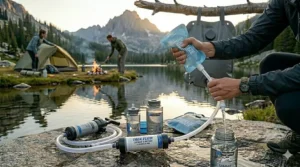
How to Choose the Right Water Filter for Camping
Selecting the perfect camping water filter review involves matching technology to your specific adventure style. Here’s my framework for making the decision.
Consider Your Adventure Type
Ultralight Backpacking: Prioritize weight and packability. The Sawyer Squeeze (3 oz) or LifeStraw Peak Squeeze (2.2 oz) minimize pack weight while providing adequate protection for wilderness water sources.
International Travel: Virus protection becomes non-negotiable. The GRAYL GeoPress or MSR Guardian remove viruses that standard filters miss. The convenience of the press-style GeoPress makes it ideal for hostels and urban camping.
Group Camping: Flow rate and capacity matter more than weight. A gravity system or the Platypus QuickDraw with 3 L/min flow speeds up group water processing significantly.
Emergency Preparedness: Longevity and versatility rule. The Sawyer Squeeze with 100,000-gallon capacity and multiple usage modes (squeeze, gravity, inline) covers virtually any emergency scenario.
Water Source Considerations
Clear mountain streams: Any filter on this list works beautifully. Prioritize weight and cost savings.
Silty desert water: Look for easy cleaning mechanisms. The Platypus QuickDraw or filters with backflushing capability maintain performance in challenging conditions.
Near human habitation: Get virus protection. Standard bacteria/protozoa filters won’t protect against norovirus, hepatitis A, or rotavirus from sewage contamination.
Budget Reality Check
Don’t just compare sticker prices – calculate cost-per-liter over expected usage:
- Sawyer Squeeze: $30 ÷ 378,541 liters = $0.00008 per liter
- GRAYL GeoPress: $100 ÷ 946 liters = $0.105 per liter
- Katadyn BeFree: $45 ÷ 1,000 liters = $0.045 per liter
For heavy users, the Sawyer Squeeze pays for itself in replacement cartridges within months.
Maintenance Tips for Maximum Performance
Proper care extends filter lifespan and maintains flow rate. Here’s what actually works based on years of field experience.
Backflushing Best Practices
For squeeze filters like the Sawyer Squeeze and LifeStraw Peak Squeeze, backflush every 50-100 liters or whenever flow slows noticeably. Use clean filtered water and the included syringe to force water backward through the membrane. This dislodges trapped sediment from the hollow fibers.
Pro tip: In silty water, pre-filter through a bandana or coffee filter before squeezing. This simple step can double the time between backflushes and significantly extend filter life.
Storage Considerations
Never store wet filters in freezing temperatures. Ice crystals expanding inside hollow fibers permanently damage the membrane structure, rendering the filter useless. On cold-weather trips, sleep with your filter inside your sleeping bag or store it in an interior jacket pocket.
Between trips, dry filters completely before storage to prevent mold and bacterial growth. Remove filters from their bags or bottles and air-dry for 24-48 hours.
Cleaning Shake-to-Clean Filters
The Katadyn BeFree and Platypus QuickDraw use shake-to-clean technology that sounds too simple to work – but it does. Fill the bottle with clean water, seal the cap, and shake vigorously for 30 seconds. The turbulence dislodges trapped particles from the filter membrane. Dump the dirty water and repeat 2-3 times until the water runs clear.
Common Mistakes When Using Portable Water Filter Outdoor Gear
After watching countless campers struggle with filtration issues, here are the mistakes I see repeatedly.
Mistake #1: Cross-Contamination
This is the most dangerous and common error. You filter pristine water into a bottle that had contaminated water moments before, reintroducing the very pathogens you just removed.
Solution: Designate separate “dirty” and “clean” containers. Mark them clearly. Never mix them up, even when rinsing.
Mistake #2: Incomplete Treatment
Filtering turbid water through a Sawyer Squeeze and calling it safe ignores the fact that sediment blocks pores and reduces effectiveness. Similarly, using chemical tablets in cold water without extending contact time allows pathogens to survive.
Solution: Combine methods when water quality is questionable. Filter first to remove sediment and protozoa, then use chemical treatment or UV for virus protection.
Mistake #3: Neglecting Maintenance
That once-lightning-fast Katadyn BeFree now takes three minutes to fill a liter bottle? You’ve been ignoring maintenance. Filters clog gradually, and by the time you notice dramatic slowdown, significant damage may have occurred.
Solution: Establish a regular cleaning schedule based on water quality. In clear mountain streams, every 50 liters. In silty desert water, every 20 liters or even daily.
Budget vs. Premium: Where to Invest Your Money
The camping water filter market spans from $15 basic straws to $400 professional purifiers. Here’s where money actually matters.
When Budget Options Work Fine
For weekend camping near clear water sources in developed campgrounds, a basic LifeStraw Personal ($20) or entry-level Sawyer Mini ($25) handles the job adequately. You’re not filtering large volumes, virus protection isn’t critical, and weight isn’t make-or-break.
When Premium Is Worth Every Penny
International travel, extended expeditions, or group leadership situations justify premium investment. The MSR Guardian at $400 seems outrageous until you’re leading a trek in Nepal where virus contamination is likely and filter failure would endanger your entire group. The self-cleaning mechanism, virus removal, and proven reliability suddenly seem worth 10x the cost of a basic squeeze filter.
Similarly, the GRAYL GeoPress makes sense for frequent travelers who would otherwise buy bottled water in developing countries. At $3-5 per day for bottled water, the filter pays for itself in a month while eliminating plastic waste.
The Sweet Spot: Mid-Range Reliability
For most serious backpackers, the $50-80 range delivers optimal value. The Platypus QuickDraw and LifeStraw Peak Squeeze provide premium features, reliable performance, and reasonable longevity without extreme pricing. You get thoughtful design, durable materials, and company accountability that budget options can’t match.
Frequently Asked Questions
❓ How often should I replace my camping water filter cartridge?
❓ Can a 0.1 micron filter rating remove viruses from contaminated water?
❓ What flow rate liters per minute should I expect from a quality squeeze filter?
❓ How does water filtration camping differ from home filtration systems?
❓ Should I boil water before using my portable water filter outdoor equipment?
Conclusion: Finding Your Perfect Match
After thousands of miles filtering backcountry water through every system imaginable, here’s my honest take: there’s no single “best” water filter for camping – only the best filter for YOUR specific needs.
For most weekend warriors and section hikers tackling North American trails, the Sawyer Squeeze remains the gold standard. Its combination of lightweight design, lifetime longevity, and rock-bottom cost-per-liter makes it nearly unbeatable. Yes, the pouches suck – but pair it with a Cnoc bag and you’ve got a killer system for under $40.
International travelers and those venturing near agricultural or populated areas need virus protection. The GRAYL GeoPress delivers foolproof purification in an idiot-proof package. It’s heavy and the cartridges don’t last forever, but the peace of mind knowing you’re protected against the full spectrum of waterborne threats is priceless.
Trail runners and fastpackers prioritizing speed will appreciate the Katadyn BeFree’s blistering flow rate, while serious backpackers seeking premium refinement should consider the Platypus QuickDraw’s thoughtful engineering.
Remember, the best camping water filter review is worthless without proper usage. Master cross-contamination prevention, maintain your equipment religiously, and always carry a backup purification method (tablets, secondary filter, or chemical treatment). Water is the one resource you absolutely cannot compromise on in the backcountry.
Now get out there, stay hydrated, and adventure safely knowing you’ve got reliable water filtration camping technology backing you up!
Recommended for You
- 7 Best Signal Mirror for Survival in 2026
- Bear Bell for Hiking Worth It? 7 Best Tested + Safety Guide 2026
- 7 Best PLB Emergency Beacons That Could Save Your Life 2026
Disclaimer: This article contains affiliate links. If you purchase products through these links, we may earn a small commission at no additional cost to you.
✨ Found this helpful? Share it with your friends! 💬🤗
