

In This Article
The first time your kid spots a hawk riding a thermal a quarter-mile off, you’ll understand why kids binoculars for camping earn their spot in the gear bag right next to the bug spray and the flashlight — the same magnification math explained in this beginner’s guide to how binoculars work from the Cornell Lab’s Bird Academy is worth a quick skim before you buy. A campsite without them is just a place to sit around a fire. A campsite with them turns into a stakeout, a scavenger hunt, a reason to wake up at dawn without being asked twice. That’s the whole pitch, really — you’re not buying an optical instrument, you’re buying forty-five extra minutes of your kid being quietly, happily obsessed with something that isn’t a screen.
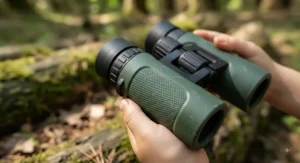
But “just grab any pair” is where a lot of parents go wrong, and I get why — the options on Amazon alone number in the hundreds, most of them near-identical clamshell packages with a cartoon fox on the front. The truth is that magnification, grip, and focus mechanism matter enormously here, and the gap between a $15 toy and a $45 real optic is bigger than the price tag suggests. Below, we’ve dug into seven real, currently-available options spanning toddler-proof toys to genuine entry-level optics your kid can grow into — with honest analysis of what each one actually delivers on a dusty trail, not just what the box promises.
Quick Comparison Table
| Product | Magnification | Best For | Price Range |
|---|---|---|---|
| GeoSafari Kidnoculars | 4x (fixed, focus-free) | Ages 3–6, first pair | Under $20 |
| Occer 12×25 Compact | 12x | Ages 8+, tweens who want real reach | $25–$40 range |
| Bushnell PowerView 2 8×21 | 8x | Ages 7+, wide field of view beginners | $30–$45 range |
| Celestron Nature DX 8×25 | 8x | Ages 9+, serious young birders | $60–$80 range |
| Celestron Nature DX 8×42 | 8x | Family “do-everything” pair | $110–$140 range |
| Shockproof Rubber-Armor Kids Binoculars (3–12) | 8×21 | Ages 4–10, drop-prone hands | Under $25 |
| Bushnell PowerView 2 16×32 | 16x | Teens wanting long-range detail | $50–$70 range |
Looking at the spread above, there’s a clear pattern: the closer a pair gets to “real optics,” the more magnification and glass quality you get, but the more careful your kid needs to be with it. The GeoSafari Kidnoculars and the Shockproof Rubber-Armor Kids Binoculars sit at the toddler-proof end, while the Celestron Nature DX 8×42 sits at the other end as something an adult would happily borrow. Most families camping with kids ages 7-12 will land somewhere in the middle, and that’s exactly where three of our seven picks live.
💬 Already have a favorite in mind? Jump straight to the pick that fits your kid’s age and skip the debate — you’ll thank yourself at 6 a.m. when the birds start moving.
Top 7 Kids Binoculars for Camping: Expert Analysis
1. GeoSafari Kidnoculars — best true starter pair for toddlers
The standout here isn’t optical power at all — it’s that a three-year-old can pick these up, aim them, and actually see something, which is a surprisingly high bar for this age group. At a fixed 4x magnification with no focus wheel to fumble, these are built focus-free on purpose: instead of asking a toddler to master a dial, Educational Insights bet correctly that removing the dial entirely gets more actual use out of the product. The unit weighs about 7.2 oz, light enough that a preschooler can hold it up without their arms giving out after thirty seconds, and it ships with a compass, magnifying glass, and a small carry bag that turns “here are binoculars” into “here’s an explorer kit.”
Based on the age-range framing from the manufacturer and outdoor-gear reviewers who cover this segment, this pair is built specifically for the 3-to-7 window, not as a scaled-down real binocular but as a genuine first tool. What most parents overlook is that focus-free doesn’t mean useless — it means the depth of field is set wide on purpose so a wobbly toddler grip still lands on a recognizable image, trading ultimate sharpness for the speed and forgiveness that keeps a four-year-old from giving up in ten seconds. Reviewers covering kids’ optics for 2026 consistently frame this as the go-to preschool option precisely because the accessories (compass, carabiner clip, magnifier) extend playtime well past the binoculars themselves, which matters when the attention span in question is measured in minutes.
Pros:
- ✅ Focus-free design means zero fumbling for little hands
- ✅ Extremely lightweight at roughly 7.2 oz
- ✅ Bundled compass and magnifier extend play value
Cons:
- ❌ Fixed 4x power is too weak once kids outgrow age 7
- ❌ Not a real optical instrument — image quality is basic
At under $20, this is the correct call if your camper is under age seven and this is their literal first pair; anything with a focus wheel at that age just becomes a toy they fling into the dirt in frustration.

2. Occer 12×25 Compact Binoculars — most magnification per dollar
The standout feature is raw reach: 12x magnification in a compact body that reviewers have repeatedly flagged as punching well above its price class. That number matters more than it sounds — at 12x, a bird sitting in a tree fifty yards out stops being a vague brown blob and becomes something your kid can actually describe later at dinner. The BaK-4 prism glass and large eyepiece design keep the image reasonably bright for a compact this size, and the body folds down small enough to live in a backpack side pocket rather than taking up real gear space.
On paper, 12x sounds like a strict upgrade over the 8x options on this list, but here’s the honest trade-off: higher magnification also magnifies hand shake, so kids under roughly age 9 or 10 sometimes find the image jittery until they learn to brace their elbows. Space.com’s testers rated these 3.5 to 4 out of 5 stars across multiple reviews, consistently praising the portability, image clarity for the price, and value, while noting the price fluctuates significantly with frequent Amazon promotions — worth checking at the time of purchase rather than assuming the listed price is final. Reviewers describe the small size and “robust build” with good grip texture as standout traits for a binocular in this bracket.
Pros:
- ✅ 12x magnification outclasses same-price competitors
- ✅ Compact, foldable body fits any backpack pocket
- ✅ BaK-4 prism glass for the price bracket
Cons:
- ❌ Higher power means more visible hand shake for younger kids
- ❌ Price fluctuates — deal-hunt before checkout
In the $25–$40 range depending on current promotions, this is the pick for a tween who’s outgrown toy-grade optics and wants to actually spot detail on distant wildlife.
3. Bushnell PowerView 2 8×21 — best field of view for spotting movement
The standout advantage is a genuinely wide field of view — 378 feet at 1,000 yards — which sounds abstract until you realize it means a kid can swing these across a tree line and actually catch a bird taking off, instead of hunting around after the fact. That wide-view bias is deliberate: 8x magnification at a 21mm objective keeps the sweet spot for “find it fast,” which matters enormously for children who don’t yet have the patience to slowly scan a fixed spot.
Bushnell’s folding roof-prism design and durable aluminum-alloy chassis wrapped in rubberized styling give this pair a reassuring heft-to-durability ratio without being genuinely heavy — official specs list it at roughly 7.2 oz. Here’s what the spec sheet won’t spell out: the non-slip rubber armor and soft-touch grip pads aren’t just about durability, they’re about a kid’s sweaty summer-camp hands actually keeping hold of the thing on a scramble up a rocky trail. As part of Bushnell’s long-running PowerView line — described by the brand as one of the most widely used affordable binocular families on the market — this model benefits from a mature, well-reviewed design rather than a first-generation gamble.
Pros:
- ✅ Wide 378-ft field of view makes fast targets easy to track
- ✅ Lightweight aluminum-alloy chassis at ~7.2 oz
- ✅ Grippy rubber armor built for sweaty, active hands
Cons:
- ❌ 21mm objective lens dims quickly at dusk
- ❌ Not listed as waterproof/fogproof like the Celestron picks
Priced around $30–$45, this is the sweet spot for a kid who wants to track fast-moving wildlife — squirrels, darting birds, chipmunks — rather than stare at a distant, stationary object.
4. Celestron Nature DX 8×25 — best real optics for a young birder
The standout feature is that this is genuinely adult-grade glass shrunk into a kid-manageable body, not a toy pretending to be a real binocular. Phase-coated BaK-4 prisms and fully multi-coated lenses deliver a level of contrast and color accuracy that the toy-grade options on this list simply can’t touch, and the 58-degree apparent viewing angle keeps the image immersive rather than tunnel-like.
What most buyers overlook about this model is the 6.5-foot close-focus distance, which sounds like a minor spec until your kid tries to look at a butterfly two feet away and every other binocular on this list just shows a blur — Nature DX handles near subjects surprisingly well for a compact. It’s also nitrogen-purged and fully waterproof, meaning a sudden downpour at the campsite or an accidental dunk in the creek doesn’t end the trip. Birding-focused reviewers have repeatedly called this model “the only binocular under $200” worth recommending in its class, and the Cornell Lab’s head-to-head affordable-binocular testing has previously ranked the broader Nature DX line among its budget-tier top picks — a strong signal of genuine optical merit rather than marketing spin, since that program evaluates gear on actual field performance rather than sponsorship.
Pros:
- ✅ Phase-coated BaK-4 prisms deliver real optical clarity
- ✅ Fully waterproof and nitrogen-purged for weather
- ✅ Close focus down to 6.5 feet for nearby subjects
Cons:
- ❌ Steeper learning curve than focus-free toy models
- ❌ Costs roughly 3x more than the Occer or Bushnell picks
In the $60–$80 range, this is the upgrade pick for a kid age 9 or older who has shown real, sustained interest in birding or wildlife-watching and is ready to graduate from toy-grade gear.
5. Celestron Nature DX 8×42 — best shared family pair
The standout here is brightness: the larger 42mm objective lenses pull in significantly more light than every other option on this list, which translates directly into a sharper, more usable image in the low-light conditions common at dawn and dusk — prime wildlife-viewing windows at any campsite. This is less a “kids binoculars” pick and more a genuine family binocular that happens to work brilliantly for an older kid or teen, and that dual-purpose nature is exactly the point.
Based on the spec comparison against the smaller Nature DX 8×25, the trade-off is straightforward: more brightness and detail in exchange for more bulk and weight, which is why this pick suits kids around age 10 and up who can comfortably hold a full-size binocular steady. The twist-up eyecups accommodate eyeglass-wearing kids, a detail smaller toy binoculars routinely ignore, and the durable rubber-armored polycarbonate housing is built to survive drops onto packed dirt and gravel without cracking. Audubon magazine’s volunteer testers named the Nature DX 8×42 the top pick in the under-$200 category in their binocular guide, a rare instance of a budget-tier optic earning praise typically reserved for far pricier glass.
Pros:
- ✅ 42mm objectives deliver noticeably brighter dawn/dusk views
- ✅ Twist-up eyecups work for kids who wear glasses
- ✅ Rugged rubber-armored housing survives real drops
Cons:
- ❌ Bulkier and heavier — less ideal for kids under 9
- ❌ Highest price point on this list
At around $110–$140, this is worth it specifically as a “grows with them” pair the whole family can pass around, rather than a dedicated just-for-kids purchase.

6. Shockproof Rubber-Armor Kids Binoculars (Ages 3–12) — most drop-resistant build
The standout feature is right there in the housing: durable polycarbonate plastic wrapped in rubber armor specifically engineered to absorb shock when the binoculars inevitably get dropped, thrown, or handed off mid-sprint. This category of product — widely sold under names like Vanstarry, Scotamalone, and similar brands — exists purely to solve one problem: kids drop things, and expensive optics don’t survive drops.
The soft, nontoxic rubber that surrounds the eyepieces isn’t just about the housing — it’s also there so a kid running with the binoculars pressed to their face doesn’t catch a hard plastic edge on a stumble, which is a real safety consideration that adult-oriented binoculars never have to account for. Reviewers and product listings across this category consistently frame the appeal as durability-first rather than optics-first: most come at 8x or similar modest magnification with a simple center focus wheel sized for small fingers, some bundled with a compass or bird-watching guide to add educational value. Because these are typically sold by smaller or newer optics brands without long-running independent lab reviews, we can’t verify specific aggregated star-rating data the way we can for Celestron or Bushnell — what’s verifiable is the design intent and construction, which consistently prioritizes survivability over image quality.
Pros:
- ✅ Shock-absorbing rubber armor built for daily drops
- ✅ Soft eyepiece padding reduces face-bump injury risk
- ✅ Large, kid-sized focus wheel for small fingers
Cons:
- ❌ Image quality trails behind genuine optics brands
- ❌ Independent review data is thinner than established brands
Typically under $25, this is the pragmatic pick for the kid who has broken, lost, or sat on every previous pair — durability wins over image quality here, deliberately.
✨ Don’t Miss These Exclusive Deals!
🔍 Take your camping trips to the next level with a pair that actually survives the whole season. Click on any highlighted pick above to check current pricing and availability — the right pair turns a quiet campsite into a full-blown wildlife stakeout your kids will beg to repeat! 🏕️
7. Bushnell PowerView 2 16×32 — most magnification for older kids and teens
The standout feature is sheer reach: 16x magnification lets a teen resolve detail on a ridge line or a distant lake shore that every other pair on this list simply can’t touch, making it the closest thing here to genuine hunting- or hiking-grade optics. That power comes from Bushnell’s updated PowerView 2 line, which pairs dielectric and PC3 phase coatings with an EXO Barrier coating designed to shed water, dust, and fingerprints — features you typically don’t see below the $100 mark.
Here’s what the spec sheet doesn’t make obvious: at 16x, hand shake becomes a real factor, so this pair rewards a kid who’s already comfortable bracing their elbows on a rock or fence post rather than trying to hand-hold a steady image while standing. The folding roof-prism design keeps the package reasonably travel-friendly despite the power on tap, and the waterproof chassis means an unexpected drizzle at camp won’t end the session early. As the newer generation of Bushnell’s long-standing PowerView family, this model inherits the brand’s decades of affordable-optics reputation while adding the weatherproofing that the original PowerView lineup sometimes lacked.
Pros:
- ✅ 16x magnification is the strongest on this list
- ✅ EXO Barrier coating resists water, dust, and fingerprints
- ✅ Waterproof chassis survives sudden weather
Cons:
- ❌ Too much shake for kids under roughly age 11-12
- ❌ Narrower field of view than the 8x picks make fast objects harder to find
At around $50–$70, this is the step-up pick for a teen ready to leave “kid binoculars” behind without jumping straight to full adult pricing.
Practical Usage Guide: Getting the Most From Camp-Ready Binoculars
Getting a new pair right the first weekend matters more than most parents expect, because a frustrating first ten minutes is often the last ten minutes a kid spends using them. Start with interpupillary distance (IPD) — the gap between your child’s pupils — before you even leave the driveway. Have them look at something distant, then gently fold the two barrels together or apart until the image merges into a single clean circle instead of two overlapping ones; kids who “see double” almost always assume the binoculars are broken rather than misadjusted. Next, teach the center focus wheel with something close and stationary, like a fence post or a parked car, so they learn what “in focus” actually looks like before they’re chasing a moving bird.
Maintenance is minimal but not optional: wipe lenses only with the included microfiber cloth, never a sleeve or a napkin, since grit can scratch coated glass permanently. Store the pair in its case when not in use rather than loose in a backpack, where zippers and water bottles do real damage over a season. The most common first-30-days mistake is skipping the neck strap — kids treat binoculars like a toy that gets set down constantly, and a strap turns “lost in the grass” into “hanging around their neck” by default. A close second mistake is over-tightening the diopter adjustment ring (found on the pricier Celestron picks); it only needs a small twist to correct for eye differences, and cranking it hard just throws off the image for everyone else who borrows the pair.
Real-World Scenario: Matching the Pair to Your Camper
Picture three families pulling into the same campground on a Friday evening. The first has a five-year-old who’s never held binoculars before and gets overwhelmed easily — for them, the GeoSafari Kidnoculars is the obvious call, since the focus-free design removes the single biggest source of toddler frustration and the bundled compass gives a backup activity when attention inevitably wanders. The second family has an eight-year-old who’s already shown real interest in the bird book from the campsite gift shop and asks a lot of “what kind is that” questions; the Bushnell PowerView 2 8×21 or the Occer 12×25 both fit here, striking a balance between real magnification and a price low enough that a mid-trip drop isn’t a financial disaster.
The third family is bringing a twelve-year-old who’s genuinely serious about wildlife-watching, has used a sibling’s old pair for a year already, and is asking for something “real” for a birthday coming up around the trip. That’s the Celestron Nature DX 8×25 or, budget allowing, the shared Nature DX 8×42 the whole family can rotate through camp — the kind of purchase that still gets used five years later on a school trip or a first solo hike. Matching the pair to the kid’s actual attention span and coordination, not just their age on paper, is the single biggest factor in whether a $20 toy or a $70 real optic turns out to be the smarter buy.
How to Choose Kids Binoculars for Camping
Picking the right pair comes down to a short list of criteria that matter far more than brand name or box art.
- Match magnification to age and hand steadiness. Kids under 7 do best with 4x-6x or focus-free designs; ages 8-11 handle 8x-12x comfortably; 16x and above suits confident preteens and teens who can brace against something solid.
- Prioritize a wide field of view for younger kids. A wider view (measured in feet at 1,000 yards) makes it dramatically easier for a beginner to actually locate a moving subject, which matters more early on than raw zoom power.
- Check the focus mechanism fits small hands. A single, large, easy-turning center focus wheel beats fussy independent-eyepiece focus for kids under 10 — the whole point is speed, not precision.
- Weigh durability against optical quality. If your kid is genuinely hard on gear, rubber-armored, shockproof builds should outrank marginal image-quality gains — an unbroken $20 pair beats a cracked $70 one.
- Confirm the weight is sub-8 oz for younger kids. Anything heavier fatigues small arms fast, and tired arms mean the binoculars come off within minutes rather than staying up for the show.
- Look for a strap and a case, not just the optics. These aren’t luxuries — they’re what keeps the pair intact between the car and the campsite.
- Decide if this needs to survive water. Waterproof and fogproof ratings (common on the Celestron picks here) matter far more for actual camping trips than for backyard use, given unpredictable weather and creek crossings.
Kids Binoculars vs Adult Binoculars
The gap between the children’s outdoor binoculars category and standard adult optics isn’t really about power — plenty of kids’ models hit real 8x or even 12x magnification. It’s about interpupillary distance range, weight distribution, and grip design. Adult binoculars are engineered around an adult IPD range, typically wider than what most kids under 10 have, which is exactly why a child squinting through a “borrowed” adult pair often gives up and assumes something’s broken; the eyepieces simply don’t collapse narrow enough for their face.
Weight is the second major divider. A full-size adult binocular in the 8×42 or 10×42 class often runs well over a pound, which is manageable for an adult’s arm endurance but genuinely tiring for a child holding it steady while tracking a bird across the sky. That’s precisely why models purpose-built or scaled for younger users — the GeoSafari Kidnoculars, the compact Occer and Bushnell picks here — keep weight under half a pound. The trade-off is real, though: those lighter, kid-scaled builds generally sacrifice some low-light brightness and edge-to-edge sharpness compared to full-size adult glass like the Celestron Nature DX 8×42. For most families, the smart move is a kid-scaled pair through around age 10-11, then a shared step-up to something closer to adult-grade once hand size and patience catch up.

What to Expect: Real-World Performance at the Campsite
Spec sheets describe optics in a vacuum; camping happens in changing light, moving subjects, and kids who lose patience fast. In practice, that 8x magnification you see listed translates to comfortably resolving a bird thirty to fifty yards out — close enough for real detail, far enough that you’re not scaring it off. Push to 12x or 16x and that same bird gets noticeably larger and sharper, but so does every tremor in small hands, which is why the higher-power picks on this list genuinely do suit older kids better, not just as a marketing distinction.
Low light is where the real separation shows up. At dusk — often the best wildlife-viewing window of a camping day, when deer move and owls start calling — the smaller 21mm and 25mm objective lenses on the budget picks noticeably dim the image compared to the 42mm objectives on the Nature DX. That’s not a flaw so much as a physics trade-off: bigger glass gathers more light, at the cost of more bulk. Field of view matters just as much as either factor in practice — a wide-view pair like the Bushnell PowerView 2 8×21 lets a kid sweep across a tree line and actually catch movement, where a narrower high-power view can leave them scanning blindly and missing the moment entirely.
Common Mistakes When Buying Kids Binoculars for Camping
The single most common mistake is buying based on magnification number alone, assuming “bigger is better” the way it often is with screens or storage space. In practice, a 16x pair in unsteady eight-year-old hands often performs worse in real use than an 8x pair, simply because the image shakes too much to hold a target. A close second mistake is ignoring weight entirely — parents fixate on optical specs and skip past the ounces, then wonder why their kid abandons a “great” pair after ten minutes of arm fatigue.
Skipping the IPD check before purchase is another frequent misstep; buying a fixed, non-adjustable pair for a very young child can mean it simply never focuses correctly for their face, regardless of how good the glass is. Parents also commonly underestimate how much a strap and hard case matter, treating them as throw-in extras rather than the actual difference between a binocular that survives a season and one that cracks on day two. Finally, going all-in on the most expensive option “to be safe” backfires with kids under 8, who statistically drop and lose gear at a rate that makes a $20-30 rubber-armored pair the objectively smarter first purchase, saving the real optics upgrade for when interest and coordination are proven.
Long-Term Cost & Maintenance
Thinking in total cost of ownership rather than sticker price changes the math considerably. A $15-20 toy-grade pair that gets dropped and cracked within a month effectively costs more per week of use than a $60-80 real optic that lasts three camping seasons and gets handed down to a younger sibling. That’s the case for the Celestron Nature DX 8×25 or 8×42 if your family camps regularly and has a kid who’s shown they can handle gear responsibly — the waterproof, nitrogen-purged construction genuinely extends usable lifespan versus uncoated, unsealed toy binoculars that fog up and degrade after repeated humidity exposure.
Maintenance costs stay low across this entire category — there are no batteries, no consumable parts, nothing to replace under normal use. The only real ongoing cost is replacement lens caps or straps if lost, both inexpensive and often available directly from the manufacturer. Where cost genuinely escalates is the “keeps buying new pairs every season” trap that unpurchased durability creates; a family that replaces a $20 pair three times in two years has spent more than they would have on one $60 pair that survives the whole stretch. The practical takeaway: match the investment to your specific kid’s track record with gear, not to an abstract sense of what “seems reasonable” to spend.
Safety Guide: Binoculars and Young Kids Outdoors
A few safety basics are worth covering before handing over any pair. Never let kids point binoculars at the sun — even briefly, magnified sunlight can cause permanent eye damage, and this warning appears directly on manufacturer packaging for good reason. Teach the “look, then walk” rule early: binoculars narrow peripheral vision dramatically, so kids should stop moving before raising them to their eyes rather than walking or running while looking through them, especially near uneven trail terrain, rocks, or drop-offs common at campsites.
Rubber eyecups and soft-padded eyepieces, standard on most kids’ models covered here, exist specifically to reduce injury risk if a child stumbles while the binoculars are pressed to their face — a real consideration given how often kids run with gear rather than walk. A properly fitted neck strap, adjusted so the binoculars sit at chest height rather than dangling to the waist, prevents both loss and the tripping hazard of a swinging strap. Finally, for wildlife viewing specifically, teach kids to observe from a safe distance rather than approaching an animal they’ve spotted — the entire point of binoculars is that they let you get a close view without getting close in real life, a lesson worth reinforcing directly since the excitement of a spotted animal can override caution.
Frequently Asked Questions
❓ What magnification is best for kids binoculars for camping?
❓ At what age can a child use real binoculars?
❓ Are kids binoculars waterproof?
❓ How much should I spend on kids binoculars for camping?
❓ Do kids binoculars need a focus wheel?
Conclusion
There’s no single “best” pair here — there’s only the best pair for the kid holding it, and that depends far more on age, patience, and how hard they tend to be on gear than on any spec sheet number. A five-year-old genuinely does better with the focus-free simplicity of the GeoSafari Kidnoculars than with anything boasting higher magnification, while a determined twelve-year-old birder will outgrow a toy-grade pair within a single camping season and deserves the real glass in the Celestron Nature DX line. The middle ground — the Occer 12×25, the Bushnell PowerView 2 8×21, or the rubber-armored shockproof option — covers the huge majority of families whose kids are somewhere between “still figuring it out” and “ready for something real.”
Whichever pair ends up in the gear bag, the outcome you’re actually buying is the same across every price point: a kid staring at something wild and far away, completely absorbed, for the first of what’s hopefully many camping trips. That’s worth getting right, and now you’ve got real, sourced information to make the call with — not just a cartoon box and a guess. For a deeper technical grounding on how binoculars actually work, the optics fundamentals covered in Wikipedia’s overview of binoculars are a genuinely useful primer if your kid starts asking “but how do they work” on the drive home.
Recommended for You
- 7 Best Camping Games for Kids in 2026
- Best Kids Headlamp 2026: 7 Safe & Fun Picks Parents Love
- Child Carrier Backpack for Hiking: 7 Best Picks for 2026
Disclaimer: This article contains affiliate links. As an Amazon Associate, I earn from qualifying purchases. If you purchase products through these links, we may earn a small commission at no additional cost to you.
✨ Found this helpful? Share it with your friends! 💬🤗
