

In This Article
You can spend a small fortune on a sleeping pad that weighs less than a sandwich. Or you can spend roughly the price of a pizza and buy something a porcupine couldn’t ruin. A budget foam sleeping pad is the second option. It has no valve, no baffles, no patch kit, and no 2 a.m. discovery that your mattress has become a very expensive tarp.

What Is a Budget Foam Sleeping Pad?
A budget foam sleeping pad is an affordable closed-cell polyethylene mat that insulates you from the ground without inflating, leaking, or needing repairs. It typically costs well under $60, weighs about a pound, and carries an R-value near 2.0. That makes it a natural fit for summer and shoulder-season camping.
The category has a long pedigree. Wikipedia’s sleeping pad entry lists a common 10 mm closed-cell foam pad at an R-value of roughly 1.4 for around $10, which is the floor of the market. The pads in this guide climb well above that floor without climbing out of reach. Think 2.0 to 2.1 on the R-value scale and sturdy construction, at prices that rarely pass the mid-$50s.
Here’s the trade, stated plainly. A closed cell foam pad gives up plushness and packs bulky. In return you get a pad that cannot fail in the field, which is a rare promise in outdoor gear.
This guide covers seven real pads from budget to the top of the foam tier, with specs translated into what they mean at 3 a.m. on a cold campsite. It then covers buying criteria, car camping tactics, and the long-term math. Prices below are ranges, so check current pricing before you buy.
Quick Comparison: 7 Budget Foam Sleeping Pads at a Glance
| Pad | R-Value | Weight | Dimensions | Price Range | Best For |
|---|---|---|---|---|---|
| Therm-a-Rest RidgeRest Classic | 2.0 | 14 oz | 72 x 20 in | $35–$45 | Therm-a-Rest RidgeRest Classic suits the lowest-cost brand-name pick |
| THINTON Foam Camping Pad | 2.1 (listed) | Check listing | 23.6 in wide | Under $30 | THINTON suits the tightest budgets |
| REDCAMP Foldable Foam Pad | 2.1 (listed) | Check listing | 72 x 22 x 0.75 in | Budget tier | REDCAMP suits easy triple-fold storage |
| Naturehike IXPE Foam Pad | 1.8 (listed) | Check listing | 78.7 x 23.6 in | Budget tier | Naturehike suits car campers who want room |
| Featherstone El Cordion | 2.1 | 13.5 oz | Check listing | Check price | Featherstone El Cordion suits hex-node comfort |
| Therm-a-Rest Z Lite Sol | 2.0 | 14 oz | 72 x 20 x 0.75 in | $50–$60 | Therm-a-Rest Z Lite Sol suits backpackers |
| NEMO Switchback | 2.0 | 14–14.5 oz | ~0.9 in thick | $55–$60 | NEMO Switchback suits the plushest foam |
Look at the R-value column first. Every pad lands between 1.8 and 2.1, so none of these is a winter pad on its own. What separates them is thickness, width, folding style, and how much you trust each manufacturer’s number. The Therm-a-Rest RidgeRest Classic wins on pure cost, and the NEMO Switchback wins on comfort per ounce. Anyone on a strict budget should note that the cheapest listings are the ones where you’ll want to read the product page twice.
💬 Just one click — help others make better buying decisions too!😊
Top 7 Budget Foam Sleeping Pads: Expert Analysis
1. Therm-a-Rest RidgeRest Classic — the original, and still the cheapest big-brand foam
The Therm-a-Rest RidgeRest Classic is the pad every other foam pad is quietly measured against. It revives the original ridged design from a brand with decades of track record, and it’s the cheapest way into the category without gambling on a no-name label.
The regular size runs 72 x 20 inches, about 0.625 inches thick, and roughly 14 ounces. The ridges do real work: the peaks cushion you and the valleys trap a thin layer of warm air. Therm-a-Rest lists an R-value of 2.0, though a few retailers still show an older 2.6 figure, so trust the manufacturer’s number. That is plenty for summer and mild shoulder-season nights, and thin for anything frosty. Based on the specs, this is the pick for anyone who wants a no-maintenance camping pad and doesn’t need plush. It rolls instead of folding and packs to about 20 x 8 inches, which is fine in a trunk and awkward on a pack.
Reviewers and retailers lean on the word durable, while the recurring complaints are thinness and bulk.
Pros:
- ✅ Lowest entry price from a major brand
- ✅ Virtually puncture-proof with zero setup
- ✅ Large size (25 x 77 in) available for broader sleepers
Cons:
- ❌ Thinnest pad in this lineup, minimal cushioning
- ❌ Rolled shape packs bulkier than accordion folds
Expect to pay around $35–$45 depending on size. Cost-per-night value is excellent.

2. THINTON Foam Camping Pad — maximum R-value claim for minimum cash
The THINTON Foam Camping Pad is the one to watch if your budget has a hard ceiling. It uses IXPE foam, lists an R-value of 2.1, and runs about 23.6 inches wide, which is roomier than the 20-inch standard.
That extra width matters more than most buyers expect. A 20-inch pad leaves elbows and shoulders on the dirt whenever you roll, while 23.6 inches keeps most of your frame supported. The egg-crate surface pattern adds some give, though it also collects dirt, so expect to shake it out. One roundup reviewer called it a legitimate alternative to premium closed-cell options for under $30, which is a notable endorsement. Still, treat the 2.1 as a manufacturer claim. THINTON isn’t among the brands publicly named as adopters of the ASTM F3340-18 R-value standard, so independent verification is missing. Dimensions and thickness also vary by listing, so confirm them on the product page.
Reviewers consistently praise the price-to-performance ratio. The recurring caveats are debris in the surface texture and the lack of a long-term brand track record.
Pros:
- ✅ Very low price for its listed R-value
- ✅ Wider-than-standard sleeping surface
- ✅ Waterproof closed-cell construction
Cons:
- ❌ Egg-crate surface traps dirt and debris
- ❌ R-value isn’t independently verified
Pricing sits under roughly $30. It’s a strong value if you accept brand-risk, and a weaker one if warranty support matters to you.
3. REDCAMP Foldable Foam Camping Pad — triple-fold convenience, no assembly
The REDCAMP Foldable Foam Camping Pad is the pad for people who hate fiddling with rolls. It folds in triple-panel accordion style and ships with a storage strap, so packing takes seconds.
It measures about 72 x 22 x 0.75 inches, so you get two extra inches of width over the RidgeRest and three-quarters of an inch of thickness. REDCAMP lists R-2.1 and a waterproof closed-cell structure. The accordion fold matters in practice: it flaps open at camp like a self-erecting chair mat, and it clips to the outside of a pack without the fiddly unrolling of a rolled pad. As with the other generic brands, REDCAMP isn’t on SectionHiker’s list of ASTM F3340-18 adopters, so read 2.1 as a claim, not a lab result. If warmth is the priority, plan to pair it with a layer.
One winter-foam roundup positioned it as its budget pick. User sentiment generally favors the convenience of the fold and the included strap.
Pros:
- ✅ Accordion fold deploys and stows fast
- ✅ Included strap simplifies carrying
- ✅ Slightly wider than standard 20-inch pads
Cons:
- ❌ R-value is a manufacturer claim only
- ❌ Fewer long-term durability reports than big brands
Prices generally sit below the big-brand foam pads. Check current pricing. For casual use, it’s good value.
4. Naturehike IXPE Foam Pad — the roomy pick for car campers
The Naturehike IXPE Foam Pad is built around space, not weight. Listed dimensions run about 78.7 x 23.6 inches, making it the longest and one of the widest options here. That size suits a foam sleeping pad for car camping, where grams don’t matter and elbow room does.
Naturehike lists an R-value of 1.8, the lowest in this lineup. In practice that means warm-weather duty. Pair it with a good sleeping bag and it handles summer nights, but it won’t carry you through a cold snap by itself. The extra length is handy for taller sleepers, since a 72-inch pad leaves feet on the ground for anyone near six feet. IXPE foam is the same closed-cell family as the others, so it shrugs off moisture. Size variants differ between listings, including some marketed for two people, so confirm exactly which version you’re buying before checkout.
User sentiment tends to center on the generous size and the low price. Insulation is the common limitation.
Pros:
- ✅ Longest and widest pad in the lineup
- ✅ Waterproof IXPE foam resists moisture
- ✅ Accordion fold stows flat in a trunk
Cons:
- ❌ Lowest listed R-value of the seven
- ❌ Listings vary, so size details need checking
It sits in the budget tier, so check current pricing. It’s a good value for warm-season car camping.
5. Featherstone Outdoor El Cordion — high R-value for a budget closed cell foam pad
The Featherstone Outdoor El Cordion is the least-known name here and one of the most interesting. It lists an R-value of 2.1 at about 13.5 ounces, and roundups note a lifetime warranty from a US-based brand.
The wide hexagonal nodes are the comfort story. Wider nodes spread pressure across more of your body and help hips and shoulders resist bottoming out on hard ground, a real advantage over simple ridged pads. At 13.5 ounces it’s also the lightest listed pad in the group. The honest caveat is that closed-cell foam is inherently less plush than inflatables, and some reviewers find the stiffer nubs firm without a layer on top. Like the other generics, its R-value hasn’t been independently verified by anything I found, so treat 2.1 as the brand’s claim. Prices weren’t consistently reported across the sources I reviewed, so check the current listing.
Review sentiment generally frames it as the best-balanced budget pick. The recurring complaint is firmness.
Pros:
- ✅ Listed R-value of 2.1 at only 13.5 oz
- ✅ Wide hex nodes spread pressure better
- ✅ Lifetime warranty adds long-term confidence
Cons:
- ❌ Stiffer nubs feel firm for side sleepers
- ❌ Smaller review pool than big-name pads
Expect pricing in the general neighborhood of other budget foam pads. It’s a good value if the warranty holds up.

6. Therm-a-Rest Z Lite Sol — the backpacker’s accordion
The Therm-a-Rest Z Lite Sol is the pad you see strapped to the outside of half the packs on a long trail. It folds accordion-style, deploys in seconds, and uses a reflective ThermaCapture coating plus dimples to boost warmth.
Specs for the regular size: 72 x 20 inches, 0.75 inches thick, about 14 ounces, R-value 2.0, packing to roughly 20 x 5 x 5.5 inches. Therm-a-Rest claims the reflective layer adds about 20% warmth. Treat that as a marketing figure, because the 2.0 is the number to plan around. A small size at 10 ounces and 51 inches is available for torso-length use. Its biggest strength is as a companion: layered under an inflatable pad, it adds R-value and puncture insurance together. CleverHiker rates it 4.3 out of 5, praising durability and simplicity while noting the bulk and firmness.
Common complaints from user reviews are firmness and the need to strap it outside a pack.
Pros:
- ✅ Unfolds in seconds, zero maintenance
- ✅ Doubles as insurance under an air pad
- ✅ Small size available for ultralight trips
Cons:
- ❌ Firm, thin surface for side sleepers
- ❌ Bulky when strapped outside a pack
Pricing runs around $50–$60. It costs more than generics but buys proven durability.
7. NEMO Switchback — the plushest foam in the lineup
The NEMO Switchback is the pad that makes foam skeptics reconsider. It uses dual-density foam with a hexagonal pattern and a reflective film, and it’s the thickest of the Big Brand foam options at about 0.9 inches.
The numbers: R-value 2.0, around 14 to 14.5 ounces depending on the source, and an accordion fold. The hexagonal nodes nest together to cushion pressure points better than the Z Lite’s flatter folds, according to GearLab-citing roundups. That extra thickness is the reason side sleepers gravitate here. Don’t expect miracles, though. A 2.0 R-value caps it at warm-weather use alone, and it’s the priciest pad in this guide. If you can afford it, it’s the one most likely to make you forget you’re on foam. For anyone choosing between the NEMO Switchback and the Therm-a-Rest Z Lite Sol, the Switchback’s extra cushion is the deciding factor.
Review sentiment is warm on comfort and durability, with a lifetime warranty cited. The consistent complaint is price relative to other foam pads.
Pros:
- ✅ Thicker, plusher dual-density foam
- ✅ Lifetime warranty cited by reviewers
- ✅ Reflective film adds modest warmth
Cons:
- ❌ Priciest closed-cell pad in this guide
- ❌ R-value 2.0 limits cold-weather use
Expect around $55–$60. It’s worth the premium if comfort is your priority.
Practical Usage Guide: Your First 30 Days with a Closed Cell Foam Pad
A closed cell foam pad is nearly impossible to ruin, but a few habits still stretch its life and sharpen its comfort.
Night one: break it in. Unfold or unroll the pad at home a day before your trip. New foam often holds a curl from packaging, and a day flat relaxes it. This costs nothing and saves you a frustrating first setup.
Setup at camp. Clear the sleeping area of sticks and pinecones anyway. Foam won’t puncture, but a rock under your hip still hurts. Lay the pad shiny-side down where a reflective layer exists, since the coating on the Therm-a-Rest Z Lite Sol and NEMO Switchback is designed to bounce heat back toward you.
Day-to-day care. The beauty of a no-maintenance camping pad is that care barely exists. Wipe it with a damp cloth, let it dry in the shade, and store it flat or loosely rolled.
Optimization tricks listings never mention:
- Put your jacket or a folded fleece under your hips for extra cushioning.
- Layer a thin foam pad beneath a thicker one to add R-value. R-values stack, according to Therm-a-Rest’s own explanation of how pad warmth works.
- Use the pad as a camp seat at lunch. Closed-cell foam also helps on boat bunks and hard benches.
Common first-month mistakes: leaving it in a hot car for days, which can warp thin foam; storing it compressed under heavy gear; and strapping it where branches can snag it on the trail.

Real-World Scenarios: Which Pad Fits Which Camper
Specs only matter when you map them to a real situation. These are three hypothetical profiles, matched to the best pad for each.
Scenario 1: The first-time family car camper. Budget is about $40, the setting is a drive-up campground, and the trip is two nights in summer. Weight is irrelevant, so go big and cheap. The Naturehike IXPE Foam Pad gives generous size, or the THINTON keeps cost minimal. The reasoning: car camping rewards width and wallet-friendliness over weight.
Scenario 2: The new backpacker on summer trips. Budget is $50–$60, trips run three to four nights, and pack space is tight. The Therm-a-Rest Z Lite Sol is the safe choice because it strapped-on packs well and never fails. If you want better cushion and can afford it, step up to the NEMO Switchback.
Scenario 3: The side sleeper who runs cold in fall. Budget is flexible up to about $60, and nights dip into the 40s°F. A single foam pad won’t cut it, so pair the NEMO Switchback for comfort with a second thin foam layer, such as the Therm-a-Rest RidgeRest Classic, for stacked insulation. The reasoning: stacking two budget pads is cheaper than one cold-rated inflatable.
✨ Don’t Miss These Exclusive Deals!
🔍 Take your camping setup to the next level with these carefully selected pads. Click on any highlighted product to check current pricing and availability. A pad that never leaks is a pad that never ruins a trip!
Problem → Solution Guide: Fixing the Usual Foam Pad Complaints
Foam pads have a short list of recurring complaints, and nearly all of them have simple fixes.
Problem 1: “It’s too hard.” The thinnest pads, like the Therm-a-Rest RidgeRest Classic, offer little cushion. Solution: step up to the NEMO Switchback, or add a folded jacket under hips and shoulders.
Problem 2: “My bottom side freezes.” An R-value near 2.0 isn’t built for cold ground. Solution: stack a second pad. Because R-values add together, an R-2.0 foam pad under a second pad is an easy way to boost warmth without buying new gear.
Problem 3: “It’s too bulky to carry.” Foam doesn’t compress like air. Solution: choose an accordion fold such as the REDCAMP Foldable Foam Camping Pad or Therm-a-Rest Z Lite Sol, and strap it outside the pack.
Problem 4: “It slides around on the tent floor.” Slick tent floors send smooth pads sliding. Solution: choose a textured pad like the Featherstone El Cordion, or place your sleeping bag directly over a textured side.
Problem 5: “I can’t trust the R-value.” Unverified R-values are a genuine issue with generic brands. Solution: prefer brands that publish ASTM-rated numbers, or treat unverified claims conservatively and plan for a cooler night than the label suggests.
How to Choose a Budget Foam Sleeping Pad
Five to seven decisions determine whether a pad suits you. Work through them in order.
- Set your season. If you camp mostly in summer, an R-value of 2.0 is fine. For fall or spring, plan to stack pads. SectionHiker’s breakdown of the ASTM F3340-18 R-value standard is worth a read if you want to compare numbers between brands.
- Check whether the R-value is verified. Brands that follow the standard, such as Therm-a-Rest, NEMO, and Klymit, are directly comparable. Generic brands often aren’t, so read their numbers as claims.
- Match thickness to your sleeping position. Back sleepers can live with about 0.6 inches. Side sleepers should lean toward 0.9 inches or more, like the NEMO Switchback.
- Pick a fold style. Accordion folds deploy faster and strap outside a pack more easily. Rolled pads like the Therm-a-Rest RidgeRest Classic pack tighter in a trunk.
- Choose the right width. A 20-inch pad is standard, but 22 to 24 inches stops your shoulders from landing on the dirt.
- Look at the warranty. A lifetime warranty from a known brand, as with NEMO and Featherstone, is meaningful insurance.
- Set a realistic price. The best budget foam sleeping pad isn’t always the cheapest. Spending $15 more for noticeably better comfort often pays off over dozens of nights.
Closed Cell Foam Pad vs Inflatable: Which Deserves Your Money?
A closed cell foam pad and an inflatable pad solve the same problem in opposite ways. REI’s comparison of closed-cell and self-inflating pads notes that most closed-cell pads sit around an R-value of 2.0, which suits spring and summer but not winter.
| Feature | Closed Cell Foam | Self-Inflating | Air Pad (Klymit Static V example) |
|---|---|---|---|
| Puncture risk | None | Possible | Possible |
| R-value | ~2.0 | ~3+ typical | 1.3 |
| Weight | ~14 oz | Heavier | ~18.7–19 oz |
| Packed size | Bulky | Moderate | ~3 x 8 in |
| Comfort | Firm | Moderate | Higher |
| Best for | Durability, budgets | Mixed use | Comfort, packability |
Here’s the twist. The Klymit Static V is an air pad with a lower listed R-value than any foam pad in this guide, at 1.3, while weighing more. Air pads win on comfort and pack size, not on insulation or toughness. If your priority is warmth per dollar and zero failure points, foam wins. If your priority is a fluffier night’s sleep, the Klymit Static V typically lands around $50–$70, putting it in direct price competition.
Foam also earns a second job. As Outside has noted, a closed-cell pad can protect an inflatable from punctures, and it helps on hard benches and bunks. Many campers end up owning both.
Foam Sleeping Pad for Car Camping: Making Cheap Foam Comfortable
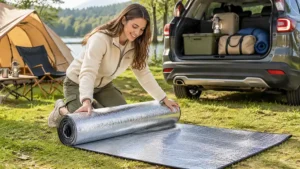
A foam sleeping pad for car camping plays by different rules than a backpacking pad. Weight stops mattering, and comfort and space start to.
Here’s what to prioritize:
- Go wide. The Naturehike IXPE Foam Pad (about 78.7 x 23.6 inches) and the REDCAMP (22 inches wide) give more room than a standard 20-inch pad.
- Go long. Taller sleepers benefit from 78 inches or more, which keeps feet off the ground.
- Stack for comfort. In a car, you can carry two pads. Layering the NEMO Switchback over the Therm-a-Rest RidgeRest Classic adds both cushion and R-value.
- Use the trunk. Bulk is a non-issue, so rolled pads that pack awkwardly on a backpack are perfectly fine.
The hidden advantage is cost. A good foam sleeping pad for car camping can cost less than a single tank of gas, and it survives pets, kids, and gravel without complaint. Pair it with a camp blanket or an inexpensive topper, and you can approach the comfort of far pricier gear.

Entry-Level Gear: Why Foam Is the Smartest First Pad
Entry-level gear should forgive mistakes, and foam forgives almost everything. A beginner will drop it, sit on it, drag it across gravel, and forget it in the rain. None of that matters.
Here’s the logic for first-timers:
- No learning curve. There’s no inflation technique, no valve to seal, and no leak to diagnose at midnight.
- Low financial risk. If you discover camping isn’t your thing, you’ve spent a modest sum. If it is, you’ll upgrade knowing exactly what you want.
- Lasting usefulness. Even after upgrading to an air pad, a foam pad keeps earning its place as puncture insurance, a seat, or a kneeling pad.
The best entry-level gear is the kind you never think about, and that’s the whole appeal of a budget foam sleeping pad. For beginners, the Therm-a-Rest RidgeRest Classic and THINTON are the lowest-risk starting points, while the Therm-a-Rest Z Lite Sol is the “buy once, keep forever” choice.
No-Maintenance Camping Pad: Long-Term Cost & Durability
A no-maintenance camping pad changes the cost equation. A pad with no failure points has no repair costs, no replacement anxiety, and no hidden fees.
Do the math with an illustrative example. A pad costing around $40 and used for 50 nights works out to under a dollar per night. Over a decade of occasional use, that figure keeps shrinking. Closed-cell foam gradually compresses with age, which slowly erodes insulation, but compared with an air pad that can develop a slow leak, the failure mode is gentle rather than sudden.
What “no-maintenance” really means in practice:
- No inflation hardware. Nothing to jam, leak, or wear out.
- No repair kit. Cuts and scuffs rarely affect function.
- Simple cleaning. A damp cloth and shade-drying handle most grime.
Brands with lifetime warranties, such as NEMO and Featherstone, add another layer of protection. Even so, a budget foam sleeping pad isn’t entirely immortal. Over years, bumps flatten and R-value drifts down. If your pad has noticeably thinned, it’s time to retire it.
Features That Actually Matter (And Those That Don’t)
Marketing loves to dress up simple foam. Here’s what deserves your attention.
Features that matter:
- Verified R-value. Standardized numbers let you compare pads honestly.
- Thickness and width. They decide whether you sleep or suffer.
- Fold style. It affects daily convenience more than almost any spec.
- Warranty. A lifetime warranty signals manufacturer confidence.
Features that matter less:
- Reflective coatings. The 20% extra warmth claimed for the Therm-a-Rest Z Lite Sol is a manufacturer figure, so don’t build a cold-weather plan around it.
- Surface patterns. Hexagons, egg-crates, and ridges each have fans, but the differences are modest. The hex nodes on the NEMO Switchback and Featherstone El Cordion feel better to many reviewers, while egg-crate surfaces collect debris.
- Color. Charcoal hides dirt, but that’s about it.
Rule of thumb: pay for thickness, width, and trust, and ignore the rest.
Price Range & Value Analysis
| Tier | Price Range | Example Pad | What You Give Up | Best For |
|---|---|---|---|---|
| Ultra-budget | Under $30 | THINTON | Verified specs, warranty | Tightest budgets |
| Low | $35–$45 | Therm-a-Rest RidgeRest Classic | Plush cushioning | First-time campers |
| Mid | $50–$60 | Therm-a-Rest Z Lite Sol, NEMO Switchback | Not much | Regular campers |
| Air pad reference | $50–$70 | Klymit Static V | Durability, R-value | Comfort seekers |
The value story is clear. Spending $35–$45 on the Therm-a-Rest RidgeRest Classic buys proven durability from a major brand, while the $50–$60 tier buys comfort and refinement, not warmth, since every pad in that tier is still near R-2.0. The air pad reference shows why foam stays competitive: the Klymit Static V costs about the same as a premium foam pad but delivers a lower R-value and can fail. For most buyers, the sweet spot sits in the middle tier.
Frequently Asked Questions About Foam Sleeping Pads
❓ How long does a closed cell foam pad last?
❓ Can I stack a foam pad under an air pad?
❓ Do foam sleeping pads work on a camping cot?
❓ Is a budget foam sleeping pad warm enough for fall camping?
❓ How do I make a foam pad more comfortable for side sleeping?
Conclusion: Spend Little, Sleep Reliably
A budget foam sleeping pad is the gear equivalent of a good cast-iron pan: unglamorous, nearly indestructible, and quietly better than the fancy alternatives at its core job. Across these seven picks, you can cover almost any budget. The Therm-a-Rest RidgeRest Classic and THINTON Foam Camping Pad win on price. The REDCAMP, Naturehike, and Featherstone El Cordion offer interesting generics with honest caveats about unverified R-values. The Therm-a-Rest Z Lite Sol and NEMO Switchback are the proven top tier of the foam world.
Remember the trade: a closed cell foam pad is firm and bulky, with an R-value near 2.0, so plan for summer and shoulder seasons or stack layers for cooler nights. In return, you get entry-level gear that can’t fail and a no-maintenance camping pad that costs less per night than a cup of campfire coffee. For most campers, the smart move is to buy one reliable pad now and let your preferences guide any later upgrade.
Recommended for You
- Foam Sleeping Pad For Winter Camping: 7 Best Picks 2026
- Foam Sleeping Pad For Ultralight Backpacking: 7 Proven Picks 2026
- Sleeping Bag For Teens Backpacking: 7 Best Picks (2026)
Disclaimer: This article contains affiliate links. As an Amazon Associate, I earn from qualifying purchases. If you purchase products through these links, we may earn a small commission at no additional cost to you.
✨ Found this helpful? Share it with your friends! 💬🤗
