
In This Article
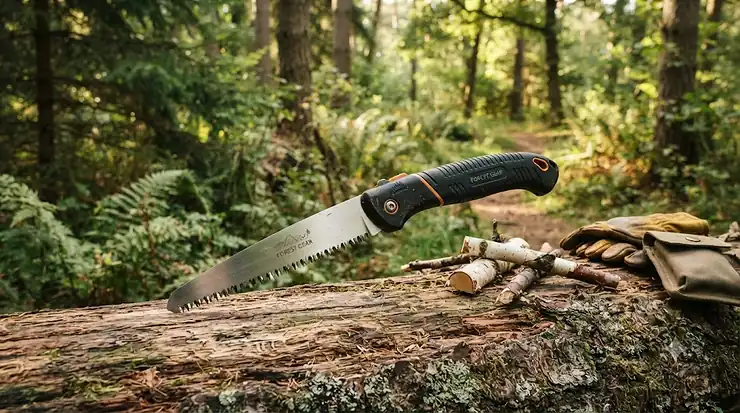
There’s a very specific kind of misery that comes from standing at your campsite at dusk, cold creeping in, holding a fistful of branches you cannot break and a fire pit that refuses to cooperate. A folding saw for camping fixes that problem in about four seconds flat, and once you’ve used a good one, you’ll wonder how you ever survived trips without it tucked in a side pocket. This isn’t a gadget. It’s the tool that separates “I have a fire going” from “I’m still snapping twigs over my knee like a caveman.”
So what is a folding saw for camping? It’s a compact hand saw with a hinged blade that folds into its own handle for safe, protected transport, designed to cut branches, deadfall, and small logs into usable firewood without the bulk, weight, or danger of an axe or chainsaw. Whether you’re a weekend car camper or a thru-hiker counting ounces, the right one turns firewood prep from a chore into something almost meditative.
We dug through real-world testing data, aggregated buyer feedback, and manufacturer specs on the most trusted names in the category — Bahco, Silky, Corona, Agawa Canyon, Opinel, and more — to build this camping saw review. Along the way we’ll unpack the technical stuff most articles skip: blade length, teeth per inch (TPI), and locking mechanisms, because those three details determine whether your saw feels like an extension of your arm or a frustrating hunk of steel. The National Park Service reminds campers to source firewood locally rather than hauling it in from home, which makes a reliable folding saw even more essential — you’ll often be processing whatever deadfall is legally available right at your site.
By the end, you’ll know exactly which of these seven saws fits your pack, your budget, and the kind of camping you actually do — not the kind Instagram thinks you do.
Quick Comparison Table
Before we go deep on each pick, here’s the fast version for anyone standing in an aisle (or a browser tab) trying to decide in the next ninety seconds.
| Saw | Blade Length | TPI | Best For | Price Range |
|---|---|---|---|---|
| Bahco Laplander | 7.5″ | 7 | Best all-around value | $20-$25 |
| Silky Gomboy Curve 240mm | 9.5″ | 8.5 | Best premium pick | $50-$65 |
| Corona RS 7265D RazorTOOTH | 10″ | 6 | Fastest pull-cut | $25-$35 |
| Agawa Canyon Boreal21 | 21″ | 7 (bow blade) | Car camping / heavy firewood | $60-$75 |
| Opinel No. 12 | 7″ | 7 | Lightest backpacking saw | $15-$25 |
| Silky BigBoy 2000 | 14″ | 6.5 | Heaviest-duty bushcraft | $90-$110 |
| REXBETI Heavy Duty | 11″ | 7 | Budget long-blade option | $20-$30 |
Looking at the spread here, you can see the category splits cleanly into three lanes: ultralight straight saws under 8 ounces, mid-size all-rounders in the 9-11 inch range, and heavy-duty bow saws or 14-inch blades built for serious wood processing. Price doesn’t always track with performance — the Laplander punches well above its $20 price tag, while the Boreal21’s extra bulk buys genuinely faster cutting for car campers who don’t mind the weight. If you only remember one thing from this table, let it be this: blade length and TPI matter more to your experience than brand name does.
💬 Just one click — help others make better buying decisions too!😊
💬 Found a saw that already caught your eye? Bookmark this page and keep scrolling — the full breakdown below explains exactly why each one earned its spot.
Top 7 Folding Saws for Camping: Expert Analysis
We didn’t just skim spec sheets for this camping saw review. Each entry below pulls from aggregated owner feedback, manufacturer data, and field-test reporting from outdoor gear publications, cross-checked so you’re getting an honest picture rather than a repackaged product listing.
1. Bahco Laplander 396-LAP — best all-around value for beginners
The Laplander earns its reputation the boring way: by working, every time, for people who don’t think about their saw until they need it. The 7.5-inch blade is fairly short compared to the rest of this list, but that’s the point — it’s short enough to stay controllable in one hand while still chewing through branches up to roughly 4 inches in diameter.
The Precision XT toothing on this blade uses a triple-ground pattern with roughly 7 teeth per inch, which in practice means a bite that’s aggressive on the pull stroke but still leaves a reasonably clean finish. At 7 ounces and a 9-inch folded length, it disappears into a pack side-pocket without you noticing it’s there, and the low-friction coating on the blade resists rust better than uncoated carbon steel typically does in humid conditions.
Who should buy this? Honestly, almost anyone starting out. Beginners get forgiving performance without a steep learning curve, budget-conscious campers get 90% of the cutting capability of saws costing twice as much, and backpackers appreciate that it barely registers on a gear scale. Reviewers consistently report that the two-position locking mechanism — one for open, one for closed — feels more secure than it has any right to for the price, and that the two-component rubberized handle stays grippy even when wet.
Aggregated review sentiment across major retailers and outdoor gear sites is remarkably consistent: the Laplander is repeatedly cited as one of the highest-rated folding saws in its class, with owners praising longevity that stretches into years of seasonal use. The most common critique isn’t about durability — it’s that the 7.5-inch blade runs out of steam on anything past 4-5 inches thick, which simply means it’s the wrong tool for bucking bigger rounds.
Pros:
- ✅ Extremely lightweight at roughly 7 ounces
- ✅ Two-position lock feels secure for the price
- ✅ Excellent value-to-performance ratio
Cons:
- ❌ Blade too short for logs over 4-5 inches
- ❌ Handle isn’t fully sealed against blade when folded
In the $20-$25 range, the Laplander is close to impossible to argue with as a value pick — you’d have to spend considerably more to meaningfully upgrade cutting capacity, and even then you’d be trading away its featherweight portability.
2. Silky Gomboy Curve 240mm — sharpest premium blade on the trail
Japanese saw manufacturers built their reputation on blade geometry, and the Gomboy Curve is a clean demonstration of why. The curved 9.5-inch blade uses impulse-hardened teeth — a manufacturing process that hardens just the tooth tips rather than the whole blade — which lets Silky get teeth that are both harder and thinner than conventional Western saws.
In practical terms, that thinner tooth profile means less material dragging through the wood on every stroke, so the saw feels noticeably faster than its blade length would suggest. At roughly 8.5 teeth per inch, it’s tuned for a smooth, controllable cut rather than the aggressive rip of a coarser blade, which matters if you’re cutting near a tent, a hammock, or your own knee. The saw offers two locking positions along the handle, letting you adjust cutting angle for awkward branches without repositioning your whole body.
Bushcraft-focused buyers and campers who genuinely use their gear season after season are the target audience here — not because the Gomboy is fussy, but because its price only pays off if you’re logging real hours with it. Reviewers who’ve owned Silky saws for multiple seasons frequently mention that the blade holds an edge dramatically longer than typical hardware-store saws, and that when it does eventually dull, replacement blades cost a fraction of a new saw.
The recurring critique in aggregated feedback is less about performance and more about value perception: casual weekend campers sometimes feel the price tag is hard to justify next to a $20 alternative that gets the job done adequately.
Pros:
- ✅ Impulse-hardened teeth stay sharp far longer
- ✅ Thinner blade profile cuts noticeably faster
- ✅ Replacement blades cost less than a new saw
Cons:
- ❌ Premium price relative to budget options
- ❌ Overkill for occasional car camping use
At around $50-$65, the Gomboy Curve is best understood as an investment tool rather than an impulse buy — the kind of thing you hand down instead of replace.
3. Corona RS 7265D RazorTOOTH — fastest pull-cut for thick branches
Corona built its name in pruning tools, and the RazorTOOTH line borrows heavily from that pedigree, which shows in how aggressively this saw handles overhead and awkward-angle branches. The curved 10-inch blade is made from SK5 Japanese carbon steel with a chrome coating, a combination that balances edge retention against rust resistance in a way plain carbon steel can’t match.
With roughly 6 teeth per inch, this is a deliberately coarse blade — the tradeoff for a rougher cut finish is genuinely fast material removal, especially on the pull stroke the RazorTOOTH is optimized for. The pistol-grip handle shape puts your wrist in a more natural position during overhead cuts than the straight handles common on cheaper saws, which matters more than it sounds like it should after your twentieth branch.
Campers clearing a site, hunters cutting shooting lanes, and anyone dealing with green wood rather than dry, seasoned lumber will appreciate this saw’s speed advantage. Aggregated customer feedback repeatedly highlights the pull-cut design as ideal for reaching branches above head height, and several reviewers specifically call out the SK5 steel’s durability under heavy repeated use. The consistent complaint across review sources is the coarser 6-TPI finish, which leaves a noticeably rougher cut edge than the Silky or Bahco — acceptable for firewood, less so if you care about a clean finish.
Pros:
- ✅ Fast, aggressive pull-cut on thick branches
- ✅ Pistol-grip handle reduces wrist strain overhead
- ✅ Chrome-coated SK5 steel resists rust well
Cons:
- ❌ Coarser 6 TPI leaves a rougher finish
- ❌ Bulkier grip than minimalist straight-handle saws
Priced around $25-$35, this is the saw to reach for when speed matters more than finesse — think firewood processing, not fine carpentry.
4. Agawa Canyon Boreal21 — most powerful bow saw for car camping
This is the outlier on our list, and deliberately so. Instead of a straight folding blade, the Boreal21 uses a triangular aluminum frame that folds flat for transport but opens into a full 21-inch bow saw, using widely available standard bow saw replacement blades rather than a proprietary one.
That 21-inch cutting length is the whole story here: it lets the saw process 6-inch-diameter logs in a fraction of the strokes a straight folding saw would need, largely because bow saw geometry keeps more blade in contact with the wood on every pass. The tool-free tensioning system means you can swap a dulled blade for a fresh one in the field in under a minute, which is a genuine advantage over fixed-blade folding saws that require full replacement once worn out. When folded, the aluminum frame fully encloses the blade, leaving no exposed teeth to snag gear or skin.
Car campers, hunters processing game or clearing shooting lanes, and base-camp setups where a few extra pounds in the vehicle don’t matter are the ideal audience. This is not the saw for a 10-mile backpacking loop — the roughly 1-pound weight (closer to 15-17 ounces depending on blade) is noticeably more than the straight folding saws on this list, and its folded footprint is bulkier too. Aggregated reviews consistently praise the cutting speed advantage over conventional folding saws, with owners specifically noting how much faster a stack of firewood comes together compared to smaller blades. The tradeoff reviewers flag most often is exactly the one you’d expect: it’s simply a bigger, heavier tool than most backpackers want to carry.
Pros:
- ✅ 21-inch blade processes logs dramatically faster
- ✅ Replacement blades are cheap and widely available
- ✅ Fully enclosed frame when folded for safety
Cons:
- ❌ Noticeably heavier than straight folding saws
- ❌ Bulkier folded profile, less pack-friendly
At $60-$75, the Boreal21 delivers genuine bow-saw cutting power in a package that still folds flat — just budget the extra weight into your car camping load, not your backpacking base weight.
5. Opinel No. 12 — lightest pick for ultralight backpacking
If you count grams the way some people count calories, the Opinel earns a permanent spot in your kit. At roughly 4 ounces, it’s built like an oversized version of Opinel’s famous folding pocket knives — a beechwood handle, a simple pivot, and a compact 7-inch blade that folds flush into the wood grip.
The tradeoff for that featherweight profile is capacity: this saw is best suited to branches recommended up to about 3.15 inches in diameter, and pushing much beyond that turns a quick job into a workout. With roughly 7 teeth per inch on a relatively narrow blade, it’s tuned for controllable, precise cuts on smaller material rather than raw cutting speed on big rounds.
Ultralight backpackers, minimalist bushcrafters, and anyone whose primary use case is kindling, tent stakes, and small deadwood rather than full rounds of firewood will get the most value here. What most buyers overlook about this model is that its simplicity is a feature, not a limitation — there’s essentially nothing to break, no complex locking hardware to fail in the field, just a wood handle and a folding blade. Aggregated feedback frequently cites the Opinel as the lightest saw testers have used, with owners appreciating how little they notice its weight in a pack. The recurring critique is capacity-related: buyers expecting to process real firewood rounds are consistently disappointed, since that’s simply outside this saw’s design intent.
Pros:
- ✅ Remarkably light at about 4 ounces
- ✅ Simple design with minimal failure points
- ✅ Compact enough to disappear in any pack
Cons:
- ❌ Limited to branches under roughly 3 inches
- ❌ Slower going on anything approaching its max capacity
At $15-$25, the Opinel No. 12 is less a firewood tool and more a precision instrument for campers who prioritize ounces above almost everything else.
6. Silky BigBoy 2000 — heaviest-duty blade for serious bushcraft
When Silky’s own marketing calls something a professional-grade landscaping tool, believe them. The BigBoy 2000 steps up to a full 14-inch blade, available across several tooth configurations so you can match the saw to green wood, dry wood, or general-purpose use rather than accepting a one-size-fits-all compromise.
At roughly 6.5 teeth per inch in its standard configuration, the BigBoy trades some of the Gomboy’s finesse for outright cutting capacity — this blade is built to process substantially thicker material without binding, which matters when you’re clearing trail obstructions or bucking real deadfall rather than tidy campground kindling. The rubberized handle is specifically shaped to wick moisture away during extended sawing sessions, a small detail that matters a lot on hour three of trail clearing.
This is a tool for people who use saws hard and often: trail crews, serious bushcrafters, hunters processing large game sites, and anyone whose “camping” regularly overlaps with backcountry work. Reviewers who’ve run this saw through multiple seasons consistently describe it as durable enough to outlast several cheaper saws combined, and note that the replaceable-blade system means the handle itself rarely needs replacing. The near-universal caveat in aggregated feedback is price and size — this isn’t a saw anyone buys casually, and its 14-inch folded length is genuinely too large for minimalist packing setups.
Pros:
- ✅ 14-inch blade handles genuinely thick material
- ✅ Multiple tooth configurations for different wood types
- ✅ Replaceable blade extends the tool’s lifespan
Cons:
- ❌ Expensive relative to most camping saws
- ❌ Too large and heavy for lightweight backpacking
Expect to pay in the $90-$110 range for the BigBoy 2000, which places it firmly in “buy once, use for a decade” territory rather than casual weekend-warrior gear.
7. REXBETI 11-Inch Heavy Duty Folding Hand Saw — longest blade on a budget
REXBETI’s pitch is straightforward: give buyers a longer blade than typical budget saws without the typical budget-saw price jump. The 11-inch SK-5 steel blade is genuinely long for this price tier, and the staggered 7-TPI tooth pattern is aggressive enough to handle branches up to roughly 6-7 inches in diameter — well beyond what the similarly priced Laplander can manage.
That extra length comes with a real-world tradeoff, though: a longer unsupported blade flexes more than the shorter, stiffer options on this list, especially compared to triangular-frame bow saws like the Boreal21 which brace the blade on both ends. In practice this means you’ll want to start cuts straight and keep steady pressure rather than forcing an angled bite, or the blade can wander mid-stroke. The bright orange locking mechanism is a smart touch, making it easy to visually confirm the blade is secured open or closed at a glance rather than checking by feel.
Budget-conscious campers who want more cutting capacity than an ultralight saw offers, without paying premium prices, are the clear target here. Aggregated reviews describe the REXBETI as a strong performer for the price on medium-diameter branches, with buyers frequently comparing it favorably to saws costing considerably more. The consistent knock against it is rigidity on the largest logs it claims to handle — reviewers note it works best when you respect its limits rather than pushing the full advertised 6-7 inch capacity every time.
Pros:
- ✅ 11-inch blade handles thicker branches than peers
- ✅ Bright locking mechanism is easy to verify visually
- ✅ Strong value at a genuinely low price point
Cons:
- ❌ Blade flexes more on the largest logs
- ❌ Bulkier and heavier than similarly priced saws
At $20-$30, the REXBETI is the pick for campers who want Corona-level cutting reach without spending Corona-level money, provided you’re willing to work within its limits on the biggest rounds.
Top 7 Folding Saws: Specs, Ratings & Value Snapshot
| Saw | Weight | Folded Length | Locking Mechanism | Rating Trend |
|---|---|---|---|---|
| Bahco Laplander | ~7 oz | 9″ | Two-position lock | Consistently high |
| Silky Gomboy Curve | ~9 oz | 10.5″ | Two-position lock | Consistently high |
| Corona RS 7265D | ~11 oz | 12″ | Single lock-back | Positive, minor finish complaints |
| Agawa Canyon Boreal21 | ~16 oz | 22″ | Tool-free tensioning lock | Positive, weight noted |
| Opinel No. 12 | ~4 oz | 8″ | Friction pivot, no lock | Positive for intended use |
| Silky BigBoy 2000 | ~13 oz | 16″ | Two-position lock | Strongly positive, long-term |
| REXBETI Heavy Duty | ~12 oz | 13″ | Single lock-back | Positive, capacity caveats |
Weight and folded length track almost exactly with cutting capacity, which shouldn’t surprise anyone but is still worth stating plainly: there’s no way to get a 21-inch cutting length in a 9-inch package. The locking mechanism column is arguably more important than most buyers realize going in — a saw without a secure open-position lock, like the friction-pivot Opinel, asks you to trust your grip strength on every stroke, which is fine for small material and unnerving for anything bigger.
Folding Saws vs. Traditional Alternatives
| Tool | Weight | Setup Time | Safety Profile | Best Use Case |
|---|---|---|---|---|
| Folding saw | 4-16 oz | Seconds | High — blade enclosed when closed | General camping, backpacking |
| Camp axe/hatchet | 1.5-3 lbs | None | Lower — swing risk, requires space | Splitting, not cross-cutting |
| Bow saw (fixed) | 1-2 lbs | None | Moderate — exposed blade | Base camp, heavy processing |
| Battery chainsaw | 6-10 lbs | Minutes (charge/assembly) | Lowest — kickback risk | Large-scale trail clearing |
A folding saw for camping wins the portability and safety categories almost by default — nothing else on this table tucks into a jacket pocket or eliminates swing-radius risk the way a folded blade does. Where it loses ground is raw processing speed against a battery chainsaw, though that comparison only matters if you’re clearing serious volume rather than prepping a night’s worth of firewood. For the vast majority of camping scenarios, the folding saw’s blend of low weight, contained blade, and genuinely fast setup makes it the more sensible everyday carry, with an axe or chainsaw reserved for jobs that specifically call for splitting or high-volume clearing.
✨ Ready to Upgrade Your Firewood Game?
🔥 Stop wrestling branches by hand and start cutting clean, controlled fuel for your next fire. Click through on any of the picks above to check current availability and pricing — your future campsite self will thank you.
Practical Usage Guide: Setup, First Cuts & Maintenance
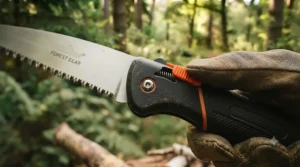
Getting a new folding saw home is only step one. Before your first trip, deploy the blade fully and confirm the locking mechanism clicks or seats firmly — this takes ten seconds and prevents an unpleasant surprise mid-stroke later. For saws like the Boreal21 that require frame assembly, practice the fold-and-lock sequence at home in good light rather than fumbling with it for the first time at dusk.
On your first few outings, resist the urge to force big cuts immediately. Start with smaller branches to get a feel for how much pressure the blade wants — most folding saws cut on the pull stroke, so overloading the push stroke just wastes energy and can bend thinner blades. A common first-30-days mistake is sawing at too shallow an angle, which causes the blade to skate across bark instead of biting in; start your cut nearly perpendicular to the branch, then settle into a natural rhythm once the kerf is established.
Maintenance matters more than most campers assume. Wipe sap and debris off the blade after each use — a damp cloth works, though the UNH Extension recommends steel wool for stubborn rust on garden cutting tools, and the same principle applies here. Store the saw folded and, ideally, lightly oiled if you’re in a humid climate, since carbon steel blades will develop surface rust faster than you’d expect after a rainy trip. Most folding saws aren’t user-sharpenable in the way a knife is, so treat dulling as a sign it’s time for a replacement blade rather than reaching for a file.
Real-World Scenarios: Which Saw Fits Your Trip
The weekend car camper. You’re driving to a developed campground, firewood is either provided or purchasable, and your saw mainly handles kindling and the occasional oversized branch. The Corona RS 7265D or REXBETI Heavy Duty both make sense here — you have the trunk space to justify a slightly bulkier saw, and the extra cutting capacity means fewer trips back to the woodpile.
The thru-hiker counting ounces. Every gram matters, your fires (where permitted) are small, and you’re processing twigs and kindling rather than full rounds. The Opinel No. 12 or Bahco Laplander are the obvious calls — both disappear into a pack and handle everything a backpacking saw realistically needs to.
The base-camp hunter or bushcrafter. You’re stationary for days, processing real volumes of wood for warmth and cooking, and weight matters less than raw output. The Agawa Canyon Boreal21 or Silky BigBoy 2000 earn their extra bulk here, cutting through logs in a fraction of the strokes a smaller saw would need.
Problem → Solution: Common Folding Saw Headaches
Blade binding mid-cut usually means you’re not applying steady, straight pressure — ease off and let the teeth do the work rather than forcing the angle, and consider a triangular-frame saw like the Boreal21 if this happens constantly with a straight blade. A saw that won’t lock securely open is a genuine safety issue; check for debris in the locking mechanism first, and if it persists, that saw needs replacing before your next trip. Rust spots after a wet trip respond well to a vinegar soak and steel wool, followed by a light coat of oil before storage. If cuts are coming out ragged and slow, the blade is likely just dull or damaged — on replaceable-blade saws like the Boreal21 or BigBoy, swap it; on fixed-blade models, that’s typically the end of the saw’s useful life. Finally, if you keep bruising your knuckles on smaller bow-style saws, lengthen your stroke and adjust your grip position rather than assuming the tool is flawed — it’s a near-universal complaint on compact bow saws and almost always a technique fix.
Blade Length and Cutting Capacity: What Actually Matters
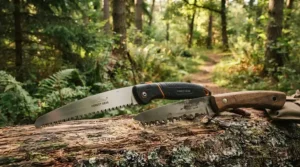
Blade length is the single biggest predictor of what a folding saw can actually cut, and manufacturers don’t always make the relationship obvious. As a rough rule, a straight folding saw can comfortably handle branches up to roughly half its blade length in diameter before you’re fighting the tool rather than the wood — so a 7.5-inch Laplander tops out around 4 inches, while a 14-inch BigBoy can chew through 7-inch material without binding.
Bow-style saws break this rule in your favor because the frame supports the blade on both ends, letting a 21-inch blade like the Boreal21’s cut proportionally larger material with less flex than a straight blade of similar length would show. What the spec sheet won’t tell you is that blade width matters almost as much as length — a wider blade resists twisting mid-cut, which is why premium straight saws often feel more stable than their raw length suggests. If your camping mostly involves kindling and small deadfall, an 7-9 inch blade is plenty; if you’re regularly processing rounds for an overnight fire, step up to 10-14 inches or consider a bow saw.
Teeth Per Inch Explained: Why TPI Changes Everything
Teeth per inch, or TPI, describes how many cutting teeth occupy each inch of blade — and it’s the spec most camping saw reviews mention without actually explaining. Lower TPI (roughly 5-6) means bigger, more widely spaced teeth that remove more material per stroke, cutting faster through green or thick wood at the cost of a rougher finish. Higher TPI (8 and above) packs teeth closer together for a smoother, more controlled cut, better suited to smaller or drier material where precision matters more than raw speed.
This is why the Corona’s 6-TPI blade feels aggressive and fast on thick branches while the Silky Gomboy’s roughly 8.5-TPI blade feels more refined on smaller cuts. Reviewers consistently note that campers who mainly process green wood — freshly fallen branches with high moisture content — get better results from lower-TPI blades, since coarser teeth clear wet sawdust more effectively without clogging. If your trips mix both green branches and dry, seasoned firewood, a mid-range TPI in the 7 range, like the Laplander, REXBETI, or Boreal21 all use, is the most versatile compromise.
Locking Mechanisms: The Safety Feature Amazon Listings Gloss Over
A folding saw’s locking mechanism is arguably more important to your safety than the blade steel, yet it’s routinely buried at the bottom of product descriptions. The best designs, like the two-position locks on the Bahco and Silky saws, secure the blade firmly in both the open and closed positions — meaning the blade can’t fold shut onto your fingers mid-cut, and won’t spring open unexpectedly while packed away.
Single lock-back mechanisms, found on saws like the Corona and REXBETI, are simpler and generally reliable but require a deliberate release action to close, which is a feature rather than a flaw — it prevents accidental folding. Tool-free tensioning systems on bow saws like the Boreal21 serve a slightly different function, keeping the blade taut under load rather than locking a hinge, but the safety principle is the same: a loose or poorly seated blade is a hazard regardless of saw type. The one outlier here is the Opinel’s friction-pivot design, which has no true lock at all — acceptable for its intended light-duty use, but worth knowing before you rely on it for anything requiring real cutting force. Before every trip, it’s worth a quick habit: open, lock, tug gently to confirm, then fold, lock, and confirm again.
Backpacking Saw vs. Car Camping Saw: Picking the Right Category
The backpacking saw category prioritizes one variable above all others: weight. If you’re carrying everything on your back for multiple days, a saw in the 4-9 ounce range — the Opinel or Bahco Laplander — earns its place precisely because you won’t notice it’s there until you need it. Cutting capacity takes a back seat, since most backpacking fires (where permitted) are small and fed with kindling rather than full rounds.
Car camping flips that priority. With a trunk instead of a pack doing the carrying, weight becomes nearly irrelevant, and cutting capacity moves to the top of the list. This is where the Boreal21, BigBoy 2000, or even the bulkier REXBETI make more sense — you can process a genuinely useful stack of firewood in less time and fewer strokes, and the extra ounces cost you nothing. The mistake we see most often is campers buying based on one category while actually doing the other: a heavy bow saw jammed into an already-overloaded backpack, or an ultralight Opinel struggling to keep up with a car camper’s bonfire ambitions.
Pruning Saw for Camping: Dual-Purpose Tools Worth Considering
Several saws on this list, notably the Corona RS 7265D and Silky Gomboy, started life as horticultural pruning tools before outdoor brands adapted them for camping use — and that heritage shows up as a genuine advantage. A pruning saw for camping brings curved-blade geometry optimized for cutting live or green branches at an angle, which is exactly the scenario campers face when clearing a tent site or trimming an overhanging limb rather than processing dead, seasoned firewood.
The tradeoff is that pruning-oriented blades, with their aggressive pull-cut design, aren’t always the fastest choice on dry, seasoned wood compared to a saw purpose-built for firewood processing. If your camping regularly involves site prep — clearing brush, trimming low branches for a hammock setup, or dealing with green deadfall after a storm — a pruning-style folding saw like the Corona or Gomboy earns its keep twice over. If your use case is strictly firewood, a straight or bow-style blade tuned for dry wood will generally out-perform a pruning saw stroke for stroke.
How to Choose a Folding Saw for Camping
- Match blade length to your typical wood diameter. If you’re mostly cutting kindling, 7-9 inches is plenty; for regular firewood rounds, look at 10 inches or more.
- Prioritize weight based on how you travel. Backpackers should weight ounces heavily; car campers can largely ignore this factor.
- Check the TPI against the wood you’ll cut most. Lower TPI for green, thick wood; higher TPI for dry, precise cuts.
- Confirm the locking mechanism secures both open and closed positions. This is a safety non-negotiable, not a nice-to-have.
- Consider blade replaceability. Saws with swappable blades, like the Boreal21 and BigBoy, cost less to maintain long-term than fixed-blade models.
- Factor in your budget realistically. A $20 Laplander outperforms its price class; a $100 BigBoy only makes sense if you’ll actually put in the hours to justify it.
- Think about your actual trip type, not your aspirational one. Buy for the camping you do most often, not the expedition you might take someday.
Common Mistakes When Buying a Folding Saw for Camping
The most common mistake is buying based purely on blade length without checking TPI or locking mechanism quality — a long blade with a weak lock is a liability, not an upgrade. Close behind is the backpacker who buys a heavy-duty bow saw because it looked impressive online, then curses its weight for ten miles. On the flip side, car campers sometimes underbuy, grabbing an ultralight saw better suited to backpacking and then wondering why it struggles with actual firewood rounds. Buyers also frequently overlook blade replaceability, not realizing that a fixed-blade saw becomes disposable once it dulls beyond field-sharpening, while a swappable-blade design like the Boreal21 stretches the tool’s useful life for years longer. Finally, skipping the safety-lock check before a trip is a mistake that only reveals itself at the worst possible moment — mid-cut, with a loose or unlocked blade.
Long-Term Cost & Maintenance: What You’ll Actually Spend
The sticker price is rarely the full cost of ownership. Fixed-blade budget saws like the Laplander or REXBETI are cheap upfront, but once the blade dulls past usable — typically after several seasons of regular use — the entire tool gets replaced, effectively resetting your investment to zero. Saws with replaceable blades change that math considerably: a Boreal21 or BigBoy 2000 costs more initially, but a fresh blade typically runs a fraction of the price of a new saw, meaning the handle and frame you already paid for keep working for years across multiple blade replacements.
Maintenance costs are modest across the board — a bottle of oil and occasional steel wool for rust spots covers most of it — but neglecting that small effort shortens a blade’s working life noticeably, especially in humid or coastal climates where carbon steel corrodes faster. Run the numbers over a five-year ownership window and the premium saws often come out roughly comparable to buying two or three budget saws in succession, with the added benefit of consistently better cutting performance the whole time rather than a slow decline toward replacement.
Firewood Rules and Safety: What Every Camper Should Know
Having the right saw doesn’t help if you’re not legally allowed to cut what’s in front of you. Most national forests permit collecting dead and down wood for on-site campfires without a permit, but cutting standing trees — dead or alive — or removing limbs from them is typically prohibited without separate authorization. The Bureau of Land Management outlines similar rules for its public lands, generally allowing reasonable personal-use collection of dead and down wood while restricting larger-scale harvesting to permitted use. Rules vary meaningfully by park, forest, and even by specific campground, so a quick check of posted regulations or the managing agency’s website before your trip saves you an awkward conversation with a ranger.
Beyond regulations, basic safety habits matter as much as the tool itself: always cut with the blade moving away from your body, keep your off-hand well clear of the cutting path, and never force a saw through material it’s clearly too small to handle — that’s how blades bind, slip, or snap. Gloves are a genuinely underrated addition for anyone processing more than a handful of branches, protecting against both blisters and the occasional slip.
Frequently Asked Questions
❓ What is the best folding saw for camping overall?
❓ What blade length do I need for a camping saw?
❓ How many teeth per inch should a camping saw have?
❓ Is a folding saw better than a hatchet for camping?
❓ How do I maintain a folding saw for camping?
Conclusion
A folding saw for camping earns its spot in your kit faster than almost any other piece of gear you’ll buy this year — it’s inexpensive, it’s safe, and it solves a problem you’ll run into on literally every trip that involves a fire. The right pick depends entirely on how you camp: backpackers should lean toward the featherweight Opinel or Bahco Laplander, car campers get real value from the cutting capacity of the Corona, REXBETI, or Boreal21, and anyone logging serious hours in the backcountry should look hard at the Silky lineup for its long-term durability.
What matters more than any single spec is matching the saw to your actual trips rather than an aspirational version of them. Blade length determines what you can cut, TPI determines how it feels to cut it, and the locking mechanism determines whether you can trust the tool in your hand. Get those three things right for your specific camping style, and you’ll have a tool that quietly does its job for years, one campfire at a time.
✨ Don’t Miss These Exclusive Deals!
🔍 Take your firewood prep to the next level with these carefully selected folding saws. Click on any highlighted pick above to check current pricing and availability, and turn your next camping trip into the warm, well-lit adventure it deserves to be.
Recommended for You
- Best Camping Hatchet 2026: 7 Top Picks, Tested & Ranked
- Leatherman vs Gerber Camping: 7 Best Multi-Tools for 2026
- 7 Best Multi-Tools for Camping in 2026
Disclaimer: This article contains affiliate links. As an Amazon Associate, I earn from qualifying purchases. If you purchase products through these links, we may earn a small commission at no additional cost to you.
✨ Found this helpful? Share it with your friends! 💬🤗
