
In This Article
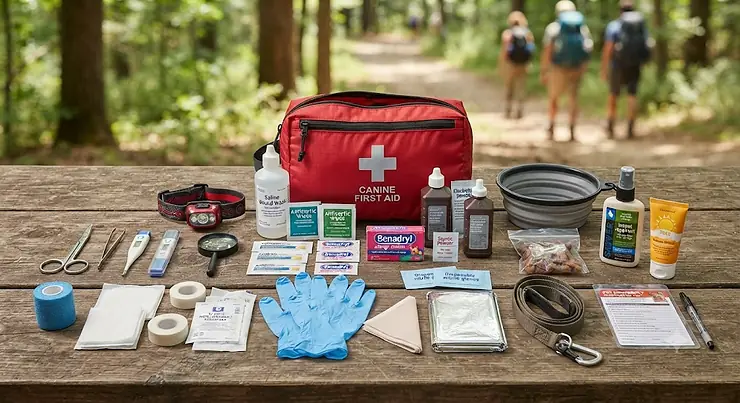
Somewhere around mile four of a hike, your dog yelps, hops on three legs, and you realize you have absolutely nothing in your pack to help. A dog first aid kit hiking setup exists precisely for that moment — a compact, purpose-built collection of wound care, tick tools, and wraps sized for paws instead of people. Unlike a human blister kit, it’s built around the injuries dogs actually rack up on trail: torn pads, embedded ticks, thorn punctures, and the occasional overheated, wobbly-legged retreat back to the car.
Trails are wonderful places for dogs, but the terrain doesn’t care about that. Sharp scree, tall grass thick with ticks, and unpredictable wildlife encounters mean the risk profile for a hiking dog is genuinely different from a couch-bound one. The National Park Service’s guidance on ticks and tickborne disease notes that hard ticks are especially common along trail edges and in wooded, brushy terrain — exactly the environment most hiking dogs move through daily. This guide walks through seven real, currently available kits — from ultralight trail pouches to full 72-hour backpacks — and shows you exactly which one matches your hiking style, your dog’s size, and your budget.
We’re not just listing what’s in the box, either. Every product section below breaks down what the specs actually mean on the trail, what real buyers report after using these kits, and where the honest tradeoffs are. You’ll also get comparison tables, a decision framework, and dedicated sections on tick removal tools, paw bandage supplies, and pet medication storage — because a kit is only as good as your ability to use it correctly when your dog is hurt and scared.
Quick Comparison Table
| Kit | Best For | Weight/Size | Price Range |
|---|---|---|---|
| Adventure Medical Kits Trail Dog Medical Kit | Lightweight day hikes | 12 oz, 7.5″x5.3″x1.5″ | $35-$45 range |
| Kurgo RSG Dog First Aid Kit | Hands-free MOLLE carry | 50 pieces, compact pouch | $30-$40 range |
| rubyloo Dog First Aid Kit | Nervous first-time owners | Compact pouch | $25-$35 range |
| ARCA PET Cat & Dog First Aid Kit | Budget starter kit | 35 pieces | Under $30 |
| RHINO RESCUE Pet First Aid Kit | Basecamp + trail combo | Compact zip case | $35-$45 range |
| EVERLIT Pet Medic First Aid Kit | Deep backcountry supply count | 95 pieces | $35-$45 range |
| Pet Evac Pak Big Dog Pak | Multi-day, big dogs, disaster-prone areas | Full backpack, 30-70 lb dogs | $90-$120 range |
Looking at the table, the split comes down to trip length and dog size more than anything else. Day hikers who want to move fast will lean toward the Adventure Medical Kits Trail Dog Medical Kit or the Kurgo RSG Dog First Aid Kit, since both prioritize low weight over sheer item count. Anyone heading into multi-day or genuinely remote territory, on the other hand, should look hard at the EVERLIT Pet Medic First Aid Kit or the backpack-style Pet Evac Pak Big Dog Pak, which trade portability for depth of supply.
💬 Just one click — help others make better buying decisions too!😊
Top 7 Dog First Aid Kits for Hiking: Expert Analysis
1. Adventure Medical Kits Trail Dog Medical Kit — lightest full-featured trail kit
At 12 ounces and roughly the size of a paperback, this kit answers the question every ultralight hiker asks first: how little can I carry and still be covered? The specs back that up — the kit ships inside a waterproof DryFlex bag, includes sterile gauze dressings, a conforming bandage, an irrigation syringe, saline wash, and a splinter picker/tick remover, all sized for wound care rather than home-medicine-cabinet bulk. Based on the spec comparison with bulkier options, this is the rare kit that doesn’t ask you to choose between “light enough to carry” and “actually useful when something goes wrong.”
What most buyers overlook about this model is the triangular bandage doing double duty as an improvised muzzle, a detail that matters more than it sounds — an injured dog in pain will sometimes bite the hand trying to help it, even a hand it trusts. Reviewers consistently note that the fur-friendly cohesive wrap doesn’t yank out fur on removal the way human athletic tape does, and multiple owners specifically mention using the kit for dogs with mobility differences (like tripod dogs) who are more prone to trail stumbles. The included handbook gets consistent praise for being genuinely readable in a stressful moment rather than written in dense clinical language.
Pros:
- ✅ Genuinely lightweight at 12 oz for full-day carry
- ✅ Waterproof inner bag keeps contents dry in wet terrain
- ✅ Splinter/tick remover and muzzle bandage included standard
Cons:
- ❌ No thermometer or medication storage space
- ❌ Limited quantity of dressings for back-to-back incidents
Priced in the $35-$45 range, this is solid value for a day-hiking essential rather than a full trip medical bag — pair it with a separate tick tool backup if you’re hiking in high tick-density regions.

2. Kurgo RSG Dog First Aid Kit — clips right onto your dog’s harness
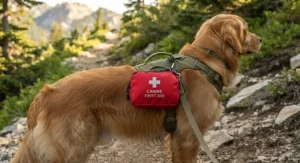
The standout feature here isn’t a medical supply at all — it’s the MOLLE-compatible attachment system that lets the pouch clip directly onto Kurgo’s RSG harnesses, activity belts, or any MOLLE-webbed pack. The 50-piece kit itself covers standard trail wound care: gauze pads in two sizes, a crepe bandage, alcohol and antiseptic prep pads, tweezers, small scissors, an instant cold pack, and a thermal foil emergency blanket, all housed in abrasion-resistant Oxford 600D fabric.
Here’s what to weigh: the hardware-first design means this kit is genuinely built for hikers who don’t want to think about where their first aid kit is mid-hike, because it’s already riding on the dog or on their belt. Reviewers consistently flag the tweezers as the weak link in an otherwise solid kit, with more than one long-term owner noting they swapped in a dedicated fine-tipped tool after years of use. The tongue depressors and cotton swabs are a nice touch for splinting small areas or applying ointment without contaminating a tube.
Pros:
- ✅ MOLLE clip system for true hands-free carry
- ✅ Durable Oxford 600D fabric holds up to repeat use
- ✅ Includes cold pack for sprains and swelling
Cons:
- ❌ Stock tweezers are a known weak point per owners
- ❌ No dedicated tick-specific removal tool included
At $30-$40 range depending on retailer, the value proposition here rides almost entirely on the attachment hardware — if you already own an RSG harness or MOLLE belt, that convenience alone can justify the price.
3. rubyloo Dog First Aid Kit — best vet-reviewed guide for panicked beginners
rubyloo’s pitch is straightforward: keep the kit compact and lean hard on a genuinely useful, vet-reviewed instruction guide rather than padding the piece count. The kit includes sterile gauze, adhesive tape, tweezers, antiseptic wipes, and a digital thermometer — a fairly standard core list — but the guide itself is the differentiator reviewers keep circling back to.
What the spec sheet won’t tell you, but user reports suggest, is that the real value shows up in the moment of panic, not on the shelf. A clearly organized, jargon-free step-by-step guide matters more than an extra roll of gauze when you’re kneeling on a trail trying to figure out if a limp needs a vet or just rest. This kit is best for beginner dog owners hiking for the first time who want confidence more than raw supply volume; it’s not the pick for someone who wants 90+ items to sort through under stress.
Pros:
- ✅ Vet-reviewed guide praised for clarity under stress
- ✅ Compact enough for a daypack side pocket
- ✅ Purchase supports a shelter-supply charitable program
Cons:
- ❌ Lighter on total item count than rival kits
- ❌ Not intended as a standalone multi-day trip solution
In the $25-$35 range, this is a smart pick for casual hikers and new dog owners who value guidance over gear density — pair it with a dedicated tick tool for full trail coverage.
4. ARCA PET Cat & Dog First Aid Kit — most budget-friendly starter kit
Aimed squarely at hikers who want baseline coverage without a big spend, this 35-piece kit includes a digital thermometer, a muzzle, and a small carabiner-style mini pouch meant for short hikes away from the main kit — a clever addition that acknowledges most people won’t carry a full first aid case on every walk. Based on the spec comparison with pricier rivals, the ARCA PET kit covers roughly the same wound-care basics (gauze, wipes, tape) at a noticeably lower price point.
Here’s what to weigh: reviewers who tested this against costlier competitors found that, for the price, you can swap in a better tick remover separately and still spend less overall than most competing kits. It’s genuinely well-suited as a first kit for hikers just starting to bring their dog on trail, and doubles nicely as a backup kit kept in the car. For serious backcountry trips far from veterinary care, though, the 35 pieces may not stretch far enough on their own.
Pros:
- ✅ Lowest price point among comparable name-brand kits
- ✅ Mini carabiner pouch splits kit for short hikes
- ✅ Includes digital thermometer, muzzle, and core wound care
Cons:
- ❌ 35 pieces may run short on multi-incident days
- ❌ Included tick remover is basic compared to dedicated tools
At under $30, this is the clearest budget-conscious pick on this list, and honestly one of the best value-per-dollar entries for anyone hiking with a dog for the first season.
5. RHINO RESCUE Pet First Aid Kit — best all-in-one for basecamp and trail
RHINO RESCUE built this kit to straddle daily pet care and trail emergencies rather than picking one lane. Along with gauze, self-adhesive bandage, an ice pack, and an emergency blanket, it adds a thermometer, a feeding kit, a muzzle, a pill bag, a collapsible water bowl, and disposable foot booties — supplies that matter as much for a rough weekend at a campsite as for an actual trail injury.
What most buyers overlook about this model is how much of it is genuinely daily-use gear, not just emergency-only supplies. The disposable booties, for instance, aren’t just for injuries — reviewers use them proactively on hot pavement or sharp scree before a cut ever happens. On paper this means slightly more bulk than a stripped-down trail-only kit, but for hikers who also car-camp or do multi-day trips with a home base, that trade makes sense. The abrasion-resistant fabric and two-way zippers hold up reasonably well according to owner feedback, though the kit runs closer to $40 than the budget tier.
Pros:
- ✅ Thermometer plus feeding kit covers daily and emergency needs
- ✅ Disposable booties useful proactively, not just after injury
- ✅ Durable two-way zipper closures on abrasion-resistant fabric
Cons:
- ❌ Bulkier than kits built strictly for lightweight day hikes
- ❌ Priced near the top of the mid-range tier
At roughly $35-$45, this is best for hikers who split time between basecamp and trail rather than pure ultralight day-trippers.
6. EVERLIT Pet Medic First Aid Kit — deepest backcountry supply count
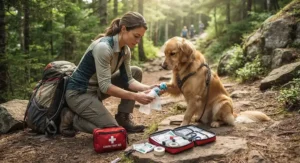
With 95 individually selected pieces, this is the deepest kit in this roundup by item count, and reviewers who’ve unboxed it consistently note that the supplies feel curated rather than padded for a bigger number on the label. The kit is built around what one reviewer called the “top 10 vet-recommended essentials,” including cleansing wipes, sterile gauze pads and non-adherent pads, vet wrap, and self-adhesive elastic bandage — plus a metal tick remover that testers repeatedly single out as sturdier than the flimsy plastic tools bundled with cheaper kits.
Based on the spec comparison with lighter kits on this list, the tradeoff is straightforward: more coverage per incident, at the cost of more bulk in the pack. This is the pick for hikers who genuinely go deep into the backcountry, away from quick access to a vet, and want enough supply volume to handle more than one injury on a single trip without rationing gauze. Casual day hikers doing a two-hour loop near the trailhead don’t need this much kit.
Pros:
- ✅ 95 curated pieces cover multiple incidents per trip
- ✅ Metal tick remover outperforms typical plastic tools
- ✅ Vet-approved essential list reduces guesswork on contents
Cons:
- ❌ Larger footprint than minimalist day-hike kits
- ❌ Overkill for short, low-risk trail outings
In the $35-$45 range, this delivers genuinely strong value per dollar for anyone doing serious mileage or multi-day backcountry trips with their dog.
7. Pet Evac Pak Big Dog Pak — premium 72-hour bugout backpack for big dogs
This is the outlier on the list, and deliberately so — it’s not a pocket-sized pouch but a full backpack designed to keep a 30-70 lb dog supplied for up to 72 hours, combining a proper first aid kit with emergency dog food, water pouches, collapsible bowls, a mylar blanket, a slip lead, and a rope toy for stress relief. The first aid component alone includes PetVet wound and burn dressing, PetFlex stretch bandage, single-dose ClotIt blood-stopping powder, hydrogen peroxide spray, an instant cold pack, tweezers, sterile wound pads, and alcohol wipes.
Here’s what to weigh: the ClotIt blood-stopping powder is a genuinely meaningful upgrade over the styptic-free contents of smaller kits, since a torn nail or deep pad cut can bleed dramatically on a big, active dog. On paper this means the Big Dog Pak is less a hiking-day-trip item and more a preparedness system for hikers in wildfire, flood, or storm-prone regions, or anyone doing multi-day backcountry trips where a vet is genuinely hours away. It is not the kit you toss in a daypack for a two-mile loop.
Pros:
- ✅ Includes styptic powder for serious bleeding control
- ✅ 72-hour food, water, and supply coverage in one pack
- ✅ Backpack format built for grab-and-go evacuation scenarios
Cons:
- ❌ Bulky and unnecessary for short or casual day hikes
- ❌ Premium price compared to pouch-style kits on this list
At $90-$120 range, this is a premium, dual-purpose pick — equal parts hiking gear and household disaster-preparedness kit — best suited to owners in disaster-prone regions or serious backcountry trippers with a larger dog.
Setting Up and Maintaining Your Dog First Aid Kit Hiking System
Buying the kit is the easy part. The value comes from setting it up correctly and actually maintaining it, since expired antiseptic and a rusted tick tool help nobody on the trail. Start by unpacking the whole kit at home, laying every item out, and cross-referencing it against the included guide so you’re not reading instructions for the first time mid-emergency. Photograph the layout on your phone; it’s a fast reference if items shift during a hike.
Paw Bandage Supplies: Wrapping Techniques That Actually Stay Put
Paw injuries are the single most common hiking mishap, and wrapping them badly is almost as common as the injuries themselves. The trick is layering: a non-adherent pad directly on the wound, gauze wrapped snugly (not tight) around that, then a cohesive, fur-friendly wrap over the top rather than human athletic tape, which pulls fur painfully on removal. Always wrap in a figure-eight pattern around the paw and up past the dewclaw slightly, so the bandage can’t slide off mid-stride, and check circulation by pressing a toenail — it should return to color within two seconds.
Pet Medication Storage on the Trail
Anything liquid or temperature-sensitive — antihistamine tablets, prescription pain relief, or eye wash — needs a dedicated waterproof pouch inside the main kit, separate from bandages that might get wet or gritty. Label doses clearly with a permanent marker rather than trusting memory under stress, and always confirm dosages with your veterinarian before the trip, never mid-trail. Rotate expired medications out every season; a 90-degree trunk in July degrades tablets faster than most owners expect.
Set a recurring calendar reminder every three to four months to check expiration dates on antiseptic wipes, saline, and any medications, and restock consumables like gauze after every real use rather than assuming there’s enough left “just in case.” The most common first-30-days mistake is packing the kit once and never opening it again until an emergency — take five minutes before your first few hikes to actually locate items by feel, since digging through a bag one-handed while holding a squirming dog is a skill worth practicing in a calm moment.
Real Trail Scenarios: Which Kit Fits Your Hike
Picture three different hikers heading out the same Saturday morning. The first is a college student with a young, high-energy Lab on a budget, doing three-mile local trail loops most weekends — for her, the ARCA PET Cat & Dog First Aid Kit or the rubyloo Dog First Aid Kit make the most sense, since neither breaks the bank and both cover the basics for the low-risk, close-to-town hikes she’s actually doing.
The second is a couple with a senior dog doing moderate weekend hikes an hour from cell service, where joint stiffness and slower recovery matter more than raw mileage — the RHINO RESCUE Pet First Aid Kit fits well here, since the thermometer and feeding kit support the kind of longer, slower-paced outings where monitoring a dog’s condition matters as much as treating an acute injury. The third scenario is a solo backpacker with a 55-pound mixed breed heading into multi-day backcountry terrain with no easy vet access — for that trip, the EVERLIT Pet Medic First Aid Kit or the Pet Evac Pak Big Dog Pak are the more defensible choices, since both are built around depth of supply and, in the Pak’s case, multi-day self-sufficiency rather than single-incident coverage.
✨ Don’t Miss These Exclusive Deals!
🔍 Take your dog first aid kit hiking setup to the next level with these carefully selected picks. Click on any highlighted item to check current pricing and availability. These tools will help you create a safer, more confident hiking routine your dog will love!
Tick Removal Tools: What Actually Works on the Trail
Every kit on this list includes some form of tick tool, but not all tick removal tools are created equal, and the tool matters more than most hikers assume. Fine-tipped tools grip closer to the skin than the blunt-tipped tweezers found in many household kits, which matters because a poor grip is what tears a tick apart mid-removal and raises infection risk. The metal tick remover included in the EVERLIT Pet Medic First Aid Kit and the splinter picker/tick remover in the Adventure Medical Kits Trail Dog Medical Kit both outperform the flimsy plastic hooks bundled into some budget kits, according to repeated reviewer feedback.
Ticks don’t have a “head” in the way most people picture — what can stay embedded after a bad removal is the mouthparts, which is exactly why slow, controlled technique matters more than speed. The core technique agrees across nearly every credible source: grasp the tick as close to the skin as possible, pull straight out with slow, even pressure, and never twist, crush, or burn it off. If your kit’s included tool feels flimsy or too small for a large dog’s thick coat, it’s worth buying a dedicated tick removal tool separately — a $10 upgrade that meaningfully reduces the odds of leaving mouthparts behind. For a full walkthrough of the technique itself, the American Kennel Club’s tick removal guide is a solid, vet-informed reference to bookmark before your next hike.
Dog Emergency Kit vs. Everyday Pet First Aid Kit: What’s the Difference
The phrase dog emergency kit and everyday pet first aid kit get used interchangeably online, but they’re not quite the same thing, and confusing them can leave a hiker under-supplied. An everyday first aid kit — like the rubyloo Dog First Aid Kit or the ARCA PET Cat & Dog First Aid Kit — is built to handle a single acute incident: one cut, one tick, one sprain, treated and then you’re heading home or to a vet.
A true dog emergency kit, like the Pet Evac Pak Big Dog Pak, is built around sustained self-sufficiency: food, water, shelter items, and medical supplies meant to support a dog for up to 72 hours if you can’t reach help quickly, whether that’s a backcountry injury far from a trailhead or a regional disaster like wildfire or flooding. Reviewers consistently note that the emergency-tier kits feel like overkill for a casual afternoon walk and exactly right for multi-day trips or disaster-prone regions — the distinction isn’t about quality, it’s about the length of time you might need to be self-reliant.
How to Choose a Pet First Aid Kit for Camping and Hiking
Picking a pet first aid kit for camping and hiking comes down to matching supply depth, weight, and organization to your actual trip pattern rather than buying the biggest kit available. Here’s the process that keeps that decision simple:
- Assess your typical trip length. Day hikes call for a compact pouch like the Adventure Medical Kits Trail Dog Medical Kit; multi-day trips justify the bulk of the EVERLIT Pet Medic First Aid Kit or the Pet Evac Pak Big Dog Pak.
- Weigh your dog’s size and coat. A thick-coated large breed benefits from a sturdier metal tick tool, while a small dog’s kit can stay leaner overall.
- Check for a genuinely usable guide. A kit with a clear, jargon-free instruction booklet, like rubyloo’s, reduces panic-driven mistakes far more than extra gauze does.
- Confirm attachment and carry style. Hands-free MOLLE or harness-clip kits, like the Kurgo RSG Dog First Aid Kit, remove the “where did I pack it” problem entirely.
- Factor in region-specific risks. Tick-heavy regions justify a dedicated, higher-quality tick tool regardless of which base kit you choose.
- Decide if you need daily-use crossover items. A thermometer or booties, as in the RHINO RESCUE Pet First Aid Kit, add value if you also car-camp or base-camp regularly.
- Set a maintenance habit before you buy. A kit only helps if you’ll actually restock and check it — pick one sized to a routine you’ll realistically keep up.
Common Mistakes When Buying a Canine First Aid Hiking Kit
The most common canine first aid hiking mistake is buying based on piece count alone. A 95-piece kit sounds superior to a 35-piece one, but if half those pieces are redundant gauze pads while the tick tool is flimsy plastic, the bigger number doesn’t translate into better real-world protection. Reviewers across nearly every kit on this list flag tool quality — tweezers, tick removers, scissors — as the detail that separates a genuinely useful kit from a padded one.
A second common mistake is buying a kit and never checking it against your dog’s specific needs — a senior dog on daily medication needs pet medication storage space a young, healthy dog doesn’t, and a heavy-coated breed needs a sturdier tick tool than a short-haired one. Finally, plenty of hikers buy a kit and store it in a closet rather than in the actual pack they hike with, which defeats the entire purpose; the best kit is the one that’s physically with you on the trail, not the one gathering dust at home.
What to Expect: Real-World Performance on the Trail
On paper, most of these kits look similar — gauze, wipes, a wrap, a tool or two. In practice, the differences show up exactly when you don’t want surprises: fumbling with a zipper one-handed while holding a squirming, injured dog, or realizing the included tweezers bend under pressure on a stubborn, engorged tick. Owners who’ve actually used these kits in the field consistently report that organization and tool quality matter more day-to-day than sheer contents count, and that a triangular bandage doubling as a muzzle is a detail you don’t appreciate until the moment you genuinely need it.
Weather matters too. A kit housed in a simple fabric pouch without a waterproof inner liner can end up with soggy gauze after a stream crossing or sudden downpour, which is part of why the DryFlex waterproof bag inside the Adventure Medical Kits Trail Dog Medical Kit gets specific praise from owners who hike in wetter climates. Expect any kit’s thermometer, if included, to require a calm dog and a second pair of hands — not a five-second task mid-trail, but a genuinely useful data point once you’re safely back at camp or the car.
Long-Term Cost & Maintenance
A dog first aid kit hiking purchase isn’t a one-time cost if you actually use it correctly. Consumables — gauze, antiseptic wipes, saline, medications — need periodic replacement, typically once or twice a season for an active hiker, adding perhaps $10-$20 a year in restocked supplies depending on how often incidents occur. Kits with registerable refill programs, like the Adventure Medical Kits line, make this notably easier by letting owners reorder exactly what was used rather than guessing.
Looked at over a three-year ownership window, a $35 kit with $15 in annual restocking runs close to $80 total, while a one-time $100 premium backpack kit like the Pet Evac Pak Big Dog Pak may need less frequent restocking but carries a higher upfront cost. The real long-term value calculation isn’t which kit is cheapest on day one — it’s which kit you’ll actually maintain, since an unmaintained $100 kit with expired antiseptic is worth less on the trail than a $30 kit refreshed every season.
Features That Actually Matter (And Those That Don’t)
Marketing copy on pet first aid kits leans hard on piece count, but a genuinely useful kit filters down to a shorter list: a quality tick tool, a fur-friendly cohesive wrap instead of adhesive tape, sterile non-adherent pads for open wounds, a readable instruction guide, and a waterproof or water-resistant housing. Those five categories cover the overwhelming majority of real trail incidents.
What matters far less than marketing suggests: exact piece count once you’re past roughly 35-40 well-chosen items, novelty inclusions like rope toys or ID tag holders (nice, not essential), and brand name recognition on basics like cotton swabs or safety pins, which perform identically across kits. Reviewers consistently note that the tools — tweezers, scissors, tick removers — are where quality differences actually show up, far more than in the commodity dressings every kit includes in some form.
Safety, Regulations & Trail Ethics Guide
Most public trail systems don’t require you to carry a first aid kit for your dog, but many do require dogs to stay leashed, and a slip lead or backup leash belongs in your kit regardless of what your main first aid supplies look like — several kits on this list, including the Pet Evac Pak Big Dog Pak, include one for exactly this reason. Beyond leash rules, tick-borne illness is the single most consistent, medically documented risk hikers face with dogs on trail. CDC guidance on ticks lists fever and chills, general aches, and in some cases a distinctive rash as the most common early symptoms of tick-related illness to watch for after any bite.
Watching your dog closely in the days following any trail tick bite is a reasonable habit regardless of which removal tool you used, and reviewing the CDC’s tickborne disease resources before a trip to a new region is worth the ten minutes it takes. If you’re heading into wildfire, flood, or storm-prone terrain with your dog, pairing your trail kit with a broader household plan is worth doing — Ready.gov’s pet disaster preparedness guidance is a useful starting point for building out that larger plan beyond just the hiking-specific kit.

FAQ
❓ What should be in a dog first aid kit for hiking?
❓ Is a human first aid kit okay for dogs on the trail?
❓ How often should I check my dog's first aid kit?
❓ Do I need a separate tick removal tool if my kit already has one?
❓ Are pet first aid kits for camping different from hiking kits?
Conclusion
Choosing the right dog first aid kit hiking setup really comes down to being honest about the hikes you actually take, not the ones you imagine taking someday. A weekend warrior doing three-mile local loops doesn’t need a 72-hour backpack, and a serious backcountry hiker with a big dog shouldn’t rely on a pocket pouch built for quick day trips. Match the kit to the trip, keep the tools inside it sharp and current, and actually learn the contents before you need them under pressure.
Across the seven kits here, the throughline is the same: piece count matters less than tool quality, organization, and whether you’ll genuinely carry and maintain the kit you bought. Start with the comparison table, pick the entry that matches your typical trail pattern and your dog’s size, and spend the ten minutes it takes to learn where everything sits inside the bag before your next hike.
Recommended for You
- Dog Cooling Vest: 7 Best Picks That Actually Beat 2026 Heat
- Portable Dog Water Bottle: 7 Leak-Proof Picks for 2026
- Dog Hiking Boots: 7 Best Picks That Actually Protect Paws (2026)
Disclaimer: This article contains affiliate links. As an Amazon Associate, I earn from qualifying purchases. If you purchase products through these links, we may earn a small commission at no additional cost to you.
✨ Found this helpful? Share it with your friends! 💬🤗
