
In This Article
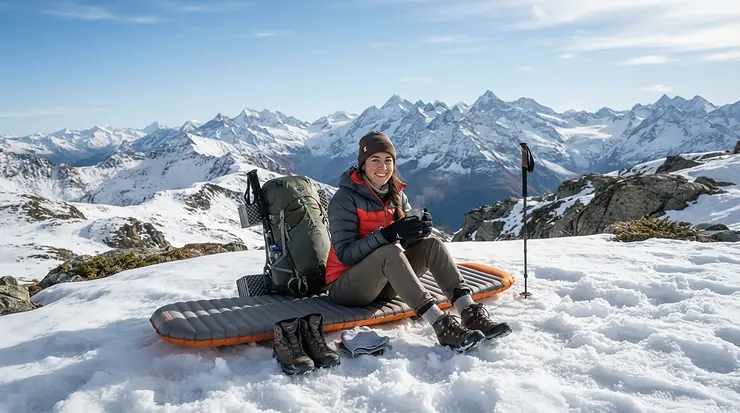
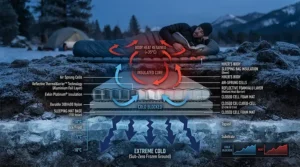
A high R-value insulated pad for winter backpacking is an inflatable or foam sleeping pad rated roughly R-5 or higher under the ASTM F3340 standard, built to block heat from escaping into frozen ground. It’s the layer your sleeping bag can’t replace, because body weight crushes the bag’s insulation flat underneath you.
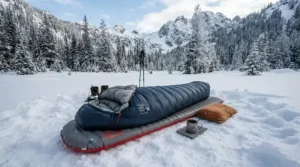
Here’s the part that surprises first-time winter campers. You can own a fat, expensive down bag and still spend the night shivering, because the ground is a bottomless heat sponge and your bag does almost nothing beneath your shoulder blades. The pad is the real front line. Think of the bag as a coat and the pad as the floor of the house. A coat is useless if the floor is missing.
For years, shopping for one meant squinting at mismatched numbers. Brands tested their pads their own way, so an “R-4” from one company might be an “R-2.5” in someone else’s lab. That changed when the outdoor industry adopted a single test method, and REI’s explanation of the new R-value standard is a good short read on why the numbers finally line up.
This guide focuses on seven real pads, from a roughly $50 foam classic to a premium air pad in the $250-$280 range. One transparency note: everything below is built from manufacturer specs and published reviewer findings, with honest analysis on top. There are no invented test nights and no made-up quotes. You’ll get the numbers, what they mean in practice, and who should buy what. Prices appear as ranges only, so check current price before you buy.
Quick Comparison: 7 Pads at a Glance
Before the deep dive, here’s the whole field on one screen.
| Pad | R-Value | Weight (Regular Unless Noted) | Thickness | Price Range | Best For |
|---|---|---|---|---|---|
| Therm-a-Rest NeoAir XTherm NXT | 7.3 | 15.5 oz | 3 in | $230-$280 | Cold sleepers who want one pad for snow |
| NEMO Tensor Extreme Conditions | 8.5 | 17 oz to 1 lb 7 oz by size | 3.5 in | $250-$280 | Deep-cold trips with an ultralight pack |
| Exped Ultra 6.5R | 6.9 | 12.5 oz (medium mummy) | 3.5 in | Around $200 | Best warmth per ounce for the money |
| Sea to Summit Ether Light XT Extreme | 6.2 | 25.6 oz | 4 in | $220-$300 | Side sleepers who want plush comfort |
| NEMO Tensor All-Season | 5.4 | 14.1 oz | 3.5 in | $200-$260 | Shoulder season through mild winter |
| Klymit Insulated Static V Peak | 4.2 | 22 oz | 2.5 in | $100-$130 | Budget starter that pairs with foam |
| Therm-a-Rest Z Lite Sol | 2.0 | 14 oz | 0.75 in | $50-$60 | Stacking layer and failure backup |
Look at the spread. The warmest pad here, the Tensor Extreme Conditions, delivers more than four times the insulation of the Z Lite Sol while weighing only a few ounces more. That’s the whole reason air pads with reflective films took over winter packing. The Insulated Static V Peak is the budget outlier, and its numbers tell you plainly that it needs a partner for real snow. If weight matters most, the Ultra 6.5R is where your eyes should land first.
💬 Just one click — help others make better buying decisions too!😊
Top 7 High R-Value Insulated Pads for Winter Backpacking: Expert Analysis
1. Therm-a-Rest NeoAir XTherm NXT — warmest option under a pound
The winter flagship from Therm-a-Rest squeezes a 7.3 R-value into a regular size that weighs about 15.5 ounces. Its Triangular Core Matrix baffles and a reflective ThermaCapture layer do the heavy lifting.
In practice, 7.3 clears the R-5 winter threshold by a mile. CleverHiker’s reviewers say it keeps you warm down to around 0°F when paired with a quality bag. At 3 inches thick it’s slimmer than some rivals, so heavier side sleepers should weigh that. The regular wide runs about 1 lb 3 oz and the large about 1 lb 4 oz. The WingLock valve allows quick one-way inflation, fast deflation, and fine-tuning even with gloves on, which matters at 6 a.m. in a frozen tent.
Based on the spec comparison, this is the “one pad and done” choice for backpackers who sleep cold and refuse to carry a second pad. Reviewers consistently praise the warmth-to-weight ratio, and CleverHiker rates it 4.5 out of 5. A common caveat in user reviews is durability, with at least one REI reviewer questioning build quality, so treat the field repair kit as mandatory.
Pros:
- ✅ 7.3 R-value at roughly one pound
- ✅ Reflective ThermaCapture layer boosts warmth
- ✅ Glove-friendly WingLock valve
Cons:
- ❌ Premium price tag
- ❌ Thinner loft than some competitors
Expect a price in the $230-$280 range depending on size. For true winter use, that’s fair money for a pad that does so much with so little weight.

2. NEMO Tensor Extreme Conditions — highest R-value in an ultralight pad
When people ask for the warmest ultralight pad, this is the answer. OutdoorGearLab cites an ASTM-tested R-value of 8.5, and Treeline Review calls it the most insulating ultralight pad available.
Here’s what that means. Four layers of Thermal Mirror metallized film are suspended inside Apex baffles (per Packstack’s breakdown), and the whole thing is 3.5 inches thick. The regular mummy weighs about 17 ounces, and larger rectangular sizes climb toward 1 lb 7 oz. By my arithmetic that’s roughly 0.5 R-points per ounce, the best ratio in this guide among the big-R pads.
What most buyers overlook is the size trade-off. The mummy shape saves ounces but leaves less room for restless sleepers, so choose the rectangular or wide version if you roll around. Reviewers praise its quiet surface and the included Vortex pump sack. GearJunkie, however, said the valve construction wasn’t its favorite.
Pros:
- ✅ 8.5 R-value for sub-zero camps
- ✅ Quiet fabric surface
- ✅ 3.5-inch stable cushioning
Cons:
- ❌ Valve design draws mild criticism
- ❌ Expensive for casual users
Plan on the $250-$280 range. If your trips regularly dip well below freezing, it’s worth every dollar. For mild winter, it’s overkill.
3. Exped Ultra 6.5R — best warmth per ounce for the money
The surprise of this list. The Ultra 6.5R tests at 6.9 R-value, while the medium mummy weighs about 12.5 ounces, according to Treeline Review. That’s a number that used to cost far more.
Its SynMat Plus design pairs recycled microfiber insulation with reflective foil. In plain English, you get a winter-capable pad that’s lighter than most three-season options. Medium wide with 25.6 inches of width weighs about 15 ounces, so you can upgrade comfort without a big weight penalty. Exped includes the Schnozzel Pumpbag UL, which doubles as a stuff sack.
GearJunkie’s tester noted it was noticeably quieter than a NeoAir. The trade-off is fabric: the 20D face material demands care around sharp rocks and abrasive surfaces. SectionHiker points to the 75D Dura 6.5R sibling if you want something tougher.
Pros:
- ✅ 6.9 R-value at around 12.5 ounces
- ✅ Quiet and comfortable for side sleepers
- ✅ Pump bag included
Cons:
- ❌ Thin 20D fabric needs careful handling
- ❌ Mid-pack durability scores
Prices land around $200. For most winter backpackers, that’s the strongest value verdict in the roundup.
4. Sea to Summit Ether Light XT Extreme — plush four-inch comfort
Not every cold-weather sleeper is counting grams. The Ether Light XT Extreme offers a 6.2 R-value in a 4-inch-thick pad, with Air Sprung Cells that conform to your body and dual-density Thermolite insulation inside.
At 25.6 ounces for the regular, it’s the heaviest air pad here. The weight buys you stability and softness that SectionHiker described as the kind where you might not want to leave your bag. It also comes in multiple widths, lengths, and both mummy and rectangular shapes, plus velcro strips to hold a pillow in place.
Reviewers mostly agree on comfort. Treeline Review’s writer reported a “wow” moment, and Australian Hiker scored it 8.8 out of 10, noting the extra weight is the price of the plushness. The spec sheet won’t tell you this, but it also doubles as a car-camping luxury pad, which stretches its value if you camp both ways.
Pros:
- ✅ 4-inch thickness for side sleepers
- ✅ Several sizes and shapes
- ✅ Relatively quiet construction
Cons:
- ❌ Heaviest air pad in this roundup
- ❌ Bulkier packed size
Check current price, since listings sit around $220-$300 depending on size and retailer. It’s best when comfort beats weight.
5. NEMO Tensor All-Season — lightest insulated pad here with real warmth
At 14.1 ounces and R-5.4, the Tensor All-Season posts roughly 0.38 R-points per ounce, a number Adventure Alan also highlights. Two suspended layers of Thermal Mirror film and Spaceframe baffles do the work.
Read the temperature claim carefully. SectionHiker positions it for three-season and mild-winter conditions, and that’s the honest lane. It handles shoulder-season frost and moderate winter nights on its own, but deep-cold trips want a foam partner or a bigger R-value. Its 3.5-inch loft supports back and side sleepers, and the Vortex pump sack is included.
Sentiment is strong but not unanimous. CleverHiker gives it 4.7 out of 5, and Treeline praises its quiet sleeping surface. Packstack, meanwhile, scored it 8.2 out of 10 and noted that it’s pricey and some sleepers find it noisy, so reports conflict on noise.
Pros:
- ✅ 5.4 R-value at about 14 ounces
- ✅ Comfortable 3.5-inch loft
- ✅ Includes pump sack and repair patches
Cons:
- ❌ Needs help below roughly freezing
- ❌ Mixed noise reports
Expect the $200-$260 range. Great value for hikers who camp from fall to early winter.
6. Klymit Insulated Static V Peak — budget starter for cold-weather backpacking
The Insulated Static V Peak carries an ASTM-rated R-value of 4.2, weighs 22 ounces in the regular size, and uses a tough 75D exterior with side rails to keep you centered.
It’s honest about its lane. GearJunkie called it an impressive value but said a higher-R pad is the better choice for dedicated winter use. That’s accurate. At 2.5 inches thick it’s the slimmest air pad on this list, so it feels firmer underneath. The real trick is pairing it with the Z Lite Sol, which brings the stack to about R-6.2 for roughly $150-$190 total.
Reviewers on Backcountry rate it around 4.5 out of 5 across 48 reviews, and GearJunkie flagged the valve design as imperfect.
Pros:
- ✅ Genuine 4.2 ASTM R-value
- ✅ Tough 75D exterior fabric
- ✅ Side rails keep you on the pad
Cons:
- ❌ Not the thickest or lightest option
- ❌ Valve design is imperfect
Prices run in the $100-$130 range. It’s a smart entry point if you add foam.
7. Therm-a-Rest Z Lite Sol — reflective stacking layer and bulletproof backup
This accordion-fold foam pad is R-2.0 on its own, 14 ounces, and about three-quarters of an inch thick. On paper it’s the weakest pad here. In a winter sleep setup, it may be the most valuable.
Therm-a-Rest says its reflective ThermaCapture surface adds nearly 15% more warmth, used reflective side up. Closed-cell foam can’t pop, can’t leak, and doubles as a camp seat so your boots stay off the snow. BetterTrail described it as a nap-friendly pad, meaning comfort isn’t its goal, and it’s too thin to handle winter alone.
Navy Exchange shoppers rate it about 4.6 out of 5 across 75 reviews, a strong sign of long-term satisfaction. The main complaint is bulk, since it straps outside your pack.
Pros:
- ✅ Puncture-proof closed-cell foam
- ✅ Adds 2.0 R-value when stacked
- ✅ Works as a seat and backup
Cons:
- ❌ Thin and firm for sleeping alone
- ❌ Bulky to pack
The $50-$60 range makes it the best low-cost insurance in winter gear.
Top 7 Side by Side
| Pad | Insulation Tech | Review Signal | Biggest Trade-Off | Best For |
|---|---|---|---|---|
| NeoAir XTherm NXT | Triangular Core Matrix + ThermaCapture | CleverHiker 4.5/5 | Some durability remarks | Warmth under one pound |
| Tensor Extreme Conditions | Four Thermal Mirror layers, Apex baffles | Packstack 8.5/10 | Price and valve | Sub-zero ultralight trips |
| Ultra 6.5R | SynMat Plus microfiber + foil | CleverHiker 4.5/5 | Thin 20D fabric | Best value warmth |
| Ether Light XT Extreme | Air Sprung Cells + Thermolite | Australian Hiker 8.8/10 | Weight and bulk | Plush comfort |
| Tensor All-Season | Two Thermal Mirror layers | CleverHiker 4.7/5 | Mixed noise reports | Shoulder season |
| Insulated Static V Peak | Klymalite + reflective film | About 4.5/5 (Backcountry, 48 reviews) | Needs foam in deep cold | Budget stacking |
| Z Lite Sol | Closed-cell foam + ThermaCapture | About 4.6/5 (Navy Exchange, 75 reviews) | Thin and bulky | Backup and base layer |
Read the table sideways. The Tensor Extreme Conditions wins on raw R-value, but the Ultra 6.5R takes the value crown by delivering 6.9 at the lowest weight on this list. If you want one pad to cover most trips, the NeoAir XTherm NXT is the safest middle path. Budget buyers can reach R-6 by combining the Insulated Static V Peak with the Z Lite Sol.
✨ Don’t Miss These Top Picks!
🔍 Take your winter sleep to the next level with these carefully selected pads. Click on any highlighted item to check current pricing and availability. These picks will help you build a warm, reliable setup for a night you’ll actually sleep through!
R-Value Explained: What the Number Actually Means
Let’s make R-value explained in plain terms. R-value measures resistance to heat flow, so a higher number means less warmth escapes from you into the ground. That’s all it is. It’s the same rating used on the pink insulation in your attic.
The lab test behind it is cleverly simple. Under ASTM F3340, a pad sits between a hot plate (your body) and a cold plate (the ground), and the energy needed to hold the plates at temperature sets the number. Cascade Designs describes its cold chamber, which runs at about 39°F. Because the same method now covers Therm-a-Rest, NEMO, REI, Exped, Sea to Summit, Big Agnes, Klymit, and ZenBivy, you can finally compare brands directly.
Here are the rough bands. Outdoor Life puts low at 1 to 4, medium at 4 to 6, and high at 6 to 10, and Backpacker says it wants to see 5 or above before calling a pad winter-worthy. R-values stack additively, so an R-4.2 pad plus an R-2.0 foam pad gives about R-6.2.
Remember the limits, though. A lab number doesn’t measure your own metabolism, a damp bag, or a drafty tent. Treat the R-value as a floor for your high R-value insulated pad for winter backpacking, not a promise of comfort. Your bag, clothing, and food all share the load.
How to Choose an Insulated Sleeping Pad for Backpacking in Winter
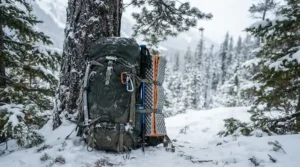
Picking an insulated sleeping pad for backpacking isn’t complicated once you know the six decisions that matter.
- Set your R-value floor. Aim for R-5 as the minimum and R-6 or higher for sustained below-freezing nights. Lower numbers belong on summer trips.
- Count R-points per ounce. Divide R-value by weight. The Ultra 6.5R lands near 0.55, the Tensor Extreme Conditions near 0.5, and the Z Lite Sol near 0.14. Higher ratios mean warmth without punishment.
- Check thickness for stability. Three inches or more cushions side sleepers. The Ether Light XT Extreme at 4 inches is the plushest here.
- Pick the shape that fits your sleep. Mummy pads save ounces, but restless sleepers often prefer rectangular or wide versions.
- Match fabric to terrain. A 20D face keeps weight down, while 75D shrugs off abrasion.
- Test the valve with gloves. A winter pad you can’t inflate with cold fingers is a bad pad.
Reflective Insulation Layer: Does the Shiny Stuff Actually Work?
A reflective insulation layer is the metallic film or foil you’ll see inside many winter pads. Its job is to bounce radiant body heat back toward you instead of letting it escape downward.
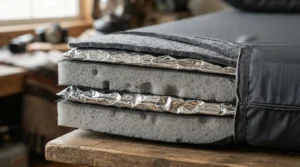
The idea shows up everywhere. NEMO suspends Thermal Mirror film inside its baffles, one layer in the Trail, two in the All-Season, four in the Extreme. Exped pairs microfiber with reflective foil in SynMat Plus. Klymit adds reflective film layers to its Insulated Static V Peak. Therm-a-Rest coats the Z Lite Sol with ThermaCapture and says it amplifies the foam’s heat-trapping dimples by about 15%.
Treat those percentages as manufacturer claims, but the principle is sound, and here’s the useful part: the ASTM test measures the pad as a whole, so the published R-value already reflects whatever its films contribute. You don’t need to add extra credit for the shiny stuff. What you do need to remember is orientation. Therm-a-Rest instructs foam users to place the reflective side up, so don’t bury it under a bag liner and expect magic. Layers matter, but a reflective insulation layer works best as a supporting actor, not the entire show.
Lightweight Insulated Pad for Cold Weather Backpacking: Where the Ounces Go
Winter packs are already heavy, so a lightweight insulated pad for cold weather backpacking earns its place. Here’s how the ratios shake out, using each pad’s R-value divided by its listed weight:
- ✅ Ultra 6.5R: about 0.55 R per ounce (medium mummy)
- ✅ Tensor Extreme Conditions: about 0.5 R per ounce
- ✅ NeoAir XTherm NXT: about 0.47 R per ounce
- ✅ Tensor All-Season: about 0.38 R per ounce
- ❌ Ether Light XT Extreme: about 0.24 R per ounce
- ❌ Insulated Static V Peak: about 0.19 R per ounce
- ❌ Z Lite Sol: about 0.14 R per ounce
The pattern is obvious. Hybrid air-and-film designs crush foam and older air pads on warmth per ounce. The catch is fragility. The lightest pads use thin 20D to 40D fabrics, so a snagged corner can end a trip faster than a cold night. Carry the included repair kit, and consider a foam backup if your route crosses rocky or icy ground.
If you’re shaving weight, choose carefully. A mummy-cut Ultra 6.5R or Tensor Extreme Conditions saves ounces, but stacking a 14-ounce foam pad on top can erase that advantage. Decide whether you need extra R-value or just the safety net.
Insulated Sleeping Pad for Snow Camping: What Changes on White Ground
Choosing an insulated sleeping pad for snow camping changes the math, because you’re sleeping on top of a giant ice cube. CleverHiker notes that since you’re camping on top of the snow, a warm pad and bag are critical, and its team brings foam under their air pad on chilly trips.
Two rules of thumb stand out. First, Backpacker’s cold-weather guidance warns that most inflatable pads not made for the cold underperform below about 30°F, so lay down closed-cell foam first. Sea to Summit follows the same logic, recommending a thin foam mat for insulation plus an insulated air pad for comfort and extra warmth.
Second, stack before you need to. A Tensor Extreme Conditions alone may be enough for many snow nights, while a Tensor All-Season wants a Z Lite Sol beneath it. Pack the foam anyway, because it doubles as a seat so you aren’t kneeling or standing directly on snow.
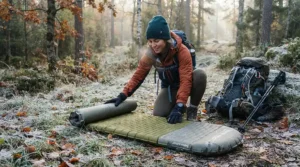
Prep the platform too. Stomp out the snow, then smooth the tent floor with your knees before you lay anything down. A lumpy floor creates cold spots and shifts pad pressure. Treat it like building a bed, not just dropping one.
Building Your Cold-Weather Sleep System
A cold-weather sleep system works like a stack of layers, and each one covers a different heat leak. Here’s a practical setup guide.
Step 1: Start with the ground layer. Choose either a single high-R pad, like the NeoAir XTherm NXT, or a stack. R-values add up, so R-7.3 plus R-2.0 gives about R-9.3 for roughly 29.5 ounces combined.
Step 2: Match the bag to the pad. CleverHiker’s winter setups pair a quality bag with an XTherm and add foam on colder trips. CleverHiker’s winter camping tips also walk through the signs of hypothermia, including uncontrollable shivering and loss of coordination.
Step 3: Add a liner and dry clothes. Change into dry sleep layers before bed. Damp insulation loses its power fast.
Step 4: Test everything at home. Inflate each pad, leave it overnight, and look for slow leaks. Practice the valve with gloves.
Step 5: Keep a 30-day habit list. Store pads loosely, keep repair patches in your lid pocket, and never blow warm, wet breath into a pad on a frozen night if a pump sack is available. The Tensor Extreme Conditions, Ultra 6.5R, and NeoAir XTherm NXT all include pump sacks or similar inflation tools.
The result: one cold-weather sleep system you understand, instead of a bag of mismatched gear you hope will work.
Real-World Scenarios: Matching Pads to Winter Backpackers
Specs are abstract. Here’s how the picks play out for three different people.
Scenario 1: The weekend snowshoe overnighter on a budget. You camp four to six nights a winter near the trailhead, on packed snow. Pair the Insulated Static V Peak with the Z Lite Sol for about R-6.2. Total cost lands near $150-$190, and the foam doubles as a seat during dinner. Weight is 36 ounces, but you’re not covering marathon miles.
Scenario 2: The ultralight shoulder-season hiker. You hike from fall frost into early winter and track every ounce. The Ultra 6.5R gives you R-6.9 for about 12.5 ounces in mummy cut, and it costs around $200. If nights stay mild, the Tensor All-Season saves a little more weight.
Scenario 3: The cold sleeper chasing sub-zero trips. You ski tour for multiple nights and hate waking up cold. Go with the Tensor Extreme Conditions for R-8.5, or the NeoAir XTherm NXT plus a Z Lite Sol if you want redundancy. A side sleeper who values softness might choose the Ether Light XT Extreme and accept the weight.
Features That Actually Matter (And Those That Don’t)
Marketing loves to bury winter pads in buzzwords. Here’s the filter.
What matters:
- ✅ ASTM-tested R-value, not a brand’s legacy number
- ✅ Weight-to-warmth ratio, because you carry it all day
- ✅ Valve design that works with gloves
- ✅ Fabric thickness matched to your terrain
What doesn’t:
- ❌ The “4-season” label by itself, since it’s not a standard
- ❌ Fancy colors or packaging
- ❌ Extras like pillow velcro strips, nice to have but not decisive
Here’s an example. The Ether Light XT Extreme includes velcro strips for a pillow, which is a lovely touch. It doesn’t change whether the pad keeps you warm at 10°F. The R-value does. Don’t let nice-to-haves distract you from the number that decides the night.
Common Mistakes When Buying a High R-Value Insulated Pad for Winter Backpacking
Even careful shoppers trip up here. Watch for these.
- Trusting “4-season” without checking the number. The label isn’t a standard. The ASTM R-value is.
- Confusing legacy R-values with ASTM ones. Klymit’s site explains that some pads list both its original rating and an ASTM-rated one. The older Insulated Static V, for instance, shows 4.4 on Klymit’s scale and 1.9 under ASTM. Always compare ASTM to ASTM.
- Buying on weight alone. A feather-light pad that leaves you awake at 2 a.m. isn’t ultralight, it’s useless.
- Skipping the foam backup. Air pads can fail. The Z Lite Sol can’t.
- Ignoring size and shape. Too narrow, and your arms hang off into the cold.
- Not testing the valve. Practice with gloves before you’re standing in a snowfield.
Insulated Air Pads vs Foam Pads vs Stacks
| Option | Typical R-Value | Weight | Durability | Best For |
|---|---|---|---|---|
| Insulated air pad, like NeoAir XTherm NXT | 5 to 8.5 | 12 to 26 oz | Can puncture | Weight-conscious winter hikers |
| Closed-cell foam, like Z Lite Sol | 2.0 | 14 oz | Very durable | Backup, seat, and base layer |
| Stack, like Insulated Static V Peak + Z Lite Sol | About 6.2 | About 36 oz | Redundant | Budget snow camping |
Air pads win on warmth per ounce and comfort, but they can fail. Foam is bulky, firm, and nearly indestructible. The stack combines both, adding R-value plus a safety net. Based on the numbers, a single Tensor Extreme Conditions is lighter than the budget stack by roughly 19 ounces, while the stack costs less and gives you built-in redundancy. Choose by what you value, whether that’s weight, price, or peace of mind.
Long-Term Cost & Maintenance
Premium pads feel pricey until you divide by nights. Here’s an estimate using the midpoint of each price range.
| Pad | Price Range | Approx. Cost per R-Point | Best For |
|---|---|---|---|
| Tensor Extreme Conditions | $250-$280 | Roughly $30 | Highest warmth per dollar at the top end |
| Ultra 6.5R | Around $200 | Roughly $30 | Best all-round value |
| NeoAir XTherm NXT | $230-$280 | Roughly $35 | Reliable premium warmth |
| Ether Light XT Extreme | $220-$300 | Roughly $40 | Comfort-first buyers |
| Tensor All-Season | $200-$260 | Roughly $40 | Mild-winter weight savers |
| Insulated Static V Peak | $100-$130 | Roughly $27 | Budget stackers |
| Z Lite Sol | $50-$60 | Roughly $27 | Cheap insurance |
The cheapest cost per R-point belongs to the budget picks, but the cheapest cost per night belongs to whichever pad you actually use. A $250 pad used 20 nights a year for five years works out to a few dollars a night. That’s cheaper than a bad night’s sleep.
Maintenance is simple. Carry the included repair kit, dry the pad out before storing it, and keep it loosely stored rather than tightly compressed. NEMO and Klymit both advertise lifetime warranties, and Sea to Summit lists a lifetime guarantee, so register purchases and keep receipts.
Winter Safety: Conduction, Cold Sleepers, and Wet Gear
Cold ground steals heat through conduction, and a pad is your only defense. Backpacker notes that even a warm cold-weather bag is a cold bag without a quality, insulated pad underneath. Their full cold-weather camping guide covers smoothing your tent floor and layering foam under inflatables.
Know the warning signs. Uncontrollable shivering, loss of coordination, and personality changes mean it’s time to get warm and dry. The Manual also warns that wet cotton is a recipe for hypothermia, so change into dry sleep layers before bed.
One practical caution: R-value is a floor, not a guarantee. If you sleep cold, are cutting calories, or plan nights below the pad’s comfort range, add foam or choose a higher R-value. Redundancy is cheaper than rescue.
Frequently Asked Questions
❓ How much does a high R-value insulated pad for winter backpacking weigh?
❓ Is R-5 enough for winter backpacking?
❓ Should the foam pad go above or below my air pad?
❓ Do I need a repair kit for a winter sleeping pad?
❓ Should I buy a regular or wide insulated sleeping pad for backpacking?
Conclusion
The best high R-value insulated pad for winter backpacking comes down to three questions: how cold, how heavy, and how much budget. For deep cold and weight savings, the Tensor Extreme Conditions is hard to beat at R-8.5. For the best warmth-per-ounce value, the Ultra 6.5R wins. For a reliable premium all-rounder, the NeoAir XTherm NXT earns its spot. Comfort-focused sleepers should look at the Ether Light XT Extreme, while the Tensor All-Season fits shoulder seasons and mild winters.
Budget buyers have a clear path too. Pair the Insulated Static V Peak with the Z Lite Sol, and you’ve built a capable stack that handles real snow without breaking the bank. Whatever you choose, remember the lesson hiding in every spec sheet: your bag handles the air, but your pad handles the ground. Treat the pad as the foundation of your cold-weather sleep system, not an afterthought, and you’ll sleep far better when the thermometer drops.
Recommended for You
- Budget Air Sleeping Pad: 7 Proven Picks For Better Sleep (2026)
- Quiet Air Sleeping Pad For Light Sleepers: 7 Best Picks (2026)
- Ultralight Air Pad For Thru-Hiking: 7 Proven Picks Ranked 2026
Disclaimer: This article contains affiliate links. As an Amazon Associate, I earn from qualifying purchases. If you purchase products through these links, we may earn a small commission at no additional cost to you.
✨ Found this helpful? Share it with your friends! 💬🤗
