
In This Article
There’s a very specific kind of dread that hits around hour three of a road trip with no rest stop in sight, or 2 a.m. in a tent when the nearest pit toilet is a quarter-mile hike through the dark and something is definitely rustling in the bushes. A portable camping toilet solves that problem in the least glamorous, most practical way possible — and once you’ve used a decent one, you genuinely wonder why you spent so many seasons without it.
This guide breaks down seven real, currently available portable toilets — from a $25 bucket-and-lid setup to a $250 battery-flush unit that would look at home in a small RV bathroom. We researched actual specifications, aggregated genuine customer-review sentiment, and cross-referenced official guidance from the Leave No Trace Center for Outdoor Ethics, a nonprofit formed in 1994 specifically to help outdoor recreationists manage exactly this kind of impact. Nothing here is invented — no fabricated five-star raves, no “I tested this for six months in the Rockies” stories. Just spec sheets, aggregated review patterns, and honest analysis of who each toilet actually fits.
If you’ve ever wondered what “flush mechanism camping” toilets even use, or whether waste tank capacity numbers on the box mean anything real-world, you’re in the right place. We’ll walk through budget bucket toilets, mid-range flush models, and premium chemical-free options, then get into the unglamorous but essential stuff: setup, maintenance, waste tank capacity, camp toilet seat comfort, and how to build actual toilet tent privacy at your campsite. This article contains affiliate links — full disclosure is at the bottom, but nothing above that line was written to sell you anything you don’t need.
Quick Comparison Table
Before diving into the deep-dive reviews, here’s the scannable version — the kind of table you’d screenshot before a camping-gear shopping trip.
| Product | Type | Waste Capacity | Price Range | Best For |
|---|---|---|---|---|
| Reliance Luggable Loo | Bucket + bags | 5 gal | Under $35 | Absolute budget, emergency kits |
| Reliance Fold-to-Go | Collapsible frame | Bag-dependent | $40-$55 | Tight cargo space, tripod setups |
| Cleanwaste GO Anywhere (PETT) | WAG-bag folding | Bag-dependent | $80-$95 | Rivers, multi-day permits, no chemicals |
| Dometic 972 | Battery-free flush | 2.6 gal | $95-$170 | Compact vans, boats, weekend trips |
| Camco 41541 | Bellows-flush | 5.3 gal | $140-$200 range | Families, longer stretches between dumps |
| Thetford Porta Potti 565E Curve | Battery-electric flush | 5.5 gal | $190-$290 range | RV-like comfort, longest trips |
| BOXIO Toilet Plus | Urine-separating composting | ~8-10 uses/cycle | $150-$200 range | Chemical-free, off-grid, van life |
Looking at the spread above, the split really comes down to how much water and weight you’re willing to haul versus how much comfort you want back. The Reliance Luggable Loo and Reliance Fold-to-Go trade tank sophistication for near-zero bulk, which makes sense for a single weekend but gets tedious fast on a week-long trip where you’re bagging and hauling out every single use. The Thetford Porta Potti 565E Curve sits at the opposite end — heavier, pricier, but genuinely closer to a real bathroom experience, which matters more than people expect once day four of a trip rolls around.
💬 Found a favorite already? Compare current prices before you commit — availability shifts fast on seasonal camping gear.
Top 7 Portable Camping Toilets: Expert Analysis
We picked these seven specifically to cover every budget tier and every mechanism type — bucket, folding frame, WAG-bag, battery-free flush, bellows flush, electric flush, and composting. Each entry below moves past the spec sheet into what that spec actually means once you’re using it at 6 a.m. in the cold.
1. Reliance Luggable Loo — cheapest real option that still feels like a toilet
The standout here isn’t a feature exactly — it’s the price-to-function ratio. For well under $35, you get a genuine 5-gallon bucket-based commode instead of a hole in the ground.
At just 3.06 pounds with a height of 15.6 inches and a 220-pound weight capacity, the Reliance Luggable Loo is essentially a snap-on seat and hinged lid that turns any standard 5-gallon pail into a toilet. There’s no tank, no flush, no water system — you’re relying entirely on a liner bag underneath. In practice, that means the seat height and stability matter more than they would on a flush model, since you’re sitting directly over whatever’s in the bucket.
Based on the spec comparison, this is the toilet for people who camp maybe three or four weekends a year and don’t want to store a bulky unit in the garage the other 48 weeks. What most buyers overlook is that the bucket itself often isn’t included — you’re buying the seat-and-lid assembly and sourcing your own 5-gallon pail, which is either a non-issue or mildly annoying depending on how prepared you like to be.
Reviewers consistently note that the round base can feel wobbly on uneven ground, with several mentioning they set the bucket inside a milk crate for extra stability — a workaround that shows up often enough in aggregated feedback to be worth planning for ahead of time. On the plus side, owners repeatedly praise how well it pairs with gelling waste bags for odor control, and multiple buyers specifically call out the metal handle version as sturdier for hauling.
Pros:
- ✅ Lowest price point of any real portable toilet option
- ✅ Extremely lightweight at just over 3 pounds
- ✅ Compatible with standard 5-gallon pails you may already own
Cons:
- ❌ Round base feels unstable without an outer support like a crate
- ❌ No tank or flush — fully dependent on liner bags for cleanliness
Expect to pay under $35 for the seat-and-lid unit alone. For occasional weekend trips or a backup emergency-kit toilet, the value here is close to unbeatable — just budget separately for waste bags and, ideally, a stabilizing crate.
2. Reliance Fold-to-Go — folds down to 5 inches for tight cargo space
The standout advantage is the collapse: this toilet folds flat to just 5 inches thick, which solves the single biggest complaint campers have about bucket toilets — that they eat a huge chunk of trunk space even when empty.
Specs-wise, it’s a tripod frame rather than a bucket, measuring 14.5 by 14.5 by 14.5 inches when set up, weighing around 4.5 to 5 pounds, and rated for roughly 250 to 300 pounds depending on the listing. Three locking legs snap into place and support a waste bag directly, so there’s no rigid tank to store — just the frame and whatever bag system you pair it with.
On paper this means it’s the natural pick for overlanders, rooftop-tent campers, and anyone building out a small SUV where every cubic inch of cargo space is already spoken for. The tripod design does mean it’s less forgiving on soft or sloped ground than a wide-based bucket toilet, since a three-point stance concentrates weight differently than a full cylindrical base.
Aggregated review sentiment is largely positive on durability — several long-term owners specifically mention the leg-locking mechanism holding up over multiple seasons without loosening, which matters given how much stress a tripod frame takes from someone sitting down repeatedly. A recurring minor complaint involves the bag not always being included despite marketing copy suggesting otherwise, so it’s worth checking the current listing before assuming bags are in the box.
Pros:
- ✅ Folds to roughly 5 inches thick for minimal storage footprint
- ✅ Locking leg system rated durable across repeated seasonal use
- ✅ Weighs under 5 pounds for easy packing
Cons:
- ❌ Tripod stance less stable than wide-base bucket toilets on soft ground
- ❌ Bag systems typically sold separately from the frame itself
Priced in the $40-$55 range, it’s a small step up from the Luggable Loo that buys back significant cargo space — a fair trade for anyone road-tripping in a smaller vehicle.
3. Cleanwaste GO Anywhere (PETT) — permitted for river trips and no-dig zones
What sets this apart is regulatory approval: it’s specifically built and permitted for multi-day river trips where digging catholes isn’t allowed and waste must be packed out entirely.
The unit weighs just 7 pounds, folds to a 19 by 4 by 15-inch briefcase-sized package, and supports up to 500 pounds, using three fold-out legs that lock into a standard toilet height and footprint. It pairs with WAG (Waste Alleviation and Gelling) bags — sealed pouches containing a gelling powder that neutralizes waste for safe disposal in any regular trash receptacle, no dump station required.
Here’s what the spec sheet won’t tell you outright: this system is built for regulatory compliance as much as comfort. It’s permitted by the U.S. Bureau of Land Management for use on rivers and in Wilderness Areas where toilets are required, and it’s the system recommended by the Leave No Trace program in conjunction with the National Forest Service. If you’re running permitted river trips or camping in high-traffic backcountry zones with strict waste rules, this isn’t just a nice-to-have — it may be the only compliant option in your kit.
Reviewers consistently highlight the setup speed — “like opening a briefcase,” as more than one aggregated review describes it — and the sturdy footing on uneven ground thanks to the three-leg design. The tradeoff shows up in ongoing costs: WAG bag refills are a recurring expense not baked into the sticker price, and heavy users burn through them faster than they initially expect.
Pros:
- ✅ Permitted for river and Wilderness Area use where digging is banned
- ✅ Sets up in seconds with a stable three-leg locking frame
- ✅ No water, chemicals, or dump station required
Cons:
- ❌ Ongoing WAG bag refill costs add up on longer trips
- ❌ No built-in privacy — needs a tent or shelter for modesty
At around $80-$95, this sits in the middle of our lineup price-wise but earns its spot for anyone camping somewhere that legally requires pack-out sanitation.
4. Dometic 972 — battery-free push-button flush in a compact footprint
The standout feature is the flush mechanism itself: a pressurized push-button system that delivers a real flush without batteries or constant hand-pumping.
The unit measures 15.2 inches long, 13 inches wide, 13.6 inches tall, and weighs about 12 pounds, with a 9.8-liter waste tank holding enough water for roughly 27 flushes — translating to a real-world capacity around 2.6 gallons. Water is pressurized manually, then a push-button releases a splash-free flush, with an extra-long discharge spout designed to prevent mess during emptying.
Based on the spec comparison, this is the toilet for people who camp in a smaller van, boat, or rooftop-tent setup where a full-size Porta Potti simply won’t fit but a bucket toilet feels like a downgrade. The compact 2.6-gallon tank means more frequent emptying than the larger flush models on this list — realistically every one to two days for a couple using it regularly — but the tradeoff is a genuinely smaller physical footprint.
Aggregated customer sentiment consistently praises the flush strength relative to the toilet’s size, with owners specifically noting it clears the bowl better than expected for something this compact. The recurring critique involves the smaller tank requiring more frequent dump runs than buyers initially anticipate, especially with more than one regular user.
Pros:
- ✅ Pressurized push-button flush needs no batteries
- ✅ Compact 12-pound build fits small vans and boats easily
- ✅ Splash-free discharge spout simplifies emptying
Cons:
- ❌ Smaller 2.6-gallon tank means more frequent dumping
- ❌ Less ideal for families or extended multi-day trips
Expect to pay in the $95-$170 range depending on retailer promotions. For weekend warriors in compact rigs, the size-to-performance ratio here is hard to beat.
5. Camco 41541 — largest mid-priced tank for stretching between dumps
The headline advantage is raw capacity at a mid-range price: a 5.3-gallon waste tank that outsizes most competitors in this price bracket.
Built from durable polymer and measuring roughly 16.9 by 14 by 16.25 inches, the unit weighs about 11.5 pounds and supports up to 330 pounds. It pairs a detachable 5.3-gallon holding tank with a sealing side valve against odors and leaks, alongside a 2.5-gallon top tank and bellows-pump flush for bowl rinsing.
What most buyers overlook about this model is how much longer that extra tank capacity actually stretches a trip in practice. Where the Dometic 972’s 2.6-gallon tank might mean daily emptying for a family, the Camco’s larger holding tank can realistically carry a family of four through a full weekend without a dump run — a meaningful convenience difference that the price tag alone doesn’t communicate.
The bellows-type flush is manual rather than pressurized or battery-powered, which means more physical effort per flush than the Dometic or Thetford, but also means there’s genuinely nothing electronic to fail. Reviewers note the two side latches securing the tank to the base feel solid and leak-resistant even after repeated detach-and-reattach cycles for emptying, and the included TST toilet treatment packets get mentioned favorably as a nice starting bonus rather than an afterthought.
Pros:
- ✅ Largest tank capacity in the mid-price tier at 5.3 gallons
- ✅ Sealing slide valve well-reviewed for leak and odor control
- ✅ Includes starter toilet chemical packets in the box
Cons:
- ❌ Manual bellows flush takes more physical effort than button models
- ❌ Bulkier footprint than compact single-tank units
Priced generally in the $140-$200 range depending on retailer, this is the value pick for families who want maximum time between dump-station visits without stepping up to premium pricing.
6. Thetford Porta Potti 565E Curve — closest thing to a real bathroom experience
The standout is the overall build: a battery-electric flush, tank level indicators, and a genuinely comfortable seat height that multiple review sources independently call the industry benchmark.
The unit measures 17-5/8 inches tall by 17-3/4 inches long by 15-1/4 inches wide, with a 4.2-gallon freshwater tank and a 5.5-gallon waste tank, delivering an average of 56 flushes per full tank at a dry weight of about 13.45 pounds. Level indicators track both the freshwater and waste tanks, so there’s no guessing when it’s time to empty or refill, and the sealed waste valve with pour-out spout is specifically engineered to prevent backsplash during dumping.
Here’s what the spec sheet won’t fully convey: the “Curve” in the name refers to a genuinely taller, more homelike seat profile compared to older Porta Potti models, and that seat-height difference is exactly what independent testers single out as the standout comfort factor. One outdoor-gear reviewer who tested it alongside competing models specifically noted it was the lightest toilet they tested at just under 8 pounds among comparable units, fitting easily into small spaces like a van or campsite setup — though the 565E Curve specifically runs a bit heavier at 13.45 pounds due to its larger tank pairing.
Reviewer sentiment across multiple retail platforms consistently lands near the top of the category, with the battery-flush system and hidden control panel drawing repeated praise for feeling closer to a household toilet than a camping accessory. The main recurring critique is price — this is the most expensive flush-style unit on our list — and the requirement to remove batteries during storage to prevent corrosion, a maintenance step some buyers admit to forgetting.
Pros:
- ✅ Largest freshwater-to-waste tank pairing among flush models here
- ✅ Battery-electric flush with dual tank level indicators
- ✅ Comfortable seat height widely praised as the category benchmark
Cons:
- ❌ Highest price point of the flush-toilet options on this list
- ❌ Requires battery removal during off-season storage to avoid corrosion
Expect a price range roughly between $190 and $290 depending on retailer and bundled accessories. For week-long trips, van life, or anyone prioritizing comfort over minimalism, this is the toilet that best justifies its premium.
7. BOXIO Toilet Plus — chemical-free composting alternative for off-grid stays
The standout feature is independence from both chemicals and dump stations entirely — solid and liquid waste separate automatically, letting you dispose of each differently without ever touching a black-water tank.
The compact unit measures 15.75 by 11.8 by 11 inches and manages roughly 8 to 10 toilet visits before needing attention, using a urine-diverting design with a separation container plus a leak-proof urine canister, supporting up to 330 pounds of load. Paired with an odor-trapping plug and hemp-based litter, the manufacturer states the system produces virtually no odor even in enclosed spaces like a van.
On paper this means solid waste (mixed with hemp litter) goes into the regular trash, while liquid waste — which is the primary source of portable-toilet odor — gets poured out separately, sidestepping the “mixed tank” smell problem that chemical flush toilets are specifically designed to chemically mask rather than eliminate. That’s a meaningfully different approach than every other product on this list, and it’s why van-lifers and off-grid campers gravitate toward this category specifically.
Aggregated review sentiment across major retailers sits notably high for a composting-style unit, with buyers frequently mentioning the near-total absence of odor as the standout real-world result, not just a marketing claim. The most common critique in reviews involves the learning curve — first-time composting-toilet users report a short adjustment period figuring out litter ratios and canister-emptying timing before things click into a routine.
Pros:
- ✅ No chemicals, water, or dump stations required
- ✅ Urine-diverting design significantly reduces odor versus flush tanks
- ✅ Compact footprint fits vans and small trunk spaces
Cons:
- ❌ Learning curve for first-time composting-toilet users
- ❌ Higher upfront cost than comparable flush-style capacity
Pricing generally runs $150-$200 range for the starter kit with accessories. For extended off-grid stays where dump stations are scarce, this is the pick that trades a short learning curve for long-term independence.
Waste Tank Capacity Explained: What Size Do You Actually Need?
Waste tank capacity is the single most misleading number on any portable toilet’s packaging, mostly because manufacturers advertise it in gallons or liters without translating that into actual days of use — which is what you’re really trying to figure out.
| Tank Size | Approx. Uses (2 adults) | Best Trip Length |
|---|---|---|
| Bag-based (no tank) | Bag-dependent, pack out each use | Any length, frequent bag changes |
| 2.6 gal (Dometic 972) | ~13-15 uses | Weekend, 2-3 days |
| 5.3 gal (Camco 41541) | ~25-30 uses | Long weekend, 4-5 days |
| 5.5 gal (Thetford 565E Curve) | ~28-30 uses | Week-long trips |
| Composting (BOXIO Toilet Plus) | 8-10 solid uses per cycle | Ongoing, empties independently |
The numbers above assume moderate use by two adults, and reviewers consistently mention real-world capacity runs a bit lower once you factor in liquid-heavy days or extra guests. A 5.5-gallon tank sounds enormous compared to a 2.6-gallon one, but in practice it buys roughly double the days before a dump run — useful math when you’re deciding whether the larger, heavier Thetford Porta Potti 565E Curve is worth hauling versus the more compact Dometic 972.
It’s also worth noting that composting systems like the BOXIO Toilet Plus measure capacity differently entirely — since liquid and solid waste separate, the “tank” doesn’t fill the same way a mixed flush tank does, which is part of why composting toilets can go longer between full servicing despite a smaller physical footprint.
✨ Don’t Miss These Exclusive Deals!
🔍 Whichever capacity fits your trip length, check current pricing and availability before you head out — tank size is the one spec that decides how many dump runs your weekend actually needs.
Flush Mechanism Camping: Which Flush Type Actually Works
Not every portable toilet flushes the same way, and the mechanism matters more than most buyers expect until they’re using one in the field.
Bellows-pump flush, used in the Camco 41541, works by manually squeezing a rubber bellows to force water into the bowl — reliable and fully mechanical, but it takes noticeably more hand strength per use than pressurized systems, which matters for anyone with grip or mobility limitations. Pressurized push-button flush, as seen in the Dometic 972, requires an initial pumping stroke to build pressure, then delivers water with a simple button press — a middle ground between effort and simplicity that reviewers consistently rate as easier on the hands than pure bellows systems. Battery-electric flush, the standout on the Thetford Porta Potti 565E Curve, needs zero manual pumping at all — just a lever press — though it does mean carrying spare batteries and remembering to remove them during storage.
Then there’s the no-flush category entirely: WAG-bag systems like the Cleanwaste GO Anywhere and bucket-and-liner setups like the Reliance Luggable Loo skip flushing altogether, relying instead on gelling powder and sealed bags. Leave No Trace specifically notes that WAG bags “generally contain some toilet paper and a sanitizing towelette,” though many experienced users find these insufficient and pack extra supplies — a detail worth knowing before you’re relying on the included kit alone for a multi-day trip.
Table analysis: if hand strength or ease-of-use is your top priority, the electric flush on the Thetford Porta Potti 565E Curve wins outright, while the Camco 41541‘s bellows system sacrifices some convenience for total mechanical reliability with nothing to charge or replace. Budget-conscious campers using bag-based systems like the Reliance Luggable Loo should factor bag and gelling-powder costs into their real per-trip price, since those recurring costs aren’t reflected in the upfront sticker price at all.
Camp Toilet Seat Comfort: What Actually Matters
Seat comfort sounds like a minor detail until you’re the one sitting on a narrow, low-profile bucket seat during a chilly early morning — at which point seat height, width, and material become surprisingly important.
Seat height varies more than people expect across this category. The Thetford Porta Potti 565E Curve sits at a genuinely comfortable seat height closer to a household toilet, while bucket-style units like the Reliance Luggable Loo sit noticeably lower, which can be uncomfortable for taller users or anyone with knee issues over repeated use. Seat width matters too — several aggregated reviews of bucket-style seats specifically mention that “not all campers are shaped alike,” and a narrow seat that works fine for one person may feel cramped for another.
Material and lid design also affect real comfort. Hard plastic seats without any cushioning, common on budget bucket toilets, get cold fast in early morning or high-altitude camping conditions — a detail nobody puts on the spec sheet but that shows up constantly in aggregated cold-weather camping feedback. Premium flush models generally use thicker, more contoured plastic with a warmer feel and a properly hinged, locking lid that won’t swing shut mid-use, which is a small but real quality-of-life upgrade once you’ve experienced the alternative.
Based on the spec comparison across our seven picks, if seat comfort is a top priority — say, for older campers, larger-bodied users, or anyone spending multiple mornings using the same unit — the Thetford Porta Potti 565E Curve and Camco 41541 both offer noticeably wider, taller seating than the bucket-based Reliance Luggable Loo or tripod-frame Reliance Fold-to-Go.
Toilet Tent Privacy: Building Your Outdoor Bathroom Setup
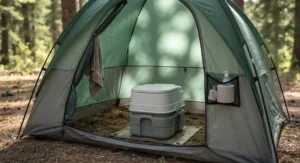
None of the seven toilets above come with built-in walls, which means toilet tent privacy is a separate purchase decision that shapes how usable your setup actually feels at a shared or semi-public campsite.
A pop-up privacy tent solves this in seconds — most fold flat into a compact bag and spring open into a standing-height enclosure with a zippered door and mesh venting. Reviewers of dedicated toilet-and-shower tents consistently recommend sizing up rather than down, since a cramped enclosure makes maneuvering a bucket toilet or flush unit awkward, especially once you add a small stool or supply caddy inside. Ground-anchored corner loops matter more than people expect too — a privacy tent that isn’t staked down properly is a genuinely unpleasant surprise in a gust of wind at the worst possible moment.
Placement matters just as much as the tent itself. Leave No Trace guidance recommends siting any toilet setup the way you would a cathole or latrine — on a durable surface, and at least 200 feet from water sources, campsites, and trails — a rule that applies whether you’re digging a hole or setting up a Cleanwaste GO Anywhere inside a privacy tent. Beyond regulation, that distance also just makes for a more pleasant campsite for everyone involved.
For van-life or overland setups, several experienced campers report mounting a privacy enclosure directly to a roof rack or awning arm using a receiver-style bracket, turning what would otherwise be a freestanding tent into a semi-permanent en-suite bathroom attached to the vehicle — a setup worth considering if you’re building out a long-term rig rather than packing fresh for every weekend trip.
Practical Usage Guide: Setup, First 30 Days & Maintenance
Getting a new portable toilet from box to functional campsite fixture takes about ten minutes for flush models and roughly two for bucket or bag-based units — but a few first-use details save real headaches down the line.
For flush-style toilets like the Camco 41541, Dometic 972, or Thetford Porta Potti 565E Curve, fill the freshwater tank first and add a capful of toilet chemical or biodegradable treatment before the first use — this breaks down waste and controls odor from day one rather than after the smell has already set in. Composting units like the BOXIO Toilet Plus need the hemp litter and odor plug installed correctly before first use; skipping this step is the single most common reason new composting-toilet owners report unexpected odor in the first week.
A simple maintenance rhythm prevents most problems: rinse and reapply seal lubricant on flush-valve toilets every few uses to keep the seal from drying out and leaking, empty bag-based systems (Reliance Luggable Loo, Cleanwaste GO Anywhere) as soon as reasonably possible rather than letting bags sit, and check battery corrosion on electric-flush units like the Thetford before each trip if it’s been in storage. The most common first-30-days mistake, based on aggregated review patterns, is under-filling the freshwater tank on flush models — a half-full tank means weak flushes and more frequent refills, which quickly turns people off a system that would otherwise work fine.
For long-term storage between trips, empty and thoroughly rinse every tank, leave lids propped slightly open to prevent trapped odor, and — critically for the Thetford — remove batteries entirely. A five-minute end-of-season routine like this is the difference between a toilet that’s ready to go next spring and one that needs a deep clean before its next use.
Real-World Scenarios: Which Toilet Fits Your Trip
The weekend car camper with two kids: Budget matters, but so does not running out of capacity mid-trip. The Camco 41541‘s 5.3-gallon tank comfortably covers a family of four through a two-to-three-day weekend without a dump run, and its manual bellows flush means nothing electronic to worry about around curious little hands.
The solo overlander with a packed-tight SUV: Cargo space is the binding constraint here, not budget or capacity. The Reliance Fold-to-Go‘s 5-inch collapsed profile solves the storage problem directly, and its 300-pound rating handles most adult users comfortably despite the minimal footprint.
The permitted river-trip group: Regulations, not preference, decide this one. If the route requires pack-out sanitation, the Cleanwaste GO Anywhere is close to a mandatory pick given its BLM permitting and Leave No Trace program endorsement — a genuine case where “best” is defined by what’s legally allowed rather than what’s most comfortable.
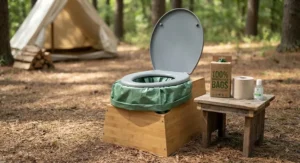
How to Choose a Portable Camping Toilet
- Start with trip length, not budget. A weekend trip barely stresses even the smallest tank, while a week-long stay makes tank capacity the deciding factor before price ever enters the conversation.
- Match the flush type to your users. Bellows flush works for most adults; pressurized or electric flush matters more for anyone with limited hand strength or grip issues.
- Weigh cargo space honestly. A toilet that never gets packed because it’s too bulky provides zero value regardless of how nice its features are on paper.
- Factor in ongoing costs. Bag-based and WAG systems have low upfront prices but real recurring refill costs that add up on frequent trips.
- Consider your camping style. Off-grid or van-life stays favor chemical-free composting systems; car camping near dump stations makes traditional flush tanks perfectly practical.
- Check the seat height and width. This sounds minor until you’ve used a too-low bucket seat for a week — comfort compounds daily.
- Confirm any regulatory requirements. Permitted wilderness areas and river routes may mandate specific pack-out systems regardless of personal preference.
Common Mistakes When Buying a Portable Toilet Outdoor
The most frequent misstep buyers make is choosing tank capacity based on the biggest number available rather than actual trip length — hauling around a 5.5-gallon Thetford for a single overnight trip is unnecessary bulk and weight for no real benefit. A close second is skipping toilet chemical or hemp litter entirely to save a few dollars upfront, which reliably backfires as odor complaints within the first weekend of use.
Buyers also commonly underestimate storage space requirements, assuming a toilet will “fit somewhere” in the trunk without actually measuring it against packed dimensions — a mistake that’s especially costly with rigid-tank units versus the collapsible Reliance Fold-to-Go. Finally, many first-time buyers overlook privacy entirely, purchasing a toilet without budgeting for a tent or shelter, then discovering at the campsite that there’s nowhere private to actually use it.
Portable Camping Toilet vs Cathole and Pit Toilet Alternatives
| Factor | Portable Camping Toilet | Cathole / Dug Latrine |
|---|---|---|
| Setup effort | Minutes, no digging | Requires trowel and 6-8 inch hole |
| Comfort | Real seat, often flush | Squatting, weather-exposed |
| Regulatory fit | Works almost anywhere | Restricted near water, high-use areas |
| Reusability | Reusable across many trips | Single-use, site-dependent |
| Best For | Camco 41541, Thetford 565E Curve | Backpacking with minimal gear |
Leave No Trace guidance specifies that catholes should be dug 6 to 8 inches deep and located at least 200 feet from water, camp, and trails — a standard that’s easy to meet with a shovel in soft soil but genuinely difficult in rocky terrain, frozen ground, or high-traffic sites where every nearby spot has already been used. A portable toilet sidesteps that terrain problem entirely, which is exactly why options like the Cleanwaste GO Anywhere exist for permitted areas where digging isn’t allowed or practical in the first place.
The honest tradeoff is weight and bulk: a cathole costs nothing to carry beyond a small trowel, while even the lightest units on this list add several pounds and real cargo space to your pack or vehicle. For car camping, van life, or short backpacking trips where space allows, the comfort and regulatory flexibility of a real toilet is worth that tradeoff for most people; for ultralight backcountry travel, a trowel and WAG bags remain the practical choice.
✨ Ready to Skip the Shovel?
🔍 Take your next trip to the next level with a toilet that fits your exact camping style. Click on any highlighted pick above to check current pricing and availability.
Safety, Regulations & Leave No Trace Compliance
Human waste disposal isn’t just a comfort issue — it’s a real environmental and public-health consideration that land managers take seriously, which is why several of the areas you might camp in have specific rules about it. The Leave No Trace Center for Outdoor Ethics identifies four core objectives behind proper waste disposal: minimizing water contamination, minimizing the spread of disease, minimizing social and aesthetic impact, and maximizing decomposition — objectives every product on this list satisfies in a different way depending on mechanism.
Before any trip, it’s worth checking site-specific regulations, since requirements shift by region and land manager. Winter conditions and permanently snow-covered terrain add extra complexity, since standard cathole guidance assumes accessible soil beneath the snow line — exactly the scenario where a bag-based or composting toilet like the BOXIO Toilet Plus avoids the problem entirely rather than working around it. For RV and van setups using flush-style toilets, always dump waste tanks only at designated dump stations rather than informal locations, both for legal compliance and basic environmental responsibility.
Storage and transport safety matters too: keep waste tanks sealed and upright during transport, store toilet chemicals away from food storage areas, and always wash hands thoroughly after handling any waste-tank component, bag, or seat assembly — a basic hygiene step that’s easy to forget when you’re rushing to break camp.
Long-Term Cost & Maintenance: Total Cost of Ownership
The sticker price only tells part of the story. Bag-based systems like the Reliance Luggable Loo and Cleanwaste GO Anywhere carry the lowest upfront cost but the highest ongoing expense, since every single use consumes a bag and gelling powder that needs restocking — a real cost that adds up fast for frequent campers, even if it stays invisible on the initial receipt.
Flush-style units flip that equation. The Camco 41541 and Thetford Porta Potti 565E Curve cost more upfront but need only occasional toilet chemical treatments, seal lubricant, and the water itself — all genuinely cheap on a per-use basis once you’ve absorbed the initial purchase price. Over a full camping season with a dozen or more trips, a flush toilet’s total cost of ownership often ends up lower than a bag-based system used at the same frequency, even though the sticker price suggests the opposite.
Composting systems like the BOXIO Toilet Plus land somewhere in between — a moderate upfront cost, plus ongoing hemp litter purchases, but no water, chemicals, or dump-station fees at all, which can make them the cheapest long-run option for anyone camping off-grid regularly where dump stations aren’t nearby or convenient anyway.

Frequently Asked Questions
❓ How often do you need to empty a portable camping toilet?
❓ Do portable camping toilets smell?
❓ Can you use a portable camping toilet inside a tent?
❓ What's the difference between a chemical toilet and a composting toilet?
❓ Are portable toilets allowed at all campsites?
Conclusion
There’s no single best portable camping toilet — there’s only the best one for your specific trip length, cargo space, and tolerance for hauling water. If budget and simplicity top your list, the Reliance Luggable Loo gets the job done for next to nothing. If comfort and capacity matter more, the Thetford Porta Potti 565E Curve delivers the closest thing to a real bathroom you’ll find in a portable format. And if you’re chasing chemical-free independence for off-grid stays, the BOXIO Toilet Plus earns its higher price tag through genuinely lower long-term hassle.
Whichever direction you land on, the improvement over a shovel-and-a-prayer approach is immediate and honestly a little life-changing the first time you use it at 2 a.m. in the cold. Pair your pick with a decent privacy tent, follow basic Leave No Trace placement guidance, and you’ve solved one of camping’s oldest, least-discussed problems for good.
Recommended for You
- Solar Shower for Camping: 7 Best Picks Tested for 2026
- Portable Camp Shower: 7 Real Picks Tested for 2026
- 7 Best Walkie Talkies for Kids Camping in 2026
Disclaimer: This article contains affiliate links. As an Amazon Associate, I earn from qualifying purchases. If you purchase products through these links, we may earn a small commission at no additional cost to you.
✨ Found this helpful? Share it with your friends! 💬🤗
