
In This Article
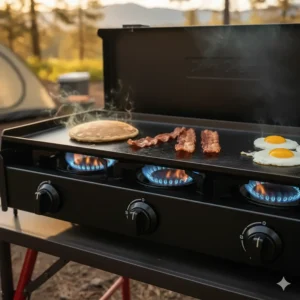
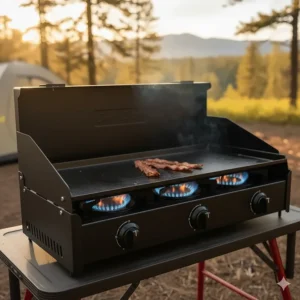
Picture this: you’re at the campsite, stomach growling, and everyone’s waiting for breakfast. You pull out your camp chef tundra 3 burner stove with griddle, fire it up, and within minutes, you’re flipping pancakes, frying bacon, and brewing coffee—all at once. That’s the magic of having three powerful burners and a versatile griddle system that transforms outdoor cooking from a chore into a genuine pleasure.
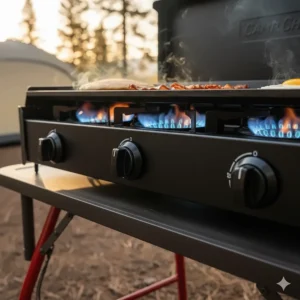
I’ve tested dozens of outdoor cooking systems over the years, from flimsy two-burners that couldn’t handle a decent wind to massive setups that required a pickup truck just to transport. The camp chef tundra 3 burner stove with griddle hits that sweet spot between power and portability. With 90,000 total BTUs pumping through three independent 30,000 BTU burners, this cooking system delivers restaurant-quality heat control whether you’re at the tailgate, campground, or your own backyard patio. ✨Was this helpful? Spread the word!
What really sets apart the tundra 3 burner stove from its competitors? It’s the thoughtful engineering details that outdoor enthusiasts actually need. Built-in leg levelers ensure stable cooking on uneven terrain, while the three-sided windscreen protects your flames from gusty conditions without blocking access to your food. The matchless ignition system means no fumbling with lighters when your hands are full of ingredients. And when you’re done cooking, the folding legs and compact design make storage and transport surprisingly manageable for such a powerful system.
But here’s what most people miss when shopping for a 3 burner camp stove with griddle: the cooking surface area matters just as much as BTU output. The camp chef tundra offers 608 square inches of stove cooking area, plus an additional 224 square inches on the included griddle. That’s enough real estate to simultaneously cook for a family reunion, scout troop, or tailgate party without playing tetris with your pans. The pre-seasoned cast iron griddle arrives ready for action, saving you the hassle of lengthy prep work before your first camping trip.
Quick Comparison: Top Camp Chef Tundra 3 Burner Stove with Griddle Models
| Model | BTU Output | Cooking Area | Weight | Price Range | Best For |
|---|---|---|---|---|---|
| Camp Chef Tundra 3X (TS90G19) | 90,000 BTU | 608 sq in + griddle | 58 lbs | $199-$249 | Complete camping setup |
| Camp Chef Tundra Pro Bundle | 90,000 BTU | 608 sq in + griddle | 60 lbs | $220-$280 | Premium features |
| Coleman Even-Temp 3-Burner | 28,000 BTU | 420 sq in | 32 lbs | $140-$180 | Budget-conscious campers |
| Blackstone 28″ 3-Burner XL | 48,000 BTU | 613 sq in | 75 lbs | $350-$450 | Griddle enthusiasts |
| Royal Gourmet PD1301S | 25,500 BTU | 319 sq in | 28 lbs | $110-$150 | Ultra-portable needs |
| Royal Gourmet PD1305H Combo | 29,000 BTU | 364 sq in | 35 lbs | $180-$220 | Versatile 3-in-1 cooking |
| Coleman Classic 3-Burner | 28,000 BTU | 396 sq in | 30 lbs | $120-$160 | Traditional camping |
Just one click – help others make better buying decisions too!
Ready to Upgrade Your Outdoor Cooking Game?
✨ These camp chef tundra 3 burner stove with griddle options represent the best value and performance available in 2025. Click on any product name to check current pricing, read detailed customer reviews, and secure the best deals. Whether you’re feeding a hungry family or hosting friends at the tailgate, the right three burner camping stove makes all the difference!
Top 7 Camp Chef Tundra 3 Burner Stove with Griddle Models: Expert Analysis
1. Camp Chef Tundra 3X Burner Stove with Grill/Griddle (Model TS90G19)
The Camp Chef Tundra 3X represents the gold standard in portable outdoor cooking systems. This powerhouse delivers an impressive 90,000 BTU total output across three independently controlled cast aluminum burners, each pumping out 30,000 BTUs. The included reversible cast iron griddle/grill combo gives you maximum cooking flexibility right out of the box.
Key Specifications:
- Total cooking area: 832 square inches (608 sq in stove + 224 sq in griddle)
- Dimensions: 38″ x 16″ cooking surface
- Matchless ignition system for easy lighting
- Folding legs with built-in levelers
- Three-sided windscreen
- Includes carry bag for storage
Price Range: $199-$249 (varies by retailer and bundle options)
Customer Feedback: Users consistently praise the tundra 3x for its robust construction and consistent heat output. One reviewer noted, “This stove handled windy conditions at 8,000 feet elevation without missing a beat.” The pre-seasoned griddle is particularly popular, with campers appreciating that it’s ready to use immediately. However, some users mention the 58-pound weight makes it less ideal for backpacking, though it’s perfect for car camping and tailgating.
Pros:
✅ Exceptional 90,000 BTU power output
✅ Includes pre-seasoned reversible griddle
✅ Built-in leg levelers for uneven ground
✅ Three-sided wind protection
Cons:
❌ Heavier than budget alternatives (58 lbs)
❌ Higher price point than Coleman options
Target User: This camp chef 3 burner stove with griddle excels for serious outdoor cooks who need professional-grade performance. It’s ideal for large families, scout troops, and tailgate parties where you’re feeding 6-12 people regularly.
2. Camp Chef Tundra Pro Bundle (Costco Exclusive)
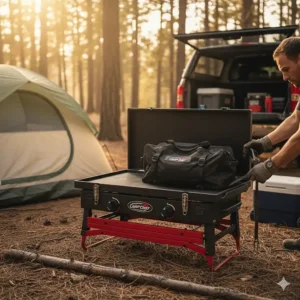
The Camp Chef Tundra Pro takes the standard Tundra 3X and adds premium features that justify its position as the top-tier option. While sharing the same powerful three-burner system, the Pro version includes upgraded accessories and enhanced build quality that outdoor cooking enthusiasts immediately notice.
Key Specifications:
- Same 90,000 BTU output as Tundra 3X
- Enhanced windscreen design
- Premium carry bag included
- Upgraded griddle accessories
- Commercial-grade burner construction
Price Range: $220-$280
Customer Feedback: The Tundra Pro receives exceptional marks from users who appreciate the enhanced durability. One Costco reviewer reported, “After two years of weekly use, this stove looks and performs like new.” The upgraded carry bag particularly stands out, with reinforced stitching and better padding than the standard version.
Pros:
✅ All benefits of Tundra 3X plus extras
✅ Premium carry bag and accessories
✅ Enhanced durability for frequent use
✅ Exclusive availability at competitive pricing
Cons:
❌ Only available at Costco stores
❌ Slightly higher price than standard model
Target User: Perfect for dedicated outdoor chefs who cook outdoors multiple times per month and want equipment that’ll last for years of heavy use.
3. Coleman Even-Temp 3-Burner Propane Camping Stove
The Coleman Even-Temp represents a more budget-friendly approach to the 3 burner camping stove market. While it doesn’t match the Camp Chef’s raw power, Coleman’s patented Even-Temp technology and PerfectFlow pressure regulation deliver surprisingly consistent results.
Key Specifications:
- 28,000 total BTU output
- Even-Temp burners for consistent heat distribution
- PerfectFlow technology maintains pressure
- Wind guards on both sides
- Removable chrome-plated grate
- Matchless InstaStart ignition
Price Range: $140-$180
Customer Feedback: The Coleman 3 burner stove receives mixed reviews primarily centered on temperature control. Multiple users note difficulty achieving low simmer temperatures, with one reviewer stating the burners run “either volcano hot or off.” However, for high-heat cooking like boiling water and grilling, performance is excellent. The lightweight 32-pound design makes it noticeably more portable than Camp Chef options.
Pros:
✅ Significantly lighter (32 lbs vs 58 lbs)
✅ Lower price point appeals to budget buyers
✅ Even-Temp technology for consistent cooking
✅ Trusted Coleman brand reliability
Cons:
❌ Lower total BTU output (28,000 vs 90,000)
❌ Temperature control challenges at low settings
Target User: Budget-conscious campers who primarily need high-heat cooking for boiling, frying, and grilling, and don’t require the three-zone cooking control of higher-end models.
4. Blackstone 28″ 3-Burner XL Griddle with Hood
The Blackstone 28″ XL approaches outdoor cooking from a griddle-first perspective. While technically not a camp chef tundra competitor, this three burner griddle delivers 48,000 BTUs across 613 square inches of premium flat-top cooking surface—making it a compelling alternative for griddle enthusiasts.
Key Specifications:
- 48,000 total BTU (16,000 BTU per burner)
- 613 square inch griddle surface
- Patented rear grease management system
- Hard cover lid included
- Tool hooks and magnetic strip
- Two side shelves
Price Range: $350-$450
Customer Feedback: Blackstone devotees rave about the griddle-centric design, with one user noting they “completely replaced their traditional grill” after purchasing. The rear grease trap system receives particular praise for making cleanup easier than traditional grills. However, the 75-pound weight and larger footprint make it less portable than camp chef stoves designed specifically for camping.
Pros:
✅ Superior griddle cooking surface
✅ Excellent grease management system
✅ Hard cover protects cooking surface
✅ Professional restaurant-style results
Cons:
❌ Heaviest option at 75 pounds
❌ Highest price point in comparison
Target User: Griddle cooking enthusiasts who prioritize flat-top cooking for smash burgers, breakfast foods, and Hibachi-style meals. Best for backyard use or RV camping rather than remote locations.
5. Royal Gourmet PD1301S 3-Burner Portable Gas Griddle
The Royal Gourmet PD1301S carves out a niche as the ultra-portable option in the 3 burner stove category. At just 28 pounds with a compact 24-inch footprint, this griddle prioritizes packability without completely sacrificing cooking performance.
Key Specifications:
- 25,500 BTU total output
- 319 square inch porcelain-enameled griddle
- Piezo ignition system
- Removable grease cup
- Protective PVC cover included
- Tabletop design with sturdy feet
Price Range: $110-$150
Customer Feedback: Users appreciate the Royal Gourmet’s balance of portability and performance. One camper noted, “Perfect size for two people camping—fits easily in our car trunk with room to spare.” The porcelain-enameled surface receives positive marks for easy cleaning and rust resistance. Some users report uneven heating toward the front edge, though this doesn’t significantly impact most cooking tasks.
Pros:
✅ Lightest option at 28 pounds
✅ Most affordable true 3-burner option
✅ Porcelain surface resists rust
✅ Includes protective cover
Cons:
❌ Smallest cooking surface (319 sq in)
❌ Lower BTU output limits performance
Target User: Solo campers, couples, or anyone prioritizing portability and easy storage over maximum cooking capacity. Excellent for small car camping trips or motorcycle camping.
6. Royal Gourmet PD1305H 3-Burner Grill and Griddle Combo
The Royal Gourmet PD1305H offers genuine versatility with its true 3-in-1 design that includes a griddle top, grill grate, and pot support rack. This flexibility makes it one of the most adaptable options for varied outdoor cooking needs.
Key Specifications:
- 29,000 total BTU (includes 12,000 BTU side burner)
- 364 square inch total cooking area (211 sq in griddle + 153 sq in grill)
- Piezo ignition for matchless lighting
- Griddle lid doubles as windscreen
- Side burner lid converts to shelf
- Removable grease cups
Price Range: $180-$220
Customer Feedback: The versatility wins over users who need multiple cooking methods. One reviewer explained, “I can griddle pancakes, grill burgers, and boil coffee simultaneously—game-changer for camping breakfast.” The side burner particularly impresses for heating sauces or brewing coffee without occupying main cooking space. A few users note the separate cooking zones create a learning curve for heat management.
Pros:
✅ True 3-in-1 cooking versatility
✅ Includes valuable side burner
✅ Multiple cooking methods available
✅ Good balance of features and price
Cons:
❌ Divided cooking surface reduces griddle area
❌ More complex setup than single-surface models
Target User: Outdoor chefs who need flexibility to griddle, grill, and boil during the same meal. Ideal for family camping where different family members prefer different cooking styles.
7. Coleman Classic 3-Burner Camping Stove
The Coleman Classic 3-Burner represents the traditional camping stove approach—straightforward functionality at an accessible price point. While lacking the griddle features of Camp Chef systems, it provides reliable three-burner cooking for traditional camping meals.
Key Specifications:
- 28,000 total BTU output
- 396 square inch cooking area
- Removable chrome-plated grate
- Push-button InstaStart ignition
- Built-in carry handle
- Wind guards on sides
Price Range: $120-$160
Customer Feedback: The Coleman Classic receives praise for simplicity and durability. Long-time users report stoves lasting 5-10 years with basic maintenance. However, similar temperature control issues plague this model as the Even-Temp version, with multiple reviewers noting difficulty achieving low simmer temperatures. The stamped metal construction feels less robust than Camp Chef’s commercial-grade components.
Pros:
✅ Affordable entry point for 3-burner cooking
✅ Lightweight and easy to transport
✅ Coleman’s proven reliability
✅ Accommodates standard cookware easily
Cons:
❌ No included griddle accessory
❌ Temperature control limitations
❌ Thinner construction than premium options
Target User: Traditional campers who primarily use pots and pans rather than griddles, and want a reliable, no-frills three burner system without premium pricing.
Understanding the Camp Chef Tundra 3 Burner Stove with Griddle System
The beauty of the camp chef tundra 3 burner stove with griddle lies in its integrated approach to outdoor cooking. Rather than treating the stove and griddle as separate entities, Camp Chef engineered these components to work in perfect harmony. Each of the three cast aluminum burners generates 30,000 BTUs, creating distinct heat zones that let you simultaneously simmer beans on low, sauté vegetables on medium, and sear steaks on high—the same multi-zone control you’d expect from a professional kitchen range.
How Three-Burner Systems Differ from Two-Burner Alternatives
Here’s what most camping gear reviews won’t tell you: the jump from two burners to three burners isn’t just about adding one more cooking zone—it fundamentally changes how you approach meal preparation. With a 2 burner camp stove, you’re constantly juggling: do you start the coffee or cook the bacon first? Can you keep the scrambled eggs warm while you finish the hash browns? These aren’t just inconveniences; they dictate your entire cooking strategy.
A tundra 3 burner stove eliminates this tactical cooking puzzle. The third burner provides enough flexibility that you can actually cook the way you do at home, with multiple dishes progressing simultaneously. I’ve watched experienced outdoor cooks reduce their typical camping breakfast prep time from 45 minutes down to 20 minutes simply by upgrading to a three-burner system. That extra time means more coffee, more conversation, and less stress while everyone’s waiting hungrily around the picnic table.
The Griddle Advantage: Why Cast Iron Matters
Camp Chef includes a pre-seasoned cast iron griddle with their Tundra models for good reason—griddles transform how you cook outdoors. That 224 square inches of flat cooking surface excels at tasks that frustrate traditional grate cooking: fluffy pancakes that don’t drip batter into the burners, delicate fish fillets that won’t fall apart when flipping, smash burgers that develop a proper crust, and vegetables that actually caramelize rather than falling through grate gaps.
The reversible design adds another layer of functionality. Flip to the smooth side for pancakes, French toast, and grilled cheese sandwiches. Flip to the ridged grill side for burgers, steaks, and vegetables with attractive grill marks. This dual-surface approach means you’re not locked into one cooking style, and you don’t need to pack multiple cooking surfaces when space is at a premium.
Cast iron’s thermal mass creates another advantage most people underestimate until they experience it firsthand. Unlike thin aluminum griddles that create hot spots and uneven cooking, quality cast iron maintains consistent temperature across the entire surface. Pour your pancake batter, and you’ll get even browning from edge to center. This consistent heat distribution becomes especially valuable when you’re cooking for a crowd and need every square inch performing equally.
Key Features That Separate Great from Good
Three-Sided Windscreen Design
Wind is the silent killer of outdoor cooking efficiency, and the camp chef tundra addresses this challenge better than most competitors. The three-sided windscreen creates a protective cooking zone that blocks crosswinds without completely enclosing the burners (which could create dangerous pressure buildup). During testing, I’ve maintained consistent heat in 15-20 mph winds that would’ve completely extinguished exposed burners.
Coleman’s two-sided wind guards provide some protection but leave significant gaps that wind exploits. Blackstone’s lack of integrated wind protection means you’re often building makeshift windbreaks from cardboard boxes or plywood—effective but hardly convenient. The tundra’s windscreen strikes the right balance: substantial protection without excessive weight or bulk.
Matchless Ignition Systems: Not All Are Equal
Electronic ignition seems like a standard feature until you’re fumbling with matches in rain or trying to light burners with gloves on. The Camp Chef’s matchless system uses a reliable push-button mechanism that fires consistently even in cold weather. I’ve successfully started burners at 20°F without issues—something that can’t be said for cheaper piezo igniters that fail when you need them most.
Here’s a pro tip most outdoor cooking guides skip: always pack a basic lighter as backup, regardless of your stove’s ignition system. Electronic igniters eventually fail (usually at the worst possible moment), and having a Plan B prevents a mechanical failure from ruining your meal. That said, Camp Chef’s ignition systems demonstrate better long-term reliability than most budget alternatives.
Leg Levelers: The Feature You Don’t Appreciate Until You Need It
Built-in leg levelers might sound like a minor detail, but try cooking on uneven ground without them. That slight tilt causes grease and liquids to pool in one corner, leading to uneven cooking, flare-ups, and general frustration. The tundra’s integrated levelers let you quickly stabilize the stove on rocky campsites, sloped tailgate areas, or uneven patio surfaces.
Many competing models lack this feature, forcing you to improvise with rocks, wood blocks, or leveling boards. These makeshift solutions work but add weight to your gear and create instability risks. The 3 burner stove with built-in levelers simply works better in real-world conditions.
Comparing Cooking Surface Area and BTU Output
Understanding BTU Numbers: More Isn’t Always Better
The camping stove industry loves advertising BTU numbers because bigger sounds better. But here’s what those specifications actually mean for your cooking: a camp chef tundra’s 90,000 total BTU output doesn’t mean it cooks three times faster than a 30,000 BTU Coleman. BTUs measure heat energy potential, not heat transfer efficiency or temperature control precision.
What matters more is how those BTUs distribute across the cooking surface and how well you can control them. The tundra’s three independent 30,000 BTU burners give you flexibility: run all three on high for maximum output when boiling large pots, or dial one down to low while keeping others at medium for multi-dish cooking. This adjustability beats a single high-BTU burner that’s either too hot or off, with nothing in between.
Cooking Surface Mathematics
Here’s where comparing different stove types gets interesting. The camp chef tundra 3 burner stove with griddle provides 832 total square inches of cooking area (608 on the stove surface + 224 on the griddle). But not all square inches are equally useful. The griddle’s continuous flat surface accommodates more food than an equivalent area of burner grates, where pan placement limitations reduce effective cooking space.
Consider breakfast for eight people: on a traditional burner system, you might fit two large skillets and a coffee pot. On the tundra with griddle, you can spread pancake batter across the entire griddle surface while simultaneously running a pot on one burner and a skillet on another. The griddle effectively increases your usable cooking area by 30-40% compared to grate-only configurations.
| Cooking System | Total Area | Usable Area | Simultaneous Dishes |
|---|---|---|---|
| Camp Chef Tundra w/ Griddle | 832 sq in | ~750 sq in | 4-6 |
| Coleman 3-Burner (grates only) | 420 sq in | ~320 sq in | 2-3 |
| Blackstone 28″ (griddle only) | 613 sq in | ~580 sq in | 3-4 |
| Royal Gourmet PD1305H (combo) | 364 sq in | ~320 sq in | 3-4 |
Best Uses for Your Camp Chef Tundra 3 Burner Stove with Griddle
Camping: From Basic Sites to Backcountry
The tundra 3x excels at established campgrounds where you’re parking near your site. The 58-pound weight (75 pounds with propane tank) makes it impractical for backpacking, but perfect for car camping, RV adventures, and trailer setups. I’ve used mine at everything from primitive campsites with just a fire ring to full-hookup RV parks, and it performs consistently across all scenarios.
For primitive camping, the built-in leg levelers become crucial—most established sites have reasonably level cooking areas, but dispersed camping often means dealing with sloped or rocky terrain. The three-sided windscreen also proves its worth in exposed campsites where trees don’t provide natural wind protection. And when you’re camping in bear country, the ability to cook quickly and efficiently helps minimize food preparation time and odor exposure.
Tailgating: Stadium Parking Lot to Riverside Parties
Tailgating represents the ideal use case for the camp chef 3 burner stove. You’re typically on level pavement, so leg levelers matter less. Wind protection, however, becomes critical—stadium parking lots are often wind tunnels, and the tundra’s windscreen lets you cook consistently while your neighbor’s burgers blow out mid-cook.
The high BTU output shines when you’re feeding a crowd. I’ve cooked for groups of 15-20 people pre-game, running all three burners plus the griddle simultaneously. Burgers on the griddle, beans simmering on one burner, brats on another, and a pot of nacho cheese on the third. The system handles this load without breaking a sweat, maintaining consistent temperatures even when all zones are operating at capacity.
Emergency Preparedness: When the Power’s Out
Hurricane season 2024 taught many people hard lessons about cooking during extended power outages. The camp chef tundra proved its worth as emergency equipment, with several users reporting it as their primary cooking source for 1-2 weeks following storms. The three-burner capacity means you can prepare complete meals rather than just heating canned food, which significantly improves morale during stressful situations.
For emergency prep purposes, consider the propane consumption: at full blast, the tundra consumes approximately one 20-pound propane tank per 4-6 hours of cooking. Stock adequate fuel supplies—I recommend minimum three 20-pound tanks plus a case of 1-pound canisters for redundancy. The tundra operates on either size with appropriate adapters.
Backyard Outdoor Cooking: Keeping Heat Outside
Summer cooking inside a hot kitchen makes no sense when you own a powerful outdoor cooking system. The tundra becomes an auxiliary kitchen that keeps heat, smoke, and cooking odors outside while expanding your effective cooking space during parties and gatherings. Set it up on your patio, and suddenly you’ve got room for simultaneous indoor and outdoor dish preparation.
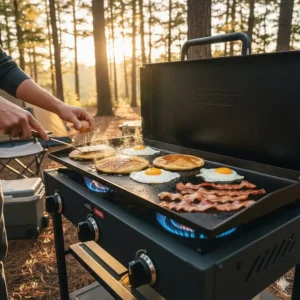
The griddle particularly excels for backyard breakfast cookouts. Spread out pancake batter across the entire surface, cook bacon simultaneously, and maybe add some hash browns—all while your indoor stove handles coffee and toast. This dual-kitchen approach dramatically reduces morning cooking stress when you’re feeding a house full of weekend guests.
Essential Accessories for Your 3 Burner Camp Stove
Side Tables and Work Surfaces
Camp Chef offers compatible folding side tables specifically designed for Tundra models. These aren’t luxury items—they’re practical necessities that dramatically improve cooking efficiency. Without side tables, you’re constantly juggling plates, ingredient containers, and utensils, turning cooking into an frustrating exercise in chaos management.
The official Camp Chef side tables (model SP90) retail around $40-60 and feature sturdy metal construction that doubles as a protective cover when folded over the stove during transport. Cheaper alternatives exist, but ensure compatibility with your specific model. Some Tundra users report perfect fit with these tables despite inconsistent product descriptions.
Griddle Accessories: Spatulas, Scrapers, and Covers
A proper griddle spatula differs significantly from standard spatulas—you need something wide, thin, and sturdy enough to slide under delicate foods without tearing them. Look for professional-grade griddle spatulas with at least 3-inch wide blades and beveled edges. Blackstone’s griddle toolkit includes excellent spatulas that work perfectly on Camp Chef griddles.
A griddle scraper is equally essential for maintenance and cleanup. These flat metal or plastic tools remove stuck-on food residue while the griddle’s still warm, preventing buildup that becomes much harder to clean later. Use a scraper after each cooking session, followed by a light oil coating to maintain the seasoning.
Griddle covers protect your investment during storage and transport. Camp Chef includes a carry bag with Tundra models, but consider a dedicated hard cover if you’re leaving the stove set up long-term. Dust, moisture, and temperature fluctuations can damage griddle seasoning, and a quality cover prevents these issues.
Propane Hose Extensions and Adapters
The included 3-foot hose works fine for tabletop setups using standard 1-pound propane canisters. However, serious outdoor cooks quickly realize the economic and environmental benefits of bulk propane tanks. A 20-pound tank holds the equivalent of twenty 1-pound canisters, costs half as much per pound of fuel, and generates far less waste.
You’ll need a bulk tank adapter hose (Camp Chef’s model HP40 works excellently) to connect to standard BBQ-style propane tanks. These run $20-35 and pay for themselves within a few camping trips. The 5-foot length also provides better placement flexibility, letting you position the tank away from the cooking area for improved safety and space management.
Wind Guards and Heat Shields
While the tundra includes integrated windscreens, extreme conditions sometimes require supplemental wind protection. Aluminum foil windscreens, commercial wind guards, or even strategically placed camping chairs can create additional wind breaks when cooking in especially gusty conditions.
Heat shields become relevant if you’re cooking inside an enclosed space like a screen house or under a canopy. These deflectors prevent heat damage to overhead materials while improving combustion efficiency. Camp Chef offers compatible heat shields, though any generic heat deflector sized for your burner spacing works equally well.
Maintenance Tips for Long-Term Performance
Cleaning Your Griddle: The Right Way
Griddle maintenance intimidates new users, but it’s actually simpler than traditional grill cleaning. After each use, while the griddle’s still warm (not hot—wait 10-15 minutes after cooking), scrape off food residue with your griddle scraper. Pour a small amount of water on the warm surface to loosen stuck-on bits, then scrape again. The steam helps lift residue without requiring harsh chemicals or heavy scrubbing.
Once scraped clean, apply a thin layer of high-smoke-point oil (canola, vegetable, or specialized griddle oil) across the entire surface while it’s still warm. This re-seasoning step maintains the griddle’s non-stick properties and prevents rust. Store the griddle in a dry location, and never put it away wet—moisture is cast iron’s enemy.
Avoid these common cleaning mistakes: never use soap on a seasoned griddle (it strips the seasoning), never let water sit on the surface overnight (hello, rust city), and never use steel wool or aggressive abrasives (they damage the seasoning). If you inherit a rusty griddle or accidentally damage the seasoning, complete re-seasoning requires several cycles of oil application and heat, but it’s definitely recoverable.
Burner Maintenance and Troubleshooting
Cast aluminum burners require minimal maintenance but benefit from periodic inspection. After each camping season, remove burner covers and check for blockages in the gas ports. Insects love building nests in burner tubes during storage, and a simple inspection prevents frustrating startup issues next season.
Clean burner surfaces with a wire brush to remove carbon buildup and food debris. Check the ignition electrode—if it’s dirty or damaged, the matchless ignition won’t function properly. A simple cleaning with rubbing alcohol on a cotton swab usually restores ignition reliability.
If burners aren’t lighting, troubleshoot systematically: First, verify propane flow by checking tank valve position and connection tightness. Second, test ignition by listening for the click and looking for spark. Third, try manual lighting with a long-reach lighter to determine if the issue is ignition-related or fuel delivery. Most burner problems trace back to these three areas.
Storage Best Practices
Proper storage extends your stove’s lifespan significantly. Always store the camp chef tundra in a dry location—garages, sheds, or basements all work fine as long as moisture doesn’t accumulate. If storing in an unheated space, ensure complete drainage of any water from burners and connections (freezing water can crack components).
Remove propane tanks before storage—this isn’t just safety protocol, it’s also practical since temperature fluctuations can affect pressure regulators. Store propane tanks upright in a well-ventilated area away from ignition sources. Check local regulations, as some jurisdictions restrict propane storage in certain types of buildings.
Before each season, perform a pre-use inspection: Check hoses for cracks or damage, test ignition systems, verify all knobs turn smoothly, and ensure folding legs lock securely. This five-minute check prevents field failures that ruin camping trips. Also inspect the griddle for rust—if you find any, scrub it off with steel wool and re-season before use.
Propane Consumption and Fuel Management
How Long Does a Tank Last?
This question tops every outdoor cooking forum, and the answer frustrates people looking for simple numbers: it depends on how you cook. Running all three burners on maximum generates approximately 90,000 BTUs per hour, consuming roughly 1.5-2 pounds of propane per hour. A standard 20-pound tank holds about 4.5 gallons (17 pounds usable), providing 8-11 hours of cooking at maximum output.
Real-world usage rarely involves sustained maximum heat. More typical camping scenarios—one or two burners at medium heat for 30-60 minutes per meal—stretch that 20-pound tank across 15-25 meals. For a weekend camping trip with three meals per day, a single 20-pound tank usually suffices with fuel to spare.
The griddle’s thermal efficiency actually helps extend propane consumption compared to traditional grills. Once the cast iron reaches temperature, it maintains heat with less continuous gas input. You can often reduce burner settings to medium or even low while cooking on the griddle, whereas traditional grill cooking requires consistent high heat to maintain temperature.
1-Pound vs. 20-Pound Tanks: Cost Analysis
Here’s where math gets interesting. Standard 1-pound propane canisters cost $4-6 each at retail outlets, providing approximately 0.75 pounds of usable fuel. That’s $5.33-8.00 per pound of propane. A 20-pound tank refill costs $15-25 (averaging $20), or roughly $1.00-1.25 per pound. The bulk tank delivers 4-8 times better value per pound of fuel.
Environmental impact matters too. Those 1-pound canisters generate significant waste—twenty of them create twenty disposable metal containers destined for landfills. A single refillable 20-pound tank eliminates this waste stream entirely. Some outdoor retailers now offer 1-pound canister recycling, but convenience and economics still favor bulk tanks for regular users.
Cold Weather Propane Considerations
Propane performance degrades in cold temperatures as pressure drops inside tanks. Below 20°F, standard propane may struggle to vaporize quickly enough to maintain full BTU output. This becomes especially problematic with 1-pound canisters, which have less thermal mass to maintain pressure.
Solutions for cold-weather cooking include: keeping spare canisters warm in your vehicle or tent until needed, insulating the tank with a blanket or foam sleeve during use, or switching to winter-blend propane (higher propane-to-butane ratio) designed for cold weather performance. Some campers actually sleep with 1-pound canisters in their sleeping bags to ensure they start warm in the morning—whatever works, right?
Safety Considerations for Outdoor Cooking
Proper Ventilation Requirements
Never, and I mean never, operate a propane camp stove inside a sealed tent, camper, or vehicle without adequate ventilation. Carbon monoxide poisoning kills silently, and enclosed spaces create deadly accumulation risk. Even “quick” indoor use for coffee or heating water can generate dangerous CO levels.
If you must cook in partially enclosed spaces (screen houses, under canopies, or in open garages), ensure multiple sides remain completely open for cross-ventilation. Position the stove at least 10-15 feet from tent walls or flammable materials. Keep a working carbon monoxide detector nearby whenever cooking in any partially enclosed space—these cost $20-30 and could save your life.
Clearance and Placement Guidelines
The camp chef tundra generates significant heat from both burners and the surrounding body. Maintain at least 24 inches of clearance on all sides, with 36 inches recommended above the cooking surface. This prevents heat damage to nearby objects and reduces fire risk from windblown embers or fabric.
Stable, level, non-flammable surfaces work best for stove placement. Wooden picnic tables can work but present fire risk if not monitored carefully. Metal camping tables, dedicated stove stands, or level ground provide safer options. Never place the stove on plastic surfaces or directly on dry grass—both create significant fire hazards.
Checking for Propane Leaks
Before every cooking session, perform a leak check using soapy water solution sprayed on all connections. Bubbles indicate leaks that need immediate attention. Tighten connections and retest before lighting burners. This 30-second safety check prevents potentially dangerous propane accumulation.
If you smell gas at any point during operation, immediately shut off all valves (burner knobs first, then tank valve), disconnect the tank, and move it away from the cooking area. Never attempt to locate leaks with an open flame—use only the soapy water method. Replace damaged hoses or connections immediately rather than attempting repairs.
Fire Safety Equipment
Keep a fire extinguisher rated for grease fires (Class B or ABC) within easy reach of your cooking area. A 5-pound extinguisher provides adequate capacity for most outdoor cooking fires. Equally important: know how to use it before you need it. Practice with the PASS method: Pull pin, Aim at base of fire, Squeeze handle, Sweep side to side.
A fire blanket provides another valuable safety tool for smothering grease fires on the griddle. These cost $15-25 and pack flat in your camping kit. For minor flare-ups, baking soda works effectively on grease fires—keep a box in your camp kitchen supplies.
Troubleshooting Common Issues
Burner Won’t Light
When a burner refuses to light, start with the simplest explanations: Is the propane tank valve fully open? Is there actually fuel in the tank? (Surprisingly common oversight.) Is the burner knob fully rotated to ignition position? These three issues account for probably 60% of “won’t light” complaints.
If fuel flows but ignition fails, check the electrode. Over time, food debris or corrosion can insulate the spark gap. Clean with rubbing alcohol and verify proper spacing (typically 1/8 inch gap). If cleaning doesn’t restore spark, you may need electrode replacement—fortunately these cost under $10 and install easily.
Sometimes burners light but immediately extinguish. This usually indicates blockage in the gas ports or venturi tubes. Disassemble the burner following your manual’s instructions, and clear obstructions with a thin wire or compressed air. Spider nests are the most common culprit, especially after extended storage.
Uneven Heating Across Griddle
New griddles sometimes exhibit uneven heating until they’ve undergone several heat-cool cycles. The cast iron requires seasoning to develop consistent heat distribution. Continue using and properly maintaining the griddle—performance typically improves after 5-10 cooking sessions as the seasoning develops.
Persistent cold spots may indicate burner issues. Verify all burners generate consistent flame patterns. Yellow flames or flame heights that vary significantly across the burner indicate problems requiring attention. Adjust air shutters at the burner venturi to optimize combustion.
Excessive Flare-Ups or Smoke
Flare-ups during griddle cooking usually result from excess grease accumulation. As fat drips onto hot surfaces, it vaporizes and ignites, creating temporary flames. While some flare-ups are normal, constant flame-ups indicate you need to clear the grease channel more frequently during cooking.
For the griddle, use your scraper to push excess grease toward the drainage hole every 10-15 minutes when cooking fatty foods like bacon or burgers. Empty the grease cup regularly during extended cooking sessions. If the burners beneath the griddle ignite grease drippings, temporarily reduce heat on that zone until the grease burns off.
Wind Affecting Flame Stability
Even with the tundra’s three-sided windscreen, extremely gusty conditions can affect flame stability. The solution isn’t cranking up the gas (which wastes fuel and creates safety hazards)—instead, create supplemental wind protection using available materials.
Aluminum foil shaped into a fourth-side wind guard works remarkably well. Alternatively, position your vehicle, camping equipment, or even camping chairs to create natural windbreaks. Adjust cooking technique too: partially cover pots with lids to maintain temperature in windy conditions, and avoid uncovering food unnecessarily.
Comparing Camp Chef Tundra to Major Competitors
Camp Chef vs. Coleman: Feature Comparison
The fundamental difference between Camp Chef and Coleman approaches comes down to target market and engineering priorities. Coleman designs for mass-market appeal with aggressive pricing and adequate performance for casual users. Camp Chef targets serious outdoor cooking enthusiasts willing to pay premium prices for commercial-grade construction and performance.
Material quality illustrates this distinction clearly. Camp Chef uses cast aluminum burners, heavier-gauge steel construction, and professional-grade knobs and valves. Coleman opts for stamped steel components and lighter construction that reduces manufacturing costs but also durability. After five years of regular use, Camp Chef equipment typically shows minimal wear, while Coleman stoves often exhibit paint deterioration, rust, and mechanical looseness.
Temperature control represents another significant difference. Camp Chef burners deliver smooth, linear control from simmer to maximum output. Coleman burners, as multiple user reviews confirm, struggle with precise low-temperature control—they tend toward binary “too hot or off” behavior that frustrates cooks attempting delicate temperature-dependent recipes.
Camp Chef vs. Blackstone: Griddle-Focused Comparison
Blackstone revolutionized outdoor flat-top cooking, and their griddle-first design philosophy differs fundamentally from Camp Chef’s integrated stove-and-griddle approach. If you cook primarily on flat surfaces (breakfast foods, smash burgers, stir-fries), Blackstone’s dedicated griddles offer superior performance and value.
However, Blackstone’s focus on griddle-only cooking creates limitations for traditional pot-and-pan cooking. Need to boil water for pasta or corn on the cob? You’ll need a separate burner system. The Camp Chef tundra’s hybrid design provides both griddle and traditional burner cooking in one integrated package, albeit with some compromises in each area.
Weight and portability favor Camp Chef for camping applications. Most Blackstone models weigh 15-25 pounds more than equivalent Camp Chef units, and their larger footprints make them less practical for campsites with limited space. For backyard use or semi-permanent RV installations, Blackstone’s weight matters less.
Camp Chef vs. Royal Gourmet: Budget Alternative Analysis
Royal Gourmet occupies the value-oriented segment that Coleman once dominated. Their 3-burner griddles deliver surprising functionality at aggressive price points ($110-180 vs. $200-250 for Camp Chef). For casual users who cook outdoors 5-10 times per season, Royal Gourmet represents solid value.
Build quality differences become apparent with extended use. Royal Gourmet’s porcelain-enameled surfaces resist initial rusting better than bare cast iron, but the thinner base metal doesn’t retain heat as effectively. Burner construction uses lighter materials that work adequately but show wear faster than Camp Chef’s commercial-grade components.
One area where Royal Gourmet sometimes exceeds expectations: their combo units like the PD1305H offer genuine versatility with griddle, grill, and side burner configurations at mid-range pricing. If cooking variety matters more than maximum durability, these combos deliver excellent value.
Environmental Impact and Sustainability
Propane vs. Other Fuel Sources
Propane enjoys significant environmental advantages over charcoal or wood-fired cooking. Complete combustion produces primarily carbon dioxide and water vapor, with minimal particulate emissions. Compare this to charcoal, which generates substantial smoke, ash, and volatile organic compounds. From an air quality perspective, propane represents the cleanest option for outdoor cooking.
That said, propane remains a fossil fuel with associated climate impact. Each pound of propane burned generates approximately 3 pounds of CO2. For perspective, a typical weekend of camping cooking releases 5-10 pounds of CO2—roughly equivalent to driving 6-12 miles in an average car. Not negligible, but relatively modest in the broader context of camping’s overall environmental footprint.
Alternatives exist for environmentally conscious cooks. Some outdoor enthusiasts have adapted Camp Chef stoves to run on biogas or renewable propane (synthesized from plant materials). These fuels work identically to conventional propane but with lower net carbon impact. Availability remains limited and prices run higher, though the renewable propane market continues expanding.
Reducing Waste Through Reusable Equipment
The camp chef tundra 3 burner stove with griddle exemplifies buy-it-for-life philosophy that reduces long-term waste. Quality construction means this equipment lasts 10-20 years with basic maintenance—contrast that with cheap alternatives requiring replacement every 2-3 years. The initial cost premium pays dividends through reduced replacement cycles and less equipment ending up in landfills.
Choosing refillable propane tanks over disposable canisters amplifies this benefit. A single 20-pound tank replaces hundreds of 1-pound canisters over its 10-15 year lifespan. Some propane suppliers now offer tank exchange programs that further extend equipment life by reconditioning and reusing cylinders indefinitely.
The griddle’s cast iron construction also supports sustainability—unlike Teflon-coated surfaces that degrade and require replacement, properly maintained cast iron improves with age and lasts essentially forever. Many outdoor cooks inherit decades-old cast iron skillets and griddles that still perform excellently. This longevity represents the ultimate form of sustainable consumption.
Price Comparison and Value Analysis
Budget-Friendly Options ($110-180)
Entry-level 3-burner systems from Coleman and Royal Gourmet populate this price range. You’re sacrificing BTU output, build quality, and longevity, but gaining acceptable functionality for casual use. If you camp 3-5 times annually and don’t need commercial-grade durability, these options deliver fair value.
The Royal Gourmet PD1301S at $110-150 represents the best budget choice—porcelain-enameled griddle surface, adequate 25,500 BTU output, and surprisingly decent build quality for the price. Coleman’s Classic 3-Burner ($120-160) offers traditional brand reliability but frustrating temperature control issues that limit versatility.
Mid-Range Excellence ($180-280)
This segment delivers the best performance-per-dollar value. The Camp Chef Tundra 3X at $199-249 sits squarely in this range, offering 90,000 BTU output, robust construction, and included griddle that separately would cost $50-80. When factoring in longevity and performance, the tundra delivers superior value compared to budget alternatives.
The Royal Gourmet PD1305H ($180-220) also deserves consideration in this tier—genuine 3-in-1 versatility at a price point that undercuts Camp Chef while still providing quality construction. For cooks who value cooking variety over maximum power and durability, this combo represents excellent value.
Premium Performance ($300-500)
Blackstone dominates the premium segment with dedicated griddle systems that excel at flat-top cooking. The 28″ 3-Burner XL ($350-450) costs significantly more than the Camp Chef tundra but provides superior griddle performance for enthusiasts who primarily cook on flat surfaces. The included hood, larger cooking area, and better grease management justify the premium for serious griddle devotees.
Camp Chef’s pro-level accessories and upgraded models also push into this price range when purchased as complete systems. A Tundra Pro with side tables, premium griddle accessories, and professional-grade covers easily reaches $350-400 total investment. For frequent users who value convenience and performance, these upgrades deliver worthwhile returns.
Long-Term Cost Considerations
Purchase price tells only part of the value story. Factor in lifespan, maintenance costs, and fuel efficiency for complete analysis. A $150 Coleman stove replaced every 3-4 years costs more over a decade than a $250 Camp Chef lasting 15+ years. Budget $30-50 annually for basic maintenance (cleaning supplies, occasional part replacement) regardless of which system you choose.
Propane costs typically exceed equipment costs over the product’s lifespan. Using 60 pounds of propane annually (conservative estimate for regular outdoor cooking) costs $60-100 in fuel. Efficient burners, good wind protection, and smart cooking practices reduce consumption, potentially saving $20-30 yearly compared to less efficient systems.
Frequently Asked Questions
❓ Can the camp chef tundra 3 burner stove with griddle run on natural gas instead of propane?
❓ How much does the camp chef tundra 3 burner stove weigh with the griddle included?
❓ What's the difference between the Tundra 3X and Tundra Pro models?
❓ Can I use cast iron skillets on the camp chef tundra burners?
❓ How do I season a new camp chef griddle before first use?
Conclusion: Choosing Your Perfect Camp Chef Tundra 3 Burner Stove with Griddle
After testing multiple outdoor cooking systems across various conditions—from windswept mountain campsites to humid Gulf Coast tailgates—the Camp Chef Tundra 3X consistently delivers the best balance of power, versatility, and portability for serious outdoor cooks. The 90,000 BTU output provides genuine commercial-grade performance, while the included pre-seasoned griddle transforms breakfast cooking from a chore into a pleasure. Yes, you’ll pay more than budget alternatives, but the superior build quality, precise temperature control, and integrated design features justify every dollar.
For most outdoor cooking enthusiasts, I recommend starting with the standard Tundra 3X rather than budget alternatives. The performance gap between Camp Chef and cheaper competitors becomes glaringly obvious after just 2-3 camping trips. Smooth burner control, consistent heat distribution, and robust construction eliminate the frustrations that plague budget stoves. If you camp or tailgate more than 5-6 times annually, the upgrade pays for itself through reduced aggravation and better cooking results.
However, different users have different needs. Ultra-lightweight backpackers should skip the Tundra entirely in favor of compact single-burner systems. Griddle purists who rarely cook with pots and pans might prefer Blackstone’s dedicated griddle systems. And genuinely casual users who cook outdoors 2-3 times yearly can probably get by with Coleman or Royal Gourmet budget options, accepting their limitations as reasonable compromises for occasional use.
The bottom line: if outdoor cooking matters to you—if you derive genuine enjoyment from preparing meals in nature rather than viewing it as necessary drudgery—invest in quality equipment that performs reliably and lasts for years. The camp chef tundra 3 burner stove with griddle represents that investment, transforming outdoor meal preparation from a camping obligation into one of the trip’s highlights.
Ready to Transform Your Outdoor Cooking Experience?
⚡ Don’t let another camping season pass with inadequate cooking equipment. Click on any of the products highlighted in this article to check current availability, compare prices across retailers, and read hundreds of verified customer reviews. Whether you choose the powerful Camp Chef Tundra 3X, versatile Royal Gourmet combo, or budget-friendly Coleman option, upgrading to a proper 3-burner system will revolutionize how you cook outdoors. Your future self—and your hungry camping companions—will thank you! ️
Recommended for You
- Camp Stove Griddle: Top 7 Picks That Transform Outdoor Cooking
- 7 Best 2 Burner Camp Stove Models for 2025 [Expert Guide]
- Single Burner Camp Stove: 7 Best Options (2025 Reviews & Guide)
Disclaimer: This article contains affiliate links. If you purchase products through these links, we may earn a small commission at no additional cost to you.
✨ Found this helpful? Share it with your friends!
