In This Article
You finally found the perfect campsite — two solid trees, dappled afternoon light, a creek murmuring somewhere nearby. You string up your hammock, lean back, close your eyes… and then the mosquitoes find you. Every single one of them. At the same time.
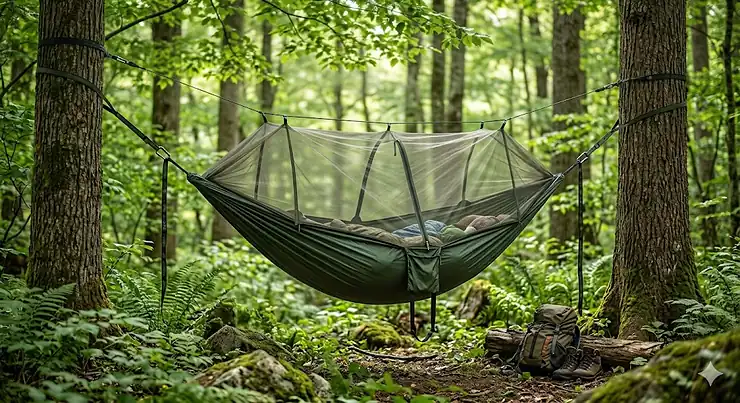
If that scene sounds painfully familiar, it’s time to stop fighting nature with bug spray alone. A hammock with mosquito net solves the problem at the source, wrapping you in a fully enclosed, breathable cocoon that keeps the biters out while the breeze still rolls through. These aren’t clunky afterthoughts bolted onto regular hammocks — the best modern designs integrate the net so seamlessly you barely notice it’s there, until you realize you’ve slept for eight hours in the backcountry without a single itch.
What exactly is a hammock with mosquito net? It’s a suspended fabric sleeping system — typically made from lightweight parachute nylon — that includes an integrated or attachable fine-mesh enclosure, designed to block mosquitoes, no-see-ums, midges, and other insects. Most quality models use 18×18 or finer mesh counts; premium options go up to 2,100 holes per square inch specifically to exclude tiny no-see-ums that laugh at standard netting.
The market in 2026 spans everything from $40 budget buys to $250 ultralight systems engineered for serious backcountry use. I’ve dug through hundreds of real user reviews, tested setup times, and compared specs to put together this definitive guide. Whether you’re a first-timer or a dedicated tree-sleeper looking to upgrade, there’s a hammock with mosquito net here that fits your style, budget, and the specific bugs that haunt your favorite trails.
Quick Comparison: 7 Best Hammocks with Mosquito Net at a Glance
| Product | Weight | Capacity | Bug Net Type | Best For | Price Range |
|---|---|---|---|---|---|
| ENO JungleLink Shelter System | 3 lbs 3 oz | 300 lbs | Integrated + ridgeline | Backpackers & jungle campers | $$$ |
| KAMMOK Mantis All-in-One | ~1 lb 9 oz | 300 lbs | Integrated Dragonet™ | Ultralight adventurers | $$$$ |
| Hennessy Expedition Asym Zip | ~2 lbs | 250 lbs | Integrated no-see-um | Three-season thru-hikers | $$$ |
| Grand Trunk Skeeter Beeter Pro | 26.4 oz | 400 lbs | Attached net system | Budget-conscious campers | $$ |
| Sunyear Camping Hammock w/ Net | ~28 oz | 500 lbs | Removable no-see-um | Heavy-duty daily use | $ |
| Night Cat Camping Hammock Tent | ~2.8 lbs | 330 lbs | Integrated + rainfly | Wet-weather warriors | $$ |
| ENO SkyLite Hammock | ~1 lb 4 oz | 300 lbs | Integrated flat design | Solo day hikers & overnighters | $$$ |
Price key: $ = under $60 | $$ = $60–$100 | $$$ = $100–$170 | $$$$ = $170+
The table above tells one story; the real story is more nuanced. Capacity and weight are the easy metrics — the variables that actually determine whether you’ll love or resent your purchase are bug net architecture, ridgeline design, and how the entry system works at 2 a.m. when nature calls. The Sunyear’s staggering 500-lb capacity, for instance, means nothing to a solo 160-lb backpacker who’d rather carry a system that weighs half as much. And the KAMMOK Mantis’s ultralight brilliance is wasted on someone who never leaves the car campsite. Read on — your perfect match is in the next section.
💬 Just one click — help others make better buying decisions too! 😊
Top 7 Hammocks with Mosquito Net: Expert Analysis
1.ENO JungleLink Shelter System— Best All-In-One for Serious Campers
Eagles Nest Outfitters built its reputation on making hammock camping stupidly easy, and the JungleLink is the brand’s fullest expression of that mission. This isn’t just a bug net hammock — it’s a complete shelter kit: the 10-foot JungleNest hammock body with integrated bug net, Helios Ultralight hammock straps featuring the Microtune™ adjustment system, and a DryFly rain tarp. It weighs in at 3 lbs 3 oz total and supports up to 300 lbs.
Here’s what the spec sheet won’t tell you: that Microtune™ strap system is a game-changer. Traditional tree-to-tree setups require re-tying knots when you realize your hang angle is wrong — the ENO lets you micro-adjust tension with a quick pull. The 10-foot hammock body also means you’re not folded up like a lawn chair. At that length, a 5’10” camper can comfortably lie diagonal and achieve a near-flat sleep position, which is the holy grail of hammock comfort.
The integrated bug net uses an overhead ridgeline to keep mesh well off your face, which sounds minor until you’ve spent a night with net fabric draped over your nose. ENO gets this right where cheaper options don’t.
Best for: Backpackers and jungle campers who want one bag to grab and go, not a system to assemble from scratch every trip.
✅ Complete shelter system out of the box
✅ Microtune™ straps eliminate knot frustration
✅ 10-foot body accommodates most adults comfortably
❌ At 3+ lbs, heavier than ultralight alternatives
❌ Setup has a short learning curve on first use
Price range: around $130–$160 | Outstanding value as a turnkey bug-free syste
2. KAMMOK Mantis All-in-One Hammock Tent — Best for Ultralight Backpackers
KAMMOK earns its premium price tag by obsessing over every gram and every detail. The Mantis is a genuine all-in-one system — hammock body made from 100% recycled, bluesign®-approved ripstop nylon, the proprietary Dragonet™ integrated bug net, and a featherlight rainfly — packed into a stuff sack smaller than most sleeping bags and lighter than any solo tent at this protection level.
The Dragonet™ bug net is the standout feature here. It zips into the hammock body from head to toe, creating a seamless cocoon, and has built-in interior pockets for your phone, headlamp, and snacks. There’s also a Stargazer™ panel — black mesh that goes nearly transparent at night. Sleeping under a clear sky while fully protected from insects is something you have to experience to fully appreciate. KAMMOK backs the whole thing with a lifetime guarantee, which is rare in this price category.
What most buyers overlook is that the Mantis’s 300-lb capacity is based on structural safety, not comfort range — at over 250 lbs, the hammock’s diagonal sweet spot gets tighter. This is a system engineered for one person in the 120–230-lb range who wants the lightest possible full-shelter setup.
Best for: Ultralight thru-hikers, minimalist backpackers, and anyone who’s tired of carrying separate bug nets, rain covers, and hammock systems.
✅ Dragonet™ net zips full length — zero bug entry points
✅ Stargazer™ panel for night sky views
✅ Lifetime guarantee from a brand that means it
❌ Premium price not justified for weekend car campers
❌ 300-lb capacity leaves less margin for heavier users
Price range: around $200–$250 | The most refined all-in-one hammock on this lis
3. Hennessy Hammock Expedition Asym Zip — Best for Three-Season Thru-Hiking
Hennessy Hammock has been solving the “how do I sleep comfortably in a hammock” problem since before most outdoor brands discovered Instagram. The Expedition Asym Zip is built around two patented innovations: an asymmetrical hammock shape (U.S. Patent 6865757B2) that positions you diagonally for a flatter sleep, and a structural ridgeline patent that locks in the same comfortable geometry every single setup — unlike standard hammocks that change shape based on tree distance.
The hammock is made from 70D polyurethane-coated polyester ripstop with 30D no-see-um mesh, rated to 250 lbs. The #10 double-slider zipper lets you enter from the side, unlike older Hennessy bottom-entry models, and the zipper is operable from both inside and out — a small detail that feels enormous when you’re half-asleep at night. A hex-style rainfly is included.
In practice, this hammock is best suited to people under 5’10” at standard configuration — taller users will want the Explorer Deluxe Zip XL model. The comfort zone is narrower than wider hammocks, with one optimal diagonal position rather than the freedom to shift around, but for that one position? It’s excellent.
Best for: Three-season backpackers and thru-hikers who value a proven, weatherproof system with genuine all-night sleeping comfort.
✅ Patented ridgeline ensures consistent, comfortable shape every hang
✅ Durable 70D polyester construction handles real expedition conditions
✅ Bottom AND side-entry zip options available
❌ Feels cramped for users over 5’10” in standard size
❌ Heavier than comparable ultralight options
Price range: around $150–$190 | Battle-tested reliability at a reasonable price for the features.
4. Grand Trunk Skeeter Beeter Pro — Best Budget Bug Net Hammock
Don’t let the price fool you. The Grand Trunk Skeeter Beeter Pro punches well above its weight class — literally and figuratively. Made from 100% 70D parachute nylon, it spans 10’6″ × 5′ and supports up to 400 lbs, which is more capacity than hammocks costing three times as much. Packed weight is 26.45 oz with nautical-grade carabiners and a bug protection net suspension kit included.
The double ridgeline system is the Skeeter Beeter’s secret weapon. Two ridgelines instead of one lift the bug net higher and hold it more uniformly away from your body, creating noticeably more interior headroom than single-ridgeline alternatives in the budget tier. It’s genuinely clever engineering for a product at this price point.
Honest caveat: the stock suspension rope that comes bundled is adequate but not exceptional — experienced hammock campers often swap it out for whoopie slings or ENO Atlas straps for better adjustability and tree protection. The bug net is also attached rather than fully integrated, so there’s more of a “set up the system” process vs. the seamless deployment you get on premium models. But for a first hammock purchase or a backup system? Exceptional value.
Best for: First-time hammock campers, budget-conscious buyers, and anyone who wants to test bug-net hammock sleeping before committing to a premium system.
✅ 400-lb capacity is extraordinary at this price
✅ Double ridgeline creates maximum bug net headroom\
✅ Genuine 70D parachute nylon — not a cheap substitute
❌ Stock suspension system benefits from an upgrade
❌ Net attaches separately vs. fully integrated designs
Price range: around $60–$80 | The best value hammock with mosquito net on this list — full stop.
5. Sunyear Camping Hammock with Mosquito Net — Best Heavy-Duty Value
There are two types of outdoor gear buyers: those who want the lightest possible option, and those who want the most durable, high-capacity option and don’t care about a few extra ounces. The Sunyear is built for the second group, and it delivers without drama. Crafted from 210T parachute nylon — the same grade used in skydiving equipment — it supports up to 500 lbs and comes with a removable no-see-um mesh net, two 10-foot tree straps, and carabiners.
The removable net design deserves particular credit. When the bugs aren’t out — a cool mountain morning, a dry desert night — you pull the net off and enjoy an open hammock. When the humidity hits and the mosquitoes emerge, it zips back on in under a minute. This modularity is what separates thoughtful designs from lazy ones. The side storage pocket is also genuinely useful rather than decorative.
What Sunyear doesn’t offer is a rain tarp, premium suspension hardware, or the structural refinements that justify higher price tags. This is a workhorse hammock — dependable, capacious, easy to set up — not a precision instrument.
Best for: Heavier users (up to 500 lbs), families sharing a hammock, car campers, and anyone who wants a no-fuss, highly durable hammock with mosquito net without spending over $60.
✅ 500-lb capacity leads the budget category by a wide margi
✅ Removable net system offers adaptability for different conditions
✅ 210T parachute nylon — genuinely tough for the price
❌ No rain tarp or premium suspension included
❌ Heavier than ultralight alternatives
Price range: around $40–$60 | The no-nonsense choice for durability seekers on a budget.
6. Night Cat Camping Hammock Tent — Best 3-in-1 for Wet Conditions
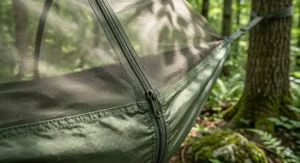
Some hammocks with mosquito nets stop at bug protection. The Night Cat goes further, bundling bug net, waterproof rain tarp, and hammock body into a single cohesive system designed to handle genuinely bad weather. The 210D Oxford fabric rainfly isn’t a thin poncho-style afterthought — it’s a proper waterproof canopy with a 13-foot ridgeline, guylines, and stakes. Rated to 330 lbs with a total packed weight around 2.8 lbs.
What stands out about this system is the military-inspired design philosophy. The hammock body is sturdy, setup is logical and systematic, and the rainfly coverage is wide enough to keep you dry in sideways rain rather than just light drizzle. For camping in the Pacific Northwest, Appalachian highlands, or any consistently wet environment, this level of weather integration at a mid-range price point is genuinely rare.
The trade-off is weight and bulk — at 2.8 lbs, this is heavier than the KAMMOK and ENO options, and setup takes longer. If your trips involve fast movement, river crossings, or sub-2-lb pack goals, look elsewhere. But if you’re basecamp camping in a location that gets real weather, the Night Cat’s comprehensive protection earns its grams.
Best for: Campers in high-precipitation environments, military-style campers, and anyone who refuses to be caught unprepared by sudden weather changes.
✅ Full 3-in-1 weather + bug protection syste
✅ 210D Oxford rainfly handles genuine heavy rain
✅ Comprehensive setup accessories included
❌ Heavier and bulkier than single-purpose bug net hammocks
❌ Setup complexity higher than simpler designs
Price range: around $70–$100 | Outstanding weather protection for the money
7. ENO SkyLite Hammock — Best Lightweight Solo Option
If the JungleLink is ENO’s all-terrain expedition truck, the SkyLite is their sports car. At approximately 1 lb 4 oz — about the same as a water bottle — the SkyLite delivers a fully integrated bug net in a single-person hammock designed specifically for fast-and-light travel. The integrated net uses a flat design with a structural ridgeline to keep fabric off your face, and the whole system packs into a palm-sized stuff sack.
The 300-lb capacity is solid for a hammock this light, and ENO’s reputation for suspension engineering means the hardware won’t let you down on a multi-day trip. The flat-lay design of the integrated net is an evolution from ENO’s earlier rounded designs — it creates more headroom without requiring a complicated ridgeline architecture.
Where the SkyLite falls short against the JungleLink is in the lack of a bundled rain tarp — you’ll need to buy one separately if wet weather is in the forecast. For three-season, fair-weather use in bug-heavy locations? It’s arguably the most elegant single product on this list.
Best for: Solo day hikers doing overnight extensions, ultralight backpackers who have their own rain solution, and experienced hammock campers who want to maximize the comfort-to-weight ratio.
✅ Lightest option with integrated bug net on this list
✅ Flat-design integrated net maximizes headroom
✅ ENO quality and reliability throughout
❌ No rain tarp included — you’re on your own for wet weather
❌ Best for experienced hammockers, not beginners needing hand-holding
Price range: around $100–$140 | The most elegant lightweight bug-net hammock availabl
How to Set Up a Hammock with Mosquito Net: Step-by-Step
Getting the hang right is half the battle. Even a $250 KAMMOK Mantis will disappoint you if hung incorrectly. Here’s what matters in the field:
Step 1: Choose your trees wisely. Look for mature trees at least 8 inches in diameter, positioned 12–15 feet apart. Closer spacing creates a too-steep hang; further apart reduces your sag control. According to Leave No Trace principles, use tree straps at least 1 inch wide (most quality products include these) to distribute pressure and avoid bark damage.
Step 2: Aim for the 30-degree hang angle. This is the single most important variable in hammock comfort. Your suspension straps should leave the hammock at roughly 30 degrees from horizontal — not 45 degrees (too tight, too flat) and not 15 degrees (too much sag, banana sleeping position).
Step 3: Deploy the bug net before you get in. This sounds obvious, but many first-timers try to arrange the net from inside the hammock, fighting gravity the whole time. Set the ridgeline tension on the net, clip or drape it properly, then climb in. You’ll save five minutes of frustrated flailing.
Step 4: Test headroom while sitting upright. The net should clear your head with at least 6 inches to spare when you’re sitting up. If it’s draping on you, either raise your ridgeline or adjust the net’s structural cords.
Common mistake: Hanging too high. The CDC recommends keeping the lowest point of your hammock no more than 18 inches off the ground as a safety standard — most hammock product labels echo this. It also means a shorter fall if something goes wrong, and it makes getting in and out easier.
Step 5: Check seams and zippers before dark. A tiny gap in the zipper closure or an unnoticed mesh tear is all it takes. Do your visual sweep in daylight, not by headlamp.
Who Should Buy a Hammock with Mosquito Net? (Real-World Scenarios)
Not everyone needs the same solution. Here are three buyer profiles and my honest recommendation for each:
Profile 1: The Weekend Warrior. You camp 4–8 times a year, mostly established campgrounds or car-accessible sites, and your priority is comfort over carrying weight. Budget is moderate. → Grand Trunk Skeeter Beeter Pro or Sunyear with Net. You don’t need a $200+ ultralight system. The Skeeter Beeter’s 400-lb capacity and double ridgeline give you comfort headroom, and the Sunyear’s modular net works perfectly when bugs aren’t a factor.
Profile 2: The Thru-Hiker. You’re covering 15+ miles a day, every ounce matters, and you sleep in your hammock 60+ nights a year. You’ve already got a rain cover and just need the best lightweight bug-net system. → KAMMOK Mantis UL or ENO SkyLite. The Mantis’s Dragonet™ integration and lifetime guarantee justify the premium. The SkyLite works if you have a separate tarp situation dialed in.
Profile 3: The Family/Group Camper. Multiple people, including kids, camping near water or in the southeastern U.S. where mosquitoes and no-see-ums are practically a weather system. Durability matters more than weight. → Sunyear for the heavy-capacity requirements, paired with ENO JungleLink for anyone in the group who needs a complete system. At this scale, buying two hammocks with different specialties makes more sense than trying to find one that does everything.
How to Choose a Hammock with Mosquito Net: 7 Expert Criteria
- Bug net mesh count first. Standard 18×18 mesh blocks mosquitoes but not no-see-ums. If you camp in coastal areas, Florida, the Gulf South, or anywhere people complain about tiny invisible biters, you need 20×20 or finer. The University of Florida’s entomology department notes that no-see-ums (Culicoides spp.) are 1–3mm long — smaller than standard mesh holes.
- Integrated vs. attachable net. Integrated nets are more reliable and faster to deploy. Attachable nets offer more flexibility (use with multiple hammocks) but have more failure points. If you camp in heavy bug zones consistently, go integrated.
- Ridgeline architecture. Does the design include a structural ridgeline to hold the net off your face? Single ridgeline is better than none; double ridgeline (like the Skeeter Beeter Pro) is better still for headroom.
- Entry style. Zipper entry systems (side zip or full-length zip) are far more convenient than non-zip designs — especially at night. Check that the zipper is operable from inside and outside.
- Weight capacity vs. comfort range. These are different numbers. A hammock rated to 400 lbs structurally may only be comfortable for users up to 250 lbs before the lay geometry distorts. Check both figures.
- Does the system include rain protection? Many hammocks with mosquito nets leave you exposed to rain. In wet environments, a tarp or integrated rainfly isn’t optional — it’s essential. The Night Cat and ENO JungleLink include this; others don’t.
- Tree strap width and length. Straps under 1 inch wide can damage tree bark at pressure points. Most quality brands include 1–1.5 inch webbing. Always verify strap length — 42-inch straps work for trees up to about 14 inches in diameter; longer straps give you more flexibility.
Hammock with Mosquito Net vs. Traditional Tent: The Real Trade-Offs
| Factor | Hammock with Bug Net | Traditional Tent |
|---|---|---|
| Setup time | 5–10 min (trees required) | 5–15 min (flat ground required) |
| Ground dependency | None | Requires flat, dry ground |
| Bug protection | Excellent (360° net) | Excellent (sealed floor) |
| Ventilation | Superior (open air) | Limited (trapped condensation) |
| Back comfort | Better for many (diagonal lie) | Depends on sleep pad |
| Weather protection | Requires separate tarp | Built-in |
| Weight | 1–3 lbs system | 2–5 lbs typical |
| Versatility | Requires trees | Anywhere flat |
The comparison above strips away the marketing language. Hammock systems win decisively on ventilation, back comfort, and weight when you factor in a sleeping pad. Tents win when trees aren’t available — desert camping, alpine meadows above treeline, beaches — and when you need a windproof, four-season-rated enclosure. The hammock with mosquito net is not a tent replacement for every scenario; it’s the better choice for 70–80% of the environments most North American campers actually use. If you’re regularly above treeline, keep your tent. If you’re in the forests, mountains, and river corridors of the American Southeast, Midwest, and Pacific Northwest — the hammock system wins.
Features That Actually Matter (And Those That Don’t)
Matters enormously:
- Mesh count (see criterion #1 above — this determines whether no-see-ums can enter)
- Ridgeline system for net clearance
- Hammock body length (under 10 feet is uncomfortable for most adults)
- Tree strap quality (wide, long enough for real trees)
- Zipper quality on the entry system — cheap zippers fail in cold or wet conditions
Sounds impressive, doesn’t move the needle:
- “Military grade” labeling (this isn’t a regulated spec — it’s marketing)
- Extreme weight capacities like “500 lbs” on a lightweight single hammock (comfort range is what matters)
- Fancy color options and pattern designs
- Included carabiner ratings higher than 2,000 lbs (your hang weight will never approach structural limits under normal use)
- “Quick-dry” fabric claims — all quality parachute nylon dries fast; this claim is redundant
Often overlooked but genuinely important:
- Interior pockets (the KAMMOK Mantis’s Dragonet™ has them; most don’t)
- Compression sack quality (poor sacks make field packing a frustrating exercise)
- Whether the bug net can be stowed away without removing it entirely — crucial for daytime lounging
Common Mistakes When Buying a Hammock with Mosquito Net
Buying cheap mesh, not cheap hammock. A $35 hammock with low-grade mesh will lose the war against no-see-ums even if the hammock body itself holds up fine. Spend your money on mesh quality first, then hammock quality. The Grand Trunk Skeeter Beeter proves you don’t have to break the bank for decent overall quality, but unknown-brand hammocks from marketplace sellers often cut corners specifically on the net.
Ignoring the ridgeline. First-time buyers often skip products with ridgeline systems thinking it’s an unnecessary complication. One night with net fabric across your face will change this opinion permanently. A structural ridgeline that holds the net away from your body is worth 2–3 oz of extra weight on every trip.
Overestimating covered conditions. A hammock with mosquito net is not a full weather system unless the product explicitly includes a rain tarp. Many buyers assume the mesh provides wind and rain protection — it doesn’t. Match your purchase to the conditions you’ll actually face.
Skipping the first dry run. Set up your hammock at home before you rely on it in the field. Learn the entry system, adjust the ridgeline, practice the zipper path. Every hammock system has quirks; you want to discover them in your backyard, not at 11 p.m. in a forest.
Selecting by weight capacity alone. As discussed above, the 500-lb Sunyear and the 300-lb KAMMOK serve the same actual user just fine. Weight capacity describes structural limits, not comfort. For comfort, the relevant spec is hammock length and lay geometry.
No-See-Um Mesh: The Feature You Cannot Overlook
Here’s the truth that most product listings bury: standard mosquito mesh — the kind you see on porch screens — will stop mosquitoes but fail completely against no-see-ums, sand flies, midges, and gnats. These insects, often called punkies or biting midges, are smaller than 2mm and slip through 16×16 standard mesh like it’s not there.
According to research on biting midge biology, Culicoides species are the primary culprits in beach and wetland environments, and they’re responsible for the “invisible bite” phenomenon that leaves campers covered in welts despite having “mosquito” protection. The solution is no-see-um mesh — typically 20×20 or finer — which is what the Hennessy Expedition Asym Zip, KAMMOK Mantis, and Hammock Bliss products specify.
If you’re camping near coastlines, lakes, marshes, or anywhere in Florida, Louisiana, or the Pacific coast during summer, verify that your hammock specifically advertises no-see-um mesh or a mesh count of 20×20 or higher. This single detail separates a good night’s sleep from a miserable one.
✨ Don’t Miss These Exclusive Deals!
🔍 Upgrade Your Outdoor Sleep Game Today
Take your hammock camping to the next level with these carefully selected products. Click any highlighted item to check current pricing and availability. These hammock systems will transform your outdoor experience — and your sleep quality — for years to come!
FAQ: Hammock with Mosquito Net
❓ What is the best hammock with mosquito net for backpacking?
❓ Can a hammock with integrated bug net be used without the net?
❓ What mesh count do I need for no-see-um protection?
❓ Is a hammock with mosquito net better than a tent for summer camping?
❓ How do I keep the bug net from touching my face while sleeping?
Conclusion: Your Perfect Bug-Free Hang Is Out There
The hammock with mosquito net market in 2026 has genuinely never been better. The gap between budget and premium options has narrowed, construction quality across the board has improved, and the integrated bug net designs from ENO, KAMMOK, Hennessy, and Grand Trunk have matured into genuinely reliable systems rather than optimistic prototypes.
For most readers: the ENO JungleLink gives you the most complete, reliable experience with minimal guesswork. It costs more than the budget options, but the system integration, strap quality, and 10-foot hammock body justify every dollar across dozens of trips. If weight is your primary concern, the KAMMOK Mantis is in a class by itself. And if your budget is tight and you’re not yet sure hammock camping is your thing, the Grand Trunk Skeeter Beeter Pro is a genuine entry point that won’t embarrass you on the trail.
Whatever you choose, prioritize mesh quality over everything else. A beautiful hammock with inadequate bug protection is just an expensive way to get bitten. Get the mesh right, set up properly at 30 degrees, and you’ll wonder how you ever camped any other way.
✨ Ready to Find Your Hammock?
Check the product links above for current pricing and availability. Your next great night’s sleep in the trees — bite-free, breezy, and perfectly suspended — is one purchase away.
Recommended for You 📚
- Best Camping Hammocks 2026: 7 Picks Tested & Reviewed
- 7 Best Camp Shoes 2026: Comfort & Recovery Picks
- 7 Best Sun Hats for Hiking That Actually Work in 2026
Disclaimer: This article contains affiliate links. As an Amazon Associate, I earn from qualifying purchases. If you purchase products through these links, we may earn a small commission at no additional cost to you.
✨ Found this helpful? Share it with your friends! 💬🤗
