In This Article
You’ve done everything right. Titanium spork. Cuben fiber stuff sack. Base layer so thin it’s practically theoretical. And then you open your pack and pull out a hammock that weighs as much as a small brick. So much for ultralight backpacking.
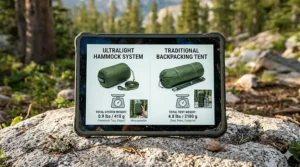
Here’s the thing nobody tells you at the trailhead: your shelter choice is the single biggest lever you have over your pack weight. A minimalist hammock camping setup — hammock, straps, a tarp — can come in under 20 ounces total. A mid-range tent? You’re looking at three to five pounds before you even touch the stakes. That difference isn’t just numbers on a spreadsheet. After mile fifteen on the Appalachian Trail, with your hips aching and your knees starting to negotiate, every ounce you didn’t carry feels like a small victory.
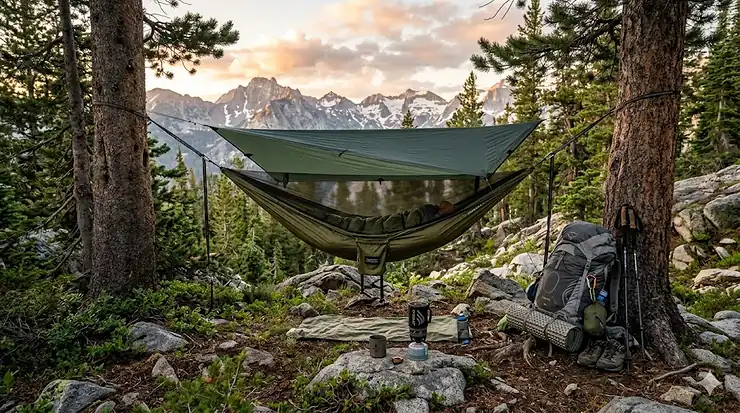
An ultralight hammock for backpacking is exactly what it sounds like: a sleeping and resting system built from high-tenacity nylon (usually 20D to 70D fabric, if you want to get specific) that packs into something roughly the size of a softball, weighs somewhere between 7 ounces and a pound, and hangs between two trees with a clearance you can adjust in thirty seconds. According to the American Hiking Society, lightweight shelter systems have become one of the fastest-growing gear categories as more hikers embrace a minimalist philosophy. And for good reason.
But — and this is a real but — not every ultralight hammock for backpacking is created equal. Some are genuinely trail-ready. Others are ultralight only in the way a paper grocery bag is waterproof. In 2026, the market is crowded. Your job shouldn’t be sorting through two hundred Amazon listings at midnight. That’s my job.
I’ve dug into the specs, field reviews, and real user feedback to bring you the seven best options on the market right now — with honest takes on who each one is actually for. Let’s get into it.
Quick Comparison Table: Top Ultralight Backpacking Hammocks at a Glance
| Product | Weight | Material | Capacity | Suspension Included | Best For |
|---|---|---|---|---|---|
| ENO SingleNest | 16 oz | 70D Nylon | 400 lbs | No (sold separately) | Budget-conscious beginners |
| ENO DoubleNest | 19 oz | 70D FreeWave Nylon | 400 lbs | No (sold separately) | Solo + occasional duo |
| Kammok Roo Single UL | ~7–9 oz | 20D Recycled Ripstop | 500 lbs | Toggle system | Gram-counters & thru-hikers |
| Grand Trunk Nano 7 | ~5.5 oz | 1.5 oz Ripstop Nylon | 300 lbs | Carabiners included | Ultralight day hiking |
| Wise Owl Outfitters Single | 24 oz | Parachute Nylon | 400 lbs | Tree straps included | Beginners, value buyers |
| Sea to Summit Pro Set | 19.7 oz | 70D Ripstop Nylon | 400 lbs | Yes — full set | All-in-one trail solution |
| Foxelli Ultralight | 26.4 oz (1.65 lb) | Parachute Nylon | 400 lbs | Ropes + carabiners | Budget, festival & camping |
Looking at this table, a few things jump out. The Kammok Roo Single UL and Grand Trunk Nano 7 occupy a different league entirely — we’re talking sub-10-ounce territory, which is where thru-hikers and serious gram-counters live. The Sea to Summit Pro Set earns its slightly higher weight by bundling straps into the box, making it the most genuinely “ready out of package” option. Budget buyers will notice the Wise Owl and Foxelli sitting heavier than their peers; that extra weight is the price of lower cost materials.
💬 Just one click — help others make better buying decisions too! 😊
Top 7 Ultralight Hammocks for Backpacking: Expert Analysis
1. ENO SingleNest Hammock — The Proven Trail Workhorse
If there’s a Mount Rushmore of camping hammocks, the ENO SingleNest is on it. Eagles Nest Outfitters has been making this thing since before “ultralight backpacking” was even a subculture, and the fact that it still ranks near the top of every serious gear list in 2026 tells you everything you need to know about its staying power.
Key specs, and what they actually mean: The SingleNest runs 9’4″ x 4’7″, weighs exactly 16 ounces, and holds 400 lbs. That 4’7″ width sounds narrow until you realize that the proper diagonal hammock lie — the technique that gets you lying nearly flat — only requires about 48 to 50 inches. You’ll fit fine. The 70D nylon is the sweet spot between durability and packability; it’s not as gossamer-thin as the ultralight 20D options, which means it resists snags on bark and rough surfaces better on extended trips.
The SingleNest packs into its own integrated stuff sack and includes aluminum wiregate carabiners. No straps in the box, though — you’ll need ENO Atlas or Helios straps separately, which adds cost and planning.
Who this is for: Backpackers taking their first serious overnight trips who want proven reliability over cutting-edge weight savings. The SingleNest is forgiving, easy to hang, nearly impossible to mess up. Experienced hikers come back to it because it just works.
Customer feedback is overwhelmingly positive — buyers consistently praise the soft feel of the nylon and the no-fuss setup. A few note that the 4’7″ width can feel snug for larger frames.
✅ Iconic, battle-tested brand with deep community support
✅ 16 oz is genuinely trail-light
✅ Integrates with all ENO accessories (bug nets, tarps, stands)
❌ Straps sold separately — add this to your budget
❌ Narrower than doubles; not ideal for restless sleepers
Price range: Around $60–$75, making it one of the better values at this weight class.
2. ENO DoubleNest Hammock — When “One Person” Isn’t Quite Accurate
Let’s be honest. Most of us buy the DoubleNest and use it alone. A 9’4″ x 6’2″ sleeping platform for one person? Pure luxury. Technically rated for two at 400 lbs capacity, the DoubleNest lives its best life as an extravagantly spacious solo hammock — the kind you sink into diagonally and wake up genuinely rested.
Specs and real-world meaning: The DoubleNest weighs 19 ounces, packs to 4″ x 5″, and uses ENO’s FreeWave™ 70D nylon taffeta, which is softer and more breathable than the original SingleNest fabric. That extra 3 ounces over the SingleNest buys you nearly 20 inches of additional width — a difference you will absolutely feel at 2 a.m. when you want to roll over without half-falling out.
The folded dimensions of 4″ x 5″ are genuinely impressive for a hammock this spacious. Side pocket when in use from the integrated stuff sack? Useful for your headlamp or phone.
Who this is for: Hikers who want the versatility of a single vs double ultralight option in one product — sleep solo all week, share with a partner on the weekend. Also ideal for heavier or taller backpackers (6’2″+ frames) who find singles cramped.
Customer feedback routinely calls this the “best hammock I’ve ever owned,” with multiple buyers describing it as so comfortable they’ve stopped using a sleeping pad entirely on warm trips.
✅ Palatially wide for solo use — game-changing comfort
✅ FreeWave fabric is softer and faster-drying
✅ Full ENO accessory ecosystem compatibility
❌ Still no straps included — plan for the added purchase
❌ At 19 oz, not the lightest for strict gram-counters
Price range: $70–$90 range. Worth every cent for the comfort upgrade.
3. Kammok Roo Single UL Hammock — The Gram-Counter’s Secret Weapon
Here’s where things get interesting. The Kammok Roo Single UL isn’t just light — it’s almost offensively light. Built from 20D recycled ripstop nylon (yes, recycled — more on why that matters in a moment), this hammock packs into something you can genuinely slip into a jacket pocket. It’s the kind of product that makes veteran thru-hikers go quiet for a second when they first pick it up.
Specs decoded: The 20D fabric is roughly half the denier of standard hammock nylons. Lower denier = thinner, lighter, more packable. But here’s what the spec sheet won’t tell you: Kammok’s proprietary weave resists tearing significantly better than commodity 20D fabrics, which tend to run thin at the stress points. Real-world reports from buyers confirm it’s held up across multiple seasons of use. Capacity sits at an impressive 500 lbs — higher than most competitors. The water-repellent treatment handles light rain surprisingly well.
The Sil/PU coated stuff sack compresses everything into what Kammok calls “pocket-sized.” That’s not marketing fluff — it’s genuinely true.
Why the recycled fabric matters: Every Roo Single UL is made from 100% recycled nylon. It also comes backed by Kammok’s lifetime Adventure Grade Guarantee. These aren’t afterthoughts — they signal a brand building gear to last rather than to be replaced.
Who this is for: Ultralight thru-hikers, minimalist hammock camping enthusiasts, anyone where pack weight ounces are being tracked obsessively. If you’re the type who weighs your toothbrush, this hammock was made for you.
Customer feedback: Buyers describe it as “the softest hammock I’ve used” and note with surprise how strong the thin fabric feels. Several confirm a year-plus of regular use with zero issues.
✅ Ultralight 20D recycled ripstop — premium sustainable choice
✅ 500 lb capacity beats most competitors at this weight class
✅ Lifetime warranty — this is gear you buy once
❌ Premium price reflects premium construction
❌ No straps included
Price range: $80–$110 range depending on color and current promotions.
4. Grand Trunk Nano 7 Hammock — The Sub-Pound Showstopper
Five and a half ounces. Let that sink in. The Grand Trunk Nano 7 weighs less than a can of soda by more than half, and it still holds 300 lbs and packs small enough to fit in a side water bottle pocket. This is the hammock that makes ultralight purists emotional.
The specs, explained: “Nano 7” refers to the 1.5 oz per square yard ripstop nylon — this is legitimately some of the thinnest structural hammock fabric available at retail. The trade-off is capacity: 300 lbs is lower than the 400–500 lb ratings of heavier competitors. For a solo hiker under 250 lbs (with a safety margin), that’s plenty. For heavier hikers or anyone wanting to share, look elsewhere.
What most buyers overlook: the packed size isn’t just small, it’s side-pocket small. On a long descent or ridge traverse where pack access matters, being able to grab your hammock without opening your main compartment is genuinely useful.
Carabiners included. Straps — like seemingly every hammock on this list — sold separately.
Who this is for: Sub-pound hammock seekers, ultralight day hikers who want optional overnight capability, bikepacking adventurers where grams translate directly into summit speed. If you’re counting every gram on a PCT resupply stretch, the Nano 7 is your hammock.
Customer feedback consistently highlights the astonishing pack weight, with some reviewers calling it “the best purchase I’ve made for long-distance trips.”
✅ Genuinely sub-pound — among the lightest hammocks you can buy
✅ Fits in a side water bottle pocket (seriously)
✅ Grand Trunk’s solid reputation for value and durability
❌ 300 lb capacity is lower — not for heavier users
❌ Very narrow; proper diagonal technique is mandatory for comfort
Price range: $30–$50 range — outstanding value for what it delivers.
5. Wise Owl Outfitters Single Camping Hammock — Best for First-Timers Getting Serious
The Wise Owl Outfitters hammock is everywhere, and there’s a reason for that: it’s the gateway drug of the hammock camping world. At 24 ounces with tree straps and carabiners already in the box, it’s the most complete out-of-package experience on this list — perfect for the hiker who doesn’t want to Google “what straps do I need” at 11 p.m. before a trip.
Specs in context: Parachute-grade nylon, 400 lb capacity, tree straps included. It’s heavier than the ENO or Kammok options, but that weight is doing work — the included straps are actually tree-friendly, which matters both for Leave No Trace principles and for protecting the bark of your anchor trees. The Leave No Trace Center for Outdoor Ethics recommends straps of at least one inch in width to prevent bark damage, and the Wise Owl’s included straps meet that standard.
The soft parachute nylon is forgiving and comfortable for newcomers still figuring out their hang angle and diagonal position. No learning curve frustration here.
Who this is for: New backpackers, casual weekenders, gift recipients who want to try hammock camping without assembling a system from scratch. Also a solid pick if you want a no-fuss spare hammock at base camp while your primary setup is out drying.
Customer feedback is strikingly positive on value and setup ease, with multiple reviews from buyers who say they “can’t believe how good this is for the price.”
✅ Complete kit in one box — straps and carabiners included
✅ 500 lb capacity (double version) for peace of mind
✅ Excellent price-to-functionality ratio
❌ At 24 oz, heavier than true ultralight competitors
❌ Parachute nylon less durable long-term than ripstop
Price range: $25–$45 range — one of the best entry-level values on Amazon.
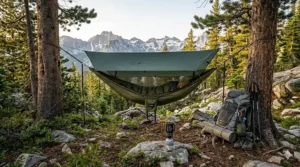
6. Sea to Summit Pro Hammock Set (Single) — The Complete Technical Package
Sea to Summit doesn’t make hammocks. They make hammock systems. The Pro Hammock Set arrives with the hammock, suspension straps, and an Ultra-Sil compression sack — everything you need to hang, all engineered by engineers who clearly spent time on real trails being frustrated by poorly designed alternatives.
What the specs mean in practice: At 19.7 ounces for the complete set, the Sea to Summit Pro Single punches above its weight class. The 70D ripstop nylon body is identical in denier to the ENO lineup, but the buckle suspension system changes the setup experience significantly. The 15mm webbing straps with triple bar-tacked high-strength steel buckles are noticeably faster to adjust than traditional whoopie slings or knot systems — particularly in failing light after a long day.
The Cordura Ultra-Sil compression bag is a small but meaningful upgrade. It’s water-resistant, abrasion-resistant, and genuinely compresses the whole kit smaller than the bag dimensions suggest. Bonus: it’s large enough to fit the included straps alongside the hammock.
The real differentiator: The Sea to Summit Pro is the hammock system you buy when you’re tired of making separate purchases. Straps, hammock, bag — one decision, one product, done.
Who this is for: Experienced backpackers who want a complete, no-compromise setup without researching compatibility between brands. Ideal for travelers and gear-minimalists who pack once and go.
Customer feedback highlights the buckle system as a revelation — “setup takes about 90 seconds” appears in multiple independent reviews. Minor criticism of the buckle learning curve on first use.
✅ Complete system — no additional purchases required
✅ Technical buckle suspension faster than knot-based alternatives
✅ Ultra-Sil compression bag protects and stores straps too
❌ Buckle suspension has a slight learning curve (worth powering through)
❌ Pricier than single-component options
Price range: $80–$110 for the full set — fair value for an all-in-one trail solution.
7. Foxelli Camping Hammock — Best Budget Pick With Surprising Trail Credentials
Don’t let the price fool you. The Foxelli Camping Hammock has earned a genuinely committed following among budget-conscious backpackers who needed more than a “just-for-the-backyard” hammock but couldn’t stretch to premium brands. At around 1.65 lbs with steel carabiners and tree-friendly ropes included, it delivers competent performance without asking for your whole gear budget.
Specs with context: The Foxelli measures 8.9 ft x 4.6 ft — large enough for one adult to sleep diagonally without feeling boxed in. The 400 lb capacity gives plenty of structural confidence. Parachute-grade nylon is softer than ripstop for lounging, though less tear-resistant in rocky or heavily wooded environments.
The built-in carry bag design deserves specific mention — it converts into a side pocket when the hammock is deployed. It’s a clever detail that many more expensive hammocks skip. Five color options let you pick something that doesn’t look like standard-issue camping gear.
At 1.65 lbs, the Foxelli isn’t a sub-pound hammock camping solution — but for casual minimalist hammock camping, weekend trips, and festival backpacking, it brings solid results at a price point that leaves money for other gear upgrades.
Who this is for: Budget backpackers, festival-goers, new hikers testing the hammock life before committing to a $100+ investment. College students who want to stop sleeping on lumpy campground ground.
Customer feedback from a 4-day backpacking trip noted appreciation for the weight savings on climbs, with the hammock holding its shape consistently. Experienced hammockers note the included ropes are adequate but upgrading to wider straps is recommended for bark health.
✅ Most affordable complete kit on this list
✅ Built-in carry bag converts to side pocket — clever design
✅ 5 vibrant color options; 400 lb capacity
❌ Heavier than true ultralight options at 1.65 lb
❌ Included ropes are narrow — upgrade straps recommended
Price range: $20–$35 range — the best dollar-per-night value for entry-level backpackers.
How to Set Up Your Ultralight Hammock for Backpacking: A Practical Field Guide
The spec sheet gets you to the trailhead. What happens next determines whether you sleep like a hammock convert or wake up banana-curved and cursing.
Step 1 — Tree selection (this matters more than you think). You want two living trees, 10 to 15 feet apart, each at least 8 inches in diameter. Dead trees can look solid and snap under your weight. The distance matters: too close and you hang steeply (uncomfortable back); too far and your straps run out of length.
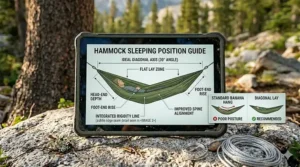
Step 2 — Hang angle: aim for 30 degrees. The single most common beginner mistake is hanging too tight — nearly horizontal looks right but feels terrible. A 30-degree sag angle is the target. Eyeball it: the distance from the ground to your hanging point should be about 5 to 6 feet, with the middle of the hammock resting 18 to 24 inches above ground when you’re in it. Hammock Forums — the largest community of hammock campers online — has documented this as the universal sweet spot after thousands of member-nights of testing.
Step 3 — The diagonal lie. This is the secret the hammock manufacturers don’t scream loudly enough. Lying straight in most hammocks curves your spine. Lying at a 30–45 degree diagonal across the hammock’s centerline gives you a nearly flat surface — dramatically better sleep. It takes two or three nights to internalize, and then you’ll never understand why you ever did it any other way.
Step 4 — Wrap straps around the tree at chest height. Higher than you think. When you climb in, the weight pulls everything down. Wrap at chest height and you’ll settle to the right position.
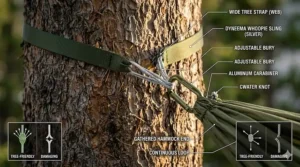
Step 5 — Leave No Trace: use wide straps, always. Narrow cords and ropes compress bark and interrupt sap flow, which can girdle and kill trees over repeated use. The LNT standard is straps at least one inch wide. Most quality suspension systems (ENO Atlas, Kammok Python 10) comply. If your kit includes skinny cord, upgrade the straps — it’s a $15–$25 fix.
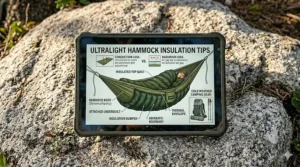
Common first-night mistake: Forgetting insulation underneath you. Hammocks expose your underside to cold air movement, and sleeping pad R-values don’t account for this. For three-season backpacking below 55°F, an underquilt or a closed-cell foam pad rigged underneath is non-negotiable.
Who Should Choose Which Hammock: A Real-World Scenario Guide
Because “best ultralight hammock for backpacking” is a phrase that means very different things to very different hikers.
The Thru-Hiker Counting Every Gram You’re 800 miles into the CDT. Your spreadsheet has its own spreadsheet. Pack weight ounces are currency. For you: the Kammok Roo Single UL or Grand Trunk Nano 7. Sub-10 ounces, strong enough to last a 2,000-mile trail, small enough that the weight barely registers. The Nano 7 wins on pure weight; the Roo UL wins on comfort and warranty peace of mind.
The Weekend Warrior Just Getting Started You’ve done car camping your whole life. This is your first serious overnight solo trip. You want something that works, doesn’t require YouTube tutorials, and won’t break if you do something wrong. That’s the Wise Owl Outfitters Single — straps included, forgiving nylon, a price that doesn’t make your stomach drop. Set it up. Sleep well. Graduate to fancier gear later.
The Hiker Who Wants to Stop Making Decisions You’re busy. You spend enough time researching gear at work. You want one product, one purchase, everything included, working correctly. That’s the Sea to Summit Pro Hammock Set. Hammock, straps, bag — one box, no compatibility research needed. Technical enough to last years, simple enough to set up in the dark.
The “I Might Share This” Hiker You want solo comfort but the occasional partner-friendly option. The ENO DoubleNest is the obvious choice — palatial for one, functional for two, and compatible with ENO’s bug net and rainfly accessories when conditions get serious.
The Budget Backpacker on a First-Season Budget Gear lists are long and wallets are short. The Foxelli handles weekends and festivals without drama. Use the money you save on a quality headlamp or rain jacket — things you genuinely cannot improvise.
How to Choose an Ultralight Hammock for Backpacking: 6 Criteria That Actually Matter
Half the buying confusion in this category comes from focusing on the wrong specs. Here’s what to actually evaluate:
1. Fabric denier (D) — weight vs. durability trade-off. 20D = ultralight, less abrasion-resistant. 70D = heavier, tougher. For thru-hiking in dense forest, 70D survives longer. For moderate trails and careful hangers, 20D saves meaningful weight.
2. Packed weight — the honest number. Always check whether the listed weight includes straps. Many listings give hammock-only weight, then you realize the suspension system adds 5–9 ounces. The Sea to Summit Pro Set gives you the fully-honest number. Others don’t.
3. Length and width — your body needs more room than you think. Minimum 9 feet long for most adults using a diagonal lie. Width under 4.5 feet gets uncomfortable. Taller hikers (6’1″+) should specifically look at the DoubleNest or Sea to Summit Double.
4. Weight capacity with real margin. Don’t hang at exactly rated capacity. Your gear pack, your midnight restlessness, the way you land when you throw yourself in — all add effective load. A hammock rated for 300 lbs with a 160 lb hiker is fine. That same hammock with a 270 lb hiker is courting a midnight floor-meeting.
5. Suspension system — the most overlooked variable. The hammock is only as good as what it hangs from. Knotless systems (ENO Atlas, Sea to Summit buckles, Kammok Python 10) set up faster and adjust more precisely than knot-based systems. If you value setup speed after a long day, this is the detail to obsess over.
6. Intended season and temperature range. A single-layer hammock is a warm-weather tool. Below ~55°F, you need an underquilt. Below 40°F, you need a serious underquilt. Plan your insulation system before you buy your hammock — they’re inseparable once you get into three-season camping.
Hammock vs. Tent for Backpacking: The Honest Comparison
| Factor | Ultralight Hammock | Ultralight Tent |
|---|---|---|
| Setup speed | ⚡ 2–5 minutes | 5–15 minutes |
| Ground required | Trees needed | Any flat surface |
| Minimum system weight | 12–16 oz (hammock only) | 20–40 oz (typical UL tent) |
| Cold weather performance | Needs underquilt below 55°F | Self-contained |
| Privacy | Minimal | Full |
| Cost | $30–$120 | $150–$600+ |
| Sleep comfort | Excellent on right terrain | Depends on ground |
| Best terrain | Forest, wooded ridges | Alpine, above treeline |
What this table doesn’t capture: the feeling of waking up swaying slightly in a forest canopy, with light filtering through the canopy, is something a tent floor simply cannot replicate. The Appalachian Trail Conservancy estimates that hammock camping accounts for a growing percentage of thru-hiker shelter choices — particularly on the southern sections where mature hardwood forest is dense and flat tent sites are scarce.
The honest verdict? Below treeline, on a warm-weather or three-season trip, a quality ultralight hammock for backpacking beats a comparable-weight tent on comfort, setup speed, and experience. Above treeline, in alpine terrain, or in desert environments where trees are scarce, a tent wins by default.
Minimalist Hammock Camping: Features That Actually Matter (and Marketing Hype That Doesn’t)
Let’s clear some things up.
Matters: Fabric weight and weave quality. The difference between a 20D hammock that lasts three seasons and one that develops pinholes after six trips comes down to the weave density and finish. Kammok and Sea to Summit both invest here. Generic brands often don’t.
Doesn’t matter: “Parachute nylon” as a selling point. Every basic hammock claims parachute nylon. The term means almost nothing without a denier rating and weave specification. It’s marketing shorthand for “nylon fabric.” Focus on the denier number, not the parachute imagery.
Matters: Suspension system design. Knotless, adjustable, tree-friendly. These aren’t upgrades — they’re requirements for a functional, ethical setup.
Doesn’t matter: “Infinite color options.” A hammock’s color doesn’t affect your sleep or your pack weight. Buy the color you like and spend the mental energy on suspension specs.
Matters: Weight with suspension included. Always ask: is this weight the hammock alone, or the full system? The difference can be 6–10 ounces — significant in ultralight territory.
Doesn’t matter: “Military grade” anything. A vague descriptor applied to products ranging from carabiners to phone cases. Ask for the actual fabric specification and capacity rating instead.
Long-Term Cost and Durability: The True Cost of a Cheap Hammock
A $25 hammock seems like a win until you’re replacing it annually. Let’s run the numbers.
A budget hammock in the $25–$35 range, replaced every two seasons of active use: $12.50–$17.50 per year. A quality mid-range hammock like the ENO SingleNest or Sea to Summit Pro, lasting five-plus years of hard use: $12–$18 per year. They’re comparable — but the premium option never lets you down on a trip.
Where the math really changes is in the premium ultralight category. The Kammok Roo Single UL with its lifetime warranty has an effective cost that trends toward zero over long enough ownership. Paying $90–$110 once and never replacing it is a better deal than paying $30 three times over the same period.
There’s also the hidden cost of inadequate gear: a hammock that blows out at mile 200 of a 500-mile trail doesn’t just cost money. It costs the trip. The redundancy cost of a quality product — peace of mind, reliability, performance consistency — is real and worth calculating into your purchase decision.
Maintenance for ultralight hammocks is minimal. Hand wash with mild soap, air dry completely before storing, inspect carabiner gates monthly for smooth operation, and never store wet (mildew is the primary long-term fabric killer). Do that, and a quality hammock lasts a decade.
✨ Don’t Miss These Exclusive Deals!
🔍 Ready to swap your tent for the ultimate ultralight sleeping system? Click any highlighted product above to check current pricing and availability on Amazon. These hammocks are the tools that turn long miles into comfortable nights — make the right choice and every trail feels better from mile one.
FAQ: Ultralight Hammock for Backpacking
❓ What is the lightest ultralight hammock for backpacking available on Amazon?
❓ Can I use a single vs double ultralight hammock for solo backpacking?
❓ Do I need a rain fly with a minimalist hammock camping setup?
❓ How do I reduce pack weight ounces with a hammock shelter system?
❓ Is lightweight hammock hiking suitable for cold weather and three-season use?
Conclusion: The Right Ultralight Hammock Changes How You Experience the Trail
There’s a before and an after in every hammock camper’s story. Before: searching for flat ground, clearing rocks, waking up with a tent pole shadow imprinted on your face. After: strapping up in ninety seconds between two pines, lying at the perfect diagonal angle, and genuinely sleeping through the night for the first time in three days on trail.
The right ultralight hammock for backpacking is the gear that creates the after.
For most backpackers, the ENO SingleNest is the starting point — proven, lightweight, expandable. Serious gram-counters should look hard at the Kammok Roo Single UL or the Grand Trunk Nano 7. Anyone who wants to stop making multiple gear purchases should go straight to the Sea to Summit Pro Hammock Set. And beginners who want to try the system before committing to premium prices can’t go wrong with the Wise Owl Outfitters Single.
Whatever you choose: learn the diagonal lie, respect the 30-degree hang angle, use wide straps, and carry an underquilt if temperatures dip. The rest is just showing up.
✨ Found your next trail upgrade?
Click any highlighted hammock above to check current pricing on Amazon. These are the exact products I’d recommend to any hiker serious about sleeping better and carrying less. Don’t wait for the next trip to feel this difference — start now.
Recommended for You
- Hammock vs Tent Camping: 7 Best Picks & Honest 2026 Comparison
- 7 Best Hammock Straps in 2026: Tree-Friendly & Tested
- Best Hammock Underquilt: 7 Expert Picks for Warm Nights in 2026
Disclaimer: This article contains affiliate links. As an Amazon Associate, I earn from qualifying purchases. If you purchase products through these links, we may earn a small commission at no additional cost to you.
✨ Found this helpful? Share it with your friends! 💬🤗
