
In This Article
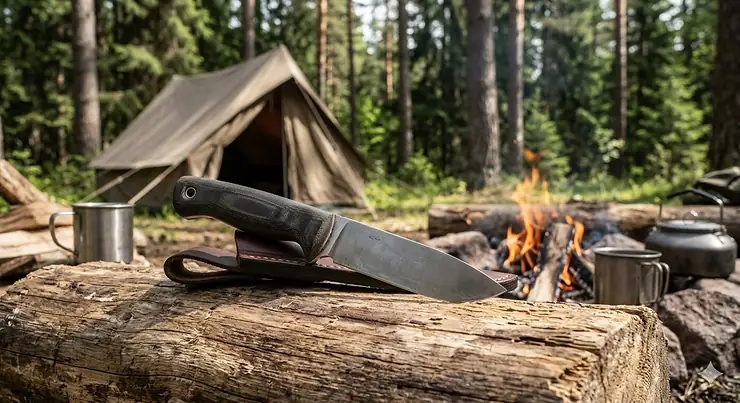
There’s a specific kind of camp humiliation that comes from realizing, halfway through skinning a fish or trying to baton a piece of pine for kindling, that the knife in your hand was never built for this. Maybe it’s a kitchen paring knife someone tossed in the cooler bag. Maybe it’s a $9 gas-station folder that’s already wobbling at the pivot. Either way, you learn fast that “a knife” and “the right knife” are not the same purchase.
That’s really the whole hunt for the best camping knife in one sentence: you’re not looking for the sharpest blade on the shelf, you’re looking for the one that matches what you actually do outside. A family car-camper slicing watermelon at a picnic table has different needs than someone splitting kindling for an off-grid week. Below are seven real knives currently sold on Amazon — no concept knives, no discontinued unicorns — spanning a $17 French folder to a $250 American-made bushcraft blade, with the actual steel, tang construction, and trade-offs behind each one.
Quick Comparison: 7 Camping Knives at a Glance
| Knife | Best For | Tang | Blade Steel | Blade Length | Price Range |
|---|---|---|---|---|---|
| Morakniv Companion | Budget all-rounder | Partial | Sandvik 12C27 stainless | 4.1″ | Under $20 |
| Opinel No.08 Carbone | Pocket/kitchen duty | Folding | XC90 carbon | 3.28″ | $15–$20 |
| Gerber StrongArm | Heavy-duty on a budget | Full | 420HC stainless | 4.8″ | $50–$90 |
| Morakniv Garberg | Full-tang Mora upgrade | Full | Carbon or Sandvik 14C28N | 4.3″ | $70–$110 |
| KA-BAR Becker BK2 | Batoning and chopping | Full | 1095 Cro-Van carbon | 5.25″ | $70–$100 |
| ESEE-4 | Made-in-USA bushcraft | Full | 1095 carbon (S35V option) | 4.5″ | $120–$145 |
| Benchmade Bushcrafter 163-1 | Premium everyday bushcraft | Full | CPM-S30V stainless | 4.43″ | $200–$250 |
A pattern shows up fast once you line these up: price tracks steel quality and tang construction almost perfectly, but not blade length. The $17 Opinel and the $230 Benchmade are both around 4 inches of cutting edge — you’re paying for metallurgy, fit and finish, and how the knife survives being dropped in a creek, not for inches of steel. If your trips rarely go past car-camping distance from the trunk, the Gerber or either Morakniv will outperform their price tag. If you’re the type who actually processes firewood by hand, the jump to full tang and tougher carbon steel (KA-BAR, ESEE) starts paying for itself.
One honest note before you scroll further: knife prices on Amazon shift constantly, so treat every figure here as a snapshot, not a quote. Always check the current listing before buying.
💬 Just one click — help others make better buying decisions too! 😊
The 7 Best Camping Knives: Expert Analysis
1. Morakniv Companion — Best Budget Overall
The Companion is the knife that convinced an entire generation of campers that you don’t need to spend $150 to own something genuinely good. It carries a 4.1-inch Sandvik 12C27 stainless blade with a Scandinavian grind — a flat, zero-bevel edge that’s almost embarrassingly easy to resharpen on a flat stone, even for someone who’s never done it before. The polymer handle has a high-friction texture that stays grippy with wet or cold hands, which matters more than it sounds like it would when you’re cleaning fish at 6 a.m.
What the spec sheet doesn’t say: this is a partial-tang knife, meaning the steel doesn’t run the full length of the handle. For food prep, whittling, and general camp chores, that’s a non-issue — the knife simply isn’t built for batoning logs or prying anything. Reviewers and longtime owners consistently flag the same two things: it arrives shaving-sharp out of the box, and the included plastic sheath, while basic, does its job without fuss.
Best for: First-time buyers, families who want a knife for every car-camping trip, anyone who wants a sharp, no-drama blade without thinking too hard about it.
✓ Razor-sharp from the factory
✓ Easy to resharpen even with zero experience
✓ Genuinely disposable-cheap if you lose it
✗ Partial tang limits heavy-duty tasks
✗ Stainless still needs drying after wet use to avoid spotting
Verdict: Under $20, this is as close to a free pass as outdoor gear gets. See current listing on Amazon.
2. Opinel No.08 Carbone — Best Folding/Kitchen Companion
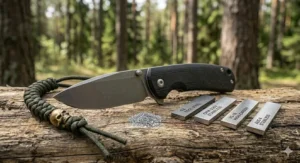
Opinel has been making essentially the same knife in the French Alps since 1890, and the No.08 is the size that stuck. It’s a 3.28-inch carbon-steel folder with a beechwood handle and the brand’s signature Virobloc ring — a rotating steel collar that locks the blade open or closed without any spring mechanism to wear out or jam with grit.
The carbon steel (Opinel’s proprietary XC90) is the real selling point here, and also the catch. It takes a finer edge than most stainless and is famously easy to touch up, which is why so many camp cooks keep one in the kitchen kit specifically for slicing tomatoes and bread. But carbon steel will develop a gray-brown patina, and rust if you put it away wet — owners consistently mention drying the blade and giving it a light coat of oil after use, which takes about ten seconds and prevents almost every complaint people have about it.
Best for: Anyone who wants a featherweight, pocketable blade for food prep, whittling, or general camp tasks — not for anyone planning to baton wood or skin game.
✓ Unbelievably sharp for the price
✓ Lightest knife on this list by a wide margin
✓ Locking ring is simple and field-serviceable
✗ Carbon blade needs drying/oiling or it stains
✗ Wood handle can swell if soaked and not dried properly
Verdict: At $15–$20, it’s the knife you buy two of — one for the pack, one as a kitchen backup. See current listing on Amazon.
3. Gerber StrongArm — Best Full-Tang Value
Gerber built the StrongArm around a simple brief: give military and outdoor users a full-tang knife that won’t bankrupt them. The result is a 4.8-inch 420HC stainless blade, a rubberized diamond-texture grip, and a striking pommel on the butt end specifically meant for pounding tent stakes — a detail that sounds gimmicky until you’re actually setting up camp in hard-packed dirt at dusk.
420HC isn’t a glamorous steel. REI’s own buying guide for knives notes it as an affordable stainless that sharpens easily and resists corrosion well, with fair (not exceptional) edge retention — and that’s exactly the trade Gerber made here. You’ll touch up the edge more often than you would with a premium steel, but you’ll never baby this knife, and that’s the point. The modular sheath is the StrongArm’s other party trick: it snaps apart and reassembles for vertical MOLLE mounting, horizontal belt carry, or drop-leg rigging, which is more flexibility than most knives twice the price offer.
Best for: Campers who want full-tang durability without full-tang pricing — this is the “beater knife” you don’t worry about scratching.
✓ Full tang holds up to batoning and prying
✓ Modular sheath adapts to how you actually carry gear
✓ Made in the USA with a lifetime warranty
✗ 420HC dulls faster than premium steels under heavy use
✗ Coating wears with time and exposes bare steel underneath
Verdict: In the $50–$90 range, this is the clearest “more knife than you paid for” pick on the list. See current listing on Amazon.
4. Morakniv Garberg — Best Full-Tang Mora
If the Companion is Morakniv’s budget icon, the Garberg is what happens when the same Swedish company decides to build a knife that can’t be accused of being delicate. It keeps the brand’s signature Scandi grind but switches to full-tang construction, with the blade running uninterrupted from tip to a small exposed pommel that doubles as a ferro-rod striker.
You can choose carbon steel (sharper, needs more babying) or Sandvik 14C28N stainless (slightly less keen edge, far more forgiving in wet conditions) — both versions ship with either a traditional leather sheath or a MOLLE-compatible polymer one. The thicker 3.2mm blade stock is the functional upgrade over the Companion: it batons through wood like a wedge instead of binding, where the thinner Companion blade would bog down.
Best for: Mora fans who’ve outgrown the partial-tang Companion and want one knife that handles both food prep and real bushcraft chores.
✓ Full tang dramatically improves durability over the Companion
✓ Spine is ground for reliable ferro-rod use
✓ Available in carbon or stainless to match your maintenance tolerance
✗ Heavier and less nimble for fine carving than the Companion
✗ Leather sheath needs occasional conditioning
Verdict: Typically $70–$110, it undercuts most full-tang competitors by a wide margin. See current listing on Amazon.
5. KA-BAR Becker BK2 Campanion — Best for Batoning and Chopping
Designed by Ethan Becker, the BK2 has built a near-cult following among people who use their camp knife as a light axe substitute. The reason is simple: a quarter-inch-thick, full-tang 1095 Cro-Van blade with a flat grind that’s overbuilt for almost everything except delicate work. Owners regularly describe using it to split kindling, pry, and even chop through small branches — tasks that would chip a thinner blade.
That thickness is also the honest trade-off. The BK2 isn’t a precision tool; it’s a workhorse, and several long-term owners note it’s genuinely awkward for fine carving or food prep because of how much steel and weight sit in your hand. The stock plastic sheath is the most consistently criticized part of the package — retention is tight enough that some owners modify it for easier one-handed draws.
Best for: Anyone who wants a single knife to handle heavy wood-processing duty at camp, and doesn’t mind sacrificing finesse to get it.
✓ Exceptionally tough 1095 Cro-Van steel
✓ Full tang built for real abuse
✓ Strong reputation for surviving years of hard use
✗ Sheath retention is notoriously stiff out of the box
✗ Too bulky for fine, detailed cutting tasks
Verdict: At $70–$100, it’s a tool first and a knife second — and that’s exactly what its fans want. See current listing on Amazon.
6. ESEE-4 — Best Made-in-USA Bushcraft Knife
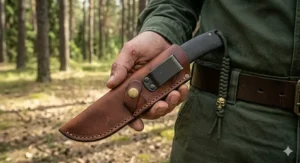
ESEE knives come out of Randall’s Adventure & Training, a company that originally built blades for jungle survival courses before selling to the public, and the ESEE-4 still carries that “designed for people who actually depend on it” pedigree. The standard version runs 1095 carbon steel at a thinner profile than the KA-BAR — enough toughness for batoning, but with a more balanced, controllable feel for feathersticking and detail carving. A premium S35V stainless version exists for buyers who want less maintenance.
The unconditional, no-questions lifetime warranty is the detail that comes up again and again in owner discussions — ESEE will repair or replace a broken knife, full stop, which matters when you’re trusting a blade in the backcountry. The trade-off with the standard carbon version is real: it will rust if neglected, and several owners report surface rust appearing within months of light, careless storage.
Best for: Bushcraft and survival-focused campers who want a genuinely field-proven, American-made knife and are willing to maintain carbon steel properly.
✓ Outstanding balance between toughness and control
✓ Industry-leading no-questions lifetime warranty
✓ Available in carbon or low-maintenance S35V
✗ Carbon version rusts without regular oiling
✗ Pricier than knives with comparable blade geometry
Verdict: Around $120–$145, you’re paying for steel performance and an unusually good warranty. See current listing on Amazon.
7. Benchmade Bushcrafter 163-1 — Premium Pick
Benchmade’s Bushcrafter line is the knife you buy once you’ve decided you’re done compromising on edge retention. The 163-1 carries a 4.43-inch, full-tang CPM-S30V blade — a powder-metallurgy stainless steel that, per outdoor retailers’ own steel comparisons, sits well above entry steels like 420HC for holding an edge and resisting corrosion. The carbon-fiber handle keeps weight reasonable for a knife this substantial, and the whole thing is made in Oregon with Benchmade’s lifetime LifeSharp service included.
The catch, and it’s a real one: S30V is genuinely hard to sharpen in the field without proper stones, which matters if you’re someone who touches up a blade with whatever’s on hand. Reviewers who’ve carried it for months consistently note that it’s one of the most comfortable fixed blades they’ve held, but if you’re chasing pure toughness for hard batoning, a carbon-steel knife like the ESEE-4 or KA-BAR will take more abuse before complaining.
Best for: Buyers who want a premium, low-maintenance American knife and do most of their sharpening at home rather than on the trail.
✓ Exceptional edge retention and rust resistance
✓ Best-in-class ergonomics on this list
✓ Backed by Benchmade’s lifetime sharpening service
✗ Difficult to resharpen in the field without flat stones
✗ Steel sacrifices some raw toughness for edge-holding
Verdict: At $200–$250, it’s the “buy it for life” option rather than the practical default. See current listing on Amazon.
How to Choose a Camping Knife
Cutting through the marketing, picking the best camping knife for you comes down to seven decisions:
- Fixed blade or folder. A fixed blade camping knife is stronger and easier to clean, with no joint that can loosen or fail. A folder is more pocketable and often the better pick if you’re not processing wood.
- Tang construction. Full tang means the steel runs the entire length of the handle — stronger, more durable, and the right call if you’ll baton or pry. Partial tang is lighter and fine for food prep and light carving.
- Blade steel type. Budget stainless (420HC, 12C27) sharpens easily but dulls faster. Carbon steel (1095) holds a wickedly sharp edge but needs active rust prevention. Premium stainless (S30V and similar) holds an edge the longest but is the hardest to resharpen without real equipment.
- Blade length. Most all-purpose camp knives land between 3.5 and 5 inches — long enough to be useful, short enough to stay controllable.
- Handle material and grip. Look for an ergonomic handle grip with some texture; smooth wood or polished synthetic gets dangerously slick when wet.
- Sheath quality. A sheath that doesn’t retain the blade securely, or that’s genuinely hard to draw one-handed, will annoy you on every single trip.
- Weight, for backpackers specifically. A 9-ounce fixed blade is nothing in a car-camping cooler bag and a real consideration over 20 trail miles.
Full Tang vs. Partial Tang: Does It Actually Matter?
Short answer: yes, but only for certain tasks. In full tang construction, the steel blank extends the entire length and width of the handle, with grip scales riveted to either side — so there’s no seam where blade meets handle that can work loose or snap under leverage. As Wikipedia’s overview of blade tangs explains, this also shifts a knife’s balance point back toward the hand, which is part of why full-tang knives feel more controlled when chopping or batoning.
Partial tang knives — like the Morakniv Companion — sacrifice some of that strength for lighter weight and a more blade-forward balance, which is genuinely better for delicate carving and food prep. The failure point on a partial tang is exactly where you’d guess: the spot where the narrower tang meets the handle material. For light camp use, that’s rarely an issue. For splitting firewood or using the knife as a pry bar (please don’t, but people do), it’s the difference between a knife that flexes safely and one that snaps.
Blade Steel, Demystified
| Steel | Type | Edge Retention | Field Sharpening | Rust Resistance |
|---|---|---|---|---|
| 420HC | Stainless | Fair | Easy | High |
| Sandvik 12C27 / 14C28N | Stainless | Good | Easy–Moderate | High |
| 1095 / 1095 Cro-Van | Carbon | Very Good | Easy | Low — needs oiling |
| XC90 (Opinel) | Carbon | Good | Easy | Low — needs oiling |
| CPM-S30V | Premium stainless | Excellent | Hard — needs stones | High |
There’s no universally “best” steel here, just trade-offs. REI’s expert guide to knives and multi-tools sums up the core tension well: harder steel holds an edge longer but resists rust less and is tougher to sharpen, while softer steel sharpens easily but won’t stay keen as long. Carbon steels like 1095 split that difference — they’re relatively soft and easy to touch up, but require real diligence about moisture. Premium powder steels like S30V flip the equation: outstanding edge life, miserable field sharpening.
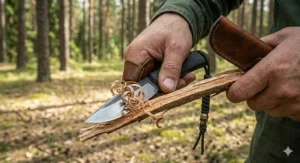
Practical Usage Guide: Keeping a Camp Knife Sharp and Rust-Free
A surprising number of “bad knife” complaints online are actually maintenance failures, not product defects. A few habits fix almost all of them:
- Dry it before sheathing. Every knife on this list — stainless or carbon — should be wiped dry after contact with water, food acid, or sap. Stainless resists rust better, but isn’t rust-proof.
- Oil carbon steel after every wet use. A drop of mineral oil or a dedicated knife oil on a cloth, wiped along the blade, is a 30-second habit that prevents nearly all of the rust complaints attached to the KA-BAR, ESEE, and Opinel above.
- Match your sharpening tool to your steel. A simple flat stone handles Scandi-ground Moras beautifully. Premium steels like S30V genuinely benefit from a proper guided sharpening system rather than a pull-through gadget.
- Don’t pry with the tip. This is the single most common way a quality knife gets ruined in the field, full tang or not. If you need leverage, use the spine, not the point.
- Check the sheath retention before you need it fast. A few dry-fire draws at home will tell you whether your sheath needs a belt-loop tweak before your trip, not during it.
Match the Knife to the Camper
Not everyone needs the same blade, and matching your knife to your actual trip style saves both money and frustration:
The car camper / family cook mostly needs something for slicing food, opening packages, and the occasional whittled marshmallow stick. The Morakniv Companion or Opinel No.08 covers this completely — there’s no reason to carry (or pay for) a heavy-duty bushcraft knife for picnic-table duty.
The ounce-counting backpacker wants the lightest knife that still handles cordage, food prep, and minor repairs. The Companion’s 3.9-ounce weight or the Opinel’s near-weightless folder both make sense here; a full-tang chopper is dead weight on a long trail.
The bushcraft hobbyist building shelters, processing firewood, and practicing fire-by-ferro-rod wants a thicker, full-tang blade that won’t flex under lateral pressure — the Garberg, BK2, or ESEE-4 are built specifically for this kind of repeated abuse.
The buyer who wants to set it and forget it — someone who’d rather pay more upfront than think about rust prevention — should lean toward stainless: the StrongArm for budget, the Bushcrafter 163-1 if cost isn’t the deciding factor.
Common Mistakes When Buying a Camping Knife
- Buying length instead of usefulness. A 7-inch survival-movie blade is harder to control and rarely more useful at camp than a 4-inch one.
- Ignoring the sheath entirely. A great knife in a bad sheath is a liability — re-read the owner feedback on retention and draw speed, not just the blade specs.
- Choosing carbon steel without intending to maintain it. Carbon steel rewards attention and punishes neglect with rust. If you know you won’t dry and oil a blade regularly, buy stainless.
- Assuming “tactical” branding means “better for camping.” Plenty of knives marketed toward tactical use are simply mediocre camp tools wearing black coating.
- Skipping the partial-vs-full-tang question entirely. It’s the single biggest predictor of whether a knife will survive being used the way you actually plan to use it.
Knife Laws and Backcountry Etiquette
Knife regulations in the U.S. vary by state and even by individual park, and they tend to hinge on blade length and intent (utility versus self-defense) more than on the knife itself. Before a trip, it’s worth a quick check of your destination’s specific rules — state knife statutes differ meaningfully, and federal land can layer additional restrictions on top. The National Park Service’s own visitor guidance is a useful starting point for understanding how individual parks handle blades and other gear, though policies vary site to site, so confirming with the specific park you’re visiting is the safer move. As a general practice, an unconcealed utility knife used for ordinary camp chores is rarely an issue anywhere in the backcountry — it’s the edge cases (concealed carry, oversized blades, stated self-defense intent) that get complicated.
Frequently Asked Questions
❓ What is the best camping knife for beginners?
❓ Is a fixed blade or folding knife better for camping?
❓ What's the difference between 1095 and 420HC steel?
❓ Do I need a full tang knife for camping?
❓How often should I sharpen my camping knife?
Conclusion
If there’s one real takeaway from putting these seven knives side by side, it’s that “best” depends entirely on what you’re cutting and how often you’re willing to maintain it. The Morakniv Companion and Opinel No.08 are nearly impossible to regret at their price. The Gerber StrongArm and Morakniv Garberg make the jump to full-tang durability without demanding premium-knife money. The KA-BAR BK2 and ESEE-4 are built for people who genuinely process wood by hand. And the Benchmade Bushcrafter 163-1 is for buyers who’ve decided that not thinking about rust is worth paying for.
Whichever one you land on, the actual best camping knife is the one that matches your trips — not the one with the most dramatic marketing photos.
Round Out Your Kit
A great knife is only half the equation. A small flat sharpening stone, a tin of knife oil, and a basic ferro rod cost very little, weigh almost nothing, and solve most of the maintenance issues described above before they start. If you’re buying your first fixed blade, it’s worth picking those up in the same order.
Recommended for You
- Winter Hammock Camping Guide 2026: 7 Gear Picks That Work
- 7 Best Hammock Stands for Camping in 2026 (No Trees Needed)
- ENO Hammock Review for Camping: 7 Best Models Tested in 2026
Disclaimer: This article contains affiliate links. As an Amazon Associate, I earn from qualifying purchases. If you purchase products through these links, we may earn a small commission at no additional cost to you.
Found this helpful? Share it with a camping buddy who’s still using a butter knife at the fire pit.
