
In This Article
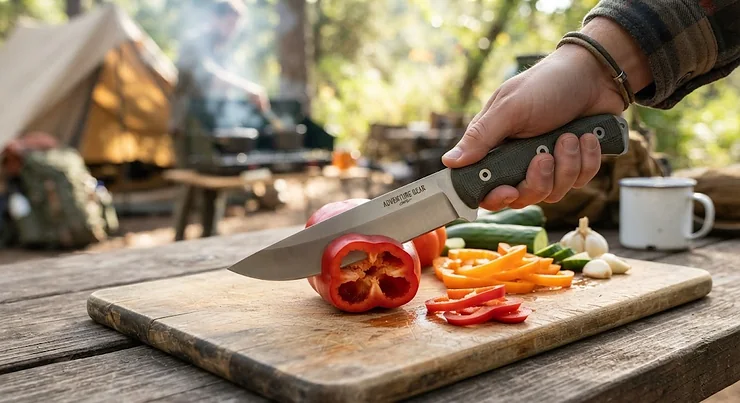
There’s a very specific kind of heartbreak that happens at a picnic table around 6 p.m., a cold beer sweating next to a cutting board, and a knife that simply will not go through an onion. You saw this coming, sort of — you packed a stove, a cooler, three kinds of hot sauce — but the knife was an afterthought, some junk drawer refugee that’s been dull since the Obama administration. A good camp kitchen knife fixes this entire scenario before it starts. It’s not glamorous gear. Nobody posts a knife to their story the way they post a sunset. But ask anyone who’s tried to break down a chicken with a butter knife at 7,000 feet, and they’ll tell you: this is the piece of gear that actually earns its space in the bin.
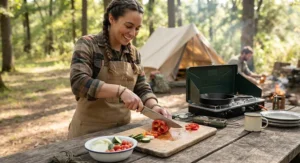
So what is a camp kitchen knife, exactly? It’s a fixed-blade or folding knife built specifically for outdoor food prep — corrosion-resistant steel, a grippy handle that works wet or dry, and a blade profile suited to slicing, dicing, and general campsite butchery rather than bushcraft or self-defense. Unlike a survival knife, it prioritizes control and edge geometry over brute toughness.
We researched real products, cross-referenced actual owner reviews, and dug into steel science and food-safety guidance to build this guide — not a rehash of Amazon listings, but a genuine buyer’s resource. Whether you’re outfitting a weekend car-camping setup or building a minimalist backpacking kit, you’ll find a fit here across budget, mid-range, and premium tiers, plus the practical knowledge — how to maintain it, how to pair it with a board, when to reach for stainless versus carbon — that actually determines whether your camp kitchen knife lasts five trips or fifteen years.
Following the CDC and FDA’s food safety guidelines, cleanliness matters just as much at a campsite as it does in a home kitchen — arguably more, since you’ve got less water and no dishwasher to bail you out.
Quick Comparison Table
Before we dig into the deep-dive reviews, here’s the fast version — the cheat sheet for anyone standing in an aisle (real or digital) trying to decide in under sixty seconds.
| Knife | Blade Material | Best For | Price Range |
|---|---|---|---|
| Morakniv Companion | Stainless (Sandvik) | All-around camp cooking | $35-$45 range |
| Victorinox Fibrox Pro 8-Inch | High-carbon stainless | Serious meal prep at camp | $35-$50 range |
| Opinel No. 8 Carbon Steel | Carbon steel | Ultralight, minimalist trips | Under $20 |
| Gerber ComplEAT 6-Piece Set | 4116 German stainless | Full prep station, groups | $120-$140 range |
| Opinel Nomad Cooking Kit | Stainless | Foragers, road-trip chefs | Around $85 |
| Benchmade Mini Bushcrafter 165 | CPM-S30V | Buy-it-for-life durability | $150-$190 range |
| Morakniv Craftline 511 | High-carbon steel | Absolute budget backup | Under $15 |
The spread here tells its own story: you’re paying for steel chemistry, handle ergonomics, and whether a sheath or storage system is bundled in — not for marketing. Based on the spec comparison, the jump from the Morakniv Craftline 511 to the Morakniv Companion buys you real corrosion resistance for about $25 more, which is arguably the single best value upgrade on this list. Meanwhile, the Gerber ComplEAT and Opinel Nomad Cooking Kit aren’t really competing with single knives at all — they’re solving a different problem (a whole prep station versus one blade), which is worth remembering before you compare them purely on price.
💬 Already know which type you need? Skip ahead — the full breakdown is right below.
💬 Just one click — help others make better buying decisions too!😊
Top 7 Camp Kitchen Knives: Expert Analysis
1. Morakniv Companion — best all-rounder for hilly, wet camp kitchens
The Morakniv Companion opens by expanding on a Swedish reputation that’s been earned the hard way: this is the knife bushcraft instructors hand to beginners because it’s nearly impossible to mess up.
Its 4.1-inch stainless blade runs about 2.5mm thick, with a Scandi grind that makes it a genuinely capable slicer rather than just a woods tool wearing a kitchen hat. At 3.6 ounces, it disappears in a pack, and the high-friction rubber handle stays grippy even when your hands are covered in fish guts or grease. Based on the spec comparison, this is a knife built around a single virtue — reliability — over decades of field use rather than lab-tested “super steel” bragging rights.
Who’s it for? Honestly, almost everyone starting a camp kitchen from scratch. It’s forgiving of neglect, easy to resharpen on a $10 stone, and versatile enough to double as a light bushcraft blade if you need to baton kindling in a pinch. Reviewers consistently report that the stainless blade resists rust far better than expected for the price, though a few note the thin blade isn’t ideal for heavy bone-in cuts.
Pros:
- ✅ Stainless blade resists rust in humid, wet camp conditions
- ✅ Comfortable rubber grip works well with wet hands
- ✅ Lightweight at 3.6 oz — barely noticeable in a pack
Cons:
- ❌ Thin blade struggles with bone-in meat or dense produce
- ❌ Included plastic sheath is functional but not premium
Priced in the $35-$45 range, the Morakniv Companion delivers outsized value — it’s the knife most outdoor-knife testers agree on, and for most campers it’s the only blade they’ll ever need to buy.
2. Victorinox Fibrox Pro 8-Inch Chef’s Knife — restaurant-grade cutting power in a camp box
The Victorinox Fibrox Pro standout feature is simple: it’s the exact knife used in professional kitchens worldwide, brought outside without losing any of its cutting authority.
Its stamped high-carbon stainless blade (X55CrMo14) is ground to a 15-degree edge per side, giving it a genuinely sharp, thin profile that glides through onions, watermelon, and raw chicken with minimal resistance. What most buyers overlook about this knife is that its NSF certification isn’t just a sticker — it means the fibrox handle resists bacterial growth and tolerates dishwasher cycles, which matters more at a campsite with limited water than it ever does at home.
This is the pick for anyone who actually cooks elaborate meals outdoors rather than just assembling hot dogs — car campers, tailgaters, van-lifers running a real kitchen setup. Reviewers consistently note the grippy handle stays secure even when wet, though several mention the stamped blade feels lighter and less substantial than a forged knife, which can be a pro or a con depending on your wrist.
Pros:
- ✅ NSF-certified handle resists bacteria and washes easily
- ✅ Thin, sharp blade handles large produce with ease
- ✅ Easy to resharpen — forgiving for camp-side touch-ups
Cons:
- ❌ No sheath included — needs a blade guard for safe packing
- ❌ Longer 8-inch blade is less compact than dedicated camp knives
At around $35-$50, this remains one of the best value chef’s knives available anywhere, camping or otherwise — the price simply hasn’t caught up to the performance.
3. Opinel No. 8 Carbon Steel — lightest true food-prep folder you can carry
The Opinel No. 8 leads with heritage: it’s the folding knife foragers reach for first, thanks to a slim carbon blade that takes an aggressive edge few stainless folders can match.
The Virobloc locking ring rotates to secure the blade fully open, addressing the classic folding-knife safety complaint, while the beechwood handle keeps total weight low enough to forget you’re carrying it. Here’s what the spec sheet won’t tell you, but foragers note constantly: the thin spine throws excellent sparks off a ferro rod, so this one knife pulls double duty for fire-starting and produce prep on minimalist trips.
It’s best suited to solo or ultralight backpackers who want one folding tool rather than a dedicated set — someone slicing cheese and bread at a trailhead lunch rather than breaking down a full dinner. The tradeoff is carbon steel’s classic weakness: it needs a wipe-down after acidic cuts or it’ll patina and eventually rust, something reviewers repeatedly flag as a required habit rather than an option.
Pros:
- ✅ Takes an extremely sharp, precise edge for slicing
- ✅ Under 2 ounces — nearly weightless in a pack
- ✅ Doubles as a ferro-rod striker for fire starting
Cons:
- ❌ Carbon steel needs drying and oiling after every use
- ❌ Folding joint is weaker than a fixed blade for hard tasks
At under $20, it’s one of the cheapest genuinely good food-prep tools on this entire list — the barrier to entry is almost nothing.
4. Gerber ComplEAT 6-Piece Cutting Board Set — the whole prep station in one nesting unit
The Gerber ComplEAT set solves a problem the other six products on this list don’t even attempt: it eliminates the “loose knives and boards floating around camp storage” chaos entirely.
Inside, you get two dual-sided cutting boards (bamboo and polypropylene), a 3.25-inch paring knife, and a 6-inch chef knife, both built from 4116 German stainless steel — a corrosion-resistant alloy long favored by European cutlery makers for exactly this kind of outdoor duty. Based on the spec comparison, keeping bamboo separate from polypropylene isn’t just a gimmick; it directly supports the cross-contamination prevention that USDA food safety guidance recommends — one board for produce, one for raw protein.
This is the pick for families and group campers who are actually cooking multi-component meals rather than reheating something in foil. Reviewers consistently praise how the whole kit nests together for compact storage, with the main complaint being that the plastic latching tray can feel a little fussy the first few times you pack it.
Pros:
- ✅ Two-board system prevents cross-contamination naturally
- ✅ 4116 German stainless resists rust and holds an edge
- ✅ Everything nests into one compact, organized unit
Cons:
- ❌ Bulkier than a single knife for minimalist trips
- ❌ Locking tray mechanism takes a trip or two to get used to
In the $120-$140 range, it’s the priciest entry here, but it’s genuinely replacing three or four separate purchases — a cutting board set, two knives, and a storage solution — which changes the math considerably.
5. Opinel Nomad Cooking Kit — the gourmet camp roll for foragers and picnic chefs
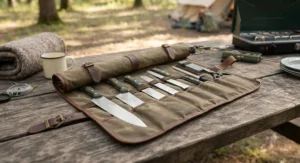
The Opinel Nomad Cooking Kit standout is its sheer completeness in a package the size of a paperback: a folding peeler, a corkscrew-equipped penknife, and a serrated blade, all wood-handled and stainless.
Each tool slots into a microfiber roll with sewn-in elastic loops that double as both napkin and knife carrier — a small design touch that testers repeatedly single out as more thoughtful than it needed to be. The serrated blade in particular earns its keep: it handles bread, tomatoes, and even foraged mushrooms cleanly, while the corkscrew knife covers cheese-and-wine stops without adding a separate tool to the bag.
This kit is built for a specific camper: the traveling bartender, the charcuterie-board enthusiast, the person who thinks a camping trip is still an occasion for a decent meal. It’s less suited to heavy-duty prep — the blades are precision tools, not workhorses — but for its intended use, the aggregated feedback is glowing, with one Outside-tested user jokingly calling the presentation “Michelin star.”
Pros:
- ✅ Three specialized tools cover peeling, slicing, and bottle duty
- ✅ Compact beechwood roll packs into almost any bag
- ✅ Stainless blades clean up fast after foraging or picnic use
Cons:
- ❌ Not built for heavy chopping or dense root vegetables
- ❌ Premium price for what is, functionally, a picnic kit
At around $85, it’s a splurge relative to a single fixed blade — but for the traveling cook who values ritual as much as function, it’s a defensible one.
6. Benchmade Mini Bushcrafter 165 — the buy-it-once premium option
The Benchmade Mini Bushcrafter 165 leads with pedigree: American-made, built around CPM-S30V steel, a modern powder-metallurgy alloy that outperforms older stainless formulas on both edge retention and corrosion resistance.
The 3.5-inch full-tang blade pairs with a G10 handle — a fiberglass-laminate material that’s essentially immune to moisture, sun, or temperature swings — and ships with a leather sheath and Benchmade’s lifetime warranty. Based on the spec comparison, S30V’s vanadium-carbide structure means this blade holds a working edge through far more camp seasons between sharpenings than the 8Cr-class steels found on entry-level knives.
This is the knife for the person who camps thirty weekends a year and has decided, correctly, that buying one excellent tool beats replacing a cheap one every eighteen months. It’s overkill for a family that camps twice a summer, and reviewers are candid about that — but nobody who owns one is trading it down for something cheaper.
Pros:
- ✅ CPM-S30V steel holds an edge far longer between sharpenings
- ✅ Full-tang construction handles hard, repeated camp use
- ✅ Backed by Benchmade’s lifetime warranty
Cons:
- ❌ Premium price puts it out of reach for casual campers
- ❌ Slightly heavier than budget stainless folders
At $150-$190, this is squarely a buy-it-for-life purchase — the value case rests on years of ownership, not day-one savings.
7. Morakniv Craftline 511 — the almost-absurd budget backup
The Morakniv Craftline 511 doesn’t pretend to be anything more than it is: a genuinely functional 3.6-inch high-carbon fixed blade that costs less than a decent camp stove meal.
At 3.0 ounces, it’s the lightest knife in this entire roundup, and the included combi-sheath with belt clip means you’re not improvising storage on day one. What most buyers overlook here is that carbon steel — even at this price point — takes a shaving-sharp edge more readily than most stainless budget knives, which is exactly why bushcraft instructors still recommend it as a starter blade.
It’s best suited as a backup knife, a loaner for a first-time camper, or a spare stashed in a go-bag where losing it wouldn’t sting. Reviewers consistently flag the same tradeoff: the carbon blade needs regular oiling to avoid rust, and the finish shows wear fast — but nobody expects showroom polish from a knife this cheap.
Pros:
- ✅ Extremely low cost for a genuinely usable fixed blade
- ✅ Lightest knife on this list at just 3.0 oz
- ✅ Combi-sheath with belt clip included out of the box
Cons:
- ❌ Carbon steel rusts quickly without regular oiling
- ❌ Not suited to humid or wet-heavy camping environments
Under $15, it’s less a value proposition than a curiosity — how did this get so cheap? — and a genuinely smart pickup as a backup blade or a low-stakes gift for a new camper.
Practical Usage Guide: Food Prep Knife Camping Setup & Maintenance
Getting a new food prep knife camping-ready takes about ten minutes, and skipping this step is exactly how a $40 knife turns into a rust-speckled regret by trip three.
Start with a proper wash and dry straight out of the packaging — factory oils and cardboard dust linger more than you’d think. Before your first trip, hone the edge on a pull-through sharpener or a whetstone if you’re comfortable with one; most knives, including budget stainless models, ship serviceable but not razor-sharp. At camp, the golden rule is: wipe the blade dry immediately after use, especially after acidic cuts like tomatoes or citrus, which accelerate corrosion on both carbon and lower-grade stainless steels. A common first-30-days mistake is tossing a wet knife straight into a pack or drawer — that’s the fastest way to invite rust, even on a corrosion-resistant blade like the Victorinox Fibrox Pro.
Set a simple maintenance rhythm: a quick strop or steel touch-up every few trips, a full re-sharpen once or twice a season depending on use, and a light coat of food-safe mineral oil on any carbon blade — like the Opinel No. 8 or Morakniv Craftline 511 — before long-term storage. For sheathed knives, check the sheath periodically for trapped moisture, since a damp sheath left sealed against a blade is a rust incubator you won’t notice until it’s too late.
✨ Don’t Miss These Exclusive Deals!
🔍 Take your camp kitchen to the next level with these carefully selected knives and prep kits. Click on any highlighted item to check current pricing and availability. These tools will help you cook real meals outdoors, not just survive them!
Real-World Scenario: Matching a Camping Chef Knife to Your Trip
Not every camper needs the same camping chef knife, and matching gear to actual use is where a lot of buyers waste money.
Take a solo weekend backpacker covering 8 miles a day: weight is everything, water access is limited, and dinner is usually one-pot. For this person, the Opinel No. 8 or the Morakniv Craftline 511 makes far more sense than a full kit — a few ounces saved matters more than having a dedicated paring knife. Now consider a family doing a week of car camping with a cooler, a two-burner stove, and actual meal plans involving fresh vegetables and proteins. Here, the Gerber ComplEAT 6-Piece Set earns its bulkier footprint — the two-board system alone saves a shocking amount of cross-contamination anxiety when you’re cooking for four people with one water jug.
Then there’s the van-lifer or tailgate cook who treats outdoor cooking as a genuine hobby rather than a survival exercise — someone building charcuterie boards at a trailhead or slicing a full roast at a campsite kitchen. That’s the Opinel Nomad Cooking Kit or the Victorinox Fibrox Pro territory, where cutting performance and presentation both matter. And for the camper who’s out thirty-plus nights a year in variable conditions, the durability case for the Benchmade Mini Bushcrafter 165 stops being a luxury and starts being simple economics — one purchase instead of three replacements.
Problem → Solution: Common Camp Kitchen Knife Headaches
Even a good camp kitchen knife runs into predictable trouble outdoors — here’s how to handle the five issues that come up most.
Problem: The blade rusts after a single humid trip. This is almost always a carbon-steel knife left wet. Solution: dry thoroughly after each use and apply a light mineral oil coat before storage; stainless options like the Morakniv Companion largely sidestep this issue if rust-proofing isn’t something you want to manage.
Problem: The knife dulls fast on cutting boards or stumps. Cutting directly on stone, ceramic, or bare wood accelerates edge wear. Solution: always use a dedicated board, and consider the Gerber ComplEAT’s built-in boards if you don’t already carry one.
Problem: Cross-contamination between raw meat and produce. With limited water at camp, this risk rises fast. Solution: designate separate boards or wash thoroughly between tasks, per USDA guidance — a two-board system removes the guesswork entirely.
Problem: A folding knife closes unexpectedly during use. Locking mechanisms like Opinel’s Virobloc ring exist for exactly this reason — always confirm the lock is engaged before applying pressure.
Problem: No safe way to pack a blade for travel. A loose knife rattling in a duffel is a liability. Solution: use a sheath, blade guard, or the knife’s original packaging, which also satisfies airline requirements — more on that below.
How to Choose a Camp Kitchen Knife
Cutting through the marketing noise, here’s the actual decision framework, broken into the criteria that matter most.
- Steel type first. Stainless resists rust with minimal upkeep; carbon sharpens easier and holds a finer edge but demands maintenance. Choose based on how much knife care you’re realistically willing to do.
- Blade length for your tasks. A 3.5–4.5-inch blade covers most food-prep needs without excess weight; anything longer starts trading portability for raw cutting reach.
- Fixed versus folding. Fixed blades are stronger and easier to clean; folders pack smaller and double as EDC tools.
- Handle material and grip. Rubber and TPE handles like Victorinox’s Fibrox stay secure when wet — a bigger deal at camp than in a dry kitchen.
- Sheath or storage included. A missing sheath means an extra purchase and a safety compromise during transport.
- Group size and meal complexity. Solo minimalist trips favor one knife; group car-camping favors a full prep set.
- Budget versus expected lifespan. A $150 knife used thirty nights a year is cheaper per use than a $15 knife replaced every season.
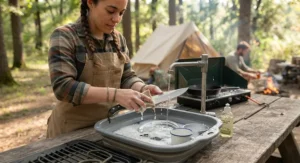
Camp Kitchen Knife vs Outdoor Cooking Knife: What’s the Real Difference?
These terms get used almost interchangeably, but there’s a real distinction worth understanding before you buy.
A camp kitchen knife typically refers to a compact, dedicated food-prep blade — think the Morakniv Companion or Opinel No. 8 — built for portability and general campsite versatility, including light non-cooking tasks like cordage or kindling. An outdoor cooking knife, by contrast, usually describes something closer to a full-size chef’s knife adapted for outdoor use, like the Victorinox Fibrox Pro 8-Inch, prioritizing genuine cutting performance over multi-tool versatility. Neither is objectively “better” — they’re solving different problems. If your trips involve one-pan dinners and general utility, a camp knife wins on flexibility. If you’re actually cooking multi-step meals outdoors, an outdoor cooking knife’s longer, sharper blade will out-perform a stubby camp blade on every real prep task, from julienning onions to breaking down a whole chicken.
The practical takeaway: many serious camp cooks eventually carry both — a small fixed blade for utility tasks and general camp duty, and a proper chef’s knife reserved strictly for food prep.
Cutting Board Set Pairing: Building a Complete Camp Prep Station
A knife is only half the equation — pairing it with the right cutting board set determines how clean, safe, and efficient your actual cooking session is.
Non-porous plastic or polypropylene boards are easier to sanitize with limited camp water, while bamboo boards offer a sturdier, more knife-friendly surface for produce and bread. The smartest setups, like the Gerber ComplEAT 6-Piece Set, use both materials deliberately — bamboo for ready-to-eat foods, polypropylene for raw meat — which mirrors exactly what USDA food safety guidance recommends for reducing cross-contamination risk. If you’re building your own kit rather than buying a bundled set, look for a board that’s stable on uneven picnic tables — rubberized feet or enough weight to resist sliding matter more outdoors than they do on a kitchen counter.
For solo or ultralight campers, a single small board (even a folding one) paired with any knife on this list covers 90% of needs; for families or group trips, the two-board system stops being a nice-to-have and becomes genuinely important kitchen hygiene.
Knife Sheath Kitchen Safety & Storage
A knife sheath does more work than it gets credit for — it’s not just a carrying convenience, it’s the single biggest factor in whether your blade survives transport without dulling, rusting, or injuring someone.
Leather sheaths, like the one bundled with the Benchmade Mini Bushcrafter 165, breathe better and reduce trapped moisture, but need occasional conditioning to avoid cracking. Plastic combi-sheaths, like the one on the Morakniv Craftline 511, are nearly maintenance-free and often include a belt clip for quick access, though they can trap condensation if a blade is sheathed while still damp. Whatever the material, the same rule applies every time: dry the blade fully before resheathing, and periodically pull it out to air both pieces.
Sheaths also matter for travel compliance — TSA guidance requires sharp objects in checked luggage to be sheathed or securely wrapped to protect baggage handlers, so a proper sheath isn’t optional if you’re flying to your camping destination rather than driving.
Stainless Blade Food-Safe: Features That Actually Matter
Marketing copy loves throwing around “food-safe” and “stainless” as though they’re interchangeable, but the actual chemistry is worth understanding before you buy.
According to reference data on blade materials, a steel only qualifies as stainless once chromium content hits roughly 10.5% or higher, which forms a passive oxide layer that resists rust — but “stainless” doesn’t mean rust-proof, just rust-resistant, and every steel corrodes eventually under enough neglect. What actually matters for a food-safe stainless blade: NSF certification (present on the Victorinox Fibrox Pro) confirms a knife meets commercial sanitation standards, not just marketing claims; a smooth, sealed handle-to-blade junction avoids trapping bacteria in visible seams; and a stamped versus forged blade construction affects sharpening ease more than food safety directly. Features that don’t matter nearly as much as marketing suggests: exotic handle materials, blade etching, and brand prestige — none of these change how safely or effectively a blade handles raw food. What most buyers overlook is that a properly cleaned carbon steel blade, like the one on the Opinel No. 8, is just as food-safe as stainless in practice — carbon steel’s rust risk is a maintenance issue, not a food-contact one, as long as it’s washed and dried between uses.
FAQ
❓ Is a fixed blade or folding camp kitchen knife better?
❓ How often should I sharpen my camping chef knife?
❓ Can I bring a camp kitchen knife on a plane?
❓ What's the best stainless steel for a food-safe camping knife?
❓ Do I need a separate cutting board set for camping?
Conclusion
A camp kitchen knife is one of those pieces of gear that’s invisible when it’s working and infuriating when it isn’t. Whether you land on the budget-friendly reliability of the Morakniv Companion, the restaurant-grade performance of the Victorinox Fibrox Pro, or the buy-it-for-life confidence of the Benchmade Mini Bushcrafter 165, the right choice comes down to how often you camp, how elaborate your meals get, and how much maintenance you’re honestly willing to do. Pair whichever knife you choose with a proper cutting board setup, dry it after every use, and store it sheathed — and it’ll outlast plenty of gear that cost far more. Good camp food starts with a good blade; everything else is just seasoning.
💬 Found the right knife for your kit? Share this guide with your camping crew — someone in your group is still using that dull kitchen drawer knife.
Recommended for You
- Best Camping Shovel Guide 2026: 7 Picks That Actually Hold Up
- Paracord for Camping: 7 Top Picks Tested & Ranked (2026)
- Silky Saw Review Camping: 7 Best Folding Saws Tested (2026)
Disclaimer: This article contains affiliate links. As an Amazon Associate, I earn from qualifying purchases. If you purchase products through these links, we may earn a small commission at no additional cost to you.
✨ Found this helpful? Share it with your friends! 💬🤗
