
In This Article
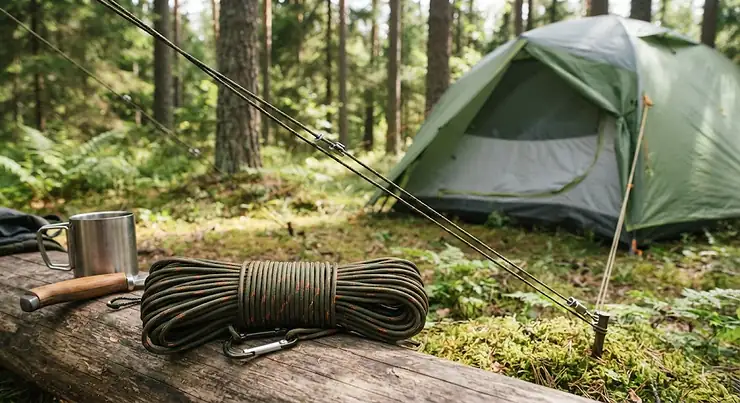
There’s a very specific kind of dumb feeling that comes from standing at a trailhead, staring at a busted tent pole, wishing you’d tossed a few feet of cord into your pack. Paracord fixes that feeling before it happens. Originally engineered for military parachute suspension lines, this braided nylon workhorse has quietly become the duct tape of the outdoors — cheap, light, and absurdly versatile. Paracord for camping isn’t a novelty item; it’s a functional backbone for tarp setups, bear bag hangs, gear repairs, and yes, even shoelaces when yours decide to snap three miles from the car.
What is paracord for camping, exactly? It’s a lightweight kernmantle cord, originally built to the now-retired US military parachute cord standard, which specified a nylon core wrapped in a woven nylon sheath. Today it’s sold in tensile ratings from 95 to 750+ pounds. The most common version, 550 paracord, balances strength, weight, and packability better than almost anything else you could stuff into a stuff sack.
Based on the spec comparison across dozens of listings, aggregated review sentiment, and hands-on breakdowns from gear testers, this guide walks through seven real paracord products worth your money, explains what the pound test rating actually means for your trip, and shows you exactly how experienced campers put this stuff to work. No fluff — just what actually matters when you’re deciding which cord earns a spot in your pack.
Quick Comparison Table
| Product | Type | Strands | Best For |
|---|---|---|---|
| TOUGH-GRID 550lb Paracord | Type III Mil-Spec | 7 (triple-ply) | Best overall authenticity |
| Amazon Basics 550 Paracord | Type III | 7-Strand Core | Budget everyday use |
| Atwood Rope MFG 550 Paracord | Type III Mil-Spec | 7-Strand | Verified USA-made purists |
| TITAN Survival Paracord 550 | Patented 620LB | 3-Strand | Extra strength margin |
| UST ParaTinder | Type III + tinder core | 7-Strand | Fire-starting backup |
| TECEUM Reflective Paracord 1000 | 1000lb reflective | Multi-strand | Nighttime visibility |
| Atomic Bear Paracord Bracelet | Wearable 550 | 7-Strand | Wearable backup cordage |
Looking at the table above, campers who just want dependable rope without overthinking it should lean toward Amazon Basics 550 Paracord or TOUGH-GRID 550lb Paracord, both of which deliver genuine Type III performance at a reasonable per-foot cost. If your priority is verified mil-spec pedigree over convenience, Atwood Rope MFG 550 Paracord is worth the modest upcharge, while anyone heading into true backcountry territory should give the fire-starting capability of the UST ParaTinder serious consideration.
💬 Already have a favorite pick in mind? Scroll down to see exactly how it stacks up against the competition!
💬 Just one click — help others make better buying decisions too!😊
Top 7 Best Paracord for Camping: Expert Analysis
1. TOUGH-GRID 550lb Paracord — most trusted mil-spec authenticity
The standout feature here is verification: TOUGH-GRID 550lb Paracord is manufactured domestically and built to meet or exceed the retired MIL-C-5040H Type III specification, which matters more than it sounds. The cord uses seven inner strands, each triple-ply twisted, wrapped in a tightly woven sheath rated for a minimum 550-pound break strength. In practice, that triple-ply construction is what separates genuine mil-spec cord from bargain-bin imitations that use thinner double-ply strands and quietly fail well under their advertised rating.
Based on the spec comparison, this is the pick for campers who’ve been burned before by “550” cord that frays after two seasons — the extra strand density noticeably improves abrasion resistance on rock and bark contact. Reviewers consistently note the company’s willingness to stand behind the product, and testers with decades of prior military experience have specifically called this cord comparable to, or better than, standard-issue paracord.
Pros:
- ✅ Genuine Type III mil-spec construction with triple-ply strands
- ✅ Made in the USA with traceable manufacturing standards
- ✅ Strong reputation for customer support and replacement policies
Cons:
- ❌ Costs more per foot than generic commercial cord
- ❌ Limited to standard 550lb rating (no higher-strength option in this line)
Available in the $10-$20 range depending on length, this is a smart mid-tier buy for anyone who wants confidence in the label matching the cord.
2. Amazon Basics 550 Paracord — most reliable no-frills budget pick
The short version: this is the cord you buy when you don’t want to think about cord. Amazon Basics 550 Paracord ships with a genuine 7-strand nylon core wrapped in a UV-resistant braided nylon jacket, and it’s cut to a straightforward 100-foot, 4mm spec that covers the vast majority of standard campsite tasks.
Its UV-resistant jacket is built to handle extended outdoor exposure without the breakdown that plagues lower-quality alternatives, and the cord shrugs off oils, acids, and abrasion — a real advantage for anyone whose cord repeatedly contacts wet bark, rocky ground, or gritty trail dust across multiple trips. What most buyers overlook about this pick is that its unglamorous consistency is precisely the point: it’s not trying to be the toughest or the flashiest cord on the shelf, it’s trying to be the one you never have to think twice about.
Pros:
- ✅ Genuine 7-strand nylon core at a budget price point
- ✅ UV, oil, and abrasion resistant jacket for repeated outdoor use
- ✅ Backed by a straightforward limited warranty
Cons:
- ❌ Sinks in water, so it’s not ideal as a retrievable line
- ❌ Not reflective, which limits nighttime visibility
Priced in the affordable under-$15 range for a 100-foot spool, this is the default recommendation for weekend campers and car campers who want dependable rope without a learning curve.
3. Atwood Rope MFG 550 Paracord — most verifiable mil-spec pedigree
Atwood Rope MFG 550 Paracord earns its spot through documentation, not marketing copy. The cord uses 100% nylon construction with 7 core yarns, all triple stranded, and includes colored manufacturer ID strands woven into the core in line with the retired MIL-C-5040H specification. It’s also Berry Amendment compliant, meaning the raw materials and manufacturing both happen domestically — a detail serious preppers and veterans specifically look for.
Here’s what to weigh: this level of verifiable compliance costs a little more, and it’s arguably overkill if you’re just tying down a tarp on car-camping trips. But for anyone building a genuine bug-out kit or replacing worn-out issued gear, the traceability is the whole appeal. Reviewers with hands-on mil-spec cord experience have specifically praised its texture and construction consistency compared to commercial imitations.
Pros:
- ✅ Documented MIL-C-5040H compliance with ID marker strands
- ✅ Berry Amendment compliant, fully domestic sourcing
- ✅ Praised by reviewers with direct military cordage experience
Cons:
- ❌ Premium pricing compared to generic commercial 550 cord
- ❌ Non-mil-spec color options may not carry the same certification
Expect to pay in the $12-$25 range depending on spool length — a reasonable premium for buyers who specifically need documentation-grade cordage.
4. TITAN Survival Paracord 550 — best strength margin above the minimum
The TITAN Survival Paracord 550 line is built around a patented construction rated at 620 pounds — meaningfully above the 550-pound floor most Type III cord targets. That extra cushion matters in real-world use because paracord rarely fails under a clean, straight pull; it fails under sudden shock loads, knots that weaken the fiber, or repeated flexing at anchor points, all of which eat into your safety margin faster than you’d expect.
Based on the spec comparison, campers who use paracord for anything load-bearing — hauling gear, rigging a hammock ridgeline, or improvising a sling — benefit most from this extra headroom. Aggregated reviews frequently mention the cord’s smooth handling and consistent diameter, though a few buyers note the 3-strand core feels different underhand than traditional 7-strand mil-spec cord, which is a texture preference rather than a performance flaw.
Pros:
- ✅ Patented 620LB rating adds real safety margin over standard 550 cord
- ✅ Wide range of lengths and color options available
- ✅ Smooth, consistent diameter across the spool
Cons:
- ❌ 3-strand core differs from traditional 7-strand mil-spec construction
- ❌ Higher price than basic commercial 550 cord
Priced roughly in the $15-$30 range depending on length, this is the pick for campers who want strength headroom without upgrading to a bulkier Type IV cord.
5. UST ParaTinder — best survival paracord for fire-starting backup
This is where “paracord” and “survival tool” genuinely overlap. UST ParaTinder wraps standard-grade paracord around a core strand of waxed jute tinder, so the same cord holding your tarp down can also start your fire if things go sideways. Independent gear testers have found the internal waxed jute strand generously sized and easy to light with a ferro rod, and reported that the cord performed well under static load testing while holding up strongly to abrasion testing.
What most buyers overlook about tinder-core survival paracord: it takes technique. Multiple aggregated user reports describe frustration lighting the tinder strand with a ferro rod, while more experienced users report quick, reliable ignition — the difference typically comes down to properly separating and fraying the tinder strand before striking, not a flaw in the product itself. For car campers this is a nice-to-have; for backcountry solo hikers, it’s a legitimately smart redundancy to build into your kit.
Pros:
- ✅ Integrated waxed jute tinder core for genuine fire-starting backup
- ✅ Performs well in load and abrasion testing according to independent reviewers
- ✅ Doubles as standard-grade utility paracord when tinder isn’t needed
Cons:
- ❌ Requires proper ferro rod technique to ignite reliably
- ❌ Tinder core reduces available length of standard usable cord
Typically priced in the $8-$18 range for shorter lengths, this is a smart add for anyone prioritizing self-rescue redundancy over raw bulk cordage.
6. TECEUM Reflective Paracord 1000 — best for nighttime campsite visibility
Anyone who’s tripped over an invisible guyline in the dark understands the appeal of TECEUM Reflective Paracord 1000 immediately. Built around a 1000-pound-rated multi-strand construction with reflective threading woven into the sheath, this cord catches headlamp and flashlight beams at a distance, which is a small feature that solves a genuinely annoying camping problem.
Here’s what the spec sheet won’t tell you outright: reflective paracord isn’t really about the tensile rating bump from 550 to 1000 pounds — for most camping tasks that extra strength is functionally unnecessary. The real value is safety and convenience around a dark campsite, where reflective tent guylines and tarp lines dramatically cut down on stubbed toes and collapsed shelters caused by someone catching a line with their foot.
Pros:
- ✅ Reflective threading dramatically improves nighttime line visibility
- ✅ Higher-rated construction handles heavier-duty tie-down tasks
- ✅ Available across a wide range of lengths and colors
Cons:
- ❌ Added bulk compared to standard 550 paracord for the same length
- ❌ Reflective benefit matters less for car camping near lit sites
Generally priced in the $10-$25 range, this cord earns its keep specifically as guyline and tent-perimeter cordage rather than an everyday utility spool.
7. Atomic Bear Paracord Bracelet (2 Pack) — best wearable backup cordage
Not every camper wants to dig through a pack for cordage, which is exactly the gap the Atomic Bear Paracord Bracelet fills. Each adjustable Cobra-weave bracelet packs roughly 12 feet of military-grade paracord along with a fire starter, compass, and emergency whistle into something worn on the wrist, adjustable to fit sizes from roughly 8 to 10.5 inches.
Honestly, a paracord bracelet camping trip won’t lean on for serious load-bearing work, and that’s not really the point. What most buyers overlook is that the value here is redundancy: it’s cordage and signaling gear you’re wearing, not gear you have to remember to pack, which matters most in the exact emergency scenario where you might not have your full kit on hand. Aggregated reviewer feedback consistently praises the adjustable fit and describes the compass and whistle as functional, if basic, backups rather than professional-grade instruments.
Pros:
- ✅ Roughly 12 feet of usable paracord always within reach on the wrist
- ✅ Built-in fire starter, compass, and whistle add redundancy
- ✅ Adjustable sizing fits a wide range of wrist sizes, including kids
Cons:
- ❌ Compass and whistle are basic, not precision instruments
- ❌ Total cord length is limited compared to a dedicated spool
Sold as a two-pack typically in the $10-$20 range, this is best framed as a smart supplemental layer rather than your primary camping cordage.
What Is 550 Paracord? Camping Essentials Explained
550 paracord camping cord is a lightweight nylon kernmantle rope rated to a minimum 550-pound break strength, built from an inner core of nylon yarns wrapped in a braided outer sheath. It’s historically associated with airborne military units, and while it’s no longer used in modern “square” parachute rigging, it remains a go-to utility cord for camping, repairs, and emergency preparedness.
The number “550” refers specifically to the Type III classification under the retired MIL-C-5040H standard. It’s the sweet spot most campers gravitate toward because it’s strong enough for tarp lines, gear lashing, and bear bag hangs, yet light and compact enough that carrying 100 feet barely registers in your pack weight. Lighter Type I cord trades strength for minimal bulk, useful mainly for crafts and lanyards, while heavier Type IV cord adds real load capacity at the cost of extra bulk and stiffness. For the overwhelming majority of camping scenarios, 550 paracord camping cordage hits the most practical balance of the bunch.
Understanding Pound Test Rating: What the Numbers Actually Mean
A pound test rating tells you the minimum force, in pounds, a cord is expected to withstand before its structural failure point under controlled, straight-pull laboratory conditions. It does not describe how the cord performs under sudden shock loads, repeated flexing, knots, or wear — all of which reduce real-world working strength well below the rated number.
| Type | Approx. Strands | Rated Strength | Best For |
|---|---|---|---|
| Type I | 1 (no core, some variants) | ~95 lbs | Lightweight crafts, lanyards |
| Type III (550) | 7-9 | ~550 lbs | General camping and utility |
| Type IV (750) | 11 | ~750 lbs | Heavy-duty tie-downs, cargo tasks |
The table above makes the practical tradeoff clear: jumping from Type III to Type IV buys roughly 200 additional pounds of rated strength but adds noticeable bulk and stiffness for tasks that rarely need it. On paper this means most campers should default to 550 paracord camping cord and reserve Type IV for genuinely heavy loads, like hauling gear over rough terrain or securing a loaded pack animal line. A useful rule of thumb from rope-rigging practice: never load working cordage past roughly 20% of its rated breaking strength for anything safety-critical, since knots alone can cut effective strength by 30-50%.
✨ Not Sure Which Rating You Need? Match your cord to your trip type using the comparison table above, then grab a spool sized for your longest planned task!
7-Strand Core vs Other Constructions: Why It Matters
The 7-strand core is the defining feature of genuine Type III paracord, and it’s worth understanding because plenty of commercial “550” cord quietly skips it. In an authentic build, each of the seven inner yarns is itself made of two or three twisted nylon fibers, all wrapped inside a 32-strand woven sheath. That layered construction is what gives the cord its combination of tensile strength, flexibility, and — crucially — internal redundancy: if the outer sheath is nicked or abraded, the inner strands still carry the load.
Reviewers consistently note a tactile difference between genuine 7-strand core cord and cheaper 4 or 5-strand imitations — the real thing feels denser and holds its shape better under repeated coiling. What most buyers overlook is that the individual strands inside a 7-strand core aren’t just filler; they can be pulled out and used separately as sewing thread, fishing line, or dental floss in a genuine emergency, effectively turning 100 feet of paracord into 700+ feet of usable thin cordage.
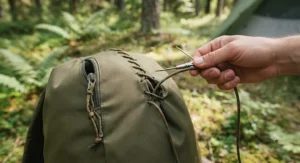
Top Paracord Uses for Camping: A Practical Guide
Paracord earns its keep at camp through sheer repetition of small, unglamorous tasks rather than any single dramatic use. Here’s where it actually shows up on a typical trip:
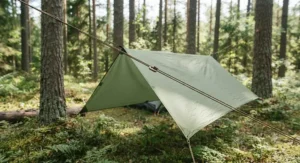
Setup and shelter: Tarp ridgelines, guy lines, and tent stake reinforcement are the most common paracord uses for camping, and a taut-line hitch lets you tension a line without needing a separate tensioner clip.
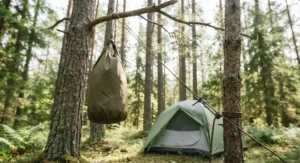
Bear bag hangs: a basic bear hang involves tying one end of your rope to a weighted object, tossing it over a sturdy branch at least 15 feet up, then hoisting your food bag at least 12 feet off the ground and five feet from the trunk. Always check local regulations first, since some parks require canisters instead. The National Park Service’s food storage guidance makes clear that rules vary by park, and skipping them can mean fines or confiscated food.
Gear repair and lashing: Broken pack straps, cracked tent poles, and loose boot laces are all fixable with a few feet of cord and a lighter to seal the ends.
First-aid improvisation: In a genuine emergency, paracord strands can serve as splint ties or a makeshift sling — not a substitute for a real first-aid kit, but a useful backup.
Common first-30-days mistakes include cutting cord to length without sealing the raw ends with a lighter flame (leading to fraying within a single trip) and over-tightening knots so hard they become nearly impossible to untie when wet. A quick maintenance habit — melting cut ends and periodically inspecting high-friction contact points — adds years to a single spool’s usable life.
Survival Paracord: When You Need More Than Rope
Survival paracord refers to cord built with additional integrated strands beyond standard nylon — most commonly a waxed tinder core, though some versions add fishing line or thin wire. The appeal is compact redundancy: instead of carrying separate fire-starting tinder, fishing line, and utility cord, survival paracord folds several tools into one package.
Here’s what to weigh honestly: aggregated testing suggests the extra strands don’t meaningfully add load-bearing capacity, and the tinder core specifically requires practiced technique with a ferro rod to use reliably in the field. It’s genuinely useful for bracelets, lanyards, and dedicated emergency kits, but most gear reviewers don’t recommend it as your primary camp cordage — pack a full spool of standard 550 paracord for bulk tasks, and reserve survival paracord for wearable or grab-and-go emergency gear.
How to Choose Paracord for Camping
- Match the rating to the task. Standard 550 paracord camping cord covers nearly everything; reserve Type IV for genuinely heavy loads.
- Verify the construction, not just the label. Look for confirmed 7-strand cores rather than trusting “550” printed on packaging alone.
- Consider length realistically. A 100-foot spool covers most weekend trips; backcountry trips involving bear hangs or multiple guylines may need more.
- Decide if reflective or tinder-core features earn their keep. These add real value for specific use cases but aren’t necessary for casual car camping.
- Factor in packability. Diameter and coil bulk matter more on backpacking trips than car camping trips.
- Check colorway practicality. High-visibility colors help with guylines; muted tones suit gear repair and general utility.
- Budget for redundancy, not just bulk. A wearable bracelet plus a full spool covers both convenience and capacity.
Real Campers, Real Cordage: Matching Paracord to Your Trip
The weekend car camper: Sarah drives up to a national forest campground twice a month with a cooler and a canopy tent. Her needs are simple — tarp lines, a clothesline, and the occasional gear tie-down. A single 100-foot spool of Amazon Basics 550 Paracord covers her entire trip roster without ever needing to be resupplied.
The backcountry backpacker: Marcus thru-hikes multi-day routes where every ounce counts and food storage is non-negotiable in bear country. He carries roughly 50 feet of TOUGH-GRID 550lb Paracord dedicated specifically to bear bag hangs, following REI’s food storage guidance to suspend food from a high, sturdy tree limb or use a bear pole where available, since some parks don’t accept bear bags as an approved method at all.
The family with scouts in tow: The Alvarez family camps with two kids in a scouting program that emphasizes self-reliance skills. Each kid wears an Atomic Bear Paracord Bracelet, both for the built-in whistle and as a low-stakes way to practice knot-tying with real gear.
Paracord Bracelet for Camping: Wearable Backup Cordage
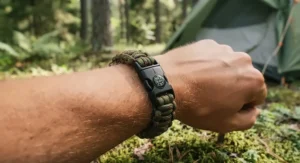
A paracord bracelet camping trip benefits from most because it solves the “gear you forgot to pack” problem. Woven typically using a Cobra or King Cobra pattern, a single bracelet can unravel into 8-12 feet of usable 550 cord, enough for an improvised shelter tie-out, a quick gear repair, or a fishing line rig in a genuine pinch.
What most buyers overlook is that bracelets marketed with add-ons — compasses, whistles, fire starters — vary widely in the actual precision of those extras. Treat the built-in compass as a rough directional aid rather than a navigation tool, and the whistle as a legitimate emergency signal since sound carries further and requires less energy than shouting. For kids, scouts, or anyone who wants hands-free redundancy without adding pack weight, a bracelet is a smart complement to — not a replacement for — a full spool of cord.
🔍 Want your whole crew geared up? Check current pricing on the bracelet and spool combinations above to outfit your next group trip!
Common Mistakes When Buying Paracord for Camping
The most frequent mistake is trusting the word “550” on packaging without checking strand construction — plenty of commercial cord uses thinner strands than genuine mil-spec builds and may not reliably hold its advertised rating. A second common error is buying based purely on color or aesthetic without considering diameter consistency, which affects how well the cord seats in buckles, cleats, and knots.
Buyers also frequently underestimate length needs, purchasing a single 25-foot hank when a realistic trip — factoring in a tarp ridgeline, guylines, and a bear hang — easily consumes 75-100 feet. Finally, some campers assume paracord is a safe substitute for climbing-rated rope; it categorically is not, since it lacks the dynamic energy-absorption properties and certified fall ratings that climbing rope requires.
550 Paracord vs Other Camping Cordage
| Cordage Type | Strength | Weight | Best For |
|---|---|---|---|
| 550 Paracord | ~550 lbs | Light | General camp tasks, tarp lines |
| Braided Nylon Utility Rope | Varies, often higher | Heavier | Heavy tie-downs, towing |
| UHMWPE/Dyneema Guyline | High for weight | Ultralight | Ultralight backpacking guylines |
| Basic Cotton Clothesline | Low | Light | Non-load-bearing camp chores only |
Analyzing the table, paracord wins on versatility — it’s the only option on this list equally suited to gear repair, fire-tinder backup, and general lashing, not just one specialized task. Ultralight UHMWPE guyline beats paracord on strength-to-weight ratio for dedicated tent guylines, but it’s a poor substitute for paracord’s general-purpose flexibility since it’s harder to knot securely and offers no usable inner strands. Heavier braided utility rope outperforms paracord for towing or major load-bearing tasks, but it sacrifices the compact, lightweight profile that makes paracord worth carrying in the first place.
Long-Term Cost & Maintenance
Paracord’s cost-per-use math strongly favors buying a full 100-foot spool over repeatedly purchasing shorter pre-cut hanks — bulk spools routinely price out to a fraction of the per-foot cost of small packaged lengths. A single spool, properly maintained, easily lasts multiple camping seasons since nylon resists rot and most degradation comes from prolonged unprotected UV exposure rather than age alone.
Maintenance is minimal but matters: seal every cut end with a lighter flame to prevent fraying, store cord coiled loosely rather than cinched tight to preserve its flex, and periodically inspect high-friction contact points — like where a tarp line rubs against a tree branch — for thinning. Treated this way, a single quality spool can realistically outlast several tents and sleeping bags, making it one of the best cost-per-camping-trip investments in a typical gear closet.
Safety, Regulations & Compliance: What Paracord Can’t Do
Paracord is a utility cord, not a certified safety device, and treating it as one in the wrong scenario is genuinely dangerous. It is not rated for climbing, rappelling, or any application involving dynamic fall arrest — its construction lacks the elongation and shock-absorption engineering that climbing-rated rope is specifically certified for.
It’s also worth remembering that cold-weather camping carries its own real risks independent of your cordage choices. According to CDC guidance on hypothermia prevention, it can set in even at temperatures above 40°F if a person becomes chilled from rain, sweat, or cold-water submersion, so a length of paracord rigged into an emergency shelter or splint is only one small piece of a broader cold-weather safety plan that should include proper layering and situational awareness. For food storage specifically, always defer to posted regulations rather than assuming a bear hang is acceptable everywhere — some designated wilderness areas mandate hard-sided canisters regardless of how well you rig your line.
Frequently Asked Questions
❓ How much paracord should I bring camping?
❓ Is 550 paracord strong enough for a hammock?
❓ Can paracord be used for climbing?
❓ What's the difference between 550 and 750 paracord?
❓ Does paracord float or sink in water?
Conclusion
Paracord for camping earns its reputation the boring way — by quietly solving small problems trip after trip rather than through any single dramatic rescue moment. Whether you land on the dependable Amazon Basics 550 Paracord for weekend trips, the documentation-grade Atwood Rope MFG 550 Paracord for a genuine preparedness kit, or the fire-starting redundancy of the UST ParaTinder for backcountry solo travel, the right pick comes down to matching pound test rating, construction quality, and extra features to how you actually camp.
None of these seven picks is objectively “best” in isolation — a car camper and a multi-day backpacker have genuinely different priorities, and buying based on someone else’s use case is how gear closets fill up with cordage nobody actually reaches for. Pin down your typical trip length, food storage needs, and whether wearable backup cordage makes sense for your group, and the right spool (or bracelet) becomes an easy call.
Recommended for You
- Silky Saw Review Camping: 7 Best Folding Saws Tested (2026)
- 7 Best Folding Saws for Camping in 2026
- Best Camping Hatchet 2026: 7 Top Picks, Tested & Ranked
Disclaimer: This article contains affiliate links. As an Amazon Associate, I earn from qualifying purchases. If you purchase products through these links, we may earn a small commission at no additional cost to you.
✨ Found this helpful? Share it with your friends! 💬🤗
