
In This Article
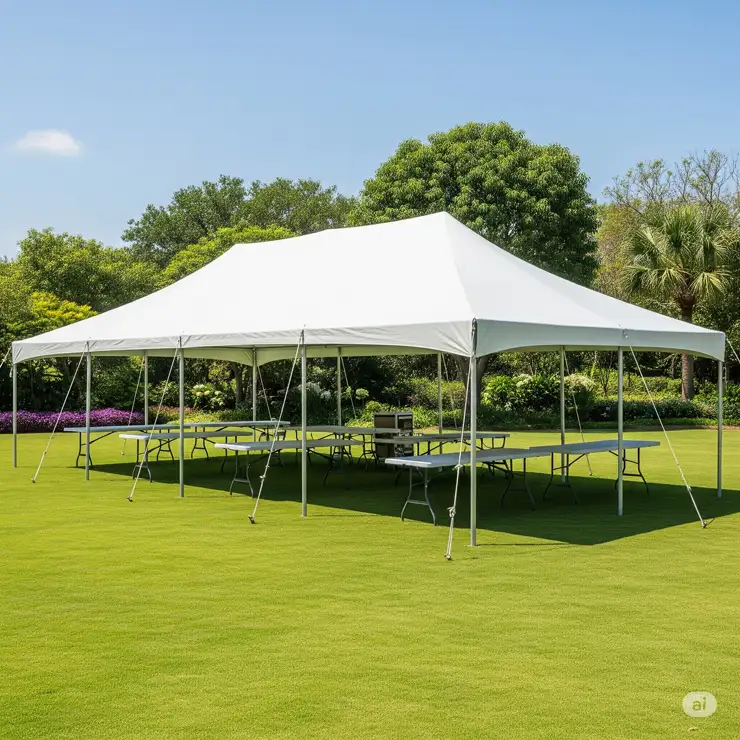
There’s a moment every host recognizes. The guest list creeps from 25 to 40, the forecast says “partly sunny” (a lie), and your 10×10 pop-up suddenly looks like a bath towel draped over a buffet. That’s when a canopy 20×30 stops being a luxury and starts being the only sensible answer.
Six hundred square feet is a serious amount of shade. It’s also a serious amount of sail, and that’s the part the product photos skip. Wind pressure climbs with the square of wind speed, so a gust that doubles in speed hits a tent with four times the force. A big canopy rewards good choices and punishes lazy ones.
I can’t offer fake hands-on testing here. What I can offer is a close read of the specs, the manufacturers’ own wind guidance, and the review patterns buyers report, plus the practical thinking that catalog pages leave out. Seven real 20×30 tents are ranked below, and every spec gets a “so what?” attached.
What Is a Canopy 20×30?
A canopy 20×30 is a 20-foot by 30-foot party or event tent, covering about 600 square feet, built on a steel or metal frame with a waterproof polyester or PE roof. Most include removable sidewalls and ground anchors. It typically shelters roughly 35 to 60 seated guests, or more if standing.
Quick Comparison: Canopy 20×30 Top Picks at a Glance
Price tiers below are estimated bands drawn from retailer listings seen during research. Prices shift constantly, so check current pricing before you decide.
| Product | Frame (per listing) | Standout Feature | Price Tier | Best For |
|---|---|---|---|---|
| Quictent 20×30 | Iron/metal, 1.5″ poles | Two zippered doors with mesh windows | Budget to mid | Quictent 20×30: airflow-minded hosts |
| SANOPY 20×30 | Galvanized steel | Attached ground poles, support beams | Mid | SANOPY 20×30: windier, exposed yards |
| COBIZI 20×30 | Powder-coated steel | Built-in sandbags, UV50+ | Mid | COBIZI 20×30: all-around value |
| HOTEEL 20×30 | Alloy steel | 4 built-in sandbags, many variants | Budget to mid | HOTEEL 20×30: hard-surface patios |
| Aoxun 20×30 | Heavy-duty steel | Roll-up door sidewalls | Mid | Aoxun 20×30: weddings and birthdays |
| LAUSAINT HOME 20×30 | Steel | Roll-up door, sized for 35-60 guests | Mid | LAUSAINT HOME 20×30: mid-size gatherings |
| TentandTable 20×30 Pole Tent | Pole system | 16oz blockout PVC top | Premium | TentandTable 20×30 Pole Tent: lawn events |
Notice the split. Six of these are frame tents, which stand on their own structure and can sit on patios or driveways with weights. The TentandTable 20×30 Pole Tent is a different animal: it needs soft ground for stakes, but its commercial-grade vinyl top is a clear step above the budget polyester. If your event surface is concrete, the pole tent is out before the contest starts. If you want the most capable fabric and your lawn is soft, it climbs to the top of the list.
💬 Just one click — help others make better buying decisions too!😊
Top 7 Canopy 20×30 Picks: Expert Analysis
1. Quictent 20×30 Party Tent — ventilation-first with zippered doors
The listing for the Quictent 20×30 describes a metal frame with 1.5-inch poles and 1.2 mm wall thickness, topped with a 160g PE cover. It ships with two sidewalls and two zippered doors with mesh windows. The spec box on one retailer page lists aluminum while the description says iron, so confirm the frame material on the exact page you buy from.
Here’s the “so what.” Mesh-windowed doors mean you can close the sides against drizzle or glare and still get cross-breeze, which matters more in a 600-square-foot tent than most buyers expect. The listed total weight of about 249 pounds hints at a substantial frame. It also means you want four people for setup, not two plus optimism.
On paper this suits hosts who value comfort and airflow over fancy extras. Reviewer sentiment is hard to generalize: one retailer listing showed a 4.9 average across 62 ratings but no written reviews, so I can’t summarize complaints with confidence. Read recent written reviews on the product page, especially about assembly time and fabric tension.
Pros:
- ✅ Zippered doors with mesh windows aid airflow
- ✅ Ground nails and wind ropes included
- ✅ Two storage bags for tidy off-season packing
Cons:
- ❌ Frame material wording is inconsistent across listings
- ❌ Only two sidewalls included, so privacy is partial
Price tier is budget to mid, so check current price; for airflow and doors it’s a strong value candidate.
2. SANOPY 20×30 Party Tent — attached ground poles for exposed yards
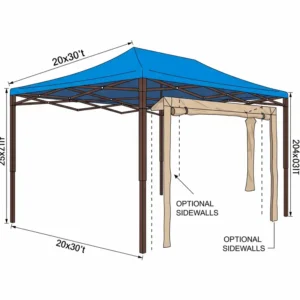
The SANOPY 20×30 leans on galvanized steel and a design with integrated support beams plus fully attached ground poles. That last part matters. Ground poles that are part of the frame, rather than loose extras, tend to spread load across more points of contact, which helps resist the leeward lift described in tent-safety literature.
The listing ships in three boxes with a set of wind ropes and carries the usual caution to take preventative measures when winds reach 25 mph or higher. Treat 25 mph as your cancellation line, not your target.
Who is it for? Anyone whose yard has no windbreak, such as a corner lot or an open field behind the house. The extra structure won’t make physics optional, but it improves your margin. The listing is thin on third-party review summaries, so I can’t characterize buyer sentiment honestly. Look for recent buyer photos showing assembled corners, because that’s where frames reveal their quality.
Pros:
- ✅ Galvanized steel frame resists rust
- ✅ Integrated support beams add rigidity
- ✅ Wind ropes included in the box
Cons:
- ❌ Three-box shipment means heavy, awkward unpacking
- ❌ Review data is limited on listings I checked
Mid-range price tier; worth it if wind exposure is your biggest worry.
3. COBIZI 20×30 Party Tent — built-in sandbags and UV50+ protection
The COBIZI 20×30 pairs a powder-coated steel frame with built-in sandbags, UV50+ fabric, and a sidewall set that, on some variants, includes window panels. Listing copy claims the powder coating beats galvanizing; treat that as marketing, though a coated frame is genuinely helpful against rust.
Built-in sandbags are the quiet star. They give you a ballast option right out of the box, which means fewer excuses at 7 a.m. on party day. Still, sandbags sized for a canopy are a baseline, not a guarantee, so add weights if the forecast gets frisky.
One retailer page showed 194 ratings and 146 written reviews, which is a healthier sample than most competitors. The sentiment I can verify is general rather than detailed, so scan the one- and two-star reviews yourself for recurring themes like missing hardware. Variants differ (8 sidewalls on some, window sidewalls on others), so match the listing to the features you want.
Pros:
- ✅ Built-in sandbag pockets for quick ballast
- ✅ UV50+ top helps with sun-baked afternoons
- ✅ Larger review sample than most rivals
Cons:
- ❌ Listings vary, so confirm sidewall counts
- ❌ Advises against use in heavy wind or rain
Mid-range tier; arguably the safest all-rounder if reviews hold up when you check them.
4. HOTEEL 20×30 Party Tent — four sandbags and a huge variant lineup
The HOTEEL 20×30 advertises four built-in sandbags, UV 50+, a waterproof top, and removable sidewalls on an alloy steel frame. It comes in many configurations, a lot of them, so you can pick sidewall counts and colors instead of paying for fabric you won’t use. The listing flags a maximum wind figure of 25 mph.
That 25 mph is honest. It also tells you something: the manufacturer isn’t promising storm duty, so plan your event around forecasts. Four sandbags on a tent this large are a starting point, which is why I’d pair them with extra weights on every leg.
Hosts with a concrete patio or driveway should love the ballast-first approach, since you can’t stake into pavement. Review data I could verify was patchy, with several listings and mixed counts, so shop the exact variant and read recent reviews rather than trusting a single star average.
Pros:
- ✅ Four built-in sandbags suit hard surfaces
- ✅ Wide variant choice for sidewall counts
- ✅ UV 50+ cover for summer events
Cons:
- ❌ Stated wind ceiling is modest at 25 mph
- ❌ Many near-identical listings can confuse buyers
Price swings widely across retailers, from the low $300s into the $500s at the time of research; compare variants before you buy.
5. Aoxun 20×30 Party Tent — roll-up door sidewalls for easy traffic
The Aoxun 20×30 pitches a heavy-duty steel frame, waterproof top, removable sidewalls, and a roll-up door. Roll-up doors are underrated. When 40 people are carrying chairs and coolers, a zipper becomes a bottleneck while a rolled panel stays out of the way.
The listing frames it for weddings, BBQs, and birthday parties, which matches its apparent focus on guest flow rather than weather survivability. That’s a fair design priority, but it means anchoring is on you. Don’t assume “heavy-duty” is a wind rating.
I found one promotional blog gushing over the Aoxun 20×30, but I can’t verify that as independent testing, so I’m not leaning on it. Genuine buyer reviews on the retailer page are the better yardstick. Look for notes about fabric fit, zipper durability, and how the roll-up panels behave when wet.
Pros:
- ✅ Roll-up door speeds guest entry and exit
- ✅ Steel frame aimed at heavier use
- ✅ Removable sidewalls adapt to weather
Cons:
- ❌ Wind rating details are thin in listing copy
- ❌ Independent review sentiment is hard to verify
Mid-range tier; a good fit for guest-heavy parties where doors and flow matter.
6. LAUSAINT HOME 20×30 Party Tent — sized and marketed for 35 to 60 guests
The LAUSAINT HOME 20×30 states a 35-to-60-person capacity, with a steel frame, waterproof canopy, removable sidewalls, and a roll-up door. I like that capacity claim for its honesty. It lines up with how much room tables, chairs, and walking lanes realistically consume under 600 square feet.
If you’re planning a seated dinner for 50, that spec is a reality check against marketing claims of 100 guests. Cramming a tent never ends well. The aisle you skip sizing becomes the aisle where someone spills something on a guest of honor.
Like several rivals, the LAUSAINT HOME 20×30 has limited independent review data on the listings I saw, so judge it on specs and fresh buyer feedback. Check whether recent reviewers mention fabric thickness and how well the frame corners fit together.
Pros:
- ✅ Capacity guidance matches real-world layouts
- ✅ Steel frame with removable sidewalls
- ✅ Roll-up door for smoother entry
Cons:
- ❌ Few verified reviews found during research
- ❌ Wind specs aren’t spelled out in listing copy
Mid-range tier; a sensible choice for hosts who plan around table counts.
7. TentandTable 20×30 Pole Tent — commercial-grade PVC top for lawn events
The TentandTable 20×30 Pole Tent isn’t a budget buy. Its 16oz blockout PVC vinyl top is described as waterproof, tear-resistant, and flame resistant, and the manufacturer says it can hold up to 120 guests. That’s more than the frame-tent competition claims, though I’d treat any 120-person claim as a standing, no-tables maximum.
The big caveat: pole tents suit grass and soft surfaces because they rely on stakes. No concrete, no driveway. The upside is that the tensioned fabric top does a lot of structural work, and vinyl handles repeated use far better than thin PE.
Who benefits? People who rent their tent out, host annual events, or want something that survives years. Reviews for this listing were sparse (just three on one retailer page), so I can’t speak to consensus sentiment. Judge it on the material spec and the manufacturer’s reputation among event renters.
Pros:
- ✅ Heavy 16oz PVC top far outlasts thin polyester
- ✅ Multiple color options for themed events
- ✅ Suited to repeated commercial-style use
Cons:
- ❌ Requires soft ground for staking
- ❌ Premium cost compared with steel-frame budget tents
Premium tier, and worth the stretch only if you’ll use it often or need the fabric quality.
Top 7 Canopy 20×30 Specs and Value Compared
| Product | Top Material (per listing) | Sidewalls / Doors | Anchoring Extras | Value Verdict |
|---|---|---|---|---|
| Quictent 20×30 | 160g PE | 2 sidewalls, 2 zippered doors | Ground nails, wind rope | Good airflow value |
| SANOPY 20×30 | Waterproof fabric | Removable sidewalls | Wind ropes, attached ground poles | Strong for exposure |
| COBIZI 20×30 | UV50+ waterproof | 8 on some variants | Built-in sandbags | Best all-rounder |
| HOTEEL 20×30 | UV 50+ waterproof | Removable, variant-based | 4 built-in sandbags | Solid on concrete |
| Aoxun 20×30 | Waterproof | Removable + roll-up door | Check box contents | Best guest flow |
| LAUSAINT HOME 20×30 | Waterproof | Removable + roll-up door | Check box contents | Honest capacity |
| TentandTable 20×30 Pole Tent | 16oz blockout PVC | Sold separately on some versions | Stakes | Premium longevity |
Looking at the comparison above, COBIZI 20×30 and HOTEEL 20×30 deliver the clearest “ballast included” story for hard surfaces, while SANOPY 20×30 makes the best structural argument for exposed yards. If guest flow is your priority, Aoxun 20×30 and LAUSAINT HOME 20×30 earn their roll-up doors. The TentandTable 20×30 Pole Tent wins on fabric longevity but loses on surface flexibility.
How to Choose a Canopy 20×30
Start with the surface under your feet, because it decides everything. Here are the steps, in order:
- Check your ground. Concrete or asphalt means a frame tent with weights. Grass opens up stakes, and a pole tent becomes possible.
- Match capacity to layout. A seated dinner uses far more space than a standing mixer. Measure your tables and walkways before trusting any “100 guests” claim.
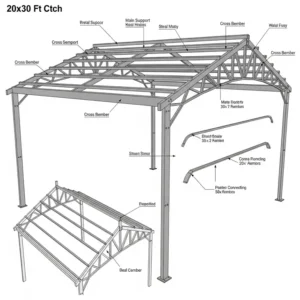
- Judge the frame, not the adjectives. Look for stated pole diameter, wall thickness, and material (galvanized, powder-coated, alloy). “Heavy-duty” alone is empty.
- Read the wind guidance. Several listings flag 25 mph as the point to take preventive action. Plan your cancellation threshold below it.
- Inspect the fabric. Check for UV 50+ and waterproof claims. PE is fine for occasional use, while heavier vinyl lasts longer.
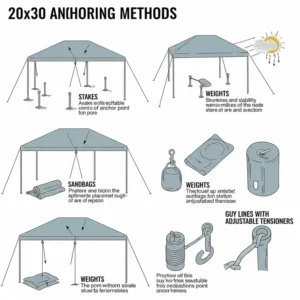
- Count anchoring gear. Sandbags, ground nails, wind ropes: what’s in the box, and what you’ll add.
- Plan the crew. Frame tents of this size weigh hundreds of pounds. Budget for at least four helpers.
Research is a useful cross-check here. A Clemson University thesis on ballast guidelines for non-certified frame tents notes that unengineered tents are often installed without proper ballast analysis, which causes sliding and lift. Translation: your tent’s anchoring is your responsibility, not the manufacturer’s.
Features That Actually Matter (And Those That Don’t)
Let’s cut through the catalog confetti.
Matter: frame material and thickness, anchoring points, fabric weight, and door design. A 1.2 mm wall thickness (like the one listed for the Quictent 20×30) tells you something tangible about rigidity. Attached ground poles on the SANOPY 20×30 are structural, not decorative.
Sort of matter: built-in sandbags. They’re handy, but only as a starting point. Treat them as ballast convenience, not a safety system.
Don’t matter much: the number of sidewalls, unless you’re hosting in cold or rainy conditions. Sidewalls don’t protect a canopy from wind, and they actually catch it. A solid wall turns your tent into a bigger sail.
Don’t matter at all: capacity claims above realistic layouts, and “commercial” labels with no specs behind them.
If you remember one sentence from this section: spend your money on frame and anchoring, and treat everything else as decoration.
Canopy 20×30 vs Traditional Alternatives
| Option | Coverage | Setup Effort | Wind Behavior | Best For |
|---|---|---|---|---|
| Quictent 20×30 (canopy 20×30 example) | 600 sq ft | High (4+ people) | Needs ballast plus ropes | Large backyard events |
| Pop-up 10×20 | 200 sq ft | Low (2 people) | Lighter, easier to lift | Small gatherings, markets |
| Rental tent with crew | Custom | None for you | Often engineered | Weddings, formal events |
| Patio umbrella cluster | Spotty | Low | Poor in gusts | Casual shade only |
A canopy 20×30 sits in a middle lane. Compared with a pop-up, you’re trading easy setup for a vastly bigger footprint, which lets you keep one coherent gathering rather than three awkward clusters. Compared with a rental, you pay once, keep the tent, and carry the setup burden yourself. If you host twice a year or more, ownership usually wins. If this is a once-ever wedding, a rental with insurance and installation crew may be the saner answer.
What to Expect: Real-World Performance of a Canopy 20×30
Specs describe a tent. Real life describes a Saturday.
On a calm day, a canopy 20×30 delivers cool, dim, genuinely comfortable shade. A UV 50+ roof like those on the COBIZI 20×30 and HOTEEL 20×30 shades guests from the harshest rays. Waterproof tops handle light rain as long as the fabric is tensioned so water sheds instead of pooling.
Wind is where plans fail. Wind force scales up fast, and tents can act like a wing, generating lift on the leeward side. That’s why the unglamorous work of anchoring all four corners matters most on the far side of the tent from the wind.
Expect setup to take hours with a crew, not minutes. Expect the fabric to wrinkle and sag until it’s properly tensioned. And expect your guests to cluster at the edges first, so keep the center free for tables rather than blocking the best shade with a buffet line.
Safety, Regulations, and Compliance for Your Canopy 20×30
Big canopies sit at the intersection of fun and liability.
Flame resistance. In the U.S., the CPAI-84 specification sets small-flame testing for tent fabrics, and California requires flame testing before tents are sold there. This overview of camping tent regulations explains the labeling. CPAI-84 isn’t the same as NFPA 701, so if a venue or fire marshal asks for NFPA 701, check your tent’s paperwork.
Permits. Many jurisdictions require permits for larger temporary tents, often tied to square footage. A canopy 20×30 is 600 square feet, so call your local fire marshal or city office before assuming you’re exempt.
Heat and flame. No open flames, grills, or heaters inside. Canopies burn. Keep cooking at a safe distance.
Wind cutoff. Several listing sources mention 25 mph as the point to take precautions. Build a cancellation or take-down plan around forecasts rather than hoping.
I’m not a lawyer, and local rules vary widely, so treat this as orientation, not legal advice.
Long-Term Cost and Maintenance of a Canopy 20×30
The sticker price is the down payment. The real cost shows up over years.
Budget a few extra purchases: extra weights or stakes, spare hardware, a tarp or ground cover, and storage space. A frame that weighs several hundred pounds (the Quictent 20×30 lists roughly 249 pounds) needs a dry corner of the garage, not the back of the shed where moisture lingers.
Fabric is your wear item. Thin PE tops tend to be the first thing to age under UV, while heavy vinyl like the TentandTable 20×30 Pole Tent top costs more up front but should outlast cheaper covers. If you host often, cost-per-use favors heavier materials. If you host once a year, a budget frame tent can spread its cost over many seasons without much penalty.
Rust is the frame’s enemy. Powder coating (COBIZI 20×30) and galvanizing (SANOPY 20×30) both fight it, but scratches still expose bare metal. Touch them up, dry everything before packing, and your investment lasts.
Common Mistakes When Buying a Canopy 20×30
Believing the biggest capacity claim. A tent can “hold” 100 people the way a subway car can “hold” a rush-hour crowd. Seated dinner space is much tighter.
Ignoring the surface. Buying a pole tent for a concrete patio is a classic miss. Stakes don’t go into pavement.
Trusting sandbags alone. Built-in sandbags like those on the HOTEEL 20×30 are a convenience, not an engineered ballast solution.
Skipping the crew. A frame this large is an assembly project. Underestimating helpers turns a fun morning into a bad one.
Overlooking listing variants. Sidewall counts, colors, and frame specs vary between listings of the same brand. Confirm the exact ASIN-level details before you click buy.
Forgetting local rules. Permits and venue requirements catch people late.
Practical Usage Guide: Setting Up and Maintaining Your Canopy 20×30
Treat setup as a project with a plan.
Before the day. Lay out all parts and read the instructions fully. Mark your tent footprint with chalk or string. Confirm utilities and surface hazards.
Assembly. Gather at least four people. Build the frame flat, attach the cover, then raise it evenly. Don’t rush a corner, since sudden lifts bend poles.
Anchoring. Stakes on soft ground, weights on hard surfaces. Guidance varies, but a fire district policy requires 40-pound weights on each leg for tents up to 20×20, and a canopy 20×30 is larger, so go heavier. Another guide suggests 24 pounds per leg in light wind and 40 to 50 or more in moderate wind. Add guy lines on the windward and leeward sides.
Sidewalls. Keep them off in gusty weather. Add them only for rain, privacy, or cool evenings.
First 30 days. Recheck bolts, retension fabric after the first rain, and look for fabric rubbing at frame joints.
Storage. Dry everything. Pack with the fabric clean and cool, and label bags so next time takes half as long.
Real-World Scenarios: Which Canopy 20×30 Fits Your Event?
Scenario 1: The backyard graduation (40 guests, concrete patio, June). Hard surface rules out stakes and the pole tent. The HOTEEL 20×30 or COBIZI 20×30, both with built-in sandbags, make sense, plus extra weights and a forecast check. Add two sidewalls on the sunny side only.
Scenario 2: The windy-lot family reunion (50 guests, open field, September). Exposure is the issue. The SANOPY 20×30 with its attached ground poles and wind ropes deserves a look, along with stakes in soft ground. Plan a take-down threshold under 25 mph.
Scenario 3: The annual fundraiser (60+ guests, lawn, every year). Frequent use rewards durability. The TentandTable 20×30 Pole Tent offers a heavier PVC top and soft-ground staking. The higher cost spreads across years of events.
Scenario 4: The birthday with heavy foot traffic (35 guests, kids running). The Aoxun 20×30 and LAUSAINT HOME 20×30 roll-up doors help with constant in and out, and the 35-to-60 sizing fits.
Problem and Solution Guide for Canopy 20×30 Owners
Problem: Fabric sags and pools water. Solution: retension corners, add a slight pitch, and clear pooled water gently before it stretches the fabric.
Problem: The tent feels like it wants to take off. Solution: remove sidewalls, add weights, tie guy lines, and be ready to take it down. If winds near 25 mph or more are forecast, don’t gamble.
Problem: Hot and stuffy inside. Solution: open both ends, use mesh-window doors like those on the Quictent 20×30, and keep the center clear for airflow.
Problem: Rust spots on the frame. Solution: sand lightly, apply rust-inhibiting paint, and dry the frame before storage. Both COBIZI 20×30 and SANOPY 20×30 use protective coatings, but scratches matter.
Problem: Can’t stake into the ground. Solution: switch to weights. Frame-and-ballast setups like HOTEEL 20×30 are built around exactly this problem.
✨ Want a tent that makes the day feel effortless? 🔍 Start with your ground surface and wind exposure, then compare the shortlisted canopy 20×30 options above. Click any highlighted product name to check current pricing and availability, and give your guests a party that stays standing.
FAQ: Canopy 20×30 Questions Buyers Ask
❓ How heavy is a canopy 20x30?
❓ Can I use a canopy 20x30 on concrete?
❓ Do I need a permit for a canopy 20x30?
❓ How many people fit under a canopy 20x30?
❓ Is a canopy 20x30 waterproof?
Conclusion: Choosing the Right Canopy 20×30 for Your Next Event
A canopy 20×30 gives you something rare: a real room, outdoors, that you control. The tradeoff is responsibility. Six hundred square feet of fabric behaves like a sail, so anchoring, surface, and wind discipline matter more than any glossy feature list.
If I had to sketch a shortlist from the specs and reviews available, it would go like this. For an all-rounder with ballast included, look at COBIZI 20×30 or HOTEEL 20×30. For exposed yards, SANOPY 20×30 makes the clearest structural case. For airflow, Quictent 20×30 stands out. For guest-heavy parties, Aoxun 20×30 and LAUSAINT HOME 20×30 bring roll-up doors. For frequent hosts with soft ground, the TentandTable 20×30 Pole Tent earns its premium.
Whatever you choose, verify the exact listing details, read recent buyer reviews, add weight beyond what the box includes, and set a wind cutoff before the party starts. A tent that stays put is the best decoration you’ll ever buy.
🎉 Ready to upgrade your next gathering? Compare your top picks above, click through to check current pricing and availability, and give your guests a shady, memorable place to celebrate! 🏕️
Recommended for You
- 10 x 20 Canopy Pop Up: Ultimate Guide for Outdoor Events and Party Planning in 2025
- 10 x 20 Canopy Heavy Duty: Top 7 Professional Options That Dominate 2025
- 10 Best Pop Up Shower Tent Options for Ultimate Privacy and Convenience in 2025
Disclaimer: This article contains affiliate links. As an Amazon Associate, I earn from qualifying purchases. If you purchase products through these links, we may earn a small commission at no additional cost to you.
✨ Found this helpful? Share it with your friends! 💬🤗
