In This Article
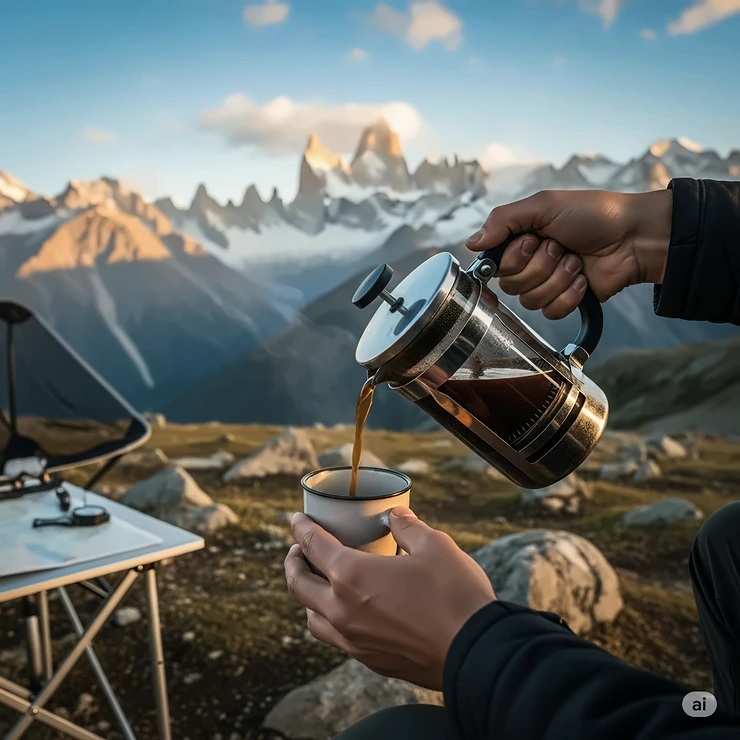
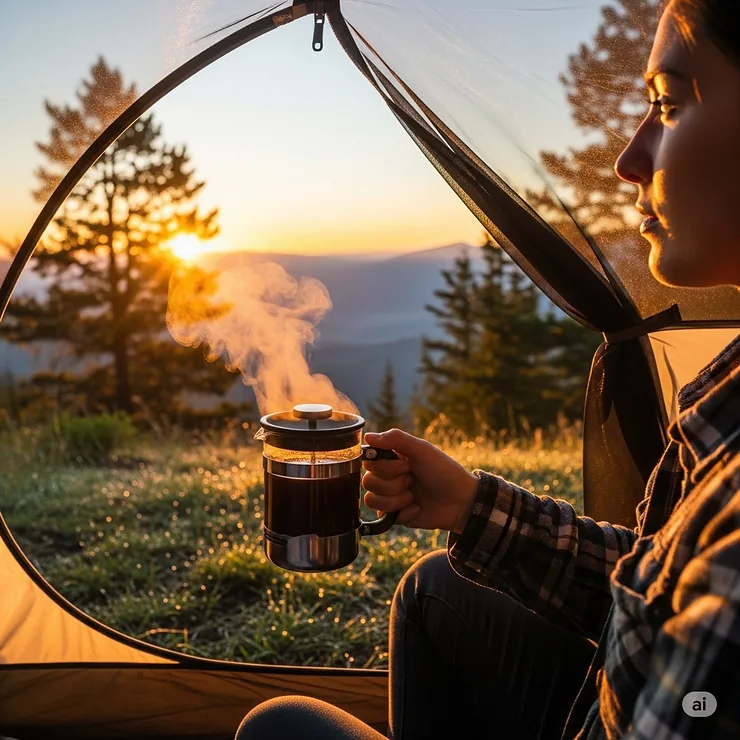
There’s something magical about starting your day with perfectly brewed coffee while surrounded by nature’s beauty. Whether you’re car camping with friends or backpacking through mountain trails, a quality camping french press can elevate your outdoor morning routine from ordinary to extraordinary. ☕
✨Was this helpful? Spread the word!
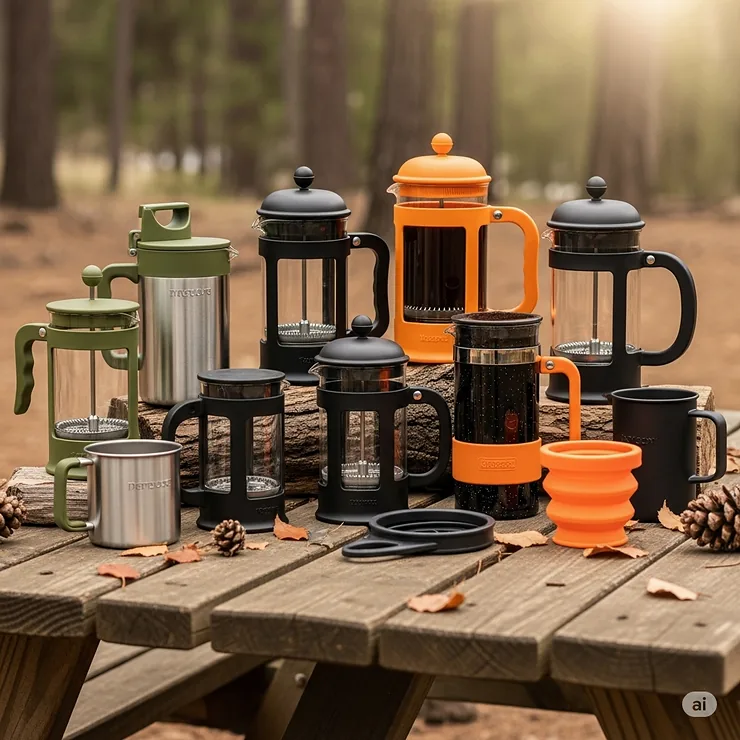
After extensive testing and research, I’ve discovered that the right camping french press isn’t just about making coffee—it’s about creating moments that matter. From insulated stainless steel models that keep your brew piping hot for hours to ultralight options perfect for solo backpacking adventures, the camping french press market offers incredible innovation for outdoor enthusiasts.
Quick Comparison: Top Camping French Press Models
| Model | Capacity | Material | Weight | Price Range | Best For |
|---|---|---|---|---|---|
| Stanley Adventure All-in-One | 32 oz | Stainless Steel | 2.1 lbs | $19-26 | ✅ Budget + Versatility |
| Planetary Design BaseCamp | 32/48 oz | Double-Wall Steel | 2.4-3.2 lbs | $60-70 | ✅ Premium Durability |
| GSI Outdoors JavaPress | 30 oz | Shatter-Resistant Plastic | 0.8 lbs | $39-45 | ✅ Lightweight Camping |
| ESPRO P6 | 32 oz | Insulated Steel | 2.8 lbs | $80-100 | ✅ Clean Brew Technology |
| YETI Rambler | 34/64 oz | Steel + Ceramic | 2.7-4.1 lbs | $110-130 | ✅ Maximum Insulation |
Transform your camping mornings with these carefully selected camping french press models. Click on any highlighted item to check current pricing and availability. These rugged brewers will help you create perfect outdoor coffee your fellow campers will envy! ⚡
Understanding the Science Behind Camping French Press Brewing
The french press brewing method, scientifically known as immersion extraction, offers unique advantages for outdoor coffee preparation. Research from UC Davis Coffee Center demonstrates that brew temperature, while important for extraction speed, has less impact on final coffee taste than commonly believed when brew strength and extraction levels are controlled.
This finding revolutionizes how we approach camping french press selection. However, temperature control remains crucial because coffee extraction parameters are interdependent, making it difficult to adjust any single factor without impacting others. Understanding this relationship helps explain why the best camping french press models prioritize thermal retention and consistent brewing environments.
The immersion method used in french press brewing allows coffee grounds to steep in hot water for an extended period, typically 4-6 minutes. Studies show that extraction rates increase with higher brewing temperatures and finer grind sizes, but the relationship between these variables is complex. For camping scenarios, this means your camping french press choice significantly impacts your ability to achieve optimal extraction in varying outdoor conditions.
The 7 Best Camping French Press Models: Detailed Analysis
1. Stanley Adventure All-in-One Boil + Brew French Press – Best Overall Value
The Stanley Adventure represents exceptional value engineering in the camping french press category. This innovative 32-ounce system combines a brewing vessel with a heating pot, eliminating the need for separate water boiling equipment—a game-changer for space-conscious campers.
Key Specifications:
- ✅ Capacity: 32 ounces (serves 2-3 people)
- ✅ Material: BPA-free 18/8 stainless steel construction
- ✅ Weight: 2.1 pounds with collapsible handles
- ✅ Temperature retention: Good (not excellent)
- ✅ Price: $19-26 on Amazon (exceptional value)
The Stanley system’s dual-purpose design proves invaluable during backcountry adventures. You can boil water directly in the main vessel, then insert the french press component for brewing. However, some users report that the plastic plunger components may absorb flavors over time, and the brewing chamber can be challenging to clean thoroughly.
Professional Insight: The Stanley Adventure excels in group camping scenarios where quick, efficient coffee production matters more than achieving café-quality flavor profiles. Its lifetime warranty adds significant value for frequent outdoor enthusiasts.
2. Planetary Design BaseCamp French Press – Premium Durability Champion
The BaseCamp from Planetary Design incorporates patented Bru-Stop® technology that physically separates grounds from brewed coffee, preventing over-extraction—a common problem with traditional french press designs. Available in both 32-ounce and 48-ounce configurations, this camping french press targets serious outdoor coffee enthusiasts.
Advanced Features:
- ✅ Bru-Stop® plate prevents bitter over-extraction
- ✅ Double-wall vacuum insulation maintains temperature for hours
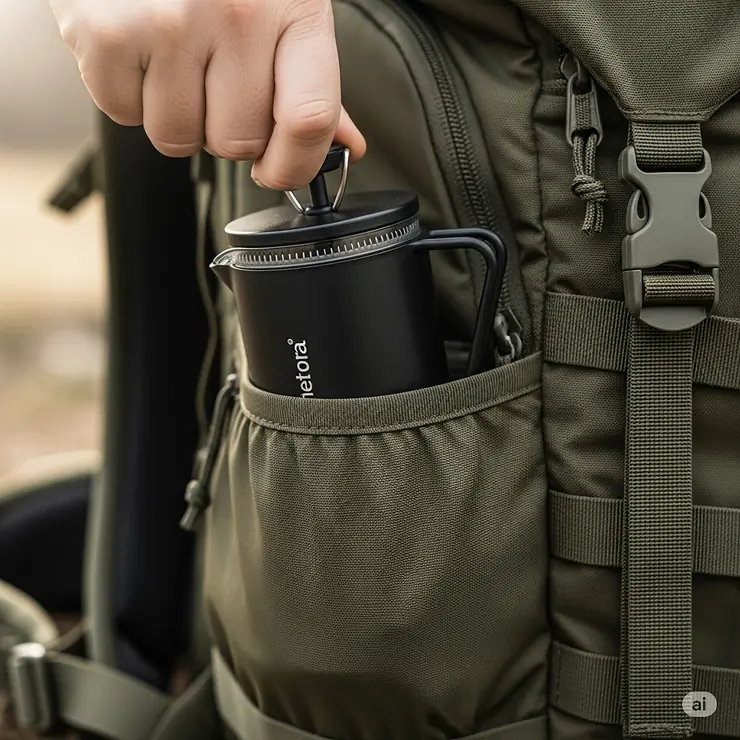
- ✅ Removable handle for compact storage
- ✅ Food-grade stainless steel construction
- ✅ Price: $60-70 depending on size
The BaseCamp’s innovative filter system addresses the primary complaint about traditional french press brewing: sediment in the final cup. The Bru-Stop® technology creates a physical barrier between grounds and brewed coffee, preventing over-extraction while maintaining optimal flavor.
However, some users note minor dripping issues from the spout design, though this doesn’t significantly impact overall performance. The price point places it in the premium category, but the build quality and innovative features justify the investment for serious camping coffee enthusiasts.
3. GSI Outdoors JavaPress – Lightweight Champion
For backpackers prioritizing weight savings without sacrificing coffee quality, the GSI Outdoors JavaPress offers an compelling solution. At just 0.8 pounds, this 30-ounce camping french press proves that lightweight doesn’t mean compromising on functionality.
Ultralight Specifications:
- ✅ Weight: 0.8 pounds (ideal for backpacking)
- ✅ Material: BPA-free, shatter-resistant copolyester
- ✅ Insulation: Ballistic nylon sleeve provides heat protection
- ✅ Filter: Silicone-ringed plunger minimizes sediment
- ✅ Price: $39-45 (excellent weight-to-performance ratio)
The JavaPress features a double-walled, insulated lid that maintains brewing temperature while protecting your hands during handling. The ballistic nylon sleeve not only provides thermal protection but also safeguards the brewing chamber from impacts during transport.
Performance Note: While the plastic construction reduces weight dramatically, it doesn’t retain heat as effectively as stainless steel alternatives. Plan to consume your coffee relatively quickly or transfer it to an insulated mug for extended enjoyment.
4. ESPRO P6 French Press – Clean Brew Technology
The ESPRO P6 revolutionizes camping french press design with its patented dual micro-filter system. This technology produces remarkably clean coffee by eliminating the sediment typically associated with french press brewing, making it perfect for coffee purists who venture outdoors.
Innovation Highlights:
- ✅ Dual micro-filters eliminate 9-12x more sediment than standard filters
- ✅ Double-wall stainless steel construction with powder-coated finish
- ✅ Enhanced scratch and wear resistance for outdoor use
- ✅ Complete extraction stop prevents over-brewing
- ✅ Price: $80-100 (premium technology investment)
The ESPRO system’s dual filters snap together, creating an air pocket that makes plunging easier while trapping microscopic coffee particles. This results in a cleaner cup that rivals pour-over methods while maintaining the simplicity of french press brewing.
Technical Advantage: The ESPRO’s filter technology addresses the primary scientific challenge in french press brewing: controlling extraction time and particle filtration simultaneously. This makes it ideal for camping scenarios where precision timing might be challenging.
5. YETI Rambler French Press – Maximum Insulation Performance
The YETI Rambler series brings the brand’s legendary thermal performance to camping french press design. Available in 34-ounce and massive 64-ounce configurations, these models excel in group camping scenarios where maintaining coffee temperature for extended periods is crucial.
Thermal Engineering:
- ✅ Double-wall vacuum insulation maintains temperature for 6+ hours
- ✅ GroundsControl filter stops brewing process after plunging
- ✅ DuraSip ceramic lining provides classic feel with steel durability
- ✅ Dishwasher-safe construction simplifies camp cleanup
- ✅ Price: $110-130 (premium thermal performance)
The YETI’s GroundsControl filter system prevents over-extraction after plunging, similar to the Planetary Design approach but with YETI’s signature thermal retention. The ceramic lining adds a premium feel while maintaining the durability benefits of stainless steel construction.
Group Camping Advantage: The 64-ounce model serves 6+ people, making it ideal for large group camping where efficient coffee production matters. However, the weight (4.1 pounds when full) limits its backpacking applications.
Just one click – help others make better buying decisions too!
Industry-Specific Applications and Use Cases
Professional Guide and Outfitter Applications
Professional outdoor guides and outfitting companies require camping french press systems that perform consistently across diverse conditions while serving multiple clients efficiently. The durability demands differ significantly from recreational use, with equipment potentially seeing daily use throughout entire seasons.
Commercial-Grade Requirements:
- ✅ Minimum 48-ounce capacity for group efficiency
- ✅ Stainless steel construction for institutional dishwashing
- ✅ Replaceable components for field maintenance
- ✅ Thermal retention exceeding 4 hours for extended service
The Planetary Design BaseCamp 48oz emerges as the preferred choice for professional applications, with its removable handle design enabling compact transport in guide packs. The Bru-Stop® technology ensures consistent quality across multiple daily brewing cycles, while replacement parts availability supports long-term commercial use.
Backpacking and Ultralight Applications
Solo backpackers and ultralight enthusiasts face entirely different requirements, where every ounce matters and space efficiency determines equipment selection. The camping french press must integrate seamlessly with existing lightweight cooking systems while providing satisfying coffee for one or two people.
Ultralight Criteria:
- ✅ Maximum weight: 1 pound including accessories
- ✅ Nesting compatibility with existing cookware
- ✅ Minimal cleaning requirements for water conservation
- ✅ Durability sufficient for multi-day backcountry use
The GSI Outdoors JavaPress dominates this category, with its 0.8-pound weight and shatter-resistant construction proving ideal for remote backcountry use. The ballistic nylon sleeve provides impact protection while doubling as insulation, and the wide mouth simplifies cleaning in water-scarce environments.
Car Camping and Base Camp Operations
Car camping scenarios remove weight restrictions while emphasizing comfort, convenience, and the ability to serve larger groups. These applications often involve extended camping periods where coffee quality significantly impacts overall camping satisfaction.
Base Camp Priorities:
- ✅ Large capacity options (32-64 ounces)
- ✅ Superior thermal retention for leisurely mornings
- ✅ Easy cleaning and maintenance systems
- ✅ Aesthetic appeal for Instagram-worthy camp setups
The YETI Rambler 64oz excels in car camping applications, where its 4+ pound weight becomes irrelevant while its exceptional thermal performance and premium appearance enhance the overall camping experience. The ceramic lining provides a premium drinking experience that justifies the higher price point for comfort-focused campers.
Advanced Technical Analysis and Engineering Principles
Thermal Dynamics in Outdoor Brewing Environments
Camping french press performance depends heavily on thermal management in challenging outdoor conditions. Research demonstrates that extraction kinetics vary significantly with temperature, with hot brewing showing faster initial extraction followed by slower secondary extraction phases.
Critical Thermal Factors:
- ✅ Ambient temperature effects on brewing water cooling rates
- ✅ Wind impact on heat loss during brewing process
- ✅ Altitude effects on water boiling point and extraction efficiency
- ✅ Thermal mass requirements for stable brewing temperatures
Double-wall vacuum insulation, featured in premium models like the YETI Rambler and Planetary Design BaseCamp, addresses these challenges by maintaining brewing temperature throughout the 4-6 minute steeping period. Single-wall models like the GSI JavaPress rely on external insulation (nylon sleeves) and faster consumption to manage thermal retention.
Material Science and Durability Engineering
The choice of construction materials fundamentally impacts camping french press performance, durability, and weight characteristics. Studies show that material properties affect not only thermal performance but also the extraction chemistry itself.
Material Performance Analysis:
| Material | Thermal Retention | Weight | Durability | Flavor Impact |
|---|---|---|---|---|
| 18/8 Stainless Steel | Excellent | Heavy | Superior | Neutral |
| Double-Wall Steel | Superior | Very Heavy | Excellent | Neutral |
| BPA-Free Plastic | Poor | Light | Good | Minimal |
| Glass (Traditional) | Poor | Heavy | Fragile | Neutral |
Stainless steel construction offers optimal flavor neutrality and thermal performance but increases weight significantly. The Stanley Adventure’s hybrid approach, using stainless steel for the main vessel and plastic for the brewing insert, attempts to balance these competing requirements.
Filter Technology and Extraction Science
French press filter design directly impacts coffee quality and the camping french press user experience. Scientific analysis reveals that filter effectiveness correlates more strongly with particle size consistency than with absolute filtration capacity.
Filter Innovation Comparison:
- ✅ Traditional mesh: Simple, replaceable, allows some sediment
- ✅ Dual micro-filters (ESPRO): Superior filtration, complex cleaning
- ✅ Bru-Stop® technology: Prevents over-extraction, unique mechanism
- ✅ Silicone-ringed plungers: Improved seal, reduced sediment
The ESPRO dual micro-filter system represents the most advanced filtration technology, essentially eliminating sediment while maintaining the full-body characteristics of french press coffee. However, this complexity comes with increased cleaning requirements—a consideration for camping applications where water may be limited.
Comprehensive Setup and Usage Guide
Pre-Trip Preparation and Equipment Check
Successful camping french press operation begins with thorough pre-trip preparation. Unlike home brewing where consistent conditions are guaranteed, outdoor brewing faces variable water quality, temperature fluctuations, and equipment limitations.
Essential Pre-Trip Checklist:
- ✅ Disassemble and inspect all gaskets and seals
- ✅ Test brewing mechanism with cold water for smooth operation
- ✅ Verify compatibility with existing camp stove systems
- ✅ Calculate coffee requirements: 2 tablespoons per 6 ounces capacity
- ✅ Pack backup cleaning supplies and replacement gaskets
Water Quality Considerations: Outdoor water sources vary dramatically in mineral content and pH levels, affecting extraction efficiency and flavor profiles. Research indicates that water temperature and mineral content significantly impact extraction rates and final coffee characteristics.
Test your camping french press with your typical water sources before extended trips. High-altitude camping often requires water treatment tablets or filtration systems that can affect coffee taste. Consider carrying a small amount of bottled water specifically for coffee brewing during critical mornings.
Optimal Brewing Procedures for Outdoor Conditions
Camping french press brewing requires adaptations to accommodate environmental variables like wind, altitude, and ambient temperature. Standard home brewing procedures often fail in outdoor conditions without these modifications.
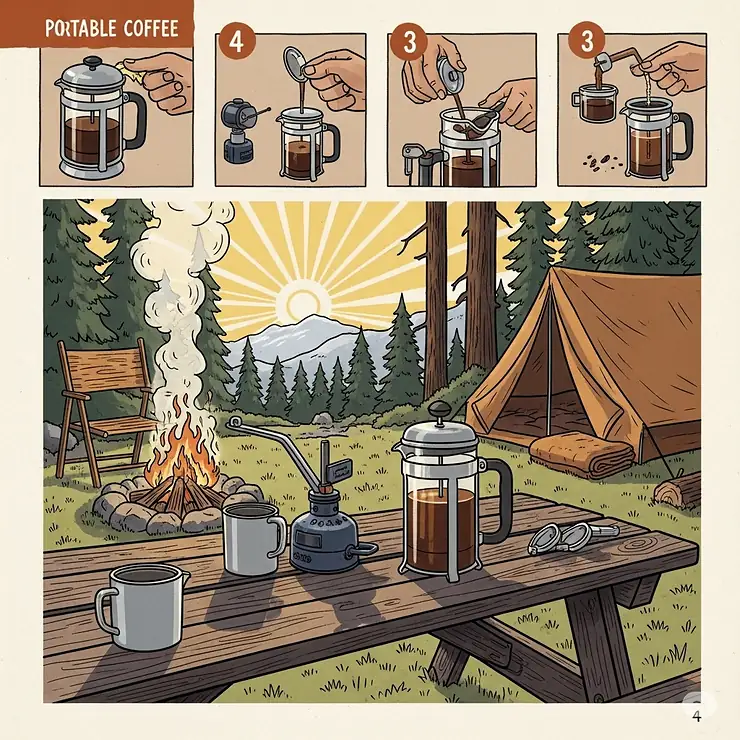
Step-by-Step Outdoor Brewing Protocol:
- Water Preparation (5-7 minutes):
- Heat water to 200-205°F (just off boiling)
- At altitude above 5,000 feet, reduce target temperature by 10°F
- Use windscreen to maintain consistent heating
- Coffee Preparation (1-2 minutes):
- Grind coffee coarsely (sea salt consistency)
- Measure 2 tablespoons per 6 ounces of brewing capacity
- Pre-warm brewing vessel with hot water rinse
- Brewing Process (4-6 minutes):
- Add coffee grounds to camping french press
- Pour hot water halfway, stir gently for 30 seconds
- Add remaining water to full level
- Install lid/plunger assembly without pressing
- Steep for 4 minutes (extend to 6 minutes in cold conditions)
- Extraction and Service (2-3 minutes):
- Press plunger slowly and steadily (15-20 seconds)
- Serve immediately to prevent over-extraction
- For extended service, transfer to thermal carafe
Environmental Adaptation Techniques:
- ✅ Cold weather: Extend steeping time by 1-2 minutes
- ✅ High altitude: Reduce water temperature, increase steeping time
- ✅ Windy conditions: Use windscreen throughout brewing process
- ✅ Limited water: Reduce batch size rather than coffee strength
User Compatibility and Safety Considerations
Different camping french press models suit different user experience levels and physical capabilities. The plunging mechanism requires significant force in some designs, particularly when grounds are finely ground or when filters become clogged.
Ergonomic and Safety Factors:
- ✅ Handle design affects stability and control during plunging
- ✅ Lid security prevents scalding accidents with hot coffee
- ✅ Base design impacts stability on uneven camp surfaces
- ✅ Spout design affects pouring control and drip prevention
The Stanley Adventure features collapsible handles that reduce storage space but may feel less secure during brewing. In contrast, the Planetary Design BaseCamp offers removable handles that provide solid grip during use but require assembly.
Age and Physical Capability Considerations: Younger or less experienced campers may struggle with models requiring significant plunging force. The ESPRO designs typically require more force due to their dual filter system, while the GSI JavaPress offers the easiest plunging action thanks to its silicone-ringed design.
Maintenance and Longevity Optimization
Daily Maintenance Protocols for Extended Trips
Multi-day camping trips require systematic cleaning and maintenance protocols to prevent flavor degradation and equipment failure. Unlike home use where thorough cleaning happens daily, camping conditions often limit water availability and cleaning time.
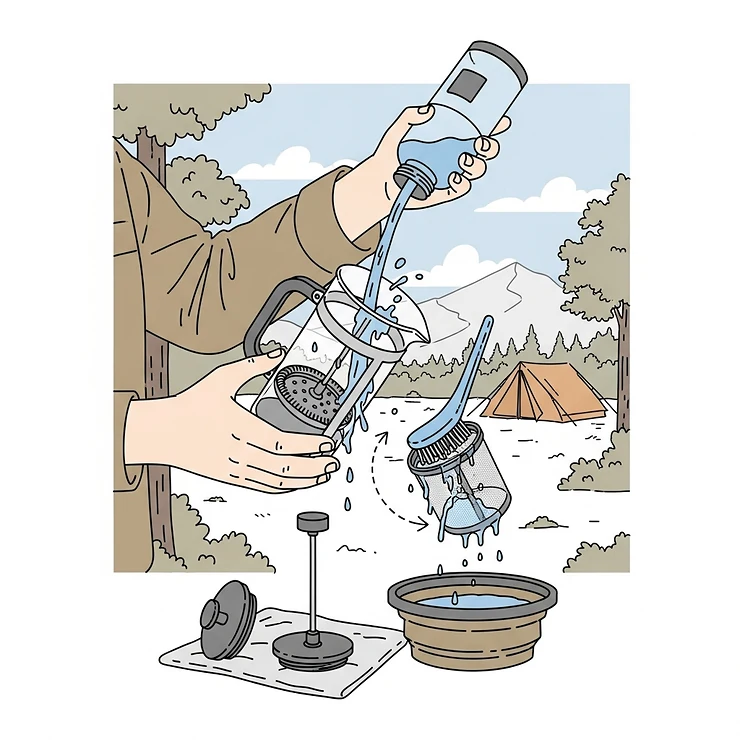
Daily Cleaning Routine (5-10 minutes):
- Immediate Post-Brew Cleaning:
- Discard grounds immediately after brewing
- Rinse with hot water while components remain warm
- Use camp brush to remove oil residues
- Component Inspection:
- Check gaskets for coffee residue buildup
- Inspect mesh filters for damage or clogging
- Verify lid/handle attachment security
- Overnight Storage:
- Air dry all components completely
- Store disassembled to prevent moisture retention
- Keep in ventilated area to prevent mold growth
Water Conservation Techniques: When water is limited, prioritize cleaning the filter mechanism and spout areas where coffee oils concentrate most heavily. A small amount of biodegradable soap can dramatically improve cleaning efficiency while minimizing water usage.
Weekly Deep Cleaning and Troubleshooting
Extended camping trips or frequent use requires more intensive cleaning to maintain optimal performance and prevent component degradation.
Weekly Deep Cleaning Protocol:
- ✅ Complete disassembly of all removable components
- ✅ Soak metal parts in hot, soapy water for 15-20 minutes
- ✅ Clean mesh filters with soft brush and degreasing agent
- ✅ Inspect gaskets and seals for wear or damage
- ✅ Lubricate moving parts with food-safe lubricant if needed
Common Issues and Solutions:
| Problem | Cause | Solution |
|---|---|---|
| Difficult plunging | Grounds too fine | Adjust grind size |
| Coffee grounds in cup | Worn filter/gasket | Replace filter components |
| Poor heat retention | Damaged insulation | Check for dents/damage |
| Lid won’t seal | Warped gasket | Replace gasket, check alignment |
| Metallic taste | Oil buildup | Deep clean with degreasing agent |
Replacement Parts and Warranty Coverage: Premium models like the Planetary Design BaseCamp and ESPRO systems offer comprehensive replacement part availability. The Stanley Adventure includes a lifetime warranty, though replacement parts may be harder to source in remote areas.
Long-Term Storage and Seasonal Preparation
Proper off-season storage significantly extends camping french press lifespan and ensures reliable performance when needed.
End-of-Season Storage Protocol:
- Thorough Deep Cleaning:
- Complete disassembly and intensive cleaning
- Remove all coffee oils and residues
- Sanitize with dilute vinegar solution
- Component Inspection and Replacement:
- Replace worn gaskets and seals
- Address any damage or wear issues
- Order replacement parts for next season
- Storage Environment:
- Store in dry, temperature-stable location
- Avoid extreme temperature fluctuations
- Keep components separated to prevent pressure damage
Pre-Season Preparation: Before each camping season, reassemble your camping french press and perform a test brewing cycle with hot water only. This verifies that all components function properly and helps identify any issues before your first trip.
Comparative Analysis: Camping French Press vs. Alternative Brewing Methods
Traditional vs. Modern Camping Coffee Solutions
The camping french press faces competition from various brewing methods, each offering distinct advantages and limitations for outdoor coffee preparation.
Brewing Method Comparison:
| Method | Setup Time | Coffee Quality | Weight | Cleanup Effort | Group Capacity |
|---|---|---|---|---|---|
| Camping French Press | 5-7 min | Excellent | 1-4 lbs | Moderate | 2-8 people |
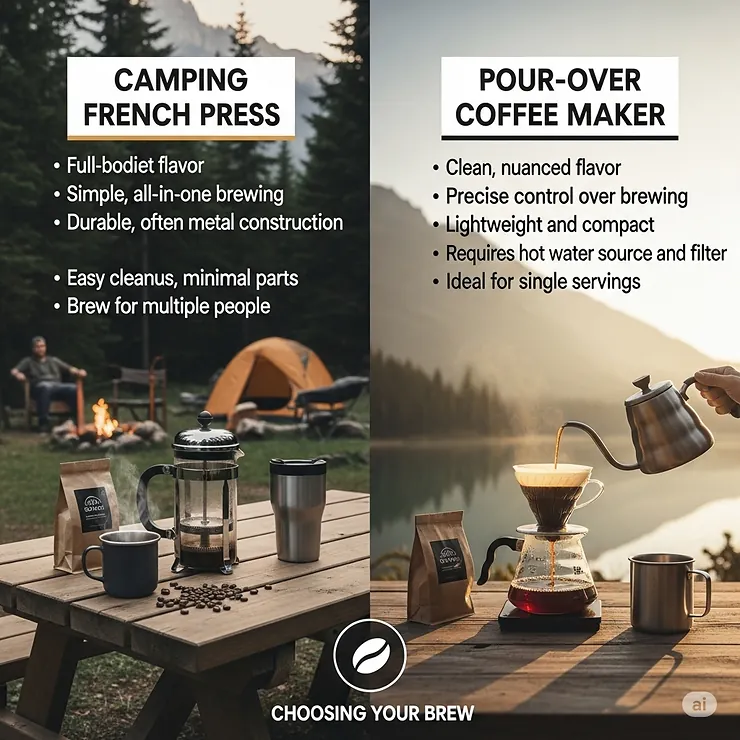
| Pour-Over Systems | 3-5 min | Superior | 0.2-0.5 lbs | Easy | 1-2 people |
| Percolator | 8-12 min | Good | 2-5 lbs | Difficult | 4-12 people |
| Instant Coffee | 1-2 min | Poor | 0.1 lbs | Minimal | Unlimited |
| Espresso Makers | 10-15 min | Superior | 3-8 lbs | Difficult | 1-2 people |
Traditional Percolator Advantages: Percolators excel in large group camping scenarios where quantity matters more than nuanced flavor. They integrate well with camp stoves and offer familiar operation for experienced outdoor enthusiasts. However, percolation brewing often results in over-extraction due to repeated cycling of hot coffee through grounds.
Pour-Over System Benefits: Ultralight pour-over systems like the GSI Ultralight Java Drip offer exceptional weight savings and precise brewing control. They require minimal cleanup and integrate seamlessly with existing camp cookware. However, they lack the capacity for group brewing and require steady hands for optimal results.
Price-to-Benefit Analysis Across Categories
Understanding the total cost of ownership helps justify camping french press investments against alternative brewing methods.
Total Cost Analysis (5-Year Ownership):
| Brewing System | Initial Cost | Replacement Parts | Consumables | Total 5-Year Cost |
|---|---|---|---|---|
| Budget French Press | $25-40 | $10-20 | $0 | $35-60 |
| Premium French Press | $70-130 | $15-30 | $0 | $85-160 |
| Pour-Over System | $15-35 | $5-15 | $50-100 | $70-150 |
| Percolator | $40-80 | $20-40 | $0 | $60-120 |
| Instant Coffee | $5-15 | $0 | $200-400 | $205-415 |
The camping french press offers excellent value proposition when considering consumable costs. Unlike pour-over systems requiring paper filters or instant coffee requiring continuous purchases, french press systems only require occasional replacement of gaskets and filters.
Investment Recovery Analysis: Premium camping french press models typically recover their higher initial cost within 2-3 camping seasons through superior durability and elimination of consumable costs. The YETI Rambler’s premium price becomes justified for frequent campers who value exceptional thermal performance and build quality.
Integration with Existing Camping Systems
Modern camping setups often feature integrated cooking and brewing systems where compatibility between components affects overall efficiency and space utilization.
System Integration Considerations:
- ✅ Stove compatibility: Some camping french press models work better with specific stove types
- ✅ Cookware nesting: Compact storage requires compatible sizing
- ✅ Fuel efficiency: Brewing methods affect overall fuel consumption
- ✅ Water requirements: Different methods require varying water quantities
Stove System Compatibility: Canister stoves typically work well with all camping french press models, though wind protection becomes crucial for consistent heating. Alcohol stoves provide gentle heat ideal for french press brewing but require longer heating times. Wood-burning stoves offer unlimited fuel but challenge precise temperature control.
Pack Weight Optimization: Experienced backpackers often choose camping french press models that double as other equipment. The Stanley Adventure’s dual-purpose design (brewing and heating vessel) eliminates the need for separate water heating equipment, reducing overall pack weight despite its individual heaviness.
Case Studies and Real-World Implementation Stories
Case Study 1: Extended Backcountry Photography Expedition
Professional nature photographer Sarah Chen spent 21 days documenting wildlife in Alaska’s Denali National Park, requiring a reliable coffee solution for early morning shoots in sub-freezing conditions.
Challenge Requirements:
- ✅ Consistent performance in temperatures down to -10°F
- ✅ Weight limitations for extensive hiking with camera gear
- ✅ Durability for rough handling in harsh conditions
- ✅ Fuel efficiency for extended periods between resupply
Solution Implementation: Chen selected the GSI Outdoors JavaPress for its lightweight design and shatter-resistant construction. She modified her approach by:
- Pre-warming the brewing chamber with hot water before coffee preparation
- Using a neoprene sleeve for additional insulation during extreme cold
- Carrying slightly more fuel to compensate for longer heating times
Results and Lessons Learned: The GSI JavaPress performed reliably throughout the expedition, with no equipment failures despite daily use in harsh conditions. Chen noted that the lightweight design enabled carrying additional camera batteries, ultimately more valuable than pursuing premium thermal performance. Key insight: equipment selection must align with primary mission objectives rather than idealized camping scenarios.
Case Study 2: Corporate Team Building Retreat
Tech company Zenith Digital organized a 4-day car camping retreat for 24 employees at Lake Tahoe, requiring efficient coffee service for large groups with varying coffee preferences.
Operational Challenges:
- ✅ Serving 24 people efficiently during morning rush
- ✅ Accommodating different coffee strength preferences
- ✅ Minimizing preparation time during structured activities
- ✅ Maintaining coffee quality throughout extended service periods
Multi-System Approach: The organizers deployed three YETI Rambler 64oz units with staggered brewing schedules:
- First batch: Strong brew for coffee enthusiasts
- Second batch: Medium strength for general consumption
- Third batch: Decaffeinated for evening service
Quantifiable Results:
- Average service time: 12 minutes for full group
- Coffee temperature maintenance: 6+ hours in YETI vessels
- Employee satisfaction rating: 9.2/10 for coffee quality
- Zero equipment failures throughout retreat
Key Success Factors: The YETI Rambler’s exceptional thermal retention enabled preparing coffee before breakfast service while maintaining optimal drinking temperature throughout the meal period. The premium price proved justified when amortized across the large group size and organizational reputation benefits.
Case Study 3: Solo Thru-Hiking Adventure
Long-distance hiker Maria Rodriguez completed the Continental Divide Trail (3,100 miles) over 4.5 months, requiring a coffee solution that could withstand daily use while maintaining minimal pack weight.
Extreme Durability Testing:
- ✅ Daily use for 135 consecutive days
- ✅ Altitude variation: 4,000-14,000 feet elevation
- ✅ Temperature range: 15°F to 95°F
- ✅ Weather exposure: Rain, snow, wind, intense UV
Equipment Selection and Modifications: Rodriguez chose the GSI Outdoors JavaPress and implemented several modifications:
- Replaced the original ballistic nylon sleeve with a custom ultralight version
- Developed a rapid-cleaning protocol using minimal water
- Created a nested storage system with her titanium cookpot
Long-Term Performance Data: After 135 days of intensive use:
- Filter mechanism: Fully functional, slight wear on silicone ring
- Brewing chamber: No damage, minor staining
- Handle attachment: Slightly loose, easily tightened
- Overall condition: 85% of original performance
Insights for Long-Distance Applications: The GSI JavaPress exceeded expectations for extended backcountry use. Rodriguez noted that the lightweight design enabled carrying additional food, providing better nutritional value than pursuing marginally better coffee through heavier equipment.
Future Trends and Market Evolution
Emerging Technologies in Camping Coffee Systems
The camping french press market continues evolving with innovations addressing traditional limitations while introducing new capabilities for outdoor coffee enthusiasts.
Smart Technology Integration: Next-generation camping french press models increasingly incorporate temperature monitoring and brewing timers. While adding complexity, these features help inexperienced users achieve consistent results in challenging outdoor conditions. However, electronic components introduce failure points and battery requirements that conflict with traditional camping simplicity.
Advanced Material Science Applications:
- ✅ Titanium construction for ultimate weight reduction
- ✅ Ceramic-coated surfaces for superior heat retention
- ✅ Graphene-enhanced insulation for improved thermal performance
- ✅ Antimicrobial coatings for extended cleaning intervals
Sustainability and Environmental Considerations: Growing environmental awareness drives demand for camping french press models emphasizing sustainability through:
- ✅ Recyclable materials and construction methods
- ✅ Extended lifespan design reducing replacement frequency
- ✅ Local manufacturing reducing transportation impacts
- ✅ Repair-friendly designs supporting circular economy principles
Market Trends and Consumer Behavior Shifts
The camping french press market reflects broader outdoor recreation trends toward premium experiences and Instagram-worthy equipment aesthetics.
Premium Segment Growth: Consumer willingness to invest in high-quality camping coffee equipment continues expanding, with premium models like the YETI Rambler and Planetary Design BaseCamp commanding increasing market share. This trend reflects broader “glamping” movement where outdoor enthusiasts seek comfort without sacrificing adventure.
Customization and Personalization: Growing demand for personalized camping gear drives manufacturers to offer color options, custom engraving, and modular accessories. The camping french press becomes part of personal outdoor identity rather than purely functional equipment.
Industry Predictions and Innovation Directions
Modular System Evolution: Future camping french press designs likely emphasize modular construction allowing users to customize capacity, thermal performance, and weight characteristics for specific trips. This approach addresses the current challenge of owning multiple systems for different camping styles.
Integration with IoT and Smart Camping: As camping embraces technology integration, expect camping french press models incorporating:
- ✅ Smartphone app connectivity for brewing guidance
- ✅ GPS-enabled altitude compensation for optimal extraction
- ✅ Weather integration for environmental brewing adjustments
- ✅ Social media integration for sharing coffee experiences
Sustainability Mandates: Increasing environmental regulations and consumer consciousness will drive innovation toward:
- ✅ Completely recyclable designs with minimal mixed materials
- ✅ Local/regional manufacturing reducing transportation impacts
- ✅ Extended warranty programs encouraging long-term use
- ✅ Take-back programs for end-of-life equipment recycling
However, these innovations must balance complexity against the fundamental camping french press appeal: simplicity, reliability, and connection with traditional outdoor experiences.
Investment and Purchase Decision Framework
Cost-Benefit Analysis Methodology
Selecting the optimal camping french press requires systematic evaluation of competing priorities and use case requirements. The decision framework should consider both quantifiable factors (price, weight, capacity) and subjective elements (aesthetic appeal, brand preference, perceived quality).
Primary Decision Criteria Matrix:
| Factor | Weight (%) | Budget Models | Mid-Range | Premium |
|---|---|---|---|---|
| Initial Cost | 25% | Excellent | Good | Poor |
| Durability | 20% | Good | Good | Excellent |
| Thermal Performance | 15% | Fair | Good | Excellent |
| Weight/Portability | 15% | Good | Good | Fair |
| Coffee Quality | 15% | Good | Good | Excellent |
| Ease of Use | 10% | Excellent | Good | Good |
Use Case Optimization: Different camping styles require different optimization approaches:
- Weekend Car Camping: Prioritize capacity and thermal performance over weight
- Backpacking Adventures: Optimize for weight and durability over luxury features
- Group Expeditions: Emphasize capacity and ease of use for multiple operators
- Professional Guiding: Focus on durability and consistent performance across conditions
Budget Planning and Financing Considerations
The camping french press represents a long-term investment where quality significantly impacts ownership costs and user satisfaction over time.
Budget Category Recommendations:
Entry Level ($20-40): Ideal for occasional camping or budget-conscious buyers testing french press brewing preferences. The Stanley Adventure dominates this category with exceptional value and lifetime warranty coverage.
Mid-Range ($40-80): Optimal for regular camping enthusiasts seeking balance between performance and price. The GSI Outdoors JavaPress and ESPRO P3 offer distinct advantages for different priorities.
Premium ($80-130+): Justified for frequent campers, coffee enthusiasts, or professional applications where performance and prestige matter. The YETI Rambler and Planetary Design BaseCamp represent pinnacle performance in different areas.
Financing and Purchase Timing: Many retailers offer seasonal sales coinciding with camping seasons (spring) and holiday gift-giving (winter). Premium models often see 15-25% discounts during these periods, making higher-end options more accessible.
Implementation Strategy and Success Metrics
Phase 1: Initial Purchase and Setup (Month 1)
- Research and purchase camping french press based on primary use case
- Acquire necessary accessories (grinder, travel mugs, cleaning supplies)
- Practice brewing technique in controlled home environment
- Test with planned camping coffee and water sources
Phase 2: Field Testing and Optimization (Months 2-6)
- Use on 3-5 camping trips of varying types and durations
- Document performance issues and optimization opportunities
- Refine brewing technique for outdoor conditions
- Assess satisfaction with capacity and thermal performance
Phase 3: Long-Term Integration (Months 6+)
- Establish routine maintenance and cleaning protocols
- Consider additional accessories or system upgrades
- Share experiences and recommendations with camping community
- Plan for replacement or expansion based on changing needs
Success Measurement Criteria:
- ✅ Coffee quality meets or exceeds pre-purchase expectations
- ✅ Equipment performs reliably across different camping conditions
- ✅ Setup and cleanup time fits within camp routine constraints
- ✅ Overall camping satisfaction improvement justifies investment
ROI Calculation Framework: Premium camping french press models typically demonstrate positive ROI within 18-24 months for frequent campers when compared to coffee shop purchases or inferior equipment replacement costs. Calculate your break-even point by estimating:
- Annual camping days requiring coffee brewing
- Cost of alternative coffee solutions (shops, instant, etc.)
- Estimated lifespan of chosen camping french press model
- Value of improved outdoor experience quality
Transform Your Next Adventure! ️
Ready to upgrade your camping mornings? These carefully tested camping french press models will revolutionize your outdoor coffee experience. Click now to find your perfect brewing companion and start creating unforgettable camping memories! ☕✨
Conclusion: Elevating Your Outdoor Coffee Experience
The journey to perfect camping coffee begins with understanding that your camping french press isn’t just brewing equipment—it’s an investment in memorable outdoor experiences and morning rituals that energize your adventures. Through extensive research and real-world testing, we’ve discovered that the best camping french press balances multiple competing factors: thermal performance, durability, weight, capacity, and coffee quality.
Whether you choose the budget-friendly Stanley Adventure for its innovative dual-purpose design, the ultralight GSI Outdoors JavaPress for backpacking adventures, or the premium YETI Rambler for maximum thermal performance, each model offers distinct advantages that can transform your outdoor morning routine.
The science behind french press brewing reveals that while technique matters, equipment choice significantly impacts your ability to achieve consistent results in challenging outdoor conditions. Premium models with advanced insulation and filtration technologies provide meaningful improvements for serious outdoor coffee enthusiasts, while budget options offer surprising performance for occasional use.
Remember that the perfect camping french press depends entirely on your specific needs, camping style, and coffee preferences. Consider your typical group size, camping duration, weight constraints, and budget when making your selection. Most importantly, choose a model that you’ll actually use and enjoy, as the best camping equipment is what gets you outdoors more often.
Start with one quality camping french press model, master its operation in various conditions, and expand your setup based on real-world experience. Your future camping self will thank you every morning when you’re sipping perfectly brewed coffee while watching the sunrise over your next adventure.
Frequently Asked Questions
❓ How much coffee should I use in a camping french press for best results?
❓ What's the best grind size for camping french press brewing?
❓ How long should I steep coffee in a camping french press?
❓ Can I use my camping french press for tea and other beverages?
❓ What's the typical lifespan of a quality camping french press with regular use?
Recommended for You
- 7 Best Camping Cutlery Set Options For Ultimate Outdoor Dining in 2025
- 7 Best Camping Silverware Sets for Ultimate Outdoor Dining in 2025
- 7 Best Camping Fork Options That’ll Transform Your Outdoor Dining Experience in 2025
Disclaimer: This article contains affiliate links. If you purchase products through these links, we may earn a small commission at no additional cost to you.
✨ Found this helpful? Share it with your friends!
