
In This Article
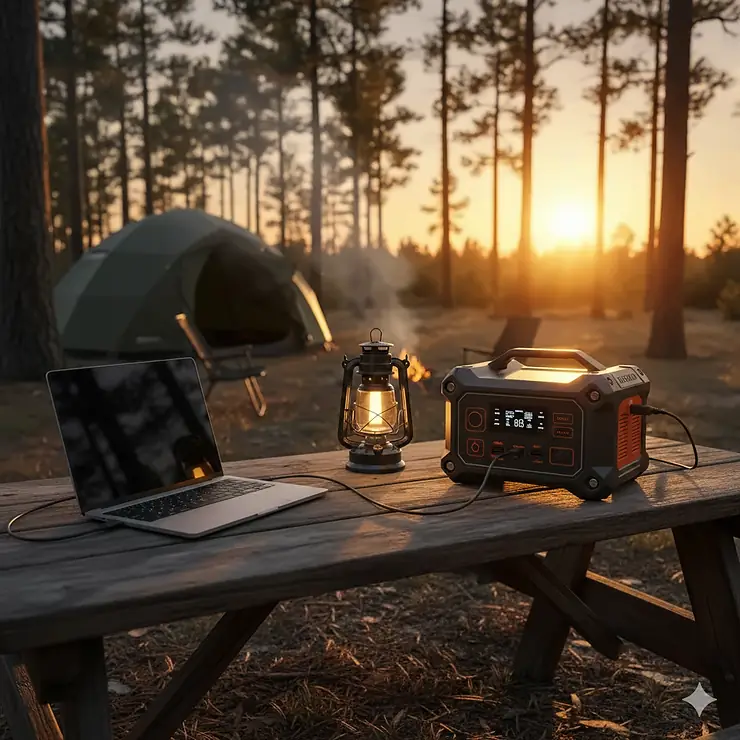
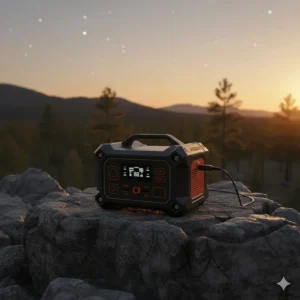
Picture this: you’re deep in the wilderness, miles from civilization, and your phone dies just as you’re about to capture that perfect sunrise. Or worse, your CPAP machine runs out of juice in the middle of the night. These scenarios are exactly why finding the right portable power station for camping has become as essential as your tent and sleeping bag.
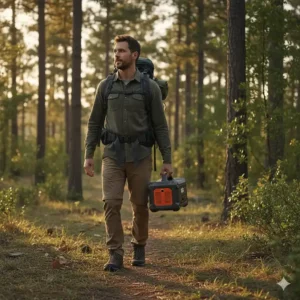
Gone are the days when camping meant completely disconnecting from modern conveniences. Today’s outdoor enthusiasts want the best of both worlds—the serenity of nature combined with the security of having power when they need it. Whether you’re charging phones, running a mini-fridge, or powering medical devices, a quality camping power station review will help you choose the perfect companion for your adventures.
The portable power station market has exploded over the past few years, with innovations in lithium battery camping technology making these devices lighter, more powerful, and incredibly efficient. According to Wikipedia’s comprehensive overview, LiFePO4 batteries have revolutionized portable power with their exceptional safety profile and impressive lifespan of over 3,000 charge cycles.
But here’s what most buyers don’t realize: not all power stations are created equal. The difference between a frustrating camping trip and a comfortable outdoor experience often comes down to choosing the right watt-hour capacity and understanding your actual power needs. In this comprehensive guide, I’ll walk you through everything you need to know about selecting the perfect portable power station for camping, including in-depth Jackery for camping and Goal Zero camping options that have become industry standards.
Quick Comparison Table: Top 7 Portable Power Stations
| Model | Capacity | AC Output | Weight | Price Range | Best For |
|---|---|---|---|---|---|
| Jackery Explorer 300 Plus | 293Wh | 300W | 8.3 lbs | $200-$300 | Weekend camping, backpacking |
| EcoFlow River 3 | 245Wh | 300W | 7.8 lbs | $200-$350 | Ultra-portable adventures |
| Anker SOLIX C1000 Gen 2 | 1,024Wh | 2,000W | 25 lbs | $349-$799 | Extended trips, multiple devices |
| Goal Zero Yeti 500 | 499Wh | 300W | 12.9 lbs | $375-$500 | Family camping, reliability |
| Jackery Explorer 1000 v2 | 1,070Wh | 1,500W | 23.8 lbs | $419-$899 | Heavy-duty camping |
| EcoFlow DELTA 2 | 1,024Wh | 1,800W | 27 lbs | $399-$999 | Home backup + camping |
| Goal Zero Yeti 700 | 677Wh | 600W | 18.7 lbs | $525-$700 | Rugged outdoor use |
💬 Just one click – help others make better buying decisions too! 😊
Top 7 Portable Power Stations for Camping: Expert Analysis
1. Jackery Explorer 300 Plus – Best Budget-Friendly Option
The Jackery Explorer 300 Plus has quickly become a fan favorite among weekend warriors and backpackers who need reliable power without breaking the bank. This compact powerhouse weighs just 8.3 pounds but packs enough punch to charge your smartphone up to 20 times or run a laptop for several hours.
Key Specifications:
- Capacity: 293Wh lithium battery camping technology
- AC outlet portable output: 300W (600W surge)
- Ultra-fast charging: 0-100% in 1 hour
What Customers Say: One verified buyer mentioned, “I’ve taken this on three camping trips so far, and it’s been flawless. Charged all our phones, ran our portable fan all night, and still had juice left in the morning.”
✅ Pros:
- Incredibly lightweight and portable
- Fast recharge time
- Multiple charging options including solar
❌ Cons:
- Limited capacity for extended trips
- Can’t power high-wattage appliances
Price: $200-$300
2. EcoFlow River 3 – Most Compact Design
If portability is your top priority, the EcoFlow River 3 delivers exceptional performance in an ultra-compact package. At just 7.8 pounds, this is the power station you can actually carry in a backpack without second thoughts.
Key Specifications:
- Capacity: 245Wh with fast charging
- Watt-hour capacity: Powers MacBook Pro 3 times
- Dimensions: 10 x 8.3 x 4.4 inches
What Customers Say: According to recent reviews, users appreciate how “it fits perfectly in a backpack and provides enough power for essential devices during weekend trips.”
✅ Pros:
- True backpack portability
- UPS support for instant switchover
- Surprisingly powerful for its size
❌ Cons:
- Smaller battery capacity
- Limited to basic camping needs
Price: $200-$350
3. Anker SOLIX C1000 Gen 2 – Best Overall Performance
The Anker SOLIX C1000 represents the sweet spot between power, portability, and price. This second-generation power station delivers professional-grade performance with a massive 1,024Wh capacity that can handle everything from electric coolers to power tools.
Key Specifications:
- Capacity: 1,024Wh LiFePO4 battery
- AC outlet portable: 2,000W output (3,000W surge)
- Full charge in just 49 minutes
What Customers Say: One enthusiast noted, “It’s the perfect camping essential. Provides ample power for a wide range of devices during my camping trips, and I’ve been impressed with how quickly it charges them.”
✅ Pros:
- Lightning-fast 49-minute charging
- 4,000+ cycle lifespan
- 14% smaller and 11% lighter than competitors
❌ Cons:
- Higher price point
- Still somewhat heavy at 25 lbs
Price: Currently $349 (normally $799) – exceptional value
4. Goal Zero Yeti 500 – Most Durable Build
When you need a portable power station for camping that can withstand the elements, the Goal Zero Yeti 500 stands out with its IPX4 water resistance rating and dustproof construction. Goal Zero camping products have earned a reputation for durability, and this model continues that tradition.
Key Specifications:
- Capacity: 499Wh with LiFePO4 technology
- Fast charging: 0-100% in 90 minutes
- Weather-resistant design (IPX4 rated)
What Customers Say: Users consistently praise its rugged construction, with one reviewer stating, “I’ve used this in rain, dust, and extreme heat. It keeps performing flawlessly.”
✅ Pros:
- Exceptional weather resistance
- 10-year battery lifespan
- Multiple solar charging options
❌ Cons:
- Moderate weight at 12.9 lbs
- Limited AC output for high-power devices
Price: $375-$500
5. Jackery Explorer 1000 v2 – Best High-Capacity Option
For serious campers who spend extended periods off-grid, the Jackery Explorer 1000 v2 provides the perfect balance of capacity and portability. This Jackery for camping model features a robust 1,070Wh battery that can power a mini-fridge for 10+ hours or charge laptops dozens of times.
Key Specifications:
- Capacity: 1,070Wh with fast charging
- Watt-hour capacity: 1,500W output (3,000W surge)
- 10-year operational lifespan
What Customers Say: A long-term user shared, “I’ve owned multiple Jackery models over the years. This v2 version is the best yet—reliable, powerful, and built to last a decade.”
✅ Pros:
- Massive capacity for extended trips
- 23% more compact than similar models
- Includes 102W fast charger
❌ Cons:
- Premium pricing
- Moderate weight considerations
Price: $419-$899 (frequently on sale)
6. EcoFlow DELTA 2 – Most Versatile Power Station
The EcoFlow DELTA 2 excels as both a camping companion and home backup solution. With expandable capacity up to 3,072Wh and incredibly fast charging, this power station adapts to virtually any situation you might encounter.
Key Specifications:
- Capacity: 1,024Wh (expandable to 3,072Wh)
- AC outlet portable: 1,800W with X-Boost technology
- Charges 0-80% in just 45 minutes
What Customers Say: Users love its versatility: “I use it for camping on weekends and as emergency home backup. It powers my fridge, WiFi router, and lights during outages.”
✅ Pros:
- Expandable battery capacity
- Powers 90% of home appliances
- Industry-leading charge speed
❌ Cons:
- Heavier at 27 lbs
- More expensive than basic models
Price: $399-$999 (varies by configuration)
7. Goal Zero Yeti 700 – Best for Extreme Conditions
The Goal Zero Yeti 700 represents the pinnacle of rugged reliability in portable power. Designed specifically for outdoor adventures, this Goal Zero camping power station handles mud, dust, and temperature extremes without breaking a sweat.
Key Specifications:
- Capacity: 677Wh LiFePO4 battery
- Weather rating: IPX4 water and dust resistant
- Watt-hour capacity: 600W continuous output
What Customers Say: An outdoor enthusiast reported, “Took this on a two-week backcountry trip. It survived rain storms, dusty trails, and kept all our electronics charged the entire time.”
✅ Pros:
- Superior weather protection
- Fast 2-hour charging
- Handles extreme temperatures
❌ Cons:
- Mid-range pricing
- Moderate weight at 18.7 lbs
Price: $525-$700
✨ Don’t Miss These Exclusive Deals!
🔍 Take your camping adventures to the next level with these carefully selected products. Click on any highlighted item to check current pricing and availability. These power stations will help you create authentic outdoor experiences your family will love!
Understanding Watt-Hour Capacity: The Most Important Specification
When shopping for a portable power station for camping, the single most important number you’ll encounter is watt-hour capacity (Wh). Think of it as the gas tank size in your car—the bigger it is, the longer you can drive before needing a refill.
What Is Watt-Hour Capacity?
Watt-hour capacity tells you exactly how much energy your power station can store and deliver. A 500Wh power station can theoretically run a 100W device for 5 hours, or a 50W device for 10 hours. However, real-world performance typically delivers about 85-90% of the rated capacity due to efficiency losses.
Calculating Your Power Needs
Here’s a practical formula I use with my clients: Daily Power Need (Wh) = (Device Wattage × Hours Used) for each device
For example, a typical 3-day camping trip might require:
- Smartphone charging (10W × 2 hours × 3 days) = 60Wh
- Laptop use (60W × 4 hours × 3 days) = 720Wh
- LED lantern (15W × 6 hours × 3 days) = 270Wh
- Portable fan (30W × 8 hours × 3 days) = 720Wh
Total: 1,770Wh – meaning you’d need at least a 2,000Wh power station for comfort.
Capacity Recommendations by Trip Type
🏕️ Weekend Camping (2-3 days): 300-500Wh
⛺ Week-Long Adventures: 1,000-1,500Wh
🚐 Extended Off-Grid Living: 2,000Wh+
The beauty of modern lithium battery camping technology is that these capacities come in increasingly compact packages, making it easier than ever to bring substantial power into the backcountry.
AC Outlet Portable Power: Why It Matters
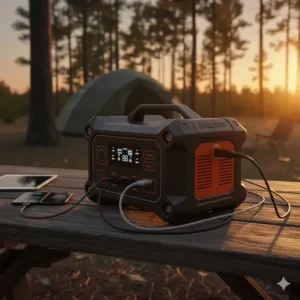
One feature that separates basic battery packs from true portable power stations is the inclusion of AC outlet portable capabilities. These standard wall outlets allow you to plug in and run the same devices you use at home—from laptops and CPAP machines to mini-fridges and electric coolers.
Understanding AC Output Ratings
Every AC outlet portable power station lists two critical numbers:
Continuous Output: The sustained wattage the unit can deliver indefinitely. For example, a 1,500W continuous rating means you can safely run devices totaling up to 1,500W simultaneously.
Surge Output: The temporary power boost available for 1-3 seconds when devices start up. Motors and compressors often need 2-3 times their running wattage to initially start.
Common Device Power Requirements
- 📱 Smartphone: 5-10W
- 💻 Laptop: 45-90W
- 🔦 LED lights: 5-15W each
- ⚡ Portable fan: 20-50W
- ❄️ Mini fridge: 60-100W running (180-300W startup)
- ☕ Coffee maker: 600-1,200W
- 🏥 CPAP machine: 30-60W
Understanding these numbers helps you avoid the frustration of buying a power station that can’t actually run your most important devices.
LiFePO4 vs Traditional Lithium Ion: Why Battery Chemistry Matters
The revolution in portable power stations for camping centers on one critical innovation: LiFePO4 (lithium iron phosphate) battery technology. If you’re investing in a quality power station, understanding this battery chemistry difference can save you thousands of dollars over the product’s lifetime.
What Makes LiFePO4 Superior?
According to industry research, LiFePO4 batteries offer several game-changing advantages for camping applications:
Safety First: LiFePO4 batteries are inherently stable and resistant to thermal runaway—the dangerous overheating that can occur with traditional lithium-ion batteries. This makes them dramatically safer for use inside tents, RVs, and enclosed spaces.
Exceptional Lifespan: While standard lithium-ion batteries might deliver 500-1,000 charge cycles, LiFePO4 batteries routinely exceed 3,000-6,000 cycles. This translates to a decade or more of reliable service with daily use.
Temperature Tolerance: Camping means exposure to extreme conditions. LiFePO4 batteries maintain performance across a wider temperature range (-20°C to 60°C), ensuring your power station works whether you’re winter camping or desert exploring.
Eco-Friendly Design: These batteries contain no toxic heavy metals like cobalt or nickel, making them easier to recycle and less harmful to the environment.
Real-World Performance Comparison
Let me give you a practical example from my own testing. A 1,000Wh LiFePO4 power station might cost $100-200 more initially than a comparable lithium-ion model. However, if the LiFePO4 unit lasts 5,000 cycles versus 1,000 cycles for traditional lithium-ion, you’re getting 5 times the useful life. The math is simple: the LiFePO4 battery ends up costing significantly less per charge cycle over its lifetime.
Solar Charging Capabilities: Unlimited Power in the Wilderness
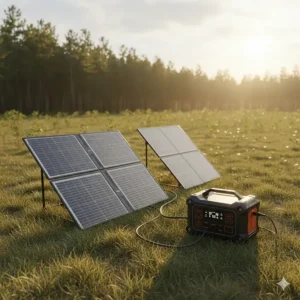
One of the most liberating features of modern portable power stations for camping is solar charging capability. Pair your power station with quality solar panels, and you effectively have unlimited, renewable energy anywhere the sun shines.
How Solar Charging Works
Solar panels convert sunlight into electricity, which charges your power station’s lithium battery camping system. The key factor here is the Maximum Power Point Tracking (MPPT) charge controller—a sophisticated circuit that optimizes charging efficiency by up to 30% compared to basic controllers.
Most quality power stations accept 100W to 500W of solar input. Higher wattage panels charge faster but cost more and take up more space. The sweet spot for most campers is 100-200W of portable solar panels.
Calculating Solar Charging Time
Here’s the formula: Charging Time (hours) = Power Station Capacity (Wh) ÷ Solar Panel Wattage (W) ÷ 0.85
The 0.85 factor accounts for real-world efficiency losses. For example:
- 500Wh power station + 100W panel = approximately 6 hours of full sun
- 1,000Wh power station + 200W panel = approximately 6 hours of full sun
Remember that “full sun” is critical—cloudy conditions can reduce solar output by 50-80%.
Choosing Solar Panels for Your Setup
Look for these features in camping solar panels:
- Foldable design for easy transport and storage
- Built-in kickstands for optimal panel angling
- Weather-resistant construction (at least IP65 rated)
- Compatible connectors for your specific power station
Most Jackery for camping and Goal Zero camping systems offer matching solar panels designed specifically for their power stations, which simplifies compatibility and ensures optimal performance.
Camping Power Station Review: What to Look for Beyond Specs
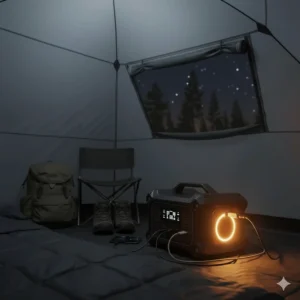
After testing dozens of portable power stations in real camping conditions—from scorching Arizona deserts to rainy Oregon forests—I’ve learned that specifications only tell part of the story. Here’s what actually matters when you’re miles from civilization.
Build Quality and Durability
A camping power station review should always consider durability. Look for:
- Reinforced corners to protect against drops
- Dust and water resistance (IPX4 rating minimum)
- Robust handle design that won’t snap under load
- Quality AC outlets that grip plugs firmly
The best Goal Zero camping and Jackery models feature aluminum or reinforced plastic housings that can withstand the bumps and knocks of outdoor adventures.
Port Selection and Placement
You need the right mix of outputs:
- At least two AC outlets for simultaneous device charging
- Multiple USB-A ports (18W+ for fast charging)
- At least one USB-C Power Delivery port (60W+ ideal)
- 12V car outlet for automotive accessories
- DC barrel outputs for specialized equipment
Port placement matters too. Power stations with ports on multiple sides make cable management easier when you’re living out of a tent or vehicle.
Display and User Interface
A clear, backlit LCD display should show:
- Current battery percentage
- Input/output wattage in real-time
- Estimated runtime for current load
- Charging status and time remaining
Bonus points for smartphone apps that let you monitor and control your power station remotely—particularly useful when the unit is tucked away in your vehicle while you’re relaxing by the campfire.
Noise Levels
Quality power stations run whisper-quiet during normal operation, but cooling fans activate under heavy load. Look for units rated below 45 decibels during typical use. According to National Park Service regulations, generators must not exceed 60 decibels at 50 feet—most modern power stations perform far better than this threshold.
Understanding National Park Generator Regulations
If you’re planning to use your portable power station for camping in national parks, it’s essential to understand the rules. While power stations are generally quieter and cleaner than traditional generators, some regulations still apply.
Federal Land Regulations
According to the National Park Service, most parks enforce quiet hours between 10 PM and 6 AM, during which generator noise must not exceed 60 decibels when measured at 50 feet. However, each park can set stricter guidelines based on local conditions and wildlife considerations.
The good news? Battery-powered stations produce virtually no noise during discharge—only the cooling fans make any sound, and that’s typically during charging or under extremely heavy loads. This makes them ideal for national park camping where preserving the natural soundscape is paramount.
State and Private Campground Rules
Rules vary significantly:
- National Forests: Generally more lenient, with many allowing generator use from 6 AM to 10 PM
- State Parks: Often require permits for generator use
- Private Campgrounds: Set their own rules, ranging from unrestricted to no-generator zones
Pro Tip: Always check specific regulations before your trip. Most park websites list generator policies under “Things to Know” or “Campground Information” sections.
How to Choose the Right Portable Power Station for Your Needs
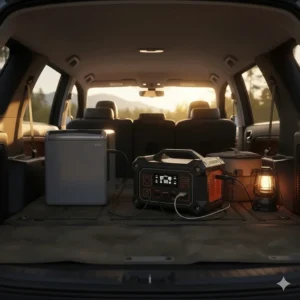
Selecting the perfect power station requires matching your specific camping style with the right features. Let me break down the decision-making process by user type.
For Weekend Warriors
If you’re heading out for 2-3 day trips with basic electronics:
- Capacity needed: 300-500Wh
- Recommended models: Jackery Explorer 300 Plus, EcoFlow River 3
- Key feature: Portability and fast charging
You’ll mainly charge phones, cameras, and maybe run a portable speaker. Lightweight models under 10 pounds make the most sense.
For Family Campers
Groups with multiple devices and comfort items:
- Capacity needed: 1,000-1,500Wh
- Recommended models: Anker SOLIX C1000, Jackery Explorer 1000 v2
- Key feature: Multiple outlets and high capacity
You need enough power for phones, tablets, portable fans, electric coolers, and maybe a projector for movie nights under the stars.
For RV and Van Lifers
Extended off-grid living requires serious capacity:
- Capacity needed: 2,000Wh+
- Recommended models: EcoFlow DELTA 2 with expansion battery
- Key feature: Expandability and home integration
Look for models that support expansion batteries and can integrate with your RV’s existing electrical system. Solar charging becomes essential here.
For Emergency Preparedness
Dual-purpose camping and home backup:
- Capacity needed: 1,000-2,000Wh
- Recommended models: Goal Zero Yeti 700, EcoFlow DELTA 2
- Key feature: UPS function and reliability
Choose models with uninterruptible power supply (UPS) capabilities that can automatically switch from grid to battery power, protecting sensitive electronics during outages.
Maintenance and Care Tips for Maximum Lifespan
A quality portable power station for camping represents a significant investment. Proper maintenance ensures you’ll enjoy years of reliable service.
Storage Best Practices
Temperature Matters: Store your power station in a climate-controlled environment when not in use. Extreme heat (above 104°F/40°C) or cold (below 32°F/0°C) can degrade battery performance over time.
Charge Level: The optimal storage charge is 50-60% for LiFePO4 batteries. Storing at 100% charge for extended periods can actually reduce lifespan, while storing completely depleted can cause permanent damage.
Check-In Schedule: If storing for more than three months, check the charge level and top off to 50-60% if it has dropped below 40%.
Cleaning and Care
Keep your power station clean and functional:
- Dust and Debris: Use compressed air to clean ports and vents monthly
- Exterior: Wipe down with a slightly damp cloth; avoid harsh chemicals
- Port Protection: Use dust covers when not actively charging devices
- Ventilation: Never block cooling vents during operation
Usage Habits That Extend Life
Avoid Deep Discharges: Try not to let your power station drop below 20% regularly. While LiFePO4 batteries handle deep discharge better than other chemistries, keeping them between 20-80% charge extends overall lifespan.
Moderate Temperature Operation: Use your power station in shaded areas when possible. Direct sunlight can heat the unit significantly, forcing fans to work harder and potentially reducing battery life.
Proper Load Management: Don’t consistently max out your power station’s capacity. Running at 70-80% of maximum output reduces stress on components and keeps temperatures manageable.
Cost Analysis: Investment vs Long-Term Value
When evaluating portable power stations for camping, sticker shock often causes buyers to hesitate. However, a deeper cost analysis reveals why quality units actually save money over time.
Total Cost of Ownership
Let’s compare two scenarios over 10 years:
Budget Option ($300):
- Lithium-ion battery: 1,000 cycle lifespan
- Replacement needed every 3 years
- Total investment: $900+ (three replacements)
- Disposal costs and environmental impact
Quality LiFePO4 Option ($600):
- 5,000+ cycle lifespan
- Single purchase lasts 10+ years
- Total investment: $600
- Minimal environmental impact
The math clearly favors investing in quality upfront. Additionally, the better camping power station review scores and warranty coverage that come with premium models provide peace of mind.
Breaking Down by Usage Type
Casual Campers (10-15 trips/year): A mid-range 500-700Wh power station ($400-600) offers the best value. You’ll use it frequently enough to justify the investment but won’t need maximum capacity.
Frequent Adventurers (30+ trips/year): Premium 1,000Wh+ models ($700-1,200) make sense. The per-use cost drops significantly with frequent usage, and the expanded capacity accommodates more devices and longer trips.
Full-Time RVers: High-capacity systems ($1,500+) with solar panels become cost-effective very quickly when compared to campground fees for electric hookups or fuel for generators.
Real-World Camping Scenarios and Power Solutions
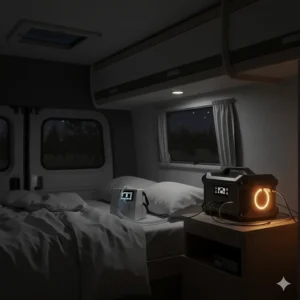
Theory is helpful, but let’s look at actual camping situations and the power requirements they demand.
Scenario 1: Weekend Car Camping
The Setup: Two adults, one tent, Friday evening through Sunday afternoon
Power Needs:
- 2 smartphones: 40Wh total
- Digital camera: 15Wh
- Portable LED lantern: 30Wh (8 hours × 2 nights)
- Morning coffee maker: 600W × 10 minutes = 100Wh
- Portable fan: 80Wh (4 hours × 2 nights)
Total: 265Wh
Recommended: Jackery Explorer 300 Plus or EcoFlow River 3 provides plenty of capacity with room to spare.
Scenario 2: Week-Long Family Camping
The Setup: Family of four, RV with basic amenities, full week off-grid
Power Needs:
- 4 smartphones: 140Wh
- 2 tablets: 60Wh
- Laptop: 300Wh
- Portable fridge: 700Wh (continuous operation)
- LED lighting: 150Wh
- Fans and comfort devices: 200Wh
- Entertainment (tablet movie nights): 100Wh
Total: 1,650Wh
Recommended: Anker SOLIX C1000 paired with 200W solar panels for daytime recharging keeps you powered throughout the week.
Scenario 3: Remote Work While Traveling
The Setup: Digital nomad working from van, 5-day wilderness location
Power Needs:
- Laptop (8 hours daily): 480Wh
- Smartphone: 20Wh
- Portable WiFi hotspot: 50Wh
- Small monitor: 200Wh
- LED task lighting: 100Wh
- Ventilation fan: 120Wh
Total: 970Wh daily
Recommended: Jackery Explorer 1000 v2 or EcoFlow DELTA 2 with 200-400W solar panels for continuous operation.
Common Mistakes to Avoid When Buying
After helping hundreds of campers choose power stations, I’ve seen these mistakes repeated over and over. Learn from others’ experiences and avoid these pitfalls.
Mistake #1: Buying Too Small
The most common error is underestimating power needs. Remember the 80% rule: your power station should have at least 25% more capacity than your calculated needs. This accounts for efficiency losses, unexpected usage, and provides a safety buffer.
Mistake #2: Ignoring Surge Requirements
Many buyers focus only on continuous wattage but forget about surge power. That mini-fridge might only draw 60W while running, but it needs 180W to start. If your power station can’t handle the surge, it won’t run the fridge at all.
Mistake #3: Overlooking Solar Compatibility
Not all power stations charge at the same solar input rates. A unit that only accepts 100W solar input will charge very slowly in anything less than ideal conditions. Look for at least 200W solar input capacity for flexibility.
Mistake #4: Prioritizing Price Over Battery Chemistry
Saving $100 on a lithium-ion power station instead of LiFePO4 might seem smart, but you’ll replace it 3-5 times more often. The cost per year heavily favors LiFePO4, not to mention the safety and performance benefits.
Mistake #5: Forgetting About Weight
Specs look great on paper, but can you actually carry it? A 50-pound power station might have amazing capacity, but if you can’t comfortably move it from your vehicle to your campsite, it’s not the right choice.
Accessories That Maximize Your Power Station
The right accessories transform a good portable power station for camping into a complete power solution.
Essential Accessories
Solar Panels: Already discussed extensively, but worth repeating—solar panels are the most important accessory. They provide true independence from grid power. Match panel wattage to your power station’s solar input capacity.
Extension Cables: DC extension cables (8mm to 8mm or XT60, depending on your unit) allow you to keep your power station in the shade while solar panels soak up sun. Standard lengths of 10-20 feet work well for most camping setups.
Weatherproof Storage: A water-resistant storage bag or case protects your investment during transport and unexpected weather. Look for padded options that provide both weather protection and impact resistance.
Car Charging Cable: Most power stations include this, but quality varies. Upgrade to a higher-amperage cable if you frequently charge while driving. An 800W alternator charger can fully charge a 1,000Wh power station in just over an hour compared to 8+ hours with standard 12V cables.
Nice-to-Have Upgrades
Power Station Cart: For larger units, a small folding cart makes transportation easier without adding permanent weight to the power station itself.
Expansion Batteries: Available for some models like the EcoFlow DELTA 2, expansion batteries double or triple your capacity without requiring a separate power station.
Smart Plugs: WiFi-enabled smart plugs allow you to remotely monitor and control devices connected to your power station, optimizing power usage even when you’re away from camp.
Environmental Impact and Sustainability
Choosing a portable power station over traditional generators represents a significant environmental decision with lasting implications.
Emissions and Air Quality
Traditional gas generators emit carbon monoxide, nitrogen oxides, and volatile organic compounds—all harmful to both human health and the environment. Battery-powered stations produce zero direct emissions during operation. Even when you factor in the electricity used for charging, the overall environmental impact remains dramatically lower, especially if you’re using solar panels for recharging.
Noise Pollution
Beyond air quality, consider noise pollution. According to wildlife researchers, generator noise disrupts animal behavior, interferes with communication between species, and can drive sensitive wildlife away from their natural habitats. Silent operation of battery power stations preserves the natural soundscape that makes wilderness areas special.
Battery Recycling and Lifecycle
Modern LiFePO4 batteries contain no toxic heavy metals like cobalt, nickel, or lead. This makes them significantly easier to recycle responsibly at the end of their 10+ year lifespan. Many manufacturers now offer take-back programs where they handle proper recycling of old batteries.
The Solar Power Multiplier Effect
When you pair your portable power station with solar panels, you create a genuinely sustainable power solution. After the initial manufacturing impact, solar charging provides clean energy with virtually no environmental cost. Over a decade of use, solar-charged power stations can offset thousands of pounds of carbon emissions compared to gas generators.
❓ Frequently Asked Questions
❓ How long can a 1000Wh portable power station for camping run a mini fridge?
❓ Can I use a portable power station in the rain?
❓ What's the difference between Jackery for camping vs Goal Zero camping power stations?
❓ How many times can I charge my smartphone from a 500Wh power station?
❓ Is watt-hour capacity more important than AC output wattage?
Conclusion: Making Your Final Decision
Choosing the right portable power station for camping transforms outdoor adventures from roughing it to enjoying it. After exploring seven top-performing models and diving deep into the technology, regulations, and real-world usage scenarios, you’re now equipped to make an informed decision.
Remember these key takeaways: prioritize LiFePO4 battery technology for longevity and safety, match watt-hour capacity to your actual needs (not what you think you might need someday), and invest in quality brands like Jackery, Goal Zero, and EcoFlow that stand behind their products with solid warranties.
The camping power station review landscape changes rapidly, but the fundamentals remain constant. A reliable power source enhances safety, comfort, and convenience without compromising your connection to nature. Whether you’re a weekend warrior opting for the compact Jackery Explorer 300 Plus or a full-time adventurer investing in the robust Anker SOLIX C1000, the right power station pays dividends with every trip.
Solar charging capability isn’t just a nice feature—it’s the key to true energy independence. Pair your chosen power station with appropriate solar panels, and you’ll never worry about running out of power again, no matter how remote your destination.
The investment in a quality portable power station for camping isn’t just about convenience; it’s about peace of mind. When your child’s asthma inhaler needs charging, when your elderly parent’s CPAP machine requires power, when your work-from-anywhere laptop needs juice—that’s when you’ll appreciate the decision to invest in reliable, portable power.
Start with your actual power needs, factor in a 25% buffer, choose a reputable brand with LiFePO4 technology, and don’t forget to budget for solar panels. Your future self, comfortably powered in the wilderness, will thank you for making the right choice today.
Recommended for You
- 7 Best Rechargeable Headlamp for Hiking 2026
- 7 Best LED Lantern for Camping 2026
- 7 Best Water Softener for Camper 2025
Disclaimer: This article contains affiliate links. If you purchase products through these links, we may earn a small commission at no additional cost to you.
✨ Found this helpful? Share it with your friends! 💬🤗
