
In This Article
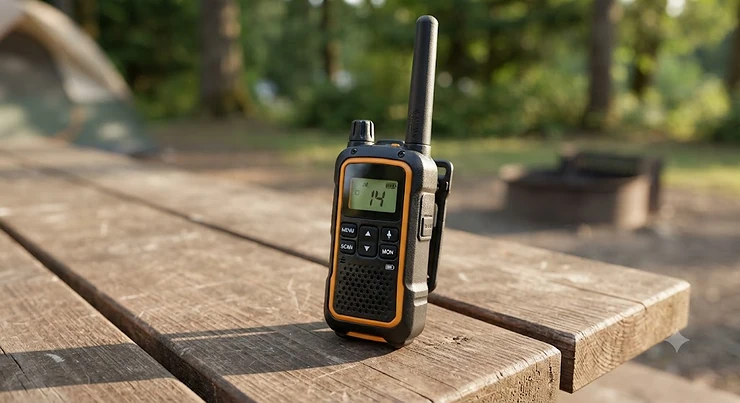
Somewhere around mile three of a group hike, your buddy peels off toward a waterfall “just for a minute,” your phone drops to zero bars, and suddenly you’re standing in a parking-lot-sized clearing wondering if you’ll ever see him again. This is the exact moment a two-way radio for camping stops being a gadget-store impulse buy and becomes the one piece of gear you’re genuinely glad you packed. Cell towers don’t care about your itinerary, and satellite messengers cost a monthly fee just to say “we’re at the lake.” A good two-way radio for camping just works, instantly, for as long as the battery holds out.

This guide skips the marketing fluff and gets into what actually matters: real range in real trees, real battery behavior, and which of the seven radios below deserves a spot in your pack. We researched actual GMRS and FRS models sold today, cross-referenced spec sheets against aggregated owner feedback, and built out honest breakdowns of who each radio is really for — the weekend car camper, the backcountry family, or the guy who insists on a $35 GMRS license so he can hit a repeater from the ridge. Whether you’re outfitting a family caravan or just want a backup line to your tentmate, there’s a two-way radio for camping on this list that fits your trip.
Quick Comparison Table
Before we go deep on all seven, here’s the 30-second version. Prices shown are ranges, since actual listings shift week to week.
| Radio | Type | Battery | Price Range | Best For |
|---|---|---|---|---|
| Midland T51VP4 | FRS | AAA (2-pack) | Under $60 | First-time buyers |
| DEWALT DXFRS800 | FRS | Rechargeable | $80-$100 range | Rugged jobsite-to-campsite crossover |
| Midland GXT1000VP4 | GMRS | AA or rechargeable pack | $80-$100 range | Feature-packed family camping |
| Motorola Talkabout T800 | FRS + Bluetooth | Rechargeable | $100-$130 range | Tech-forward groups |
| BTECH GMRS-V2 | GMRS | USB-C rechargeable | $60-$90 range | Serious range and repeater access |
| Rocky Talkie Mountain Radio | FRS | USB-C rechargeable | Premium tier, $200+ per kit | Backcountry and alpine trips |
| Motorola MS350R | GMRS | AA | $70-$100 range | Waterfront and lakeside camping |
A quick read of this table already tells a story: the cheapest option and the toughest option are rarely the same radio, and “GMRS” doesn’t automatically mean “better” — it means more power, which only helps if you’re willing to get licensed and actually need the extra reach. Notice, too, that rechargeable options now dominate the mid-to-premium tier, while the true budget picks still lean on disposable AAAs. That trade-off — upfront cost versus long-term convenience — comes up again and again as we go product by product.
Just one click — help others make better buying decisions too! 😊
Top 7 Two-Way Radios for Camping: Expert Analysis
We dug into specs, verified real customer sentiment where available, and sorted these seven into budget, mid-range, and premium tiers so there’s an honest option no matter your trip style.
1. Midland T51VP4 — most beginner-friendly budget pick
Right out of the box, the Midland T51VP4 is built for people who’ve never touched a walkie-talkie and don’t want to read a manual to find out how. It’s part of Midland’s X-Talker line, which typically bundles in a NOAA weather scan feature alongside the standard 22 FRS/GMRS channels — a nice bit of insurance for a $60 radio. The claimed 28-mile range is the classic best-case marketing number; in reality, expect closer to half a mile to a mile through wooded campgrounds, which is still plenty for keeping tabs on kids at the next site over.
Based on the spec comparison against similar entry-level FRS units, the Midland T51VP4 earns its “Overall Pick” badge at major retailers less through raw power and more through sheer usability — big buttons, a simple channel dial, and a battery-strength indicator that doesn’t require a manual to decode. Reviewers consistently report solid performance for close-range family use, with the expected complaints about range dropping off around hills and dense brush. If you just need a walkie talkie camping setup for two adults keeping an eye on separate campsites, this clears the bar without asking much of your wallet.
Pros:
- ✅ Genuinely simple setup even for total beginners
- ✅ NOAA weather scan built into a budget-tier radio
- ✅ Strong review volume backing real-world reliability
Cons:
- ❌ Claimed 28-mile range is wildly optimistic in the woods
- ❌ Runs on AAA batteries unless you buy a rechargeable pack separately
At under $60 for a pair, the Midland T51VP4 is hard to beat as a low-stakes entry point — just don’t expect GMRS-level distance from it.
2. DEWALT DXFRS800 — toughest build for jobsite-to-campsite crossover
If you’ve ever dropped a radio off a tailgate and watched it die on impact, the DEWALT DXFRS800 exists specifically to prevent that. Carrying an IP67 rating, this FRS radio is rated for full submersion, not just splash resistance — a meaningfully higher bar than the IPX4 “splash-proof” rating that shows up on most consumer walkie-talkies. What most buyers overlook about this model is that it was engineered for contractors first, campers second, which is exactly why the housing shrugs off drops onto gravel or rock that would crack a plastic-shelled FRS unit.
The rechargeable battery pack that ships standard is another point in its favor: no fumbling with AAAs at 6 a.m. when you’re breaking camp. Because it’s FRS-only rather than GMRS, its transmit power tops out lower than several radios on this list, so don’t expect it to out-range the GMRS options here — its real selling point is durability, not distance. Reviewers of DEWALT’s radio lineup generally describe the build as noticeably heavier and bulkier than typical FRS units, a fair trade for people who value ruggedness over pocketability.
Pros:
- ✅ IP67 rating survives full submersion, not just splashes
- ✅ Rechargeable battery pack included standard
- ✅ Jobsite-grade housing handles hard drops on rock or gravel
Cons:
- ❌ Bulkier and heavier than typical FRS competitors
- ❌ FRS-only power caps its range below GMRS alternatives
Priced in the $80-$100 range, the DEWALT DXFRS800 makes the most sense for campers who also use it for truck-bed work — two use cases, one rugged radio.
3. Midland GXT1000VP4 — best all-around feature set for families
The Midland GXT1000VP4 is the radio that shows up again and again in camping gear roundups, and the reason is simple math: 50 channels, a NOAA weather scan, vibrate alerts, hands-free VOX operation, and the flexibility to run on either AA batteries or a rechargeable NiMH pack. On paper this means one radio adapts to however you camp — swap in AAs for a week-long trip with no outlet in sight, or charge the pack for weekend car camping.
Here’s what the spec sheet won’t tell you, but aggregated reviews consistently note: the claimed 36-mile range is a laboratory number that assumes flat, obstruction-free terrain — a scenario that basically never happens at an actual campground. Real-world performance in mixed woods lands closer to one to two miles, which still comfortably covers a sprawling group site or a family split between a lake and the fire pit. With 4.3-plus stars across hundreds of verified ratings at major retailers, the Midland GXT1000VP4 has earned its reputation less on flashy tech and more on consistent, dependable performance trip after trip.
Pros:
- ✅ 50 channels plus NOAA weather scan cover most camping scenarios
- ✅ Runs on AA batteries or a rechargeable pack, your choice
- ✅ Consistently rated 4.3+ stars across hundreds of verified reviews
Cons:
- ❌ 36-mile claim only applies in unrealistic open-field conditions
- ❌ Bulkier housing feels dated next to newer competitors
In the $80-$100 range for a pair, the Midland GXT1000VP4 remains the sensible default for families who want one dependable pair of GMRS radios and don’t need Bluetooth bells and whistles.
4. Motorola Talkabout T800 — smartest app-connected option
The Motorola Talkabout T800 takes a genuinely different approach: it pairs to a smartphone app over Bluetooth, letting group members exchange text messages and GPS location even with zero cell signal, since the data actually rides over the radio waves rather than a cellular network. What most buyers overlook about this model is that the app functionality works independently of carrier coverage — it’s the radio doing the heavy lifting, not your phone plan, which makes it a legitimately different tool than a basic walkie talkie camping setup.
Based on comparisons against Motorola’s own rugged T-series lineup, the Motorola Talkabout T800 shares that family’s reputation for water-resistant, drop-tolerant housings, and its rated range sits in the same optimistic 35-mile ballpark as its GMRS-class competitors here. Reviewers researching the T-series consistently flag Motorola’s smart features — Bluetooth pairing, app messaging — as the brand’s clearest edge over Midland, whose radios instead lean into raw transmission power. The tradeoff is upfront cost: this is one of the pricier picks on this list, and the app-messaging feature only works once both units are paired to compatible phones ahead of time, which means a setup step you don’t get with simpler radios.
Pros:
- ✅ Bluetooth app pairing sends texts and GPS location off-grid
- ✅ Rugged, water-resistant shell built for wet trailheads
- ✅ Backed by Motorola’s well-regarded customer support
Cons:
- ❌ Premium price compared to basic FRS models
- ❌ App messaging requires pre-pairing both radios to phones first
At $100-$130 for a pair, the Motorola Talkabout T800 is the right call for tech-comfortable groups who want more than voice — just budget the setup time.
5. BTECH GMRS-V2 — best true GMRS power for serious range
Where most radios on this list max out at 2 watts of FRS power, the BTECH GMRS-V2 transmits at the full 5 watts GMRS allows, and it’s repeater-compatible, meaning licensed users can bounce a signal off a mountaintop repeater and talk across a genuinely useful distance — not just a campsite, but potentially an entire valley. Here’s what the spec sheet won’t tell you: BTECH rebuilt this model’s chipset specifically for GMRS frequencies rather than adapting a generic dual-band design, and reviewers who’ve put it through range testing note noticeably better receiver sensitivity and cleaner audio pulling in weak or distant signals compared to older budget GMRS radios.
Beyond raw power, the BTECH GMRS-V2 packs 200 fully customizable channels programmable via free CHIRP software, true USB-C charging (finally retiring the old micro-USB standard many competitors still cling to), a built-in NOAA weather receiver, and dual PTT for monitoring two channels at once. Aggregated owner feedback describes 8-12 hours of typical battery life per charge, dropping faster under heavy scanning or continuous transmission. The catch, and it’s a real one: hitting that 5-watt output legally requires a $35 GMRS license from the FCC, and the IP54 rating only protects against splashes and dust, not a dunk in the lake.
Pros:
- ✅ True 5-watt GMRS output with repeater compatibility
- ✅ USB-C charging plus free CHIRP programming software
- ✅ 200 customizable channels and a built-in NOAA weather receiver
Cons:
- ❌ Full power legally requires a $35 FCC GMRS license
- ❌ IP54 rating handles splashes only, not full submersion
Typically priced in the $60-$90 range, the BTECH GMRS-V2 is the pick for campers who actually want GMRS radio camping range, not just the GMRS logo on the box.
6. Rocky Talkie Mountain Radio — best ultralight backcountry build
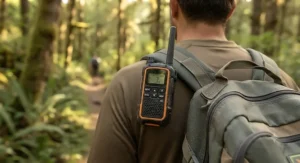
The Rocky Talkie Mountain Radio was designed by climbers who got tired of consumer walkie-talkies dying, cracking, or getting lost mid-scramble, and that origin story shows in every design choice. A climbing-grade Trango carabiner and backup leash keep the unit clipped to a harness or pack strap, while a shatterproof LED screen and rubberized housing shrug off the kind of impacts that would crack a big-box FRS radio. Reviewers testing it against the long-standing favorite, the BCA BC Link 2.0, consistently note it holds its own despite a smaller, sleeker footprint.
What most buyers overlook about this model is its battery: a specialized cold-resistant lithium-ion cell rated for three to five days of continuous use per charge, even in freezing alpine temperatures — a category where standard alkaline batteries lose capacity fast. Reviewers testing real-world distance describe one to five miles as typical in mountainous or forested terrain, with the marketed 35-plus-mile figure reserved for unobstructed line-of-sight conditions most campers will never encounter. It runs on FRS frequencies, so no license is required, and the tradeoff for all this ruggedness is a premium price point — this is not the radio you buy for a casual overnight at a state park campground.
Pros:
- ✅ 3-5 day battery life dwarfs most single-charge competitors
- ✅ Climbing-grade carabiner and leash prevent losing it on a scramble
- ✅ Reviewers consistently praise its glove-friendly, simplified controls
Cons:
- ❌ Premium pricing puts it well above mainstream FRS/GMRS options
- ❌ Weather-resistant, but not rated fully waterproof
Often bundled as a two-radio kit in the $200-plus range, the Rocky Talkie Mountain Radio earns its price tag on backcountry trips where a dead or broken radio isn’t just inconvenient — it’s a safety problem.
7. Motorola MS350R — best floating waterproof design for the waterfront
Camping near a lake, river, or coastline changes your priorities, and the Motorola MS350R was built with exactly that environment in mind. Its housing is fully waterproof and designed to float, so an accidental drop off a canoe or dock doesn’t end the trip — a meaningfully different promise than the “water-resistant” language stamped on most FRS radios. Motorola’s Xtreme Range Technology is marketing language for a genuinely improved antenna and receiver setup, and aggregated feedback suggests it does deliver clearer audio at moderate distances than older, cheaper GMRS models, even if the marketed 35-mile range remains a best-case fantasy.
With 50 channels and a built-in NOAA weather alert function, the Motorola MS350R doubles as a lightweight emergency radio if a storm rolls in while you’re miles from the truck. Reviewers researching this model report real-world usable range closer to one to two miles in mixed terrain, dropping further around hills or heavy tree cover — consistent with what every GMRS radio on this list experiences once physics gets involved. It runs on standard AA batteries rather than a rechargeable pack, which is a minor inconvenience balanced against the reassurance of not needing an outlet on a multi-day paddling trip.
Pros:
- ✅ Fully waterproof housing that floats if dropped
- ✅ 50 channels plus NOAA weather alert for storm awareness
- ✅ Xtreme Range Technology genuinely improves clarity over base models
Cons:
- ❌ Real-world range lands far under the marketed 35-mile figure
- ❌ AA-only power means no built-in rechargeable option
At $70-$100 for a pair, the Motorola MS350R is the obvious choice for anyone whose camping trips involve more water than dry land.
Top 7 at a Glance: Full Spec Comparison
| Radio | Watts / Service | Rated Range | Weatherproofing | Best For |
|---|---|---|---|---|
| Midland T51VP4 | ~0.5W FRS | 28 mi. claimed | Basic | Beginners |
| DEWALT DXFRS800 | 2W FRS | Long range (FRS-capped) | IP67 | Rugged crossover use |
| Midland GXT1000VP4 | 5W GMRS | 36 mi. claimed | Splash-resistant | Feature-rich family use |
| Motorola Talkabout T800 | 5W GMRS/FRS | 35 mi. claimed | Water-resistant | App-connected groups |
| BTECH GMRS-V2 | 5W GMRS | Repeater-extended | IP54 | Serious range seekers |
| Rocky Talkie Mountain Radio | 2W FRS | 1-5 mi. real-world | Weather-resistant | Backcountry/alpine |
| Motorola MS350R | 5W GMRS | 35 mi. claimed | Waterproof, floats | Lakeside/waterfront camping |
Looking at the table above, the wattage story matters more than the marketed mile counts: every GMRS radio here transmits at up to 5 watts, but only the BTECH GMRS-V2 is built to actually exploit that power through repeater access. Meanwhile, waterproofing splits clearly along use-case lines — the DEWALT DXFRS800 and Motorola MS350R are the two genuinely built for wet conditions, while the rest offer varying degrees of splash tolerance that shouldn’t be trusted near open water.
Practical Usage Guide: Setting Up Your Two-Way Radio for Camping
Getting a two-way radio for camping ready before you leave the driveway saves a surprising amount of frustration once you’re at the site. Start by fully charging rechargeable units overnight — lithium-ion batteries perform best when they aren’t started from a partial charge on day one — and pack fresh AAs or AAAs as backups if your radio supports them. Before you leave cell signal behind, sit everyone down and agree on a shared channel and privacy code; nothing kills morale faster than one radio silently sitting on channel 4 while everyone else chats on channel 7.
A common first-30-days mistake is leaving radios on constant transmit-scan mode, which drains batteries far faster than standby monitoring. Instead, use VOX or a simple “check in every 30 minutes” rule to conserve power on multi-day trips. For maintenance, rinse dust and grit off the antenna and speaker grille after dusty trips, and store rechargeable units with roughly half a charge if they’ll sit unused for months — full or empty storage degrades lithium-ion cells faster over time. Finally, test range on your very first trip in daylight, at a distance you can walk back from, so you actually know your radio’s real limits before you need them.
Real-World Scenarios: Matching the Right Radio to Your Trip
If you’re a family of four car camping at a state park with the kids exploring a short loop trail, a budget FRS pair like the Midland T51VP4 covers you fine — you’re rarely more than a quarter-mile apart, and simplicity matters more than range. If you’re organizing a multi-vehicle caravan heading to a dispersed BLM site with intermittent cell service, the Midland GXT1000VP4 or Motorola Talkabout T800 makes more sense; GMRS power and, in the T800’s case, app-based location sharing help coordinate a scattered group across a larger area.
For backcountry backpackers or alpine climbers splitting into a faster and slower group, weight and battery life outrank raw wattage — this is exactly the scenario the Rocky Talkie Mountain Radio was built for, and its multi-day battery life matters far more once you’re three nights from a charging outlet. Paddlers and lakeside campers face a different risk profile entirely: gear ends up in water, not just mud, which is why the fully waterproof Motorola MS350R earns its keep on canoe trips where a “water-resistant” rating just isn’t good enough insurance.
What Is a Two-Way Radio for Camping?
A two-way radio for camping is a handheld transceiver that lets multiple people talk to each other over open radio frequencies, without relying on cell towers or Wi-Fi. Most models use FRS or GMRS channels, offering free or low-cost, license-optional communication across distances ranging from a few hundred feet to several miles depending on terrain.
Unlike a phone call, a two-way radio for camping works the same whether you’re at a fully-serviced campground or twelve miles up a trail with zero bars. That reliability, not raw range, is the actual selling point — it’s the one communication tool that doesn’t care whether a tower is nearby.
GMRS Radio for Camping: License, Power, and Why It’s Worth It
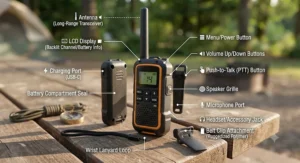
Stepping up to a GMRS radio for camping means trading a bit of paperwork for meaningfully more transmit power — up to 50 watts on some mobile units, though handhelds typically run 5 watts, versus the 2-watt ceiling on FRS. The license itself, per current FCC rules, costs $35, requires no exam, lasts ten years, and covers your entire immediate family under one registration — genuinely one of the more generous licensing setups in radio.
Is it worth the extra step for a weekend camping trip? Based on the spec comparison across this list, the honest answer is: only if you actually need the range. A family staying within shouting distance of the same fire pit gets little practical benefit from GMRS power. But if your group regularly splits across a large property, a sprawling campground, or hilly terrain — or if you want repeater access for genuinely long-distance backup communication — the license pays for itself the first time it saves you a frantic search for a wandering hiker.
Walkie Talkie Camping vs GMRS Family Radio: FRS, GMRS, and Ham Explained
The terms get thrown around loosely, so here’s the honest breakdown. A basic walkie talkie camping setup almost always means FRS — the Family Radio Service, which is license-free, capped at 2 watts on most channels, and designed specifically to let families and groups coordinate without any FCC paperwork. It’s genuinely “plug and play”: charge it, turn it on, talk.
A family radio camping setup that steps up to GMRS shares the same 22 channels as FRS but adds higher power, repeater access, and — critically — a licensing requirement. Ham (amateur) radio sits a tier above both: more frequencies, more range, but a written exam stands between you and a call sign, which is overkill for the vast majority of camping trips. For most groups, the honest recommendation is simple: start with FRS, and only step up to GMRS if you’ve genuinely hit its range ceiling.
Range Miles Radio: What Actually Determines Distance
Every radio on this list advertises a range miles radio figure that assumes flat, obstruction-free terrain with a direct line of sight between units — conditions that describe almost no actual campground. Trees, hills, buildings, and even heavy humidity all eat into real-world range, which is why a “36-mile” radio typically delivers one to two miles through mixed woods, and even less in dense forest or canyon terrain.
Reviewers consistently note that GMRS radios generally outperform FRS radios at comparable price points simply because of higher wattage, and repeater-compatible models like the BTECH GMRS-V2 can extend effective range dramatically by relaying a signal off a fixed tower. The practical takeaway: judge a radio by its lowest realistic range estimate, not its box art, and treat any advertised maximum as a number you’ll only hit standing on a mountaintop with nothing between you and your partner.
Weather Channels NOAA: Why Built-In Alerts Matter
A surprising number of camping emergencies trace back to weather that nobody saw coming until it was already overhead, which is exactly the gap weather channels NOAA features are built to close. Several radios on this list — including the Midland T51VP4, Midland GXT1000VP4, BTECH GMRS-V2, and Motorola MS350R — include a built-in receiver tuned to NOAA Weather Radio, a nationwide network broadcasting continuous forecasts and hazard alerts straight from the National Weather Service.
What most buyers overlook about this feature is that it works independently of the radio’s talk function — you’re simply tuning into a one-way government broadcast, not relying on the campground’s cell signal or Wi-Fi to check a forecast app. For anyone camping somewhere genuinely remote, a radio with weather channels NOAA support functions as a lightweight, no-subscription severe weather warning system, which is a meaningfully bigger deal than it sounds like on a spec sheet.
Rechargeable Battery Radio: Lithium vs Alkaline for the Backcountry
Choosing a rechargeable battery radio versus one that runs on disposable AAs or AAAs comes down to trip length and access to power. USB-C rechargeable units like the BTECH GMRS-V2 and Rocky Talkie Mountain Radio are cheaper to run over time and more convenient if you’re already carrying a power bank or car charger, but they’re dead weight once the battery runs out mid-trip with no way to recharge. Alkaline-powered models like the Motorola MS350R trade that convenience for simplicity: pack extra AAs, and you’re never truly stranded without power, even a week into the backcountry.
Based on the spec comparison across this list, lithium-ion rechargeable batteries also tend to hold up noticeably better in cold weather than alkaline cells, which lose capacity fast below freezing — a real consideration for shoulder-season or high-altitude trips. The middle path, offered by radios like the Midland GXT1000VP4, lets you run a rechargeable pack for convenience and swap in AAs as an emergency backup, arguably the smartest setup for anyone who camps across a range of trip lengths and conditions.
✨ Don’t Miss These Exclusive Deals!
🔍 Take your camping communication setup to the next level with these carefully vetted radios. Click on any highlighted pick to check current pricing and availability before your next trip — reliable contact with your group is worth the few extra minutes it takes to compare options. 🏕️📻
How to Choose a Two-Way Radio for Camping
Picking the right two-way radio for camping comes down to matching a handful of criteria to how you actually camp, not to which box has the biggest number printed on it.
- Trip type first. Car camping needs less range and ruggedness than backcountry or alpine trips — don’t overspend on features you won’t use.
- Realistic range, not marketed range. Assume one to two miles through trees for most GMRS radios, regardless of the advertised maximum.
- FRS vs GMRS. Choose FRS for simple, license-free use; step up to GMRS only if your group genuinely needs the extra power or repeater access.
- Battery type. Rechargeable suits short trips near power sources; AA/AAA suits multi-day trips with no outlet in sight.
- Weatherproofing. Waterfront and paddling trips demand a genuinely waterproof unit, not just a “water-resistant” label.
- Group size and coordination needs. Larger, spread-out groups benefit from features like Bluetooth app pairing or NOAA weather alerts.
- Budget versus longevity. A slightly pricier, more durable radio often outlasts two cheaper replacements bought after drops or water damage.
If your situation is simple — two adults, one campsite, occasional check-ins — a budget FRS pair covers it. If your group regularly splits up across rugged or spread-out terrain, prioritize GMRS power and durability over price.
Common Mistakes When Buying Camping Radios
The single biggest mistake is trusting the advertised maximum range as a real-world planning number — as the Wikipedia entry on GMRS notes, theoretical line-of-sight range between two handhelds on flat ground is closer to one or two miles, nowhere near the 30-plus-mile figures splashed across packaging. A second common error is buying GMRS radios and never getting licensed; it’s a minor legal risk most casual users skip, but it also means missing out on repeater access, which is often the actual point of paying more for GMRS in the first place.
Buyers also frequently underestimate battery needs, packing a single charge for a multi-day trip with no backup plan, and overlook weatherproofing ratings entirely, assuming “water-resistant” means the same thing as “waterproof” when it very much does not. Finally, plenty of campers buy radios with more channels and features than their group will ever use, paying a premium for complexity when a simple, reliable FRS pair would have done the job just fine.
Two-Way Radio vs Satellite Communicator for Camping
It’s worth being honest about what a two-way radio for camping can’t do: it only talks to other radios within range, with no way to summon outside help if your entire group is in trouble. Satellite communicators, like a Garmin inReach or similar device, solve that specific gap by sending an SOS and messages to emergency services from literally anywhere on Earth, but they require an ongoing subscription and a much higher upfront cost.
| Feature | Two-Way Radio | Satellite Communicator |
|---|---|---|
| Upfront cost | Low to moderate | High |
| Ongoing cost | None | Monthly/annual subscription |
| Range | 1-5 mi. real-world | Global |
| Emergency SOS to responders | No | Yes |
| Best for | In-group coordination | True emergency backup |
The analysis here is simple: these tools solve different problems and pair well together rather than competing directly. A two-way radio for camping handles the day-to-day coordination — “meet at the trailhead,” “dinner’s ready” — while a satellite communicator handles the worst-case scenario a radio physically cannot, which is why serious backcountry travelers often carry both rather than picking one.
Long-Term Cost & Maintenance
Sticker price is only part of the real cost of a two-way radio for camping. A budget alkaline-powered pair like the Midland T51VP4 costs less upfront, but factor in a steady stream of AAA batteries over years of trips, and the total cost of ownership climbs closer to a rechargeable model’s price over time — with the added inconvenience of always needing fresh batteries on hand. Rechargeable units like the BTECH GMRS-V2 or Rocky Talkie Mountain Radio cost more initially but pay that back through hundreds of free recharge cycles, assuming you’re not somewhere with zero power access for weeks at a time.
Maintenance costs stay low across the board — occasional antenna cleaning, gasket checks on weatherproof models, and eventual battery replacement after a few years of heavy lithium-ion cycling. The radios most likely to need early replacement are budget units used in wet conditions they weren’t rated for; spending a bit more upfront on genuine waterproofing, as with the DEWALT DXFRS800 or Motorola MS350R, is often the cheaper choice across a multi-year ownership window.
Frequently Asked Questions
❓ What is the best two-way radio for camping in 2026?
❓ Do you need a license for a GMRS radio while camping?
❓ How far do walkie talkies actually reach at a campsite?
❓ Are rechargeable two-way radios better than ones that use AA batteries?
❓ Can two-way radios pick up NOAA weather alerts?
Conclusion
A two-way radio for camping isn’t the most exciting item on your packing list, but it’s consistently one of the most useful — right up there with a headlamp or a decent knife. The right choice really does depend on how you camp: budget FRS pairs like the Midland T51VP4 cover simple family trips, GMRS options like the Midland GXT1000VP4 and BTECH GMRS-V2 earn their keep for larger or more spread-out groups, and rugged specialists like the Rocky Talkie Mountain Radio and waterproof Motorola MS350R solve problems that generic radios simply can’t.
Whatever you land on, the real lesson from testing and researching all seven of these is the same one that shows up in every honest camping gear guide: buy for the trip you actually take, not the trip you imagine taking. Match range needs, weatherproofing, and battery type to your real camping style, and any of the seven radios above will earn its spot in your pack for years of trips to come.
Recommended for You
- Dry Shampoo for Camping: 7 Best Waterless Picks for 2026
- Camping Toilet Paper: 7 Best Septic-Safe Picks for 2026
- Camp Shower Tent: 7 Best Picks for Private, Easy Showers (2026
Disclaimer: This article contains affiliate links. As an Amazon Associate, I earn from qualifying purchases. If you purchase products through these links, we may earn a small commission at no additional cost to you.
✨ Found this helpful? Share it with your friends! 💬🤗
