
In This Article
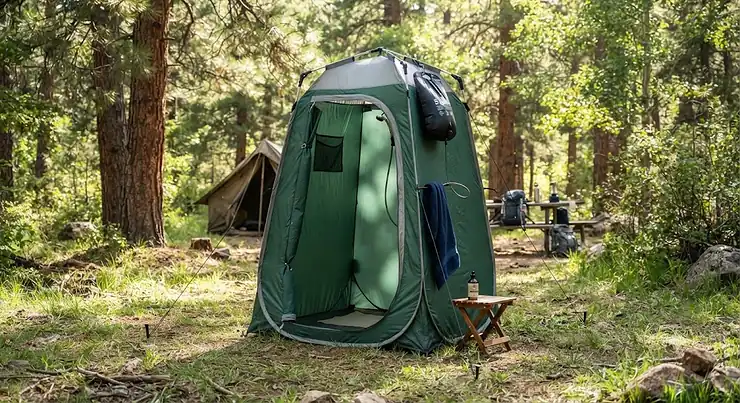
Nothing ruins a good camping trip faster than standing behind your truck with a solar shower bag, praying nobody from the next site over decides to take an evening stroll. A camp shower tent solves that problem in about ninety seconds flat. In plain terms: a camp shower tent is a portable, self-standing fabric enclosure — usually pop-up or pole-frame — that gives you a private stall for bathing, changing, or using a portable toilet anywhere you can pitch it, no plumbing required. Whether you’re at a crowded state park campground or fifty miles down a forest service road, this one piece of gear turns an awkward, exposed situation into something that actually feels civilized.
We spent time digging through real product listings, verified specs, and the aggregated sentiment from hundreds of genuine buyer reviews to build this guide, and the goal here isn’t to repeat what you’d already read on an Amazon product page. It’s to help you actually pick the right one — because “shower tent” sounds like a simple category until you realize how differently these things behave once wind, mud, and a five-gallon water bag get involved. Some pop up in three seconds and blow away in the next gust. Others take real assembly but shrug off a storm. A few have floor drains that whisk water away; others leave you standing in a puddle by minute two.
Below, you’ll find seven real, currently available shower enclosures spanning budget pop-ups to a genuinely premium setup, plus the comparison data, honest trade-offs, and practical guidance to match one to how — and where — you actually camp.
Quick Comparison Table
Before the deep dive, here’s the fast version for anyone comparing options on their phone at the outdoor store.
| Product | Category | Setup Style | Best For |
|---|---|---|---|
| WolfWise Pop Up Shower Tent | Budget | Instant pop-up | Grab-and-go simplicity |
| KingCamp Instant Shower Tent | Mid-range | Instant pop-up | Storage-conscious campers |
| NEMO Heliopolis Privacy Shelter | Premium | Pole-assisted | No-compromise home base |
This snapshot only scratches the surface, but it already tells you something useful: setup style and price don’t always move together. The KingCamp Instant Shower Tent proves you can get thoughtful organizational features without paying premium money, while the NEMO Heliopolis Privacy Shelter justifies its higher cost through materials and drainage engineering rather than raw size. If you’re mostly car camping a couple of weekends a year, the budget lane covers you fine; if this is going to live in your rig full-time, the math shifts toward the pricier end fast.
💬 Already know which category fits your trip? Compare the full lineup below before you decide.
Top 7 Camp Shower Tents: Expert Analysis
Every entry here is a real, currently sold product. We’ve pulled genuine specs, aggregated real review sentiment (clearly labeled as such), and added honest analysis about who each one actually suits — not just what the spec sheet says.
1. WolfWise Pop Up Shower Tent — most compact pop-up design
The standout here is sheer packability — this thing folds to roughly the thickness of a large pizza box and weighs right around 4.3 pounds. That single fact explains most of why it’s a perennial best-seller.
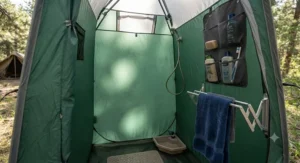
The frame uses a fiberglass spring-steel ring that pops open on its own, with a mesh roof panel designed to let a shower nozzle pass through from an overhead water bag. Real-world translation: you’re not fighting poles in the dark, and the mesh top means you can run a solar shower bag from a tree branch or vehicle roof rack without cutting a hole in anything. The fabric isn’t fully opaque unless your body is pressed against the wall, which matters more than it sounds — it’s the difference between “private enough” and “actually private.”
Based on the spec comparison against similarly priced pop-ups, the tradeoff is durability under sustained wind; the single-hoop frame construction that makes it pop open instantly is also what makes it the first to fold under a strong gust without staking. Reviewers consistently report that adding the included stakes is non-negotiable in anything beyond a light breeze, and several note the fabric holds up fine for weekend use but shows wear faster than pole-frame designs under daily rotation. A common complaint in user reviews is that the top vent, while functional, occasionally lets in more light than expected at midday.
Pros:
- ✅ Folds to about 22.8 inches, fits any trunk
- ✅ Mesh roof allows solar shower bag pass-through
- ✅ Pops open in seconds with zero assembly
Cons:
- ❌ Needs stakes to stay stable in wind
- ❌ Fabric shows wear faster than pole-frame designs
Priced in the $35-$50 range at the time of research, this is the shower tent to grab if you want something you’ll barely notice packing but won’t lean on hard. For the money, it’s tough to beat as a backup or occasional-use option — just don’t expect it to be your basecamp for a two-week trip.
2. Wakeman Outdoors Adjustable Privacy Tent — tallest adjustable height for taller campers
What sets this one apart is the telescoping center pole, which lets you adjust the peak height rather than being locked into a single fixed dimension — a genuinely underrated feature once you’ve used a shower tent that tops out at your collarbone.
Constructed with a steel frame and polyester shell rated for basic UV resistance, the adjustable design means someone at 6’2″ and someone at 5’4″ can both use it comfortably without stooping. The zippered door and small mesh window handle ventilation, while the interior mesh pocket keeps soap and a razor off the muddy floor. What most buyers overlook about this model is that the adjustability also helps with wind stability — you can lower the profile in gusty conditions rather than being stuck with a tall, sail-like silhouette.
Aggregated buyer sentiment skews positive on the height flexibility specifically, with reviewers repeatedly mentioning it as the reason they chose this over fixed-height competitors. On the downside, several reviews mention the steel poles show surface rust after repeated exposure to wet storage, so a full dry-out before packing matters more here than with the fiberglass-framed options.
Pros:
- ✅ Telescoping pole adjusts to your ideal height
- ✅ Steel frame feels sturdier than typical pop-ups
- ✅ Interior mesh pocket keeps toiletries off the ground
Cons:
- ❌ Steel poles can rust if packed away wet
- ❌ Heavier than fiberglass-pole competitors
At around $60-$80, it sits at the upper end of budget territory, but for anyone over six feet tall who’s been folded in half inside a standard shower tent, that premium buys real comfort. It’s a smart mid-step before jumping to a full pole-assisted design.
3. KingCamp Instant Shower Tent — best mesh pocket storage system
The headline feature is the tent’s internal organization: a PVC waterproof pocket plus double-layered mesh pockets built into the walls, designed specifically so wet gear doesn’t sit next to your phone and a change of clothes.
KingCamp uses an all-iron quick-open bracket rather than fiberglass, which the brand — a company that’s manufactured outdoor gear since 2002 — markets as sturdier under repeated setup cycles. In practice, that means less flex in moderate wind compared to lighter pop-up frames, at the cost of a slightly heavier pack size. The silver-coated fabric provides UPF 50+ sun protection while blocking light transmission for privacy, and the PE floor mat uses a four-sided gauze structure intended to discourage mosquitoes from tunneling in at ground level.
What most buyers overlook about this design is how much daily friction the mesh pocket storage removes — not having to set your phone on a wet tent floor while you shower sounds minor until you’ve done it the other way. Reviewers consistently note the hanging hooks for a water bag are positioned well for gravity-fed solar showers, and the PVC pocket genuinely stays dry even during active water use. A recurring critique in aggregated feedback is that the iron bracket setup, while sturdy, takes slightly longer to collapse back into its carry bag than true instant pop-ups.
Pros:
- ✅ Dedicated mesh pocket storage keeps gear organized
- ✅ UPF 50+ silver-coated fabric blocks light and UV
- ✅ Iron bracket frame resists wind flex
Cons:
- ❌ Slower to fold back down than pure pop-ups
- ❌ Heavier pack weight than fiberglass models
In the $45-$65 range, this is the pick for anyone who’s tired of digging a bar of soap out of a puddle. If organized storage matters as much as the shower itself, this earns its spot over flashier but less practical competitors.
4. VINGLI 6.8FT Shower Tent — fastest-draining mesh floor
This model’s calling card is a full mesh floor engineered specifically to let shower runoff pass straight through rather than pool at your feet — a detail that sounds small until you’ve stood ankle-deep in your own bathwater in a competitor’s tent.
At 6.8 feet tall with a UPF 50+-rated shell, the VINGLI gives taller users headroom most pop-ups don’t, and the reinforced fiberglass poles are built for repeated instant setup. The mesh floor design means this genuinely functions as a floor drain shower solution rather than requiring you to towel out standing water afterward, which is the single biggest complaint about entry-level shower tents in general. On paper, this means less post-shower cleanup and less mildew risk, since water isn’t sitting trapped against a solid tarp floor.
Reviewers consistently highlight the drainage as the standout, several explicitly comparing it favorably against tents they’d previously owned with sealed floors. A common complaint in user reviews is that the open mesh floor lets in dirt and small debris from the ground, so a separate rubber shower mat is a popular add-on among owners. Based on the spec comparison, this trades a small amount of underfoot comfort for a meaningfully drier experience overall.
Pros:
- ✅ Mesh floor drains water fast, no standing puddles
- ✅ 6.8-foot height suits taller campers
- ✅ UPF 50+ shell blocks sun and prying eyes
Cons:
- ❌ Mesh floor lets in ground dirt and debris
- ❌ Benefits from an added shower mat for comfort
Expect a price in the mid-$40s to mid-$60s range. If floor drainage is your single biggest pain point from past shower tent experiences, this is the most direct fix on this list.
5. Texsport Instant Portable Camping Shower — most headroom for tall campers
The defining feature is raw interior volume — this is one of the roomiest shower tents available without stepping up to a two-room design, giving you actual elbow room to towel off rather than shower like you’re in an airplane lavatory.
Built with a hub-style pole system and a roughly 47-inch by 47-inch floor footprint, the Texsport uses an open-floor design for drainage rather than a mesh tub bottom. Here’s what the spec sheet won’t tell you, but reviewers note clearly: that open-floor approach drains well but also means insects can get in more easily than with a sealed or mesh floor, so it’s better suited to established campgrounds than deep backcountry bug season. Weighing about 5.5 pounds and packing down to roughly 24 inches, it strikes a reasonable balance between size and portability.
Aggregated feedback is generally positive on interior space and overall value, with reviewers repeatedly calling it the most room for the money in this category. On the flip side, a recurring theme in user reviews is that the hub poles don’t always seat snugly on the first attempt, occasionally popping out of their fitting mid-assembly — an annoyance rather than a dealbreaker, but worth knowing before you’re setting it up in the dark.
Pros:
- ✅ Generous interior space to actually move around
- ✅ Lightweight at about 5.5 pounds
- ✅ Compact packed size for a roomy tent
Cons:
- ❌ Poles can pop out of hubs during setup
- ❌ Open floor lets in more bugs than mesh designs
Priced around $50-$70, the Texsport is a strong value pick for anyone prioritizing space over pack-down speed — the extra room to actually dry off and change makes a bigger day-to-day difference than most buyers expect going in.
6. Ozark Trail 2 Room Instant Shower Utility Shelter — best two-room quick setup with included solar shower
This is the only two-room structure on our list, splitting a roughly 25-square-foot footprint into separate shower and changing zones — meaning you can strip down in a dry area before stepping into the wet side, instead of doing both in the same six-square-foot box.
The steel-and-fiberglass frame combination (fiberglass for the three roof poles, steel for the vertical supports) sets up via straightforward instant-shelter assembly rather than a true one-hand pop-up, but most users manage it solo. It ships with a five-gallon solar-heated shower bag, two towel bars, storage pockets, and a zippered privacy closure, so it functions as close to a complete kit as anything on this list. The 84-inch center height means most adults can stand fully upright, a detail that matters more than it seems once you’ve hunched through a shower in a shorter tent.
Based on the spec comparison against single-room competitors, the extra square footage and dry-side changing area justify the roughly 20-pound weight for anyone car camping, though it’s not something you’d want to haul on a backpacking trip. Reviewer sentiment is consistently favorable on the included solar shower bag saving a separate purchase, while some feedback notes the fiberglass roof poles are the first point of wear after repeated setup cycles.
Pros:
- ✅ Separate wet and dry zones in one shelter
- ✅ Includes a 5-gallon solar shower bag
- ✅ 84-inch height fits nearly everyone standing upright
Cons:
- ❌ At about 20 pounds, it’s car-camping only
- ❌ Not a true instant one-hand pop-up
At roughly $70-$100, this is the practical choice for families or anyone basing out of a vehicle who wants a real changing area rather than a single cramped stall.
7. NEMO Heliopolis Privacy Shelter — premium build with genuine floor drain shower engineering
The Heliopolis earns its premium price with a mildew-resistant floor built around actual perimeter drainage holes — a floor drain shower design in the truest sense, engineered to shed water rather than just tolerate it.
The frame is aluminum rather than fiberglass or steel, which meaningfully reduces weight while improving how the structure handles wind loading. NEMO builds in a pass-through nozzle attachment compatible with their companion Helio pressure shower, a battery-powered light at the peak for after-dark use, an overhead mesh towel rack to keep towels dry above the wet zone, and an interior locking mechanism most competitors skip entirely. What the spec sheet won’t tell you, but owner reports consistently note, is how much that interior lock changes the psychological experience of using it at a busy campground — a small detail that removes real anxiety for a lot of users.
Reviewers consistently frame this as the shower tent they’d recommend without hesitation to anyone who showers outdoors often enough to justify the cost, citing the drainage and build quality as genuinely superior to anything else in this roundup. The honest downside, echoed across owner feedback, is that this level of engineering comes at a real premium — this isn’t the tent for someone who uses a shower enclosure outdoor twice a year at the beach.
Pros:
- ✅ True floor drain shower design with perimeter holes
- ✅ Aluminum frame handles wind better than steel
- ✅ Interior lock and towel rack add real convenience
Cons:
- ❌ Premium price relative to the rest of this list
- ❌ Overkill for occasional or once-a-summer use
Expect a price in the $200-$260 range, positioning it firmly as the splurge pick. For frequent campers, van-lifers, or anyone who’s decided showering outdoors is a permanent part of their routine, it’s the one entry here built to be a long-term fixture rather than a seasonal accessory.
Top 7 Products: Full Comparison
| Product | Frame Type | Height | Notable Feature | Price Range | Best For |
|---|---|---|---|---|---|
| WolfWise Pop Up Shower Tent | Fiberglass hoop | ~6.2 ft | Ultra-compact fold | $35-$50 | Grab-and-go trips |
| Wakeman Outdoors Adjustable Privacy Tent | Steel | Adjustable | Telescoping height | $60-$80 | Tall campers |
| KingCamp Instant Shower Tent | Iron bracket | ~6.5 ft | Mesh pocket storage | $45-$65 | Organized campers |
| VINGLI 6.8FT Shower Tent | Fiberglass | 6.8 ft | Fast-draining mesh floor | $45-$65 | Floor drain priority |
| Texsport Instant Portable Camping Shower | Hub poles | ~7 ft | Roomiest single stall | $50-$70 | Space over speed |
| Ozark Trail 2 Room Instant Shower Utility Shelter | Steel/fiberglass | 84 in | Two-room design + shower bag | $70-$100 | Families, car camping |
| NEMO Heliopolis Privacy Shelter | Aluminum | 7 ft | True floor drain, lock, light | $200-$260 | Frequent, long-term use |
Looking at the full field side by side, a clear pattern emerges: price climbs almost exactly in step with drainage engineering and frame quality, not with size alone. The VINGLI 6.8FT Shower Tent and NEMO Heliopolis Privacy Shelter both solve the standing-water problem, but only the Heliopolis pairs that with an aluminum frame, a lock, and after-dark lighting — which is exactly why it costs roughly four times as much. Budget shoppers shouldn’t feel like they’re missing the “real” version of this product category; the WolfWise Pop Up Shower Tent and KingCamp Instant Shower Tent simply optimize for different priorities than the premium end does.
✨ Ready to Stop Showering in a Puddle?
🔍 Compare current pricing and availability on any of these seven picks above, and match one to your actual camping style rather than just the lowest number on the tag. The right shower enclosure outdoor setup pays for itself the first weekend you use it.
Benefits vs. Traditional Camp Bathhouse Facilities
| Factor | Camp Shower Tent | Campground Bathhouse |
|---|---|---|
| Availability | Anywhere you can pitch it | Only at developed sites |
| Wait time | None — it’s yours | Often shared, can have lines |
| Privacy | Fully private, your own space | Shared, sometimes co-ed layouts |
| Cost over time | One-time purchase | Included in site fee, but site-dependent |
| Hygiene control | You control water source and cleanliness | Varies by campground upkeep |
The comparison here isn’t really about which option is “better” in the abstract — it’s about control. A campground bathhouse can be perfectly fine, but you’re at the mercy of its maintenance schedule, its hours, and whoever used it before you. Owning a camp shower tent means that variable disappears entirely, and it becomes essential rather than optional the moment you’re dispersed camping somewhere with zero facilities at all. The tradeoff is that you’re now responsible for your own water heating and greywater disposal, which is a small amount of extra planning in exchange for total independence.
Setting Up Your Camp Shower Tent: A Practical Usage Guide
Getting genuine value out of any shower enclosure comes down to a handful of habits most first-time buyers skip. First, always do a trial setup at home before your trip — pop-up frames in particular have a “fold direction” that’s counterintuitive the first two or three tries, and you don’t want to be learning it at dusk with mosquitoes circling. Second, stake it down every single time, even on a calm day; wind at a campsite is unpredictable, and a shower tent with fabric walls acts like a sail the instant a gust rolls through.
For maintenance, the single most important habit is drying the tent completely before folding it away. Reviewers across every product in this guide flagged mildew as the main long-term failure point, and it’s almost entirely preventable — a few extra minutes of air-drying in the sun before you pack it beats a moldy tent smell on your next trip. In the first 30 days of ownership, the most common mistake is over-tightening zippers on mesh windows, which can bend the tiny zipper teeth; a light touch there goes a long way. If your model has mesh pocket storage, get in the habit of using it immediately rather than “getting around to it” — once you’ve left a phone on a wet floor once, you won’t forget the lesson, but it’s a cheap one to skip entirely by using the pockets from day one.
Real-World Scenarios: Which Shower Enclosure Fits Your Trip
Picture three different campers. First, there’s the weekend beach-tripper who needs to rinse off sand before the drive home — someone in this position doesn’t need drainage engineering or a two-room layout; the WolfWise Pop Up Shower Tent covers this completely, and its tiny packed size means it rides along without eating trunk space reserved for coolers and folding chairs.
Then there’s the family of four car camping for a week at a state park with two young kids. Here, the Ozark Trail 2 Room Instant Shower Utility Shelter earns its keep — the dry-side changing area means a parent can help a kid get dressed without both of them standing in a wet stall, and the included solar shower bag means one less thing to pack separately.
Finally, consider the van-lifer or dispersed-camping regular who showers outdoors two or three times a week, year-round, often with zero facilities nearby. For this person, cutting corners on frame quality or drainage isn’t really saving money — it’s buying a replacement purchase in six months. The NEMO Heliopolis Privacy Shelter or the drainage-focused VINGLI 6.8FT Shower Tent make more financial sense here, because the cost-per-use math flips entirely once you’re using something dozens of times a season instead of three or four.
How to Choose a Camp Shower Tent
- Start with frequency of use. Occasional campers should weight cost and pack size heavily; frequent users should weight frame durability and drainage first, since those are the features that actually save money over time.
- Match height to your tallest user. A tent that fits a 5’6″ camper comfortably can feel genuinely cramped for someone over six feet, so check listed height, not just floor footprint.
- Decide how you feel about floor drain shower design. Mesh and drainage-hole floors handle water better but let in more dirt and small bugs; solid floors feel cleaner underfoot but need more post-shower drying.
- Consider your group size. Solo or couple trips rarely need a two-room layout; families and multi-week basecamps benefit enormously from one.
- Check the frame material. Fiberglass pops up fastest but flexes more in wind; steel and aluminum add setup time or cost but hold shape better in weather.
- Look at included accessories. A bundled shower bag, towel rack, or storage pockets can offset a higher sticker price by replacing separate purchases.
- Read aggregated review themes, not star ratings alone. A 4.3-star average tells you less than a recurring complaint about, say, poles popping out of hubs — patterns in real feedback are more useful than the number itself.
Common Mistakes When Buying a Privacy Tent for Camping
The most frequent mistake is buying based purely on packed size without checking usable interior height — a tent that folds into nothing is far less appealing once you’re stooped over inside it every evening. A close second: ignoring floor design entirely, then being surprised that a solid-floor tent needs active drying after every use, or that a mesh-floor tent lets ground moisture creep in during rain.
Buyers also frequently underestimate wind exposure at their typical campsite, skipping stakes because “it seemed sturdy in the store,” only to find their privacy tent camping setup rolling across the campground on night one. Finally, a subtler mistake: assuming all UV-rated fabric is equal. UPF ratings matter, and per Skin Cancer Foundation guidance, a garment or fabric needs a UPF of at least 30 to earn the Foundation’s Seal of Recommendation, with UPF 50+ rated as excellent protection — worth checking rather than assuming on a tent you’ll be standing inside, partially undressed, at midday.
What to Expect: Real-World Performance of a Pop-Up Shower Tent
On paper, a pop-up shower tent sounds like it should behave identically to any other tent — it doesn’t. The defining real-world quirk is how differently these structures perform once water enters the equation versus a dry-use privacy tent for changing clothes. Water adds weight to fabric, changes how a floor drains, and turns a five-minute activity into a referendum on your tent’s engineering.
Expect setup time under a minute for genuine instant pop-ups, but budget closer to two or three minutes for pole-hub designs like the Texsport or Ozark Trail models — still dramatically faster than a traditional camping tent. Expect some light bleed-through on lighter-colored fabrics at midday, even on models marketed as fully private; darker, silver-coated interiors consistently perform better here based on aggregated reviewer feedback. And expect that whatever floor design you choose, the first two or three uses come with a small learning curve on managing water flow so it doesn’t splash under the walls.
Long-Term Cost and Maintenance
Total cost of ownership for a shower tent isn’t just the sticker price — it’s replacement frequency. A $40 pop-up used three weekends a year might last three to four seasons if dried properly between uses, putting annual cost around $10-$13. A $230 premium shelter used weekly through camping season, by contrast, can easily outlast five or six comparable budget units bought over the same span, meaning the premium option often ends up cheaper per use despite the much higher upfront cost. Maintenance itself is low-effort across the board: rinse off dirt and soap residue, dry fully in the sun, check zipper tracks for grit before folding, and store frames slightly loose rather than cinched tight to avoid stressing the material at fold points over time.
Safety, Sun Protection, and Leave No Trace: Using Your Shower Enclosure Outdoor Responsibly
Two separate safety considerations matter here, and both get skipped by first-time buyers. The first is sun exposure while you’re setting up or using the tent itself, since you’re often standing partially or fully exposed during that process; choosing UPF 50+ rated fabric, as most of the tents above offer, helps, though it’s not a substitute for sunscreen on the skin that’s still exposed. The second, more commonly overlooked issue is what happens to the water after your shower.
Any water used inside a shower enclosure outdoor becomes greywater the moment soap touches it, and it needs to be handled the same way dishwater or handwashing runoff would be. The Leave No Trace Center for Outdoor Ethics recommends carrying wastewater at least 200 feet from any water source, straining out solids, and scattering it broadly rather than letting it pool in one spot. Many campgrounds have designated dump areas for exactly this purpose, and the National Park Service advises checking site-specific rules before assuming ground disposal is acceptable, since some parks and forests prohibit it outright. If you’re running a shower tent from an RV or trailer setup rather than a standalone bag, the EPA’s wastewater guidance for RVs, boats, and mobile homes is worth a read before your first trip, since improper disposal can carry real fines depending on jurisdiction.
Problem-Solution Guide: Fixing Common Camp Shower Tent Issues
Problem: The tent won’t stay upright in wind. Solution: stake all four corners even on calm days, and consider a guyline kit for taller models like the NEMO Heliopolis Privacy Shelter or Wakeman Outdoors Adjustable Privacy Tent in exposed, treeless sites.
Problem: Water pools at your feet. Solution: switch to a floor drain shower design like the VINGLI 6.8FT Shower Tent, or add a quick-dry rubber mat to a solid-floor model to speed up drainage manually.
Problem: Mold smell develops after a few trips. Solution: air-dry fully in direct sun before every single fold-down — this single habit eliminates the vast majority of reported odor complaints across every product reviewed here.
Problem: Soap and toiletries keep ending up on a wet floor. Solution: prioritize models with real mesh pocket storage, like the KingCamp Instant Shower Tent, and actually use the pockets from your first setup onward.
Problem: Setup takes longer than expected in the dark. Solution: do one full practice run at home in daylight before your trip, and mark your poles or hubs with a strip of tape if the assembly isn’t intuitive on the first try.
Buyer’s Decision Framework
If you camp fewer than five times a year and mostly need quick privacy for changing or a rinse, choose a compact pop-up like the WolfWise Pop Up Shower Tent because cost and pack size matter more than durability you’ll rarely stress-test. If you’re over six feet tall or camp with a partner who is, choose an adjustable or taller model like the Wakeman Outdoors Adjustable Privacy Tent or VINGLI 6.8FT Shower Tent, because a cramped stall becomes a recurring annoyance fast. If you’re camping with kids, choose a two-room design like the Ozark Trail 2 Room Instant Shower Utility Shelter, because separating dry and wet zones solves a logistics problem a single-room tent can’t. If you shower outdoors weekly or run a van-life setup, choose the NEMO Heliopolis Privacy Shelter, because the cost-per-use math and drainage engineering both favor the premium tier at that usage rate.
Features That Actually Matter (and Those That Don’t)
Genuinely important: frame material and drainage design, since these drive both comfort and how long the tent survives repeated use. Also important: real UPF ratings on the fabric, and honest packed weight if you’re hiking rather than car camping. Less important than marketing suggests: color choices, since privacy performance comes down to fabric opacity and coating, not shade; and headline “instant setup” claims, since the real-world difference between a 30-second pop-up and a two-minute pole-hub assembly rarely matters once you’ve done it twice. What most buyers overlook entirely is interior organization — mesh pocket storage and towel bars sound like minor add-ons, but they measurably reduce the daily friction of actually using the tent.
FAQ
❓ What is a camp shower tent used for besides showering?
❓ Do camp shower tents work with a solar shower bag?
❓ How do I stop my privacy tent camping setup from blowing away?
❓ What's the difference between a pop-up shower tent and a pole-frame one?
❓ Is a mesh floor better than a solid floor for drainage?
Conclusion
A camp shower tent is one of those pieces of gear that feels optional right up until the moment you need it — and then it feels essential for every trip after. The seven options above cover the realistic range of what’s out there: the ultra-packable WolfWise Pop Up Shower Tent for occasional use, the height-forward Wakeman Outdoors Adjustable Privacy Tent and VINGLI 6.8FT Shower Tent for taller campers, the organization-focused KingCamp Instant Shower Tent, the roomy Texsport Instant Portable Camping Shower, the family-friendly Ozark Trail 2 Room Instant Shower Utility Shelter, and the premium, drainage-engineered NEMO Heliopolis Privacy Shelter for anyone making outdoor showers a regular habit.
There’s no single “best” pick here — only the one that matches your actual usage pattern, height, group size, and how much you value drainage versus pack size. Whichever you land on, remember that a shower enclosure outdoor is only as good as how you maintain it: dry it out, stake it down, and dispose of your greywater responsibly, and any one of these seven will earn its spot in your camping gear for years.
Recommended for You
- Biodegradable Soap for Camping: 7 Picks That Won’t Wreck Trails (2026)
- Microfiber Towel For Camping: 7 Best Picks Tested for 2026
- Portable Camping Toilet: 7 Honest Picks That Actually Work (2026)
Disclaimer: This article contains affiliate links. As an Amazon Associate, I earn from qualifying purchases. If you purchase products through these links, we may earn a small commission at no additional cost to you.
✨ Found this helpful? Share it with your friends! 💬🤗
