In This Article
A military sleeping bag is a rugged, synthetic-fill sleeping bag built to government specifications, or inspired by them, to survive wet, cold, abusive field conditions. The category spans genuine U.S. issue systems like the Modular Sleep System, European defense-contract bags, and civilian look-alikes that borrow the camo and the attitude.
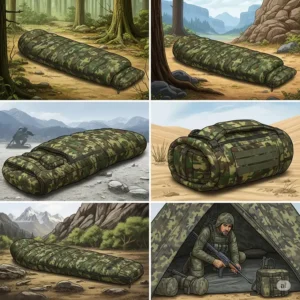
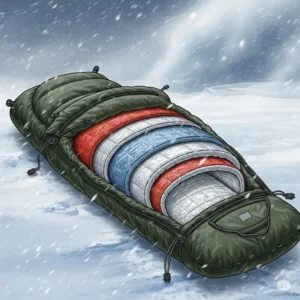
A military sleeping bag was never meant to be pretty, light, or cheap. It was meant to be issued to thousands of tired people, crammed into wet rucksacks, and expected to work anyway. That brutal brief is why a good military sleeping bag still beats plenty of pricier civilian bags on durability and flexibility. The Modular Sleep System used by the U.S. Army pairs two synthetic bags with a bivy cover, so you build warmth the way you build a layered outfit. Cold snap? Add a layer. Warm night? Drop one.
The category has traps, though. Temperature numbers on military gear are survival thresholds, not cozy-night promises. Knock-offs borrow the camouflage without the construction. And the best military sleeping bag for a deer hunter in the Northern Rockies is a clumsy pick for a weekend backpacker in the Southeast.
This guide cuts through the noise. You’ll get seven real options (genuine U.S. issue, European defense-contract, and budget camo), with specs translated into what they mean at 2 a.m. when the temperature drops. You’ll also get honest review themes, price ranges instead of exact figures (they move constantly), and the practical know-how listings leave out. Research was done in October 2026, and availability can change.
Quick Comparison: 7 Military Sleeping Bag Options at a Glance
| Product | Best For | Rating as Listed | Approx. Weight | Price Range |
|---|---|---|---|---|
| USGI Modular Sleep System (MSS) | Winter hunting, base camps, year-round versatility | About -10°F (intermediate bag alone); about -30°F stacked with bivy | About 10 lb complete | $150-$250 |
| USGI Patrol Bag | Budget three-season use, layering inside a bigger system | About 30-50°F | About 2.5 lb | $50-$100 |
| USMC Three-Season Sleep System (3S) | Lighter-weight three-season field use | About 20°F and up (system) | About 2.6 lb bag; 4.8 lb system | $150-$250 |
| Snugpak Softie Elite 3 | Variable-temperature camping | Comfort -5°C (23°F); limit -10°C (14°F) | Check listing | Low $100s-$150 |
| Snugpak Softie Expansion 5 | Cold-weather camping with extra room | Comfort -15°C (5°F); low -20°C (-4°F) | 5.1 lb (2,300 g) | $200-$260 |
| Carinthia Defence 4 | Hard-use three-season trips, cold-weather hiking | Comfort limit -15°C (5°F); extreme -35°C | 4.1 lb (1,850 g, medium) | $250-$350 |
| Mil-Tec Commando | Summer, kids, cabin nights | Listed as “15 comfort / 10 extreme” (units not stated) | About 1.5 lb (listed) | Under $100 |
The table shows a trade-off that runs through the whole category: the more versatile and bomb-proof the system, the heavier it is. The USGI MSS wins on adaptability but is a car-camp or base-camp system, not a pack-friendly one. The Carinthia Defence 4 is the best pound-for-pound performer here, while the Mil-Tec Commando sacrifices warmth for a rock-bottom price. Read the “Best For” column first, then the ratings, because the right military sleeping bag depends on your coldest night, not your average one.
💬 Just one click — help others make better buying decisions too!😊
Top 7 Military Sleeping Bags: Expert Analysis
Every pick below is a real product with real specs. Ratings are the manufacturers’ or issuers’ own, so read them as claims to interpret rather than guarantees.
1. USGI Modular Sleep System (MSS) — the do-everything four-season stack
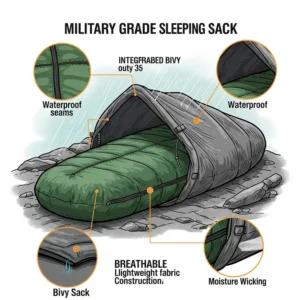
The big idea behind the USGI Modular Sleep System (MSS) is that you never carry more bag than the night demands. Tennier Industries of Huntsville, Tennessee, makes the real stuff. Kits usually include a patrol bag, an intermediate cold weather bag, a waterproof bivy cover, and compression sacks.
The patrol bag is listed around 30-50°F and the black intermediate bag down to about -10°F. Nest them together with the bivy and the stack is rated near -30°F, stretching toward -50°F with extended cold weather clothing layers. Those are survival thresholds, though. One surplus guide notes they assume a foam pad and roughly four hours of survivable sleep, and suggests adding 10-20°F to find a realistic comfort floor. The complete system runs about 10 lb, so this is a car-camping, hunting-camp, or backyard-emergency kit rather than an ultralight rig.
Based on the spec comparison, the USGI MSS suits anyone who faces wide temperature swings and values toughness over weight. Reviewers on Trailspace describe it as adaptable and strong value used. Buyers on resale listings repeatedly warn that the ratings run optimistic and that imitations run colder than genuine Tennier stock.
Pros:
- ✅ Layers adapt from mild nights to deep winter
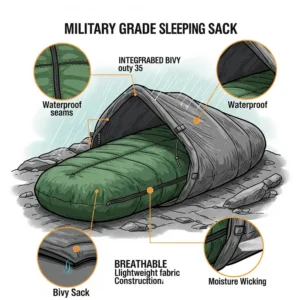
- ✅ Bivy cover handles rain, wind, and frost
- ✅ Built to survive years of abuse
Cons:
- ❌ Heavy and bulky for any hiking use
- ❌ Ratings assume a pad and are optimistic
Complete surplus kits typically land in the $150-$250 range, which is strong value for a true four-season system.
2. USGI Patrol Bag — cheapest way into genuine issue
The USGI Patrol Bag is the light half of the modular system, sold on its own. For many buyers it’s all the military sleeping bag they need.
It’s listed for roughly 30-50°F and weighs around 2.5 lb. On paper that makes it a late-spring-to-early-fall bag. The snaps let it accept the heavier intermediate bag later, so you can start cheap and grow into the full system. It also fits inside the bivy cover for rain protection.
On analysis alone, the USGI Patrol Bag is a smart first step for scouts, cabin stays, and car camping in mild seasons. A reviewer on a resale listing called it good for what it is but said the temperature ratings run far off, which echoes the broader advice to treat military numbers as survival limits. Because it’s a modular piece, the ripstop nylon shell and polyester fill are built for abuse rather than comfort, so expect a utilitarian feel instead of plush softness.
Pros:
- ✅ Genuine issue construction at a low entry price
- ✅ Light enough for short carries
- ✅ Snaps into the larger modular system later
Cons:
- ❌ Real comfort floor sits well above the rating
- ❌ Utilitarian feel, minimal bells and whistles
Used or surplus examples sit around the $50-$100 range. For genuine issue gear that is fair value if you stay within its mild-weather lane.
3. USMC Three-Season Sleep System (3S) — Marine-designed lighter replacement
The USMC Three-Season Sleep System (3S) came out of a frustration: Marines in mountain operations carried only the patrol bag to save weight, and it didn’t protect them enough in the cold. According to Military.com’s coverage, the 3S gives roughly 12°F more protection than the old green patrol bag while weighing about 0.7 lb less.
The Marine Corps information paper puts the full system (bag, bivy cover, and compression sack) at 4.8 lb. It’s designed to protect at about 20°F and above for four hours of uninterrupted sleep, with clothing layers extending that to roughly 0°F. Resale listings describe the bag alone at around 2.6 lb with a nylon shell, polyester batting, and antimicrobial liner. Note the compatibility trap: the 3S is not interchangeable with the older MSS, so don’t mix the pieces.
For buyers who want authentic issue gear without the old system’s bulk, the USMC 3S is the leaner pick. Independent review volume is thin, so claims here rest mainly on official documentation and listing details.
Pros:
- ✅ Noticeably lighter than the older modular stack
- ✅ Single-bag simplicity with bivy included
- ✅ Regular and long sizes available
Cons:
- ❌ Not compatible with the older MSS pieces
- ❌ Limited independent reviews to confirm field claims
Surplus examples generally run in the $150-$250 range. Early limited buys reportedly cost far more, so current surplus pricing is a bargain by comparison.
4. Snugpak Softie Elite 3 — expandable room without losing warmth
Snugpak is a British brand with military heritage, and the Snugpak Softie Elite 3 applies that thinking to a bag you can adjust on the fly. The Expander Panel System lets you widen the bag from about 75 cm to 87.5 cm. On warmer nights that extra air space cools the bag down. Zip the panel back in and you’re snug again.
The listed comfort rating is -5°C (about 23°F), with a limit of -10°C (about 14°F). The Softie synthetic insulation keeps working when damp, and the Paratex outer fabric resists wind and water. Clips shorten the bag from 220 cm to 175 cm, so shorter sleepers avoid carrying dead air. Snugpak says its ratings come from decades of user feedback and assume you’re lightly clothed on a quality mat.
Here’s what the spec sheet won’t tell you outright: the expansion panel makes this a sensible one-bag solution for people who camp across seasons or hate mummy-bag claustrophobia. Verified aggregated review data wasn’t available at the time of research, so treat this as spec-based analysis.
Pros:
- ✅ Adjustable width solves mummy-bag claustrophobia
- ✅ Insulation keeps working when damp
- ✅ Shortening clips trim dead air space
Cons:
- ❌ Slightly heavier than minimalist hiking bags
- ❌ Independent review depth is limited
Retail pricing generally runs from the low $100s to about $150, depending on seller and region. That is mid-range value for an adaptable bag.
5. Snugpak Softie Expansion 5 — expedition warmth with a built-in torch
The Snugpak Softie Expansion 5 is the cold-weather sibling, aimed at people who want real winter margin without a multi-piece system. The comfort rating is -15°C (5°F), with a low limit of -20°C (-4°F). It weighs 2,300 g (about 5.1 lb) and packs to roughly 32 x 26 cm.
Notable details include an elasticated expander panel, a thermal suede foot lining, a built-in LED torch, and anti-snag zippers with an insulated baffle. The Softie fill and Reflectatherm lining help trap heat. Foot-end hanging tabs make airing and drying easy.
What most buyers overlook is that a one-piece bag at this rating is a different proposition than a modular stack. You get simplicity and decent packability, but you lose the ability to dial warmth down for mild nights, apart from venting the panel. That makes the Softie Expansion 5 better suited to people who know they’ll face cold weather regularly.
Pros:
- ✅ Strong cold rating in a single bag
- ✅ Expander panel adds room for layers
- ✅ Handy extras like torch and hanging tabs
Cons:
- ❌ Overkill and warm for mild-season nights
- ❌ Heavier than down alternatives at this rating
Expect roughly the $200-$260 range depending on seller. That is fair for a dependable winter-rated military sleeping bag, particularly compared with buying two bags to cover the same range.
6. Carinthia Defence 4 — the three-season workhorse
The Carinthia Defence 4 is the lone European high-end pick here. The Austrian maker targets both military and civilian users, and retailer descriptions state that German, Swedish, and Finnish defense forces have used the Defence line.
The bag is tested to the ISO 23537 / EN 13537 standard, so the numbers are more standardized than many military claims: comfort for women at -8.8°C (about 16°F), comfort limit for men at -15°C (5°F), and an extreme limit of -35°C, which is a survival figure. Weight is 1,850 g (about 4.1 lb) in medium and 2,000 g in large, with a pack size around 25 x 38 cm. G-Loft insulation and a Thermoflect layer help retain heat. Layered with the lighter Carinthia Tropen bag, it forms a colder-weather system.
A reviewer at Northern Bush describes the Carinthia Defence 4 as tough, waterproof and windproof, and quicker to dry than down. On weight-to-warmth it beats the older U.S. modular stack comfortably.
Pros:
- ✅ Standardized ratings are easier to trust
- ✅ Excellent warmth for its weight
- ✅ Tough, water-resistant shell for field use
Cons:
- ❌ Premium price compared with surplus bags
- ❌ Cut is trim, less roomy than expansion bags
Expect roughly the $250-$350 range depending on size and seller. Pricey, yes, but it’s the best option here for hikers who care about weight.
7. Mil-Tec Commando — budget camo for mild nights
The Mil-Tec Commando is the budget end of the spectrum, a camo-patterned mummy bag that suits warm-weather camping, cabin nights, and kids. Listings describe polyester shell and lining, a 150 g/m² polyester fill, an integral drawstring hood, and a two-way zipper. The packed size is about 15.4 x 7 x 7 inches.
The rating is listed as “comfort 15, extreme 10” without stating units. Given the light fill, it should be treated as a summer or mild-weather bag, and a sensible shopper should confirm the units before buying. The product is made in China, which is worth noting if genuine military construction matters to you.
The Mil-Tec Commando makes sense where cost and weight matter more than extreme-cold performance, such as a backyard sleepover, an emergency car kit, or a first scout campout in summer. Verified independent reviews weren’t available at the time of research, so this is spec-based analysis.
Pros:
- ✅ Very low cost of entry
- ✅ Light and compact for easy storage
- ✅ Familiar camo styling for younger campers
Cons:
- ❌ Light fill limits cold-weather use
- ❌ Rating units unclear, so verify before buying
Prices typically stay under $100. That is acceptable for casual summer use but poor value for anything colder.
Practical Usage Guide: Setting Up and Maintaining Your Military Sleeping Bag
Even the best military sleeping bag underperforms when set up badly. Here’s the routine that gets the most out of any of the picks above.
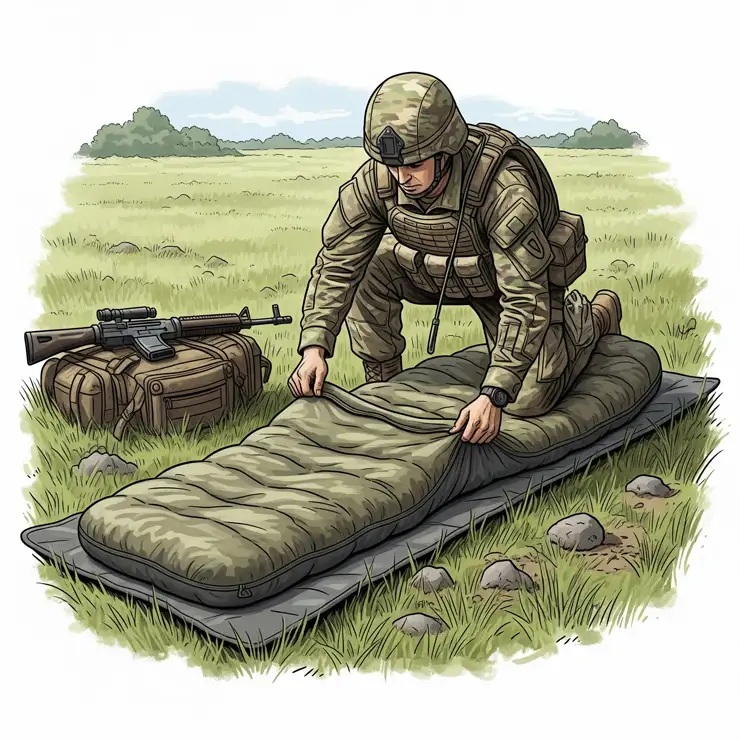
Unpack early. Pull the bag from its stuff sack as soon as you reach camp so the fill can loft. Synthetic fill compressed all day needs time to recover, so a bag unrolled at 4 p.m. will outperform one fluffed at bedtime.
Build the stack correctly. In a modular system, the heavier intermediate bag goes inside the patrol bag, secured with the snaps, and the bivy cover goes on the outside. Don’t mix a U.S. Marine 3S with MSS pieces, because the designs are incompatible.
Respect the pad. Surplus guides note that military ratings assume a foam pad underneath. Ground cold travels straight through insulation you’re lying on, so a closed-cell foam pad, or two, is cheap insurance.
Manage moisture. Vent the zipper slightly on mild nights, and don’t breathe into the bag on cold ones. Moisture builds in synthetic fill over multiple nights, so air the bag in the sun when you can.
Store it loose. Marine Corps materials recommend a mesh storage bag in garrison because long-term compression degrades the insulation. At home, hang it or store it in a large breathable sack.
Common first-30-day mistakes: trusting the rating without a pad, sleeping in too many damp layers, compressing the bag nightly instead of only for transport, and washing it too aggressively.
Real-World Scenarios: Matching a Military Sleeping Bag to Your Life
Specs only matter when they meet a real use case. Here are four profiles.
The cold-weather hunter. You camp near a deer stand for several nights in subfreezing conditions, mostly by truck. Weight barely matters; warmth and moisture protection do. The USGI MSS with its bivy is the obvious fit, and a foam pad plus insulated underlayers will bring the stack toward its rated limit.
The three-season hiker. You carry everything on your back for 8-12 miles a day from spring to fall. The Carinthia Defence 4 or the USMC 3S makes more sense, since both keep the weight in the 4-5 lb range or lower.
The scout leader on a budget. You need to outfit a few kids who’ll outgrow gear fast. One Trailspace reviewer argues that a used modular system plus two foam pads is hard to beat on value for new scouts. The USGI Patrol Bag with a bivy, or the Mil-Tec Commando for summer-only trips, keeps costs manageable.
The hot sleeper who hates mummy bags. You kick off covers by 2 a.m. and feel trapped in tapered shapes. The Snugpak Softie Elite 3 and its expansion panel handle this better than any rigid mummy cut.
✨ Don’t Miss These Exclusive Deals!
🔍 Take your next camping trip to the next level with these carefully selected products. Click on any highlighted item to check current pricing and availability. A well-chosen military sleeping bag will help you sleep warm, dry, and ready for whatever the night throws at you!
Problem to Solution: Fixing the Most Common Military Sleeping Bag Complaints
Owners tend to complain about the same five things. Each has a fix.
“It’s too heavy.” The modular stack is heavy by design. If you’re carrying it, drop the intermediate bag until the forecast demands it, or swap to a lighter bag like the Carinthia Defence 4 or USMC 3S.
“The rating was way off.” Buyers on resale listings repeatedly say ratings overstate comfort. Add 10-20°F to the stated rating, as one surplus guide advises. Choose a bag with ISO/EN-tested numbers, like the Carinthia Defence 4, when you want a more honest baseline.
“I woke up damp.” Condensation is a function of humidity and ventilation, not just the bag. Use the bivy cover only when you need it, vent the zipper, and dry the bag in the sun after each trip.
“My feet are freezing.” Cold feet usually mean compressed fill or ground cold. Use a thicker pad, wear dry socks to bed, and avoid cramming boots into the footbox. The Snugpak Softie Expansion 5 adds a thermal suede lining at the foot end for exactly this reason.
“The mummy shape feels like a straitjacket.” Choose a bag with an expander panel, such as the Snugpak Softie Elite 3 or Softie Expansion 5, or size up one step in a modular system.
What Is a Military Sleeping Bag, Really?
A military sleeping bag is a field sleeping bag made to government or defense-force specifications, or a civilian bag built in that spirit. It usually pairs a tough ripstop shell with synthetic insulation that keeps working when damp. The point is reliability in rough conditions rather than light weight or luxury.
There are three families worth knowing. U.S. issue systems include the Army’s modular stack and the Marines’ 3S, both made by Tennier Industries. The Forestry Service also uses a simpler two-part system. European defense-contract bags, like those from Carinthia, use standardized tests and technical insulation. Civilian-market military-style bags copy the look and basic design, often at lower prices and with lighter fill.
Where a bag sits in these families determines nearly everything: how heavy it is, how honest its rating is, and how long it lasts. A genuine USGI MSS is overbuilt for abuse. A Mil-Tec Commando is built to a price. Neither is wrong; they serve different users.
How to Choose a Military Sleeping Bag
Follow these seven steps and the right military sleeping bag usually becomes obvious.
- Set your coldest realistic night. Pick the lowest temperature you’ll actually face, then add a safety buffer. REI’s guidance on temperature ratings explains why lab-tested numbers rarely match real-world comfort.
- Decide on weight. If it rides in a car, heavy is fine. If it rides on your back, favor a single lighter bag over a stack.
- Check how the rating was produced. ISO/EN-tested numbers beat vague “survival” claims.
- Choose modular or single. Modular covers more temperatures; single is simpler and lighter per night of use.
- Confirm the fit. Too much space wastes body heat, and too little compresses insulation. Add a few inches over your height.
- Plan the pad. Budget for a closed-cell foam pad or insulated mat, because ground cold defeats the best bag.
- Verify authenticity. For genuine U.S. gear, check Tennier labeling and NSN numbers.
Military Sleeping Bag Temperature Ratings and Features That Actually Matter
Marketing loves temperature numbers. Here’s what they really mean.
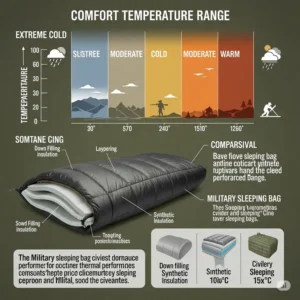
U.S. issue ratings are survival-oriented. They were derived from testing that confirms a soldier in standard thermal underwear on a military foam pad can survive roughly four hours at the stated temperature. Surviving is not the same as sleeping well. That’s why surplus guides advise adding 10-20°F to the rating.
European ratings follow ISO 23537 / EN 13537, which separate comfort from limit and extreme figures. The extreme figure, like the -35°C on the Carinthia Defence 4, is a survival number you should ignore when planning a normal trip. Look at the comfort limit.
Features that matter: a draft collar and zipper baffle, a two-way zipper for venting, a shell that sheds water, and compatible snaps if you want modularity. Features that matter less: gadget pockets, fancy colors, and the headline extreme rating.
Treat any military sleeping bag rating as one data point. Pair it with your sleeping pad, your clothing, and your own tendency to run warm or cold.
Military Sleeping Bag vs Civilian Sleeping Bag
| Factor | Military-Style Bag | Civilian Backpacking Bag | Civilian Car-Camping Bag | Best For |
|---|---|---|---|---|
| Durability | Very high (USGI MSS, Carinthia Defence 4) | Moderate | Moderate | Hard use |
| Weight | Often heavy | Light, expensive | Heavy | Depends on carry |
| Modularity | Strong in modular systems | Rare | Rare | Variable climates |
| Rating honesty | Mixed; verify standard | Usually ISO/EN | Usually ISO/EN | Planning |
| Cost | Low to moderate surplus | High | Low to moderate | Budget builds |
A military sleeping bag usually wins on abuse tolerance and modular flexibility, and it often wins on price if you buy surplus. A civilian backpacking bag wins on weight, packing size, and comfort ratings you can trust. Car-camping bags win on plushness but rarely tolerate rough handling. If you want one bag that can be dropped, dragged, and drenched, the military option is hard to beat. If you want to cover 15 miles a day, look at lighter options like the Carinthia Defence 4 or USMC 3S.
Common Mistakes When Buying a Military Sleeping Bag
Most disappointments trace back to five errors.
Trusting the extreme rating. That number is for survival, not sleep. Plan around comfort, with a buffer.
Ignoring authenticity. Resale listings warn that imitations run colder than genuine Tennier gear. If you’re paying genuine prices, verify genuine labeling.
Buying the biggest system. The full USGI MSS is impressive, but if you only camp in spring and fall, the USGI Patrol Bag may be all you need.
Mixing incompatible systems. The Marine 3S doesn’t interchange with the older modular pieces, so check compatibility before buying components separately.
Skipping the pad. Military ratings assume a foam pad underneath. Without it, you’re giving away the warmth you paid for.
A sixth, quieter mistake is buying on camo alone. A camouflage print says nothing about fill weight, shell fabric, or the honesty of the rating. Read the specs, not the pattern.
Military Sleeping Bag for Hunters, Scouts, and Preppers
Different users want different things from the same category.
Hunters value moisture resistance and warmth over weight, especially when a truck or ATV carries the load. The USGI MSS and its bivy cover fit here. If you glass hillsides on foot, the Carinthia Defence 4 trades some cold margin for much lower weight.
Scouts and youth groups need low cost and durability. A used modular system is a classic value choice, according to one Trailspace reviewer who recommends pairing it with two foam pads. The USGI Patrol Bag is the budget path in, and the Mil-Tec Commando works for summer events.
Preppers value shelf life and flexibility. A modular system stored loosely in a breathable bag, as Marine materials recommend, can wait years until needed. The ability to scale warmth up and down is exactly why the modular approach appeals to emergency planners.
Women and cold sleepers should pay attention to the comfort rating rather than the limit. The Carinthia Defence 4 lists a separate women’s comfort figure of -8.8°C, which is more useful for cold sleepers than the headline -15°C.
Long-Term Cost and Maintenance of a Military Sleeping Bag
A cheap military sleeping bag that dies in two seasons costs more than a better one that lasts a decade. Think in cost per year of use.
| Product | Price Range | Value Notes | Best For |
|---|---|---|---|
| USGI MSS | $150-$250 | Covers many temperatures in one purchase | Variable climates |
| USGI Patrol Bag | $50-$100 | Cheapest genuine issue entry | Mild-season budget |
| USMC 3S | $150-$250 | Light, single-system simplicity | Field use |
| Snugpak Softie Elite 3 | Low $100s-$150 | Adjustable width, mid-range price | Multi-season campers |
| Snugpak Softie Expansion 5 | $200-$260 | Winter rating in one bag | Cold-weather camping |
| Carinthia Defence 4 | $250-$350 | Premium weight-to-warmth | Hikers |
| Mil-Tec Commando | Under $100 | Lowest cost, lowest cold margin | Summer and kids |
Looking at the table, the USGI MSS offers the best breadth per dollar, while the Carinthia Defence 4 delivers the best performance per pound. The Mil-Tec Commando is cheapest, but only if your use case stays warm. Budget buyers should avoid paying premium prices for gear that won’t match their actual conditions.
Maintenance extends life. The retailer care guidance for the modular bags calls for a gentle machine wash and low-heat tumble drying. REI’s guide on cleaning a sleeping bag adds useful tips, like using tennis balls in the dryer to break up wet clumps. Store the bag loosely between trips, and wash it only when needed, because every wash wears the fill and shell.
Spotting Genuine Gear: Authenticity and Safety Guide
Surplus markets are messy, and authenticity matters because performance depends on it.
Look for the maker. Genuine U.S. modular components are made by Tennier Industries in Huntsville, Tennessee. Resale listings warn that imitation systems can be notably colder than the real thing, with some buyers suggesting differences of around 20°F.
Check the stock numbers. The standard four-part system carries NSN 8465-01-445-6274, and the improved system uses NSN 8465-01-547-2757. Individual components have their own numbers. These can help you match listings to genuine issue.
Understand condition grades. Surplus dealers grade bags from new to very good. Inspect zippers, snaps, and loft, and ask about odors and stains.
Respect the safety limit. No bag can substitute for dry clothing, a pad, shelter, and sound judgment. If you’re relying on a rating to survive a cold night, you’re relying on the wrong thing. Plan margin, carry extra layers, and treat survival figures as emergencies only.
FAQ
❓ What is the warmest military sleeping bag a civilian can buy?
❓ Is a military sleeping bag waterproof?
❓ How much does a military sleeping bag weigh?
❓ How can I tell if a military sleeping bag is genuine issue?
❓ Can you machine wash a military sleeping bag?
Conclusion
Choosing a military sleeping bag comes down to honesty about your coldest night, your carry method, and your budget. The USGI MSS remains the most flexible, a layered system you can scale from mild evenings to deep winter. The USGI Patrol Bag is the cheapest way to own genuine issue gear. The USMC 3S trims weight for field use, and the Snugpak Softie Elite 3 and Softie Expansion 5 reward people who hate tapered shapes. The Carinthia Defence 4 earns its premium for hikers, while the Mil-Tec Commando is a budget camo option for warm nights only.
Remember what the numbers mean. Military ratings are survival thresholds, so add a real margin, pair the bag with a good pad, and verify authenticity before paying surplus-market prices. Do that, and a good military sleeping bag can outlast most civilian alternatives. Prices and availability can change, so check current listings before you buy.
✨ Ready to sleep warmer on your next trip? 🔍 Click through to check current pricing and availability on the military sleeping bag that matches your coldest night, and head out with gear that can take a beating! 🏕️
Recommended for You
- 7 Best Tent Pavilion Options For Ultimate Outdoor Events in 2025
- 7 Best Pop Up Tent Mosquito Protection Solutions for Ultimate Bug-Free Camping in 2025
- 7 Best 6×6 Pop Up Canopy Options for Ultimate Outdoor Comfort in 2025
Disclaimer: This article contains affiliate links. As an Amazon Associate, I earn from qualifying purchases. If you purchase products through these links, we may earn a small commission at no additional cost to you.
✨ Found this helpful? Share it with your friends! 💬🤗
