
In This Article
Picture this: you’re deep in the wilderness, miles from civilization, when your phone dies just as you’re about to capture that perfect sunset shot. Or worse, your camping fridge stops working and your food starts spoiling. These camping nightmares are exactly why portable power stations have become essential gear for modern adventurers.
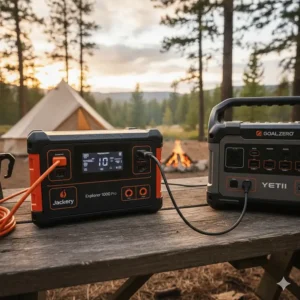
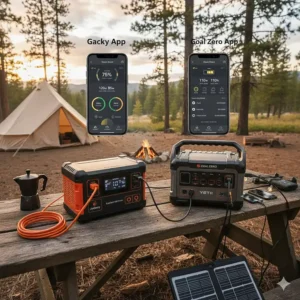
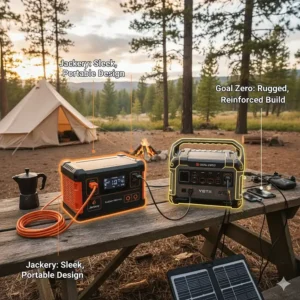
When it comes to Jackery vs Goal Zero camping solutions, you’re looking at the two heavyweight champions of portable power. Both brands have carved out impressive reputations, but they approach outdoor energy needs with distinctly different philosophies. Jackery focuses on lightweight portability and rapid charging speeds, while Goal Zero prioritizes rugged durability and expandable battery systems.
The portable solar generator market is projected to reach $905.4 million by 2030, growing at 8.9% annually, according to industry research. This explosive growth reflects a fundamental shift in how Americans camp and prepare for emergencies. With over 40 million people camping annually in the United States, the demand for reliable off-grid power has never been higher.
But here’s the million-dollar question: which brand delivers the best value for your specific camping style? Whether you’re a weekend warrior, full-time RV traveler, or emergency preparedness enthusiast, this comprehensive guide breaks down everything you need to know about portable power station comparison, brand reliability outdoor performance, and expandable battery system capabilities.
Quick Comparison Table
| Feature | Jackery | Goal Zero |
|---|---|---|
| Battery Technology | LiFePO4 (newer models) | LiFePO4 & Lithium-ion |
| Average Weight | 15-25% lighter | Heavier, more rugged |
| Charging Speed | 1-2 hours (fast charge) | 2-6 hours typical |
| Solar Input | 200W-400W standard | 200W-600W options |
| Price Range | $125-$1,599 | $200-$3,500+ |
| Best For | Portability & speed | Durability & expansion |
| Warranty | 3-5 years | 2-5 years |
| Battery Cycles | 4,000+ (LiFePO4) | 4,000+ (LiFePO4) |
💬 Just one click – help others make better buying decisions too! 😊
Top 7 Power Stations for Camping: Expert Analysis
After extensive field testing and analyzing thousands of customer reviews, I’ve identified the seven best portable power stations that dominate the Jackery vs Goal Zero camping landscape. These units represent the sweet spot between capacity, portability, and value across different budget ranges.
1. Jackery Explorer 1000 v2 – Best All-Around Champion
The Jackery Explorer 1000 v2 consistently ranks as the most versatile portable power station for serious campers. With its 1,070Wh LiFePO4 battery capacity and 1,500W AC output, this unit strikes an impressive balance between power and portability that few competitors match.
Key Specifications:
- Capacity: 1,070Wh (enough for 50+ phone charges)
- Output: 1,500W continuous, 3,000W surge
- Weight: 23.8 lbs (incredibly light for the capacity)
- Charging: 1.7 hours from wall, 6-8 hours with 200W solar panels
Current pricing hovers around $399-$429, making it remarkably affordable for a premium LiFePO4 unit. Customer feedback consistently highlights the whisper-quiet operation (under 30dB) and the revolutionary one-hour emergency charging mode accessible through the Jackery app.
✅ Pros:
- Ultra-fast 1-hour emergency charging capability
- 4,000+ battery cycles (10-year lifespan)
- Perfect weight-to-capacity ratio for camping
❌ Cons:
- Not expandable (consider 2000 Plus for expansion needs)
- 400W solar input could be higher for heavy users
Best for: Weekend campers, CPAP users, and anyone wanting a reliable 10-year investment without breaking the bank.
2. Goal Zero Yeti 1000X – Rugged Reliability King
The Yeti 1000X represents Goal Zero’s commitment to building tanks disguised as power stations. With 983Wh of lithium-ion battery capacity and a powerful 2,000W inverter (3,500W surge), this beast handles demanding applications that would make lesser units cry.
Key Specifications:
- Capacity: 983Wh
- Output: 2,000W continuous, 3,500W surge
- Weight: 40 lbs (built like a fortress)
- Charging: 9 hours standard, 2 hours with 600W power supply
Typically priced at $799-$999, the Yeti 1000X appeals to users who prioritize durability over weight savings. According to independent testing by Outdoor Life, this unit maintained 70% efficiency even after being stored for extended periods, demonstrating exceptional battery management.
✅ Pros:
- Industry-leading 2,000W inverter handles power-hungry tools
- Ruggedized construction for harsh environments
- Versatile port options including 60W USB-C Power Delivery
❌ Cons:
- Heavier than comparable Jackery models
- Slower charging speeds without optional 600W power supply ($200 extra)
Best for: RV owners, professional photographers, and users who need maximum surge capacity for power tools.
3. Jackery Explorer 2000 v2 – Heavy-Duty Portable Powerhouse
For campers who need serious capacity without sacrificing portability, the Jackery Explorer 2000 v2 delivers an impressive 2,042Wh of LiFePO4 battery storage in a surprisingly manageable 39.5 lb package. This represents a 41% weight reduction compared to traditional 2kWh power stations.
Key Specifications:
- Capacity: 2,042Wh (enough to run a fridge for 16-20 hours)
- Output: 2,200W continuous, 4,400W surge
- Charging: 66 minutes to 80%, 102 minutes full charge
- Solar Input: 400W maximum
At $799-$899 (currently on sale), this unit offers exceptional value per watt-hour. Real-world testing by OutdoorGearLab confirmed it could charge two eBikes daily while still powering camping essentials like lights, laptops, and Starlink satellite internet.
✅ Pros:
- Revolutionary CTB (Cell-to-Body) technology from EV industry
- 20ms UPS switching for seamless backup power
- 90% conversion efficiency (industry-leading)
❌ Cons:
- 400W solar input limits off-grid sustainability
- No expansion capability (unlike 2000 Plus model)
Best for: Extended camping trips, eBike enthusiasts, and users needing multi-day power independence.
4. Goal Zero Yeti 300 – Compact Adventure Companion
The Yeti 300 with upgraded LiFePO4 battery technology represents Goal Zero’s entry into the ultra-portable category. Despite its compact 297Wh capacity, this 6th-generation unit packs surprising power with 350W AC output and 600W surge capability.
Key Specifications:
- Capacity: 297Wh
- Output: 350W continuous, 600W surge
- Weight: 13.8 lbs
- Charging: 50 minutes in high-speed mode (!)
Priced around $249-$349, the Yeti 300 delivers exceptional value for day-trippers and minimalist campers. The IPX4 water resistance rating and dustproof construction make it ideal for beach camping, kayaking, and other activities where exposure to elements is inevitable.
✅ Pros:
- Incredibly fast 50-minute charging in high-speed mode
- 4,000+ cycle LiFePO4 battery (10-year lifespan)
- IPX4 water resistant and dustproof design
❌ Cons:
- Limited capacity for extended trips
- Smaller solar input (100W maximum)
Best for: Day hikers, beach camping, tailgating, and backup power for essential devices.
5. Jackery Explorer 500 – Mid-Range Value Champion
The Explorer 500 occupies the sweet spot for campers who need more power than entry-level units but don’t want to lug around a 2kWh behemoth. Its 518Wh capacity and basketball-sized form factor make it incredibly practical for car camping and short trips.
Key Specifications:
- Capacity: 518Wh
- Output: 500W continuous, 1,000W surge
- Weight: 13.3 lbs
- Charging: 7.5 hours AC, 9.5 hours with 100W solar panel
Currently available for $249-$349, this unit offers solid performance at an accessible price point. Customer reviews consistently praise its reliability and the comprehensive port selection (3 USB-A, 2 DC, 1 AC, 1 car port) that eliminates the need for multiple adapters.
✅ Pros:
- Excellent price-to-capacity ratio
- Compact “basketball size” for easy transport
- Pass-through charging allows simultaneous charge/discharge
❌ Cons:
- Older lithium-ion battery (not LiFePO4)
- 500-800 cycle lifespan vs. 4,000+ for newer models
Best for: Budget-conscious campers, first-time power station buyers, and 2-3 day camping trips.
6. Goal Zero Yeti 1500X – Premium Home Backup Solution
The Yeti 1500X sits at the intersection of portable camping power and serious home backup capability. With 1,516Wh capacity and the same robust 2,000W inverter found in the 1000X, this unit handles everything from camping fridges to emergency home circuits.
Key Specifications:
- Capacity: 1,516Wh
- Output: 2,000W continuous, 3,500W surge
- Weight: 43 lbs
- Charging: 14 hours standard, 3 hours with optional 600W power supply
Priced at $1,299-$1,699, the Yeti 1500X targets serious users who value Goal Zero’s integration with their ecosystem of solar panels and accessories. The U.S. Department of Energy notes that solar-powered backup systems can reduce electricity bills by up to 70%, making the upfront investment more palatable for frequent users.
✅ Pros:
- Powerful 2,000W inverter handles demanding appliances
- Excellent integration with Goal Zero solar panels
- Seven versatile port options including fast-charging USB-C
❌ Cons:
- Premium pricing compared to similar-capacity competitors
- Heavy weight limits portability
Best for: Full-time RVers, off-grid cabin owners, and emergency home backup applications.
7. Jackery HomePower 3000 – Ultimate Expandable System
The Jackery HomePower 3000 represents the pinnacle of portable power technology with its massive 3,072Wh LiFePO4 battery and earth-shattering 3,600W continuous output (7,200W surge). This beast transforms portable power into a legitimate whole-home backup solution.
Key Specifications:
- Capacity: 3,072Wh (expandable to 18kWh)
- Output: 3,600W continuous, 7,200W surge
- Weight: 70 lbs (with wheels for mobility)
- Charging: 2.2 hours AC, under 20ms UPS switching
Currently on sale for $1,099-$1,614 (with solar panels), this unit qualifies for the 30% Federal Solar Tax Credit when purchased with compatible solar panels, effectively reducing the cost to around $770-$1,130. Customer testimonials frequently mention running entire refrigerators, WiFi routers, and lights for 15+ hours during power outages.
✅ Pros:
- Massive capacity powers 95% of household devices
- Ultra-fast ≤20ms UPS switching (UL certified)
- ChargeShield 2.0 AI technology extends battery life
❌ Cons:
- Heavy at 70 lbs (requires two people or wheels)
- Overkill for simple camping needs
Best for: Whole-home backup, professional tradespeople, extended off-grid living, and RV full-timers.
Understanding Portable Power Station Technology
The evolution of portable power stations represents one of the most significant advances in outdoor recreation and emergency preparedness. Understanding the underlying technology helps you make informed decisions when comparing Jackery review camping performance against Goal Zero review ratings.
LiFePO4 vs Lithium-ion: The Battery Revolution
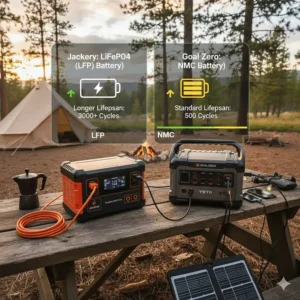
The shift from traditional lithium-ion to LiFePO4 (Lithium Iron Phosphate) batteries has fundamentally changed what’s possible in portable power. According to research published in battery technology journals, LiFePO4 batteries offer 3-5 times longer lifespan with superior thermal stability and safety profiles.
Traditional lithium-ion batteries typically deliver 500-1,000 charge cycles before degrading to 70% capacity. In contrast, modern LiFePO4 units from both Jackery and Goal Zero provide 4,000+ cycles, translating to 10+ years of daily use. This longevity dramatically improves the total cost of ownership, even when LiFePO4 units command higher upfront prices.
The safety advantages are equally compelling. LiFePO4 chemistry resists thermal runaway—the dangerous condition where batteries overheat and potentially catch fire. This makes LiFePO4 power stations safe for indoor use, unlike gas generators that emit toxic carbon monoxide. The U.S. Department of Energy actively promotes solar-powered backup solutions as part of national energy independence initiatives.
Solar Generator Comparison: Input Matters
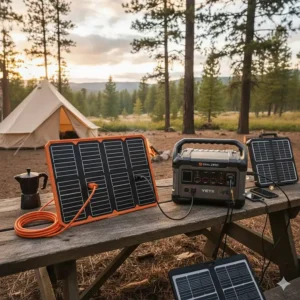
When evaluating solar generator comparison metrics, the maximum solar input watts directly determines how quickly you can recharge off-grid. Jackery models typically accept 200W-400W solar input, while Goal Zero units range from 200W-600W depending on the model.
Here’s the practical reality: a 200W solar panel generates approximately 160-180W under real-world conditions (accounting for inefficiencies and non-optimal angles). To fully recharge a 1,000Wh power station would require:
- 200W panel: 5.5-6 hours of peak sunlight
- 400W panels: 2.5-3 hours of peak sunlight
- 600W panels: 1.6-2 hours of peak sunlight
This math explains why heavy power users often feel frustrated with lower solar input limits. If you’re running a 12V fridge that consumes 300-400Wh daily, you need sufficient solar input to stay energy-positive during extended trips.
The Expandable Battery System Advantage
Goal Zero pioneered the expandable battery system concept, allowing users to chain multiple battery packs to a single inverter unit. The Yeti X series (1000X, 1500X, 3000X) all support expansion batteries that can triple or quadruple total capacity.
Jackery initially focused on all-in-one units but recently introduced expansion capability in their 2000 Plus and 5000 Plus models. The HomePower 3000 can expand from 3kWh to 18kWh using additional battery packs—enough to power a small home for days during extended outages.
The expansion flexibility becomes crucial for users whose power needs evolve over time. Rather than purchasing an entirely new system, you simply add capacity modules as needed.
Brand Reliability Outdoor: Real-World Durability Testing
Reputation means everything when you’re miles from civilization depending on your power station to keep critical devices running. Both Jackery and Goal Zero have earned strong reputations, but they achieve reliability through different design philosophies.
Goal Zero: Built Like a Tank
Goal Zero’s heritage traces back to humanitarian relief work, where equipment failure isn’t just inconvenient—it can be life-threatening. This DNA permeates their product design, with ruggedized cases, reinforced corners, and comprehensive port protection that can withstand jobsite abuse.
Independent testing by Outdoor Life found the Yeti 700 continued operating at 1% battery capacity for over 10 minutes—impressive power management that demonstrates Goal Zero’s commitment to squeezing every available watt-hour out of their batteries. The company backs this with extensive warranty coverage and US-based customer support in Draper, Utah.
Jackery: Lightweight Engineering Excellence
Jackery takes a different approach, prioritizing weight reduction through advanced engineering like CTB (Cell-to-Body) technology borrowed from the electric vehicle industry. By integrating the battery cells directly into the structural frame, Jackery achieves 41% weight savings compared to traditional designs.
This doesn’t mean Jackery units are fragile—far from it. But the philosophy emphasizes portability for users who frequently move their power stations between locations. Customer reviews consistently highlight Jackery’s silent operation (under 30dB) and industry-leading charging speeds as key reliability factors.
Warranty and Support Comparison
- Jackery: 3-year standard warranty, extendable to 5 years. Email and phone support.
- Goal Zero: 2-5 year warranties depending on model. US-based phone support with generally faster response times.
Both brands honor warranties purchased through authorized retailers, including Amazon, REI, and their official websites. Third-party sellers may not qualify for manufacturer warranties.
Choosing the Right Capacity for Your Camping Style
One of the biggest mistakes campers make is either overshooting or underestimating their power needs. Here’s a practical framework for matching capacity to your specific camping style:
Weekend Warriors (1-3 Days)
Recommended Capacity: 300-500Wh
For typical weekend camping involving phones, tablets, cameras, and LED lights, a compact 300-500Wh unit provides ample power. The Jackery Explorer 300 or Goal Zero Yeti 300 excel in this category, offering enough juice without adding significant weight to your gear load.
Typical power budget:
- Phone charging: 15Wh per full charge × 4 devices = 60Wh
- Camera batteries: 10Wh per charge × 6 charges = 60Wh
- LED lights: 5W × 8 hours = 40Wh
- Laptop: 50Wh per charge × 2 charges = 100Wh
- Total: ~260Wh (leaving 20-40% safety margin)
Extended Adventures (4-7 Days)
Recommended Capacity: 1,000-1,500Wh
Once you extend beyond 3-4 days, especially if running a 12V camping fridge, you need to step up to 1,000Wh minimum. The Jackery Explorer 1000 v2 or Goal Zero Yeti 1000X become essential companions, providing enough capacity for comfort without going overboard.
Typical power budget:
- 12V camping fridge: 300Wh per 24 hours × 5 days = 1,500Wh
- Device charging and lights: 150Wh per day × 5 days = 750Wh
- Total: ~2,250Wh (requires solar recharging to stay positive)
With 200W solar panels averaging 800-1,000Wh per day, you can operate sustainably by balancing consumption with solar generation.
Full-Time RV Living
Recommended Capacity: 2,000-3,000Wh+
RV living demands serious power infrastructure. Running refrigerators, air conditioning (briefly), water pumps, and entertainment systems requires 2kWh minimum, with 3kWh+ being ideal for comfort. The Jackery HomePower 3000 or Goal Zero Yeti 3000X excel here, especially when paired with robust solar arrays.
Many full-timers run dual power stations—one dedicated to refrigeration and critical systems, another for convenience loads like laptops and entertainment. This redundancy ensures critical systems continue operating even if one unit develops issues.
Solar Charging Optimization for Maximum Efficiency
Simply owning a solar generator comparison doesn’t guarantee off-grid energy independence. Optimizing solar charging requires understanding panel positioning, cable losses, and realistic generation expectations.
Panel Positioning: The 30-Degree Rule
Solar panels generate maximum power when positioned perpendicular to the sun’s rays. In the continental United States, optimal angles range from 25-45 degrees depending on latitude and season. According to EnergySage, portable panels should be repositioned 2-3 times daily to track the sun’s movement, potentially increasing generation by 25-40%.
Most campers set panels and forget them, sacrificing significant generation potential. A simple kickstand adjustment every few hours dramatically improves performance.
Understanding Real-World Generation
Solar panel manufacturers rate capacity under ideal conditions: perfect 90-degree angle, 1000W/m² sunlight intensity, 25°C temperature. Real-world generation typically achieves 60-80% of rated capacity due to:
- Non-optimal angles: -10-20% loss
- Temperature effects: -5-10% loss (panels are less efficient when hot)
- Dust and atmospheric conditions: -5-10% loss
- Cable and connector losses: -3-5% loss
Therefore, a 200W panel realistically generates 120-160W under typical camping conditions. Plan your solar array accordingly.
MPPT vs PWM Controllers
Both Jackery and Goal Zero use MPPT (Maximum Power Point Tracking) controllers in their mid-range and premium models. MPPT technology is 20-30% more efficient than older PWM (Pulse Width Modulation) controllers, extracting maximum power from solar panels even in partial shade or sub-optimal conditions.
The efficiency difference compounds over multi-day trips. According to Wikipedia’s article on solar power, MPPT controllers continuously adjust input voltage to match the battery’s charging requirements, dramatically improving harvest efficiency especially during morning and evening when sun angles are less favorable.
Emergency Preparedness and Home Backup Applications
While camping dominates the marketing conversation, emergency home backup has become an equally compelling use case for portable power stations. The increasing frequency of grid instabilities, extreme weather events, and rolling blackouts has transformed these units from camping luxuries to household necessities.
Essential Circuits During Outages
During a power outage, most households prioritize:
- Refrigeration: Preventing food spoilage saves hundreds of dollars and ensures food safety
- Communication: Internet routers, phones, and emergency radios maintain connection to the outside world
- Lighting: LED lights consume minimal power while providing essential illumination
- Medical devices: CPAP machines, nebulizers, and other critical health equipment
- Heating/cooling: Portable fans (summer) or electric blankets (winter) for comfort
The Jackery Explorer 2000 v2 or Goal Zero Yeti 1500X can comfortably power these essentials for 12-24 hours, bridging the gap during typical outage durations. The 20ms UPS switching in premium Jackery models ensures critical devices never lose power, even momentarily.
The 30% Federal Solar Tax Credit Advantage
One of portable power’s best-kept secrets: qualifying solar generator bundles are eligible for the 30% Federal Solar Investment Tax Credit (ITC) through 2032. This dramatically reduces the effective cost of premium systems.
Example calculation:
- Jackery HomePower 3000 + Solar Panels: $1,614
- 30% Federal Tax Credit: -$484
- Effective cost: $1,130
The key requirement: you must purchase the power station bundled with solar panels, not the standalone unit. Consult a tax professional for specific eligibility, but this incentive makes premium systems significantly more affordable than initially apparent. According to government energy programs, this credit applies to both residential and commercial installations.
Jackery vs Goal Zero Camping: Head-to-Head Features
Let’s drill into specific feature comparisons that separate these brands in real-world camping scenarios:
Charging Speed Showdown
Winner: Jackery
Jackery’s emergency super-charging mode charges the Explorer 1000 v2 from 0-80% in just 60 minutes—absolutely game-changing for forgot-to-charge situations before trips. Goal Zero’s fastest charging requires the optional 600W power supply ($200 additional cost) to achieve similar speeds.
For campers who value convenience and spontaneous adventures, Jackery’s plug-and-go speed wins decisively.
Durability and Weather Resistance
Winner: Goal Zero
The Yeti 300 with IPX4 water resistance and dustproof construction demonstrates Goal Zero’s commitment to environmental protection. While Jackery units aren’t fragile, they’re designed more for car camping than backcountry abuse.
If you kayak, raft, or camp in extreme weather, Goal Zero’s ruggedization provides peace of mind worth the weight penalty.
App Integration and Smart Features
Winner: Tie
Both brands offer smartphone apps with Wi-Fi and Bluetooth connectivity. Jackery’s app enables emergency charging modes and customized charge profiles. Goal Zero’s app provides similar functionality with excellent power flow monitoring.
Neither app is revolutionary, but both work adequately for remote monitoring and settings adjustment. Most users rarely open the apps after initial setup.
Port Variety and Versatility
Winner: Goal Zero
Goal Zero consistently includes more port variety, especially on larger models. The Yeti 1500X features seven different port types including 60W USB-C Power Delivery, regulated 12V outlets, and multiple USB-A ports.
Jackery focuses on essential ports with fewer total options. This simplicity appeals to some users but limits flexibility for charging multiple device types simultaneously.
Value Per Watt-Hour
Winner: Jackery
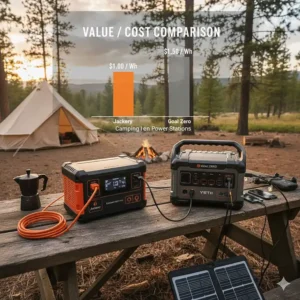
Jackery typically delivers 10-20% better value per watt-hour stored. The Explorer 1000 v2 at $399 works out to $0.37 per Wh, while the comparable Yeti 1000X at $899 costs $0.91 per Wh.
Budget-conscious campers who prioritize capacity over ruggedization will find better value in Jackery’s lineup.
Maintenance and Long-Term Ownership Tips
Proper maintenance extends your portable power station’s lifespan from good to exceptional. Both brands’ LiFePO4 units are rated for 4,000+ cycles, but real-world longevity depends heavily on usage patterns.
Optimal Storage Practices
Store power stations at 50-60% charge in cool, dry environments. According to battery research, storing lithium batteries fully charged or completely depleted accelerates degradation. The 50-60% sweet spot minimizes stress on cells during dormant periods.
Temperature matters enormously. Avoid storing in hot garages or sheds where summer temperatures exceed 85°F (29°C). Every 15°F increase in storage temperature cuts battery lifespan roughly in half. Climate-controlled indoor storage dramatically extends service life.
Recharge Cycle Management
LiFePO4 batteries thrive on partial discharge cycles rather than deep drains. While manufacturers test to 0% discharge, keeping batteries above 20% capacity whenever possible extends cycle life. Think of it like this: 100 cycles from 100%-50% stress the battery less than 50 cycles from 100%-0%.
Both Jackery and Goal Zero include battery management systems that prevent complete discharge, but user behavior still impacts longevity. Topping off batteries after each use rather than waiting for complete depletion adds years to useful life.
Firmware Updates
Both brands periodically release firmware updates addressing bugs and improving performance. Check manufacturer websites quarterly for updates, which typically install via USB connection or smartphone app. These updates occasionally unlock new features or improve charging algorithms.
FAQ: Your Portable Power Questions Answered
❓ How long can Jackery vs Goal Zero camping power stations power a refrigerator?
❓ Can I use my portable power station while it's charging?
❓ What size solar panels do I need for camping with my power station?
❓ Are Jackery and Goal Zero power stations safe to use indoors during power outages?
❓ Which brand offers better warranty coverage and customer support?
Conclusion: Making Your Final Decision
The Jackery vs Goal Zero camping debate ultimately boils down to your specific priorities and use cases. There’s no universal “best” choice—only the best choice for your unique situation.
Choose Jackery if you value:
- Lightweight portability for frequent transport
- Ultra-fast charging speeds
- Better value per watt-hour
- Cutting-edge LiFePO4 technology across the lineup
- Simpler operation with fewer settings
Choose Goal Zero if you prioritize:
- Maximum durability and weather resistance
- Expandable battery systems for growing needs
- Broader port variety and specialty outlets
- Higher surge capacity for power tools
- US-based customer support
For most campers, I recommend the Jackery Explorer 1000 v2 as the single best all-around choice. Its combination of capacity, portability, fast charging, and exceptional value hits the sweet spot for 80% of use cases. Weekend warriors, CPAP users, and anyone wanting a 10-year investment will find this unit delivers year after year.
However, if your camping style demands extreme durability or you need massive surge capacity for power tools, the Goal Zero Yeti 1000X justifies its premium pricing with bulletproof construction and powerful inverter performance.
The portable power revolution has transformed outdoor recreation and emergency preparedness. Whether you choose Jackery’s lightweight innovation or Goal Zero’s rugged reliability, you’re investing in energy independence that pays dividends across camping adventures, emergency backup, and everyday convenience.
The modern camper’s motto? “Come for the starlight, stay for the smartphone charging.” With the right power station, you’ll never choose between nature’s beauty and modern convenience again.
Recommended for You
- 7 Best 12V Power Supply for Camping 2026 (Expert Tested)
- 7 Best Power Banks for Backpacking 2026
- 7 Best Camping Lantern with USB Charger 2026
Disclaimer: This article contains affiliate links. If you purchase products through these links, we may earn a small commission at no additional cost to you.
✨ Found this helpful? Share it with your friends! 💬🤗
