
In This Article
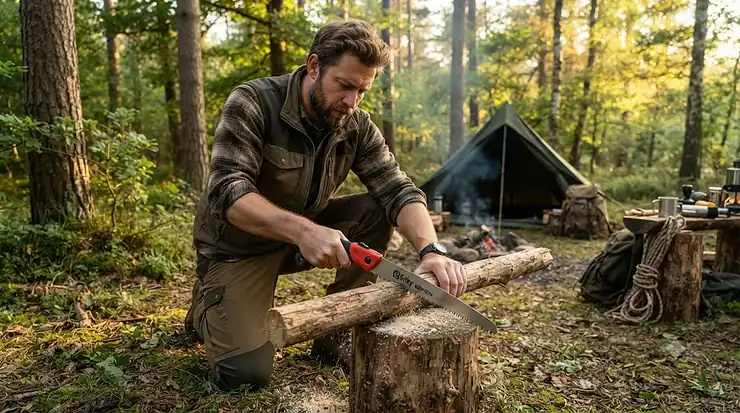
There’s a specific kind of regret that hits around 9 p.m. at a campsite, when the fire’s dying, the only “kindling” left is a fistful of damp twigs, and the only cutting tool in your pack is a butter knife you packed for the cheese. A good folding saw fixes that problem forever, and this silky saw review camping guide exists because most people don’t realize how far pack saws have come since the days of the rusty Boy Scout bow saw. Silky, a Japanese manufacturer with a century of blade-making behind it, has more or less rewritten the rulebook for what a hand saw can do when you shrink it down to backpack size.
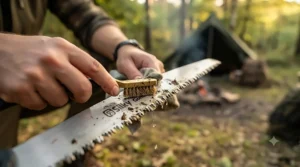
So what is a Silky saw, exactly? It’s a Japanese-made folding hand saw that cuts on the pull stroke rather than the push stroke, using impulse-hardened teeth on a taper-ground blade to slice through green or dry wood faster and with less effort than a typical Western saw. That single design choice — cutting on the pull instead of the push — is the reason these saws show up in the packs of trail crews, hunters, overlanders, and weekend car campers who got tired of hacking at branches with a multitool.
This guide walks through seven real folding saws worth your money, from a $25 backyard classic to Silky’s biggest camp saw, and it digs into the mechanics that actually matter: pull stroke cutting, impulse hardened teeth, and how the Silky Gomboy camping crowd differs from people who need something bigger, like the Bigboy 2000. We’ll also put Silky vs other saws head to head, cover blade replacement for Silky saws when your edge finally dulls, and give you a decision framework so you’re not just guessing. Prices below are shown as ranges rather than fixed numbers, since retailer pricing shifts constantly — check current listings before you buy.
Quick Comparison: Top Camping Saws at a Glance
| Saw | Blade Length | Teeth Style | Weight | Price Range | Best For |
|---|---|---|---|---|---|
| Silky Gomboy 240 | 240mm (9.5″) | Medium, straight | ~9.6 oz | $45-$60 | All-around camping |
| Silky Pocketboy 170 | 170mm (6.75″) | Large, curved | ~7.8 oz | $35-$50 | Ultralight backpacking |
| Bahco Laplander | 190mm (7.5″) | 7 TPI, straight | ~6.6 oz | $20-$35 | Budget/value pick |
| Corona RS 7265D | 250mm (10″) | 3-sided razor, curved | ~8 oz | $25-$35 | Garden-to-camp crossover |
| Silky Ultra Accel 240 Curve | 240mm (9.5″) | Large, curved | ~10.4 oz | $70-$90 | Overhead/canopy cutting |
| Silky Bigboy 2000 | 360mm (14.2″) | XL, curved | ~15 oz | $80-$100 | Big logs, trail crews |
| Silky Zubat Professional 330 | 330mm (13″) | Large, curved, fixed | ~9-14 oz | $75-$95 | Arborist-grade/game processing |
Analysis: Notice the split in this table between compact folding saws under 8 ounces and the two heavyweights, the Bigboy 2000 and the Zubat, that trade portability for raw cutting reach. If your trips involve carrying every ounce yourself, the Pocketboy or Laplander earn their keep by disappearing in a pack pocket. If you’re clearing a trail or feeding an overnight fire for a group, the extra half-pound on the Bigboy pays for itself in fewer strokes per log. The price spread is also telling — you’re not paying double for the Silky name alone, you’re paying for aluminum chassis construction, impulse-hardened steel, and, in most cases, a longer warranty.
💬 Found a favorite already? Tap through and compare current prices before the good sizes sell out.
💬 Just one click — help others make better buying decisions too!😊
Top 7 Camping Saws: Expert Analysis
Coverage below spans budget, mid-range, and premium tiers, plus a couple of non-Silky saws so you can weigh the Japanese pull-saw approach against Western designs on their own merits.
1. Silky Gomboy 240 — best all-around Silky saw review camping pick
The number in the name refers to the 240mm blade length, and that single dimension is why this is the most recommended saw in the entire Silky lineup for general camping use. Right out of the case, the taper-ground blade is noticeably wider at the teeth than at the spine, a shape that lets it bite hard on the pull stroke while resisting binding partway through a cut.
The blade carries 8.5 teeth per inch in the medium configuration, weighs about 9.6 ounces with its hard plastic case, and locks into two cutting angles for both standard and flush cuts. In practice, that spec sheet means you can buck a 4-to-5-inch limb for firewood and then, without changing tools, flush-cut a stump or tent stake nub level with the ground. Based on the spec comparison with cheaper folding saws, the chrome plating and impulse-hardened teeth are what let this blade outlast bargain saws by years rather than months.
Reviewers consistently note that the Gomboy outcuts comparably sized Western saws by a wide margin, with more than one owner on gear forums describing it as leaving competitors “not even a close contest” once wood starts biting into the teeth. Home improvement retailer reviews do flag occasional blade snaps under improper force, a reminder that these saws are built to be pulled, not pushed or twisted.
Pros:
- ✅ Taper-ground blade resists binding mid-cut
- ✅ Two locking angles allow flush cutting
- ✅ Lightweight enough for daily pack carry
Cons:
- ❌ Blade can snap if pushed instead of pulled
- ❌ Case rattles slightly during transport
In the $45-$60 range, the Gomboy 240 delivers premium cutting performance for a mid-tier price, making it the easiest recommendation on this list for a first Silky saw.
2. Silky Pocketboy 170 — lightest true backpacking option
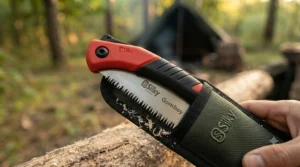
Nicknamed the “Little Giant” by Silky’s own marketing, and for once that’s not just copywriting — this saw punches well above its size class. The standout feature here is how little space it demands: folded down, it disappears into a jacket pocket or hip-belt pouch without you noticing the weight.
With a 170mm curved blade, 6.8 teeth per inch in the large-tooth version, and an overall weight around 7.8 ounces including its belt-clip case, the Pocketboy is built for small-to-medium branches rather than firewood-processing marathons. What most buyers overlook about this size is that the curved blade geometry puts more teeth into contact with the wood per stroke than a straight blade of the same length, which partly offsets the shorter cutting surface.
Reviewers who carry it on bikes, in glove boxes, and on day hikes describe it as capable of handling any roadside obstruction with surprising speed for its size, and several note it’s the first Silky saw they bought but rarely the last. The main complaint in aggregated feedback is that the handle feels short for anyone with large hands, and the case can rattle against gear when clipped externally.
Pros:
- ✅ Fits in a pocket or hip pouch easily
- ✅ Curved blade compensates for shorter length
- ✅ Impulse-hardened teeth hold an edge for years
Cons:
- ❌ Handle feels short for larger hands
- ❌ Limited to branches under about 4 inches
Priced around $35-$50 depending on tooth configuration, the Pocketboy 170 is the value leader for anyone whose priority is grams saved, not logs processed.
3. Bahco Laplander — best budget alternative to Silky
Swedish, not Japanese, and cutting on both the push and pull strokes rather than pull-only, the Laplander is the saw most often mentioned in the same breath as Silky, usually as the “half the price, most of the performance” option. Its standout feature is a push-pull tooth pattern using Bahco’s XT hardpoint steel, which trades some of the Silky’s pull-stroke efficiency for versatility in awkward cutting positions.
At roughly 9 inches folded with a 7.5-inch blade, 7 teeth per inch, and a weight just over 6 ounces, the Laplander is dimensioned for branches and small trees up to about 4-5 inches in diameter — trying to push it much past that turns into a workout. Here’s what to weigh: the coated Sandvik steel blade resists rust well and the button-lock mechanism secures the blade both open and closed, a genuine safety plus for anyone tossing it loose into a pack.
Owners across gear forums repeatedly call it the “benchmark” budget folding saw, with many noting they’d trust it for years of firewood duty even after watching premium alternatives cut faster in side-by-side tests. The most common gripe is that the stiff button lock is hard to depress when new, and sharpening the impulse-hardened teeth at home isn’t practical once they finally dull.
Pros:
- ✅ Cuts on both push and pull strokes
- ✅ Doubly-secure open-and-closed locking button
- ✅ Excellent value at roughly half Silky’s price
Cons:
- ❌ Locking button is stiff when new
- ❌ Struggles past 4-5 inch diameter wood
In the $20-$35 range, the Laplander remains the reference point every budget folding saw gets measured against.
4. Corona RS 7265D RazorTOOTH — most affordable garden-to-camp crossover
Corona built its reputation in orchards and gardens, and this saw’s standout feature — 3-sided razor teeth sharpened on a whetstone grind — reflects that pruning pedigree rather than a bushcraft one. It still earns a spot on most budget camping-saw shortlists because the same geometry that shears through fruit-tree limbs also handles firewood-sized branches without complaint.
The 10-inch curved, taper-ground blade cuts up to 6 teeth per inch and is rated for branches 5-6 inches in diameter, all on a saw that typically weighs around 8 ounces. Based on the spec comparison, the curved profile puts more of the blade’s length in contact with the wood per pull than a straight-bladed saw of the same size, which is why owners describe it finishing cuts “twice as fast” as older, flat-blade designs.
Aggregated reviews are largely favorable on cutting speed, though a recurring theme is that the blade bends more easily under sideways pressure than Silky’s chrome-plated steel — a fair trade for a saw that often costs a third of the price. Reviewers note the co-molded handle stays comfortable through extended pruning sessions, which translates well to a long night of processing firewood.
Pros:
- ✅ Razor-sharp 3-sided teeth cut fast
- ✅ Curved blade maximizes contact per pull
- ✅ Replaceable blade keeps long-term costs low
Cons:
- ❌ Blade bends more easily than premium steel
- ❌ Best suited to branches under 6 inches
At around $25-$35, this is the saw to hand a first-time camper or keep as a glovebox spare without worrying about losing an expensive tool.
5. Silky Ultra Accel 240 Curve — best for overhead and canopy work
Where the Gomboy uses a folding steel frame, the Ultra Accel’s standout feature is its aluminum chassis, built to give a folding saw the rigidity of a fixed-blade tool without the bulk. That stiffness matters most when you’re reaching up into a canopy or cutting at an awkward angle where a flexier blade would twist.
Specs run 240mm curved blade, roughly 6.4 teeth per inch, and a weight near 10.4 ounces — heavier than the Gomboy, but the aluminum handle spreads that weight in a way that reduces hand fatigue on longer sessions. What the spec sheet won’t tell you, but reviewers note, is that the curve is specifically tuned for cutting above shoulder height, so it’s less ideal than a straight blade for low, close-in bucking work at a fire ring.
Owners who’ve used it for a full season of chipping brush and trimming dirty roots describe the blade as staying sharp far longer than expected, and several single it out as their pick for climbing work, not just ground-level camp chores. The trade-off most reviewers flag is straightforward: it costs noticeably more than the Gomboy for a similar-length blade, and the extra weight is only worth it if you’re actually using the reach and rigidity it offers.
Pros:
- ✅ Aluminum chassis resists twisting under load
- ✅ Curved blade excels at overhead cutting
- ✅ Holds an edge across a full season of use
Cons:
- ❌ Heavier than comparably sized folding saws
- ❌ Premium price for similar blade length
At $70-$90, the Ultra Accel 240 Curve is a specialist’s pick — buy it for the aluminum rigidity and overhead reach, not as a general-purpose camp saw.
6. Silky Bigboy 2000 — best for big wood and trail crews
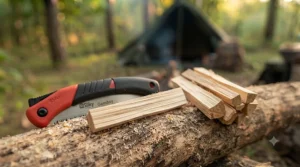
If the Gomboy is the everyday tool, the Bigboy 2000 is the one you reach for when a downed tree is blocking the trail. Its standout feature is a 360mm (14.2-inch) curved blade with a low-angle 2,000mm radius curve, engineered to keep cutting fast and smooth through logs up to about 8 inches in diameter.
At 5.5 teeth per inch and roughly 15 ounces with its rubberized two-handed grip, this saw is dimensioned for two-handed leverage rather than one-handed convenience — you’re meant to grip it like a small bucksaw, not flick it like a pocketknife. Reviewers consistently note it cuts green and dry wood with equal ease and that its pull-only stroke rewards patience: force it on the push and you risk bending the thin spine.
Trail-maintenance volunteers and overlanders are the loudest fans here, with several describing it as outperforming a 24-inch traditional bucksaw in the hands of an experienced user, and others recounting clearing 12-to-18-inch diameter deadfall from forest roads. The most common complaint across owner reviews is a lack of a secure closed-position lock on some versions, which lets the blade swing open unexpectedly if the pivot screw loosens.
Pros:
- ✅ 14.2-inch blade handles logs up to 8 inches
- ✅ Two-handed grip reduces per-stroke fatigue
- ✅ Cuts green and dry wood equally well
Cons:
- ❌ No secure closed-position lock on some units
- ❌ Too large for solo ultralight backpacking
Running $80-$100, the Bigboy 2000 is worth the premium exclusively for people who regularly process wood bigger than a wrist — car campers, overlanders, and volunteer trail crews.
7. Silky Zubat Professional 330 — premium fixed-blade for arborist-grade cutting
Unlike the other six saws here, the Zubat isn’t a folding design — its standout feature is a mono-constructed, non-folding blade carried in a pivoting scabbard, the format professional arborists reach for when a folding hinge would be one more point of failure under heavy load. It’s included here specifically for the “Silky vs other saws” comparison, because it represents the ceiling of what a Silky pull saw can do once you remove the folding mechanism entirely.
The 330mm curved blade runs about 7.5 teeth per 30mm, cuts stock up to roughly 6.5 inches in diameter, and the whole package — saw plus scabbard — weighs under a pound. Reviewers consistently describe the Zubat as the top-selling Silky saw in the commercial arborist market, which honestly says more about its performance than any marketing copy could. For camping specifically, its scabbard-carry format also suits hunters who need a saw for both firewood and game processing in a single trip.
Owner sentiment aggregated across retailer reviews is close to universally positive on cutting speed and blade retention, with the main critique being that a fixed blade demands a dedicated sheath and belt space that a folding saw doesn’t. For campers who prioritize pack compactness above all else, that’s a real consideration.
Pros:
- ✅ Fixed blade eliminates hinge failure points
- ✅ Handles branches up to 6.5 inches easily
- ✅ Doubles for game processing on hunting trips
Cons:
- ❌ Requires a separate belt sheath
- ❌ Not as pack-compact as a folding saw
At $75-$95, the Zubat is the premium pick for anyone who wants Silky’s best cutting geometry and doesn’t mind carrying a sheath instead of a folding hinge.
✨ Ready to add one of these to your kit? Check current availability before your next trip.
How to Choose a Camping Saw
Picking between these seven options gets easier once you break the decision into a short checklist rather than trying to compare every spec at once:
- Match blade length to typical wood diameter. A 170-240mm blade handles most campfire-sized branches; anything over 5-6 inches regularly calls for a 300mm-plus blade like the Bigboy or Zubat.
- Decide how much weight you’ll actually carry. Backpackers should stay under 8 ounces; car campers and overlanders can justify the extra heft of a two-handed saw.
- Consider tooth count for your typical wood. Fewer, larger teeth (5.5-7 TPI) cut faster through soft or green wood; more, finer teeth suit dry hardwood and cleaner cuts.
- Check the locking mechanism. A saw that locks both open and closed, like the Laplander or Gomboy, is safer to toss loosely into a pack than one that only locks open.
- Factor in blade replacement cost. Silky and Corona both sell replacement blades, so a saw with a screw-pivot design extends its useful life well beyond the first dulled edge.
- Weigh push-pull versus pull-only cutting. Pull-only Japanese blades cut faster per stroke but punish improper technique; push-pull Western designs like the Laplander are more forgiving for beginners.
- Budget for the whole kit, not just the saw. A case, sheath, or lanyard adds real protection and is worth factoring into your total spend.
Silky Gomboy Camping: Why This Line Leads the Pack
Ask any long-time backpacker or trail volunteer which single saw they’d recommend to a first-timer, and the Silky Gomboy camping line comes up more than any other name on this list, and for reasons that go beyond brand loyalty. The Gomboy 240 in particular sits at a sweet spot of blade length, weight, and price that the rest of Silky’s catalog is built around, either scaling up (Bigboy, Zubat) or down (Pocketboy) from that baseline.
Part of the appeal is versatility. A single Gomboy can flush-cut a stake, buck a limb for the fire, and clear light brush from a trail without swapping tools or blade angles. That’s a meaningfully different experience from carrying a dedicated pruning saw that struggles the moment the wood gets thick, or a hardware-store folding saw that dulls within a season. Reviewers who’ve owned other Silky models for a decade or more routinely point to the Gomboy as the one that never leaves the truck or the pack, precisely because it doesn’t demand you think about which saw a given task requires.
The other reason the Gomboy camping crowd is so loyal comes down to interchangeability: the folding and fixed-blade Gomboy-7 versions share blades across the same length, so a worn edge can be swapped without buying an entirely new saw. For anyone building a first camp kit and unsure which Silky to buy, starting with a Gomboy 240 and adding a Pocketboy or Bigboy later, once you know what your trips actually demand, is a genuinely sound approach.
Japanese Folding Saw Design: Pull Stroke Cutting and Impulse Hardened Teeth Explained
Every Japanese folding saw on this list, and most of the ones you’ll find at an outdoor retailer, share two design principles that trace back centuries: they cut on the pull stroke, and their blades are typically thinner than Western equivalents. Unlike most Western saws, which cut on the push, Japanese saws are engineered to bite as the blade is drawn toward the user, a design difference that lets the steel be thinner and harder without the risk of buckling that a push stroke would create.
That thinness has a direct payoff at the campsite. A thinner blade means a narrower kerf, so less wood is converted to sawdust with every cut and less effort is wasted overcoming friction. Because the blade is under tension rather than compression during the cutting motion, manufacturers can use a harder steel alloy than a push saw could tolerate, which is exactly where impulse hardened teeth come in. That process — briefly heating and rapidly cooling just the tooth edge — leaves the cutting surface dramatically harder than the surrounding steel, so the teeth resist dulling roughly three times longer than non-hardened equivalents, while the spine of the blade stays flexible enough not to snap.
The trade-off, and it’s worth being honest about, is that impulse-hardened teeth can’t be resharpened with a standard file the way a softer Western blade can. Once the edge finally goes, the practical fix on nearly every saw in this guide is a full blade swap rather than a sharpening session — which is exactly the topic of the blade replacement section below. It’s also worth noting that pull-stroke cutting doesn’t easily let you lean your body weight into a stroke the way a push saw does, so thin Japanese blades were originally developed for comparatively soft woods before modern reinforced designs made them effective on hardwoods too.
Silky vs Other Saws: How the Japanese Pull Saw Stacks Up
The Silky vs other saws question usually comes down to one trade-off: raw cutting speed versus cost and forgiveness. In direct testing against the Bahco Laplander, more than one owner who bought both saws for comparison reported the Silky simply outcutting the Bahco, describing it as “not even a close contest” once the blade engaged the wood — largely because the Silky handle doesn’t extend past the cutting edge the way the Laplander’s does, keeping more usable blade in play per stroke.
| Comparison Point | Silky (Pull-Only) | Bahco Laplander (Push-Pull) | Corona RazorTOOTH (Pull-Only, Curved) |
|---|---|---|---|
| Cutting speed | Fastest per stroke | Moderate, forgiving | Fast on soft/green wood |
| Beginner-friendliness | Requires technique | Most forgiving | Moderate |
| Blade durability | Highest (impulse-hardened) | Good, replaceable | Good, replaceable |
| Typical price | $35-$100 | $20-$35 | $25-$35 |
| Best use case | All-around camping | Budget backpacking | Garden-to-camp crossover |
Analysis: If you’re brand new to folding saws, the Laplander’s push-pull design is genuinely more forgiving of sloppy technique, since you can correct mid-stroke in either direction. Once you’ve built a feel for letting the saw do the work — the same principle experienced users apply to any pull-stroke tool — the Silky’s pull-only design consistently cuts faster for the same physical effort. The Corona lands in between: its curved, impulse-hardened blade is nearly as fast as a Silky on soft or green wood, but reviewers note it’s more prone to bending under sideways pressure than Silky’s proprietary steel. None of these are objectively “wrong” choices; they represent different bets on price, forgiveness, and top-end performance.
🔍 Compare Your Shortlist Before You Buy
Cross-check current listings for whichever two or three saws made your shortlist, since availability and blade configuration options shift by season.
Practical Usage Guide: Setup, Break-In, and Maintenance
Getting a new folding saw ready for its first trip takes about five minutes, but skipping the steps is how people end up with a bent blade on day one. First, unfold the saw fully and confirm the lock clicks into place with no wobble; a loose lock is often just a pivot screw that needs a quarter-turn tightening, not a defect. Second, before your first real cut, practice a few light strokes on a scrap branch to get a feel for letting the pull stroke do the work rather than muscling the blade — impulse-hardened teeth cut cleanly on their own and resist to the point of bending if you force them sideways.
For ongoing care, wipe the blade dry after each use, especially if you’ve been cutting resinous softwoods like pine; built-up sap increases friction and can be dissolved with a bit of vegetable or olive oil rather than harsh solvents that might degrade a rubber handle. Store the folded saw somewhere dry, since even chrome-plated blades can develop surface rust if packed away wet for an extended trip. A drop of light oil on the pivot point every month or so during heavy-use seasons keeps the folding action smooth and prevents grit from working into the joint.
Common first-30-days mistakes worth avoiding: pushing the blade instead of pulling (the fastest way to bend or snap a Silky), forcing a cut through a knot instead of repositioning, and closing a folding saw with debris caught in the hinge. None of these are hard to avoid once you know to watch for them, and doing so is the difference between a saw that lasts one season and one that lasts a decade.
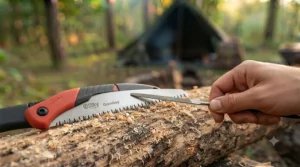
Real-World Scenarios: Which Saw Fits Your Trip?
The weekend car camper. Sarah drives to a state park campground twice a month with her family, gathers dead-and-down wood for a fire ring, and wants one tool that does everything without fuss. A Silky Gomboy 240 covers her needs completely — light enough to toss in a car door pocket, versatile enough for both kindling and modest logs, and durable enough to survive being handled by kids learning to help with camp chores.
The ultralight thru-hiker. Marcus counts ounces obsessively and only needs a saw occasionally, mostly for clearing a low branch blocking a tent site or splitting kindling in wet conditions. The Silky Pocketboy 170 or the Bahco Laplander both make sense here; the Pocketboy edges ahead on raw cutting speed, while the Laplander wins on price if Marcus is still deciding whether he wants a saw in his kit at all.
The overlander clearing forest roads. Priya drives remote routes where a downed tree can mean turning around and adding hours to a trip. For her, the Silky Bigboy 2000 or the fixed-blade Zubat 330 are the only realistic choices on this list — anything shorter turns clearing an 8-inch-diameter trunk into a half-hour ordeal instead of a five-minute task.
Blade Replacement for Silky Saws: When and How
Every Silky folding saw on this list, along with the Corona, is built around a replaceable-blade system, which is one of the most underrated reasons to buy into the ecosystem in the first place. Because the teeth are impulse-hardened, you genuinely cannot resharpen them at home with a standard file the way you might a softer carbon-steel Western blade; once cutting speed noticeably drops despite clean technique, the practical move is to swap the blade rather than fight a losing sharpening battle.
The process itself is simple across the lineup: most Silky folding saws attach the blade with a single screw or bolt at the pivot, removable with a Phillips or flat screwdriver, which lets you separate the old blade and drop in a genuine replacement in under a minute. Because the Gomboy folding and fixed-blade Gomboy-7 share blade lengths, a worn Gomboy 240 blade can be replaced with either version’s stock part. Replacement blades typically run $20-$40 depending on length and tooth configuration, which is a meaningful savings compared to buying a whole new saw, and it’s a big part of why long-time owners report using the same handle for a decade or more.
A quick problem-to-solution reference for the most common blade issues: if the blade feels noticeably slower on wood it used to cut easily, that’s dulling — replace it. If the blade develops a visible bend or kink, that’s usually from a push-stroke mistake — a replacement is safer than trying to bend it back. If rust spots appear despite drying the blade, wipe with light oil before storage going forward, and consider a replacement if pitting has actually reached the teeth.
Common Mistakes When Buying (and Using) a Camping Saw
The single most common mistake buyers make is choosing blade length based on the saw’s price tag rather than the wood they’ll actually cut — a longer, pricier saw is wasted weight if you’re mostly cutting kindling, while a short Pocketboy will frustrate anyone regularly bucking wrist-thick logs. A close second is ignoring the locking mechanism entirely; a saw that only locks open, like some Bigboy 2000 units, can swing dangerously loose in a pack if the pivot screw isn’t checked periodically.
On the usage side, the most damaging habit is applying push-stroke force to a pull-only Japanese blade, which is the single fastest way to bend or snap an otherwise excellent saw — reviewers across nearly every Silky product mentioned in this guide flag this as the main cause of blade failure. Buyers also frequently underestimate how differently curved and straight blades behave; a curved blade like the Pocketboy’s cuts more aggressively per stroke but is less precise for flush or detail cuts than a straight blade like the base Gomboy.
Finally, many first-time buyers skip budgeting for a replacement blade entirely, treating the saw as disposable rather than a system with a renewable edge — which, given how the Silky and Corona ecosystems are actually designed, leaves real long-term value on the table.
Long-Term Cost & Maintenance: Total Cost of Ownership
| Saw | Upfront Price | Replacement Blade Cost | Realistic Lifespan |
|---|---|---|---|
| Bahco Laplander | $20-$35 | $15-$20 | 5-10+ years |
| Corona RS 7265D | $25-$35 | $12-$18 | 3-7 years |
| Silky Gomboy 240 | $45-$60 | $20-$30 | 10-15+ years |
| Silky Bigboy 2000 | $80-$100 | $35-$55 | 10-15+ years |
Analysis: On paper this means the Laplander and Corona look cheapest, and for occasional use they genuinely are the better value. But amortized over a decade of regular camping, the Gomboy’s higher upfront cost narrows considerably once you factor in how many owners report a single handle lasting through several blade swaps rather than being replaced outright. The real long-term cost driver isn’t the saw at all — it’s technique. A pull-only Silky blade abused with push-stroke force will need replacing far sooner than the numbers above suggest, while a properly used one can genuinely outlast a decade of trips.
Safety, Regulations & Leave No Trace Wood Gathering
A sharp folding saw is a genuinely useful safety tool in the backcountry — it lets you process wood cleanly with far less risk to your hands than forcing a knife or hatchet through the same branch — but it comes with real responsibilities around what and where you cut. On public land in the United States, official Forest Service policy governs when and how saws may be used for trail maintenance and land management work, and volunteers doing organized trail-clearing work typically need to complete a recognized sawyer training course before operating on National Forest System lands.
For personal camping use, the more relevant guidance is around what wood you’re allowed to cut in the first place. Under widely adopted outdoor ethics guidelines, campers should only collect wood that is already dead and down, avoiding any cutting of live branches or standing trees, which keeps ecosystems healthier and avoids leaving visible scars on the landscape for other visitors. In practice, this means your folding saw’s real job at most campsites is processing already-fallen deadwood into fire-ring-sized pieces, not felling anything green or standing.
Basic handling safety matters too: always cut with the blade moving away from your body and off-hand, keep fingers well clear of the kerf when a branch nears its final connection, and never force a bent or partially-set blade back into a fully locked position. None of the saws in this guide are dangerous when used as designed — most injuries reported in aggregated reviews trace back to rushed technique rather than any flaw in the tool itself.
Buyer’s Decision Framework
Use this simple priority checklist if you’re still torn between two or three options from this guide:
- If you want one saw that does everything reasonably well, choose the Silky Gomboy 240, because its blade length and weight split the difference between every specialized option here.
- If ounces are your top priority and you rarely cut anything thicker than a wrist, choose the Silky Pocketboy 170, because its size-to-performance ratio beats every other saw on this list.
- If budget is your top priority and you’re new to folding saws, choose the Bahco Laplander, because its forgiving push-pull design and low price make it the easiest entry point.
- If you regularly process logs over 6 inches in diameter, choose the Silky Bigboy 2000, because nothing else here has the reach or leverage to keep up.
- If you want arborist-grade cutting without a folding hinge, choose the Silky Zubat Professional 330, because its fixed blade removes the one mechanical weak point every folding saw shares.
FAQ
❓ Is a Silky saw worth the extra money over a Bahco Laplander?
❓ Can you resharpen a Silky saw blade at home?
❓ What size Silky saw is best for backpacking?
❓ Do Silky saws cut on the push or pull stroke?
❓ How often should I replace a folding camp saw blade?
Conclusion
Choosing between these seven saws really comes down to matching blade length and weight to the wood you actually cut, not chasing the biggest or most expensive option on the shelf. For most people reading a silky saw review camping guide like this one, the Gomboy 240 remains the safest starting point — versatile, proven, and priced in the middle of the pack. Backpackers who count every ounce should look to the Pocketboy or the Laplander, while anyone regularly facing logs thicker than a fist needs the reach of the Bigboy 2000 or the fixed-blade confidence of the Zubat.
What ties all seven together, Silky and non-Silky alike, is that a genuinely good folding saw changes how you interact with the outdoors — it turns “there’s no dry kindling” from a real problem into a five-minute chore. Whichever one ends up in your pack, the difference between a great trip and a frustrating one is often smaller and sharper than people expect.
✨ Don’t Miss These Camping Saw Deals!
🔍 Take your next trip further with a saw that actually keeps up. Check current pricing on any of the seven picks above before your next outing — the right one earns its place in your pack for years.
Recommended for You
- 7 Best Folding Saws for Camping in 2026
- Best Camping Hatchet 2026: 7 Top Picks, Tested & Ranked
- Leatherman vs Gerber Camping: 7 Best Multi-Tools for 2026
Disclaimer: This article contains affiliate links. As an Amazon Associate, I earn from qualifying purchases. If you purchase products through these links, we may earn a small commission at no additional cost to you.
✨ Found this helpful? Share it with your friends! 💬🤗
