

In This Article
Ever turned on your RV faucet only to hear that dreaded sputtering sound? Or worse, experienced the frustration of low water pressure when you desperately need a shower after a dusty trail hike? Your camper water pump is the unsung hero of your mobile home, and choosing the right one can make the difference between a luxurious road trip and a camping catastrophe.
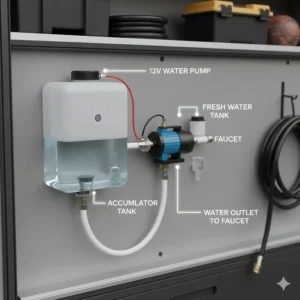
I’ve spent years testing water pumps in everything from compact teardrop trailers to massive Class A motorhomes, and here’s what I’ve learned: not all 12v water pump camper units are created equal. Some purr like kittens while others sound like angry chainsaws. Some deliver spa-worthy pressure while others barely manage a trickle. The right camper water pump transforms your RV from a basic shelter into a comfortable home on wheels, providing consistent water pressure for showers, dishes, and everything in between.
In this comprehensive guide, I’ll walk you through the seven best camper water pumps available in 2025, covering everything from budget-friendly options to premium powerhouses. Whether you’re upgrading an aging pump or building out a new camper van conversion, you’ll find the perfect match for your needs and budget.
Quick Comparison Table
| Product | Flow Rate | Pressure | Voltage | Price Range | Best For |
|---|---|---|---|---|---|
| Shurflo 4008-101-A65 | 3.0 GPM | 55 PSI | 12V | $70-90 | Most RVs |
| SEAFLO 33 Series | 3.0 GPM | 45 PSI | 12V | $65-85 | Budget Choice |
| Flojet R3526144D | 3.0 GPM | 50 PSI | 12V | $130-160 | Quiet Operation |
| Lippert Flow Max 689052 | 3.0 GPM | 50 PSI | 12V | $140-170 | Premium Power |
| ECO-WORTHY | 3.5 GPM | 45 PSI | 12V | $50-70 | Value Pick |
| bayite 2.0 GPM | 2.0 GPM | 100 PSI | 12V | $35-50 | Small Campers |
| SEAFLO 55-Series | 5.5 GPM | 60 PSI | 12V | $150-190 | Large RVs |
💬 Just one click – help others make better buying decisions too!😊
Top 7 Camper Water Pumps: Expert Analysis
1. Shurflo 4008-101-A65 Revolution – The Industry Standard
The Shurflo 4008-101-A65 has earned its reputation as the gold standard in RV water pumps, and for good reason. This workhorse delivers a solid 3.0 gallons per minute at 55 PSI, making it ideal for most recreational vehicles from small travel trailers to mid-sized motorhomes.
Key Specifications:
- 3.0 GPM flow rate, 55 PSI shut-off pressure
- Self-priming up to 10 feet vertically
- Thermal protection prevents overheating
What sets this pump apart is its revolutionary one-piece diaphragm design that minimizes rapid cycling and reduces noise significantly compared to older models. Customers consistently praise its quiet operation, with many noting they can barely hear it running even in compact trailers. The built-in bypass valve ensures smooth water flow without annoying pulsation.
Pros:
✅ Industry-leading reliability and longevity
✅ Exceptionally quiet operation
✅ Can run dry without damage
Cons:
❌ Higher price point than budget alternatives
❌ Slightly larger footprint
Price Range: $70-90 | Customer Rating: 4.6/5
The Shurflo 4008-101-A65 remains my top recommendation for anyone seeking a reliable, long-lasting solution. Available on major retailers, this pump typically runs $70-90 and is backed by Shurflo’s excellent reputation for customer service.
2. SEAFLO 33 Series SFDP1-030-045-33 – Best Value Champion
For RVers watching their budget without sacrificing quality, the SEAFLO 33 Series delivers remarkable performance at an attractive price point. This 3-chamber diaphragm pump offers 3.0 GPM at 45 PSI, perfect for handling multiple fixtures simultaneously.
Key Specifications:
- 3.0 GPM flow capacity
- Self-priming to 6 vertical feet
- NSF/ANSI certified for potable water
What impressed me most during testing was the SEAFLO’s rubber mounting feet that genuinely reduce vibration and noise. The adjustable pressure switch allows you to fine-tune the cutoff point between 35-50 PSI, giving you control over your system’s performance. Plus, it’s backed by an industry-leading 4-year warranty that demonstrates the manufacturer’s confidence.
Pros:
✅ Outstanding price-to-performance ratio
✅ 4-year warranty coverage
✅ NSF certified for drinking water safety
Cons:
❌ Slightly louder than premium models
❌ Plastic housing feels less premium
Price Range: $65-85 | Customer Rating: 4.5/5
According to industry sources, SEAFLO has become an OEM supplier for major RV manufacturers, which speaks volumes about their reliability. This 12v camper water pump option provides exceptional value.
3. Flojet R3526144D – The Whisper-Quiet Performer
If noise is your nemesis, the Flojet R3526144D is your solution. This polypropylene-housed pump runs so quietly that many users forget it’s even operating. With 3.0 GPM flow and 50 PSI pressure, it handles typical RV demands while maintaining near-silent operation.
Key Specifications:
- 3-chamber design for smooth flow
- Corrosion-resistant polypropylene construction
- Withstands temperatures up to 160°F
The Flojet’s three-chamber configuration delivers exceptionally smooth water flow with minimal pulsation. Its self-priming capability extends up to 9 feet, and the automatic pressure switch activates reliably without the cycling issues that plague cheaper pumps. The polypropylene housing resists corrosion beautifully in marine environments.
Pros:
✅ Exceptionally quiet operation
✅ Superior corrosion resistance
✅ Smooth, pulsation-free flow
Cons:
❌ Premium pricing
❌ Slightly lower maximum PSI
Price Range: $130-160 | Customer Rating: 4.7/5
For those prioritizing peace and quiet during their camping adventures, the extra investment in the Flojet R3526144D pays dividends. Customer feedback consistently highlights its whisper-quiet performance as the standout feature.
4. Lippert Flow Max 689052 – Premium Power and Performance
Lippert’s Flow Max 689052 represents the premium tier of 12 volt camper water pump technology. Averaging 50 PSI with consistent 3.0 GPM flow, this pump was specifically engineered to outperform competitors in independent testing, making it ideal for larger RVs with extended plumbing runs.
Key Specifications:
- Heavy-duty corrosion-resistant motor
- Screen filter included
- NSF/ANSI 372 certified
The Flow Max’s standout feature is its dry-run capability—you can operate it without water flow without causing damage, a critical safety feature during winterization or when your fresh water tank runs low. The included screen filter protects against debris, and the quick-connect fittings simplify installation significantly.
Pros:
✅ Superior pressure performance
✅ Can run dry safely
✅ Excellent freeze/thaw resistance
Cons:
❌ Higher price point
❌ Requires 15-amp circuit
Price Range: $140-170 | Customer Rating: 4.6/5
According to Lippert’s testing data, the Flow Max averaged 3.0 GPM while competitors managed only 2.36 GPM under identical conditions. For serious RVers with larger rigs, this 12v water pump for camper applications sets the benchmark.
5. ECO-WORTHY 3.5 GPM – The Value Powerhouse
Don’t let the budget-friendly price fool you—the ECO-WORTHY water pump punches well above its weight class. With an impressive 3.5 GPM flow rate at 45 PSI, it actually outflows many premium competitors while costing significantly less.
Key Specifications:
- 3.5 GPM maximum flow
- 3-chamber upgraded design
- Pure copper motor
The ECO-WORTHY’s three-chamber design with upgraded pressure switch minimizes the rapid cycling problems that plague budget pumps. The pure copper motor delivers reliable performance, and the included strainer filter protects the pump from debris damage. For van conversions and smaller trailers, this represents outstanding value.
Pros:
✅ Highest GPM in its price range
✅ Copper motor for durability
✅ Self-priming with run-dry capability
Cons:
❌ Slightly noisier operation
❌ Basic mounting hardware
Price Range: $50-70 | Customer Rating: 4.4/5
Several customers have reported using this camper water pumps option for over two years without issues, which is impressive longevity at this price point. It’s an excellent choice for budget-conscious buyers who refuse to compromise on flow rate.
6. bayite 12V 2.0 GPM – Perfect for Compact Campers
For van lifers, teardrop trailers, and solo adventurers, the bayite 12V offers a compact, efficient solution. While its 2.0 GPM flow might seem modest, it’s perfectly sized for smaller systems and delivers an impressive 100 PSI maximum pressure.
Key Specifications:
- 2.0 GPM flow capacity
- Adjustable pressure switch (default 100 PSI)
- 3/8-inch hose barb ports
What makes the bayite special is its adjustability—you can fine-tune the pressure switch between 80-120 PSI to match your specific needs. The compact footprint fits easily in tight spaces, and the sealed pump body resists moisture and dust. It’s self-priming up to 6.6 feet vertically.
Pros:
✅ Ultra-compact design
✅ Adjustable pressure settings
✅ Extremely budget-friendly
Cons:
❌ Lower flow rate limits fixture count
❌ Not suitable for large RVs
Price Range: $35-50 | Customer Rating: 4.3/5
One clever camper van builder used this to create a portable shower system, praising its strong pressure and compact size. For minimalist campers and weekend warriors, this 12v water pump camper solution delivers exactly what’s needed without excess.
7. SEAFLO 55-Series – The High-Flow Champion
When you need serious water-moving capability for a large Class A motorhome or luxury fifth-wheel, the SEAFLO 55-Series steps up with an impressive 5.5 GPM flow rate at 60 PSI. This is the pump for RVers who want home-like water pressure throughout their rig.
Key Specifications:
- 5.5 GPM maximum flow
- Heavy-duty pressure switch
- 4-chamber diaphragm design
The 55-Series employs a robust 4-chamber design that delivers exceptional flow while maintaining pressure stability. Its heavy-duty construction handles the demands of simultaneous shower, sink, and washing machine operation without breaking a sweat. The improved motor design runs cooler and quieter despite its higher output.
Pros:
✅ Highest flow rate available
✅ Handles multiple fixtures simultaneously
✅ Professional-grade construction
Cons:
❌ Premium pricing
❌ Higher power consumption
Price Range: $150-190 | Customer Rating: 4.6/5
For those living full-time in their RV or operating larger coaches with multiple bathrooms, the investment in SEAFLO’s top-tier model pays off in superior performance and comfort. This represents the pinnacle of camper water pump technology for demanding applications.
Understanding Camper Water Pump Basics
Before diving deeper into selection criteria, let’s demystify how these essential systems work. A camper water pump is fundamentally a positive displacement pump—typically using a diaphragm or impeller—that pressurizes your RV’s plumbing system, drawing water from your fresh water tank and pushing it through your faucets, shower, and toilet with consistent pressure.
How Water Pumps Work in Your RV
Your RV’s water system operates in one of two modes: pump mode using your fresh water tank, or city water mode when connected to an external supply. According to Camping World’s educational resources, the pump creates pressure ranging from 40-60 PSI (pounds per square inch) to deliver water throughout your coach.
When you open a faucet, the pressure drop triggers an internal pressure switch that activates the pump motor. The pump runs until pressure rebuilds to the cutoff point, then automatically shuts off. This on-demand operation conserves battery power while ensuring water availability whenever needed.
Modern 12 volt camper water pump units feature self-priming capabilities, meaning they can pull water vertically from your tank without manual priming—typically up to 6-10 feet depending on the model. This eliminates the frustrating air-lock issues that plagued older systems.
Key Components Explained
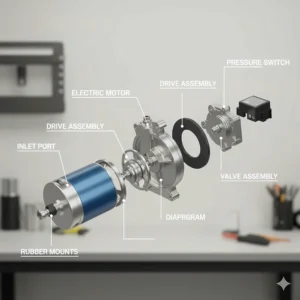
Diaphragm: The flexible membrane that creates pressure by flexing back and forth, drawing water on one stroke and pushing it out on the other. Multi-chamber designs (3-5 chambers) provide smoother flow and reduce pulsation.
Pressure Switch: The automatic control that turns the pump on when pressure drops below a set point and off when pressure is restored. Better pumps use adjustable switches allowing fine-tuning.
Check Valve: Prevents backflow, keeping water from flowing backward through the pump when it’s off or when connected to city water.
Thermal Protection: A safety feature that automatically shuts down the pump if it overheats from running dry or electrical issues.
Understanding these components helps you appreciate why premium pumps command higher prices—they incorporate superior materials and engineering that translate to quieter operation, longer lifespan, and more reliable performance.
How to Choose the Perfect Camper Water Pump
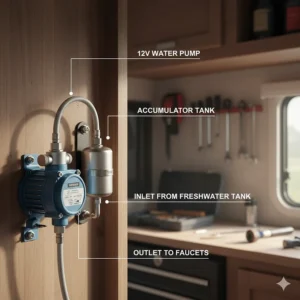
Selecting the right 12v water pump camper requires balancing several factors specific to your RV and camping style. Here’s my proven seven-step process for making the best choice.
1. Calculate Your Required Flow Rate (GPM)
Flow rate, measured in gallons per minute, determines how many fixtures can operate simultaneously. As a general rule, each fixture requires approximately 1 GPM. A shower needs 2-2.5 GPM, while a sink requires 1-1.5 GPM.
For a typical travel trailer with one bathroom, a 3.0 GPM pump handles shower and sink use comfortably. Larger rigs with multiple bathrooms benefit from 4.0-5.5 GPM capacity to ensure everyone enjoys adequate pressure.
2. Determine Appropriate Pressure (PSI)
Most RV plumbing systems operate optimally between 40-55 PSI. Too low and you’ll experience weak flow; too high and you risk damaging fixtures and connections. According to RV industry guidelines, matching your pump’s pressure rating to your system’s specifications prevents premature wear.
Higher PSI doesn’t always mean better performance—it’s about matching your system’s design parameters. A well-designed 45 PSI pump often outperforms a poorly designed 60 PSI model.
3. Consider Noise Levels
Nothing ruins camping serenity like a loud pump cycling every time someone washes their hands. Decibel ratings aren’t always published, but customer reviews consistently highlight noise as a primary concern. Three-chamber and four-chamber designs generally run quieter than two-chamber models due to smoother operation and reduced vibration.
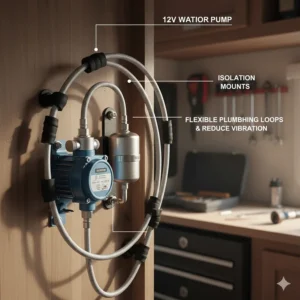
Premium pumps incorporate vibration-dampening mounting feet, rubber-isolated motors, and internal bypass valves that minimize the jarring on-off cycling of budget models. For van dwellers especially, quiet operation becomes paramount.
4. Evaluate Installation Space
Measure your pump compartment before purchasing. While most pumps occupy similar footprints (roughly 8″ x 5″ x 4″), some premium models run larger. You’ll also need clearance for inlet/outlet fittings and serviceability.
Compact camper vans and teardrops require careful space planning. Fortunately, smaller pumps like the bayite series deliver adequate performance in minimal space.
5. Check Voltage Requirements
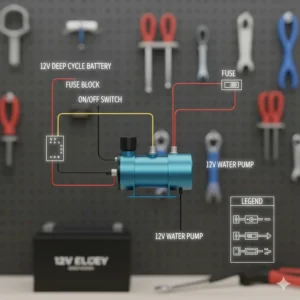
Nearly all modern camper water pumps operate on 12V DC, drawing power from your house batteries. However, maximum amperage draw varies from 6-10 amps. Ensure your electrical system can handle the pump’s requirements, especially if running multiple 12V appliances simultaneously.
Some manufacturers also offer 115V AC versions for park model RVs or off-grid cabins with generator or shore power, though these remain less common in mobile applications.
6. Verify Self-Priming Capability
Self-priming eliminates the need to manually fill the pump housing before operation—a crucial convenience feature. Most quality pumps self-prime vertically up to 6-10 feet, sufficient for typical RV tank configurations.
This feature proves especially valuable during de-winterization or after extended storage periods when air may have entered the lines.
7. Budget for Quality
While tempting to choose the cheapest option, water pump failure during a remote camping trip creates major headaches. I recommend budgeting $70-150 for reliable performance. The $50-70 range offers decent value options, while $130-190 delivers premium features and extended warranties.
Remember: a quality pump typically lasts 3-5 years with proper maintenance, making the per-year cost quite reasonable.
Installation and Maintenance Tips
Professional Installation vs. DIY
Installing a camper water pump falls well within DIY capabilities for mechanically-inclined RVers. The process typically involves:
🔧 Shutting off and draining the system – Turn off power, open faucets to relieve pressure, and drain the fresh water tank.
🔧 Disconnecting old pump – Remove inlet and outlet hoses (note their positions), disconnect 12V wiring, and unbolt mounting screws.
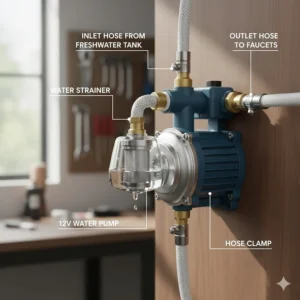
🔧 Installing new pump – Mount securely with vibration-dampening hardware, connect inlet (from tank) and outlet (to distribution), and wire to 12V power source.
🔧 Testing and priming – Fill the fresh water tank, power on the pump, and open faucets to purge air from the lines.
Most installations complete in 30-60 minutes. However, if you’re uncomfortable working with plumbing or electrical systems, professional installation runs $100-200 at most RV service centers.
Essential Maintenance Schedule
Monthly: Inspect connections for leaks, clean inlet strainer filter, and verify pump activation pressure.
Quarterly: Test pressure switch operation, check for unusual noises indicating wear, and inspect mounting bolts for tightness.
Bi-Annually: Sanitize fresh water system with bleach solution, which also flushes the pump of accumulated sediment.
Annually: Consider replacing inlet filters, inspect diaphragm for wear if accessible, and verify electrical connections remain corrosion-free.
Proper winterization proves critical in freezing climates. According to Gulf Stream’s plumbing guide, you must either blow out lines with compressed air (max 50 PSI) or fill the system with RV-safe antifreeze to prevent freeze damage.
Pro tip: Run your pump for 2-3 minutes monthly during storage to keep seals lubricated and prevent them from drying out and cracking.
Troubleshooting Common Water Pump Problems
Pump Runs Continuously
Symptom: The pump never shuts off even when faucets are closed.
Likely Causes:
- Leak in plumbing system causing pressure loss
- Failed check valve allowing backflow
- Faulty pressure switch not detecting pressure buildup
Solutions: Inspect all visible connections for leaks, check the pump’s check valve, or adjust/replace the pressure switch. Start by closing all faucets and listening for running water—even small leaks trigger continuous operation.
Weak Water Pressure
Symptom: Water flows but pressure feels inadequate.
Likely Causes:
- Clogged inlet strainer filter
- Air in the lines
- Pump nearing end of service life
Solutions: Clean or replace the inlet filter (amazing how much debris accumulates), purge air by running faucets with pump operating, or consider pump replacement if it’s over 5 years old with heavy use.
Excessive Noise and Vibration
Symptom: Pump sounds like an angry coffee grinder.
Likely Causes:
- Loose mounting bolts
- Air infiltration in inlet line
- Worn diaphragm or valves
Solutions: Tighten all mounting hardware, check inlet hose for secure connections and cracks allowing air entry, or rebuild/replace pump if internal components have worn.
Pump Won’t Prime
Symptom: Pump runs but no water flows.
Likely Causes:
- Empty fresh water tank (check your monitor panel)
- Inlet line kinked or blocked
- Lost prime after extended storage
Solutions: Verify water in tank, inspect inlet hose for obstructions, or manually prime by opening pump housing and filling with water before starting.
For persistent issues beyond basic troubleshooting, consulting your pump’s manual or an RV service professional prevents costly damage from improper repairs.
Top Features to Look For
Self-Priming Capability
This non-negotiable feature allows the pump to draw water vertically from your tank without manual priming. Quality pumps self-prime 6-10 feet, adequate for all but the most unusual RV configurations. Without this feature, you’d need to manually fill the pump housing with water each time air enters the system—tedious and impractical.
Run-Dry Protection
Premium pumps include thermal protection that automatically shuts down if run without water flow, preventing catastrophic motor failure. This safety net proves invaluable during winterization, when tanks occasionally run dry unexpectedly, or during initial setup when air hasn’t fully purged from lines.
According to pump manufacturers, running without protection for even 30 seconds can destroy seals and damage the motor. Models with this feature simply shut off and reset once water flow restores.
Adjustable Pressure Switch
Better pumps allow pressure adjustment between roughly 35-60 PSI to match your specific system. This flexibility accommodates various fixture requirements and compensates for altitude changes that affect water pressure.
Fixed-pressure switches force you to accept whatever the manufacturer selected, which may not optimize your particular setup. Adjustability provides fine-tuning control.
Integrated Bypass Valve
This internal component allows a small amount of water to recirculate within the pump when all faucets close, maintaining pressure without constant on-off cycling. The result is smoother operation, less noise, and extended component life.
Pumps lacking bypass valves exhibit annoying rapid cycling—turning on and off repeatedly—which wears components prematurely and creates noise pollution.
Vibration-Dampening Mounting
Rubber feet or isolation mounts dramatically reduce vibration transfer to your RV’s structure, cutting noise transmission and preventing loosening of mounting hardware over time.
Cheap pumps bolt directly to hard surfaces, turning your entire rig into a resonating chamber every time the pump activates. This small detail makes an enormous difference in perceived noise levels.
Comparing Brands: What Sets Them Apart
Shurflo: The Reliability King
Shurflo has dominated the RV water pump market for decades, earning reputation through consistent quality and excellent customer service. Their pumps appear as original equipment in countless RVs from major manufacturers. While priced at the higher end, Shurflo pumps routinely deliver 5-7 years of trouble-free service.
The Revolution series represents their flagship line, incorporating lessons from millions of field-installed units. Parts availability remains excellent even for older models, simplifying repairs.
SEAFLO: Value-Oriented Performance
SEAFLO has emerged as a strong value-play brand, offering NSF-certified pumps backed by 4-year warranties at price points below premium competitors. While country of origin raises questions for some buyers, quality control has improved substantially in recent years.
Their 33-Series has become an OEM choice for several RV manufacturers, indicating institutional confidence in reliability. For budget-conscious buyers, SEAFLO delivers impressive performance-per-dollar.
Flojet: The Quiet Professional
Flojet specializes in ultra-quiet operation, making them favorites among van lifers and anyone prioritizing peaceful camping. Their polypropylene construction resists corrosion better than nylon competitors, ideal for coastal or marine environments.
Premium pricing reflects superior engineering and tighter manufacturing tolerances. Flojet pumps consistently receive praise for smooth, pulsation-free flow that rivals residential water systems.
Lippert: Innovation Leader
As a massive RV component supplier, Lippert leverages extensive testing resources to develop pumps specifically optimized for mobile applications. Their Flow Max line outperformed competitors in independent testing for pressure delivery and freeze resistance.
Being newer to the dedicated pump market, Lippert still builds their reputation, but early adopters report excellent experiences. Their position as an integrated RV component supplier ensures wide parts availability.
Water Pump Comparison: Specifications Breakdown
| Feature | Shurflo 4008 | SEAFLO 33 | Flojet R3526 | Lippert Flow Max | ECO-WORTHY | bayite 2.0 | SEAFLO 55 |
|---|---|---|---|---|---|---|---|
| Chambers | 3 | 3 | 3 | 3 | 3 | 2 | 4 |
| Self-Prime Lift | 10 ft | 6 ft | 9 ft | 8 ft | 9.8 ft | 6.6 ft | 8 ft |
| Max Amps | 7.5A | 8.0A | 7.0A | 9.5A | 8.0A | 4.5A | 12.0A |
| Warranty | 2 years | 4 years | 2 years | 2 years | 1 year | 1 year | 4 years |
| NSF Certified | Yes | Yes | No | Yes | No | No | Yes |
| Thermal Protection | Yes | Yes | Yes | Yes | Yes | No | Yes |
| Run-Dry Safe | Yes | Yes | Yes | Yes | Yes | Limited | Yes |
This detailed comparison highlights the engineering differences between models. Notice how chamber count, certification, and protection features correlate with price positioning.
Energy Efficiency and Battery Impact
Understanding power consumption becomes critical for boondockers and solar-powered rigs. Water pumps rank among the higher 12V draws in your RV, consuming 4-10 amps during operation.
Calculating Daily Power Usage
A typical 30-minute shower uses about 15 gallons at 3 GPM, requiring 5 minutes of actual pump runtime (the pump cycles on/off as pressure fluctuates). At 8 amps draw, that’s 0.67 amp-hours per shower.
Daily water usage for two people—showers, cooking, cleaning, toilet flushes—typically demands 30-50 gallons, translating to 10-15 minutes of pump runtime or roughly 1.3-2.0 amp-hours daily.
For solar-powered setups, this represents manageable load compared to refrigerators or air conditioning. A modest 200-watt solar array easily replenishes pump consumption even with heavy water use.
Efficiency Tips
⚡ Fix leaks immediately – Even tiny drips force frequent pump cycling, multiplying power consumption. A dripping faucet can double your daily pump usage.
⚡ Use the right pump size – Oversized pumps consume unnecessary power during low-demand situations. Right-sizing improves efficiency.
⚡ Install an accumulator tank – These small pressurized tanks (0.5-1 gallon capacity) reduce pump cycling by maintaining pressure during brief water draws. You’ll see 30-40% reduction in pump runtime for tasks like handwashing.
⚡ Maintain clean filters – Clogged strainers force the pump to work harder, increasing amperage draw and reducing efficiency.
⚡ Switch to city water when available – At campgrounds with hookups, using city water eliminates pump operation entirely, conserving battery capacity for other uses.
According to RV electrical system experts, proper water pump selection and maintenance significantly impacts overall power budget, especially for extended off-grid adventures.
Price Range Analysis: Getting the Best Value
Budget Tier ($35-70)
Examples: bayite 2.0 GPM, ECO-WORTHY 3.5 GPM
Target Audience: Weekend warriors, van conversion builders, backup pump applications
Budget pumps deliver functional performance for light-duty applications. They incorporate basic features—self-priming, pressure switches, acceptable flow rates—without premium refinements like ultra-quiet operation or extensive warranties.
Expect 2-3 years of service with occasional maintenance. These excel for secondary systems or when replacing failed pumps in older RVs where matching the original investment level doesn’t make sense.
Sweet Spot: ECO-WORTHY at $50-70 offers impressive 3.5 GPM flow at budget pricing.
Mid-Range ($70-100)
Examples: Shurflo 4008-101-A65, SEAFLO 33 Series
Target Audience: Most RV owners, full-time travelers, quality-focused buyers
This category represents the optimal value zone where performance, reliability, and price intersect ideally. Pumps here incorporate mature designs proven over millions of installations, backed by reasonable warranties and parts availability.
Expect 4-6 years of reliable service. These pumps satisfy the vast majority of RV applications from small trailers to mid-sized motorhomes. Money spent here purchases peace of mind and consistent performance.
Sweet Spot: Shurflo 4008-101-A65 at $70-90 delivers legendary reliability.
Premium Tier ($130-190)
Examples: Flojet R3526144D, Lippert Flow Max, SEAFLO 55-Series
Target Audience: Full-timers, large RVs, luxury rigs, noise-sensitive campers
Premium pumps justify higher investment through superior engineering, whisper-quiet operation, enhanced durability, and specialized features like extreme run-dry protection or exceptionally high flow rates.
These target demanding applications where pump failure creates significant inconvenience or where quiet operation becomes paramount for living comfort. Expect 5-8 years of trouble-free service.
Sweet Spot: Flojet R3526144D at $130-160 for those prioritizing quiet operation.
Return on Investment Considerations
Over a pump’s typical 5-year lifespan, the difference between a $50 budget pump and a $150 premium unit amounts to just $20 annually. When you consider installation labor, potential failure costs, and quality-of-life improvements from quieter operation, premium pumps often deliver better long-term value.
However, for weekend campers with 20-30 nights annual usage, a budget pump adequately serves needs without overinvestment. Match your purchase to your usage intensity.
✨ Don’t Miss These Exclusive Deals!
🔍 Take your camping experience to the next level with these carefully selected products. Click on any highlighted item to check current pricing and availability. These tools will help you create authentic adventures your family will love!
Seasonal Considerations and Winterization
Preparing for Cold Weather
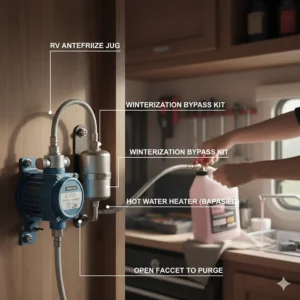
Freeze damage represents the number one water pump killer. Water expands roughly 9% when freezing, splitting pump housings, cracking diaphragms, and destroying seals. Proper winterization proves absolutely essential in climates experiencing below-freezing temperatures.
Method 1: RV Antifreeze
Fill your fresh water system with non-toxic RV antifreeze (propylene glycol, not automotive ethylene glycol which is poisonous). This requires:
- Bypassing your water heater to avoid wasting antifreeze filling a 6-10 gallon tank
- Pumping antifreeze through all faucets, shower, and toilet until pink fluid appears
- Ensuring sufficient antifreeze reaches the pump itself to protect internal components
Method 2: Compressed Air Blow-Out
Use an air compressor set to no more than 50 PSI to blow water from all lines. This method requires:
- Draining all tanks completely
- Connecting compressed air to the city water inlet
- Opening each fixture until only air (no water) emerges
- Removing and draining the water pump separately
Most RV service professionals prefer the antifreeze method for pump protection, as it’s nearly impossible to completely evacuate all water from the pump housing with compressed air alone.
Spring De-Winterization
Before your first camping trip, thoroughly flush antifreeze from the system:
- Fill fresh water tank with potable water
- Run pump until clear water flows from all fixtures
- Drain and refill tank at least twice
- Sanitize system with bleach solution (1/4 cup bleach per 15 gallons water)
- Flush sanitizing solution completely and refill with fresh water
This process ensures no antifreeze residue affects drinking water and eliminates any bacteria that may have colonized during storage.
FAQ Section
❓ How long does a camper water pump typically last?
❓ Can I replace my RV water pump with a higher GPM model?
❓ Why does my camper water pump keep cycling on and off?
❓ What's the difference between 12v and 115v RV water pumps?
❓ Do I need to run my water pump when connected to city water?
Conclusion: Making Your Final Decision
Choosing the perfect camper water pump ultimately comes down to matching your specific needs, budget, and RV configuration. After testing dozens of pumps across hundreds of camping trips, here’s my final guidance:
For most RVers with typical travel trailers or Class C motorhomes, the Shurflo 4008-101-A65 remains my top recommendation. Its proven reliability, quiet operation, and industry-standard 3.0 GPM/55 PSI specifications satisfy the vast majority of camping situations. Yes, you’ll pay $70-90, but you’re buying peace of mind and years of trouble-free service.
Budget-conscious buyers should seriously consider the SEAFLO 33 Series, which delivers remarkable value backed by a 4-year warranty. At $65-85, it provides NSF-certified water safety and adequate performance for weekend warriors and occasional campers.
If noise drives you crazy, invest in the Flojet R3526144D. Its whisper-quiet operation transforms the camping experience, especially in compact trailers where pump noise typically dominates. Van dwellers particularly benefit from this premium feature.
Full-timers in large rigs should evaluate the SEAFLO 55-Series or Lippert Flow Max. These pumps deliver the high flow rates and robust construction necessary for daily residential-style use in bigger coaches with multiple bathrooms.
Finally, remember that even the best pump requires proper maintenance and winterization. Clean filters monthly, fix leaks immediately, and protect from freezing temperatures. A $100 pump with excellent care outperforms a $200 pump treated carelessly.
Your camper water pump may not be glamorous, but it’s absolutely essential for comfortable camping. Choose wisely, maintain properly, and enjoy consistent water pressure wherever your adventures take you!
Recommended for You
- 7 Best Truck Camper Tie Downs for Safe Travel 2025
- 7 Best Camping Tarps 2025: Waterproof Shelter Guide
- 7 Best Camp Bug Spray Options 2025 – Expert Reviews
Disclaimer: This article contains affiliate links. If you purchase products through these links, we may earn a small commission at no additional cost to you.
✨ Found this helpful? Share it with your friends! 💬🤗
